
Glenn Reinman Brad Calder Department of Computer Science

Glenn Reinman, Brad Calder, Department of Computer Science and Engineering, University of California San Diego and Todd Austin Department of Electrical Engineering and Computer Science, University of Michigan 1 Fetch Directed Instruction Prefetching
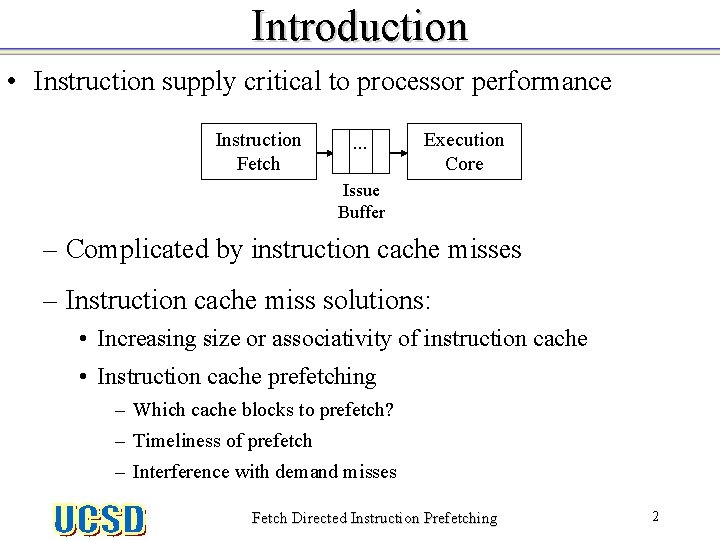
Introduction • Instruction supply critical to processor performance Instruction Fetch . . . Execution Core Issue Buffer – Complicated by instruction cache misses – Instruction cache miss solutions: • Increasing size or associativity of instruction cache • Instruction cache prefetching – Which cache blocks to prefetch? – Timeliness of prefetch – Interference with demand misses Fetch Directed Instruction Prefetching 2
Prior Instruction Prefetching Work • Next line prefetching (NLP) (Smith) – Each cache block is tagged with an NLP bit – When block is accessed during a fetch • NLP bit determines whether next sequential block is prefetched – Prefetch into fully associative buffer • Streaming buffers (Jouppi) – On cache miss, sequential cache blocks, starting with block that missed, are prefetched into a buffer • Buffer can use fully associative lookup • Uniqueness filter can avoid redundant prefetches • Multiple streaming buffers can be used together Fetch Directed Instruction Prefetching 3
Our Prefetching Approach • Desirable characteristics – Accuracy of prefetch • Useful prefetches – Timeliness of prefetch • Maximize prefetch gain • Fetch Directed Prefetching – Branch predictor runs ahead of instruction cache – Instruction cache prefetch guided by instruction stream Fetch Directed Instruction Prefetching 4
Talk Overview • Fetch Target Queue (FTQ) • Fetch Directed Prefetching (FDP) • Filtering Techniques • Enhancements to Streaming Buffers • Bandwidth Considerations • Conclusions Fetch Directed Instruction Prefetching 5
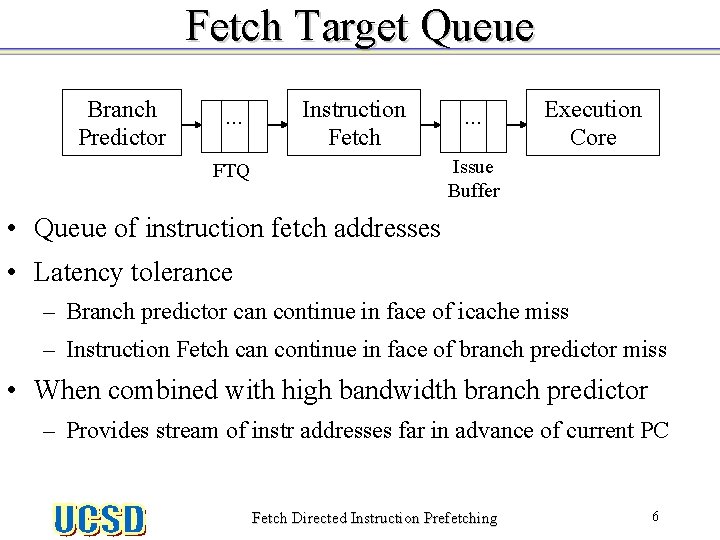
Fetch Target Queue Branch Predictor . . . Instruction Fetch . . . Execution Core Issue Buffer FTQ • Queue of instruction fetch addresses • Latency tolerance – Branch predictor can continue in face of icache miss – Instruction Fetch can continue in face of branch predictor miss • When combined with high bandwidth branch predictor – Provides stream of instr addresses far in advance of current PC Fetch Directed Instruction Prefetching 6
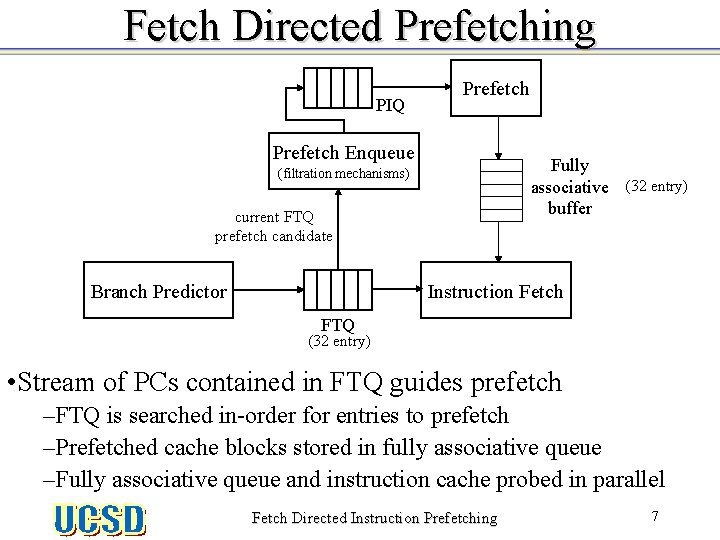
Fetch Directed Prefetching PIQ Prefetch Enqueue Fully associative (32 entry) buffer (filtration mechanisms) current FTQ prefetch candidate Branch Predictor Instruction Fetch FTQ (32 entry) • Stream of PCs contained in FTQ guides prefetch –FTQ is searched in-order for entries to prefetch –Prefetched cache blocks stored in fully associative queue –Fully associative queue and instruction cache probed in parallel Fetch Directed Instruction Prefetching 7
Methodology • Simple. Scalar Alpha 3. 0 tool set (Burger, Austin) – SPEC 95 C Benchmarks • Fast forwarded past initialization portion of benchmarks – – Can issue 8 instructions per cycle 128 entry reorder buffer 32 entry load/store buffer Variety of instruction cache sizes • 16 K 2 -way and 4 -way associative • 32 K 2 -way associative • Tried both single and dual ported configurations – Instruction cache size for this talk is 16 K 2 -way – 32 K 4 -way associative data cache – Unified 1 MB 4 -way associative second level cache Fetch Directed Instruction Prefetching 8
Bandwidth Concerns • Prefetching can disrupt demand fetching – Need to model bus utilization • Modified Simple. Scalar’s memory hierarchy – Accurate modeling of bus usage – Two configurations of L 2 cache bus to main memory • 32 bytes/cycle • 8 bytes/cycle – Single port on L 2 cache • Shared by both data and instruction caches Fetch Directed Instruction Prefetching 9
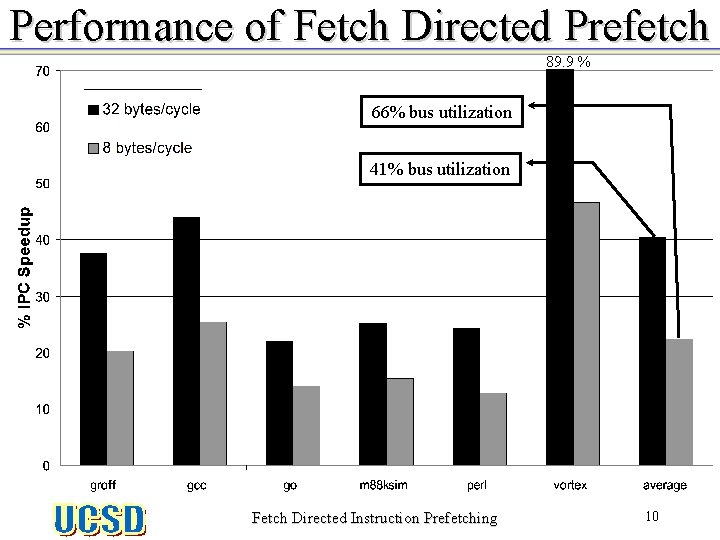
Performance of Fetch Directed Prefetch 89. 9 % 66% bus utilization 41% bus utilization Fetch Directed Instruction Prefetching 10
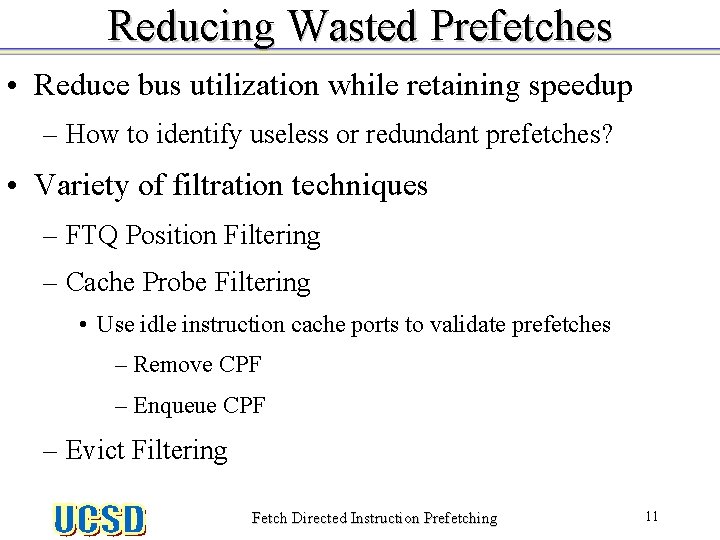
Reducing Wasted Prefetches • Reduce bus utilization while retaining speedup – How to identify useless or redundant prefetches? • Variety of filtration techniques – FTQ Position Filtering – Cache Probe Filtering • Use idle instruction cache ports to validate prefetches – Remove CPF – Enqueue CPF – Evict Filtering Fetch Directed Instruction Prefetching 11
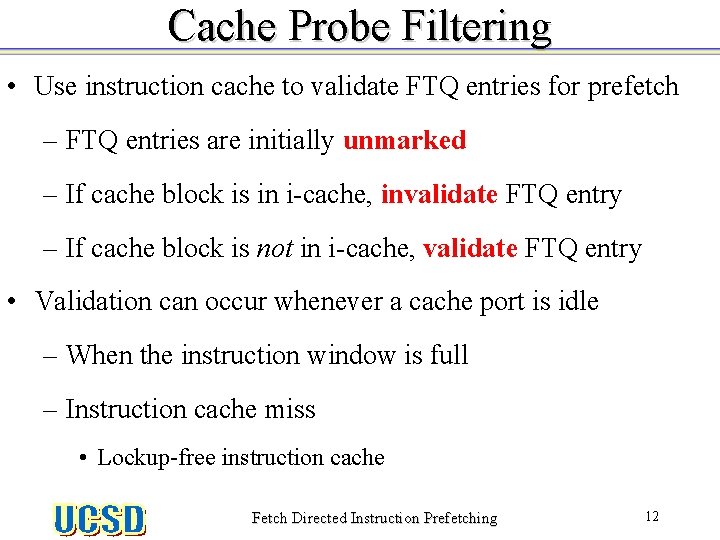
Cache Probe Filtering • Use instruction cache to validate FTQ entries for prefetch – FTQ entries are initially unmarked – If cache block is in i-cache, invalidate FTQ entry – If cache block is not in i-cache, validate FTQ entry • Validation can occur whenever a cache port is idle – When the instruction window is full – Instruction cache miss • Lockup-free instruction cache Fetch Directed Instruction Prefetching 12
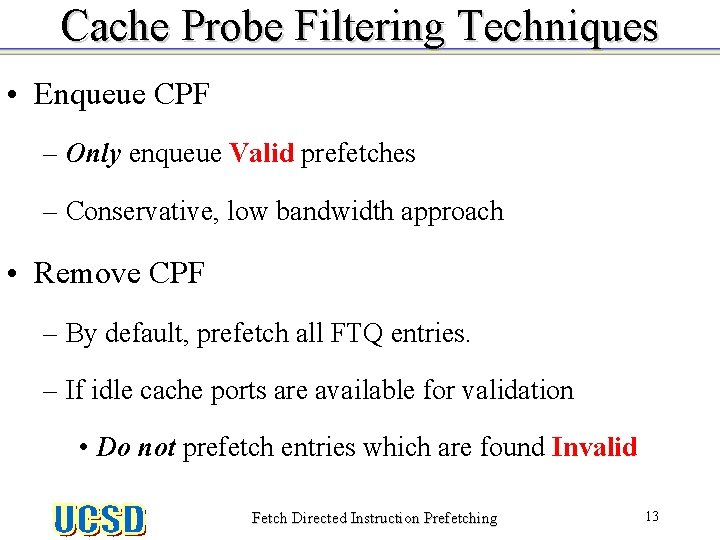
Cache Probe Filtering Techniques • Enqueue CPF – Only enqueue Valid prefetches – Conservative, low bandwidth approach • Remove CPF – By default, prefetch all FTQ entries. – If idle cache ports are available for validation • Do not prefetch entries which are found Invalid Fetch Directed Instruction Prefetching 13
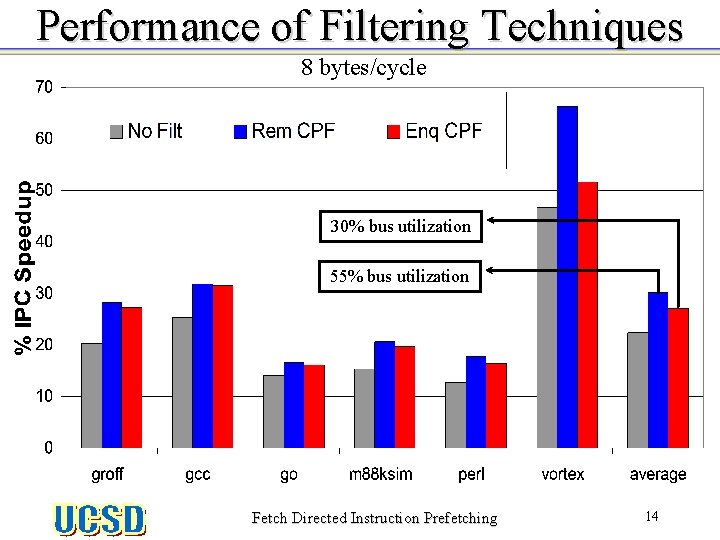
Performance of Filtering Techniques 8 bytes/cycle 30% bus utilization 55% bus utilization Fetch Directed Instruction Prefetching 14
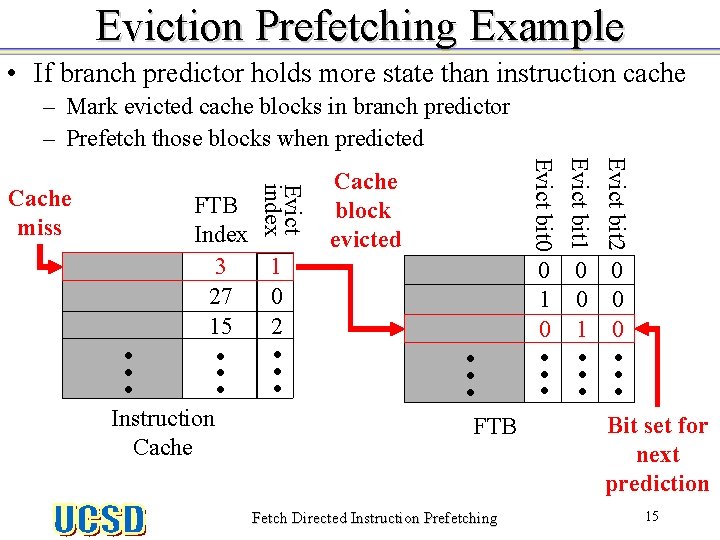
Eviction Prefetching Example • If branch predictor holds more state than instruction cache – Mark evicted cache blocks in branch predictor – Prefetch those blocks when predicted Instruction Cache • • • Evict bit 2 • • • Evict bit 1 FTB Index 3 1 0 27 2 15 Evict bit 0 Evict index Cache miss Cache block evicted 0 0 0 1 0 • • • FTB Fetch Directed Instruction Prefetching • • • Bit set for next prediction 15
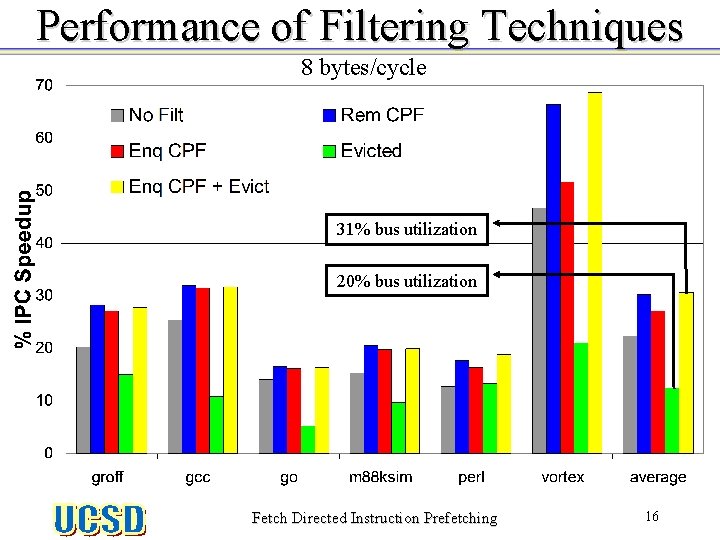
Performance of Filtering Techniques 8 bytes/cycle 31% bus utilization 20% bus utilization Fetch Directed Instruction Prefetching 16
Enqueue CPF and Eviction Prefetching • Effective combination of two low bandwidth approaches • Both attempt to prefetch entries not in instruction cache • Enqueue CPF needs to wait on idle cache port to prefetch • Eviction Prefetching can prefetch when prediction is made • Combined – Eviction Prefetching gives basic coverage – Enqueue CPF finds additional prefetches that Evict misses Fetch Directed Instruction Prefetching 17
Streaming Buffer Enhancements • All configurations used uniqueness filters and fully associative lookup • Base configurations – Single streaming buffer (SB 1) – Dual streaming buffers (SB 2) – Eight streaming buffers (SB 8) • Cache Probe Filtering (CPF) enhancements – Filter out streaming buffer prefetches already in icache – Stop filtering Fetch Directed Instruction Prefetching 18
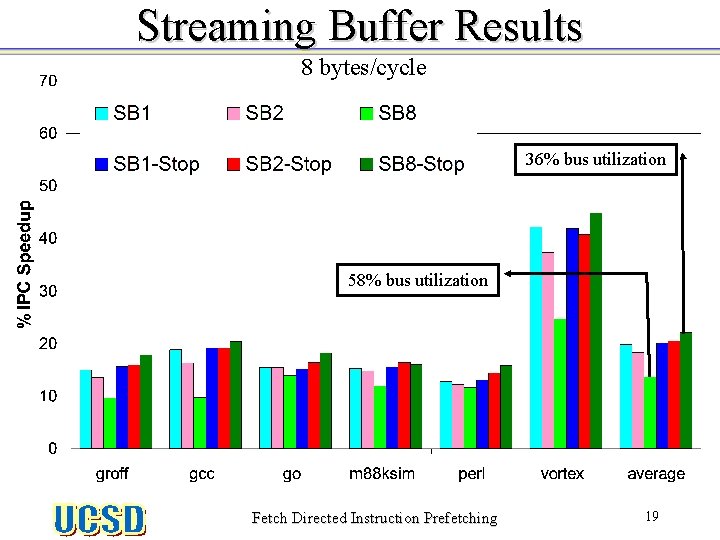
Streaming Buffer Results 8 bytes/cycle 36% bus utilization 58% bus utilization Fetch Directed Instruction Prefetching 19
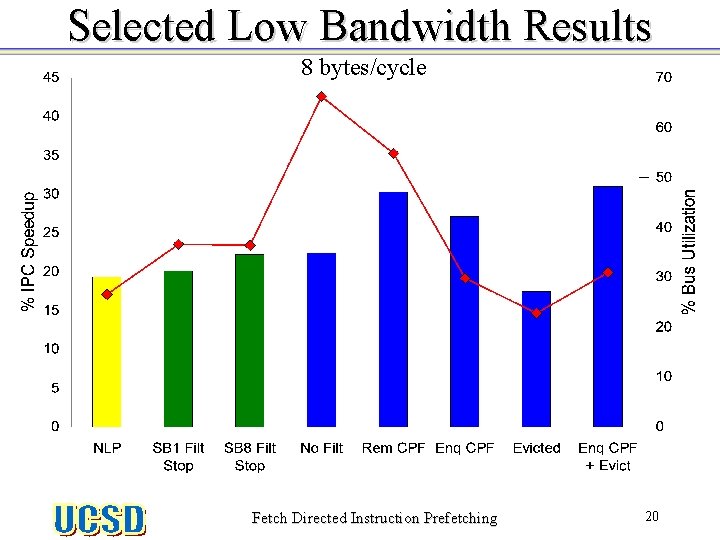
Selected Low Bandwidth Results 8 bytes/cycle Fetch Directed Instruction Prefetching 20
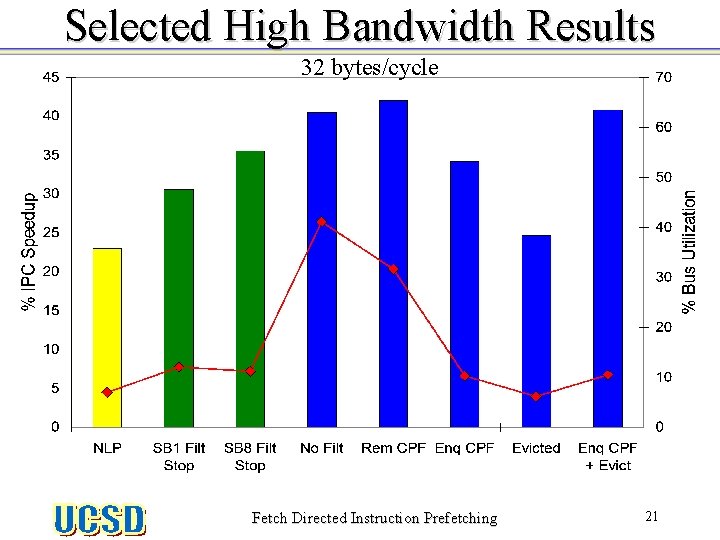
Selected High Bandwidth Results 32 bytes/cycle Fetch Directed Instruction Prefetching 21
Conclusion • Fetch Directed Prefetching – Accurate, just in time prefetching • Cache Probe Filtering – Reduces bus bandwidth of fetch directed prefetching – Also useful for Streaming Buffers • Evict Filter – Provides accurate prefetching by identifying evicted cache blocks • Fully associative versus inorder prefetch buffer – Available in upcoming tech report by end of year Fetch Directed Instruction Prefetching 22
Prefetching Tradeoffs • NLP – Simple, low bandwidth approach – No notion of prefetch usefulness – Limited timeliness • Streaming Buffers – Takes advantage of latency of a cache miss – Can use low to moderate bandwidth with filtering – No notion of prefetch usefulness • Fetch Directed Prefetching – Prefetch based on prediction stream – Can use low to moderate bandwidth with filtering – Most useful with accurate branch prediction Fetch Directed Instruction Prefetching 23
- Slides: 23