
Glencoe Health Lesson 1 Providing First Aid LESSON
- Slides: 29
Glencoe Health Lesson 1 Providing First Aid
LESSON 1 Providing First Aid BIG IDEA Knowing how to perform first aid can save a life in an emergency. New Vocabulary first aid universal precautions Good Samaritan laws Glencoe Health Chapter 27 First Aid and Emergencies Lesson Home
LESSON 1 Providing First Aid First Steps in an Emergency Main Idea The three steps for responding to an emergency are check, call, and care. If you ever find yourself in an emergency, knowing first aid could save someone’s life. Glencoe Health Chapter 27 First Aid and Emergencies Lesson Home
LESSON 1 Providing First Aid First Steps in an Emergency By learning and using proper first-aid procedures, you can help prevent victims from suffering further injury and reduce the number of victims who die. New Vocabulary first-aid The immediate, temporary care given to an ill or injured person until professional medical care can be provided. Glencoe Health Chapter 27 First Aid and Emergencies Lesson Home
LESSON 1 Providing First Aid First Steps in an Emergency Recognizing an emergency is the first step in responding to it. The next step is to check the scene to look for hazards and make sure it is safe for you to respond. Glencoe Health Chapter 27 First Aid and Emergencies Lesson Home
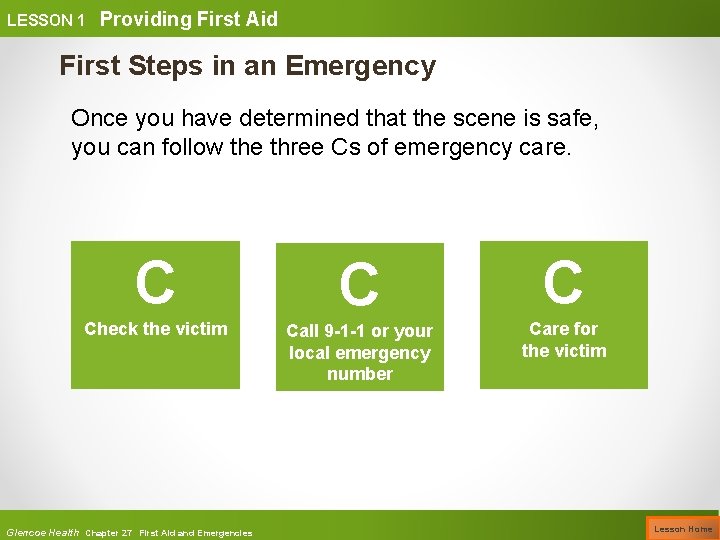
LESSON 1 Providing First Aid First Steps in an Emergency Once you have determined that the scene is safe, you can follow the three Cs of emergency care. C Check the victim Call 9 -1 -1 or your local emergency number Care for the victim Glencoe Health Chapter 27 First Aid and Emergencies Lesson Home
LESSON 1 Providing First Aid First Steps in an Emergency CHECK… CALL… CARE Check the victim. A victim who is unconscious or has a life-threatening condition needs immediate care. Only move the victim if he or she is in direct physical danger or if you must move the victim in order to provide lifesaving care. Glencoe Health Chapter 27 First Aid and Emergencies Lesson Home
LESSON 1 Providing First Aid First Steps in an Emergency CHECK… CALL… CARE Call 9 -1 -1 or your local emergency number and stay on the line until help arrives. If the victim is in need of immediate care, get someone else at the scene to call 9 -1 -1 while you provide first aid. Glencoe Health Chapter 27 First Aid and Emergencies Lesson Home
LESSON 1 Providing First Aid First Steps in an Emergency CHECK… CALL… CARE Care for the victim. If possible, get the victim’s permission before giving first aid. If the victim refuses help, respect this decision. If the victim cannot speak to give permission, provide care. Glencoe Health Chapter 27 First Aid and Emergencies Lesson Home
LESSON 1 Providing First Aid First Steps in an Emergency Most states have Good Samaritan laws to protect the rescuer. New Vocabulary Good Samaritan laws Statutes that protect rescuers from being sued for giving emergency care. Glencoe Health Chapter 27 First Aid and Emergencies Lesson Home
LESSON 1 Providing First Aid First Steps in an Emergency Universal precautions require people who provide first aid or medical care to treat all body fluids as if they could carry disease. New Vocabulary universal precautions Steps taken to prevent the spread of disease through blood and other body fluids when providing first aid or health care. Glencoe Health Chapter 27 First Aid and Emergencies Lesson Home
LESSON 1 Providing First Aid Universal Precautions Wear sterile gloves whenever you might come into contact with someone’s blood or body fluids. Wash hands immediately after providing first aid. Use a mouthpiece, if one is available, when providing rescue breathing. Glencoe Health Chapter 27 First Aid and Emergencies Lesson Home
LESSON 1 Providing First Aid for Bleeding Main Idea The steps for treating bleeding depend on the type of injury and how severe it is. The appropriate first aid for bleeding depends on what type of wound you are dealing with and how severe the bleeding is. Glencoe Health Chapter 27 First Aid and Emergencies Lesson Home
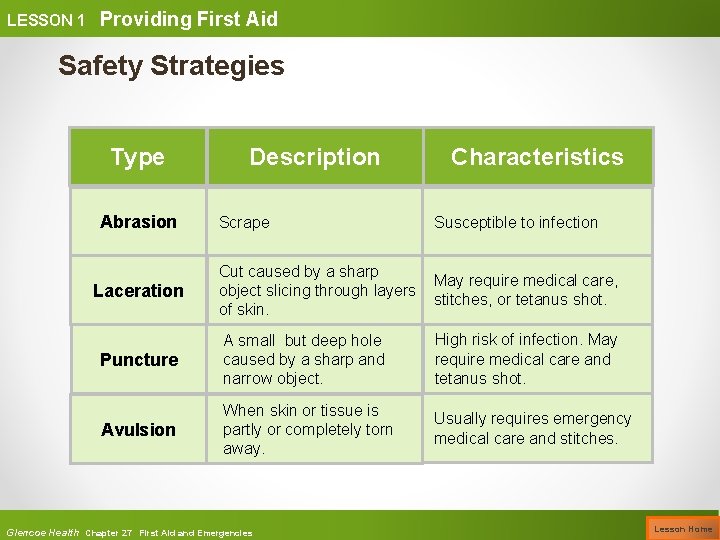
LESSON 1 Providing First Aid Safety Strategies Type Abrasion Description Characteristics Scrape Susceptible to infection Cut caused by a sharp object slicing through layers of skin. May require medical care, stitches, or tetanus shot. Puncture A small but deep hole caused by a sharp and narrow object. High risk of infection. May require medical care and tetanus shot. Avulsion When skin or tissue is partly or completely torn away. Usually requires emergency medical care and stitches. Laceration Glencoe Health Chapter 27 First Aid and Emergencies Lesson Home
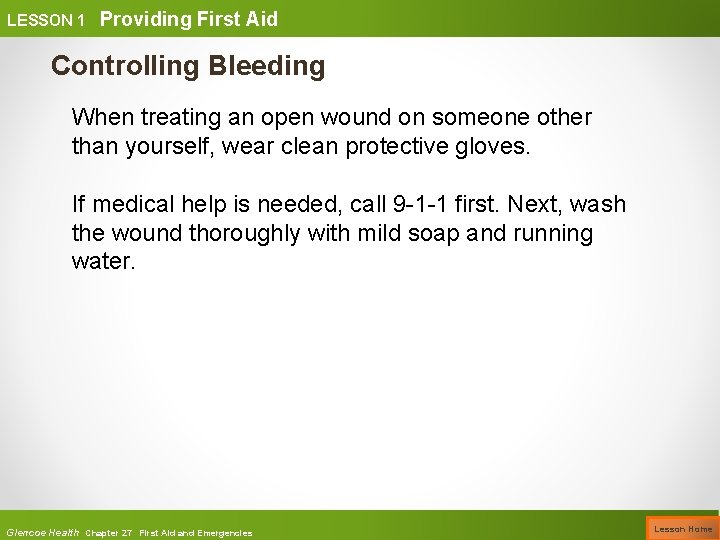
LESSON 1 Providing First Aid Controlling Bleeding When treating an open wound on someone other than yourself, wear clean protective gloves. If medical help is needed, call 9 -1 -1 first. Next, wash the wound thoroughly with mild soap and running water. Glencoe Health Chapter 27 First Aid and Emergencies Lesson Home
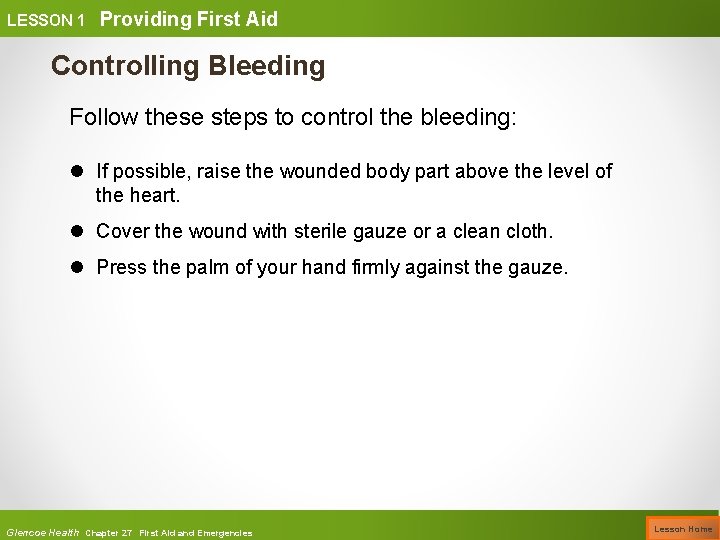
LESSON 1 Providing First Aid Controlling Bleeding Follow these steps to control the bleeding: l If possible, raise the wounded body part above the level of the heart. l Cover the wound with sterile gauze or a clean cloth. l Press the palm of your hand firmly against the gauze. Glencoe Health Chapter 27 First Aid and Emergencies Lesson Home
LESSON 1 Providing First Aid Controlling Bleeding Follow these steps to control the bleeding: l Apply steady pressure to the wound for five minutes or until help arrives. l Do not stop to check the wound; you may interrupt the clotting of the blood. l If blood soaks through the gauze, add another gauze pad on top of the first and continue to apply pressure. Glencoe Health Chapter 27 First Aid and Emergencies Lesson Home
LESSON 1 Providing First Aid Controlling Bleeding Follow these steps to control the bleeding: l Once the bleeding slows or stops, secure the gauze or gauze pads. The pad should be snug, but not too tight. You should be able to feel the person’s pulse. l If the bleeding does not stop after five minutes, call for medical help and apply pressure until help arrives. Glencoe Health Chapter 27 First Aid and Emergencies Lesson Home
LESSON 1 Providing First Aid Controlling Bleeding from the eyes, nose, mouth, or ears may be a sign that internal bleeding is occurring. Call for help right away and take steps to prevent the victim from going into shock. Glencoe Health Chapter 27 First Aid and Emergencies Lesson Home
LESSON 1 Providing First Aid for Burns Main Idea Treatment for burns depends on the severity of the burn. Burns can result from exposure to heat, flame, hot water, steam, sunlight, electricity, and certain chemicals. Glencoe Health Chapter 27 First Aid and Emergencies Lesson Home
LESSON 1 Providing First Aid for Burns First-degree burns involve only the outer layer of skin, called the epidermis. The burned area may become swollen and painful. Glencoe Health Chapter 27 First Aid and Emergencies Lesson Home
LESSON 1 Providing First Aid for Burns Second-degree burns involve the epidermis and the underlying layers of skin (the dermis). The skin develops blisters and there is severe pain and swelling. Glencoe Health Chapter 27 First Aid and Emergencies Lesson Home
LESSON 1 Providing First Aid for Burns Third degree burns involve all layers of the skin and may penetrate the underlying tissue. These burns can destroy nerve endings, so victims may not experience pain. Glencoe Health Chapter 27 First Aid and Emergencies Lesson Home
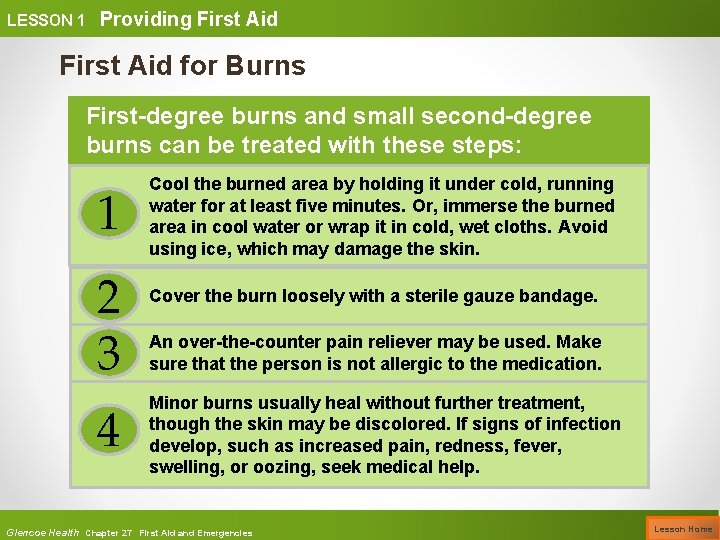
LESSON 1 Providing First Aid for Burns First-degree burns and small second-degree burns can be treated with these steps: 1 2 3 4 Cool the burned area by holding it under cold, running water for at least five minutes. Or, immerse the burned area in cool water or wrap it in cold, wet cloths. Avoid using ice, which may damage the skin. Cover the burn loosely with a sterile gauze bandage. An over-the-counter pain reliever may be used. Make sure that the person is not allergic to the medication. Minor burns usually heal without further treatment, though the skin may be discolored. If signs of infection develop, such as increased pain, redness, fever, swelling, or oozing, seek medical help. Glencoe Health Chapter 27 First Aid and Emergencies Lesson Home
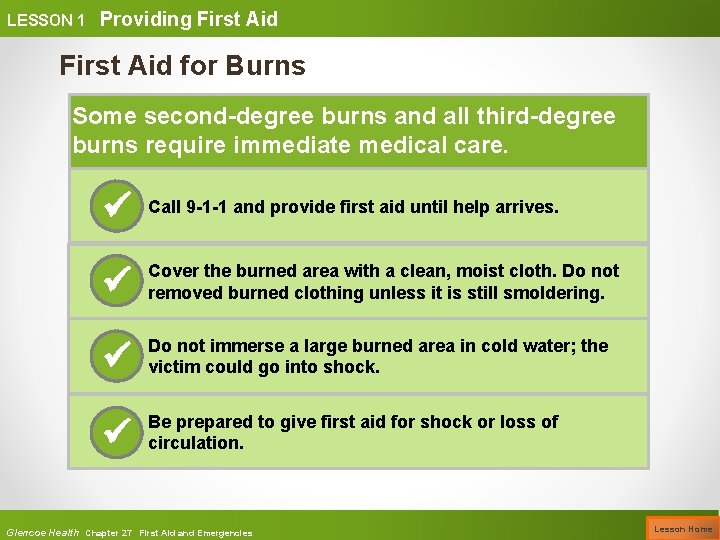
LESSON 1 Providing First Aid for Burns Some second-degree burns and all third-degree burns require immediate medical care. Call 9 -1 -1 and provide first aid until help arrives. Cover the burned area with a clean, moist cloth. Do not removed burned clothing unless it is still smoldering. Do not immerse a large burned area in cold water; the victim could go into shock. Be prepared to give first aid for shock or loss of circulation. Glencoe Health Chapter 27 First Aid and Emergencies Lesson Home
LESSON 1 Review Providing First Aid After You Read Reviewing Facts and Vocabulary 1. What are three first steps for responding to an emergency? Check, call, care. Glencoe Health Chapter 27 First Aid and Emergencies Lesson Home
LESSON 1 Review Providing First Aid After You Read Reviewing Facts and Vocabulary 2. Identify the four types of open wounds. Abrasions, lacerations, punctures, and avulsions. Glencoe Health Chapter 27 First Aid and Emergencies Lesson Home
LESSON 1 Review Providing First Aid After You Read Reviewing Facts and Vocabulary 3. Describe the procedure for treating a minor burn. Cool the burn with cold water, cover it with a sterile bandage, and give an over-the-counter pain reliever if the person is not allergic to it. Glencoe Health Chapter 27 First Aid and Emergencies Lesson Home
Glencoe Health End of Chapter 26 First Aid and Emergencies Lesson 1 Providing First Aid Lesson Home