
GLAST LAT Project Update on LAT Science Tools
- Slides: 13
GLAST LAT Project Update on LAT Science Tools Gamma-ray Large Area Space Telescope S. W. Digel Stanford Linear Accelerator Center GLAST Users Committee Meeting, 6 -7 June 2005 1
GLAST LAT Project Outline • The Big Picture – Science tools & LAT ground software effort • Status of the science tools and related topics • Near-term development & testing milestones GLAST Users Committee Meeting, 6 -7 June 2005 2
GLAST LAT Project Big Picture: Science tools and LAT ground software • The science tools are for the highest-level analyses of the LAT data, depending on many things already having been done (in addition to the LAT being operated safely and the L 0 data reaching the ISOC): – Event reconstruction and classification (including background rejection) – Livetime and pointing history – These data made accessible in a convenient, efficient way – Response functions (Aeff, PSF, and energy dispersion) characterized – essential for likelihood analysis (or analysis of GRBs via Xspec) GLAST Users Committee Meeting, 6 -7 June 2005 3
GLAST LAT Project Notes on status • Development model is spiral – iterations with evaluations – 6 -week build cycle adopted after DC 1 (thanks to James Peachey) – The idea is to build and test on short cycles, to avoid a ‘train wreck’ at the data challenges; of course, not everything can be worked on for every cycle – Cycle 8 just completed – ‘Already used’ designation does not imply that tool is complete, but is meant to imply that remaining issues are a matter of refinement Status key (color coding for next slide) Already used in at least one checkout Prototype exists Does not exist yet GLAST Users Committee Meeting, 6 -7 June 2005 4
GLAST LAT Project Status of tools • Likelihood analysis – gtbackfile, gtdiffresp, gtexpmap, gtlikelihood, gtsrcmaps, gttsmap, what else? – Most of these are ‘helper’ tools; the number is also driven by OS command-line philosophy of FTOOLs; Jim will demonstrate interactive likelihood analysis • Source identification – gtsrcid What’s this? • Pulsar analysis – glbary, pulse. Phase, gtpsearch, gtpulsardb, blind search – gtpulsardb is also backed up by an ‘ephemeris ingest’ tool – gtpsearch applies periodicity tests for a known ephemeris, but allows a small range of timing parameters, in case of Status key small errors Already used in at least one checkout Gamma-ray Large Area Space Telescope Prototype exists Does not exist yet GLAST Users Committee Meeting, 6 -7 June 2005 5
GLAST LAT Project Status of tools (2) • GRB analysis – gtbin, gtrspgen, burst. Fit, (unbinned spectral analysis via Band function in likelihood), spectral-temporal modeling – The first two provide a pathway to Xspec and to joint spectral studies with GBM data – burst. Fit is the start of the GRB temporal analysis tool • Observation simulation (high-level) – gtorbsim, gtobsim – These share orbit/attitude and event scheduler with Gleam – Many user-specifiable sources exist, including diffuse, Status key transient, and pulsars Already used in at least one checkout Prototype exists • Utilities Does not exist yet – gtlivetimecube, gtpsf, gtselect, gtcntsmap, exposure_map – event display (to be a Web service) GLAST Users Committee Meeting, 6 -7 June 2005 6
GLAST LAT Project Other components of the SAE • Data access – Level 1 server at GSSC has reached a high level of refinement – Data server at SLAC, which will drive the event display, is being prototyped • Interstellar emission model – A 0 -th version exists, based directly on the current GALPROP models – Many improvements to the model are in the works (and were discussed last month in a workshop at SLAC) – ask me for details later – these will include supporting mmwave observations – We also anticipate refining during the first year of the mission, of course GLAST Users Committee Meeting, 6 -7 June 2005 7
GLAST LAT Project Other components (2) • Response functions − some open questions for the DC 2 time scale: – How fine grained should the characterization be (i. e. , what is the point of diminishing returns in terms of numbers of event classes)? – How adjustable should the tradeoff be regarding background rejection vs. effective area for higher-level analyses? GLAST Users Committee Meeting, 6 -7 June 2005 8
GLAST LAT Project Near-term milestones for science tools • • • Near term, project-level: – Science Tools Checkout 3 – September 2005 – Data Challenge 2 – January 2006 Science Tools Checkouts – Checkout 1 (October 2004) and Checkout 2 (March-April 2005) • Evaluators were recruited from developer pool – Checkout 3 (September 2005) will have a broader spectrum of users from within the GSSC + LAT, and so will depend on having good user-level documentation Data challenge 2 (January-February 2006) – You’ve heard about this from Peter – DC 2 also requires Data for the Challenge • From the science tools perspective, this means defining realistic celestial sources • E. g. , Galactic diffuse [not necessarily exactly the same as our model], pulsars, blazars, GRBs, extended sources [external galaxies, SNR, etc. ], and new source classes GLAST Users Committee Meeting, 6 -7 June 2005 9
GLAST LAT Project Backup slides follow GLAST Users Committee Meeting, 6 -7 June 2005 10
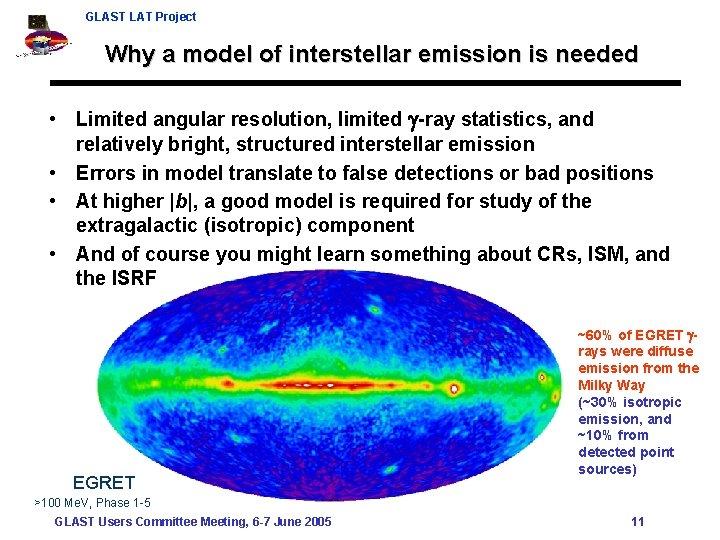
GLAST LAT Project Why a model of interstellar emission is needed • Limited angular resolution, limited g-ray statistics, and relatively bright, structured interstellar emission • Errors in model translate to false detections or bad positions • At higher |b|, a good model is required for study of the extragalactic (isotropic) component • And of course you might learn something about CRs, ISM, and the ISRF ~60% of EGRET grays were diffuse emission from the Milky Way (~30% isotropic emission, and ~10% from detected point sources) EGRET >100 Me. V, Phase 1 -5 GLAST Users Committee Meeting, 6 -7 June 2005 11
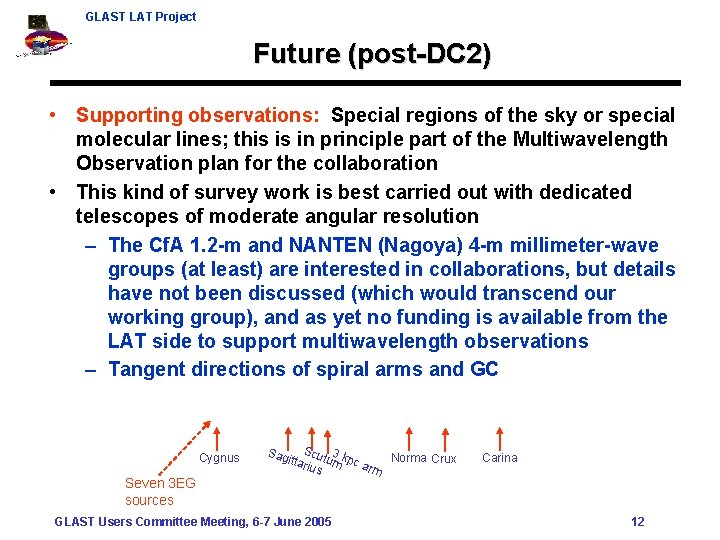
GLAST LAT Project Future (post-DC 2) • Supporting observations: Special regions of the sky or special molecular lines; this is in principle part of the Multiwavelength Observation plan for the collaboration • This kind of survey work is best carried out with dedicated telescopes of moderate angular resolution – The Cf. A 1. 2 -m and NANTEN (Nagoya) 4 -m millimeter-wave groups (at least) are interested in collaborations, but details have not been discussed (which would transcend our working group), and as yet no funding is available from the LAT side to support multiwavelength observations – Tangent directions of spiral arms and GC Cygnus Seven 3 EG sources Sc 3 Norma Crux ittar utum kpc a ius rm Sag GLAST Users Committee Meeting, 6 -7 June 2005 Carina 12
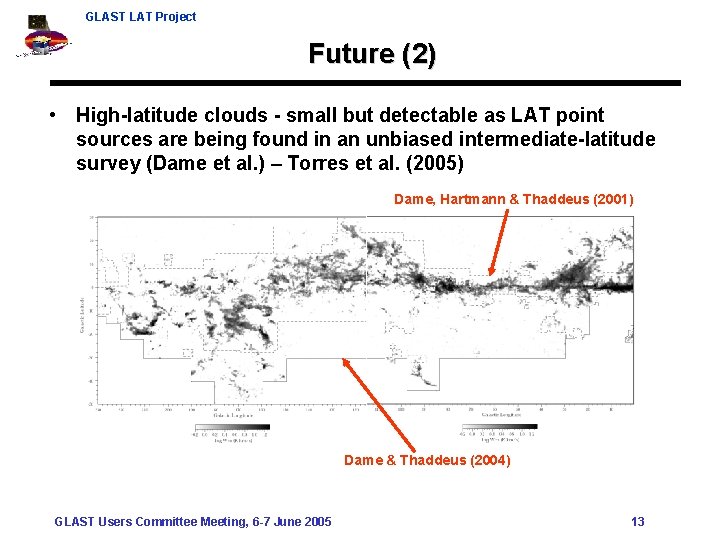
GLAST LAT Project Future (2) • High-latitude clouds - small but detectable as LAT point sources are being found in an unbiased intermediate-latitude survey (Dame et al. ) – Torres et al. (2005) Dame, Hartmann & Thaddeus (2001) Dame & Thaddeus (2004) GLAST Users Committee Meeting, 6 -7 June 2005 13