
GLAST LAT Project Analytical Objectives Gammaray Large Area
GLAST LAT Project Analytical Objectives Gamma-ray Large Area Space Telescope for Science Tools for DC 2 S. W. Digel Stanford Linear Accelerator Center DC 2 Software Workshop, GSFC, June 27 -29, 2005 1
GLAST LAT Project Outline • Goal of this talk/discussion is a prioritized list of new tools/features to be implemented for DC 2 – Is a goal the same thing as an objective? – My presentation is subjective: The requirements and goals for science analyses in DC 2 need to be written down some place with more detail than in a Power. Point presentation • Standard Analysis Environment vs. ‘Science Tools’ • Summary of status of SAE • Some SAE objectives for DC 2 not already discussed this week – and some SAE tools that are explicitly not part of DC 2 • Other objectives for Science Tools for DC 2 Software Workshop, GSFC, June 27 -29, 2005 2
GLAST LAT Project Science Tools & the SAE • ‘Science Tools’ has been a catch-all term for the tools for astronomy – This is not my term, and should not be taken to imply that what comes before is not science • The Standard Analysis Environment is the collection of science tools being developed jointly with the GSSC for highlevel analyses of LAT (or LAT + GBM) data. – Conceptually SAE is a subset of Science Tools DC 2 Software Workshop, GSFC, June 27 -29, 2005 3
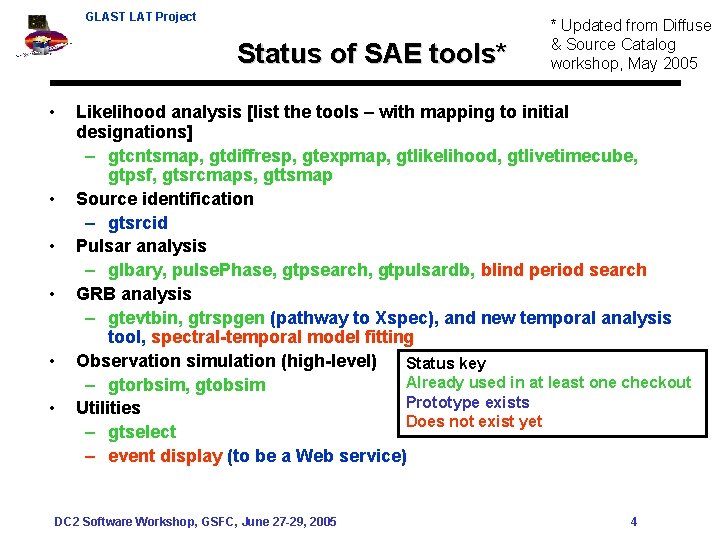
GLAST LAT Project Status of SAE tools* • • • * Updated from Diffuse & Source Catalog workshop, May 2005 Likelihood analysis [list the tools – with mapping to initial designations] – gtcntsmap, gtdiffresp, gtexpmap, gtlikelihood, gtlivetimecube, gtpsf, gtsrcmaps, gttsmap Source identification – gtsrcid Pulsar analysis – glbary, pulse. Phase, gtpsearch, gtpulsardb, blind period search GRB analysis – gtevtbin, gtrspgen (pathway to Xspec), and new temporal analysis tool, spectral-temporal model fitting Observation simulation (high-level) Status key Already used in at least one checkout – gtorbsim, gtobsim Prototype exists Utilities Does not exist yet – gtselect – event display (to be a Web service) DC 2 Software Workshop, GSFC, June 27 -29, 2005 4
GLAST LAT Project Notes on status • Development model is spiral – iterations with evaluations (science tools checkouts and data challenges) – 6 -week build cycle adopted after DC 1 (thanks to James Peachey) – ‘Already used’ designation does not imply that tool is complete, but is meant to imply that remaining issues are a matter of refinement DC 2 Software Workshop, GSFC, June 27 -29, 2005 5
GLAST LAT Project gtsrcid (w/ catalog. Access) • • Jürgen Knödlseder has prototyped the source identification tool, using the catalog. Access classes designed by Dirk Petry and implemented by Aymeric Sauvageon The prototype has fairly limited functionality – which is good – Basically v 0 can be used to look for positional coincidences between LAT sources and astronomical catalogs – See http: //wwwglast. slac. stanford. edu/sciencetools/workshops/May 05 Diffuse. Cat/agenda. htm • • This is already good enough for DC 2; further improvements in functionality are planned in advance of DC 2 – The design allows for fairly general identification strategies, e. g. , depending on radio flux ratios, or radio & X-ray properties in separate catalogs Quantitative assessments of probabilities of counterpart identification are the ideal, but may not be attainable, and the Catalogs group needs to study this issue and potential alternatives DC 2 Software Workshop, GSFC, June 27 -29, 2005 6
GLAST LAT Project Event display (server) • From the SAE perspective this is related to the server planned at SLAC that will provide access to the digi and recon information that the event display needs, so that science tools users can look up events by event number • Discussion seemed to converge on having a Web-driven event display – no tool to install or support – with either canned views or limited control options • Riccardo thinks that this can be done with Fred; I think that Tony may have plans to do it with Wired • I can’t say that this should be a DC 2 goal. Certainly the data servers at SLAC need to come first. DC 2 Software Workshop, GSFC, June 27 -29, 2005 7
GLAST LAT Project SAE tools that explicitly are not part of DC 2 • A tool (A 4) was originally specified for blind periodicity searches, but we probably will not develop it as part of the SAE – Certainly the LAT team wants to be in this business, but sensitive searches are going to be the work of specialists • GRB spectral-temporal modeling (A 10) will not be implemented for DC 2 – Possibly not ever as a guest investigator tool. It is specified as a very sophisticated modeling tool for simultaneously fitting spectral and temporal variations of a GRB – useful if you have global models with few enough parameters that you can learn something DC 2 Software Workshop, GSFC, June 27 -29, 2005 8
GLAST LAT Project not SAE Other objectives for Science Tools for DC 2 • Source detection tool – See Isabelle Grenier & Jean Ballet’s talk in this session • GRB detection tool [right? ] • AGN light curve, … – In general, specialized analysis needs that come from the collaboration science working groups. They may also come with developers • Source simulation needs not already covered… • Also needed: CALDB representation of IRFs, dotting the i’s on the data product formats, IRF display, ROOT-FITS converter… • The Ephemeris Computer tool that Masa Hirayama described today for querying the pulsar ephemeris database will be very useful for pulsar studies in DC 2 – It is not formally part of the SAE but it should be DC 2 Software Workshop, GSFC, June 27 -29, 2005 9
GLAST LAT Project Getting to DC 2: Priorities for development (Highest to lowest) • Taking the data servers for granted, and under the assumption that GBM-related developments are covered by GBM + GSSC, and that diffuse emission model work is covered by the Diffuse CSWG • Highest priority should be definition of event classes and characterization of the IRFs; this certainly would benefit from IRF visualization • Masa’s tool for querying the pulsar ephemeris file • More functionality for GRB temporal analysis tool (A 7)? • Event display Web service [will also require defining event numbers] • [Highest priority for the SAE overall is development of good user-level documentation – not really an analysis objective] • [User interface issues – like GUIs – also technically are not analysis objectives] DC 2 Software Workshop, GSFC, June 27 -29, 2005 10
- Slides: 10