
Glass forming ability of slags in the Fe
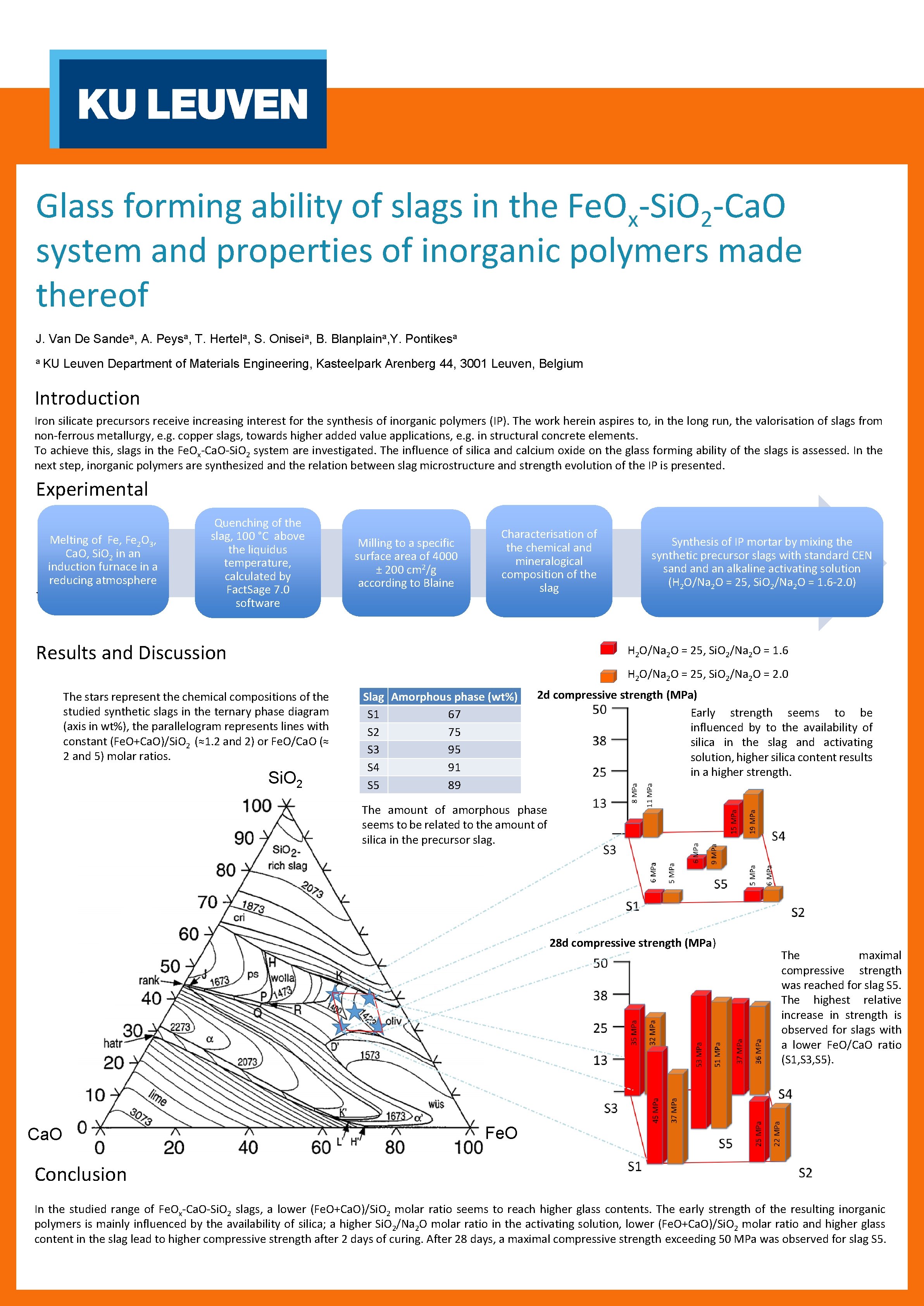
Glass forming ability of slags in the Fe. Ox-Si. O 2 -Ca. O system and properties of inorganic polymers made thereof J. Van De Sandea, A. Peysa, T. Hertela, S. Oniseia, B. Blanplaina, Y. Pontikesa a KU Leuven Department of Materials Engineering, Kasteelpark Arenberg 44, 3001 Leuven, Belgium Introduction Iron silicate precursors receive increasing interest for the synthesis of inorganic polymers (IP). The work herein aspires to, in the long run, the valorisation of slags from non-ferrous metallurgy, e. g. copper slags, towards higher added value applications, e. g. in structural concrete elements. To achieve this, slags in the Fe. Ox-Ca. O-Si. O 2 system are investigated. The influence of silica and calcium oxide on the glass forming ability of the slags is assessed. In the next step, inorganic polymers are synthesized and the relation between slag microstructure and strength evolution of the IP is presented. Experimental . Melting of Fe, Fe 2 O 3, Ca. O, Si. O 2 in an induction furnace in a reducing atmosphere Quenching of the slag, 100 °C above the liquidus temperature, calculated by Fact. Sage 7. 0 software Milling to a specific surface area of 4000 ± 200 cm 2/g according to Blaine Characterisation of the chemical and mineralogical composition of the slag Results and Discussion Synthesis of IP mortar by mixing the synthetic precursor slags with standard CEN sand an alkaline activating solution (H 2 O/Na 2 O = 25, Si. O 2/Na 2 O = 1. 6 -2. 0) H 2 O/Na 2 O = 25, Si. O 2/Na 2 O = 1. 6 H 2 O/Na 2 O = 25, Si. O 2/Na 2 O = 2. 0 The stars represent the chemical compositions of the studied synthetic slags in the ternary phase diagram (axis in wt%), the parallelogram represents lines with constant (Fe. O+Ca. O)/Si. O 2 (≈1. 2 and 2) or Fe. O/Ca. O (≈ 2 and 5) molar ratios. Si. O 2 Slag Amorphous phase (wt%) S 1 67 S 2 75 S 3 95 S 4 91 S 5 89 2 d compressive strength (MPa) Early strength seems to be influenced by to the availability of silica in the slag and activating solution, higher silica content results in a higher strength. The amount of amorphous phase seems to be related to the amount of silica in the precursor slag. 28 d compressive strength (MPa) Ca. O The maximal compressive strength was reached for slag S 5. The highest relative increase in strength is observed for slags with a lower Fe. O/Ca. O ratio (S 1, S 3, S 5). Fe. O Conclusion In the studied range of Fe. Ox-Ca. O-Si. O 2 slags, a lower (Fe. O+Ca. O)/Si. O 2 molar ratio seems to reach higher glass contents. The early strength of the resulting inorganic polymers is mainly influenced by the availability of silica; a higher Si. O 2/Na 2 O molar ratio in the activating solution, lower (Fe. O+Ca. O)/Si. O 2 molar ratio and higher glass content in the slag lead to higher compressive strength after 2 days of curing. After 28 days, a maximal compressive strength exceeding 50 MPa was observed for slag S 5.
- Slides: 1