
Glasgow 5 March 1971 Edwin Morgan Glasgow 5
- Slides: 13
Glasgow 5 March 1971 Edwin Morgan
Glasgow 5 March 1971 Edwin Morgan
From: ‘Instamatic Poems’ – published 1972 “I began a while ago by writing short poems which were directly about events which I had either read about or seen in newspapers or on television. ”
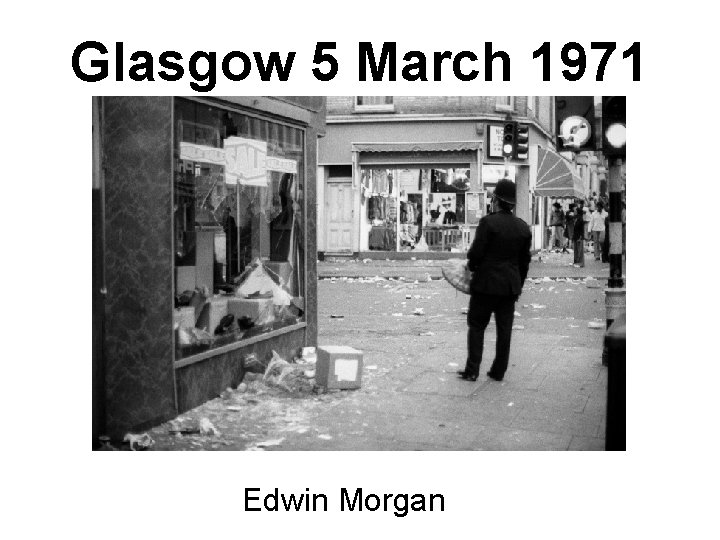
“the poem must be presented in such a way as to give a visual picture of this event… as if somebody had been there with an Instamatic camera and had just very quickly snapped it…”
About the collection ‘Instamatic Poems’: The poems' titles comprise a place-name and date, for example 'London November 1971'. The dates range from June 1970 to June 1972. The first six poems all share the same date, 5 March 1971; the remainder are dated only by month and year.
Subject matter: • Describes an incident in a Glasgow street when a young couple are pushed backwards through a shop window by two youths who are intent on robbing the shop. • The poem goes on to describe the attitude of the youths and of the other people nearby.
Themes: • Violence • Social responsibility
Form: • Free verse • No fixed line length • No rhyme scheme
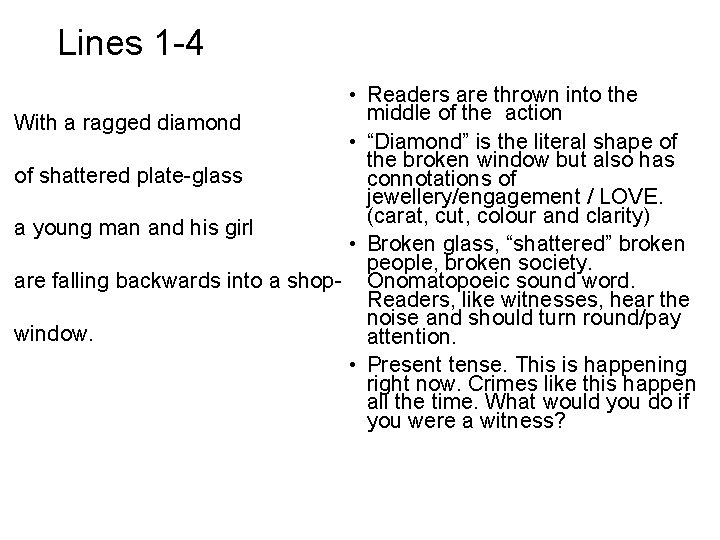
Lines 1 -4 • Readers are thrown into the middle of the action With a ragged diamond • “Diamond” is the literal shape of the broken window but also has of shattered plate-glass connotations of jewellery/engagement / LOVE. (carat, cut, colour and clarity) a young man and his girl • Broken glass, “shattered” broken people, broken society. are falling backwards into a shop- Onomatopoeic sound word. Readers, like witnesses, hear the noise and should turn round/pay window. attention. • Present tense. This is happening right now. Crimes like this happen all the time. What would you do if you were a witness?
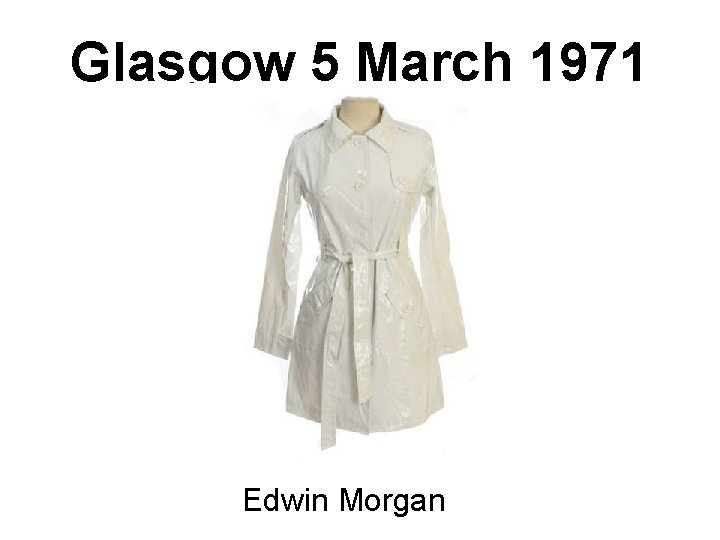
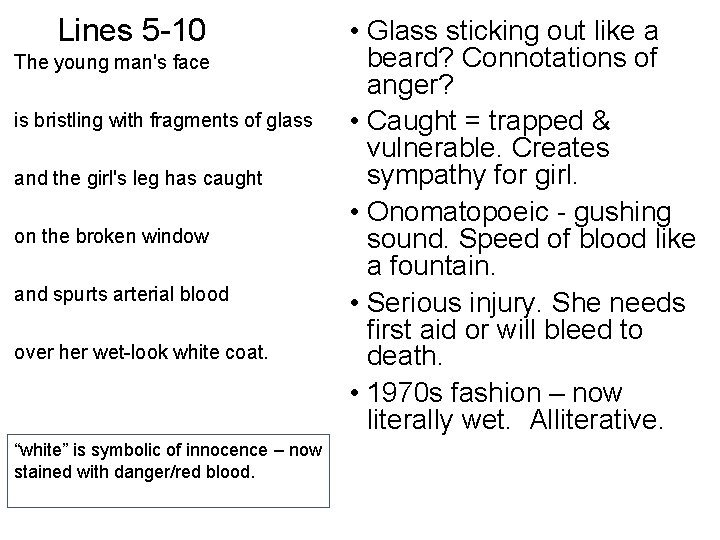
Lines 5 -10 The young man's face is bristling with fragments of glass and the girl's leg has caught on the broken window and spurts arterial blood over her wet-look white coat. “white” is symbolic of innocence – now stained with danger/red blood. • Glass sticking out like a beard? Connotations of anger? • Caught = trapped & vulnerable. Creates sympathy for girl. • Onomatopoeic - gushing sound. Speed of blood like a fountain. • Serious injury. She needs first aid or will bleed to death. • 1970 s fashion – now literally wet. Alliterative.
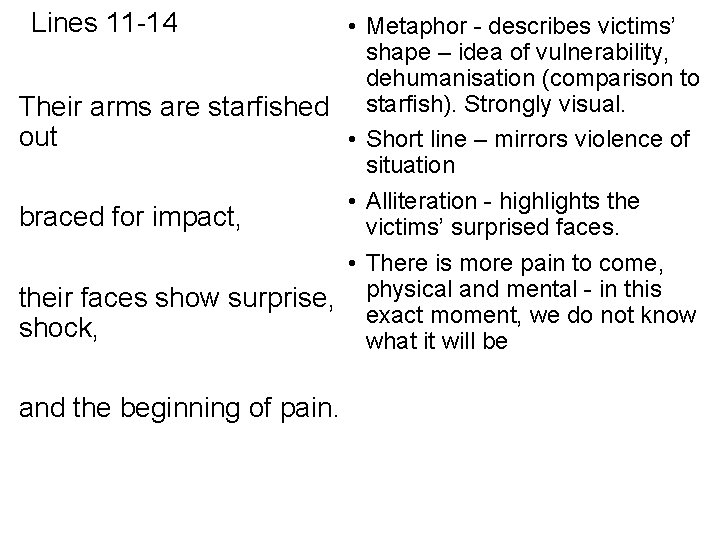
Lines 11 -14 • Metaphor - describes victims’ shape – idea of vulnerability, dehumanisation (comparison to Their arms are starfished starfish). Strongly visual. out • Short line – mirrors violence of situation • Alliteration - highlights the braced for impact, victims’ surprised faces. • There is more pain to come, their faces show surprise, physical and mental - in this exact moment, we do not know shock, what it will be and the beginning of pain.
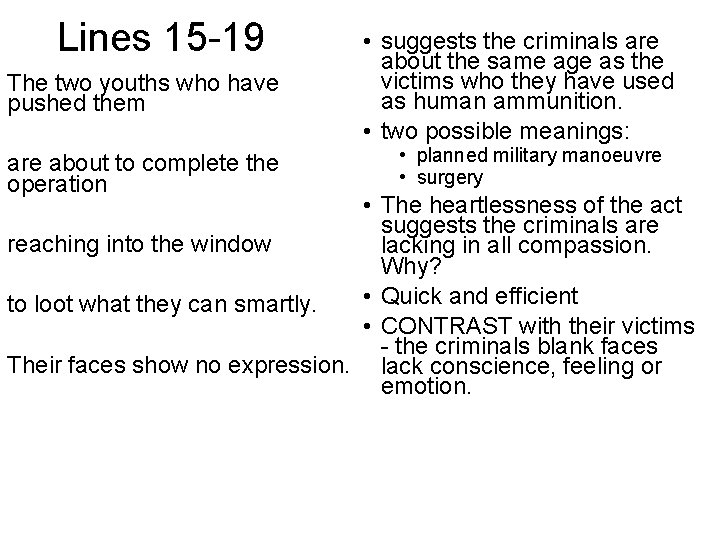
Lines 15 -19 The two youths who have pushed them are about to complete the operation • suggests the criminals are about the same age as the victims who they have used as human ammunition. • two possible meanings: • planned military manoeuvre • surgery • The heartlessness of the act suggests the criminals are reaching into the window lacking in all compassion. Why? • Quick and efficient to loot what they can smartly. • CONTRAST with their victims - the criminals blank faces Their faces show no expression. lack conscience, feeling or emotion.
Lines 20 -23 It is a sharp clear night in Sauchiehall Street. In the background two drivers keep their eyes on the road. • links to bitterly cold evening/ cutting wind. Word also associated with cutting/destroying. • Everyone can see the crime. • Very public place. Alliteration echoes sound of shattering glass • Ironic – not because they are attentive motorists, but because they want to ignore the crime they have witnessed