
Glaciated Landforms These icons indicate that teachers notes
- Slides: 39
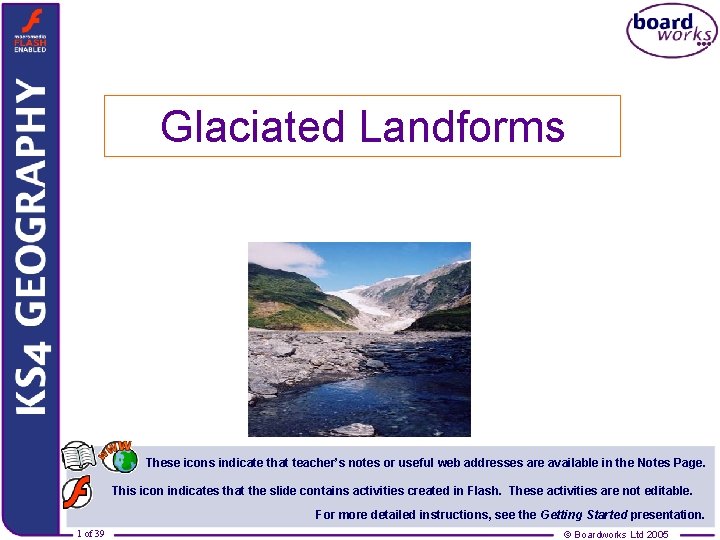
Glaciated Landforms These icons indicate that teacher’s notes or useful web addresses are available in the Notes Page. This icon indicates that the slide contains activities created in Flash. These activities are not editable. For more detailed instructions, see the Getting Started presentation. 1 of 39 © Boardworks Ltd 2005
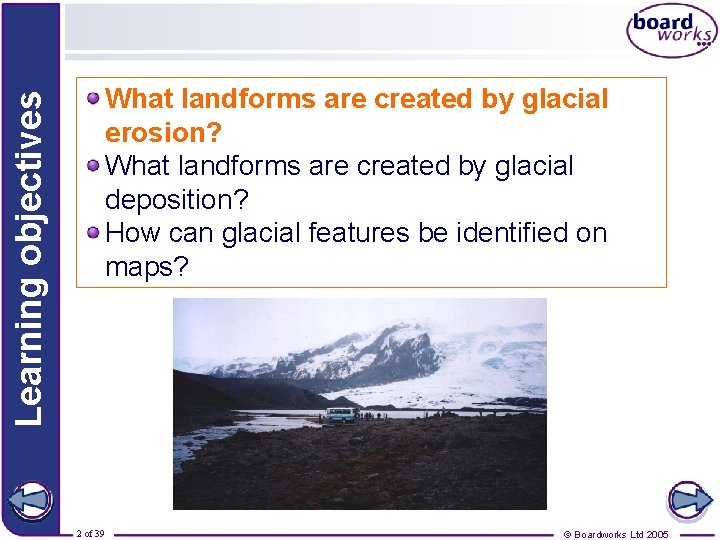
Learning objectives What landforms are created by glacial erosion? What landforms are created by glacial deposition? How can glacial features be identified on maps? 2 of 39 © Boardworks Ltd 2005
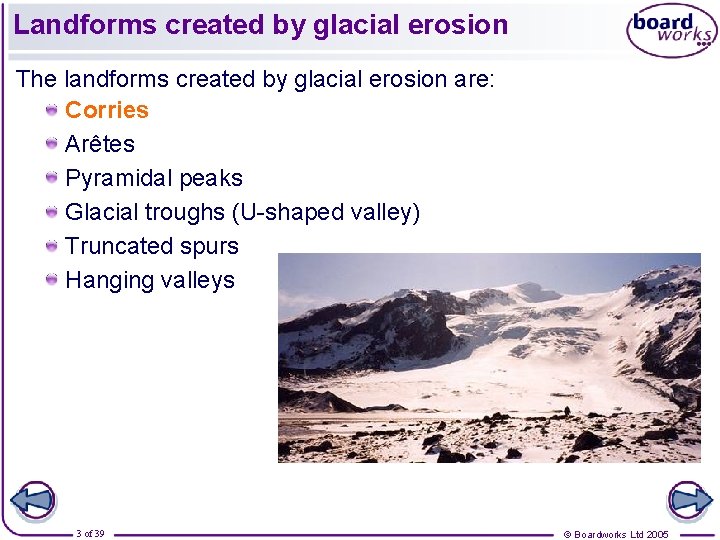
Landforms created by glacial erosion The landforms created by glacial erosion are: Corries Arêtes Pyramidal peaks Glacial troughs (U-shaped valley) Truncated spurs Hanging valleys 3 of 39 © Boardworks Ltd 2005
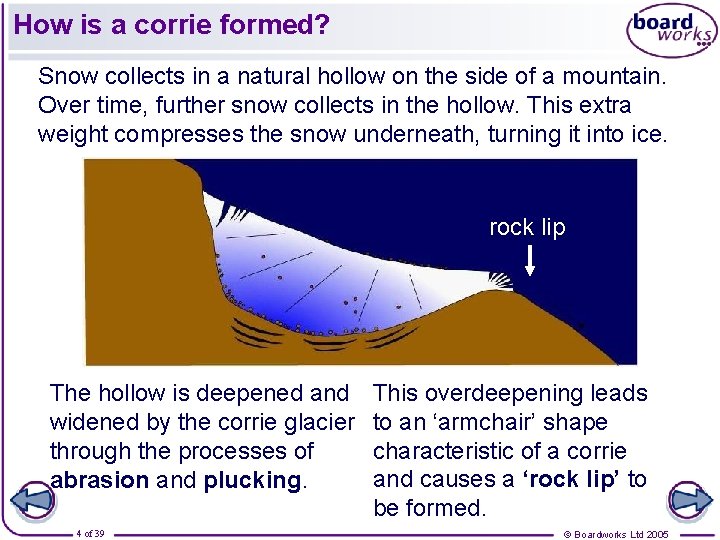
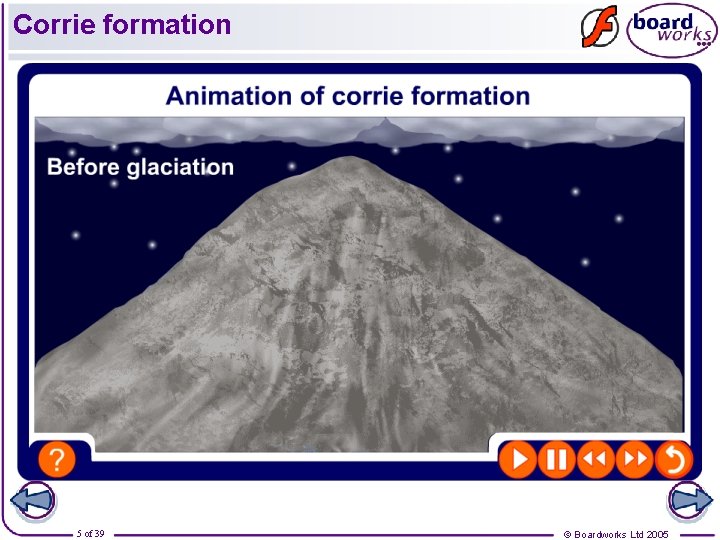
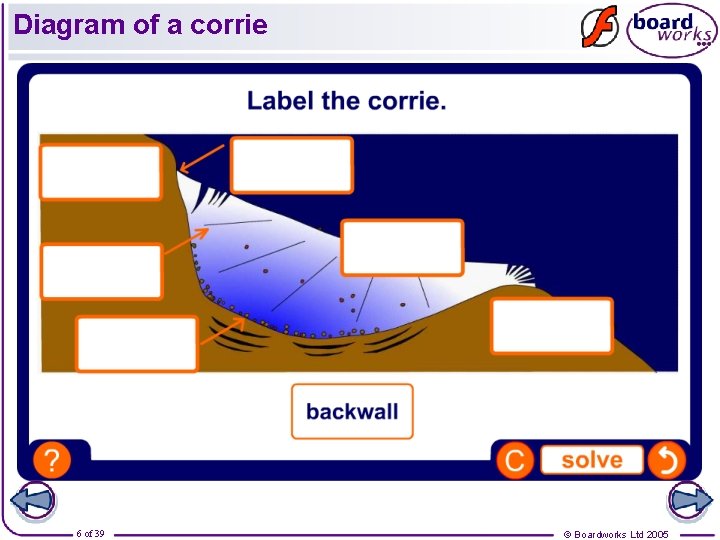
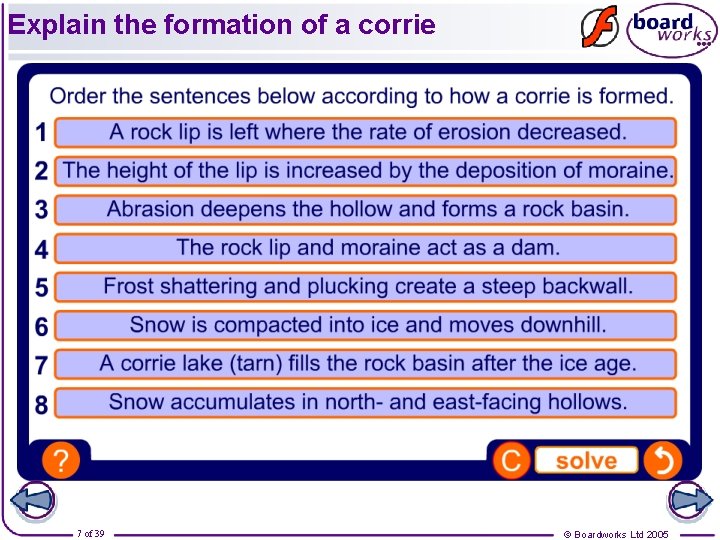
How is a corrie formed? Snow collects in a natural hollow on the side of a mountain. Over time, further snow collects in the hollow. This extra weight compresses the snow underneath, turning it into ice. rock lip The hollow is deepened and widened by the corrie glacier through the processes of abrasion and plucking. 4 of 39 This overdeepening leads to an ‘armchair’ shape characteristic of a corrie and causes a ‘rock lip’ to be formed. © Boardworks Ltd 2005
Corrie formation 5 of 39 © Boardworks Ltd 2005
Diagram of a corrie 6 of 39 © Boardworks Ltd 2005
Explain the formation of a corrie 7 of 39 © Boardworks Ltd 2005
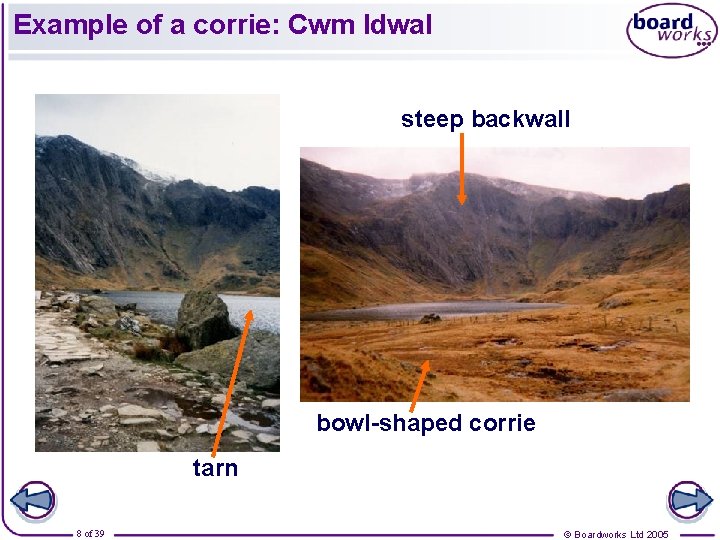
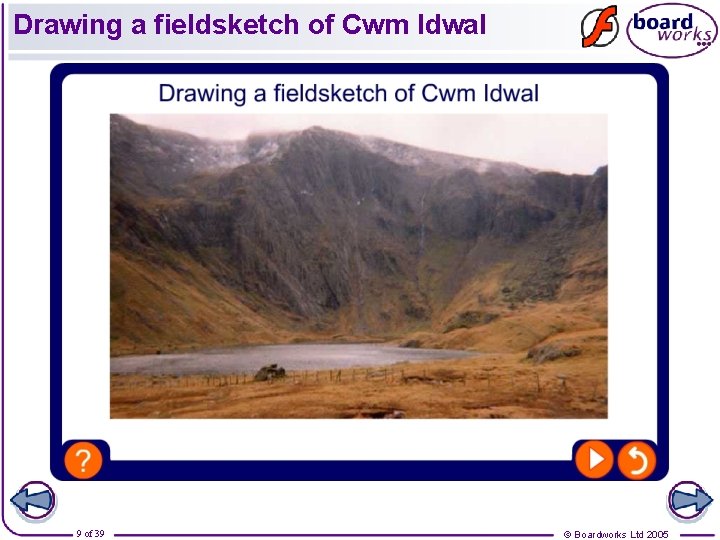
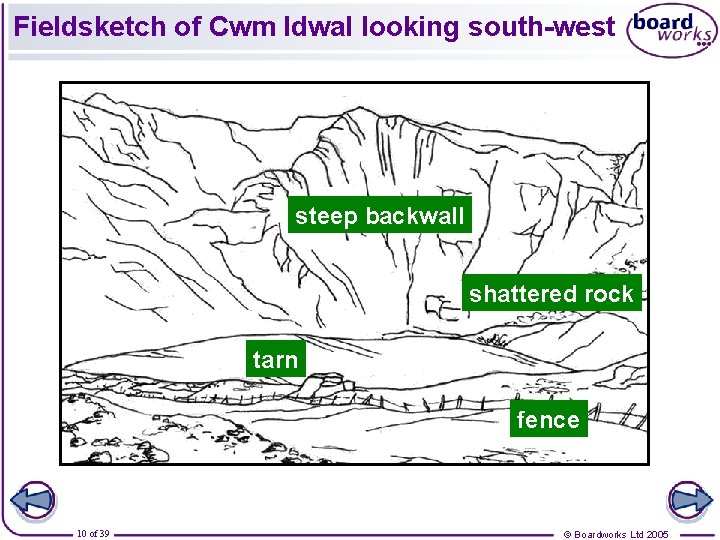
Example of a corrie: Cwm Idwal steep backwall bowl-shaped corrie tarn 8 of 39 © Boardworks Ltd 2005
Drawing a fieldsketch of Cwm Idwal 9 of 39 © Boardworks Ltd 2005
Fieldsketch of Cwm Idwal looking south-west steep backwall shattered rock tarn fence 10 of 39 © Boardworks Ltd 2005
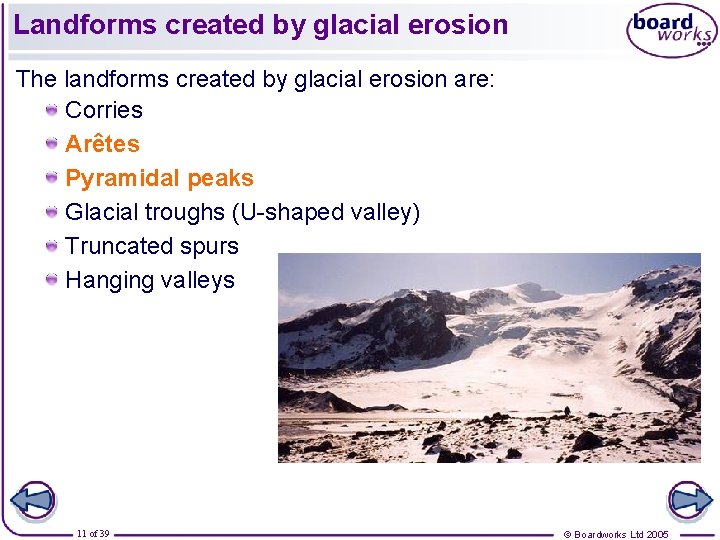
Landforms created by glacial erosion The landforms created by glacial erosion are: Corries Arêtes Pyramidal peaks Glacial troughs (U-shaped valley) Truncated spurs Hanging valleys 11 of 39 © Boardworks Ltd 2005
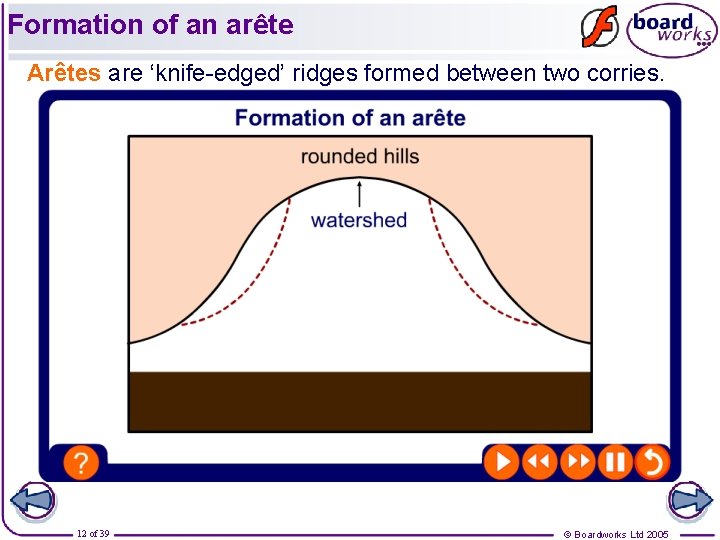
Formation of an arête Arêtes are ‘knife-edged’ ridges formed between two corries. 12 of 39 © Boardworks Ltd 2005
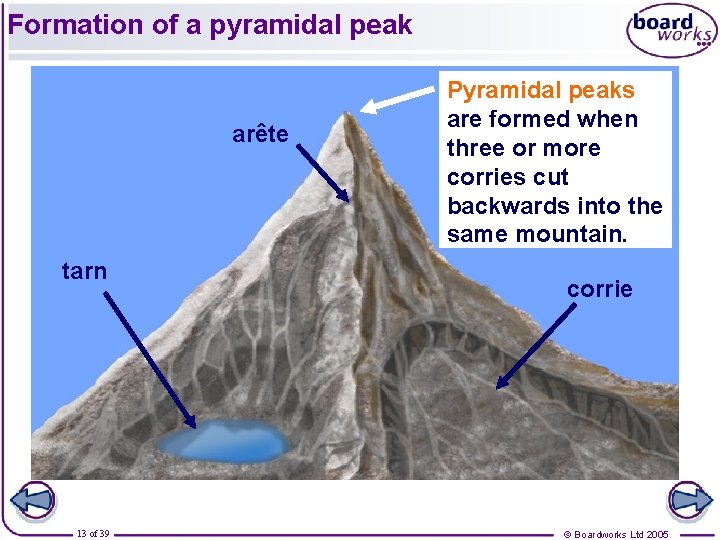
Formation of a pyramidal peak arête tarn 13 of 39 Pyramidal peaks are formed when three or more corries cut backwards into the same mountain. corrie © Boardworks Ltd 2005
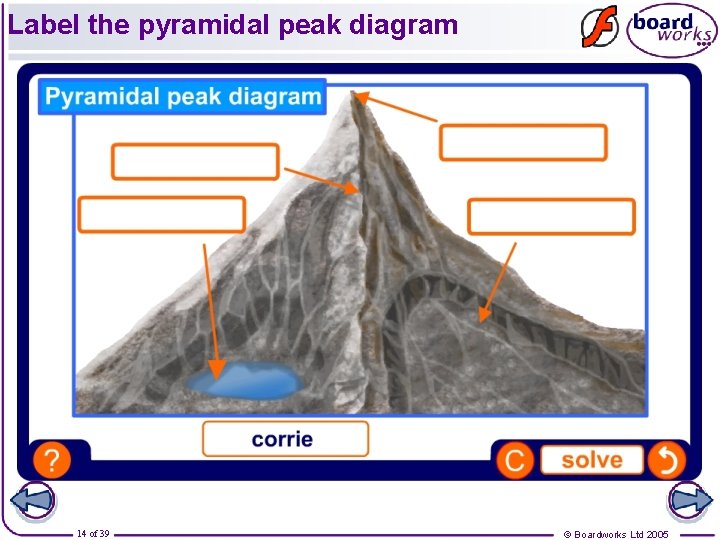
Label the pyramidal peak diagram 14 of 39 © Boardworks Ltd 2005
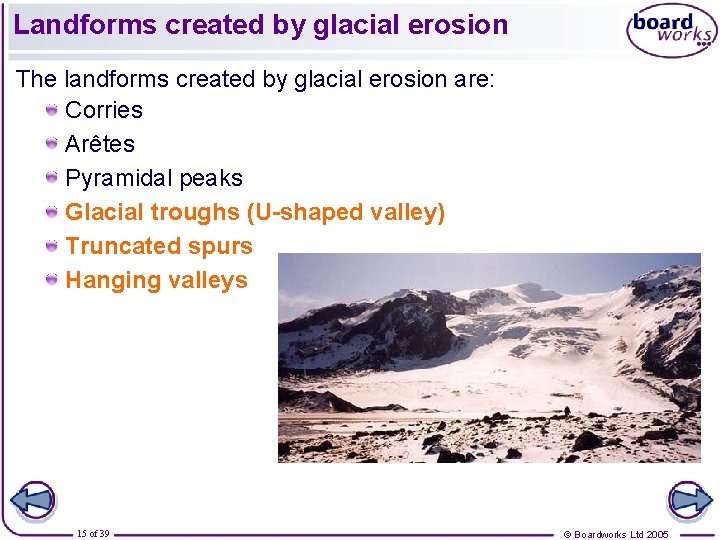
Landforms created by glacial erosion The landforms created by glacial erosion are: Corries Arêtes Pyramidal peaks Glacial troughs (U-shaped valley) Truncated spurs Hanging valleys 15 of 39 © Boardworks Ltd 2005
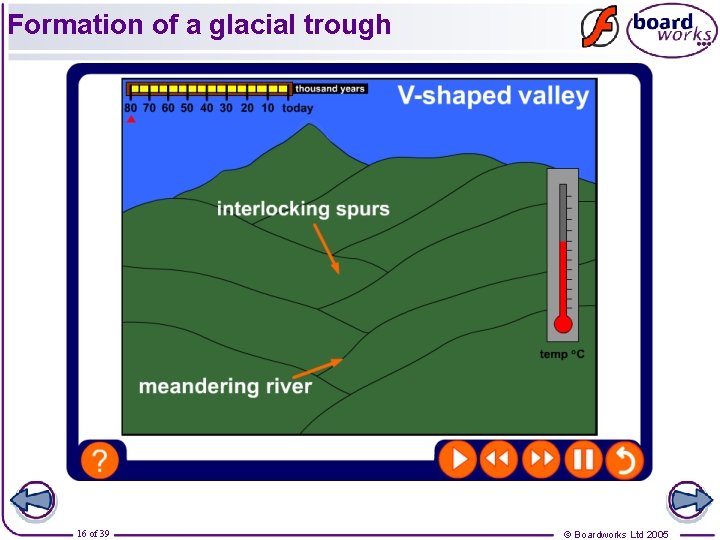
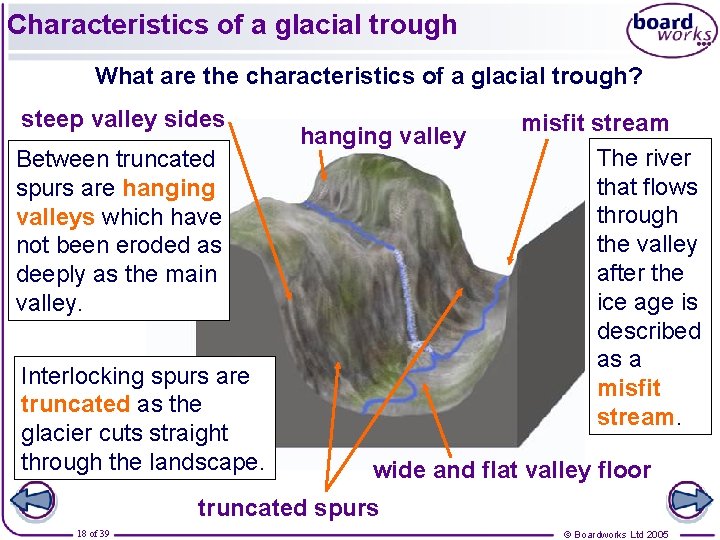
Formation of a glacial trough 16 of 39 © Boardworks Ltd 2005
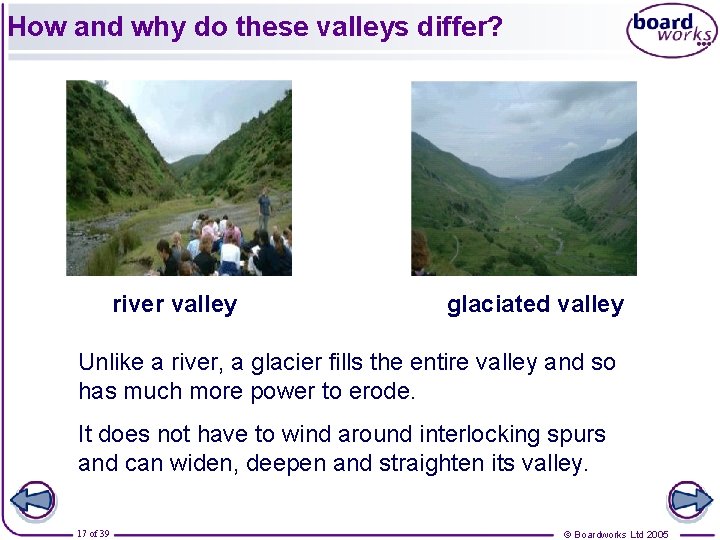
How and why do these valleys differ? river valley glaciated valley Unlike a river, a glacier fills the entire valley and so has much more power to erode. It does not have to wind around interlocking spurs and can widen, deepen and straighten its valley. 17 of 39 © Boardworks Ltd 2005
Characteristics of a glacial trough What are the characteristics of a glacial trough? steep valley sides Between truncated spurs are hanging valleys which have not been eroded as deeply as the main valley. Interlocking spurs are truncated as the glacier cuts straight through the landscape. hanging valley misfit stream The river that flows through the valley after the ice age is described as a misfit stream. wide and flat valley floor truncated spurs 18 of 39 © Boardworks Ltd 2005
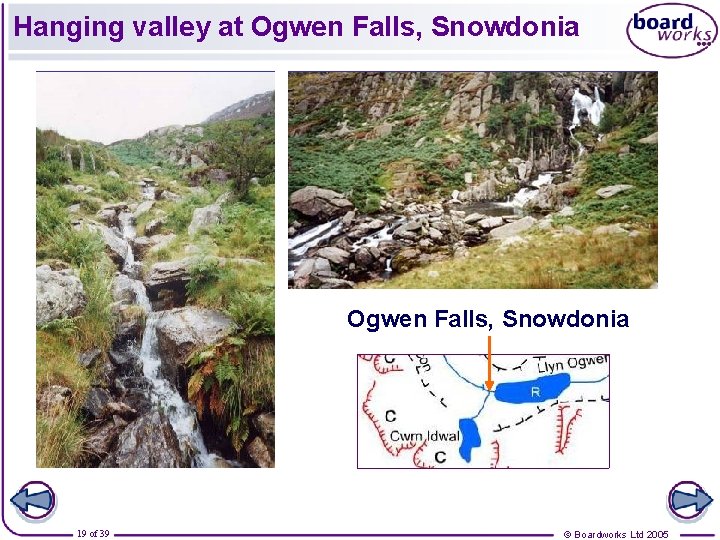
Hanging valley at Ogwen Falls, Snowdonia 19 of 39 © Boardworks Ltd 2005
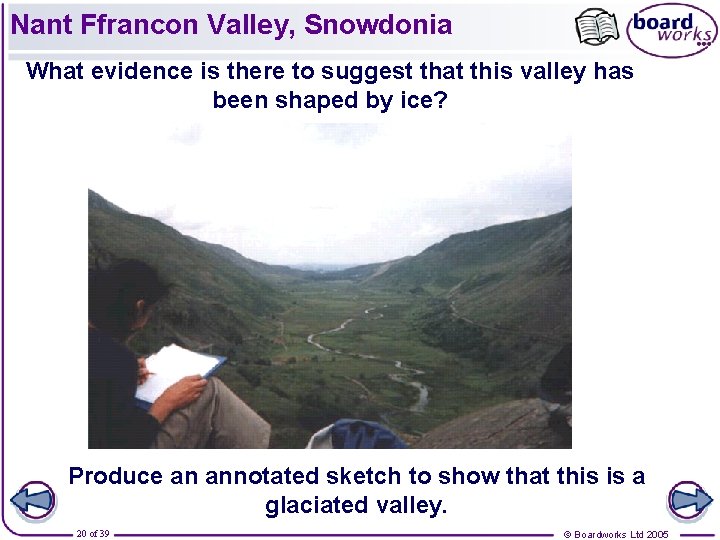
Nant Ffrancon Valley, Snowdonia What evidence is there to suggest that this valley has been shaped by ice? Produce an annotated sketch to show that this is a glaciated valley. 20 of 39 © Boardworks Ltd 2005
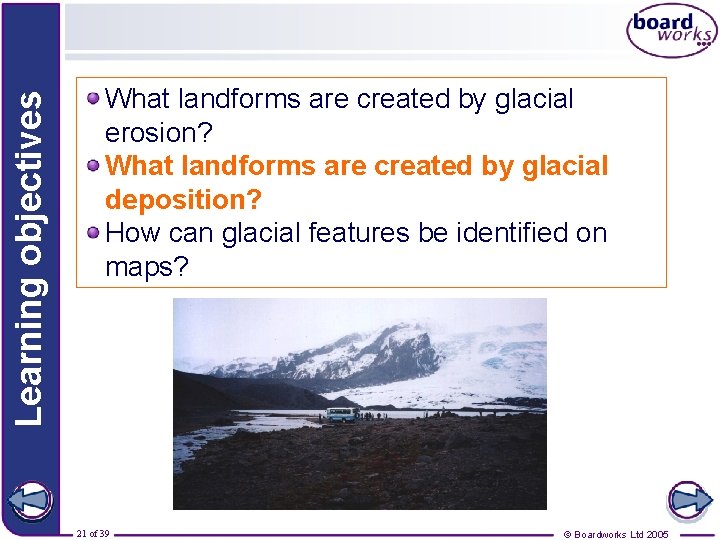
Learning objectives What landforms are created by glacial erosion? What landforms are created by glacial deposition? How can glacial features be identified on maps? 21 of 39 © Boardworks Ltd 2005
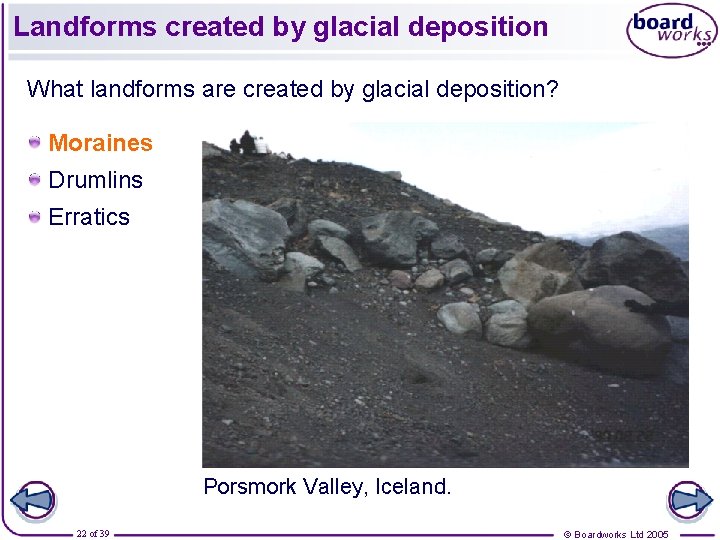
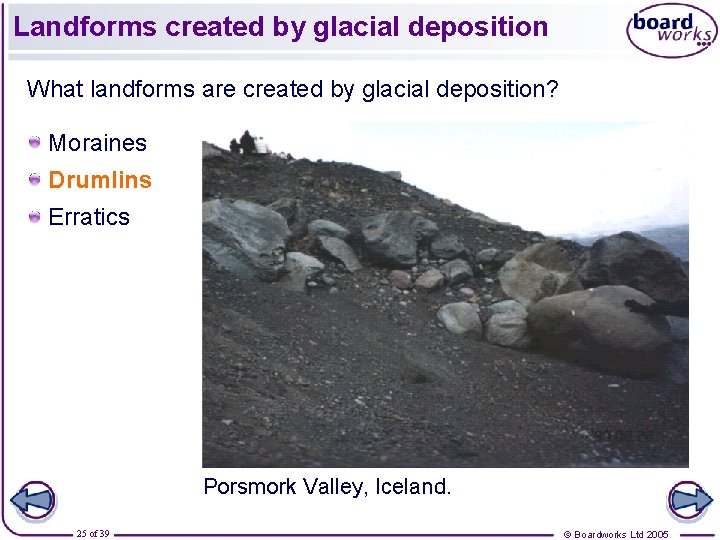
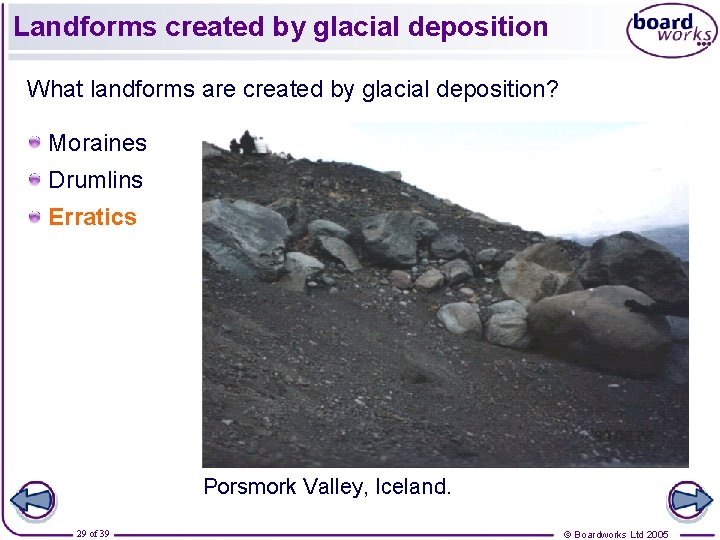
Landforms created by glacial deposition What landforms are created by glacial deposition? Moraines Drumlins Erratics Porsmork Valley, Iceland. 22 of 39 © Boardworks Ltd 2005
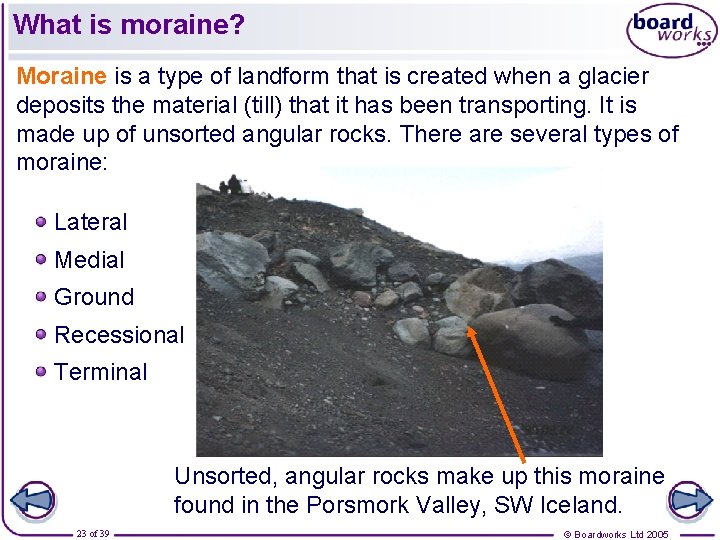
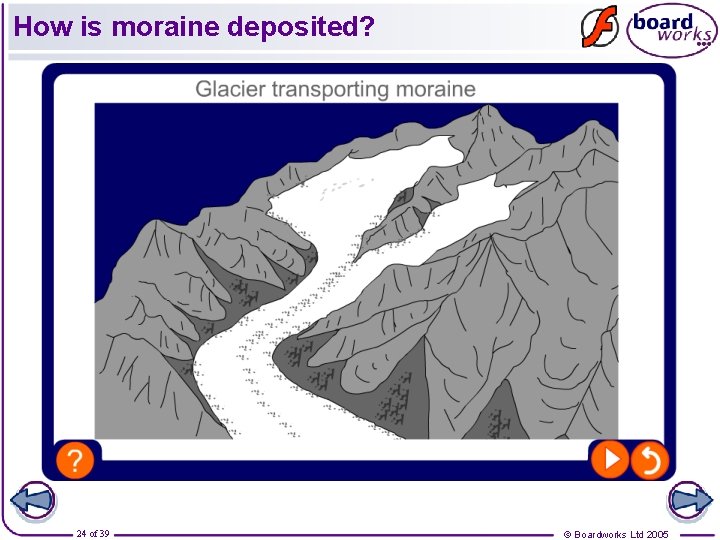
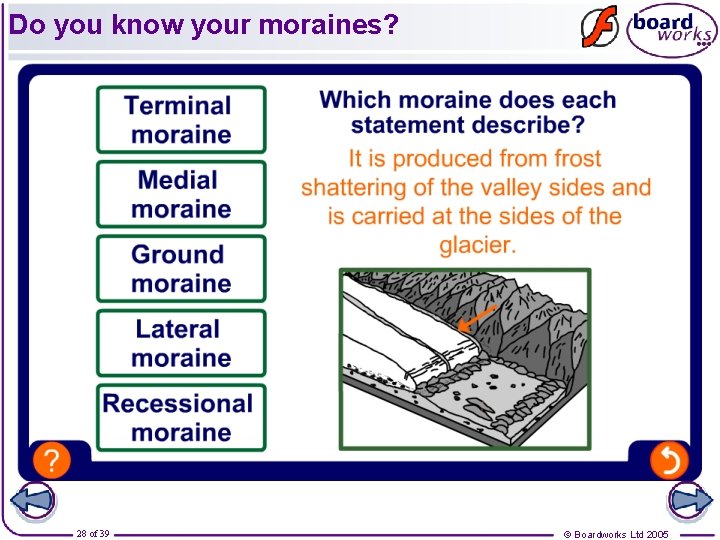
What is moraine? Moraine is a type of landform that is created when a glacier deposits the material (till) that it has been transporting. It is made up of unsorted angular rocks. There are several types of moraine: Lateral Medial Ground Recessional Terminal Unsorted, angular rocks make up this moraine found in the Porsmork Valley, SW Iceland. 23 of 39 © Boardworks Ltd 2005
How is moraine deposited? 24 of 39 © Boardworks Ltd 2005
Landforms created by glacial deposition What landforms are created by glacial deposition? Moraines Drumlins Erratics Porsmork Valley, Iceland. 25 of 39 © Boardworks Ltd 2005
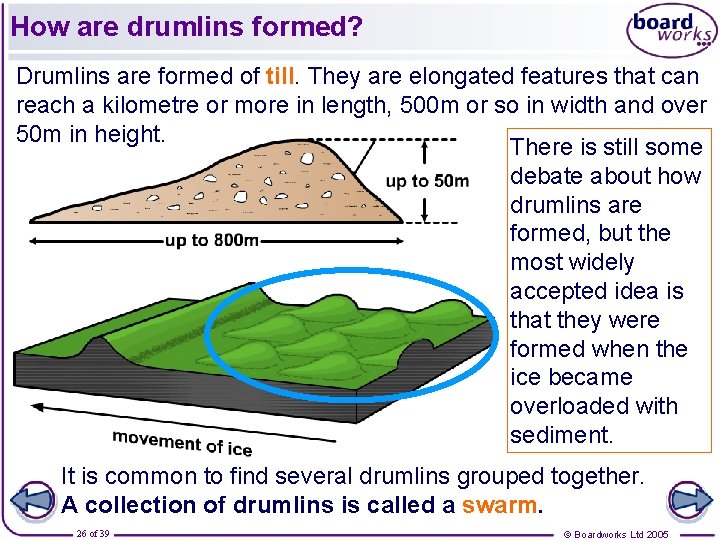
How are drumlins formed? Drumlins are formed of till. They are elongated features that can reach a kilometre or more in length, 500 m or so in width and over 50 m in height. There is still some debate about how drumlins are formed, but the most widely accepted idea is that they were formed when the ice became overloaded with sediment. It is common to find several drumlins grouped together. A collection of drumlins is called a swarm. 26 of 39 © Boardworks Ltd 2005
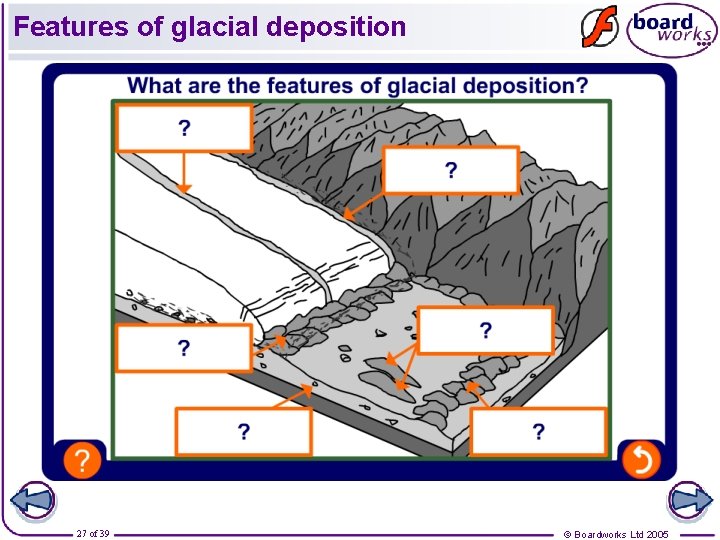
Features of glacial deposition 27 of 39 © Boardworks Ltd 2005
Do you know your moraines? 28 of 39 © Boardworks Ltd 2005
Landforms created by glacial deposition What landforms are created by glacial deposition? Moraines Drumlins Erratics Porsmork Valley, Iceland. 29 of 39 © Boardworks Ltd 2005
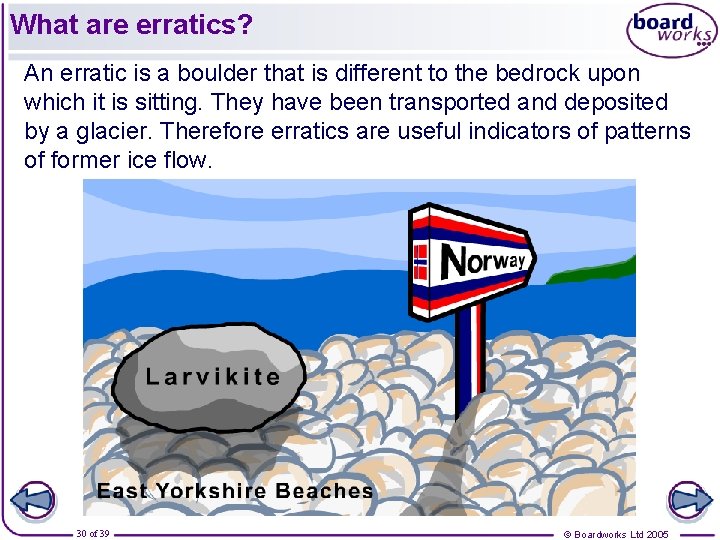
What are erratics? An erratic is a boulder that is different to the bedrock upon which it is sitting. They have been transported and deposited by a glacier. Therefore erratics are useful indicators of patterns of former ice flow. 30 of 39 © Boardworks Ltd 2005
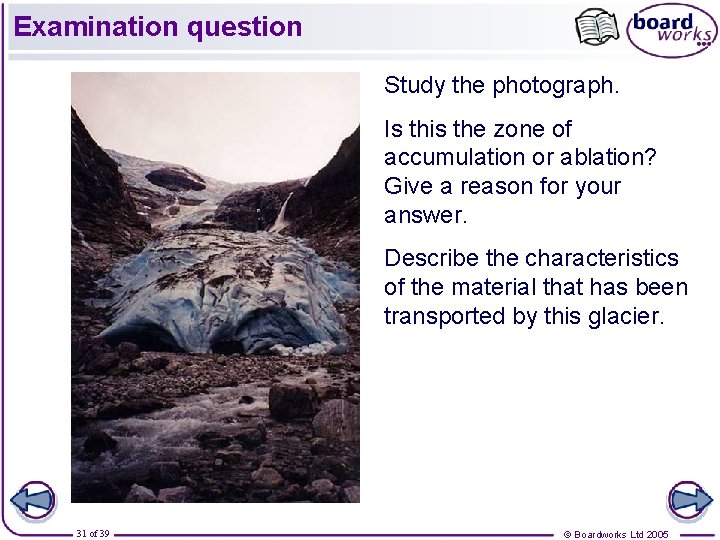
Examination question Study the photograph. Is this the zone of accumulation or ablation? Give a reason for your answer. Describe the characteristics of the material that has been transported by this glacier. 31 of 39 © Boardworks Ltd 2005
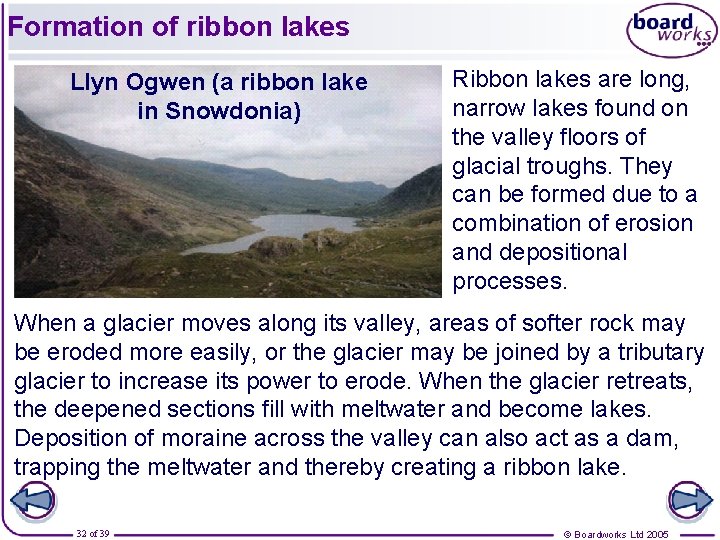
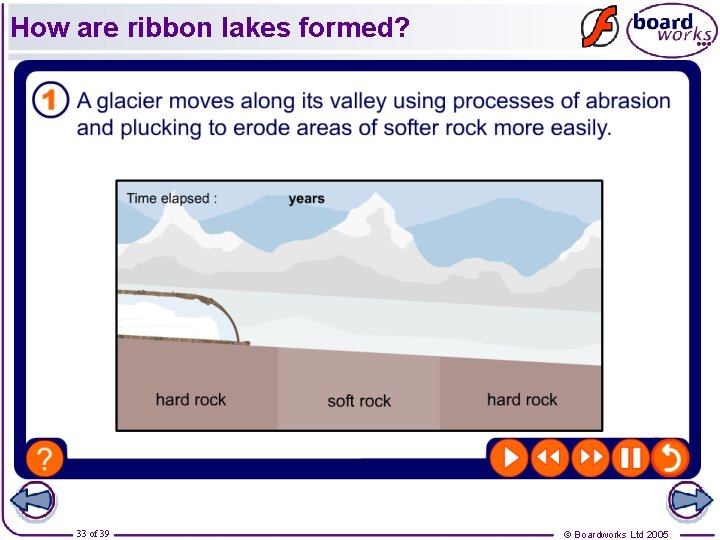
Formation of ribbon lakes Llyn Ogwen (a ribbon lake in Snowdonia) Ribbon lakes are long, narrow lakes found on the valley floors of glacial troughs. They can be formed due to a combination of erosion and depositional processes. When a glacier moves along its valley, areas of softer rock may be eroded more easily, or the glacier may be joined by a tributary glacier to increase its power to erode. When the glacier retreats, the deepened sections fill with meltwater and become lakes. Deposition of moraine across the valley can also act as a dam, trapping the meltwater and thereby creating a ribbon lake. 32 of 39 © Boardworks Ltd 2005
How are ribbon lakes formed? 33 of 39 © Boardworks Ltd 2005
Learning objectives What landforms are created by glacial erosion? What landforms are created by glacial deposition? How can glacial features be identified on maps? 34 of 39 © Boardworks Ltd 2005
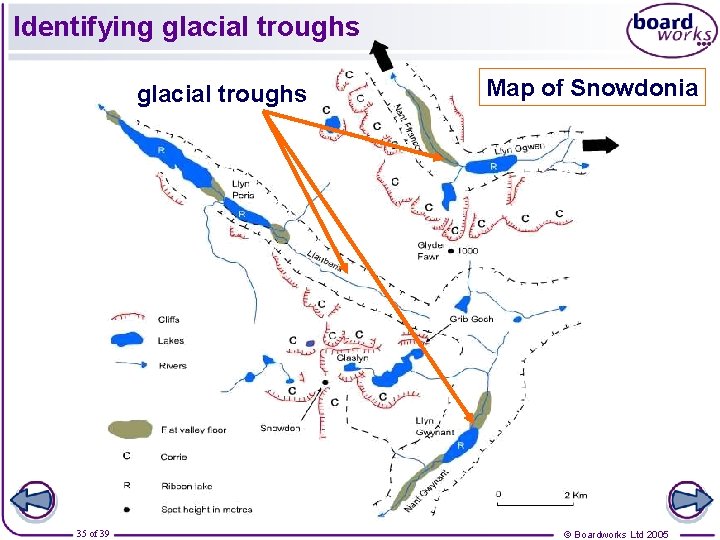
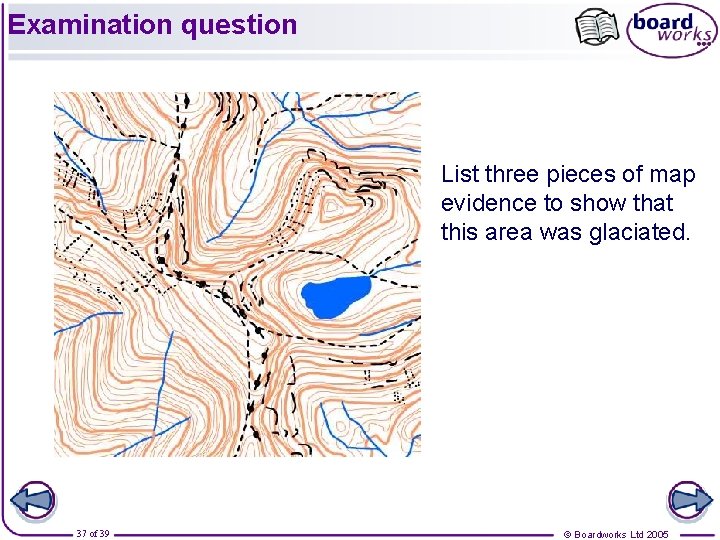
Identifying glacial troughs 35 of 39 Map of Snowdonia © Boardworks Ltd 2005
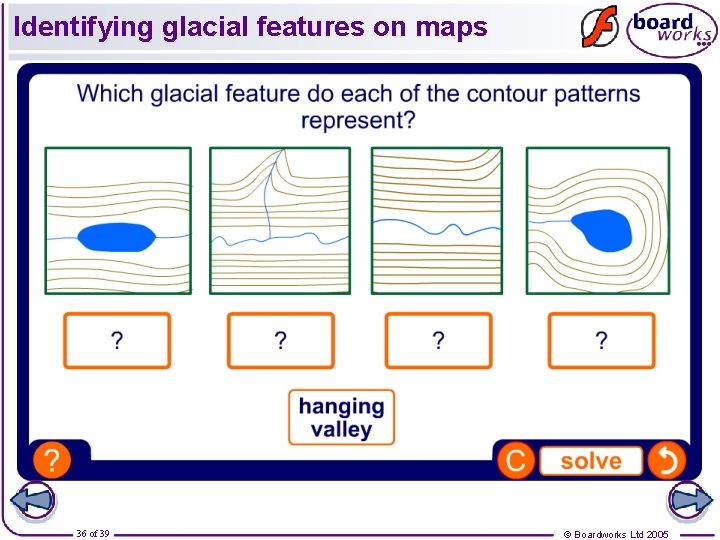
Identifying glacial features on maps 36 of 39 © Boardworks Ltd 2005
Examination question List three pieces of map evidence to show that this area was glaciated. 37 of 39 © Boardworks Ltd 2005
Glaciation quiz 38 of 39 © Boardworks Ltd 2005
Key ideas Corries, arêtes, pyramidal peaks and glacial troughs are created by glacial erosion. Moraines, drumlins and erratics are the result of glacial deposition. Moraine is a type of landform that is created when a glacier deposits the material (till) that it has been transporting. There are five main types of moraine. Contour patterns on maps can give a clear indication as to whether a landscape has been glaciated. 39 of 39 © Boardworks Ltd 2005