
GL HEAVY VEHICLE DRIVING CENTRE has been formed
G&L HEAVY VEHICLE DRIVING CENTRE has been formed in view of the stability the industry now offers and specifically because of the growth potential for the future. The Company’s Training Facilitators have extensive backgrounds within the Road Safety Industry and are amongst the most highly qualified trainers in Australia. All trainers and training courses comply with Certificate IV Workplace Standards and (ASQA ) Australia Standards Quality Assurance Systems. G&L Heavy Vehicle Driving Centre is dedicated to delivering the highest quality of professional training to the transport industry, public and endeavours to develop and enhance the skills and knowledge of all road users. 4 Hines Road Wingfield SA 5013 Phone: 83590099 Email enquiries@gnltruck. com. au Fax: WEB www. gnltruck. com. au 83590095 Version 1. 2 04/04/14 Review 04/15
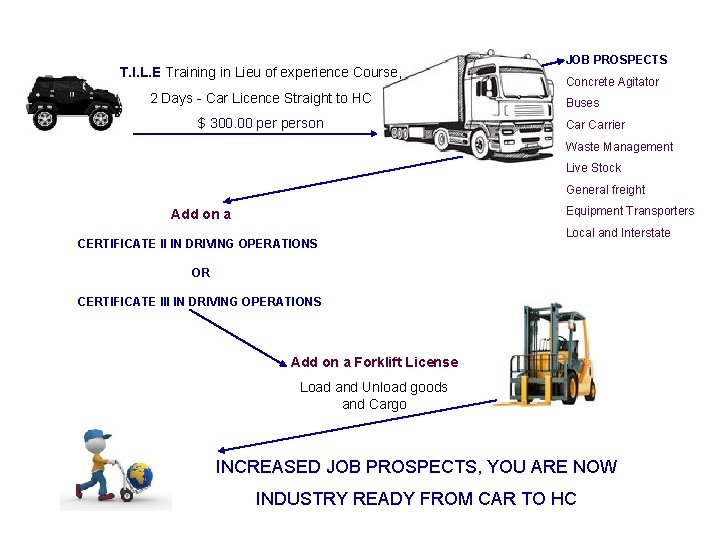
T. I. L. E Training in Lieu of experience Course, 2 Days - Car Licence Straight to HC $ 300. 00 person JOB PROSPECTS Concrete Agitator Buses Carrier Waste Management Live Stock General freight Equipment Transporters Add on a CERTIFICATE II IN DRIVING OPERATIONS Local and Interstate OR CERTIFICATE III IN DRIVING OPERATIONS Add on a Forklift License Load and Unload goods and Cargo INCREASED JOB PROSPECTS, YOU ARE NOW INDUSTRY READY FROM CAR TO HC
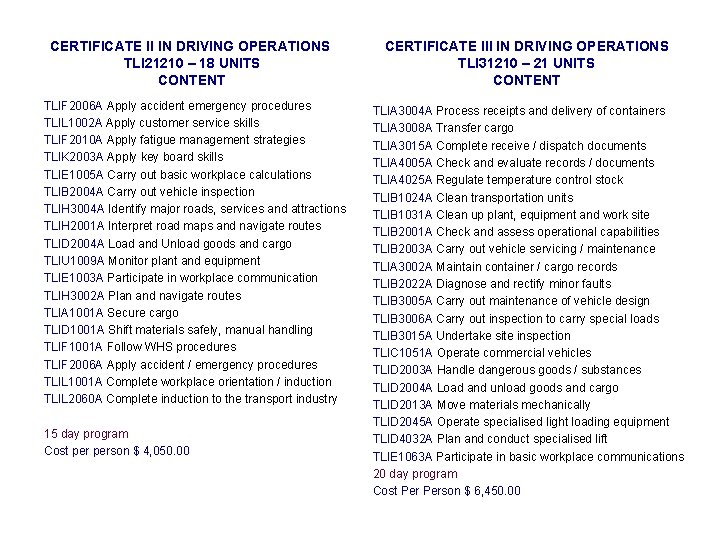
CERTIFICATE II IN DRIVING OPERATIONS TLI 21210 – 18 UNITS CONTENT TLIF 2006 A Apply accident emergency procedures TLIL 1002 A Apply customer service skills TLIF 2010 A Apply fatigue management strategies TLIK 2003 A Apply key board skills TLIE 1005 A Carry out basic workplace calculations TLIB 2004 A Carry out vehicle inspection TLIH 3004 A Identify major roads, services and attractions TLIH 2001 A Interpret road maps and navigate routes TLID 2004 A Load and Unload goods and cargo TLIU 1009 A Monitor plant and equipment TLIE 1003 A Participate in workplace communication TLIH 3002 A Plan and navigate routes TLIA 1001 A Secure cargo TLID 1001 A Shift materials safely, manual handling TLIF 1001 A Follow WHS procedures TLIF 2006 A Apply accident / emergency procedures TLIL 1001 A Complete workplace orientation / induction TLIL 2060 A Complete induction to the transport industry 15 day program Cost person $ 4, 050. 00 CERTIFICATE III IN DRIVING OPERATIONS TLI 31210 – 21 UNITS CONTENT TLIA 3004 A Process receipts and delivery of containers TLIA 3008 A Transfer cargo TLIA 3015 A Complete receive / dispatch documents TLIA 4005 A Check and evaluate records / documents TLIA 4025 A Regulate temperature control stock TLIB 1024 A Clean transportation units TLIB 1031 A Clean up plant, equipment and work site TLIB 2001 A Check and assess operational capabilities TLIB 2003 A Carry out vehicle servicing / maintenance TLIA 3002 A Maintain container / cargo records TLIB 2022 A Diagnose and rectify minor faults TLIB 3005 A Carry out maintenance of vehicle design TLIB 3006 A Carry out inspection to carry special loads TLIB 3015 A Undertake site inspection TLIC 1051 A Operate commercial vehicles TLID 2003 A Handle dangerous goods / substances TLID 2004 A Load and unload goods and cargo TLID 2013 A Move materials mechanically TLID 2045 A Operate specialised light loading equipment TLID 4032 A Plan and conduct specialised lift TLIE 1063 A Participate in basic workplace communications 20 day program Cost Person $ 6, 450. 00
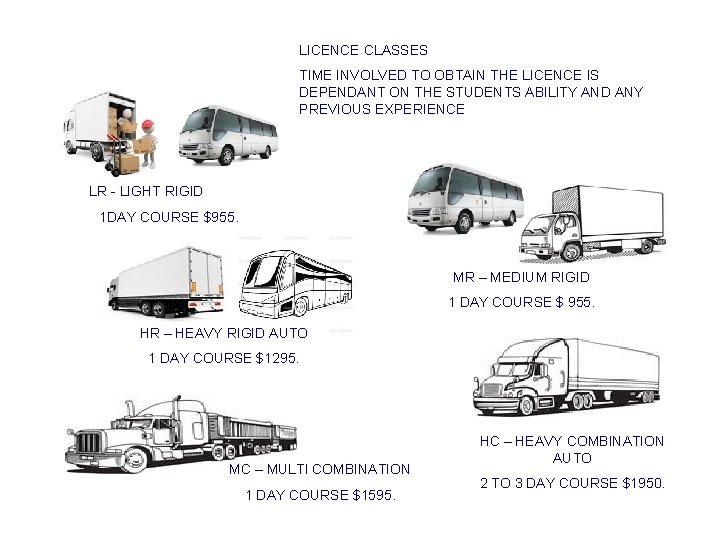
LICENCE CLASSES TIME INVOLVED TO OBTAIN THE LICENCE IS DEPENDANT ON THE STUDENTS ABILITY AND ANY PREVIOUS EXPERIENCE LR - LIGHT RIGID 1 DAY COURSE $955. MR – MEDIUM RIGID 1 DAY COURSE $ 955. HR – HEAVY RIGID AUTO 1 DAY COURSE $1295. MC – MULTI COMBINATION 1 DAY COURSE $1595. HC – HEAVY COMBINATION AUTO 2 TO 3 DAY COURSE $1950.
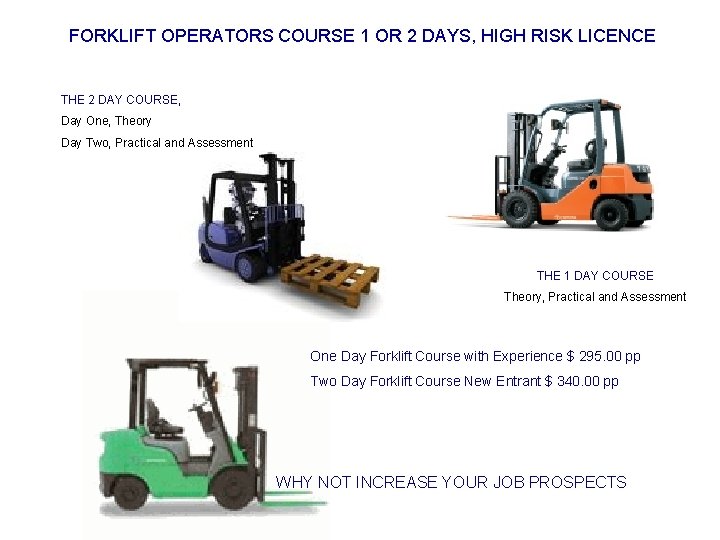
FORKLIFT OPERATORS COURSE 1 OR 2 DAYS, HIGH RISK LICENCE THE 2 DAY COURSE, Day One, Theory Day Two, Practical and Assessment THE 1 DAY COURSE Theory, Practical and Assessment One Day Forklift Course with Experience $ 295. 00 pp Two Day Forklift Course New Entrant $ 340. 00 pp WHY NOT INCREASE YOUR JOB PROSPECTS
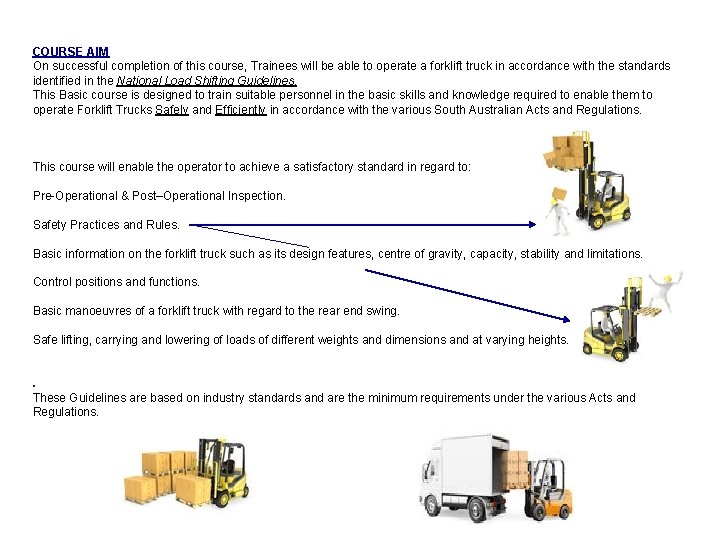
COURSE AIM On successful completion of this course, Trainees will be able to operate a forklift truck in accordance with the standards identified in the National Load Shifting Guidelines. This Basic course is designed to train suitable personnel in the basic skills and knowledge required to enable them to operate Forklift Trucks Safely and Efficiently in accordance with the various South Australian Acts and Regulations. This course will enable the operator to achieve a satisfactory standard in regard to: Pre-Operational & Post–Operational Inspection. Safety Practices and Rules. Basic information on the forklift truck such as its design features, centre of gravity, capacity, stability and limitations. Control positions and functions. Basic manoeuvres of a forklift truck with regard to the rear end swing. Safe lifting, carrying and lowering of loads of different weights and dimensions and at varying heights. . These Guidelines are based on industry standards and are the minimum requirements under the various Acts and Regulations.
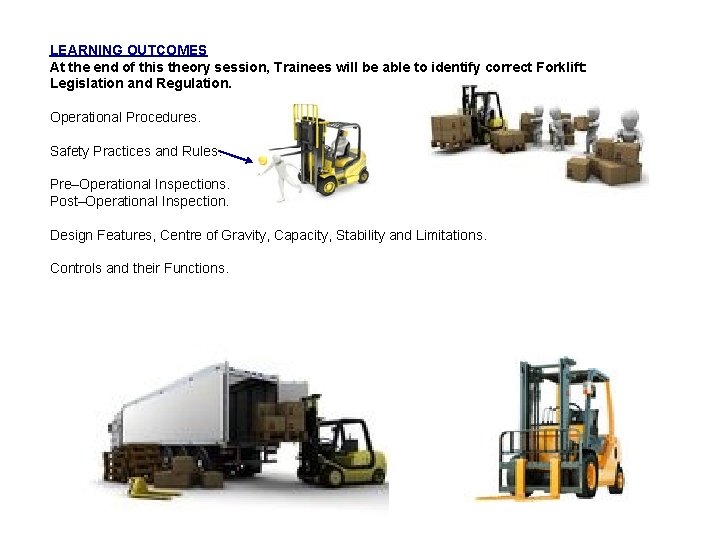
LEARNING OUTCOMES At the end of this theory session, Trainees will be able to identify correct Forklift: Legislation and Regulation. Operational Procedures. Safety Practices and Rules. Pre–Operational Inspections. Post–Operational Inspection. Design Features, Centre of Gravity, Capacity, Stability and Limitations. Controls and their Functions.
NATIONALLY ACCREDITED INSTRUCTOR COURSES MDI – MOTOR DRIVING INSTRUCTORS QUALIFICATION – CLASS CAR COURSE IS CONDUCTED OVER 25 DAYS NATIONAL COURSE CODE TLI 41210 HVDI – HEAVY VEHICLE DRIVING INSTRUCTORS QUALIFICATION COURSE IS CONDUCTED OVER 25 DAYS NATIONAL COURSE CODE TLI 41310 Able to link to a Driving School or start Your own Driving School ( BUSINESS ) Direct links to a Commercial Driving Schools New Car Driving Instructors build their Business very quickly, due to the demands from High Schools, UNI, TAFE and Migrants. People need Licences. Exists a shortage in South Australia for Commercial Driving Instructors, Combined Industry is Seeking 15 Instructors Cost Person $ 8, 940 Cost Person $ 8, 500. 00
MOTOR DRIVING INSTRUCTORS QUALIFICATION (CLASS CAR) TLI 41210 Packaging Rules Requirements for completion of the qualification: Fulfil requirements of current existing relevant transport and logistics safety regulations prior to issuance of a Car Driving Instructor Licence A successful assessment outcome for a total 11 core units, comprising: Field Unit C - Vehicle Operation - TLIC 3036 A - Apply safe car driving behaviours E - Communication and Calculation - BSBRKG 304 B - Maintain business records F - Safety Management - TLIF 1001 A -Follow Worker Health and Safety procedures G – Teamwork - TLIG 2007 A - Work in a socially diverse environment I - Customer Service - BSBCUS 301 A - Deliver and monitor a service to customers L - Resource Management - TLIL 1001 A - Complete workplace orientation/induction procedures TLIL 2008 A - Complete routine administrative tasks M - Training and Assessment - TAEDEL 402 A - Plan, organise and facilitate learning in the workplace TAEDEL 301 A - Provide work skill instruction TAEDES 401 A - Design and develop learning programs TLIM 4001 A - Develop safe car driving behaviours in others Units are discrete from each other; however units may be clustered and delivered and/or assessed concurrently and/or holistically.
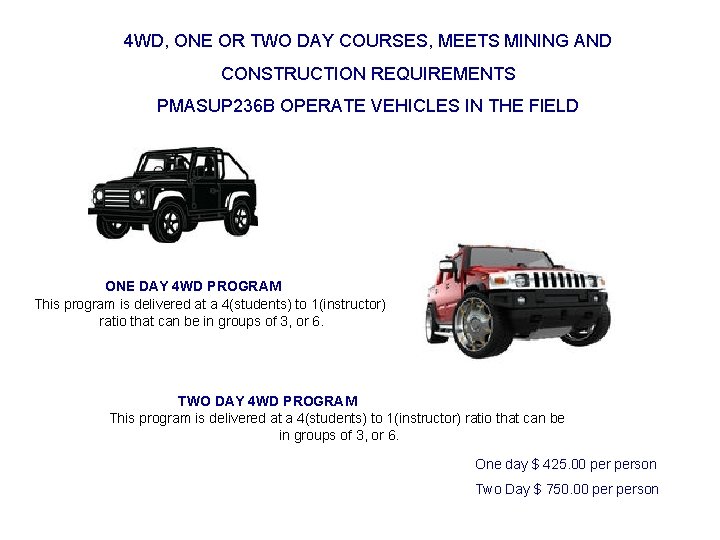
4 WD, ONE OR TWO DAY COURSES, MEETS MINING AND CONSTRUCTION REQUIREMENTS PMASUP 236 B OPERATE VEHICLES IN THE FIELD ONE DAY 4 WD PROGRAM This program is delivered at a 4(students) to 1(instructor) ratio that can be in groups of 3, or 6. TWO DAY 4 WD PROGRAM This program is delivered at a 4(students) to 1(instructor) ratio that can be in groups of 3, or 6. One day $ 425. 00 person Two Day $ 750. 00 person
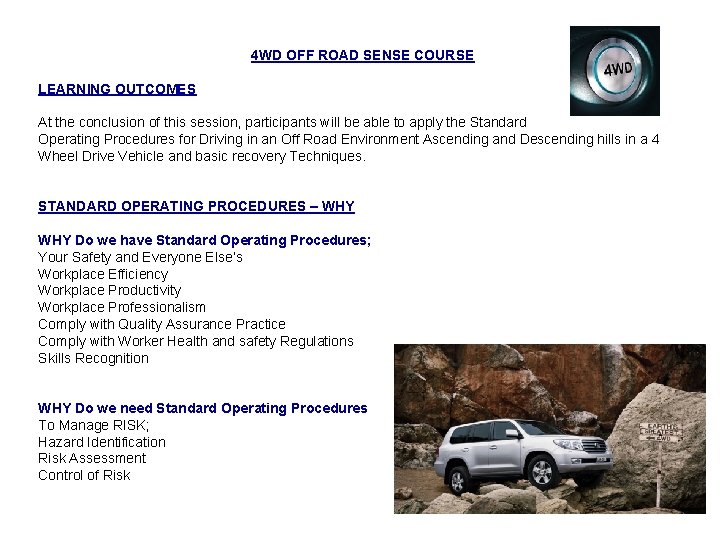
4 WD OFF ROAD SENSE COURSE LEARNING OUTCOMES At the conclusion of this session, participants will be able to apply the Standard Operating Procedures for Driving in an Off Road Environment Ascending and Descending hills in a 4 Wheel Drive Vehicle and basic recovery Techniques. STANDARD OPERATING PROCEDURES – WHY Do we have Standard Operating Procedures; Your Safety and Everyone Else’s Workplace Efficiency Workplace Productivity Workplace Professionalism Comply with Quality Assurance Practice Comply with Worker Health and safety Regulations Skills Recognition WHY Do we need Standard Operating Procedures To Manage RISK; Hazard Identification Risk Assessment Control of Risk
ONE DAY DRIVER AWARENESS PROGRAM TLIC 3036 A Apply Safe Car Driving Behaviours The one day driver awareness course suits any person of any age who holds a vehicle licence. From individuals to groups, corporate and fleet operators and drivers. Some insurance companies are recognising the driver awareness program and offer special incentives to those who have attended the program. P Platers are also looked at more favourably for first time insurance if they have attended this program. ONE DAY DRIVER AWARENESS PROGRAM This program is delivered at a 3(students) to 1(instructor) ratio that can be in groups of 3, 6, or 9. Vehicles are supplied along with a comprehensive course manual. We are able to make use of company vehicles to ensure that the trainee is comfortable with vehicles that they are familiar with CERTIFICATION All participants of the course will receive a certificate at completion. Cost: $495. 00 person, Lunch is not included
DRIVER AWARENESS COURSES AIM OF COURSE The aim of this course is to improve drivers’ skills and knowledge of vehicles that they drive, and the daily conditions they drive with. Understanding these conditions will improve safety and reduces cost. LEARNING OUTCOMES OF THE COURSE To give the trainee a sound understanding of the importance of reading the road and traffic conditions they are driving in, and include refreshing the trainee’s knowledge of road law and the correct use of the vehicle they are driving. ATTITUDE Safe and Responsible Driving requires a driver to drive to a system of vehicle control, which is outlined in the course program. Every driver needs to accept a personal Duty of Care. Not to put your self, passengers or other road users at risk. SKILLS Throughout the course the trainee will be assessed on their current ability and their developing skill levels. A copy of the drive assessment will be given out with your certificate. SAFETY Our Instructor maintains control of the trainee’s driving actions, vehicle movements and directions throughout the course. The trainee will be required to drive by the guidance of the Instructor to complete the course in a safe manner.
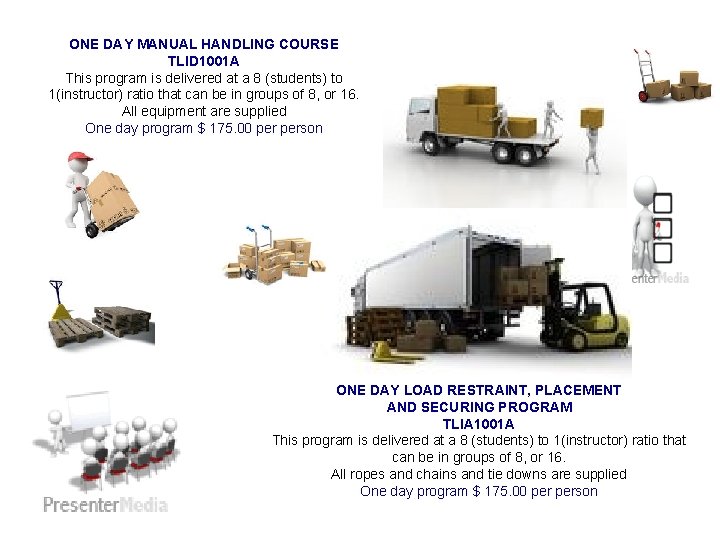
ONE DAY MANUAL HANDLING COURSE TLID 1001 A This program is delivered at a 8 (students) to 1(instructor) ratio that can be in groups of 8, or 16. All equipment are supplied One day program $ 175. 00 person ONE DAY LOAD RESTRAINT, PLACEMENT AND SECURING PROGRAM TLIA 1001 A This program is delivered at a 8 (students) to 1(instructor) ratio that can be in groups of 8, or 16. All ropes and chains and tie downs are supplied One day program $ 175. 00 person
Nationally Recognised Unit Code & Title: TLID 1001 A Shift Materials Safely Using Manual Handling Methods This course applies to employees in the transport and logistics industry, but is also applicable to any workplace where manual handling methods are employed to relocate goods or materials. It is relevant for people working in manufacturing, transport, warehousing, wholesale or retail, that is concerned with application of the basic principles for the safe lifting and movement of loads when shifting materials using manual handling methods as part of the day-to-day work. One Day classroom training and assessment This course covers the skills and knowledge required to shift loads using manual handling methods, including assessing the risks associated with relocating the load, planning the relocation process and carrying out the relocation in accordance with the plan, Which includes: • Understanding manual handling risks and hazards in the workplace • Correct manual handling techniques • Correct use of equipment including PPE • Planning load relocation • WHS requirements and workplace procedures for safe manual handling • Use of team lifting for load relocation • Checking relocated items and reporting variances There are no prerequisite units for this course, though participants should have numeracy and literacy skills equivalent to level 2 of the National Reporting System. Progressive assessment throughout the course, including demonstration of practical skills and written and oral questions relating to underpinning knowledge.
NATIONALLY RECOGNISED UNIT CODE & TITLE: TLIA 1001 A LOAD RESTRAINT, PLACEMENT AND SECURING CARGO Unit Description This training covers the performance outcomes, skills and knowledge required to secure cargo including preparing to secure cargo/containers, lashing and unlashing cargo, protecting cargo from weather, and packing and unpacking cargo. Learning Outcomes By the end of this training course, participants will prepare to secure cargo/containers, Work area is prepared and maintained in accordance with the national standards, safety codes and site operating procedures - Unsafe work practices and/or equipment are reported to appropriate personnel Appropriate protective clothing, equipment and fittings are selected Formwork is erected where no lashing points exist Lashing plan is read and interpreted. Lash and unlash cargo, Work is conducted in accordance with industry standards, statutory requirements, safety codes, site operating requirements and any special requirements of the cargo - Lashing points are identified and appropriate fittings and lashing equipment are used for each lashing point Cargo is lashed / secured to lashing points no spread of lashings Tensioners are securely fastened When unlashing, fittings are released, disconnected and removed from the cargo Lashing equipment is placed in designated storage areas or cleared from work area Lashing/unlashing operations ensure no injury to personnel or damage to machinery or cargo Lashing is completed in accordance with lashing plan, Protect cargo from weather, Cargo is covered / uncovered safely Work is conducted in accordance with the requirements of national standards, safety codes and site operating procedures. Damaged cargo is identified and reported following enterprise procedures - Cargo is sorted and stacked prior to packing or after unpacking, ensuring the stack is in the correct location, in accordance with national standards, safety codes, and site operating procedures - Cargo is identified through the interpretation of marks or numbers - Tight stow of cargo is maintained - Cargo is handled ensuring no injury to personnel or damage to cargo or equipment
TLIF 2010 A APPLY FATIGUE MANAGEMENT STRATEGIES Fatigue is a problem on our roads. Just over 25% of heavy vehicle driver’s drive fatigued at least once every 4 trips. And it is caused by work pressure and lack of proper rest and puts a lot of people at risk. It’s time for a wake up call. From the 29 th of September 2008, new national heavy Vehicle Driver Fatigue Laws have come into effect. If you drive a heavy vehicle with a gross vehicle mass over 12 tonnes or a bus with more than 12 seats including the driver, then these laws apply to you. They set new work and rest limits for heavy vehicle drivers and require better management of driver fatigue. They apply to everyone in the supply chain – not just drivers – and are consistent with current Worker Health, Safety ( WHS ) Laws. The Aim of the new Laws is to minimise the risk of driver Fatigue and make the roads Safer for everyone. It is up to you to do your part and make sure people you work with do theirs, as the responsibilities now lies with everyone. WHAT ARE THE KEY ELEMENTS OF THE NEW LAWS? Accreditation schemes to provide reward for effort. A general duty of care ( Consistent with WHS Laws ). Guidelines for managing Heavy Vehicle Driver Fatigue. Chain of responsibility provisions. Fair Penalties. Strengthened record keeping ( Work Diary ). New enforcement powers. WHAT ARE THE MAJOR CHANGES? The new Laws are about working Safer, not less. They’re also about realising there is no distinction between work and driving – its all work. Operators and drivers who “ do the right thing” by properly managing Fatigue will have a greater say in when they can work and rest. This means productivity levels can be maintained simply by planning trips and rest breaks, checking records and training staff to understand the causes of Driver fatigue. WHAT ARE THE OPTIONS? There are three maximum work and minimum rest options. The Standard Hours option will suit most Businesses and there are limits for work and rest. If you need more flexible hours, you can apply for Basic Fatigue Management ( BFM ) or Advanced Fatigue Management ( AFM ) Accreditation.
TLIF 2010 A APPLY FATIGUE MANAGEMENT STRATEGIES Continued WHO IS RESPONSIBLE? The new Laws require all parties in the supply chain to take reasonable steps to manage Driver Fatigue. The parties include; Driver Employer of a Driver Prime Contractors of a Driver Operators of a vehicle Schedulers of Drivers ( and goods or passengers ) Consignors and consignees Loading managers Loaders and Unloaders Consider that if your actions, inactions or demands cause or contribute to Road Safety Breaches, then you can be held Legally Accountable. TAKING REASONABLE STEPS When it comes to Fatigue, taking reasonable steps is more than just allowing enough time to get from A to B; its about communicating with everyone in the supply chain and finding out what’s involved with each job. Reasonable steps will vary according to each individuals circumstances and you may need to change the way you do your daily Business. BUSINESS PRACTICES You should regularly review your business practices to make sure the steps you are taking are reasonable at all times. These steps should include; Ensuring your work practices do not contribute to or cause on – road breaches. Training staff to make sure they understand their obligations under the chain of responsibility. Audits / spot – checks to make sure of compliance ( for example, Monitoring of loading and unloading ). Reviewing of contracts and commercial arrangements to make sure they do not encourage breaches of fatigue laws. Have documented contingency plans to manage operational issues ( Like driver sickness or traffic delays ) Within the Law. FATIGUE RISK MANAGEMENT SYSTEMS Ensuring your business is taking reasonable steps to prevent Driver Fatigue requires you to identify, assess, control and review situations that put drivers safety at risk, these include; Risk Identification – What could happen Risk Assessment – What is the likelihood of it happening? Risk Control – What can we do about it? Monitor and Review – What systems are in place. ;
TLIF 2010 A APPLY FATIGUE MANAGEMENT STRATEGIES Continued THE WORK DIARY When do I have to record in a work diary You must use a work diary if you will drive outside a radius of 100 + km from your base (100+ km work) under Standard Hours. You must always use a work diary if you work under BFM (14 hours), AFM (16 hours) or Exemption Hours (regardless of whether or not you are driving outside a radius of 100 + km from your base). You are not required by law to obtain or record in a work diary if; you always do local work (driving only within a 100 km radius of your base). under Standard Hours. If you occasionally do 100+ km work you should obtain a work diary and record all the required details on any day in which you do the 100+ km work. Only ever record information in a single written work diary at any one time. You must record all details for each day on which you do 100+ km work, beginning from the time you first start work, including any local work you do on that day. If you leave on a trip that will take you outside a radius of 100 + km from your base, you must record all work and rest time from the start of the trip. EXAMPLE OF WHEN A WORK DIARY IS REQUIRED Steve starts work one day at 4 am doing deliveries around town. All Steve’s trips are within a 100 km radius of Steve’s base. However, at 10 am Steve is scheduled to do a 100+ km trip – in other words, a trip that will take him outside a 100 km radius from his base. Because Steve is doing 100+ km work that day, he has to make sure he records all work and rest hours he has that day, including the local work, beginning from midnight. What is a fatigue-regulated heavy vehicle? A fatigue-regulated heavy vehicle is a vehicle with a gross vehicle mass (GVM) of more than 12 tonnes. This includes a vehicle combination of a total GVM of more than 12 tonnes, and a bus of more than 4. 5 tonnes that seats more than 12 adults, including the driver. A vehicle built or modified to operate as machinery or equipment off-road and which is not capable of carrying goods or passenger by road, is not a fatigue-regulated heavy vehicle. A motor-home is not a fatigue-regulated heavy vehicle. One Day classroom training and assessment
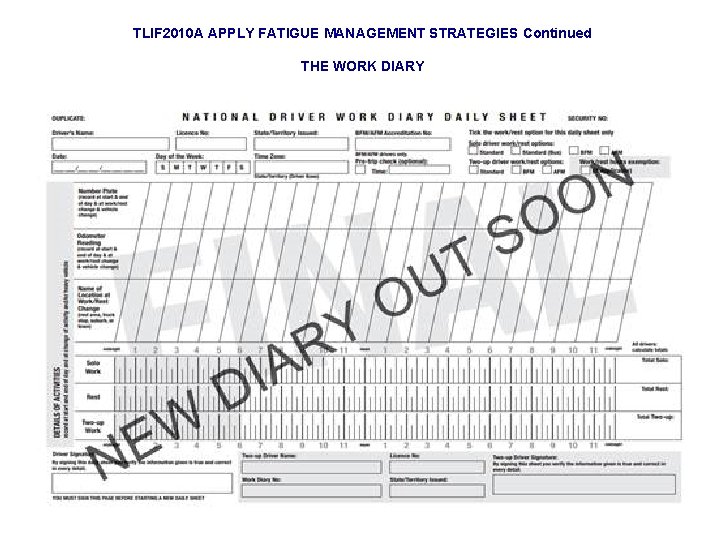
TLIF 2010 A APPLY FATIGUE MANAGEMENT STRATEGIES Continued THE WORK DIARY
- Slides: 20