
Giving feedback in language learning Error correction Methods
Giving feedback in language learning. Error correction Methods of English Language Teaching III/5 English majors Ferenc Rákóczi II Transcarpathian Hungarian College of Higher Education Tutor: Ilona Huszti, Ph. D
What is ‘feedback’? Feedback is information that is given to the learner about his / her performance of a learning task, usually with the objective of improving this performance. • ‘Yes, right. ’ • A grade of 80% on an exam • A raised eyebrow in response to a mistake in grammar • Comments written in the margin of an essay
Two main distinguishable components: ASSESSMENT & CORRECTION • In Assessment, the student is informed how well or badly he or she has performed, e. g. a percentage grade on an exam; a mark at the end of a written assignment, etc. • In Correction, the teacher provides specific information on aspects of the student’s performance, e. g. through explanation or provision of better or other alternatives, or through elicitation of these from the student. • In principle, Correction can and should include information on what the learner did right, as well as wrong, and why.
TASK 1 • Analyse your MELT mini-tests. What can you see? How would you characterize the feedback on them? QUESTION • Can you have Assessment and Correction completely separable from each other?

Feedback can be given by both the teacher and the learners. It can be oral or written. ‘I, as a teacher, feel I ought to correct everything in my students’ performance. ’ (Penny Ur, 2008, plenary talk at 42 nd TESOL Convention in New York)
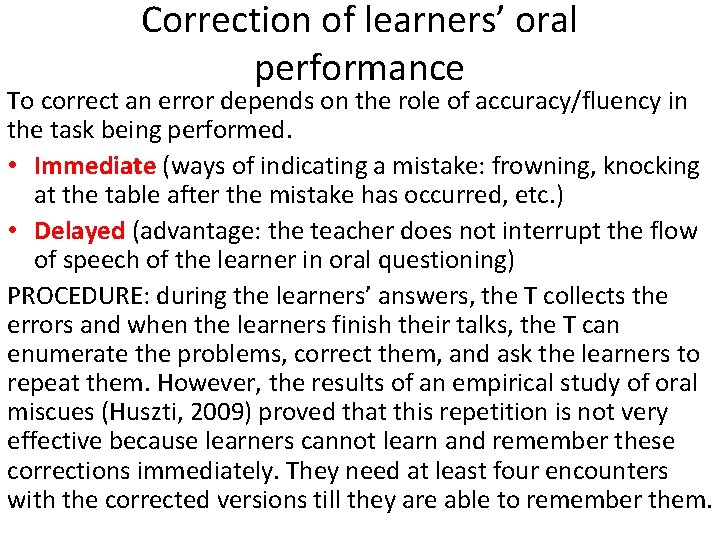
Correction of learners’ oral performance To correct an error depends on the role of accuracy/fluency in the task being performed. • Immediate (ways of indicating a mistake: frowning, knocking at the table after the mistake has occurred, etc. ) • Delayed (advantage: the teacher does not interrupt the flow of speech of the learner in oral questioning) PROCEDURE: during the learners’ answers, the T collects the errors and when the learners finish their talks, the T can enumerate the problems, correct them, and ask the learners to repeat them. However, the results of an empirical study of oral miscues (Huszti, 2009) proved that this repetition is not very effective because learners cannot learn and remember these corrections immediately. They need at least four encounters with the corrected versions till they are able to remember them.
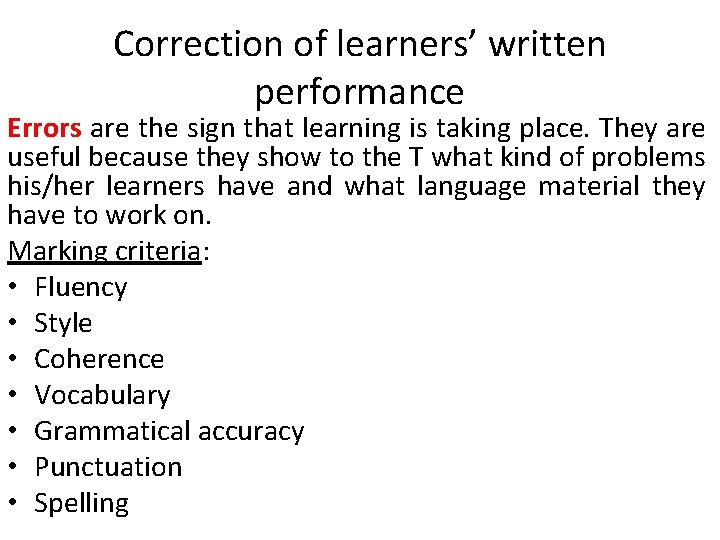
Correction of learners’ written performance Errors are the sign that learning is taking place. They are useful because they show to the T what kind of problems his/her learners have and what language material they have to work on. Marking criteria: • Fluency • Style • Coherence • Vocabulary • Grammatical accuracy • Punctuation • Spelling
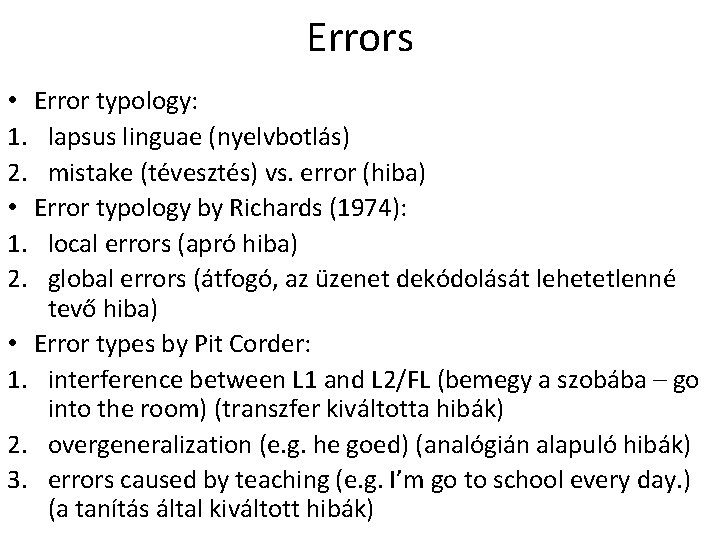
Errors • Error typology: 1. lapsus linguae (nyelvbotlás) 2. mistake (tévesztés) vs. error (hiba) • Error typology by Richards (1974): 1. local errors (apró hiba) 2. global errors (átfogó, az üzenet dekódolását lehetetlenné tevő hiba) • Error types by Pit Corder: 1. interference between L 1 and L 2/FL (bemegy a szobába – go into the room) (transzfer kiváltotta hibák) 2. overgeneralization (e. g. he goed) (analógián alapuló hibák) 3. errors caused by teaching (e. g. I’m go to school every day. ) (a tanítás által kiváltott hibák)

Using common correction symbols when correcting learners’ written performance Symbol and meaning p. punctuation pl. plural s. Subject word missing unnecessary word v. Verb capitalization w. f. wrong word form prep. Preposition v. t. verb tense w. w. wrong word conj. Conjunction agr. Subject-verb agreement wrong word order Article make one word or sentence RO run-on E. g. Lily was fired she is upset. FRAG (fragment – incomplete sentence) E. g. She was fired. Because she was always late. sp. Spelling T add a transition She was also careless. She frequently spilt coffee on the table. ¶ symbol for a fresh paragraph
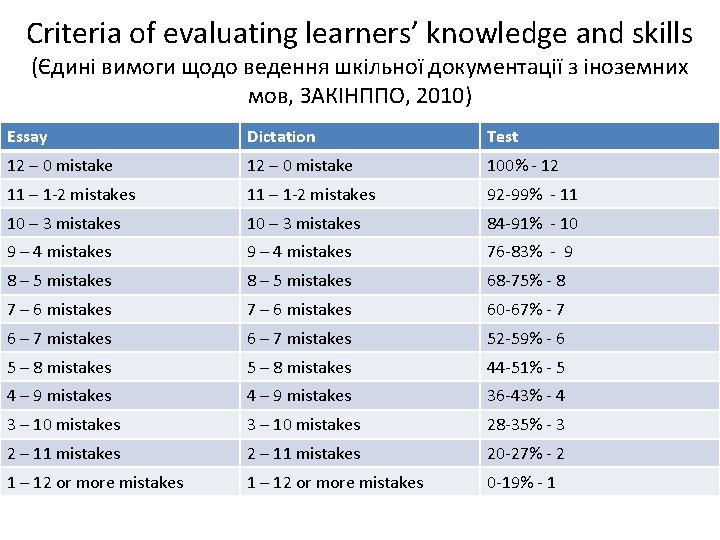
Criteria of evaluating learners’ knowledge and skills (Єдині вимоги щодо ведення шкільної документації з іноземних мов, ЗАКІНППО, 2010) Essay Dictation Test 12 – 0 mistake 100% - 12 11 – 1 -2 mistakes 92 -99% - 11 10 – 3 mistakes 84 -91% - 10 9 – 4 mistakes 76 -83% - 9 8 – 5 mistakes 68 -75% - 8 7 – 6 mistakes 60 -67% - 7 6 – 7 mistakes 52 -59% - 6 5 – 8 mistakes 44 -51% - 5 4 – 9 mistakes 36 -43% - 4 3 – 10 mistakes 28 -35% - 3 2 – 11 mistakes 20 -27% - 2 1 – 12 or more mistakes 0 -19% - 1
- Slides: 10