
Giving Feedback 1 DR A M KADRI PROFESSOR
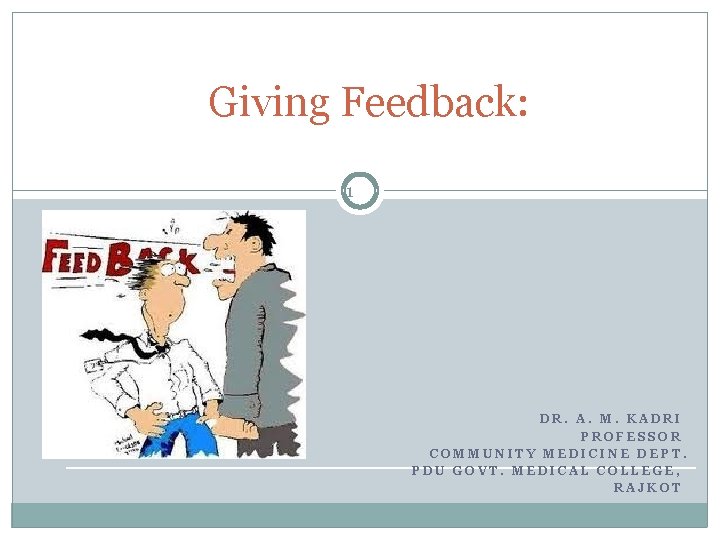
Giving Feedback: 1 DR. A. M. KADRI PROFESSOR COMMUNITY MEDICINE DEPT. PDU GOVT. MEDICAL COLLEGE, RAJKOT
Objectives 2 Describe rationale for giving feedback in medical education Identify types of feedback Describe principles and strategies for giving constructive feedback Define characteristics of effective feedback Observe and practice giving feedback Discuss common problems in giving effective feedback To review the distinction between “feedback” and “evaluation”
Questions for Discussion 3 Why we should give Feedback? What is feedback? What is the role of feedback in teaching and evaluation? Why do we avoid giving feedback? What characterizes effective feedback? What problems do we commonly encounter? How can we improve feedback in our training programs?
4 Why we should give feedback?
Rationale for Giving Feedback 5 Without feedback, Good performance is not reinforced, Mistakes go uncorrected, Competence is achieved empirically or, not at all. Ende J. Feedback in Clinical Medical Education. JAMA 1983; 250: 777 -781.
More Rationale 6 High stakes outcomes It is our responsibility It will help learners improve their performance Can enhance the learner teacher relationships
Definition 8 What is Feedback?
Feedback 9 Communication to another person which gives information about how he/she affects and is perceived by others. A way of helping another person consider changing his/her behavior.
Feedback 10 Communication to another person which gives information about how he/she affects and is perceived by others. A way of helping another person consider changing his/her behavior.
Feedback 11 Provides information Based on observations Descriptive Immediate “Formative” Faculty Development Office Faculty of Medicine © 2001
Reinforcement/ Minimal 12 Feedback Statement expressing positive (or negative) reaction to a behavior which aims to increase (or decrease) the likelihood of that behavior happening again “That was a great presentation” “You need to work on your presentation skills”
Evaluation 13 Qualitative judgment which ranks a learner’s performance in comparison to other learners Often the only measure of performance visible to the learner Usually given after the performance is over
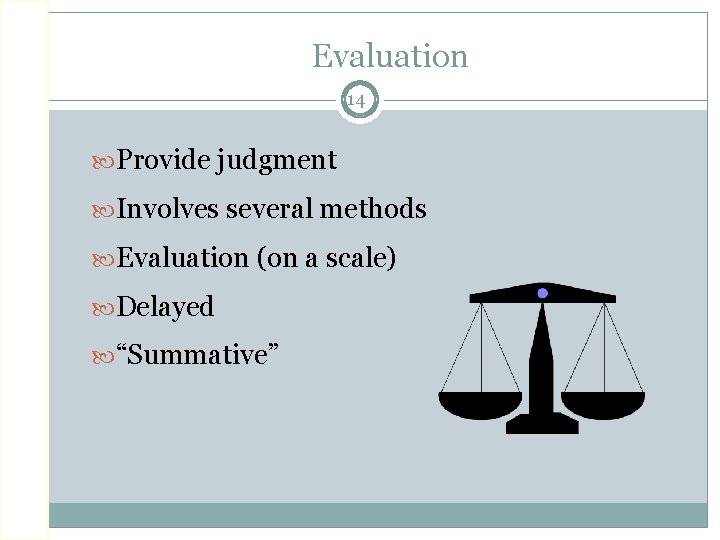
Evaluation 14 Provide judgment Involves several methods Evaluation (on a scale) Delayed “Summative”
Feedback 15 (Reinforcement or correction) + Explanation Keeps recipient on course to meet goals Allows recipient to adjust your course to meet goals Given immediately after the performance or at some time soon after, when the learner still has time to demonstrate improvement

16 BARRIERS
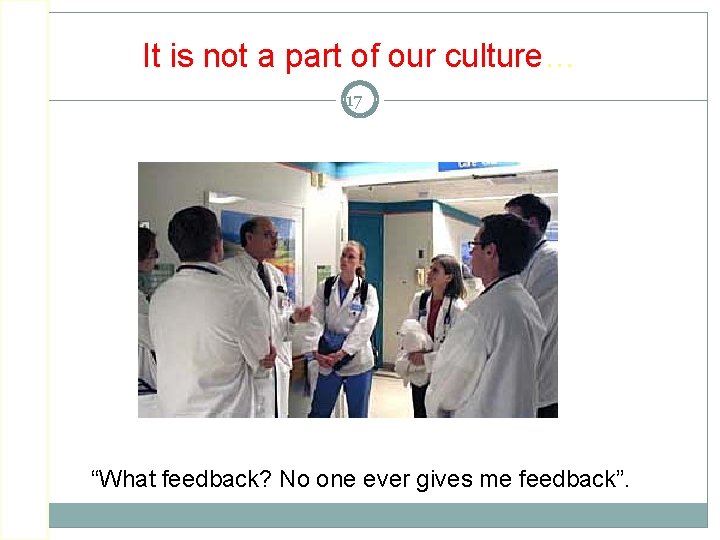
It is not a part of our culture… 17 “What feedback? No one ever gives me feedback”.
Why is Feedback often Avoided/Neglected? 18
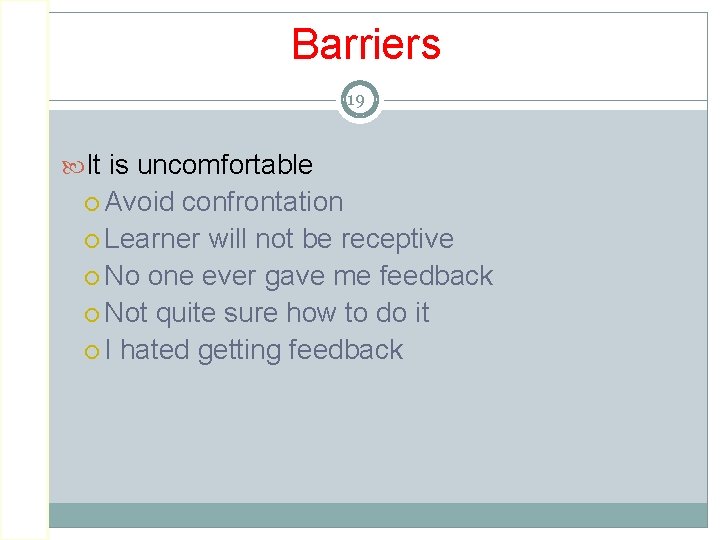
Barriers 19 It is uncomfortable Avoid confrontation Learner will not be receptive No one ever gave me feedback Not quite sure how to do it I hated getting feedback
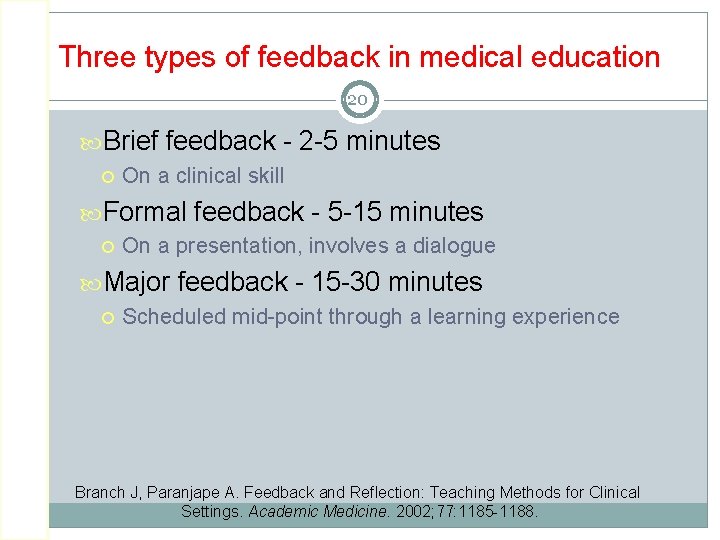
Three types of feedback in medical education 20 Brief feedback - 2 -5 minutes On a clinical skill Formal feedback - 5 -15 minutes On a presentation, involves a dialogue Major feedback - 15 -30 minutes Scheduled mid-point through a learning experience Branch J, Paranjape A. Feedback and Reflection: Teaching Methods for Clinical Settings. Academic Medicine. 2002; 77: 1185 -1188.
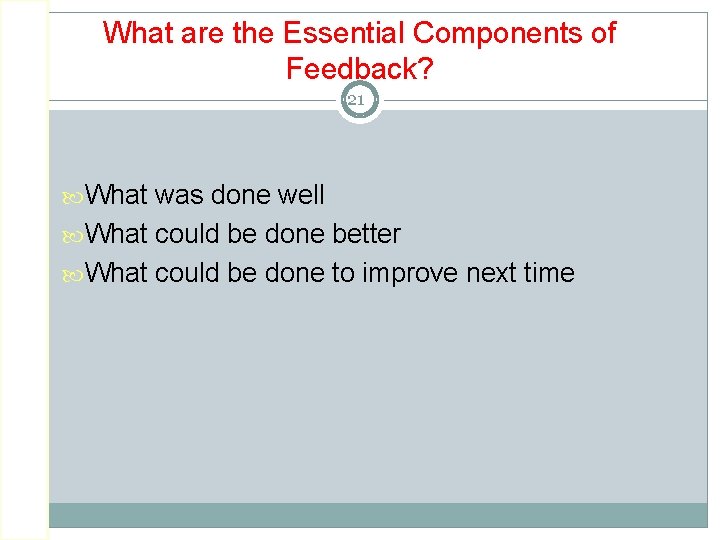
What are the Essential Components of Feedback? 21 What was done well What could be done better What could be done to improve next time
What Makes Effective Feedback? 22
Elements of Constructive Feedback 23 Make sure that your feedback is: Timely and expected Based on observations Based on changeable behaviors Related to learning goals Limited in quantity
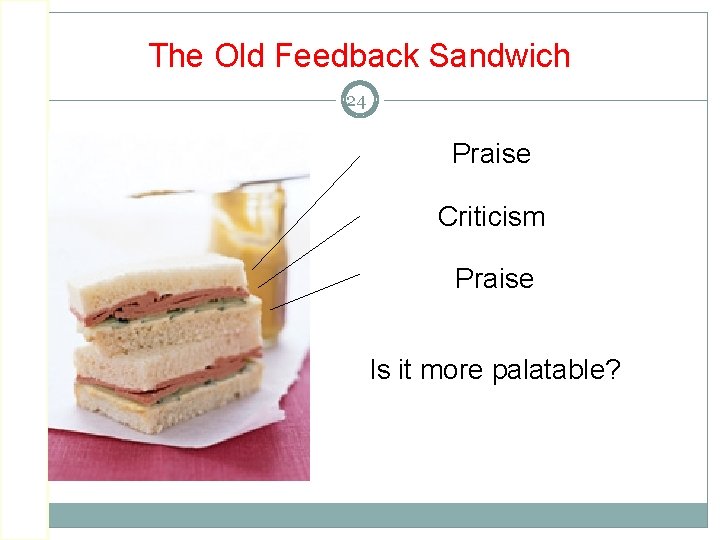
The Old Feedback Sandwich 24 Praise Criticism Praise Is it more palatable?
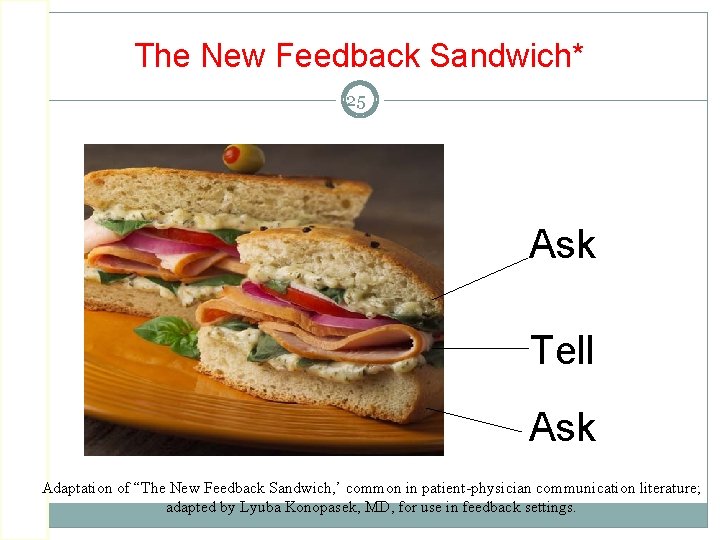
The New Feedback Sandwich* 25 Ask Tell Ask Adaptation of “The New Feedback Sandwich, ’ common in patient-physician communication literature; adapted by Lyuba Konopasek, MD, for use in feedback settings.
In Closing 26 Keep personal needs and feelings out Monitor your reactions Do not overload Time your feedback appropriately Teach self-critique
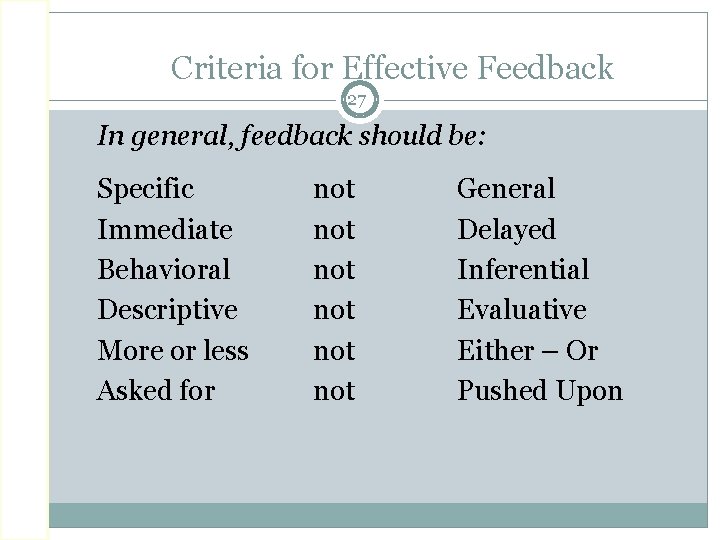
Criteria for Effective Feedback 27 In general, feedback should be: Specific Immediate Behavioral Descriptive More or less Asked for not not not General Delayed Inferential Evaluative Either – Or Pushed Upon
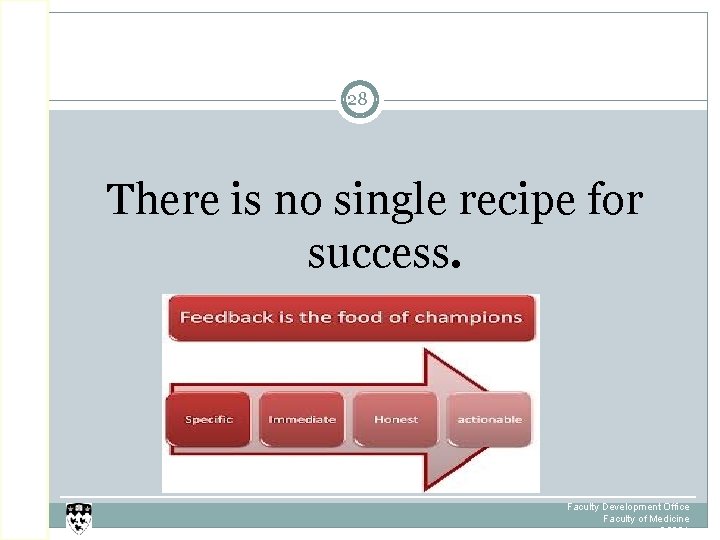
28 There is no single recipe for success. Faculty Development Office Faculty of Medicine © 2001
29 Feedback should be given in a way that the receiver can hear it, understand it, and choose to use or not use it.
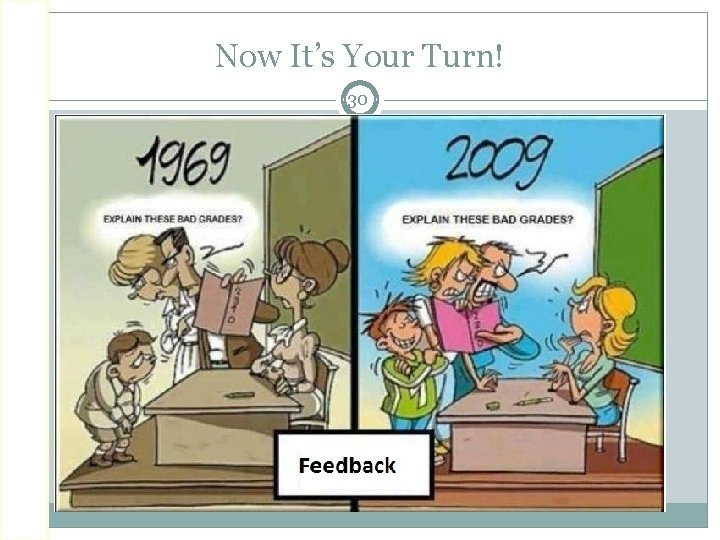
Now It’s Your Turn! 30
- Slides: 29