
Giving Effective Academic Presentation s What are the



- Slides: 46
Giving Effective Academic Presentation s
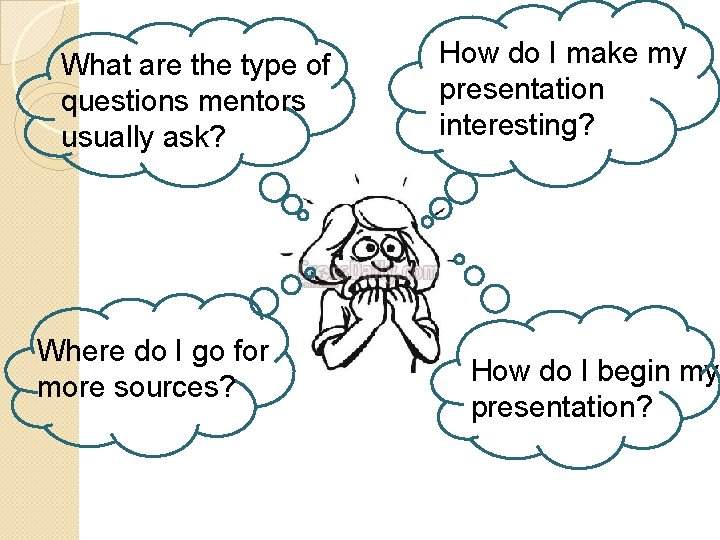
What are the type of questions mentors usually ask? Where do I go for more sources? How do I make my presentation interesting? How do I begin my presentation?
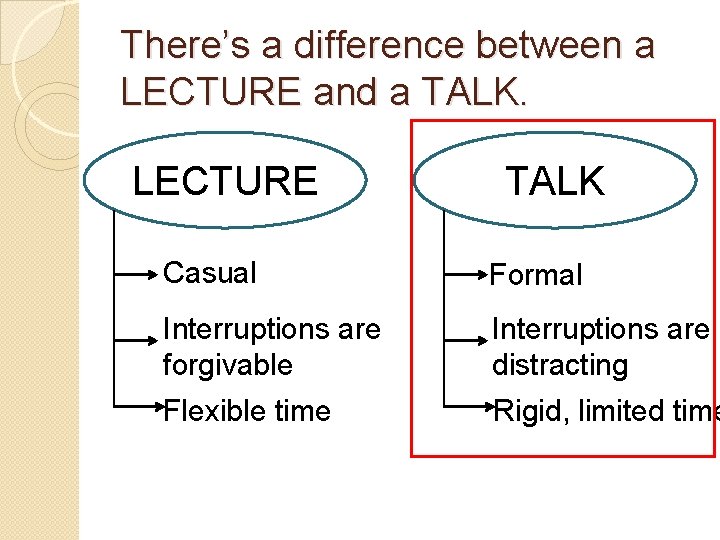
There’s a difference between a LECTURE and a TALK. LECTURE TALK Casual Formal Interruptions are forgivable Interruptions are distracting Flexible time Rigid, limited time
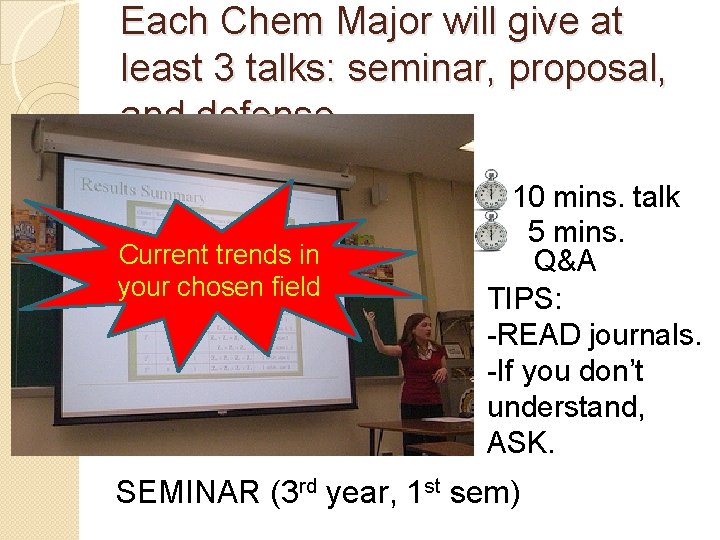
Each Chem Major will give at least 3 talks: seminar, proposal, and defense. Current trends in your chosen field 10 mins. talk 5 mins. Q&A TIPS: -READ journals. -If you don’t understand, ASK. SEMINAR (3 rd year, 1 st sem)
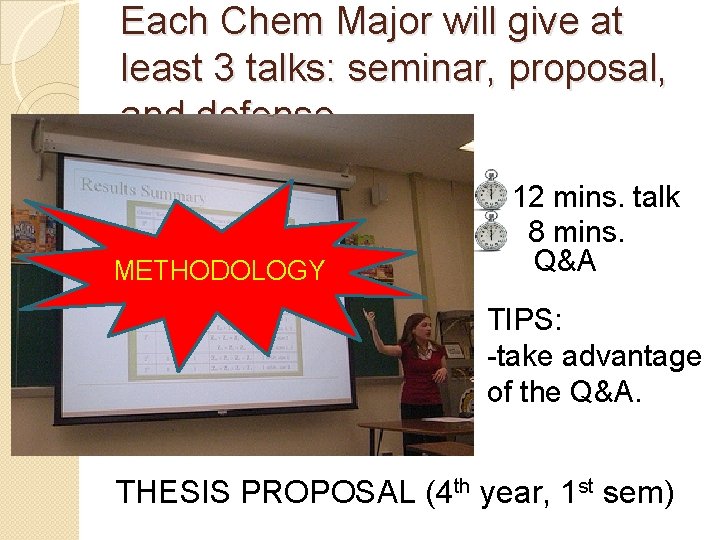
Each Chem Major will give at least 3 talks: seminar, proposal, and defense. METHODOLOGY 12 mins. talk 8 mins. Q&A TIPS: -take advantage of the Q&A. THESIS PROPOSAL (4 th year, 1 st sem)
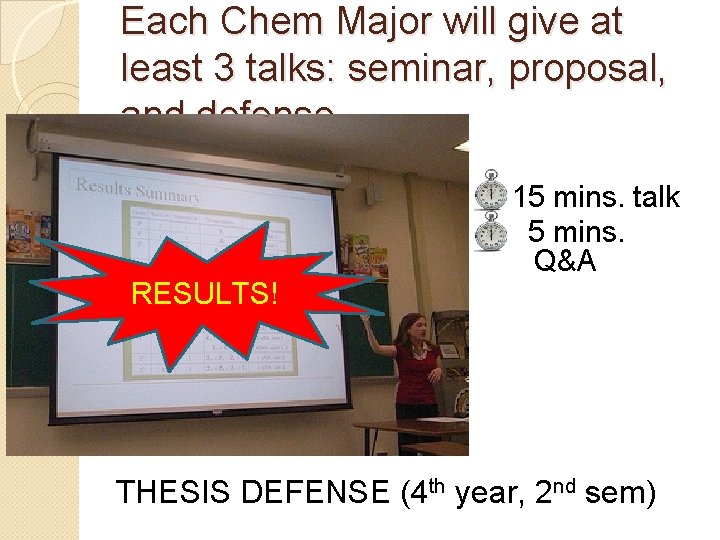
Each Chem Major will give at least 3 talks: seminar, proposal, and defense. RESULTS! 15 mins. talk 5 mins. Q&A THESIS DEFENSE (4 th year, 2 nd sem)
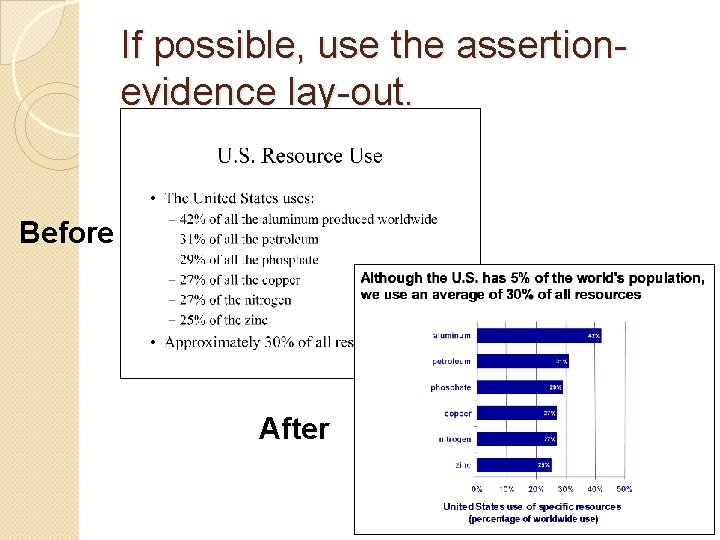
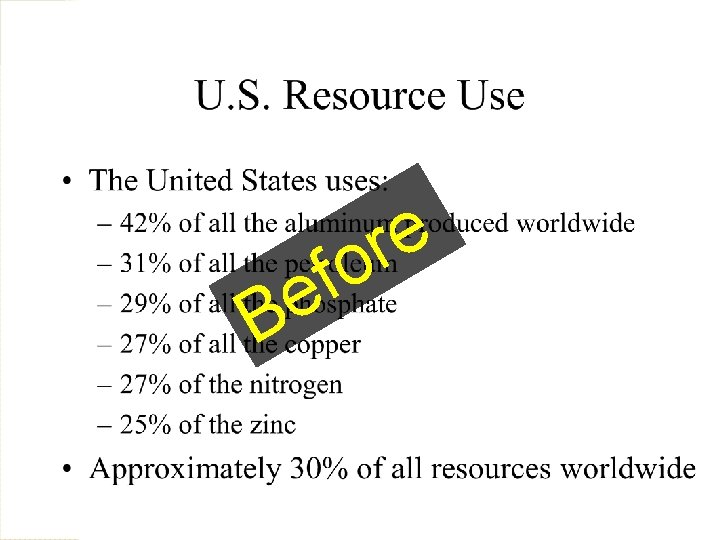
If possible, use the assertionevidence lay-out. Before After
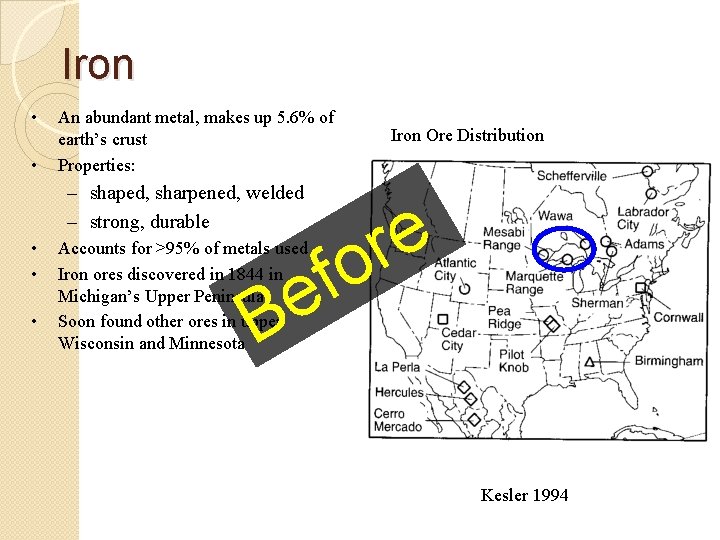
Iron • • An abundant metal, makes up 5. 6% of earth’s crust Properties: – shaped, sharpened, welded – strong, durable • • • Accounts for >95% of metals used Iron ores discovered in 1844 in Michigan’s Upper Peninsula Soon found other ores in upper Wisconsin and Minnesota e B Iron Ore Distribution e r fo Kesler 1994
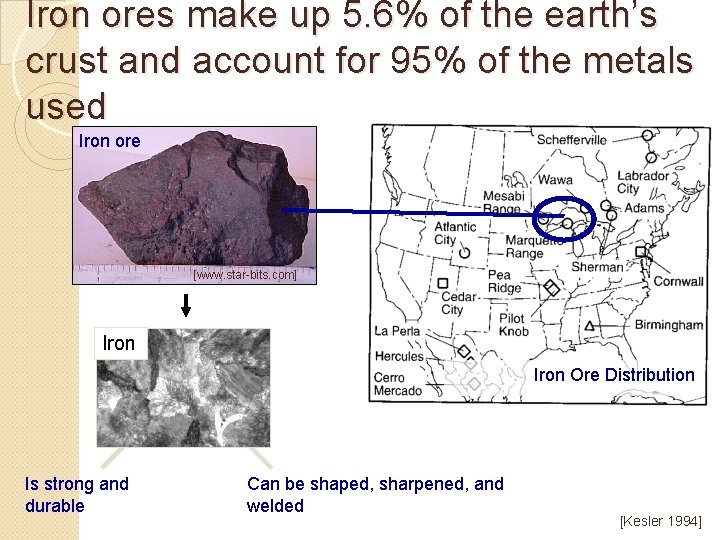
Iron ores make up 5. 6% of the earth’s crust and account for 95% of the metals used Iron ore [www. star-bits. com] Iron Ore Distribution Is strong and durable Can be shaped, sharpened, and welded [Kesler 1994]
e B e r fo
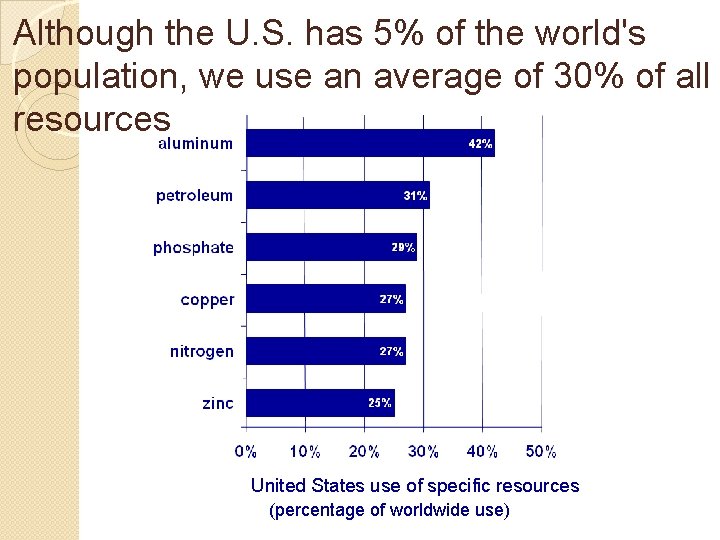
Although the U. S. has 5% of the world's population, we use an average of 30% of all resources United States use of specific resources (percentage of worldwide use)
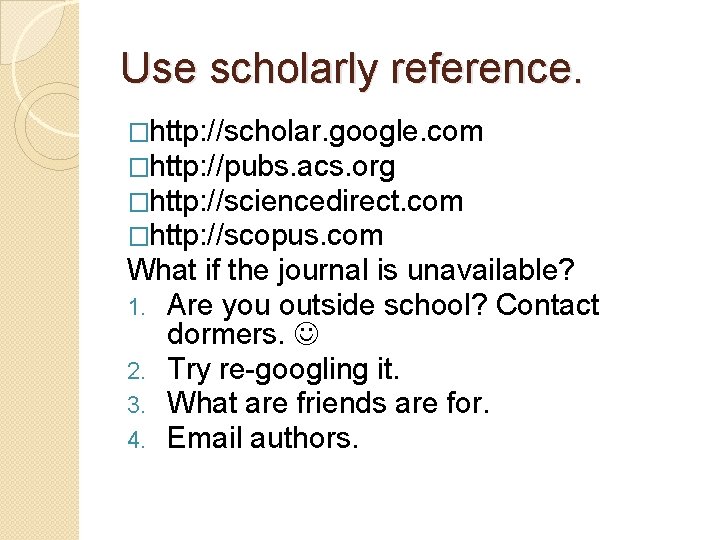
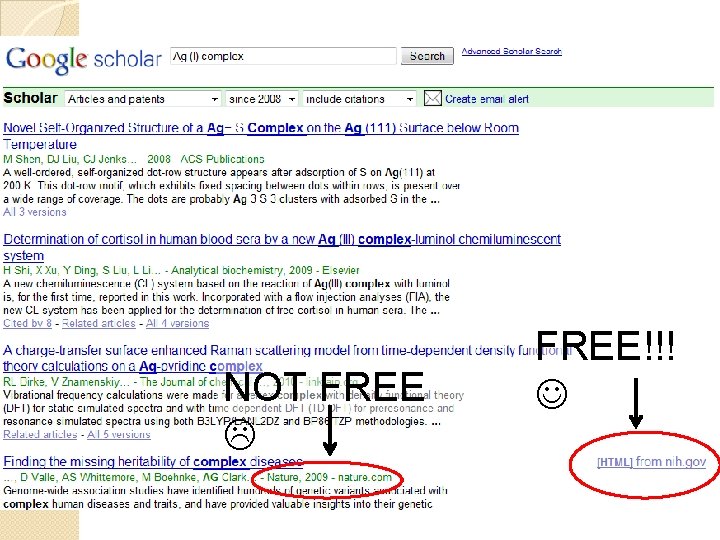
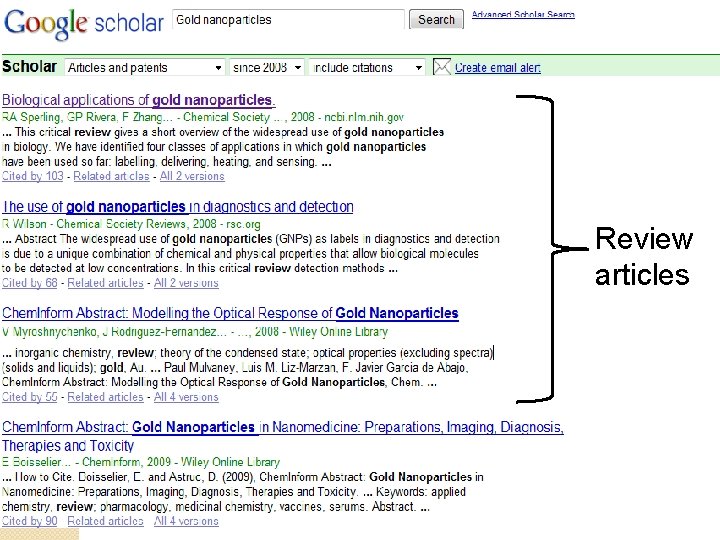
Use scholarly reference. �http: //scholar. google. com �http: //pubs. acs. org �http: //sciencedirect. com �http: //scopus. com What if the journal is unavailable? 1. Are you outside school? Contact dormers. 2. Try re-googling it. 3. What are friends are for. 4. Email authors.
NOT FREE!!!
Review articles
The title should tell the readers what your research is about. �“mini-skirt principle” ◦ LONG enough to cover the essentials ◦ SHORT enough to be interesting �It should NOT be misleading.
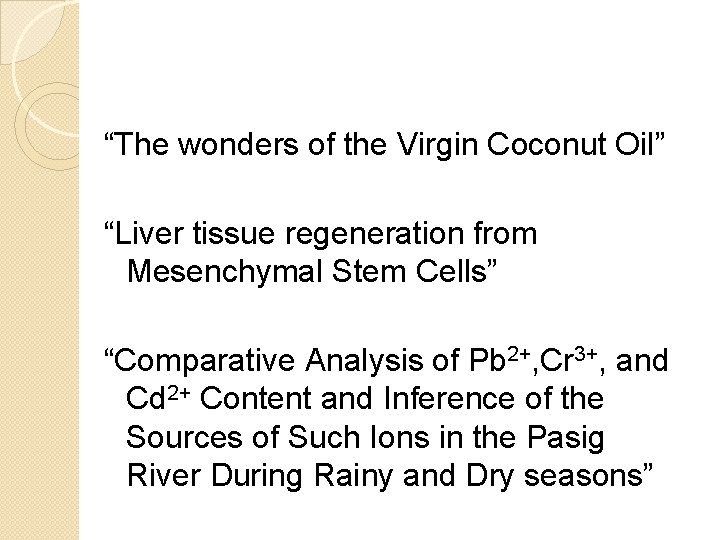
“The wonders of the Virgin Coconut Oil” “Liver tissue regeneration from Mesenchymal Stem Cells” “Comparative Analysis of Pb 2+, Cr 3+, and Cd 2+ Content and Inference of the Sources of Such Ions in the Pasig River During Rainy and Dry seasons”
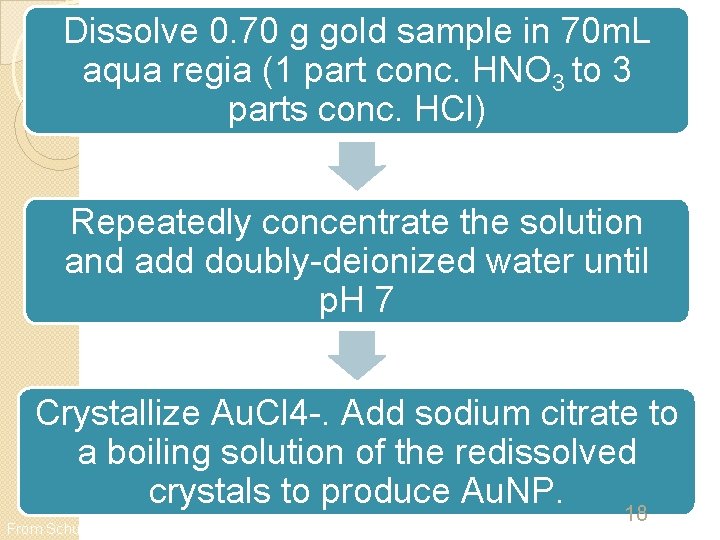
Mention what happens not what you will do in your methodology. �A list bores the audience! �No need to mention amounts, unless crucial.
Dissolve 0. 70 g gold sample in 70 m. L aqua regia (1 part conc. HNO 3 to 3 parts conc. HCl) Repeatedly concentrate the solution and add doubly-deionized water until p. H 7 Crystallize Au. Cl 4 -. Add sodium citrate to a boiling solution of the redissolved crystals to produce Au. NP. 18 From Schubert, U. , et. al, Materials Syntheses: A Practical Guide. New York: Springer Wien
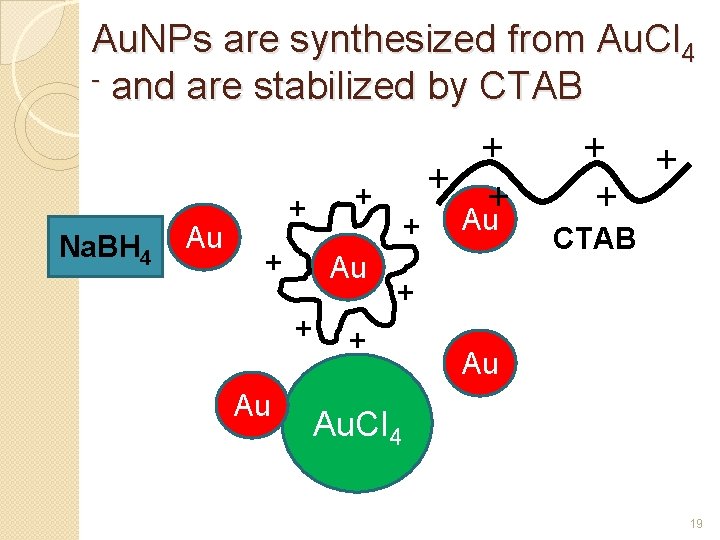
Au. NPs are synthesized from Au. Cl 4 - and are stabilized by CTAB Na. BH 4 Au + + + Au + + + CTAB + + Au Au. Cl 4 19
Keep explanations brief. �Use pictures rather than long stretches of sentences �Tables instead of listing data �PRACTICE your spiel! (avoid unnecessary words and/or repetitions)
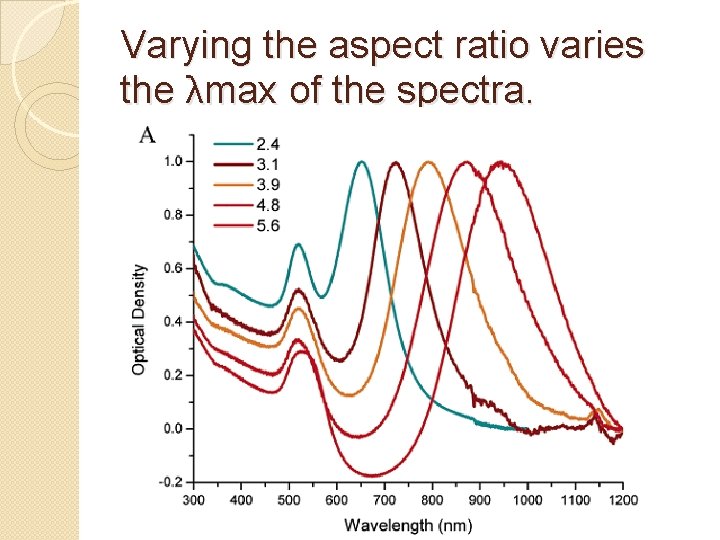
Varying the aspect ratio varies the λmax of the spectra.
‘Guide’ the audience when you explain complicated pictures/graphs. �That’s why you’re given a laser pointer �Organize the way you introduce the picture/graph
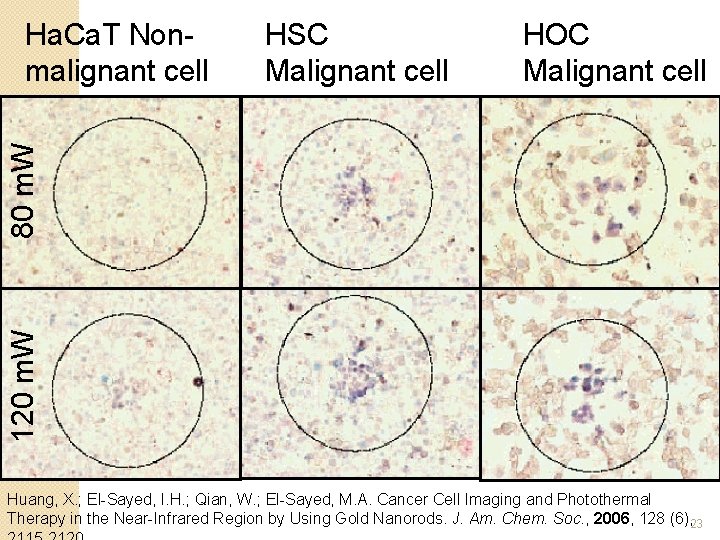
HSC Malignant cell HOC Malignant cell 120 m. W 80 m. W Ha. Ca. T Nonmalignant cell Huang, X. ; El-Sayed, I. H. ; Qian, W. ; El-Sayed, M. A. Cancer Cell Imaging and Photothermal Therapy in the Near-Infrared Region by Using Gold Nanorods. J. Am. Chem. Soc. , 2006, 128 (6), 23
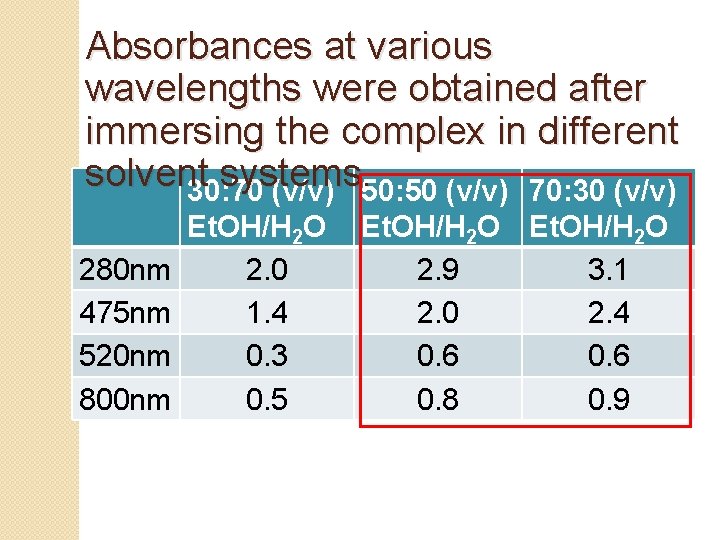
Absorbances at various wavelengths were obtained after immersing the complex in different solvent systems. 30: 70 (v/v) 50: 50 (v/v) 70: 30 (v/v) 280 nm 475 nm 520 nm 800 nm Et. OH/H 2 O 2. 0 1. 4 0. 3 0. 5 Et. OH/H 2 O 2. 9 3. 1 2. 0 2. 4 0. 6 0. 8 0. 9
Use pictures for enumerating examples �A list is okay… but a list of pictures is better.
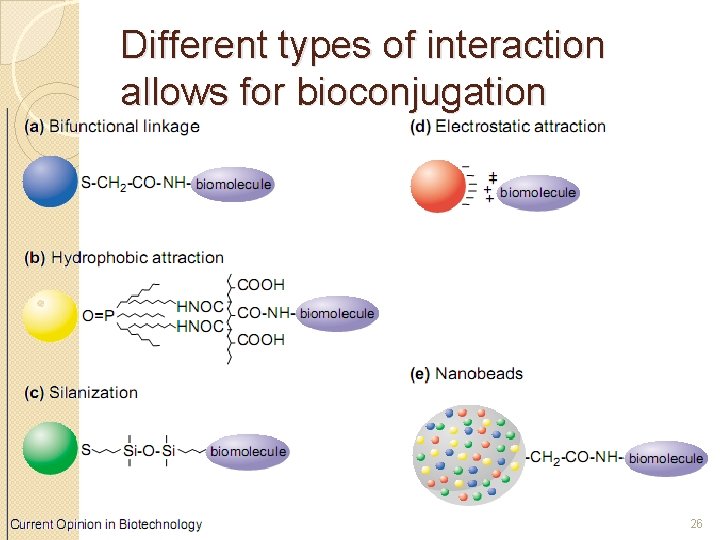
Different types of interaction allows for bioconjugation 26
Avoid text-heavy slides. If inevitable, do not flash them at once. �“ 7 x 7 rule”(for the body): 7 words, 7 lines per slide ONLY. �Use SIMPLE animations. My personal favorite is “appear” and “wipe”.
SUMMARY �Particles exhibit quantum-size effects when reduced to nanosize which is not present in bulk molecules. �Using Au. NRs with appropriate aspect ratios, one can couple cancer detection with selective killing of cancer cells
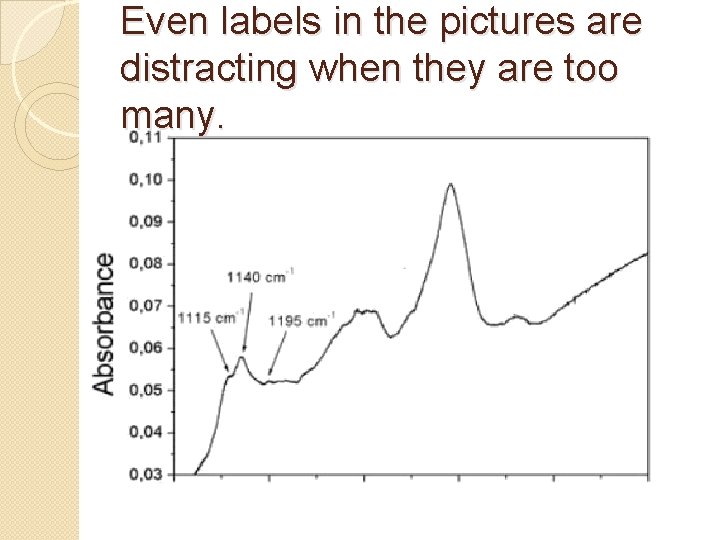
Even labels in the pictures are distracting when they are too many.
Be conscious about the font color, size, background color, etc. �What you see is NOT what you get. �The truth about the LCD projector… ◦ Backgrounds = lighter ◦ Contrast = less �Ask help for color combinations if you are not too familiar with them. �Font size: title = ~40; body = ~30
Some common ppt tools �Crop �“Set transparent color” �Use of semi-transparent background text box
Your body posture and gestures can affect the way you deliver a talk. �Don’t be a distraction to your own talk! �Voice projection �Be conscious of your “uhmms” and “aaahs” and “like”….
Keep within the time allowed. Practice and time yourself! �Estimate the length of your talk. �Time management is 5 points of the talk. Most profs give you 0 if you go beyond the time.
TECH STUFF: Include an outline at the start of your talk. �It gives the audience a sense of the “big picture”.
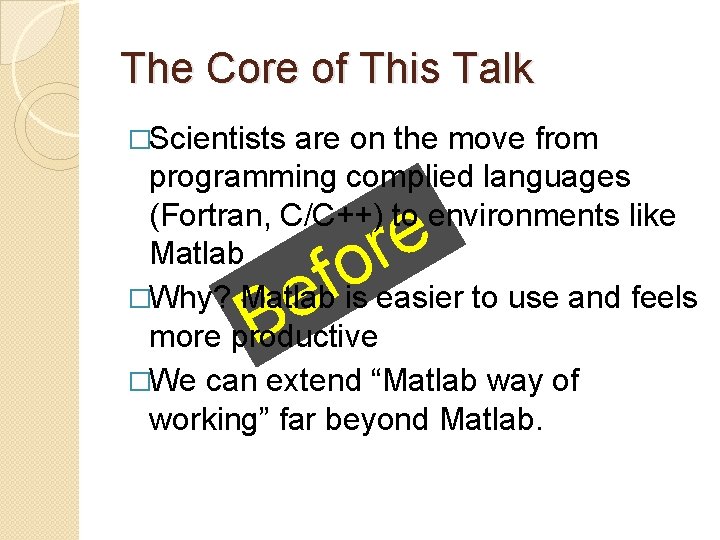
The Core of This Talk �Scientists are on the move from programming complied languages (Fortran, C/C++) to environments like Matlab �Why? Matlab is easier to use and feels more productive �We can extend “Matlab way of working” far beyond Matlab. e B e r fo
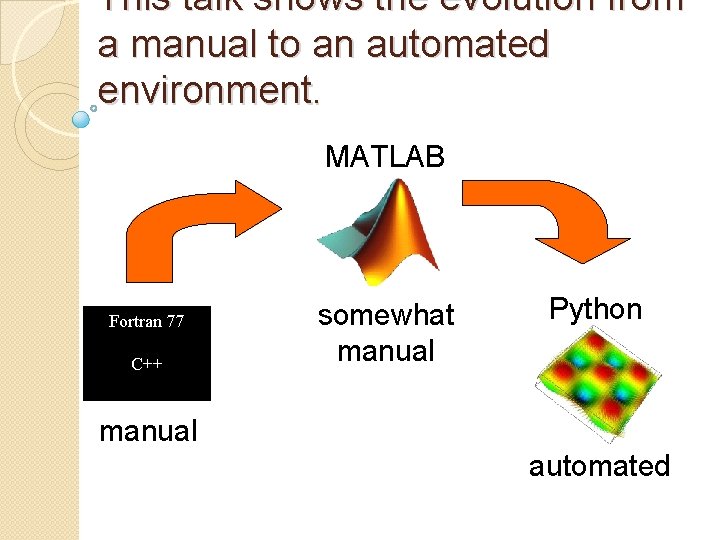
This talk shows the evolution from a manual to an automated environment. MATLAB Fortran 77 C++ somewhat manual Python manual automated
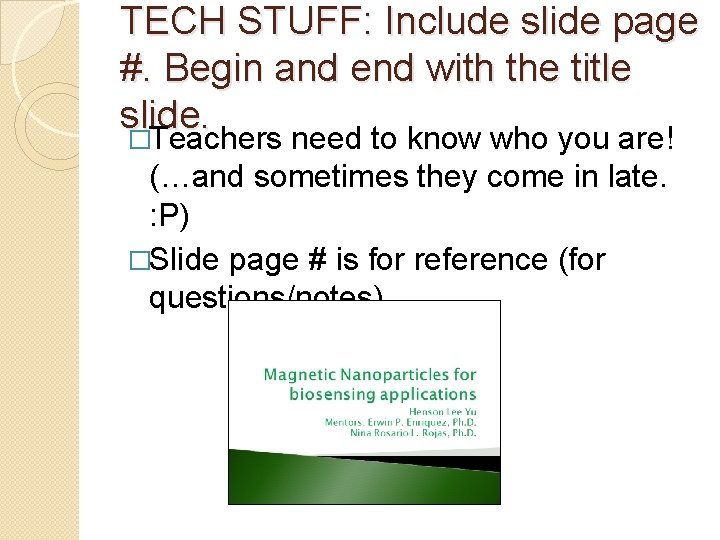
TECH STUFF: Include slide page #. Begin and end with the title slide. �Teachers need to know who you are! (…and sometimes they come in late. : P) �Slide page # is for reference (for questions/notes)
TECH STUFF: Always put references. DO NOT PLAGIARIZE. �Font size: ~18 �Pictures, graphs, tables must have references when they appear in the slide. �Summarize all references at the end.
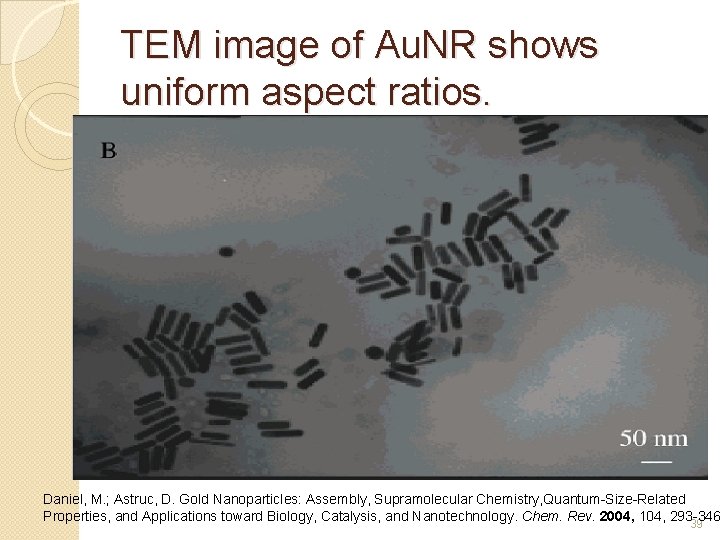
TEM image of Au. NR shows uniform aspect ratios. Daniel, M. ; Astruc, D. Gold Nanoparticles: Assembly, Supramolecular Chemistry, Quantum-Size-Related Properties, and Applications toward Biology, Catalysis, and Nanotechnology. Chem. Rev. 2004, 104, 293 -346 39
SUGGESTIONS: Talk about the relevance of your topic at the start. �“hook” your audience by claiming it is relevant to them
41
SUGGESTIONS: Prepare extra slides containing “additional info” �Answers to “potential questions” �Specifics of an experimental setup/condition
INSIDER: Each mentor has his/her own “style” of asking. �Doc V - practical questions such as setup; experimental conditions, how much etc… �Doc Guidote - if you were the researcher…. . (esp when you talk about "limitations") �Doc Soma - anything and everything about the polymer you talked about (crosslinker, monomer)
INSIDER: Each mentor has his/her own “style” of asking. �Doc EPE - "did the literature mention…. ", theory �Doc Rojas - curious questions… facts about your presentation �Doc So - mechanism and structure
Answer the questions “smartly”. �Good if you know the answer. �If you don’t. . . “I’ll look into that…” “I don’t exactly know how it works, but if I were to guess…” �Better yet, don’t mention things that you aren’t really sure about. . : P
Questions? : D