
Giving Credit Where Credit is Due Citing Sources
- Slides: 15
Giving Credit Where Credit is Due Citing Sources
What in the World is a Works Cited? A Works Cited is a list of sources that you have used in your essay or paper. The sources should be listed in alphabetical order for easy reference. The Works Cited is used to give credit to people who have published information for others to use and/or build upon.
What’s the Point of Citing Sources? • The sharing of information • Crediting those work you’ve built upon • Creating a network of similar work on similar material • Being academically honest
Citation Formats • MLA §Modern Language Association §Commonly used by those studying humanities §Particularly used by fields that study literature or critical theory §EX: English, comparative literature • APA §American Psychological Association §Commonly used by those studying social sciences §EX: psychology, linguistics, education • Chicago §Used by a wide variety of fields §Fields that use Chicago could also use MLA or APA §EX: history, information science, journalism
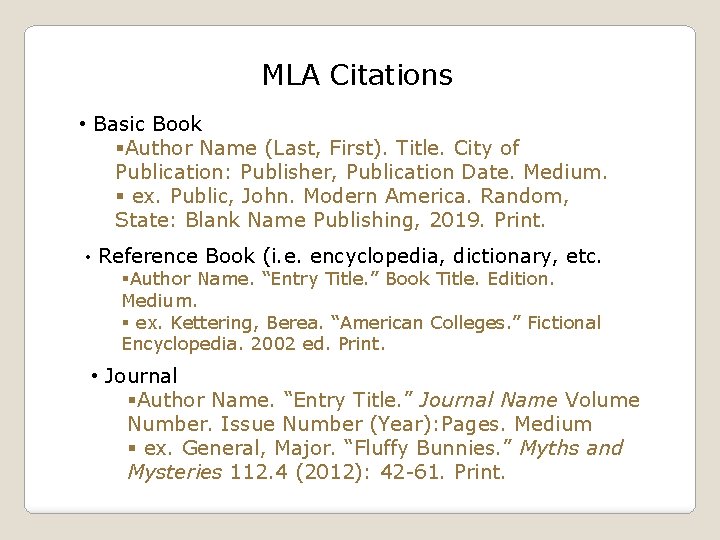
MLA Citations • Basic Book §Author Name (Last, First). Title. City of Publication: Publisher, Publication Date. Medium. § ex. Public, John. Modern America. Random, State: Blank Name Publishing, 2019. Print. • Reference Book (i. e. encyclopedia, dictionary, etc. §Author Name. “Entry Title. ” Book Title. Edition. Medium. § ex. Kettering, Berea. “American Colleges. ” Fictional Encyclopedia. 2002 ed. Print. • Journal §Author Name. “Entry Title. ” Journal Name Volume Number. Issue Number (Year): Pages. Medium § ex. General, Major. “Fluffy Bunnies. ” Myths and Mysteries 112. 4 (2012): 42 61. Print.
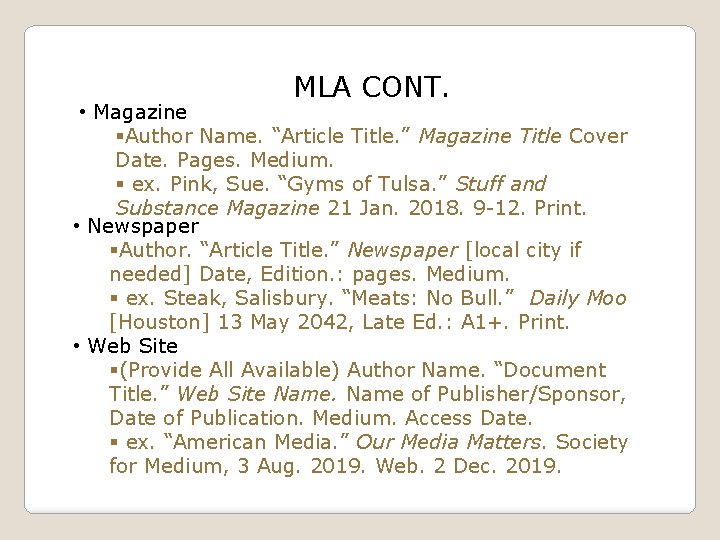
MLA CONT. • Magazine §Author Name. “Article Title. ” Magazine Title Cover Date. Pages. Medium. § ex. Pink, Sue. “Gyms of Tulsa. ” Stuff and Substance Magazine 21 Jan. 2018. 9 12. Print. • Newspaper §Author. “Article Title. ” Newspaper [local city if needed] Date, Edition. : pages. Medium. § ex. Steak, Salisbury. “Meats: No Bull. ” Daily Moo [Houston] 13 May 2042, Late Ed. : A 1+. Print. • Web Site §(Provide All Available) Author Name. “Document Title. ” Web Site Name of Publisher/Sponsor, Date of Publication. Medium. Access Date. § ex. “American Media. ” Our Media Matters. Society for Medium, 3 Aug. 2019. Web. 2 Dec. 2019.
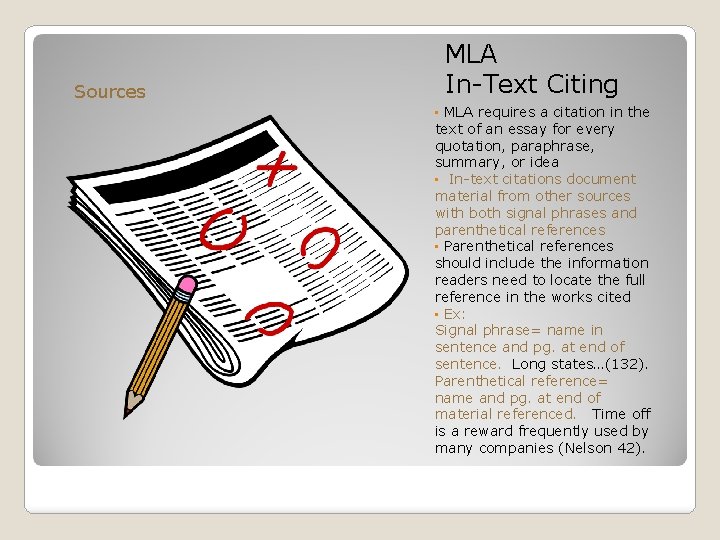
Sources MLA In Text Citing • MLA requires a citation in the text of an essay for every quotation, paraphrase, summary, or idea • In text citations document material from other sources with both signal phrases and parenthetical references • Parenthetical references should include the information readers need to locate the full reference in the works cited • Ex: Signal phrase= name in sentence and pg. at end of sentence. Long states…(132). Parenthetical reference= name and pg. at end of material referenced. Time off is a reward frequently used by many companies (Nelson 42).
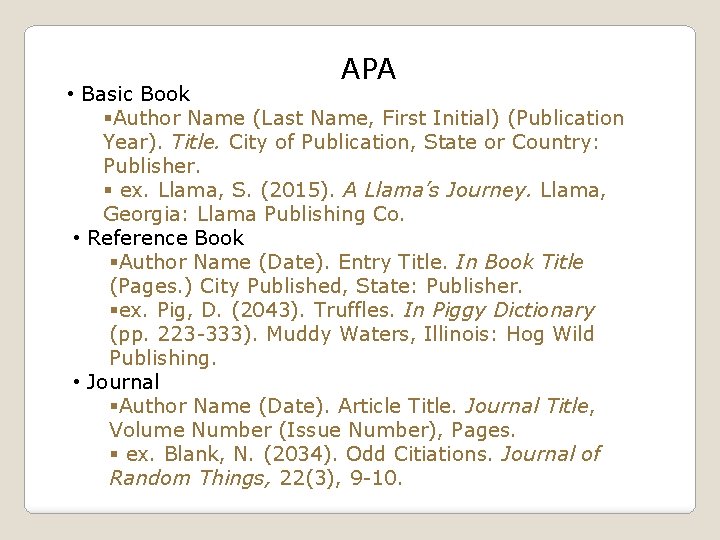
APA • Basic Book §Author Name (Last Name, First Initial) (Publication Year). Title. City of Publication, State or Country: Publisher. § ex. Llama, S. (2015). A Llama’s Journey. Llama, Georgia: Llama Publishing Co. • Reference Book §Author Name (Date). Entry Title. In Book Title (Pages. ) City Published, State: Publisher. §ex. Pig, D. (2043). Truffles. In Piggy Dictionary (pp. 223 333). Muddy Waters, Illinois: Hog Wild Publishing. • Journal §Author Name (Date). Article Title. Journal Title, Volume Number (Issue Number), Pages. § ex. Blank, N. (2034). Odd Citiations. Journal of Random Things, 22(3), 9 10.
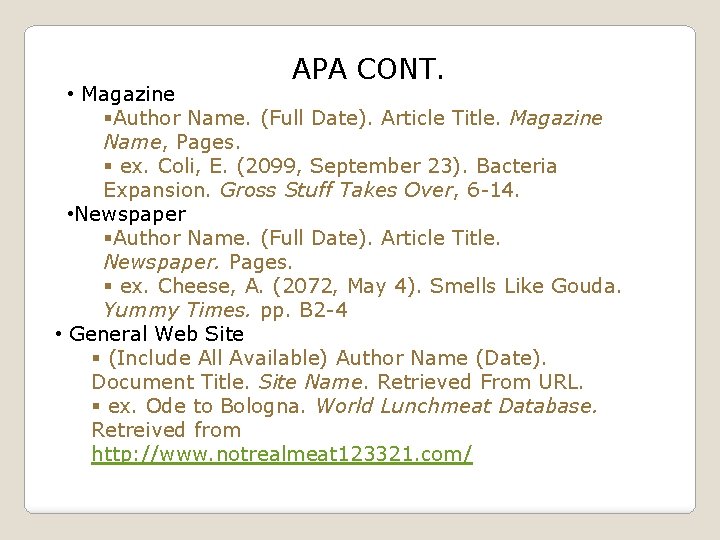
APA CONT. • Magazine §Author Name. (Full Date). Article Title. Magazine Name, Pages. § ex. Coli, E. (2099, September 23). Bacteria Expansion. Gross Stuff Takes Over, 6 14. • Newspaper §Author Name. (Full Date). Article Title. Newspaper. Pages. § ex. Cheese, A. (2072, May 4). Smells Like Gouda. Yummy Times. pp. B 2 4 • General Web Site § (Include All Available) Author Name (Date). Document Title. Site Name. Retrieved From URL. § ex. Ode to Bologna. World Lunchmeat Database. Retreived from http: //www. notrealmeat 123321. com/
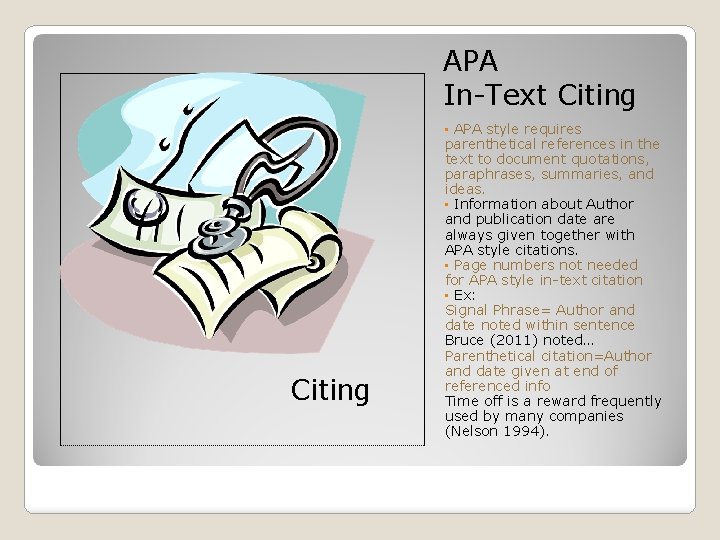
APA In Text Citing • APA style requires Citing parenthetical references in the text to document quotations, paraphrases, summaries, and ideas. • Information about Author and publication date are always given together with APA style citations. • Page numbers not needed for APA style in text citation • Ex: Signal Phrase= Author and date noted within sentence Bruce (2011) noted… Parenthetical citation=Author and date given at end of referenced info Time off is a reward frequently used by many companies (Nelson 1994).
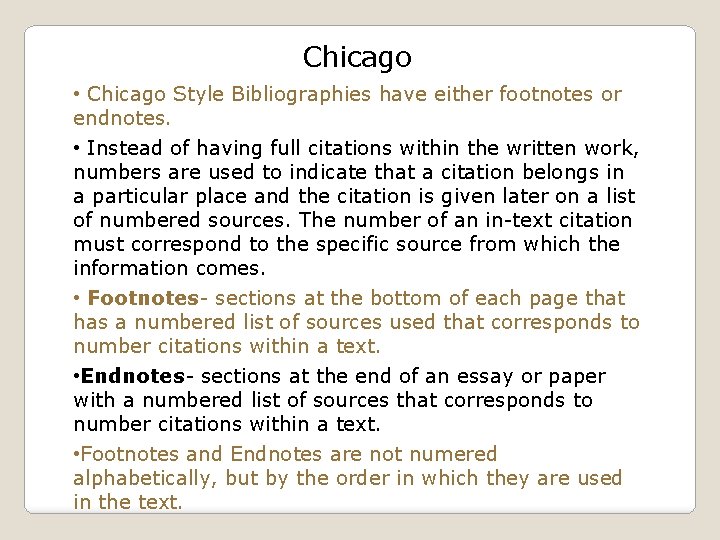
Chicago • Chicago Style Bibliographies have either footnotes or endnotes. • Instead of having full citations within the written work, numbers are used to indicate that a citation belongs in a particular place and the citation is given later on a list of numbered sources. The number of an in text citation must correspond to the specific source from which the information comes. • Footnotes sections at the bottom of each page that has a numbered list of sources used that corresponds to number citations within a text. • Endnotes sections at the end of an essay or paper with a numbered list of sources that corresponds to number citations within a text. • Footnotes and Endnotes are not numered alphabetically, but by the order in which they are used in the text.
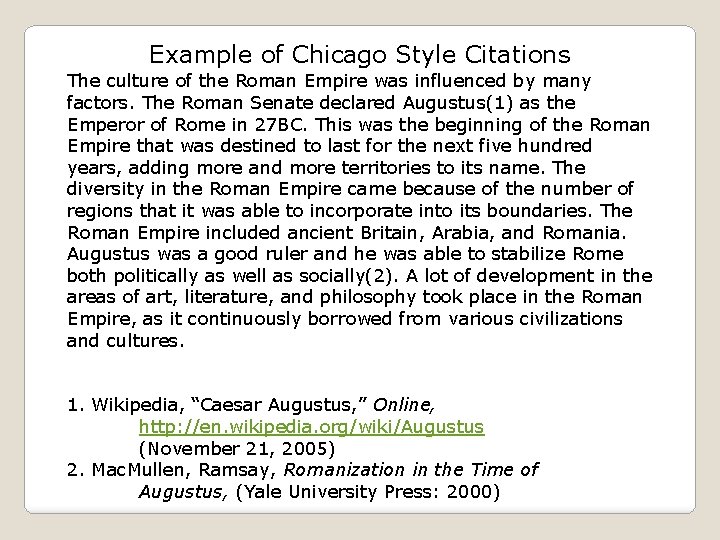
Example of Chicago Style Citations The culture of the Roman Empire was influenced by many factors. The Roman Senate declared Augustus(1) as the Emperor of Rome in 27 BC. This was the beginning of the Roman Empire that was destined to last for the next five hundred years, adding more and more territories to its name. The diversity in the Roman Empire came because of the number of regions that it was able to incorporate into its boundaries. The Roman Empire included ancient Britain, Arabia, and Romania. Augustus was a good ruler and he was able to stabilize Rome both politically as well as socially(2). A lot of development in the areas of art, literature, and philosophy took place in the Roman Empire, as it continuously borrowed from various civilizations and cultures. 1. Wikipedia, “Caesar Augustus, ” Online, http: //en. wikipedia. org/wiki/Augustus (November 21, 2005) 2. Mac. Mullen, Ramsay, Romanization in the Time of Augustus, (Yale University Press: 2000)
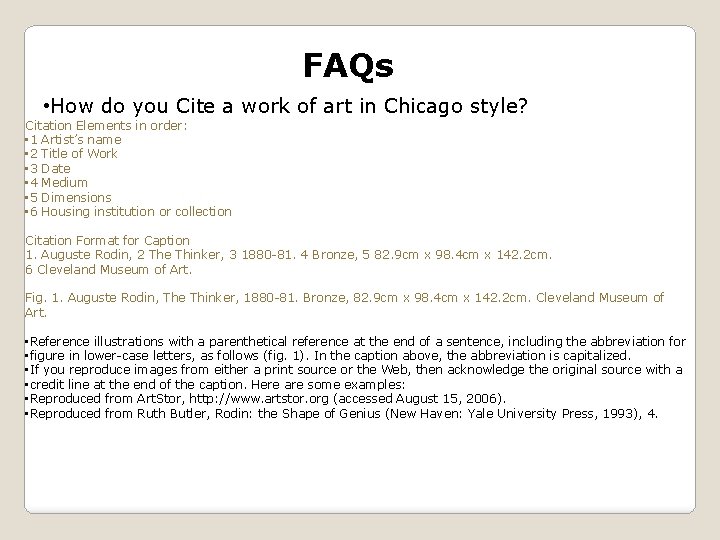
FAQs • How do you Cite a work of art in Chicago style? Citation Elements in order: • 1 Artist’s name • 2 Title of Work • 3 Date • 4 Medium • 5 Dimensions • 6 Housing institution or collection Citation Format for Caption 1. Auguste Rodin, 2 The Thinker, 3 1880 81. 4 Bronze, 5 82. 9 cm x 98. 4 cm x 142. 2 cm. 6 Cleveland Museum of Art. Fig. 1. Auguste Rodin, The Thinker, 1880 81. Bronze, 82. 9 cm x 98. 4 cm x 142. 2 cm. Cleveland Museum of Art. • Reference illustrations with a parenthetical reference at the end of a sentence, including the abbreviation for • figure in lower case letters, as follows (fig. 1). In the caption above, the abbreviation is capitalized. • If you reproduce images from either a print source or the Web, then acknowledge the original source with a • credit line at the end of the caption. Here are some examples: • Reproduced from Art. Stor, http: //www. artstor. org (accessed August 15, 2006). • Reproduced from Ruth Butler, Rodin: the Shape of Genius (New Haven: Yale University Press, 1993), 4.
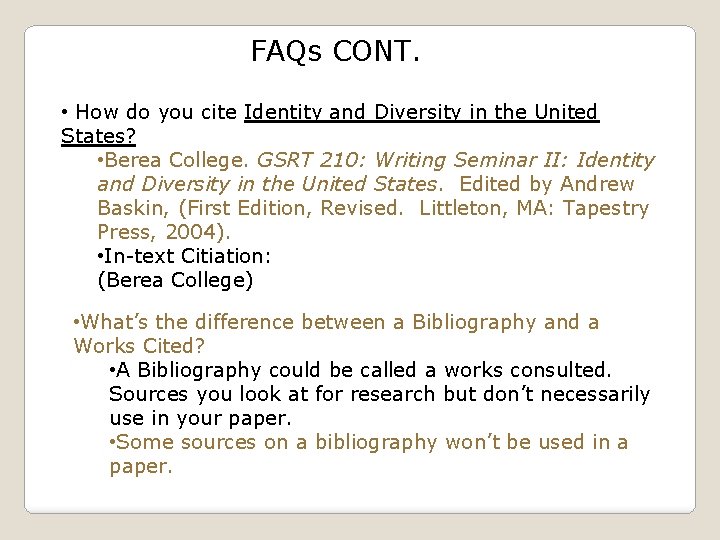
FAQs CONT. • How do you cite Identity and Diversity in the United States? • Berea College. GSRT 210: Writing Seminar II: Identity and Diversity in the United States. Edited by Andrew Baskin, (First Edition, Revised. Littleton, MA: Tapestry Press, 2004). • In text Citiation: (Berea College) • What’s the difference between a Bibliography and a Works Cited? • A Bibliography could be called a works consulted. Sources you look at for research but don’t necessarily use in your paper. • Some sources on a bibliography won’t be used in a paper.
For more specific assistance with citing work, feel free to visit the Learning Center or consult the St. Martin’s Handbook, from which most of the info in this presentation came! You could also use St. Martin’s Handbook online! Remember to Cite ALL Information that is NOT YOUR Original Work or Ideas!!!