
Giving and receiving feedback in the mathematical sciences
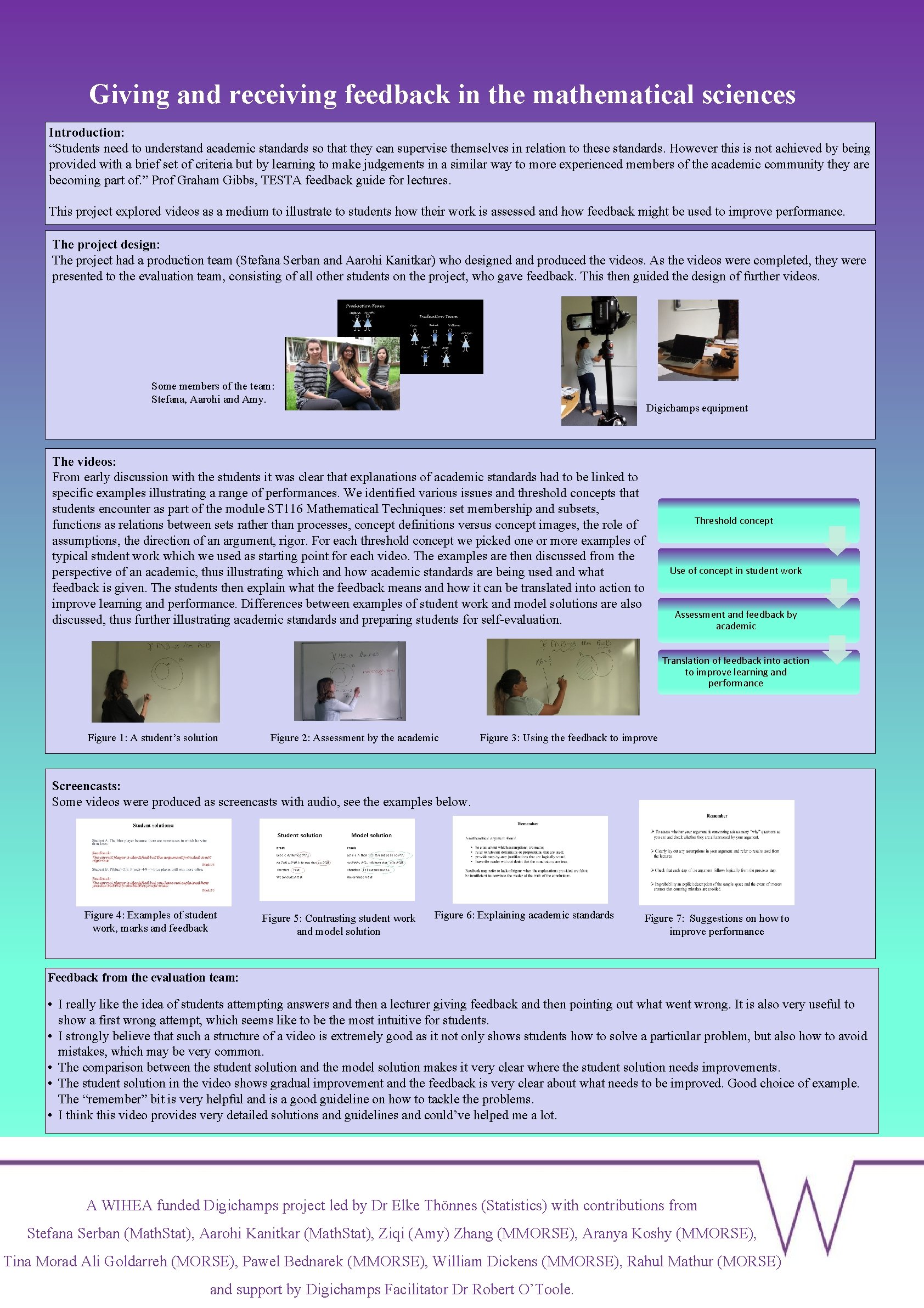
Giving and receiving feedback in the mathematical sciences Introduction: “Students need to understand academic standards so that they can supervise themselves in relation to these standards. However this is not achieved by being provided with a brief set of criteria but by learning to make judgements in a similar way to more experienced members of the academic community they are becoming part of. ” Prof Graham Gibbs, TESTA feedback guide for lectures. This project explored videos as a medium to illustrate to students how their work is assessed and how feedback might be used to improve performance. The project design: The project had a production team (Stefana Serban and Aarohi Kanitkar) who designed and produced the videos. As the videos were completed, they were presented to the evaluation team, consisting of all other students on the project, who gave feedback. This then guided the design of further videos. Some members of the team: Stefana, Aarohi and Amy. Digichamps equipment The videos: From early discussion with the students it was clear that explanations of academic standards had to be linked to specific examples illustrating a range of performances. We identified various issues and threshold concepts that students encounter as part of the module ST 116 Mathematical Techniques: set membership and subsets, functions as relations between sets rather than processes, concept definitions versus concept images, the role of assumptions, the direction of an argument, rigor. For each threshold concept we picked one or more examples of typical student work which we used as starting point for each video. The examples are then discussed from the perspective of an academic, thus illustrating which and how academic standards are being used and what feedback is given. The students then explain what the feedback means and how it can be translated into action to improve learning and performance. Differences between examples of student work and model solutions are also discussed, thus further illustrating academic standards and preparing students for self-evaluation. Threshold concept Use of concept in student work Assessment and feedback by academic Translation of feedback into action to improve learning and performance Figure 1: A student’s solution Figure 2: Assessment by the academic Figure 3: Using the feedback to improve Screencasts: Some videos were produced as screencasts with audio, see the examples below. Figure 4: Examples of student work, marks and feedback Figure 5: Contrasting student work and model solution Figure 6: Explaining academic standards Figure 7: Suggestions on how to improve performance Feedback from the evaluation team: • I really like the idea of students attempting answers and then a lecturer giving feedback and then pointing out what went wrong. It is also very useful to show a first wrong attempt, which seems like to be the most intuitive for students. • I strongly believe that such a structure of a video is extremely good as it not only shows students how to solve a particular problem, but also how to avoid mistakes, which may be very common. • The comparison between the student solution and the model solution makes it very clear where the student solution needs improvements. • The student solution in the video shows gradual improvement and the feedback is very clear about what needs to be improved. Good choice of example. The “remember” bit is very helpful and is a good guideline on how to tackle the problems. • I think this video provides very detailed solutions and guidelines and could’ve helped me a lot. A WIHEA funded Digichamps project led by Dr Elke Thönnes (Statistics) with contributions from Stefana Serban (Math. Stat), Aarohi Kanitkar (Math. Stat), Ziqi (Amy) Zhang (MMORSE), Aranya Koshy (MMORSE), Tina Morad Ali Goldarreh (MORSE), Pawel Bednarek (MMORSE), William Dickens (MMORSE), Rahul Mathur (MORSE) and support by Digichamps Facilitator Dr Robert O’Toole.
- Slides: 1