
Giving an Effective Poster Presentation REU Summer Seminar

- Slides: 20
Giving an Effective Poster Presentation REU Summer Seminar Series July 7, 2008
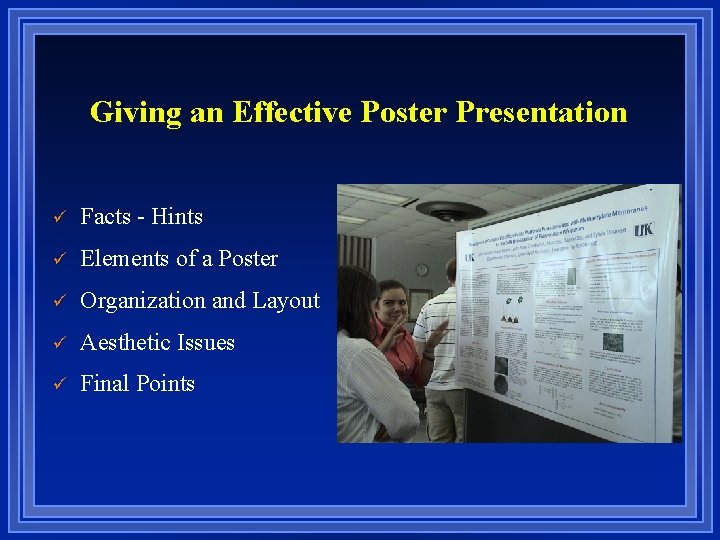
Giving an Effective Poster Presentation ü Facts - Hints ü Elements of a Poster ü Organization and Layout ü Aesthetic Issues ü Final Points
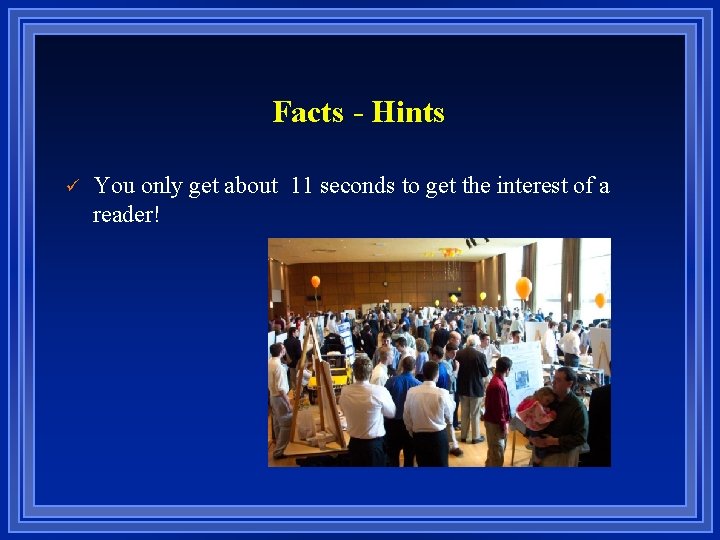
Facts - Hints ü You only get about 11 seconds to get the interest of a reader!
Facts - Hints ü Make your poster easy to understand so that ideas can be grasped in one reading ü Looks are important, so take care when you preparing your poster. Do not make it too fancy, try to avoid cluttered look, and occupy only 65 to 75 percent of your available space
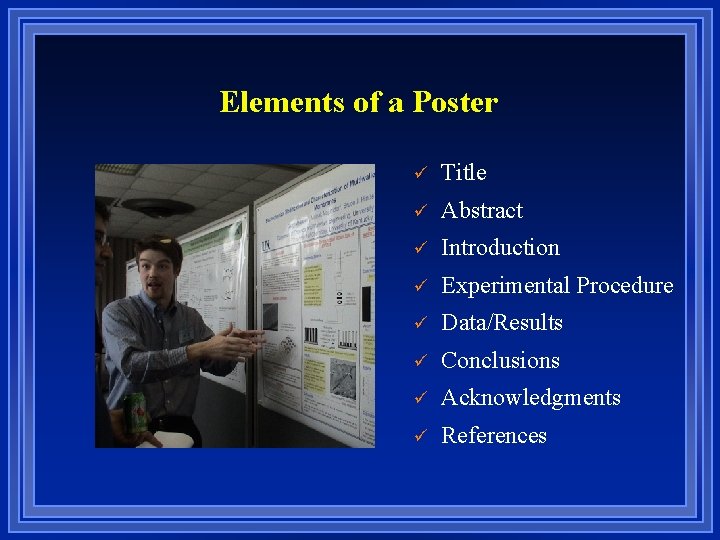
Elements of a Poster ü Title ü Abstract ü Introduction ü Experimental Procedure ü Data/Results ü Conclusions ü Acknowledgments ü References
Title ü ü ü Title – Make the title the most prominent block of text on the poster – Catching, simple, able to be seen from 20 feet away Author(s) – Always use first and last name – Use middle initials if space permits Institution – Institution and department – City names and state names can be dropped
Abstract ü This section is not always a requirement ü Follow guidelines ü Identify what is being studied, how you are studying it ü Identify your hypothesis ü State your findings
Introduction ü Less in-depth than an introduction for a paper ü Highlight and focus on: – Questions raised answered by previous research – The question you are asking and why you are asking it
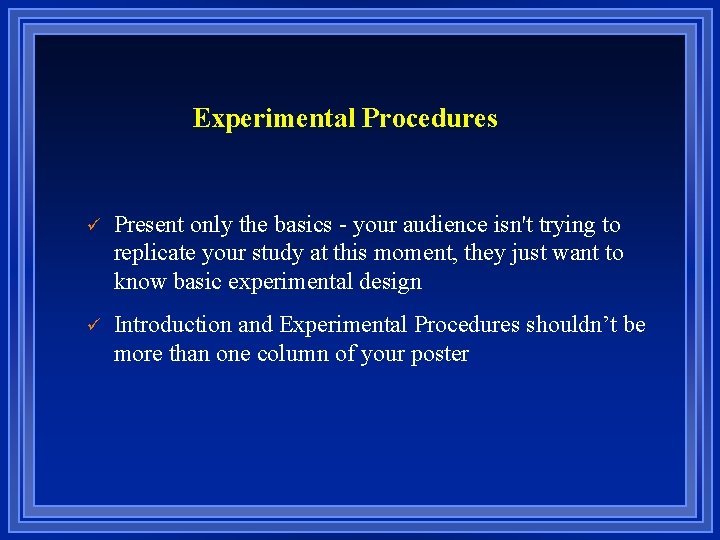
Experimental Procedures ü Present only the basics - your audience isn't trying to replicate your study at this moment, they just want to know basic experimental design ü Introduction and Experimental Procedures shouldn’t be more than one column of your poster
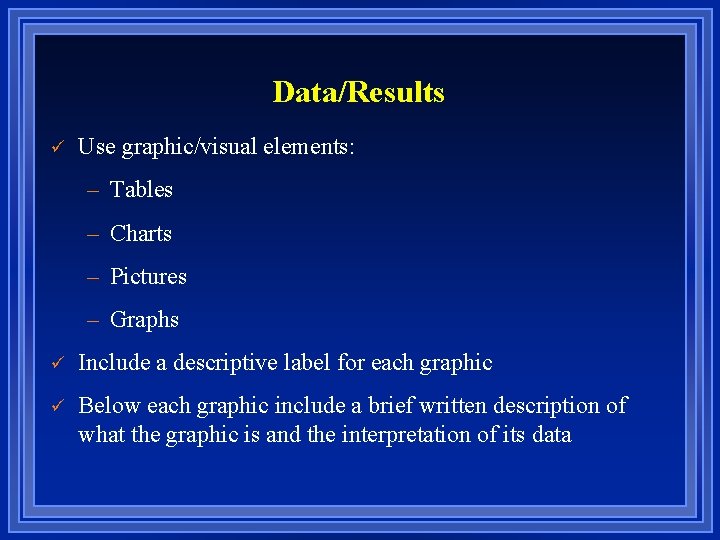
Data/Results ü Use graphic/visual elements: – Tables – Charts – Pictures – Graphs ü Include a descriptive label for each graphic ü Below each graphic include a brief written description of what the graphic is and the interpretation of its data
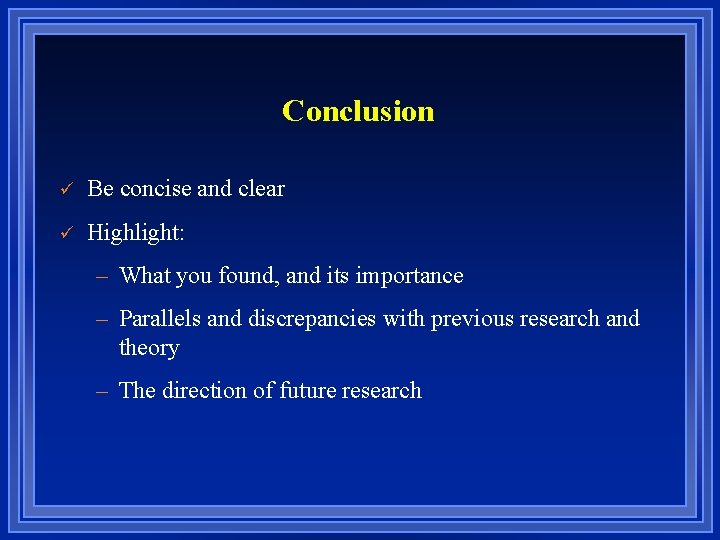
Conclusion ü Be concise and clear ü Highlight: – What you found, and its importance – Parallels and discrepancies with previous research and theory – The direction of future research
Acknowledgments ü Acknowledge the funding agency that supported this research ü Acknowledge those professionals and research assistants outside of the authors that contributed to your study Acknowledgements: The author thanks the National Science Foundation and the University of Kentucky Center of Membrane Sciences for financial support of this research. The work was completed as part of a NSF-REU Program at the University of Kentucky Center of Membrane Sciences. ü
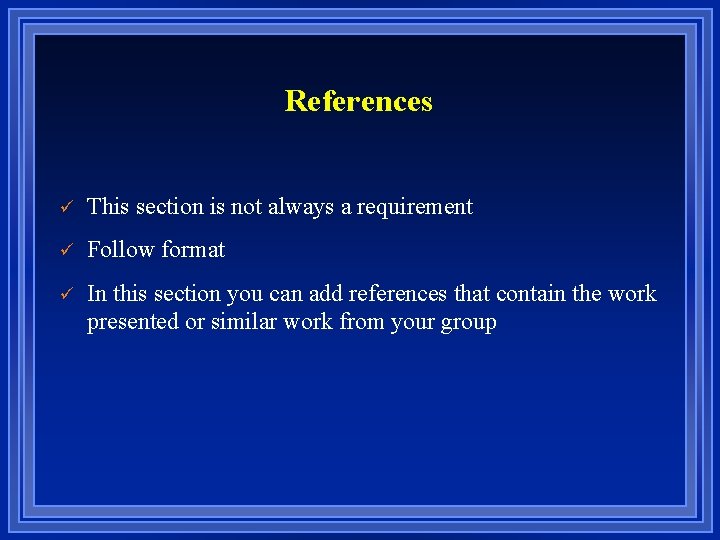
References ü This section is not always a requirement ü Follow format ü In this section you can add references that contain the work presented or similar work from your group
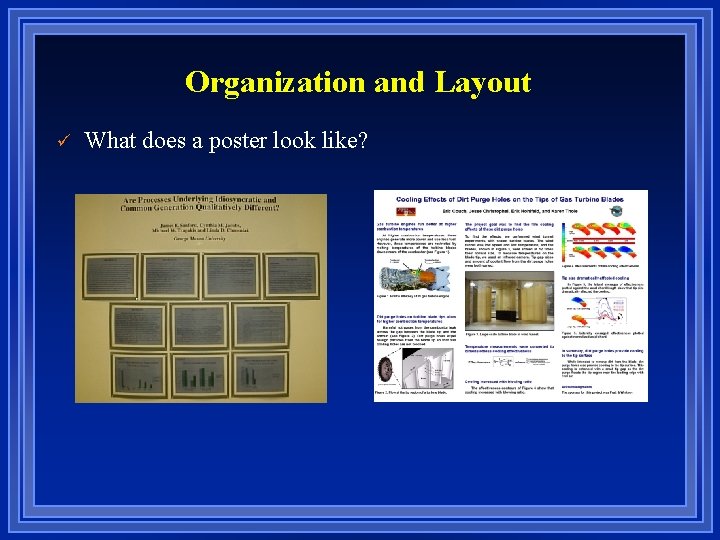
Organization and Layout ü What does a poster look like?
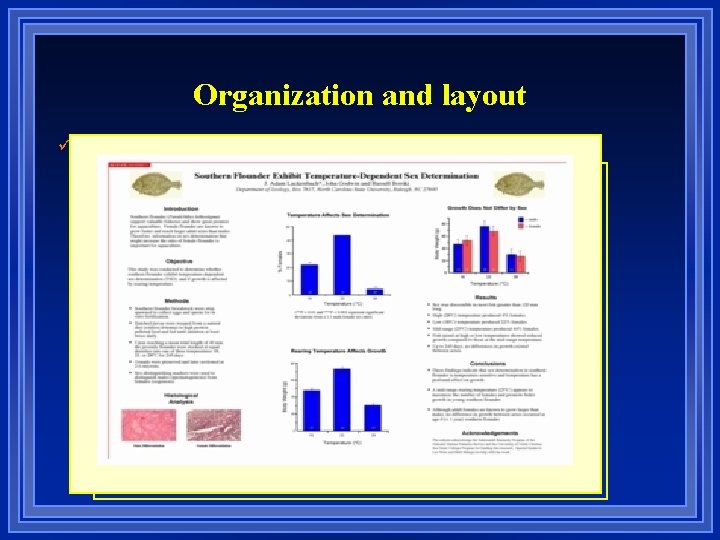
Organization and layout ü A general guide to poster layout: Conclusion Acknowledg ments References
Aesthetic Issues ü Color: – Used effectively, color is an effective method of attracting people to your poster – If you use color, stick to using a set number of colors in a consistent pattern – Limit your color use to 2 -3 colors – Use contrasting colors for readability and a professional look
Aesthetic Issues ü Layout: – Limited space doesn’t mean you can cram things together – Use a consistent spacing rule between each element of your poster – Try to align content along vertical and horizontal lines
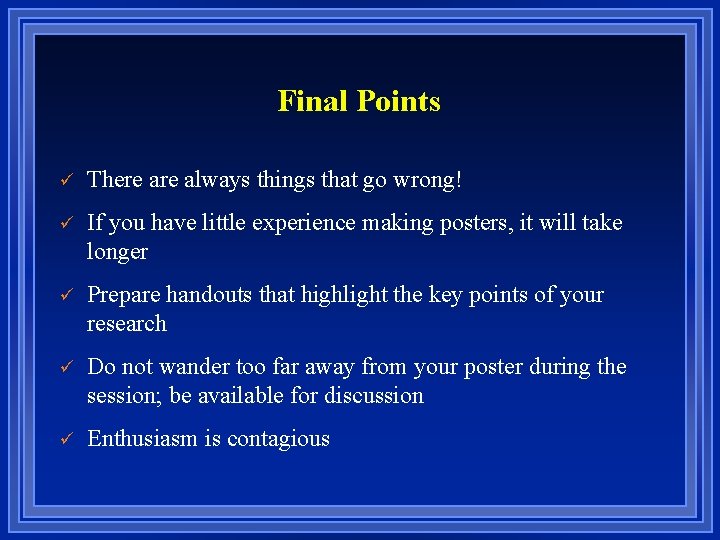
Final Points ü There always things that go wrong! ü If you have little experience making posters, it will take longer ü Prepare handouts that highlight the key points of your research ü Do not wander too far away from your poster during the session; be available for discussion ü Enthusiasm is contagious
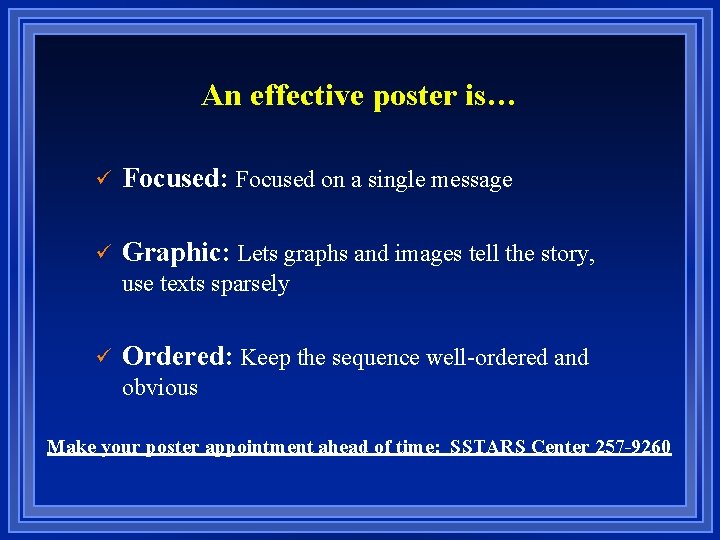
An effective poster is… ü Focused: Focused on a single message ü Graphic: Lets graphs and images tell the story, use texts sparsely ü Ordered: Keep the sequence well-ordered and obvious Make your poster appointment ahead of time: SSTARS Center 257 -9260
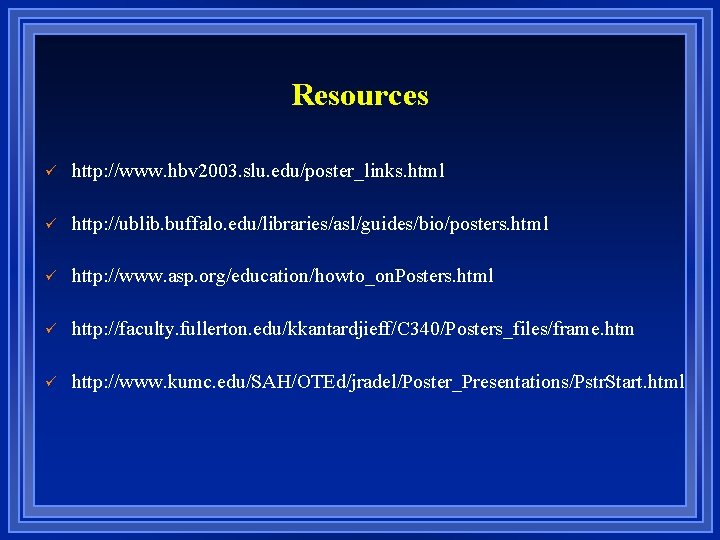
Resources ü http: //www. hbv 2003. slu. edu/poster_links. html ü http: //ublib. buffalo. edu/libraries/asl/guides/bio/posters. html ü http: //www. asp. org/education/howto_on. Posters. html ü http: //faculty. fullerton. edu/kkantardjieff/C 340/Posters_files/frame. htm ü http: //www. kumc. edu/SAH/OTEd/jradel/Poster_Presentations/Pstr. Start. html