
Given examples of the various objectives the students
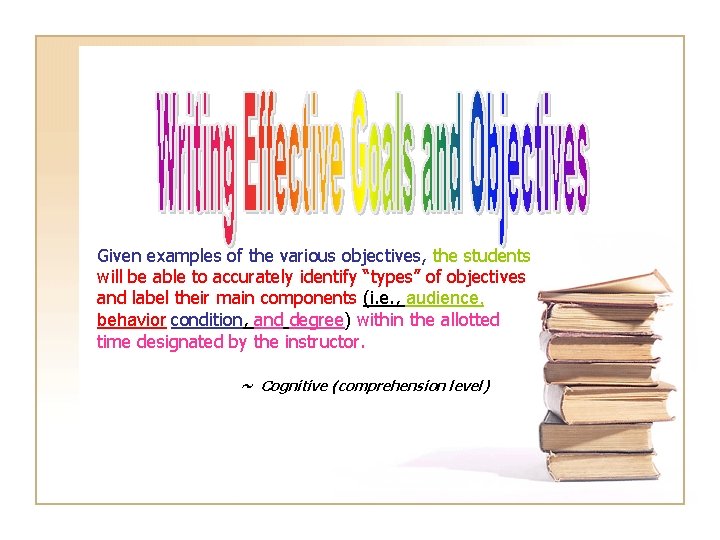
Given examples of the various objectives, the students will be able to accurately identify “types” of objectives and label their main components (i. e. , audience, behavior condition, and degree) within the allotted time designated by the instructor. ~ Cognitive (comprehension level)
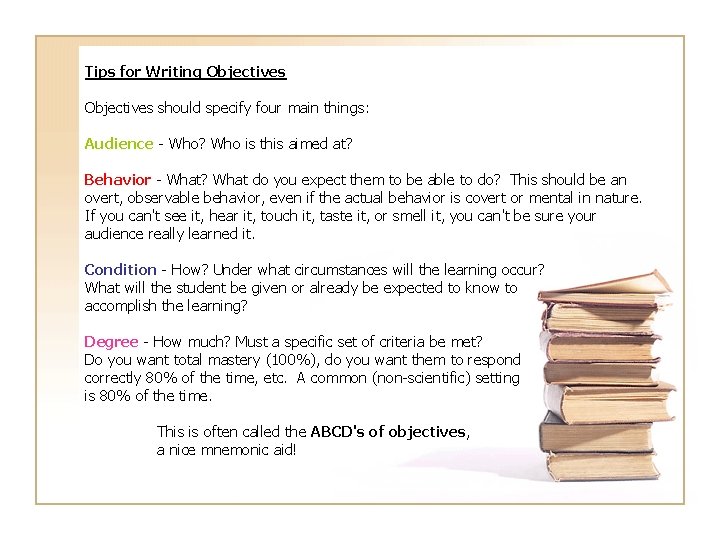
Tips for Writing Objectives should specify four main things: Audience - Who? Who is this aimed at? Behavior - What? What do you expect them to be able to do? This should be an overt, observable behavior, even if the actual behavior is covert or mental in nature. If you can't see it, hear it, touch it, taste it, or smell it, you can't be sure your audience really learned it. Condition - How? Under what circumstances will the learning occur? What will the student be given or already be expected to know to accomplish the learning? Degree - How much? Must a specific set of criteria be met? Do you want total mastery (100%), do you want them to respond correctly 80% of the time, etc. A common (non-scientific) setting is 80% of the time. This is often called the ABCD's of objectives, a nice mnemonic aid!
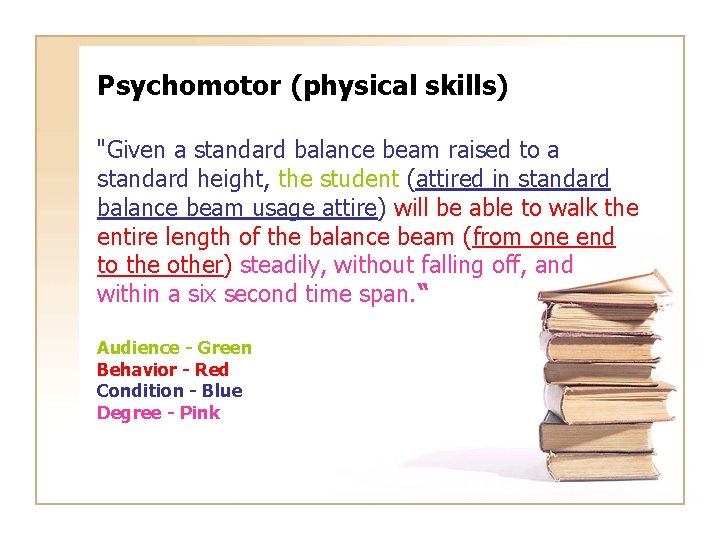
Psychomotor (physical skills) "Given a standard balance beam raised to a standard height, the student (attired in standard balance beam usage attire) will be able to walk the entire length of the balance beam (from one end to the other) steadily, without falling off, and within a six second time span. “ Audience - Green Behavior - Red Condition - Blue Degree - Pink
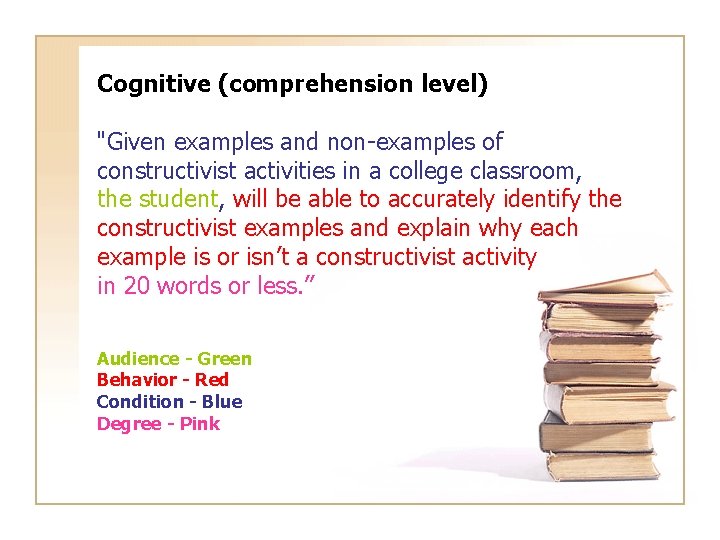
Cognitive (comprehension level) "Given examples and non-examples of constructivist activities in a college classroom, the student, will be able to accurately identify the constructivist examples and explain why each example is or isn’t a constructivist activity in 20 words or less. ” Audience - Green Behavior - Red Condition - Blue Degree - Pink
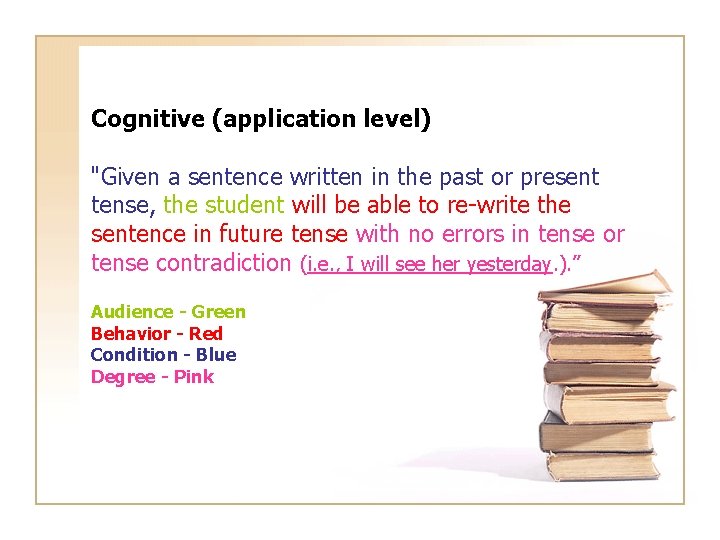
Cognitive (application level) "Given a sentence written in the past or present tense, the student will be able to re-write the sentence in future tense with no errors in tense or tense contradiction (i. e. , I will see her yesterday. ). ” Audience - Green Behavior - Red Condition - Blue Degree - Pink
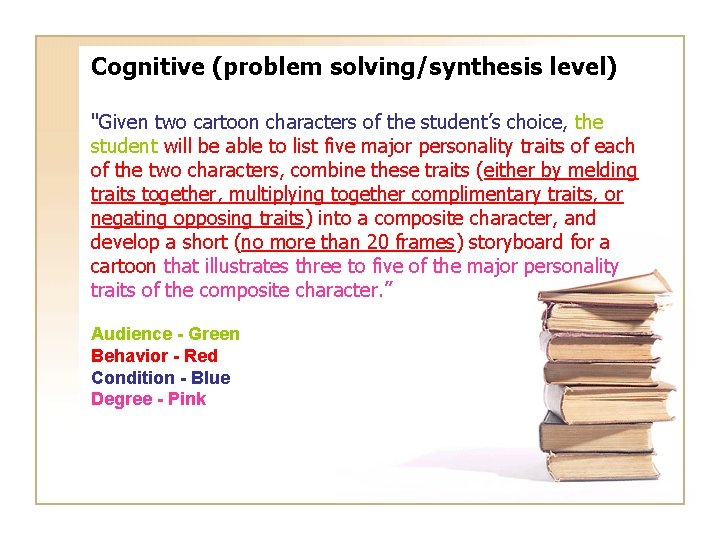
Cognitive (problem solving/synthesis level) "Given two cartoon characters of the student’s choice, the student will be able to list five major personality traits of each of the two characters, combine these traits (either by melding traits together, multiplying together complimentary traits, or negating opposing traits) into a composite character, and develop a short (no more than 20 frames) storyboard for a cartoon that illustrates three to five of the major personality traits of the composite character. ” Audience - Green Behavior - Red Condition - Blue Degree - Pink
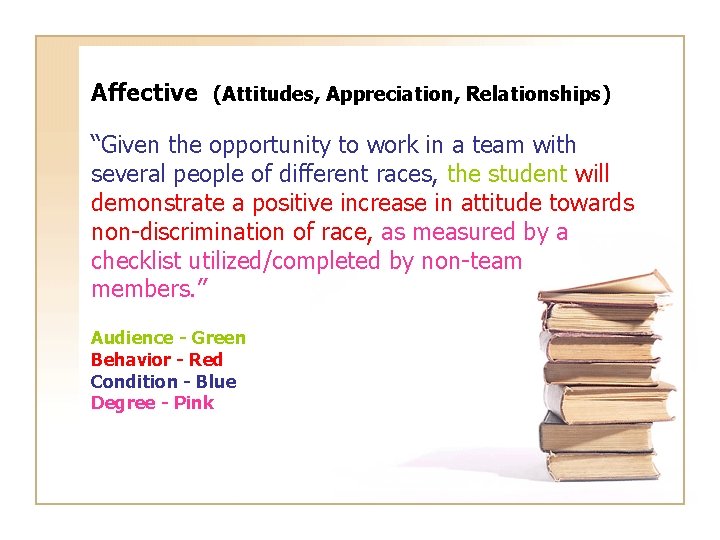
Affective (Attitudes, Appreciation, Relationships) “Given the opportunity to work in a team with several people of different races, the student will demonstrate a positive increase in attitude towards non-discrimination of race, as measured by a checklist utilized/completed by non-team members. ” Audience - Green Behavior - Red Condition - Blue Degree - Pink

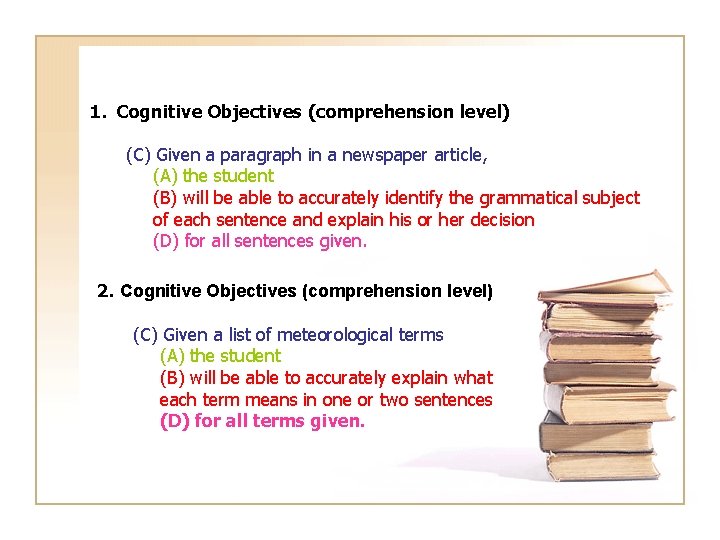
1. Cognitive Objectives (comprehension level) (C) Given a paragraph in a newspaper article, (A) the student (B) will be able to accurately identify the grammatical subject of each sentence and explain his or her decision (D) for all sentences given. 2. Cognitive Objectives (comprehension level) (C) Given a list of meteorological terms (A) the student (B) will be able to accurately explain what each term means in one or two sentences (D) for all terms given.
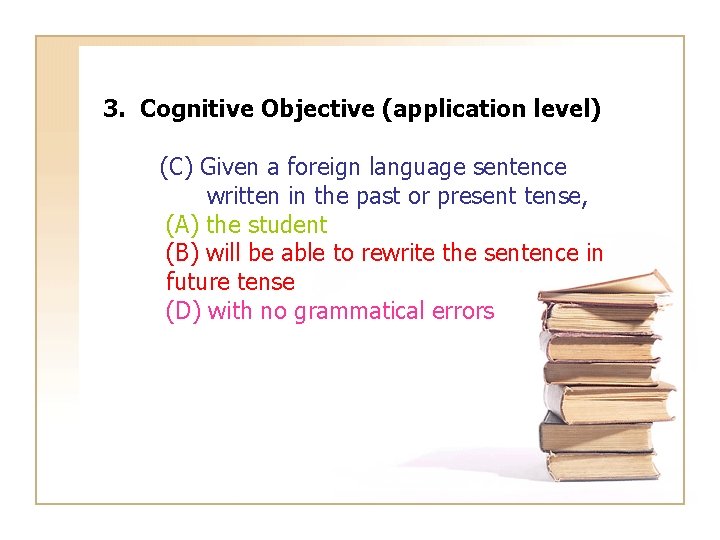
3. Cognitive Objective (application level) (C) Given a foreign language sentence written in the past or present tense, (A) the student (B) will be able to rewrite the sentence in future tense (D) with no grammatical errors
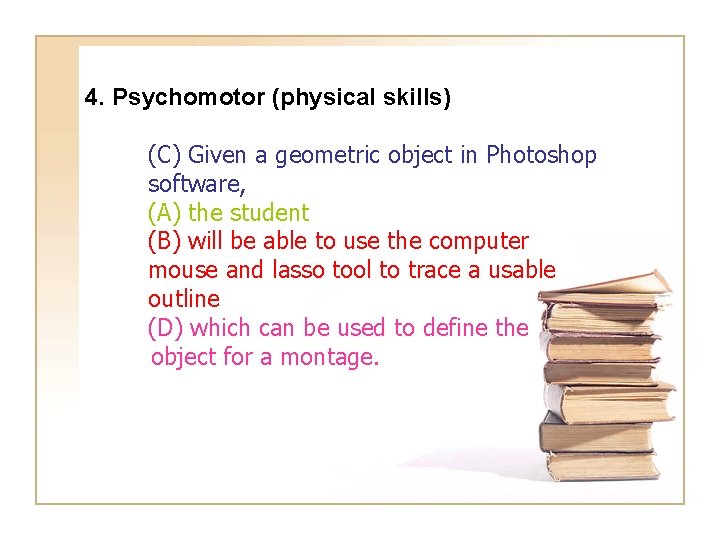
4. Psychomotor (physical skills) (C) Given a geometric object in Photoshop software, (A) the student (B) will be able to use the computer mouse and lasso tool to trace a usable outline (D) which can be used to define the object for a montage.
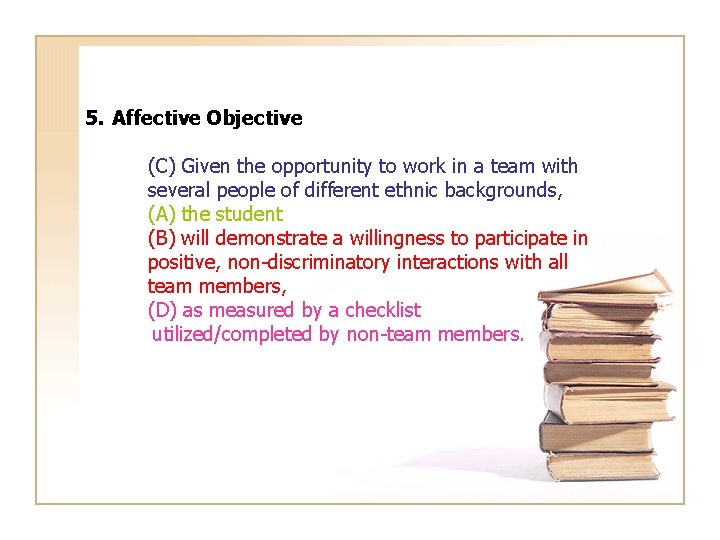
5. Affective Objective (C) Given the opportunity to work in a team with several people of different ethnic backgrounds, (A) the student (B) will demonstrate a willingness to participate in positive, non-discriminatory interactions with all team members, (D) as measured by a checklist utilized/completed by non-team members.
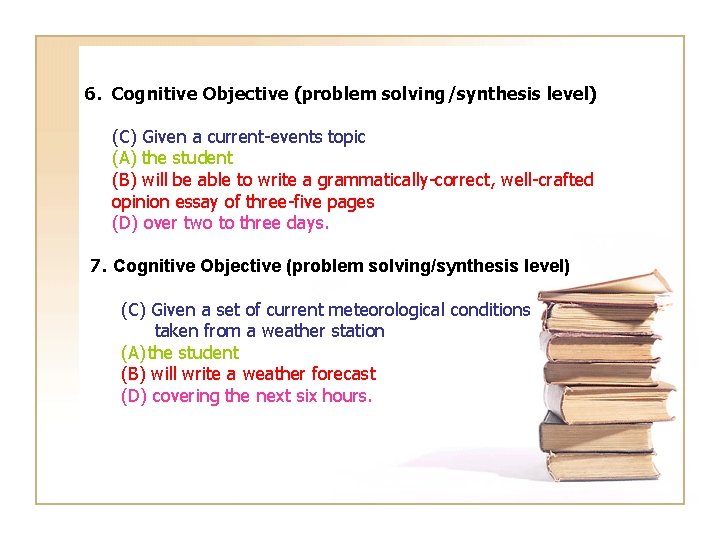
6. Cognitive Objective (problem solving/synthesis level) (C) Given a current-events topic (A) the student (B) will be able to write a grammatically-correct, well-crafted opinion essay of three-five pages (D) over two to three days. 7. Cognitive Objective (problem solving/synthesis level) (C) Given a set of current meteorological conditions taken from a weather station (A) the student (B) will write a weather forecast (D) covering the next six hours.

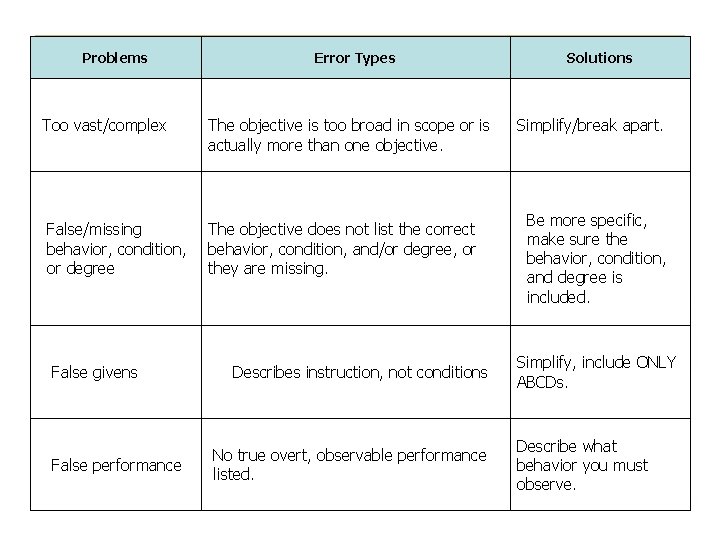
Problems Too vast/complex False/missing behavior, condition, or degree False givens False performance Error Types The objective is too broad in scope or is actually more than one objective. The objective does not list the correct behavior, condition, and/or degree, or they are missing. Describes instruction, not conditions No true overt, observable performance listed. Solutions Simplify/break apart. Be more specific, make sure the behavior, condition, and degree is included. Simplify, include ONLY ABCDs. Describe what behavior you must observe.
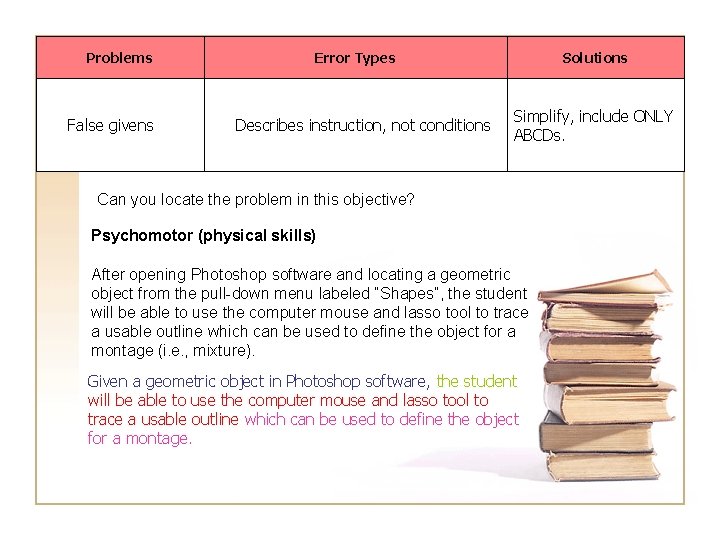
Problems False givens Error Types Describes instruction, not conditions Solutions Simplify, include ONLY ABCDs. Can you locate the problem in this objective? Psychomotor (physical skills) After opening Photoshop software and locating a geometric object from the pull-down menu labeled “Shapes”, the student will be able to use the computer mouse and lasso tool to trace a usable outline which can be used to define the object for a montage (i. e. , mixture). Given a geometric object in Photoshop software, the student will be able to use the computer mouse and lasso tool to trace a usable outline which can be used to define the object for a montage.
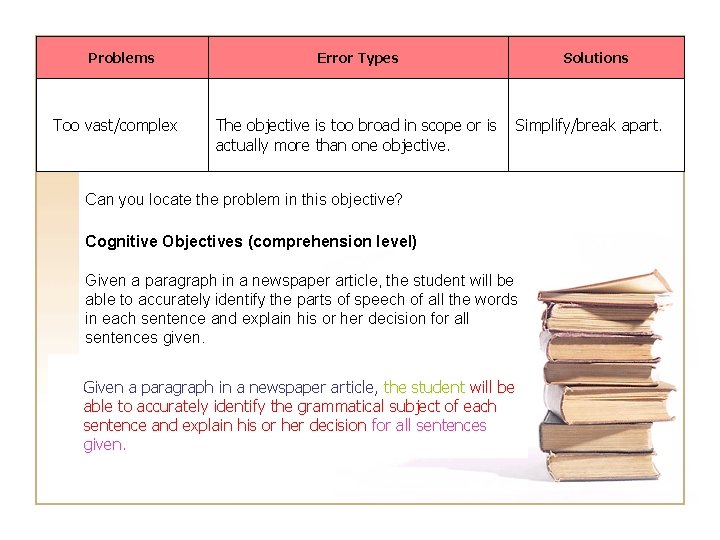
Problems Too vast/complex Error Types The objective is too broad in scope or is actually more than one objective. Solutions Simplify/break apart. Can you locate the problem in this objective? Cognitive Objectives (comprehension level) Given a paragraph in a newspaper article, the student will be able to accurately identify the parts of speech of all the words in each sentence and explain his or her decision for all sentences given. Given a paragraph in a newspaper article, the student will be able to accurately identify the grammatical subject of each sentence and explain his or her decision for all sentences given.
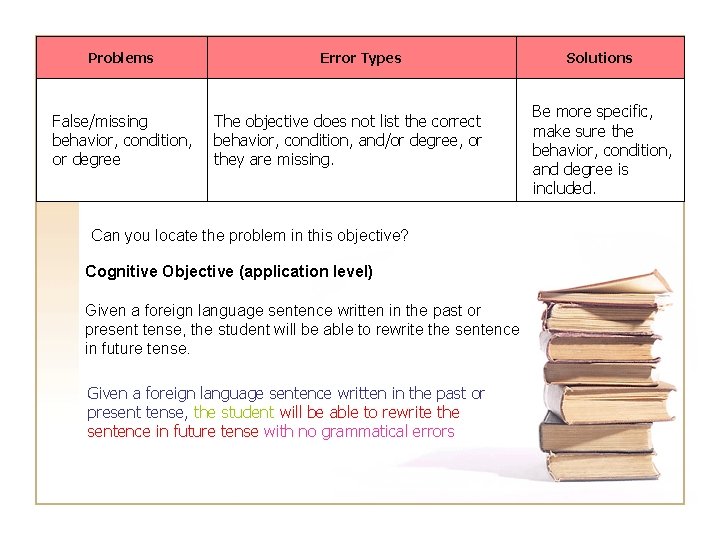
Problems False/missing behavior, condition, or degree Error Types The objective does not list the correct behavior, condition, and/or degree, or they are missing. Can you locate the problem in this objective? Cognitive Objective (application level) Given a foreign language sentence written in the past or present tense, the student will be able to rewrite the sentence in future tense with no grammatical errors Solutions Be more specific, make sure the behavior, condition, and degree is included.
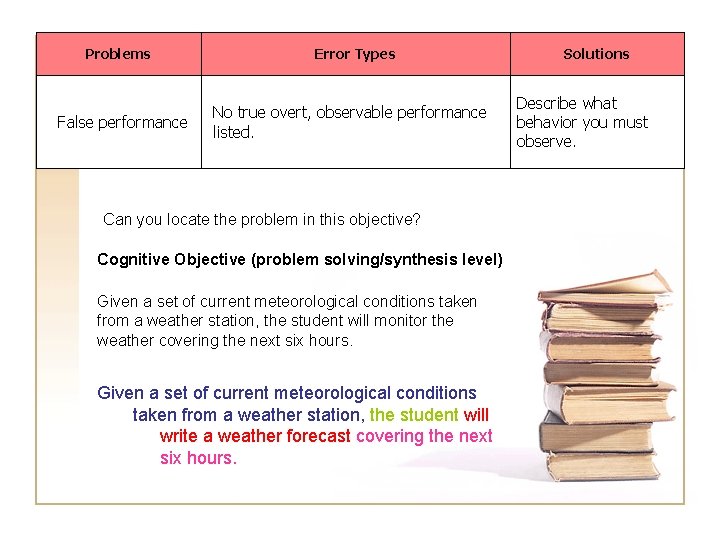
Problems False performance Error Types No true overt, observable performance listed. Can you locate the problem in this objective? Cognitive Objective (problem solving/synthesis level) Given a set of current meteorological conditions taken from a weather station, the student will monitor the weather covering the next six hours. Given a set of current meteorological conditions taken from a weather station, the student will write a weather forecast covering the next six hours. Solutions Describe what behavior you must observe.
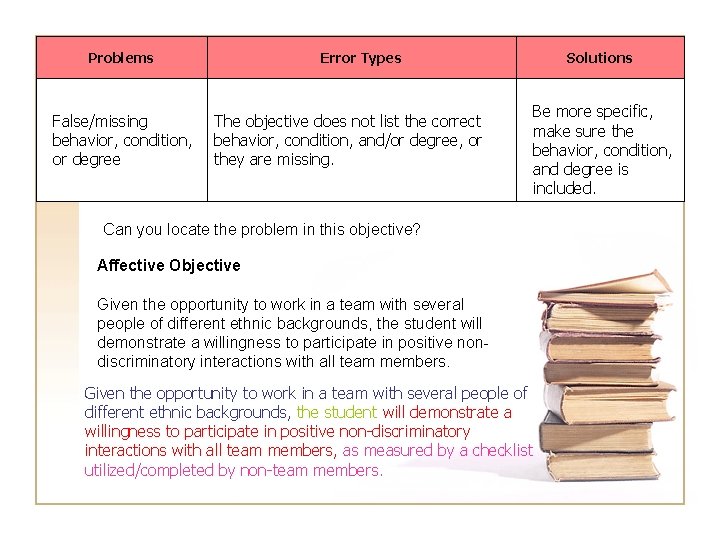
Problems False/missing behavior, condition, or degree Error Types The objective does not list the correct behavior, condition, and/or degree, or they are missing. Can you locate the problem in this objective? Affective Objective Given the opportunity to work in a team with several people of different ethnic backgrounds, the student will demonstrate a willingness to participate in positive nondiscriminatory interactions with all team members. Given the opportunity to work in a team with several people of different ethnic backgrounds, the student will demonstrate a willingness to participate in positive non-discriminatory interactions with all team members, as measured by a checklist utilized/completed by non-team members. Solutions Be more specific, make sure the behavior, condition, and degree is included.
With your team, write two clear objectives, using the knowledge you gained today, for your 5 -E Group Lesson Plan.
- Slides: 21