
Give Me Liberty Chapter 4 Slavery And Empire
Give Me Liberty! Chapter 4
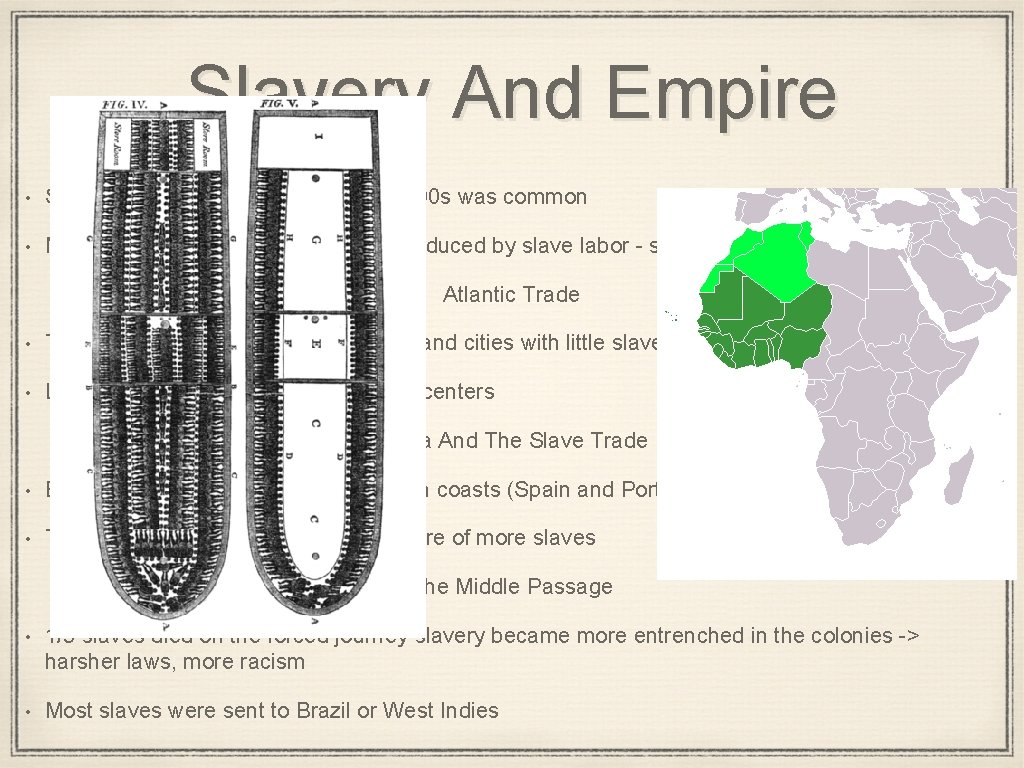
Slavery And Empire • Slavery in the British Empire in the 1700 s was common • Many goods that were traded were produced by slave labor - sugar, tobacco, etc. Atlantic Trade • Triangular Trade benefitted port cities and cities with little slaves • Liverpool and Bristol became banking centers Africa And The Slave Trade • Europeans went further into the African coasts (Spain and Portugal) • The use of guns encouraged the capture of more slaves The Middle Passage • 1/5 slaves died on the forced journey slavery became more entrenched in the colonies -> harsher laws, more racism • Most slaves were sent to Brazil or West Indies
Slavery And Empire • Remember Chesapeake Slavery when I burned down Tobacco-based slavery was a main source of income for Chesapeake Jamestown? plantations • • Post-Bacon’s Rebellion Politicians were/had ties to planter elites and defended/encouraged the growth of slavery Freedom And Slavery In The Chesapeake • A master’s power over slaves increased over time • Free blacks lost rights - couldn’t bear arms, loss of suffrage Indian Slavery In Early Carolina • Creek Indians in SC and GA captured and sold slaves -> West Indies
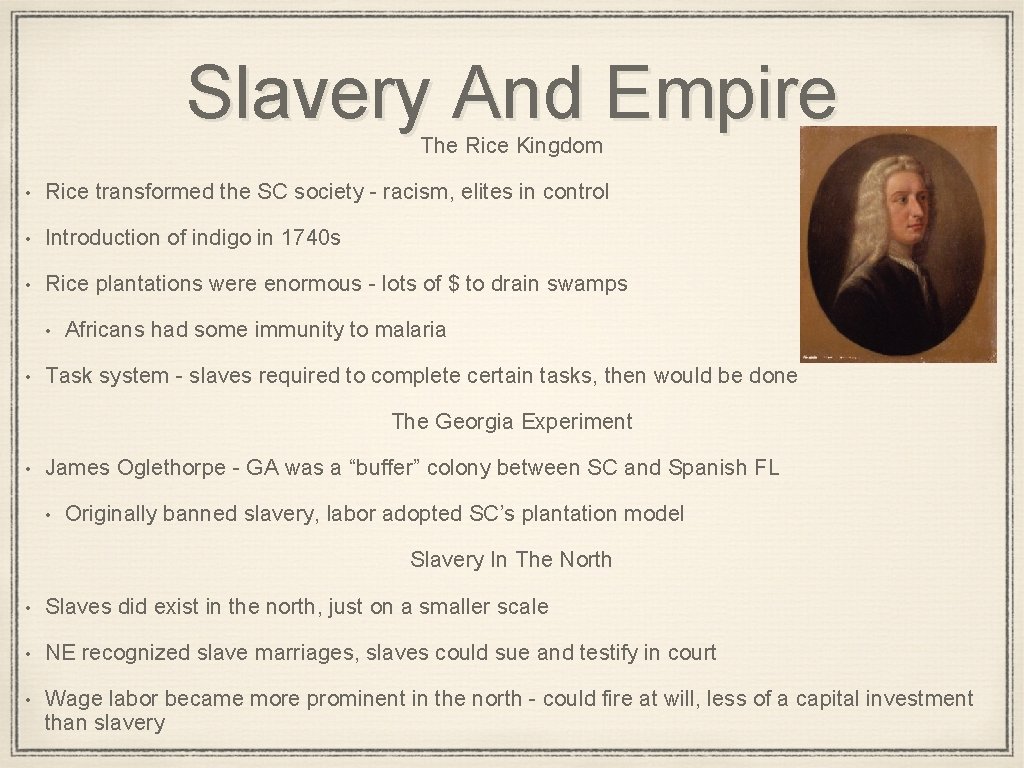
Slavery And Empire The Rice Kingdom • Rice transformed the SC society - racism, elites in control • Introduction of indigo in 1740 s • Rice plantations were enormous - lots of $ to drain swamps • • Africans had some immunity to malaria Task system - slaves required to complete certain tasks, then would be done The Georgia Experiment • James Oglethorpe - GA was a “buffer” colony between SC and Spanish FL • Originally banned slavery, labor adopted SC’s plantation model Slavery In The North • Slaves did exist in the north, just on a smaller scale • NE recognized slave marriages, slaves could sue and testify in court • Wage labor became more prominent in the north - could fire at will, less of a capital investment than slavery
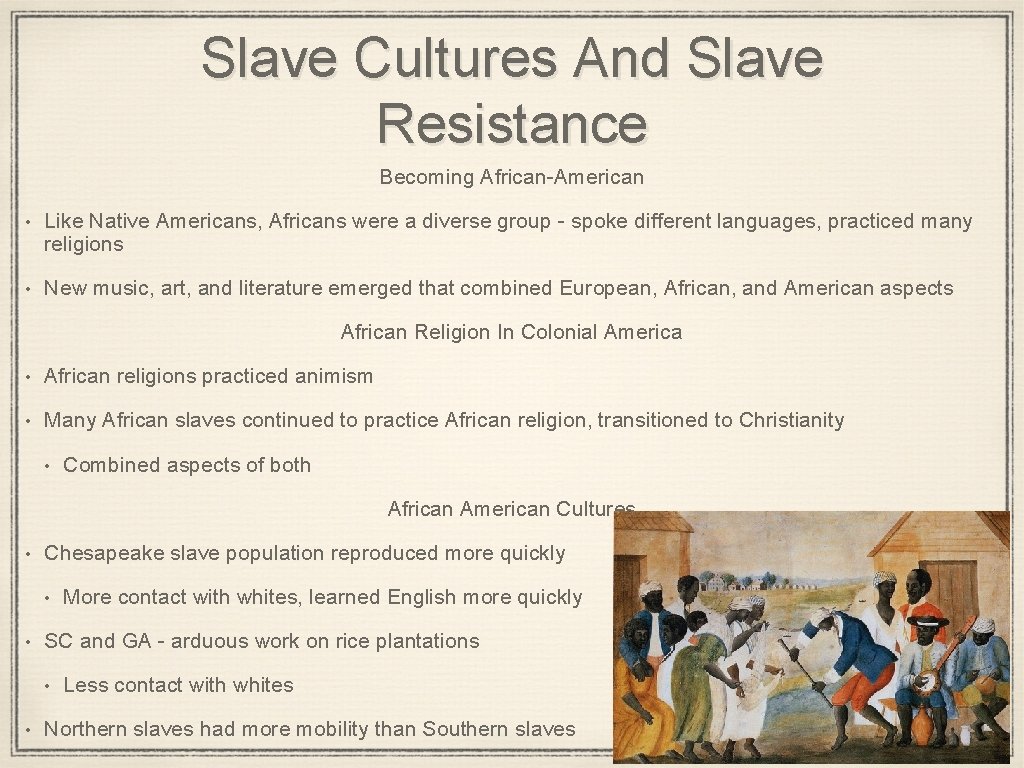
Slave Cultures And Slave Resistance Becoming African-American • Like Native Americans, Africans were a diverse group - spoke different languages, practiced many religions • New music, art, and literature emerged that combined European, African, and American aspects African Religion In Colonial America • African religions practiced animism • Many African slaves continued to practice African religion, transitioned to Christianity • Combined aspects of both African American Cultures • Chesapeake slave population reproduced more quickly • • SC and GA - arduous work on rice plantations • • More contact with whites, learned English more quickly Less contact with whites Northern slaves had more mobility than Southern slaves
Slave Cultures And Slave Resistance to Slavery • Newspapers were often filled with ads for runaway slaves • NYC Slave Rebellion • • Slaves set fires to houses, killed 9 whites • Many slaves were executed in response Maroon Communities - made up of runaway slaves, distinct cultures The Crisis of 1739 - 1741 • Stono Rebellion (SC) • Slaves tried to flee to Spanish FL, killed whites along the way • Many slaves were executed • Stronger slave codes were enacted as a result
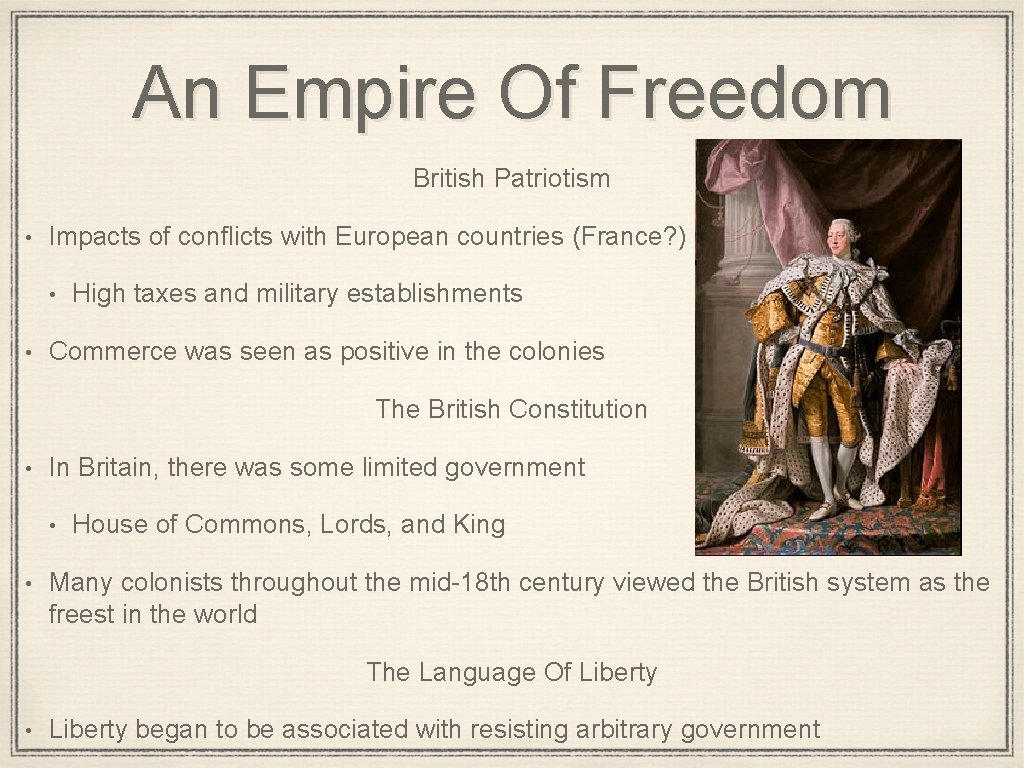
An Empire Of Freedom British Patriotism • Impacts of conflicts with European countries (France? ) • • High taxes and military establishments Commerce was seen as positive in the colonies The British Constitution • In Britain, there was some limited government • • House of Commons, Lords, and King Many colonists throughout the mid-18 th century viewed the British system as the freest in the world The Language Of Liberty • Liberty began to be associated with resisting arbitrary government
An Empire Of Freedom Republican Liberty • Republicanism - promoted public life participation by being economically independent • Belief that property-owners were the only ones to possess virtue Liberal Freedom • Liberalism - focused on individuals and private life • Government should protect natural rights (John Locke) • Liberalism focused on protection of property (including slaves) • Many women and slaves began to challenge their state based on the belief of natural rights
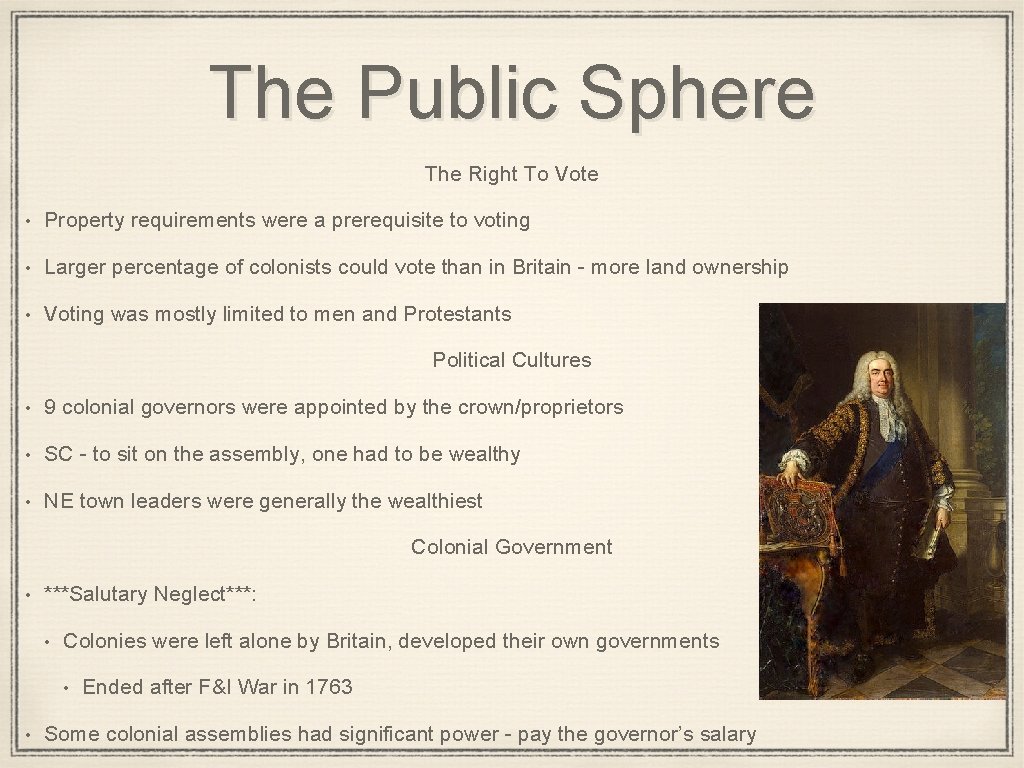
The Public Sphere The Right To Vote • Property requirements were a prerequisite to voting • Larger percentage of colonists could vote than in Britain - more land ownership • Voting was mostly limited to men and Protestants Political Cultures • 9 colonial governors were appointed by the crown/proprietors • SC - to sit on the assembly, one had to be wealthy • NE town leaders were generally the wealthiest Colonial Government • ***Salutary Neglect***: • Colonies were left alone by Britain, developed their own governments • • Ended after F&I War in 1763 Some colonial assemblies had significant power - pay the governor’s salary
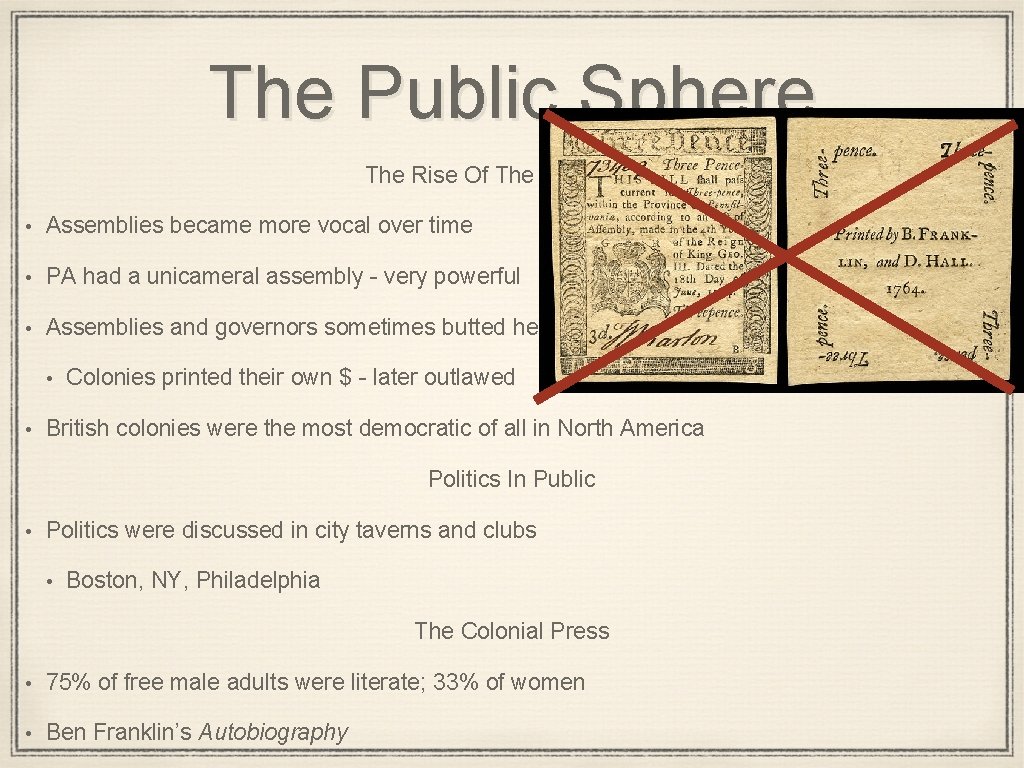
The Public Sphere The Rise Of The Assemblies • Assemblies became more vocal over time • PA had a unicameral assembly - very powerful • Assemblies and governors sometimes butted heads • • Colonies printed their own $ - later outlawed British colonies were the most democratic of all in North America Politics In Public • Politics were discussed in city taverns and clubs • Boston, NY, Philadelphia The Colonial Press • 75% of free male adults were literate; 33% of women • Ben Franklin’s Autobiography
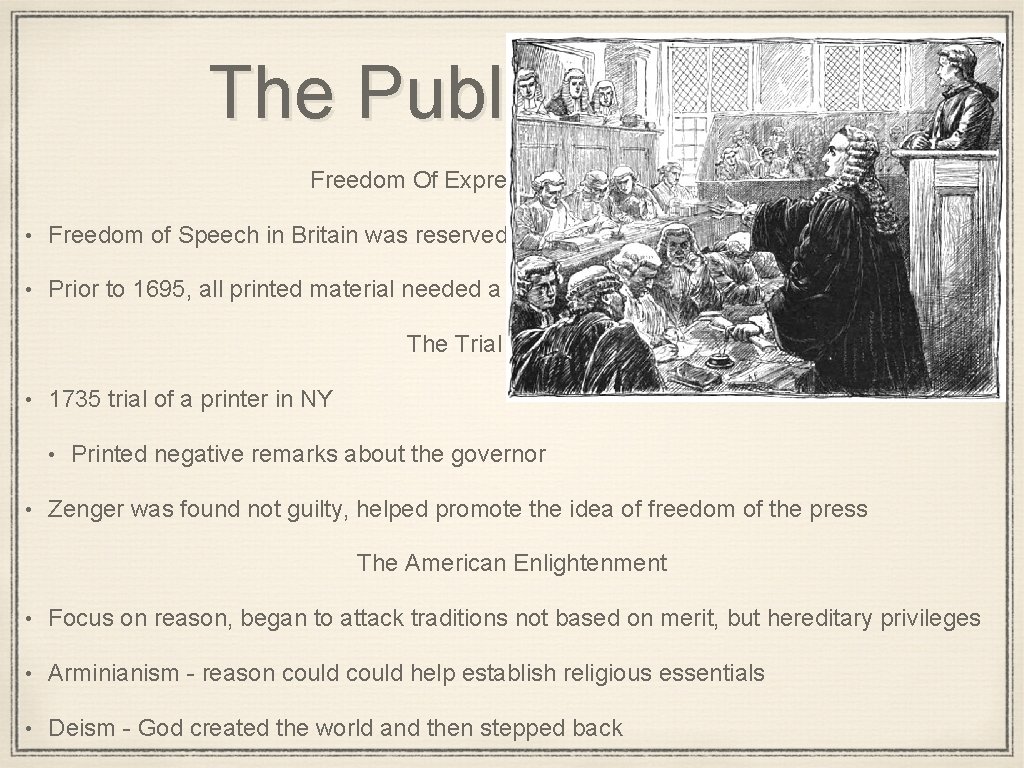
The Public Sphere Freedom Of Expression And Its Limits • Freedom of Speech in Britain was reserved for legislators, not citizens • Prior to 1695, all printed material needed a government license The Trial Of Zenger • 1735 trial of a printer in NY • • Printed negative remarks about the governor Zenger was found not guilty, helped promote the idea of freedom of the press The American Enlightenment • Focus on reason, began to attack traditions not based on merit, but hereditary privileges • Arminianism - reason could help establish religious essentials • Deism - God created the world and then stepped back
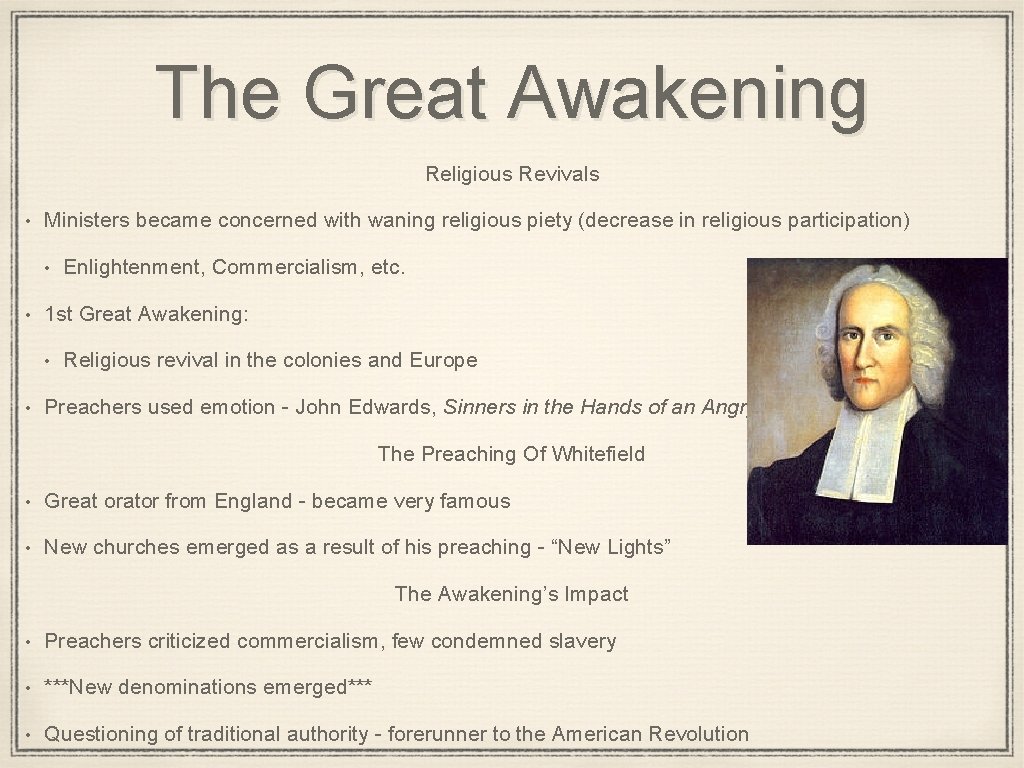
The Great Awakening Religious Revivals • Ministers became concerned with waning religious piety (decrease in religious participation) • • 1 st Great Awakening: • • Enlightenment, Commercialism, etc. Religious revival in the colonies and Europe Preachers used emotion - John Edwards, Sinners in the Hands of an Angry God The Preaching Of Whitefield • Great orator from England - became very famous • New churches emerged as a result of his preaching - “New Lights” The Awakening’s Impact • Preachers criticized commercialism, few condemned slavery • ***New denominations emerged*** • Questioning of traditional authority - forerunner to the American Revolution

Imperial Rivalries Spanish North America • Controlled Mexico, SW US, Great Plains, LA Purchase after 1763 • Colonized TX beginning in early 1700 s • Presidios - military outposts The Spanish In California • Many presidios were established in CA • Many natives died after Spain settled • Spain sought to assimilate the natives The French Empire • Present-day Canada and Mississippi River Valley • Much smaller population than the British colonists (only 65, 000) • Active trade alliances with Natives
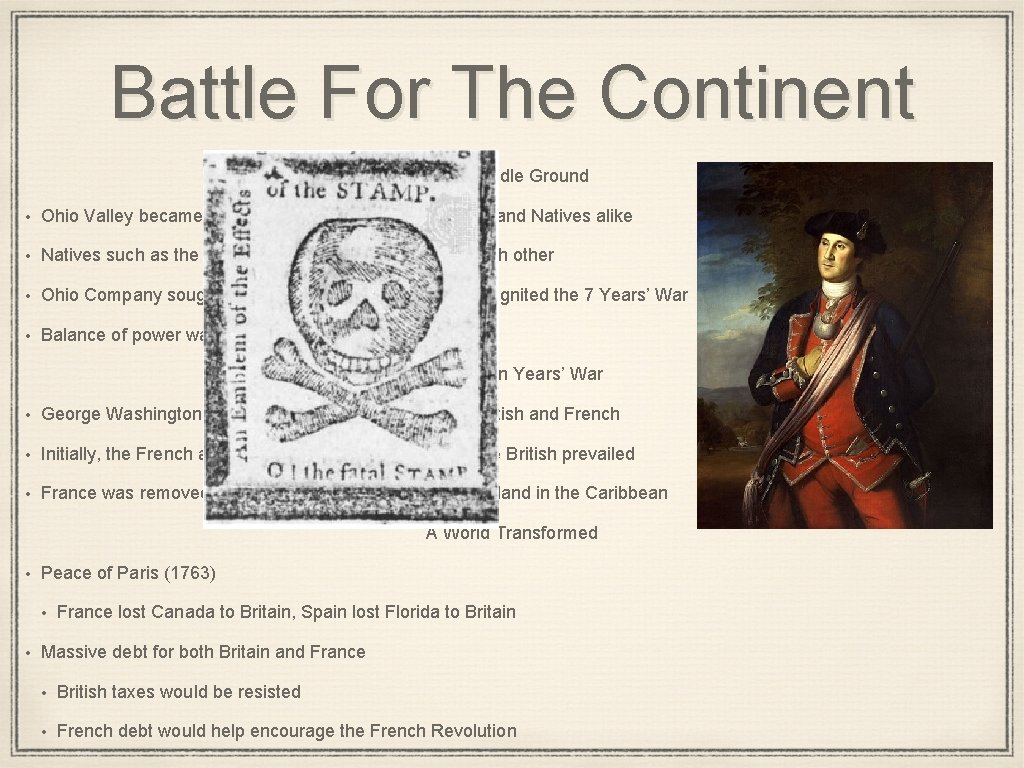
Battle For The Continent The Middle Ground • Ohio Valley became very important for England, France, and Natives alike • Natives such as the Iroquois played Europeans off of each other • Ohio Company sought land recognition from France and ignited the 7 Years’ War • Balance of power was forever altered in North America The Seven Years’ War • George Washington helped start the war between the British and French • Initially, the French and Natives were successful, later the British prevailed • France was removed from North America, Britain gained land in the Caribbean A World Transformed • Peace of Paris (1763) • • France lost Canada to Britain, Spain lost Florida to Britain Massive debt for both Britain and France • British taxes would be resisted • French debt would help encourage the French Revolution
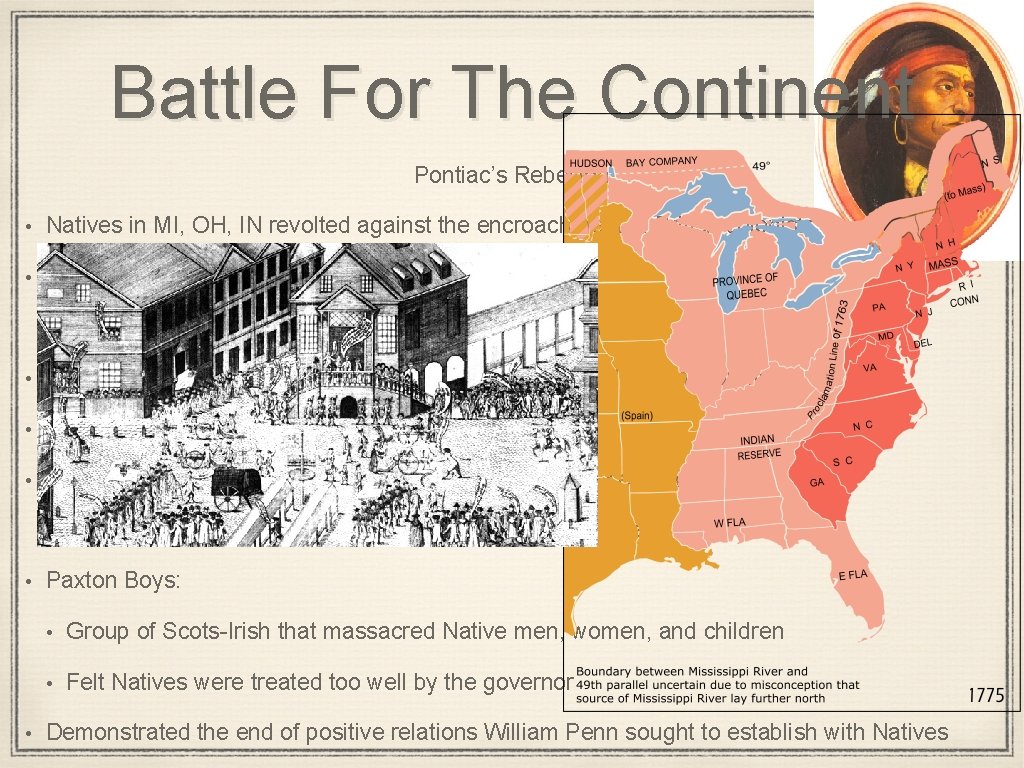
Battle For The Continent Pontiac’s Rebellion • Natives in MI, OH, IN revolted against the encroachment of British colonists • Helped lead directly to the……. . The Proclamation Line • 1763 - prohibited westward expansion beyond the Appalachian Mountains • Natives could NOT sell land to colonists • Colonists were FURIOUS - fought for the land in the 7 Years’ War Pennsylvania And The Indians • • Paxton Boys: • Group of Scots-Irish that massacred Native men, women, and children • Felt Natives were treated too well by the governor Demonstrated the end of positive relations William Penn sought to establish with Natives
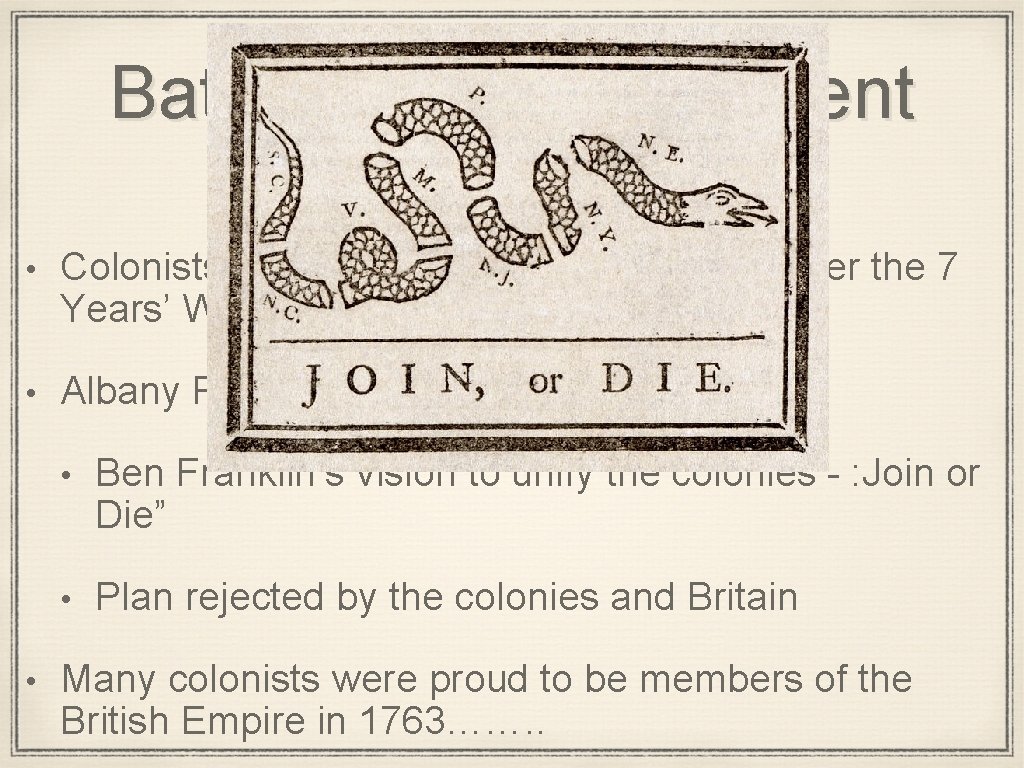
Battle For The Continent Colonial Identities • Colonists became a more unified identity after the 7 Years’ War • Albany Plan of Union (1754) • • Ben Franklin’s vision to unify the colonies - : Join or Die” • Plan rejected by the colonies and Britain Many colonists were proud to be members of the British Empire in 1763……. .
Quick Recap Middle Passage Slavery in the Chesapeake vs. SC/GA Creation of GA African religions/cultures and how they blended with America Slave Rebellions - NYC and Stono Voting requirements Power of colonial assemblies John Peter Zenger Edwards, Whitefield, The Great Awakening and its impacts 7 Years’ War Pontiac’s Rebellion -> Proclamation Line of 1763 Paxton Boys Albany Plan of Union
See You Back Here For Chapter 5! Thanks for watching Subscribe and share Check out other videos in the description Good luck in May!

Thesis X, however, 1, 2, 3, y
- Slides: 19