
GIS Standards and Interoperability Understanding and Using GML
GIS Standards and Interoperability: Understanding and Using GML David Arctur, Ph. D (ESRI) Co-chair, OGC Simple Features Revision Working Group Co-chair, OGC GML-SF Revision Working Group Co-chair, OGC Web Feature Service Working Group
Geospatial Data Exchange Today • Today there a number of approaches, sometimes called design patterns, for accomplishing geospatial data exchange between dissimilar systems – File based approach: geographic data is encoded in a structured file format, for batch transfer or download – Application programming interface (API) approach: geographic data is accessed and exchanged as needed between software systems on the same workstation, often interactively with the user – Web services approach: geographic data is accessed and exchanged over networks and the Internet between software components, using http and other web based protocols
Geospatial Data Exchange Standards • Geography Markup Language (GML) has its roots in decades-old geo-data exchange standards – US Geological Survey’s Digital Line Graph (DLG) – US Spatial Data Transfer Standard (SDTS) – – Canada’s Spatial Archive and Interchange Format (SAIF) …and many others • These have all been developed to solve the problem of packaging geospatial data in a file format independent of any GIS vendor’s software
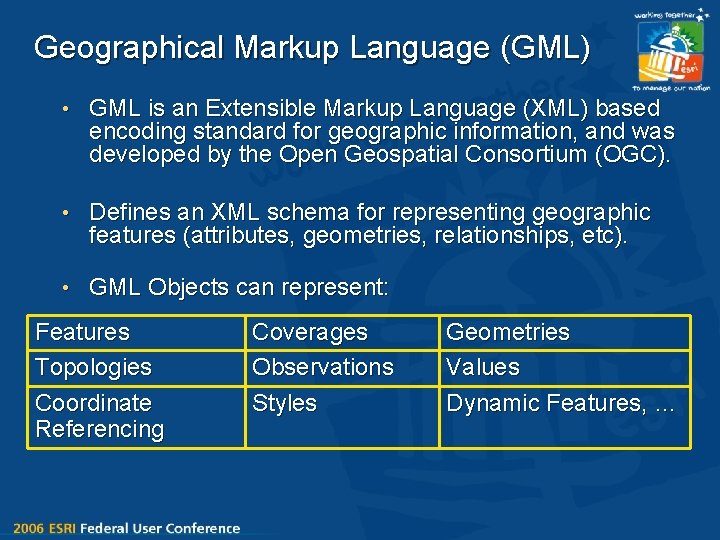
Geographical Markup Language (GML) • GML is an Extensible Markup Language (XML) based encoding standard for geographic information, and was developed by the Open Geospatial Consortium (OGC). • Defines an XML schema for representing geographic features (attributes, geometries, relationships, etc). • GML Objects can represent: Features Topologies Coordinate Referencing Coverages Observations Styles Geometries Values Dynamic Features, …
GML and XML • Because GML is based on XML, it leverages a wealth of standards, tools and practices for data exchange being developed by several consortia around the world • Standard XML technologies exist… – for encoding and data modeling expression (DTD, RDF and XSD) – for linking and associating resources (XLink) – for selecting and pointing (XPath, XPointer) – for transforming content (XSLT) – for graphical rendering (SVG, VML, X 3 D)
GML Evolution • ESRI presently implements GML 2. 1. 2 – Simple geometry model (points, lines, polygons with linear interpolation) • Moving to GML 3 – GML 3. x = 2. x + temporality + coordinate reference systems + units of measure + coverages + non-linear geometries + topology + …) • But GML 3 defines several complex entities such as topologies, dynamic features, and nested features, and these entities have many optional aspects. This impacts the way GML consumers would process a data exchange, as well as the potential for achieving interoperability.
Schemas and Profiles: Harnessing the functionality in GML • GML Core Schema (Developed by OGC) – Features, coverages, observations & measures – Geometry, coordinate reference system – Metadata, other common geospatial constructs – Rules for extending GML schemas • GML Profiles (OGC) – Selected subset of elements from GML – Current: Point Profile, Simple Features Profile, GML in JPEG 2000 – Future: Feature Profile, Grid Coverage Profile, CRS Profile, … • Application Schemas (Domain users) – Data models for common application domains, built on GML core schema and profiles – Transportation model; Hydrographic model; Land information model
GML Simple Features (GML-SF) Profile • Profile defines a prescribed subset of GML 3 • Simple, “fixed” schema (no dynamic or nested • • features) Simple geometry (point, linestring, polygon, aggregates) Dynamic enumerations ok No topology …
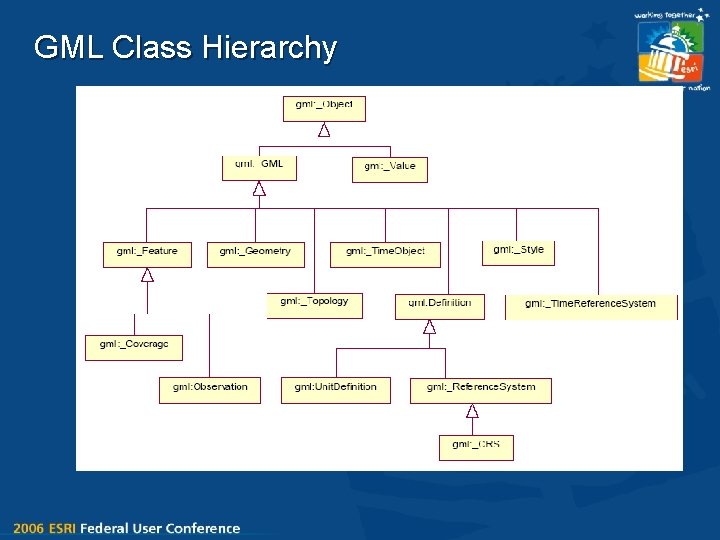
GML Class Hierarchy
GML Simple Features Profile: Why Needed? • Initially motivated to help WFS’ use of GML 3 • GML 3 enables dynamic creation of application schema, which complicates GML parsers • GML SF Profile “fixes” application schemas to only allow the elements prescribed in the profile • This allows WFS servers and clients to be more efficient; the types of data which they need to anticipate are finite and reasonably structured for fast parsing
GML Simple Features Profile: Why Needed (cont’d) • Can be the basis for users’ application schemas – As long as the schema elements required for the data model are defined within the GML-SF Profile • The geometry model will be coordinated with SQL/MM spec development now underway at ISO
GML Simple Features Profile: Recent Progress • GML-SF started out as GML 3 Level 0 in 2003 – GML 2 was already “GML for Simple Features” • Extra push to complete this as a Simple Features Profile of GML 3, starting in Jan’ 05 – Fixed schema – 3 D coordinates – Simple geometry (points, lines, polygons, multipart) – Dynamic codelists (eg, coded value domain lists) – Reference links (can href to other resources, eg, for handling foreign/primary keys) – Metadata links (can href to metadata)
![GML-SF: Compliance Levels • SF-2 : essentially same as OGC SF [SQL, COM, CORBA]](http://slidetodoc.com/presentation_image_h2/89b4f754a47ba6fb07f2330d3a010a83/image-13.jpg "GML-SF: Compliance Levels • SF-2 : essentially same as OGC SF [SQL, COM, CORBA]")
GML-SF: Compliance Levels • SF-2 : essentially same as OGC SF [SQL, COM, CORBA] • Restricted set of geometry property types • No restrictions on non-spatial properties, except for parts of GML that have been deprecated • SF-1 : same as SF-2 with the following restrictions: • Allows user-defined types for non-spatial properties • User-defined types must use simple data types specified in this profile • SF-0 : same as SF-1 with the following restrictions: • Allows only simple data types specified in this profile • Cardinality of property values can be at most 1 • NOTE: in practice, this is the most interoperable, and follows the practice of most implementers of original OGC Simple Features spec.
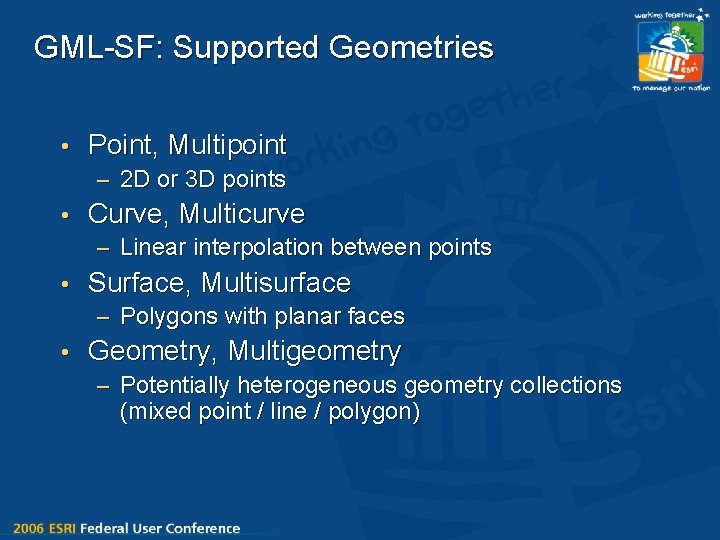
GML-SF: Supported Geometries • Point, Multipoint – 2 D or 3 D points • Curve, Multicurve – Linear interpolation between points • Surface, Multisurface – Polygons with planar faces • Geometry, Multigeometry – Potentially heterogeneous geometry collections (mixed point / line / polygon)
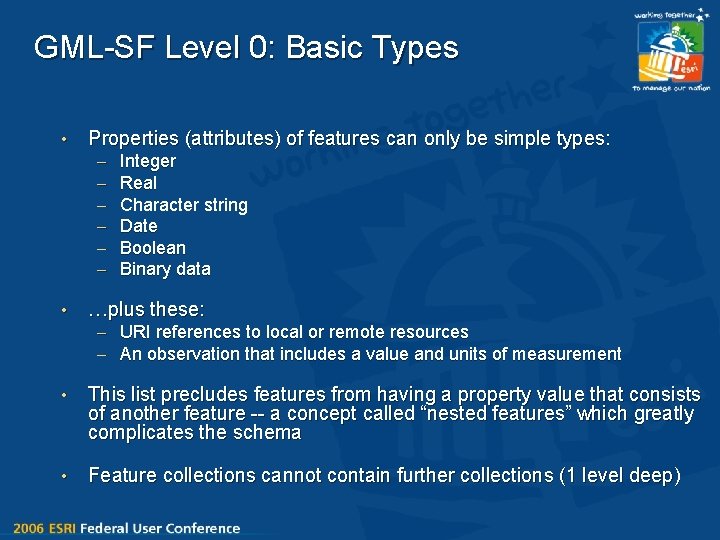
GML-SF Level 0: Basic Types • Properties (attributes) of features can only be simple types: – – – • Integer Real Character string Date Boolean Binary data …plus these: – URI references to local or remote resources – An observation that includes a value and units of measurement • This list precludes features from having a property value that consists of another feature -- a concept called “nested features” which greatly complicates the schema • Feature collections cannot contain further collections (1 level deep)
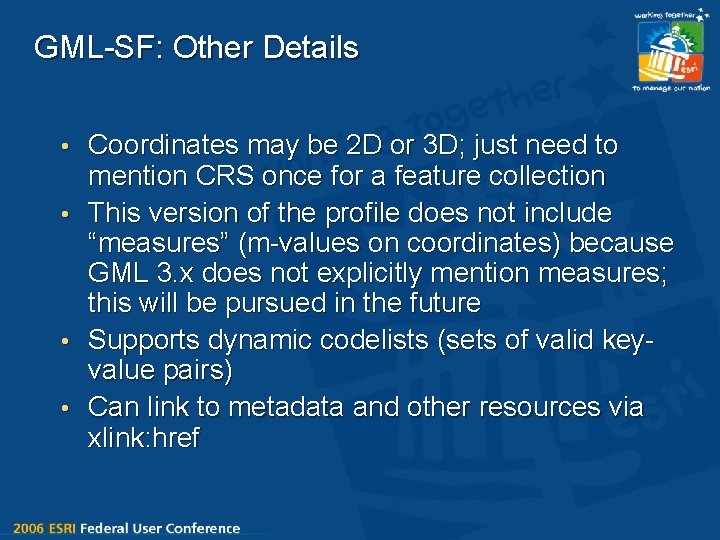
GML-SF: Other Details • Coordinates may be 2 D or 3 D; just need to mention CRS once for a feature collection • This version of the profile does not include “measures” (m-values on coordinates) because GML 3. x does not explicitly mention measures; this will be pursued in the future • Supports dynamic codelists (sets of valid keyvalue pairs) • Can link to metadata and other resources via xlink: href
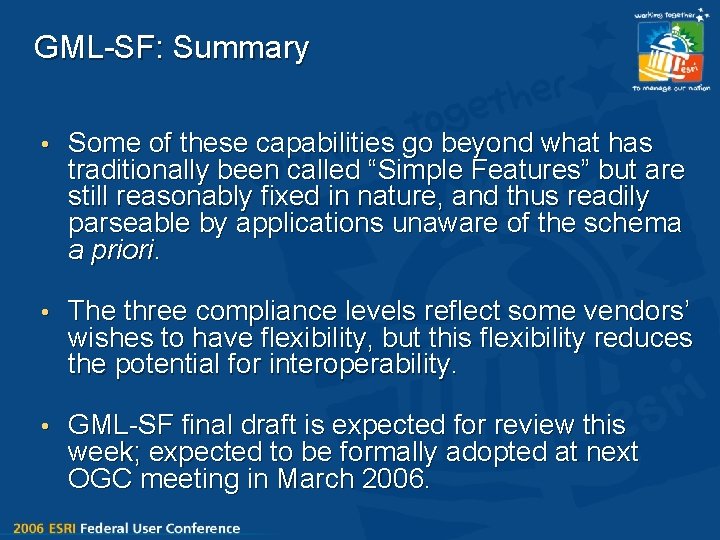
GML-SF: Summary • Some of these capabilities go beyond what has traditionally been called “Simple Features” but are still reasonably fixed in nature, and thus readily parseable by applications unaware of the schema a priori. • The three compliance levels reflect some vendors’ wishes to have flexibility, but this flexibility reduces the potential for interoperability. • GML-SF final draft is expected for review this week; expected to be formally adopted at next OGC meeting in March 2006.
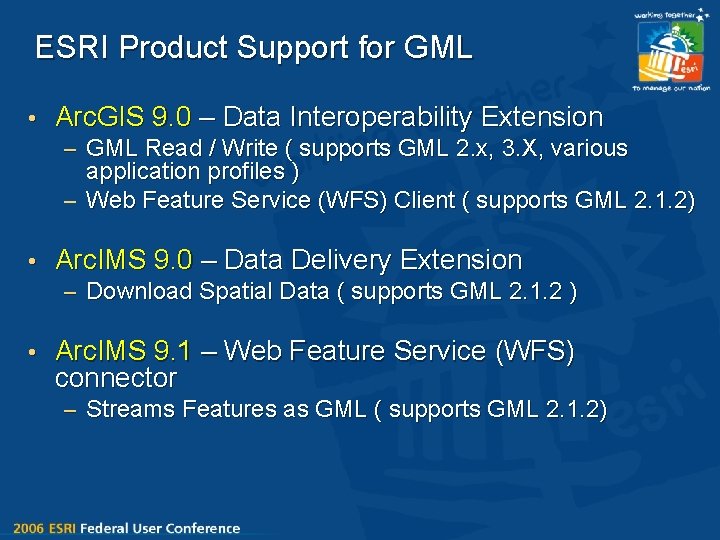
ESRI Product Support for GML • Arc. GIS 9. 0 – Data Interoperability Extension – GML Read / Write ( supports GML 2. x, 3. X, various application profiles ) – Web Feature Service (WFS) Client ( supports GML 2. 1. 2) • Arc. IMS 9. 0 – Data Delivery Extension – Download Spatial Data ( supports GML 2. 1. 2 ) • Arc. IMS 9. 1 – Web Feature Service (WFS) connector – Streams Features as GML ( supports GML 2. 1. 2)

Arc. GIS Data Interoperability Extension • Allows users to integrate many different spatial data formats into their GIS analysis directly. • Direct read for 65+ spatial data formats • Export of 50+ spatial data formats • Read / Write Support for GML formats include: GML 2. x, Top 10 NL, OS(GB) Master. Map (GML 2), … • WFS Client Support for GML 2. 1. 2 • Ability to diagram and model your own spatial data format • Ideal tool for consuming new GML application schemas. • Built by ESRI and Safe Software
Road Ahead - ESRI Planned Product Support for GML • Continue to Support new GML Profiles and Application Schemas • Provide out-of-the-box support for GML simple features profile
- Slides: 20