
GIS Interventions in the Punjab A Critical Review
GIS Interventions in the Punjab – A Critical Review COUNTRY PAPER BY SAI PAKISTAN 28 TH INTOSAI WGITA MEETING, NADI , FIJI
Abbreviations ADB BHU CMAP CNIC DG DGPS DMS DWIWG EPI FERRP GIS ICT i. LRMIS ISOR ISSN IT 28 th INTOSAI WGITA Meeting KPRRP Asian Development Bank Basic Health Unit Crime mapping & analysis program Computerized National Identity Card Director General Differential Global Positioning System Disaster Management System Digital Geographic Information Working Group Expanded Programme on Immunisation Flood Emergency Reconstruction & Resilience Project Geographic Information Systems Information and Communication Technology Integrated Land Record Information System International organization of Scientific Research International Standard Serial Number Information Technology Khadim-e Punjab Rural Roads Program 2/24/2021 2
Abbreviations MAPS NATO NDA NSDI OGC PDMA PITB PPMRP SDI SDTS SUPARCO TB UC UIPT 28 th INTOSAI WGITA Meeting Mapping and Analysis for Public Safety Program North Atlantic Treaty Organization Non-Disclosure Agreement National Spatial Data Infrastructure Open GIS consortium Punjab Disaster Management Authority Punjab Information Technology Board Punjab Public Management Reforms Program Spatial Data Infrastructure Spatial Data Transfer Standards Pakistan Space and Upper Atmosphere Research Commission Tuberculosis Union Councils Urban immovable property tax 2/24/2021 3
Sequence Of Presentation • • • Introduction Statement of the problem Scope of the study GIS concepts GIS in the Punjab 28 th INTOSAI WGITA Meeting 2/24/2021 4
Sequence Of Presentation …Contd. . • • Analysis of selected GIS projects Overall Critical Review of GIS implementation Conclusion Recommendations 28 th INTOSAI WGITA Meeting 2/24/2021 5
Introduction • GIS represents a modern-era manifestation of the impact Information Technology (IT) has made in various public and private sector operations • By digitizing the basic spatial information of an area, GIS has enabled an integrated real-time data-driven approach to government operations 28 th INTOSAI WGITA Meeting 2/24/2021 6
Introduction… Contd… • In Pakistan GIS has made foot prints as well • In recent years the provincial government of the Punjab has undertaken various GIS projects to modernize and enhance its service delivery • This paper looks to analyze such initiatives 28 th INTOSAI WGITA Meeting 2/24/2021 7
Statement Of The Problem • How and to what extent the government of the Punjab has undertaken GIS interventions? • Have the GIS solutions increased efficiency and significantly modernized the erstwhile traditional working to the target government offices? and • Have GIS interventions added value to the government services? 28 th INTOSAI WGITA Meeting 2/24/2021 8
Scope Of The Study • “Over-view” of GIS implementations in the province of Punjab only. • Detail analysis of two GIS interventions in the Punjab. • Broad assessment of the potential avenues for future GIS implementation. 28 th INTOSAI WGITA Meeting 2/24/2021 9
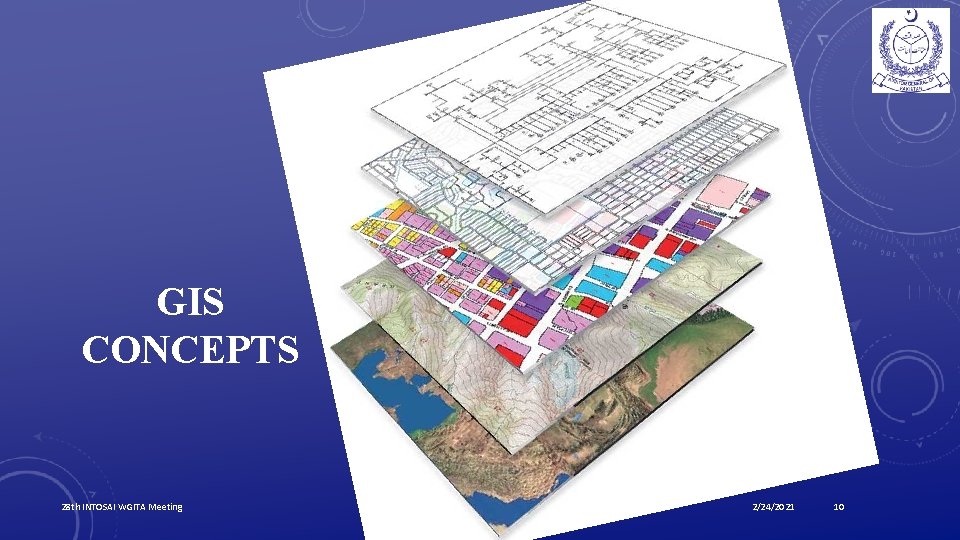
GIS CONCEPTS 28 th INTOSAI WGITA Meeting 2/24/2021 10
GIS Concepts • Geographical Information System (GIS) is “A system for capturing, storing, checking, manipulating, analyzing and displaying data which are spatially referenced to the Earth” (A Peter Burrough 1998). 28 th INTOSAI WGITA Meeting 2/24/2021 11
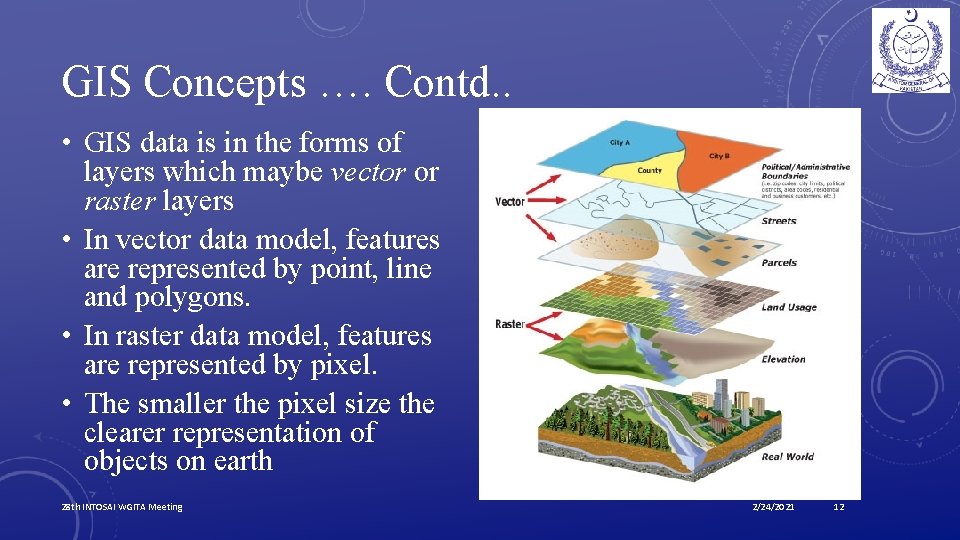
GIS Concepts …. Contd. . • GIS data is in the forms of layers which maybe vector or raster layers • In vector data model, features are represented by point, line and polygons. • In raster data model, features are represented by pixel. • The smaller the pixel size the clearer representation of objects on earth 28 th INTOSAI WGITA Meeting 2/24/2021 12
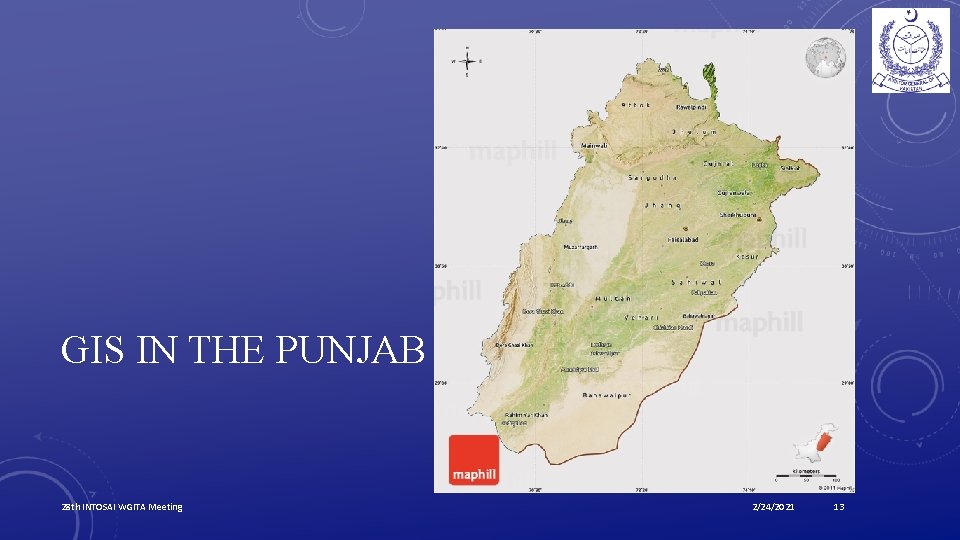
GIS IN THE PUNJAB 28 th INTOSAI WGITA Meeting 2/24/2021 13
GIS In The Punjab • GIS interventions undertaken by specialized offices, including: • The Punjab Information Technology Board (PITB) • The Punjab Disaster management Authority • Urban Sector Planning & Management Services Unit (Pvt. ) Ltd. 28 th INTOSAI WGITA Meeting 2/24/2021 14
GIS In The Punjab…. Contd… PITB: • An autonomous body under the P & D dept. since 2011 • Responsible for undertaking IT projects and acting as the IT service provider. • Important GIS based projects carried out include: • Dengue tracking system (2012) • Till 2017, fifty thousand houses geo-tagged • 21 million dengue surveillance activities undertaken • Crime mapping system for Punjab Police (Source: PITB Interventions & impact report 2017) 28 th INTOSAI WGITA Meeting 2/24/2021 15
GIS In The Punjab…. Contd… PDMA: • It was estb. in compliance of section 3 sub-section (1) of the NDMA act of 2010 • It maintains a GIS enabled control room to monitor floods • Flood disaster management system developed • Analysis of satellite data for compensation disbursement • Flood Emergency Reconstruction and Resilience Project (FERRP)underway using GIS tools 28 th INTOSAI WGITA Meeting 2/24/2021 16
GIS In The Punjab…. Contd… Urban Unit (Pvt. ) Ltd: • Leading GIS development house in Punjab • Projects undertaken include: • Integration of Land Record Management Information System with GIS (2014) • Punjab Rural Roads Program (KPRRP April 2015 - June 2017) • Brick Kilns Census Punjab (2016) • Punjab Cities Growth Atlas 1995 -2015 28 th INTOSAI WGITA Meeting 2/24/2021 17
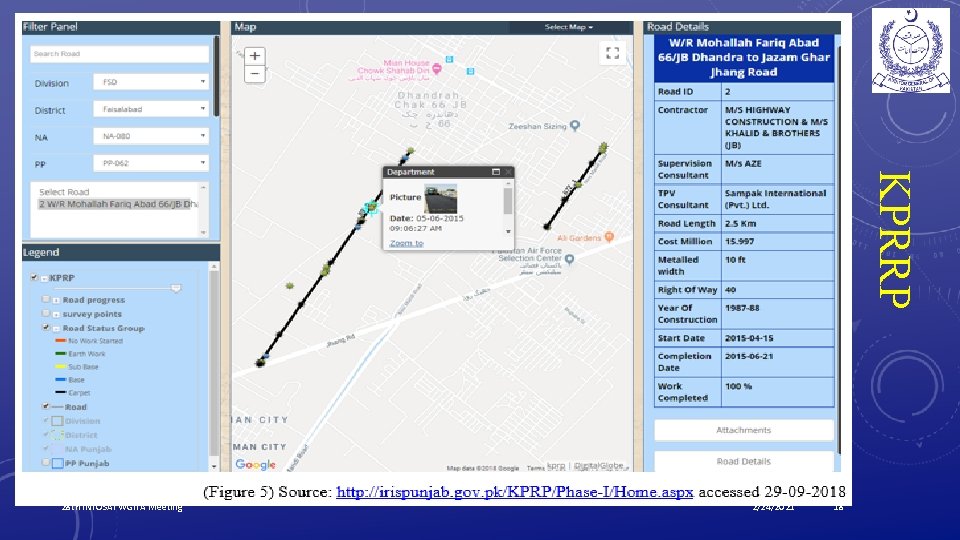
KPRRP 28 th INTOSAI WGITA Meeting 2/24/2021 18
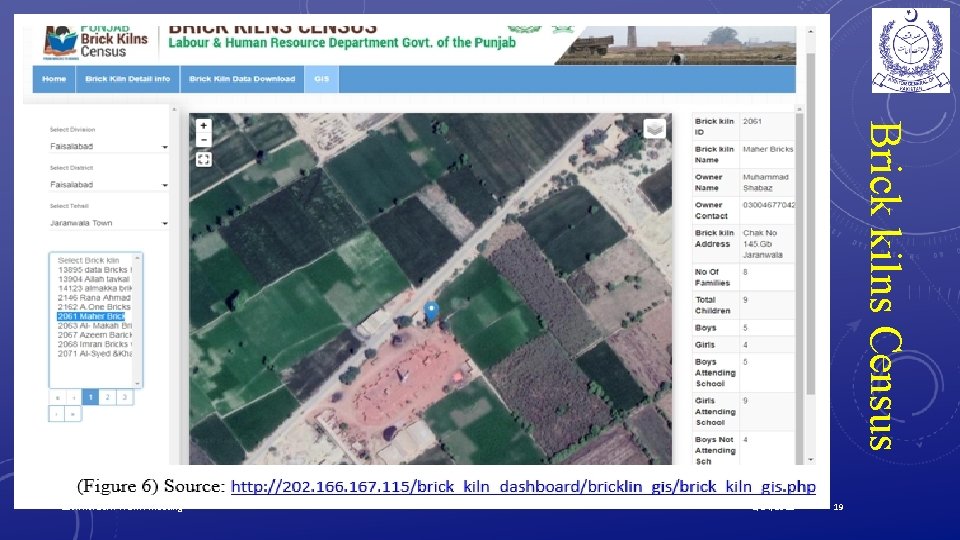
Brick kilns Census 28 th INTOSAI WGITA Meeting 2/24/2021 19
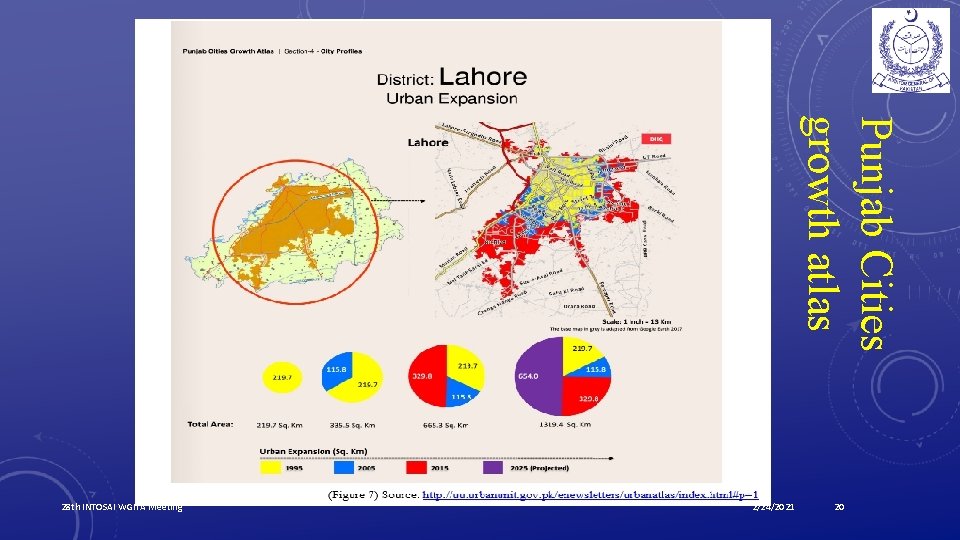
Punjab Cities growth atlas 28 th INTOSAI WGITA Meeting 2/24/2021 20
ANALYSIS OF SELECTED GIS PROJECTS 28 th INTOSAI WGITA Meeting 2/24/2021 21
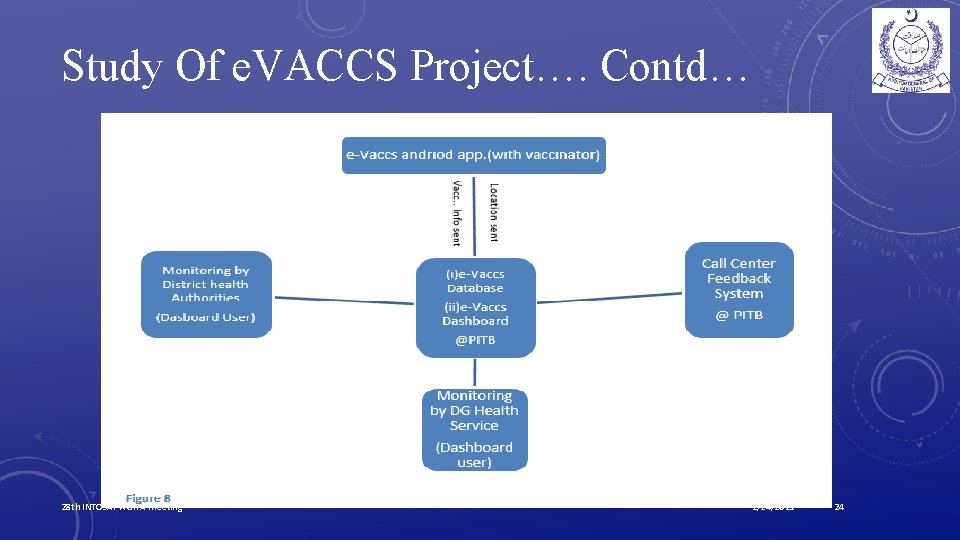
Study Of e. VACCS Project • Project initiated under World Bank Program PPMRP • Planned IT intervention was for EPI/Child Vaccination • GIS based vaccinator performance program named e-Vaccs was launched in June 2014 28 th INTOSAI WGITA Meeting 2/24/2021 22
e. VACCS. . Contd. . 1. The vaccinators given smartphones with e. Vaccs application installed 2. The vaccinators would setup their “kit stations” 3. When the vaccinator would start the e-Vaccs application, his/her geographical location would be automatically stored 4. For each child a unique record would be saved, along with picture of the child. The name of the child’s parent with CNIC would also be fed in the app. 5. The type of vaccine given would also be stored 6. Whenever the vaccinator’s smartphone would connect to the internet, each vaccination activity-record would be sent to the PITB data-center. 7. At the PITB data-center all the activities of the vaccinators would automatically get reflected on a dashboard. 28 th INTOSAI WGITA Meeting 2/24/2021 23
Study Of e. VACCS Project…. Contd… 28 th INTOSAI WGITA Meeting 2/24/2021 24
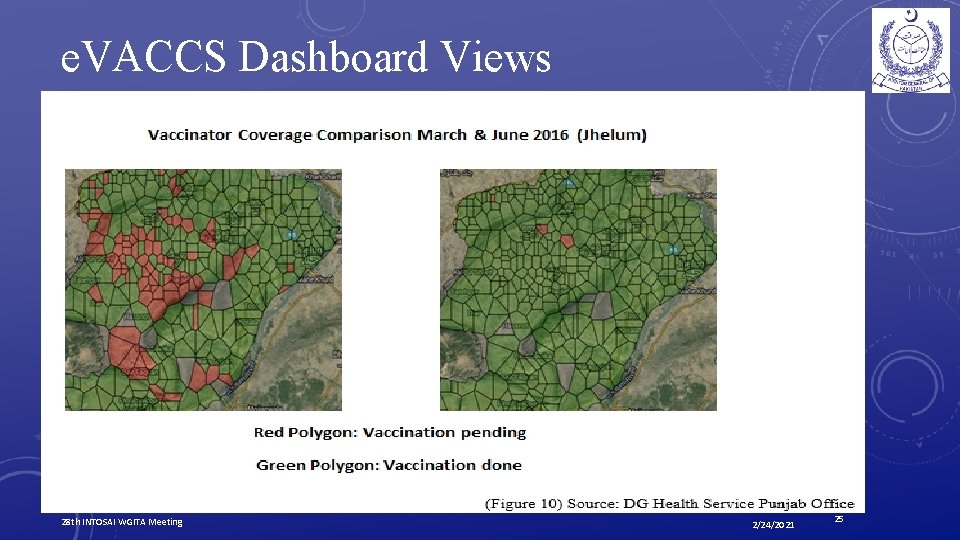
e. VACCS Dashboard Views 28 th INTOSAI WGITA Meeting 2/24/2021 25
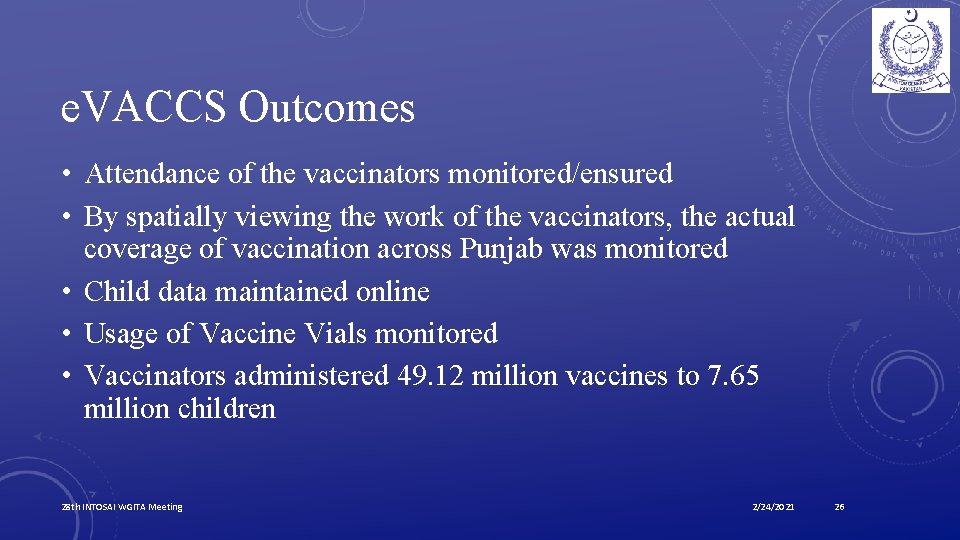
e. VACCS Outcomes • Attendance of the vaccinators monitored/ensured • By spatially viewing the work of the vaccinators, the actual coverage of vaccination across Punjab was monitored • Child data maintained online • Usage of Vaccine Vials monitored • Vaccinators administered 49. 12 million vaccines to 7. 65 million children 28 th INTOSAI WGITA Meeting 2/24/2021 26
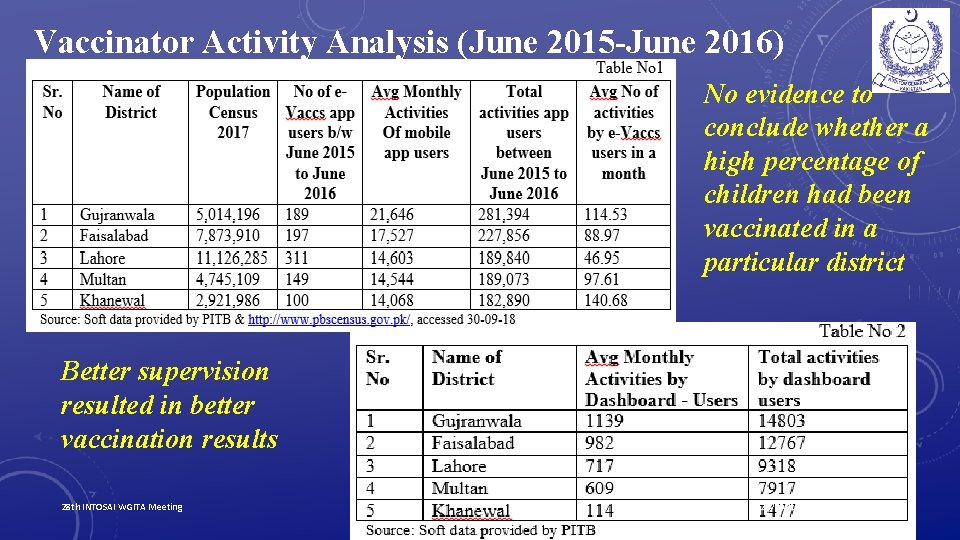
Vaccinator Activity Analysis (June 2015 -June 2016) No evidence to conclude whether a high percentage of children had been vaccinated in a particular district Better supervision resulted in better vaccination results 28 th INTOSAI WGITA Meeting 2/24/2021 27
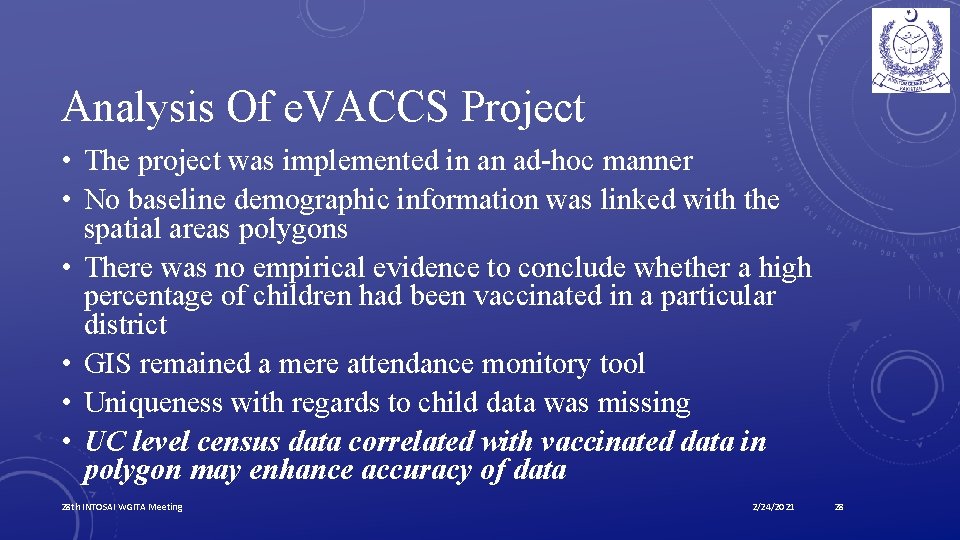
Analysis Of e. VACCS Project • The project was implemented in an ad-hoc manner • No baseline demographic information was linked with the spatial areas polygons • There was no empirical evidence to conclude whether a high percentage of children had been vaccinated in a particular district • GIS remained a mere attendance monitory tool • Uniqueness with regards to child data was missing • UC level census data correlated with vaccinated data in polygon may enhance accuracy of data 28 th INTOSAI WGITA Meeting 2/24/2021 28
Computerization Of Urban Immovable Property Tax Phase I • Client: Excise Taxation and Narcotics Control Dept. • Project started in 2013 with Sialkot as pilot • Computerization done for 06 districts including Lahore 28 th INTOSAI WGITA Meeting 2/24/2021 29
Urban Immovable Property Tax System • A manual property tax system was in-vogue • Revenue targets remained low due to ad-hoc methods of property tax evaluation • Lack of transparency as no system methods were available to supervise and evaluate the property taxation activity • Due to lack of supervision there wide spread public grievances’ inducing a culture of property tax evasion 28 th INTOSAI WGITA Meeting 2/24/2021 30
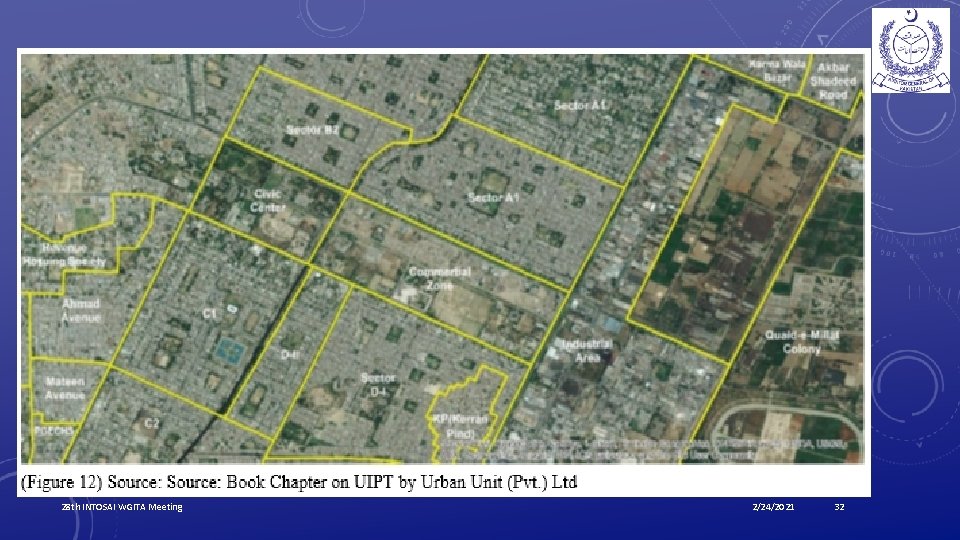
Urban Immovable Property Tax System • Urban unit carried out following activities: • All the existing manual record available in forms PT-1, PT-8 and PT-10 was scanned • The scanned data was typed into a specially designed Excise and Taxation record database • New digital form for recording the PT-1 information was made • Satellite imagery was used for parcel mapping of urban areas 28 th INTOSAI WGITA Meeting 2/24/2021 31
28 th INTOSAI WGITA Meeting 2/24/2021 32
Urban Immovable Property Tax System • All properties within tax zones were turned into unique parcels using GIS tools • Each digital spatial property on the digital map of the district had a unique 28 -digit PIN code • The taxation data was linked in the with the spatial property PIN codes 28 th INTOSAI WGITA Meeting 2/24/2021 33
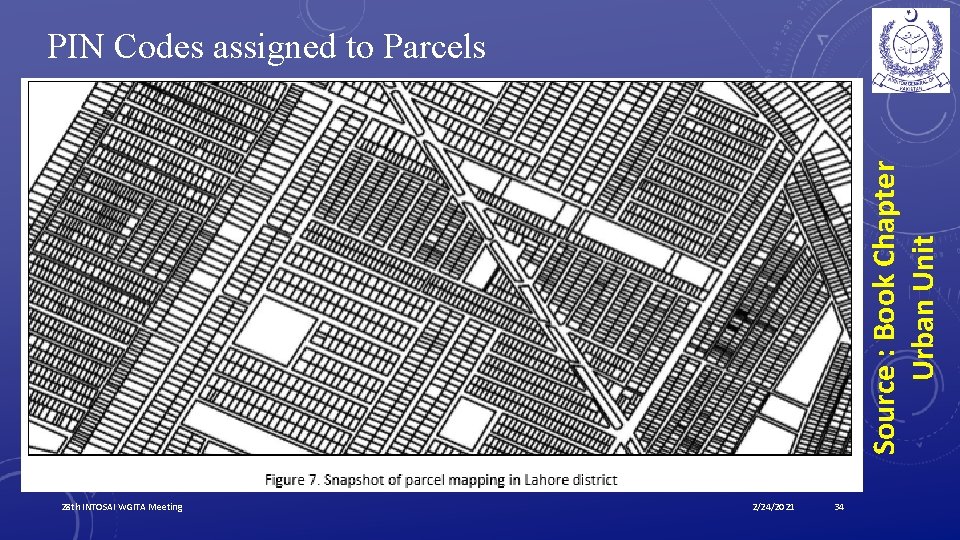
Source : Book Chapter Urban Unit PIN Codes assigned to Parcels 28 th INTOSAI WGITA Meeting 2/24/2021 34
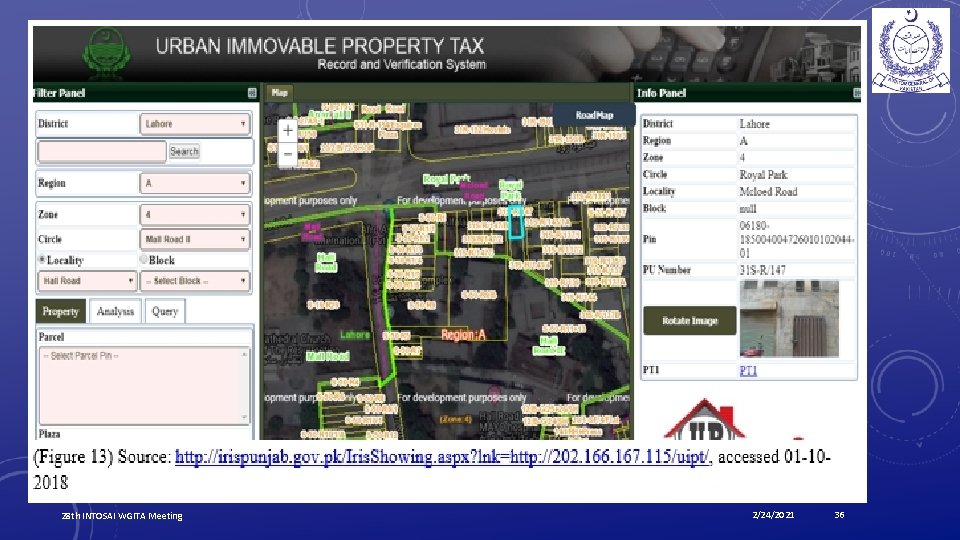
Urban Immovable Property Tax System • Comprehensive survey of all properties in the cities for their geo-tagging • A dashboard was prepared to view the urban property system online 28 th INTOSAI WGITA Meeting 2/24/2021 35
28 th INTOSAI WGITA Meeting 2/24/2021 36
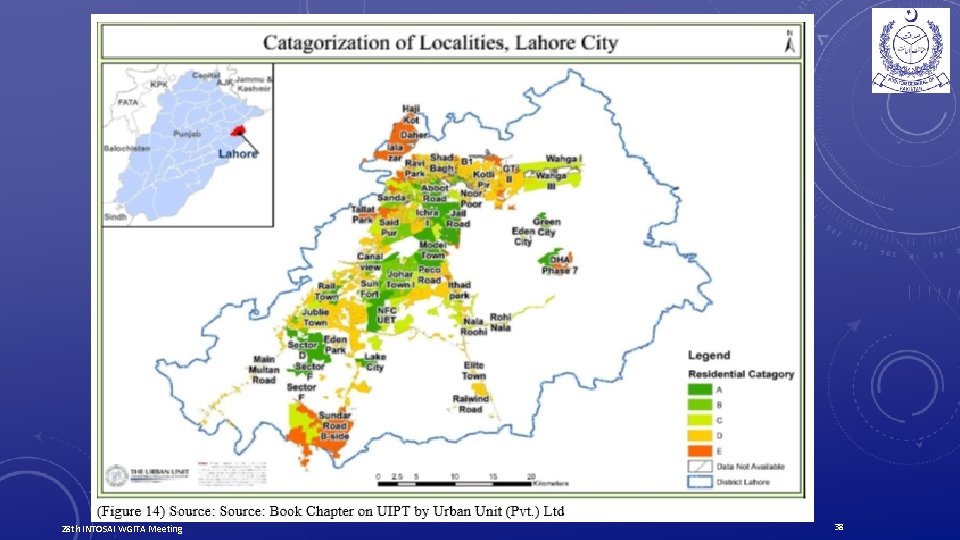
Project Outcomes • Business process re-engineering done to replace manual system with IT solution • The department could now plan its taxation targets on evidence basis rather than on manual estimates • 0. 498 million new properties identified • Classification of properties on value categories was done • Real-time supervision of staff was made possible (Source: Book chapter on UIPT project by Urban Unit) 28 th INTOSAI WGITA Meeting 2/24/2021 37
2/24/2021 28 th INTOSAI WGITA Meeting 38
Analysis Of Project • Maps were not certified by any competent forum • Data converted from manual to digital form was not “digitally” signed off / approved by the Excise and Taxation Dept. • Lack of capacity of Departmental staff was a sustainability issue • System and database kept with urban unit instead of Excise dept. • Parcel dimensions did not reflect actual area of source location 28 th INTOSAI WGITA Meeting 2/24/2021 39
OVERALL CRITICAL REVIEW OF GIS IMPLEMENTATION 28 th INTOSAI WGITA Meeting 2/24/2021 40
Critical Review • • Ad-hoc approach to GIS development followed GIS deployed as mere location tracking tool Most GIS interventions were city centric Change management aspect not given due consideration • Parent offices had week GIS skill 28 th INTOSAI WGITA Meeting 2/24/2021 41
Critical Review… Contd… • Standard approach to software development was not followed • Detail requirement analysis not done • GIS attributes only added on “as you learn along the way” basis • Loads of redundant and incompatible spatial data being populated by different public offices • No spatial data infrastructure (SDI) for the Punjab 28 th INTOSAI WGITA Meeting 2/24/2021 42
CONCLUSION 28 th INTOSAI WGITA Meeting 2/24/2021 43
Conclusion • The government of Punjab is gradually adopting GIS solutions for • modernizing the working of various departments, • introducing real-time supervision and • enhancing operational transparency in the public sector • The GIS development has largely been urban oriented • Great scope remains for further development is other areas. • A myopic/ ad-hoc approach to GIS implementation carry the risk of GIS technology not being used to its full potential • and also being suspect to sustainability issues. 28 th INTOSAI WGITA Meeting 2/24/2021 44
Recommendations • A SDI may be developed for the province of the Punjab • GIS interventions may be considered as full “business process models”, rather than mere tracking and graphic tools • GIS interventions may be utilized more for rural landscape projects, environmental initiatives and in agriculture and forestry domains 28 th INTOSAI WGITA Meeting 2/24/2021 45
Recommendations … Contd. . • Ownership for the new spatial information should be established in the public offices • Periodic exercise on change management may be carried out • In-depth sectoral research may be carried out on the specific need assessment of GIS interventions 28 th INTOSAI WGITA Meeting 2/24/2021 46

THANK YOU! 28 th INTOSAI WGITA Meeting 2/24/2021 47
- Slides: 47