
GIS Curriculum for High School Earth and Environmental
- Slides: 18
GIS Curriculum for High School Earth and Environmental Science Peer Review Brief William Gallaway 6 May 2013 Gallaway Slide 1
Outline • • Project Description Project Goals Background Scope Deliverables Methodologies Sample Course Modules Challenges and Conclusions Gallaway Slide 2
Project Description • Design GIS course modules tailored for Prince William County, Virginia High School ‘Earth and Environmental Science’ curriculum. Gallaway Slide 3
Project Goals • Introduce high school teachers and students to GIS technologies and methodologies to: – Enhance the learning environment () – Expose students to technology and tools used by professionals – Introduce web-based research and datasets “…After data are mapped, pattern-seeking and analysis inquiries (collectively known as spatial thinking) can help students draw conclusions, solve problems, make decisions, and consider areas of further research. ” - Sarah Bednarz, Geo. Journal 2004 Gallaway Slide 4
Background • Why GIS? “ (1) Key tool to analyze the environment and solve problems (2) Enhances student interest (3) Motivates students to career in science and engineering” - NCGIA Core Curriculum, 1990 • Studies of effectiveness – Boulder High School, 2000 – West Covina High School, 2004 Gallaway Slide 5
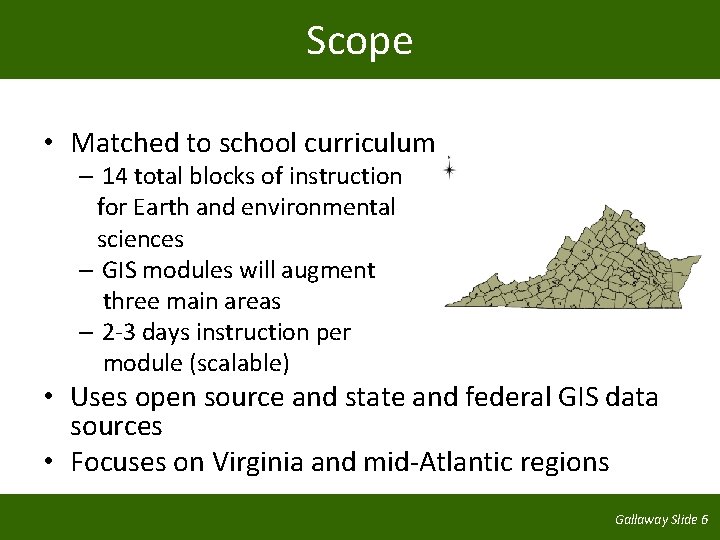
Scope • Matched to school curriculum – 14 total blocks of instruction for Earth and environmental sciences – GIS modules will augment three main areas – 2 -3 days instruction per module (scalable) • Uses open source and state and federal GIS data sources • Focuses on Virginia and mid-Atlantic regions Gallaway Slide 6
Deliverables • Three instructional modules for teachers 1. Introduction to GIS (Mapping Block) 2. Earthquake Risks (Geology Processes Block) 3. Wind Power (Renewable Resources Block) • Data Sets – Shapefiles, raster files – Solution sets Gallaway Slide 7
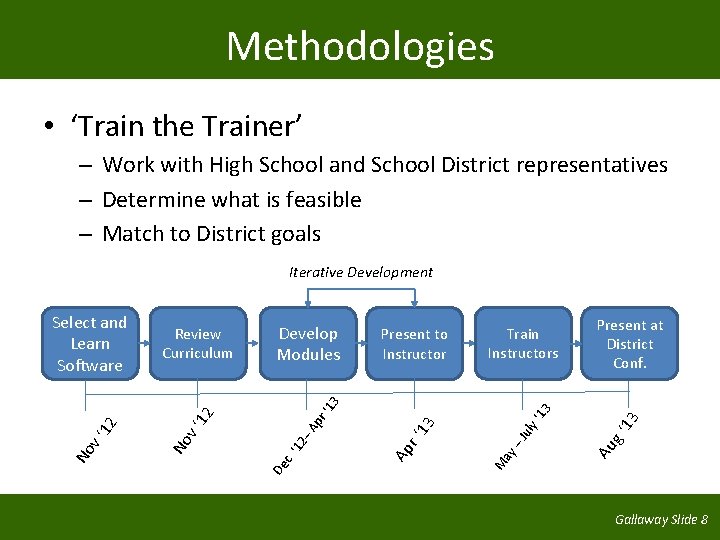
Methodologies • ‘Train the Trainer’ – Work with High School and School District representatives – Determine what is feasible – Match to District goals Iterative Development –J M ay 13 ‘ 13 uly 13 r‘ Ap pr –A ‘ 12 De c Present at District Conf. g‘ Train Instructors Au Present to Instructor ‘ 13 Develop Modules 12 Review Curriculum No v‘ 12 Select and Learn Software Gallaway Slide 8
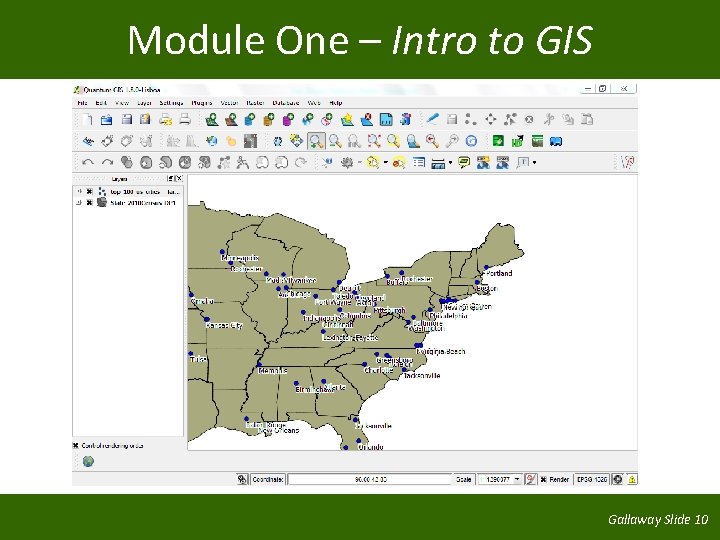
Module One – Intro to GIS • Terminal learning objectives: – Introduce students to GIS discipline, concepts and uses – Introduce software (QGIS) • Enabling learning objectives: – Familiarization with basic GIS concepts – Basic Tools (Add files, View Spatial properties, etc…) Gallaway Slide 9
Module One – Intro to GIS Gallaway Slide 10
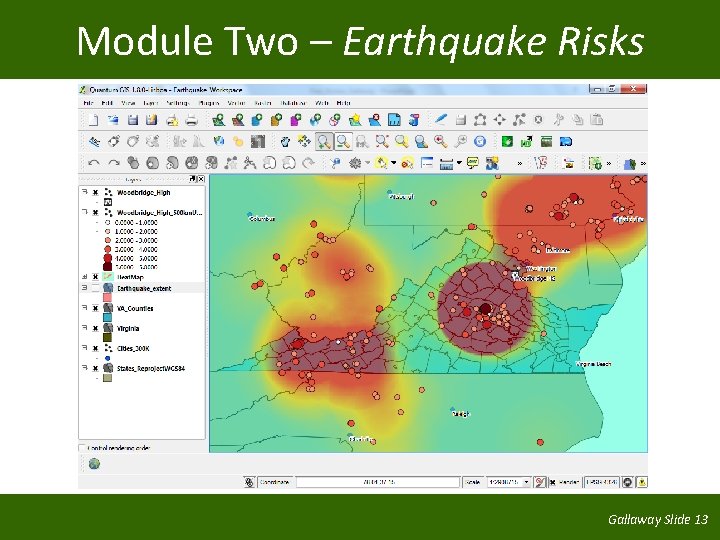
Module Two – Earthquake Risks • Terminal learning objectives – Demonstrate basic GIS analysis – Familiarize with government sources of GIS data • Enabling learning objectives – Research, create and download earthquake data and population data – Create heat map – Determine Virginia counties at highest risk for earthquake hazards Gallaway Slide 11
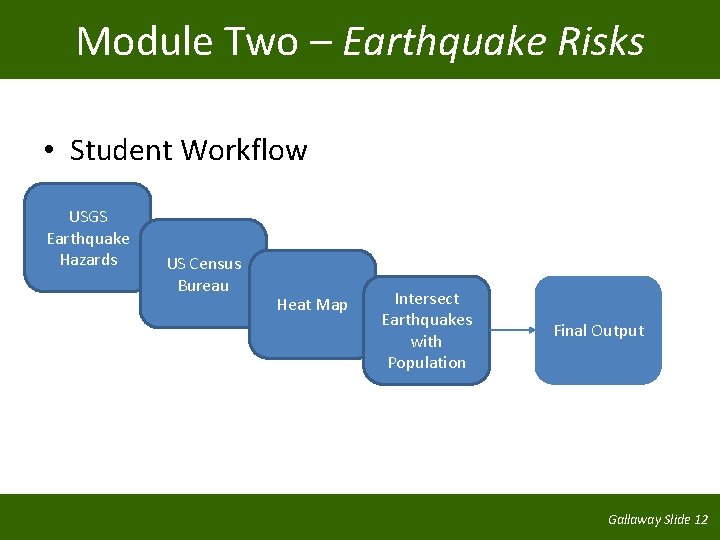
Module Two – Earthquake Risks • Student Workflow USGS Earthquake Hazards US Census Bureau Heat Map Intersect Earthquakes with Population Final Output Gallaway Slide 12
Module Two – Earthquake Risks Gallaway Slide 13
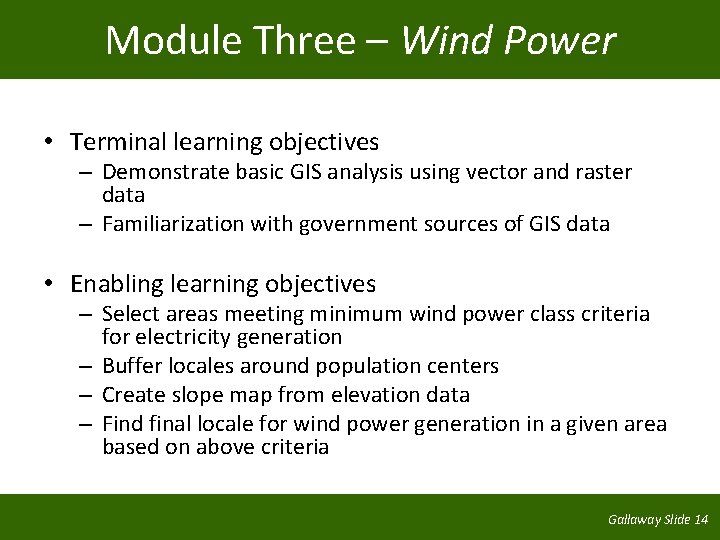
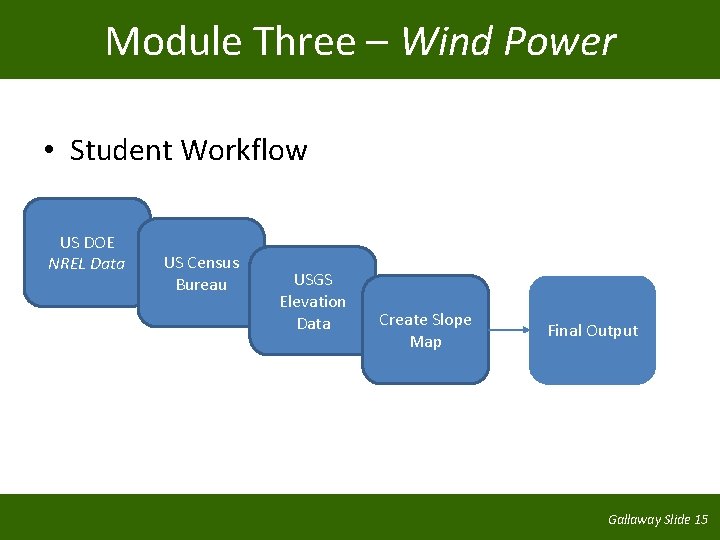
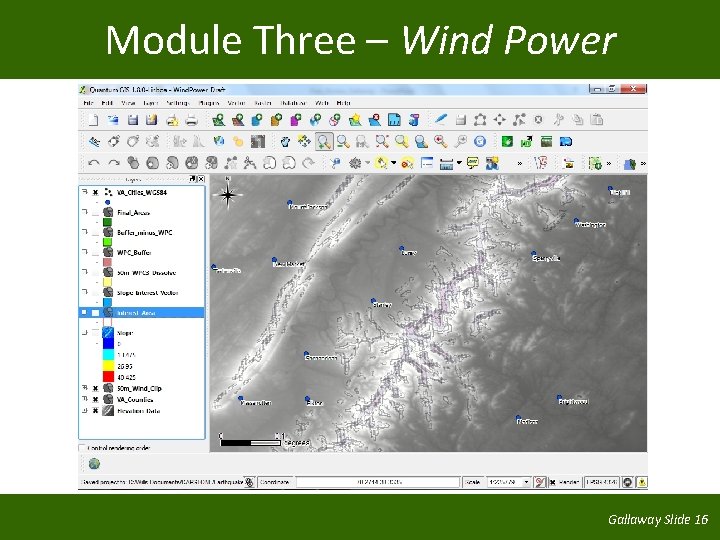
Module Three – Wind Power • Terminal learning objectives – Demonstrate basic GIS analysis using vector and raster data – Familiarization with government sources of GIS data • Enabling learning objectives – Select areas meeting minimum wind power class criteria for electricity generation – Buffer locales around population centers – Create slope map from elevation data – Find final locale for wind power generation in a given area based on above criteria Gallaway Slide 14
Module Three – Wind Power • Student Workflow US DOE NREL Data US Census Bureau USGS Elevation Data Create Slope Map Final Output Gallaway Slide 15
Module Three – Wind Power Gallaway Slide 16
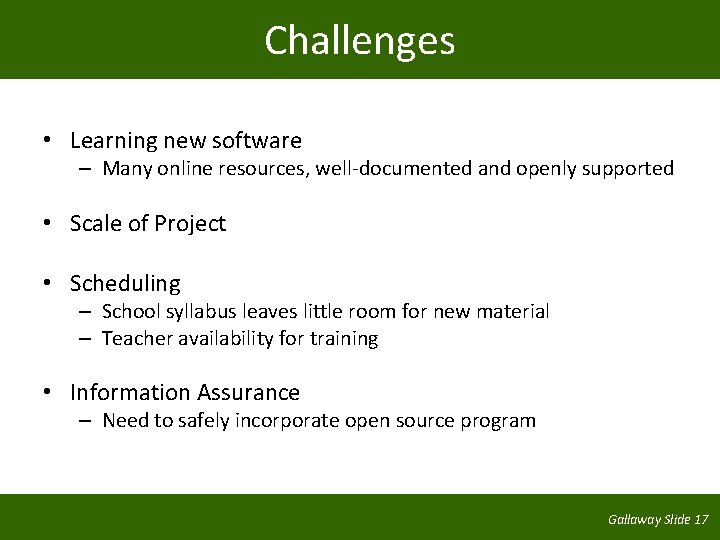
Challenges • Learning new software – Many online resources, well-documented and openly supported • Scale of Project • Scheduling – School syllabus leaves little room for new material – Teacher availability for training • Information Assurance – Need to safely incorporate open source program Gallaway Slide 17
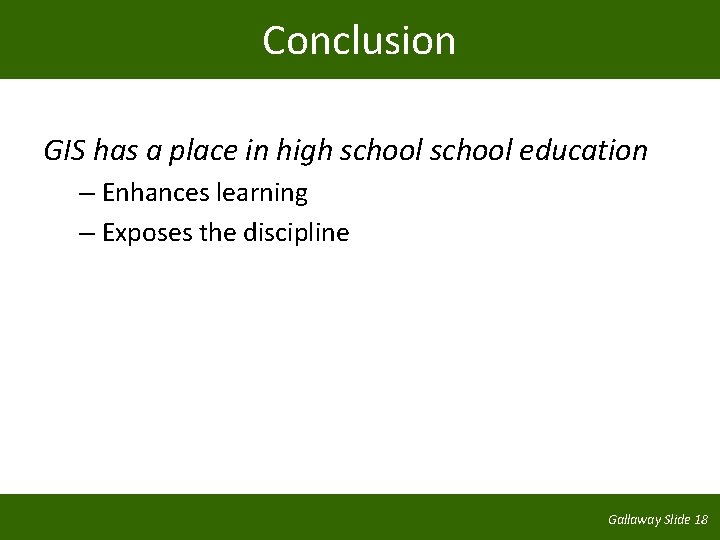
Conclusion GIS has a place in high school education – Enhances learning – Exposes the discipline Gallaway Slide 18