
GIS and Spatial Visualization Stacy CurryJohnson Geospatial Librarian
GIS and Spatial Visualization Stacy Curry-Johnson Geospatial Librarian stacy. e. curry@vanderbilt. edu
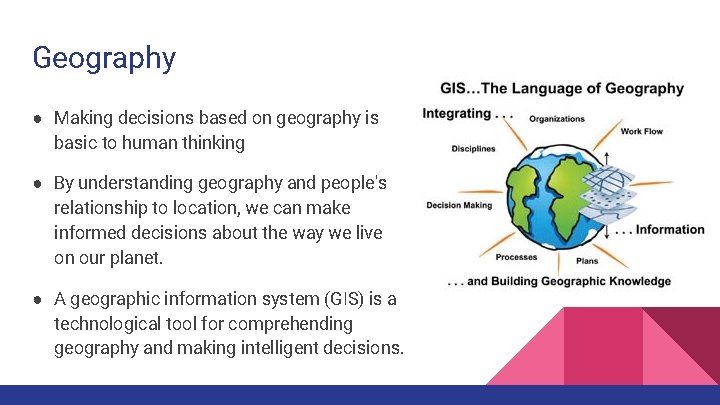
Geography ● Making decisions based on geography is basic to human thinking ● By understanding geography and people's relationship to location, we can make informed decisions about the way we live on our planet. ● A geographic information system (GIS) is a technological tool for comprehending geography and making intelligent decisions.

What is GIS? Geographic Information Systems ● Techniques and scholarship that combines tabular data with geographical features to query, map, and visualize information. ● GIS organizes geographic data so that a person reading a map can select data necessary for a specific project or task. ● GIS maps are interactive. On the computer screen, map users can scan a GIS map in any direction, zoom in or out, and change the nature of the information contained in the map.

Data
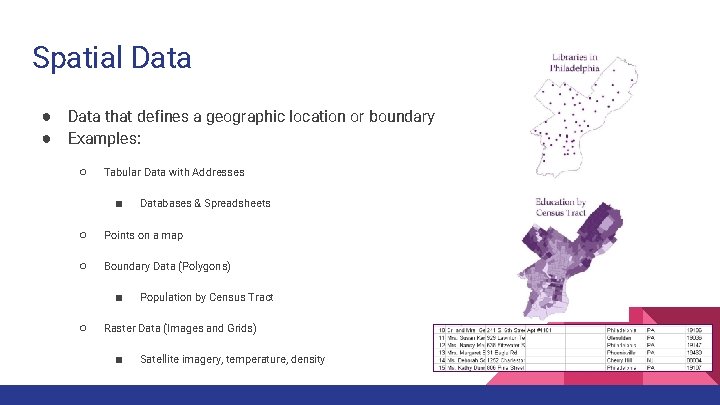
Spatial Data ● Data that defines a geographic location or boundary ● Examples: ○ Tabular Data with Addresses ■ Databases & Spreadsheets ○ Points on a map ○ Boundary Data (Polygons) ■ ○ Population by Census Tract Raster Data (Images and Grids) ■ Satellite imagery, temperature, density
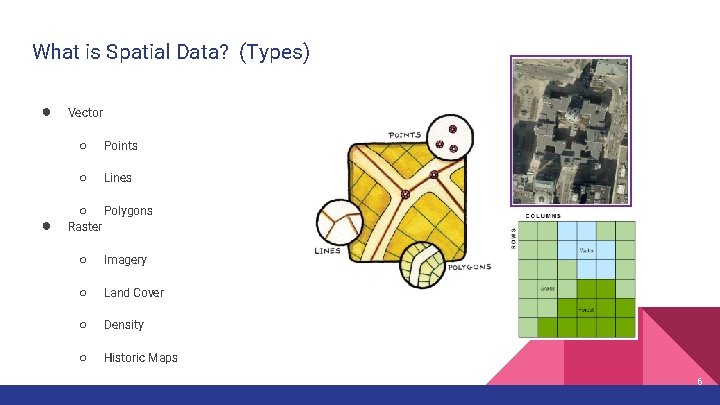
What is Spatial Data? (Types) ● ● Vector ○ Points ○ Lines ○ Polygons Raster ○ Imagery ○ Land Cover ○ Density ○ Historic Maps 6
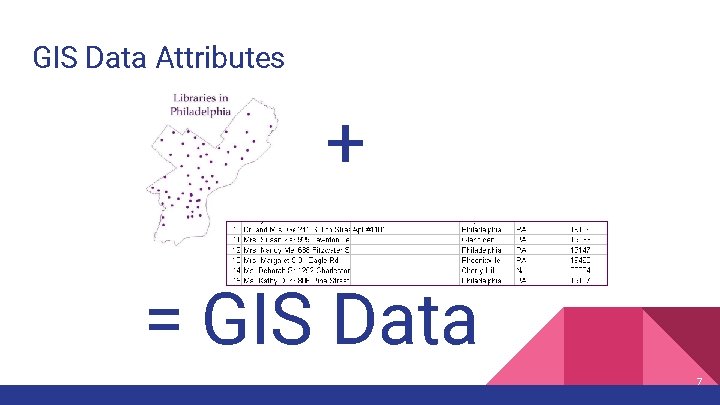
GIS Data Attributes + = GIS Data 7
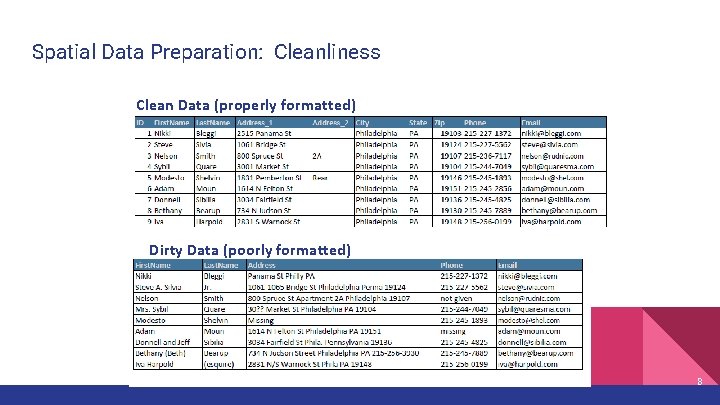
Spatial Data Preparation: Cleanliness Clean Data (properly formatted) Dirty Data (poorly formatted) 8
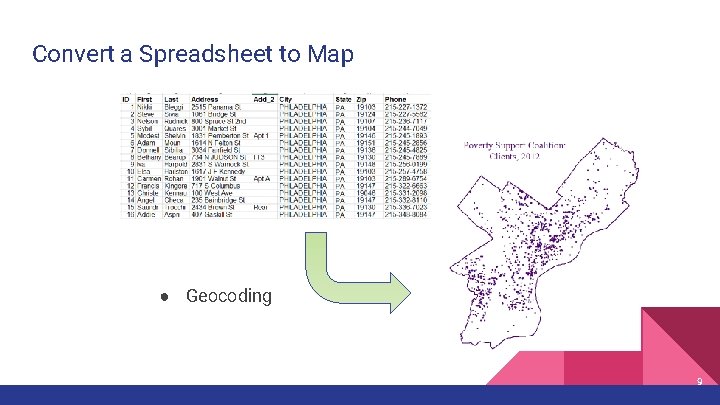
Convert a Spreadsheet to Map ● Geocoding 9

Tools
GIS TOOLS ● Arc. GIS ○ Windows-only ○ Expensive commercial program ● QGIS ○ Open-source ○ Mac, PC, and Linux. 11
WEB MAPPING TOOLS ● Online counterparts ○ Google Maps ○ Palladio ○ Mapbox ○ Arc. GIS Online (online ○ Carto. DB version of desktop Arc. GIS) 12
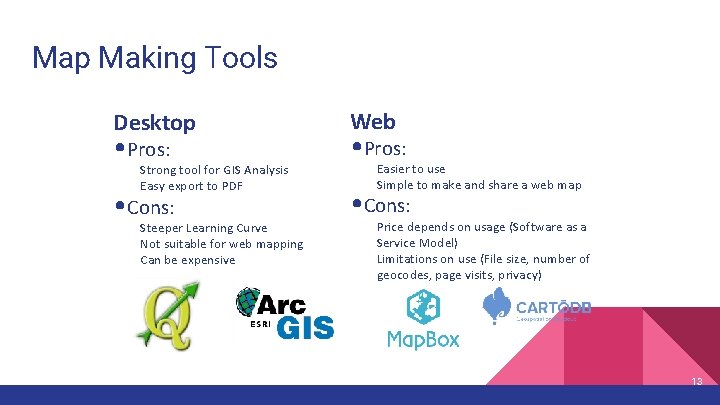
Map Making Tools Desktop • Pros: Strong tool for GIS Analysis Easy export to PDF • Cons: Steeper Learning Curve Not suitable for web mapping Can be expensive Web • Pros: Easier to use Simple to make and share a web map • Cons: Price depends on usage (Software as a Service Model) Limitations on use (File size, number of geocodes, page visits, privacy) 13
NARRATIVE MAPS ● A narrative map tells a story plotted through space. ● The point of a narrative map is not to display data, but to provide an explicit visual counterpart to the implicit spatial underpinnings of a narrative or argument. ● Narrative maps are broadly useful across the disciplines, since many texts have a spatial component. 14
Story Maps ● Story mapping is an interactive form of storytelling that allows your user to step through a narrative that you build around your data ● Generally, the narrative can be oriented on a temporally or geospatial related sequence of events ● A story map is a type of mapping application that is stored in the Arc. GIS Online cloud, and has a specific set of tabs, text, photographs, video, and audio capabilities presented to the map user

Resources
- Slides: 16