
Giovanni Bittante Lattivit del National Focal Point After
Giovanni Bittante L’attività del National Focal Point
After years of steady progress, recent setbacks In the fight against hunger and malnutrition arising from the combined effects of high food prices and the global economic downturn coupled with the continuing problems of underdevelopment, civil strife, inadequate food supplies, social discrimination and environmental stress, jeopardize the earlier hopes for achieving the poverty, hunger and nutrition-related Millennium Development Goals (MDGs).
According to FAO, there were 105 million more hungry people in 2009 than in the previous year and the number of malnourished people now stands at 1. 02 billion. Around the world close to 10 million children die before their fifth birthday every year, over one-third of which are associated with under nutrition. One in three developing-country children under the age of five 178 million children – are stunted due to chronic under nutrition and poor health, and some 148 million children are underweight.
Micronutrient deficiencies or “hidden hunger” affects around 2 billion people worldwide or about one third of the world’s population. These vitamin and mineral deficiencies, especially of iron, iodine, zinc and vitamin A, lead to poor physical growth and development, lowered mental capacities, reduced productivity, impaired immune systems, blindness and death - all of which are preventable.
While the cost of treating and dealing with the effects of malnutrition, whether in fiscal, economic or human terms, is high, the prevention of malnutrition is much less. Investing in nutrition, therefore, not only is a moral imperative, but also makes economic sense as it reduces health care costs, improves productivity and economic growth and promotes education, intellectual capacity and social development.
The importance of food-based approaches for overcoming malnutrition and improving nutrition is fully recognized by the FAO. Focusing on the distinctive relationship between agriculture, food and nutrition, FAO works actively to protect, promote and improve established food-based systems as the sustainable solution to ensure food and nutrition security, combat micronutrient deficiencies, improve diets and raise levels of nutrition, and by doing so, to achieve the nutrition-related MDGs.
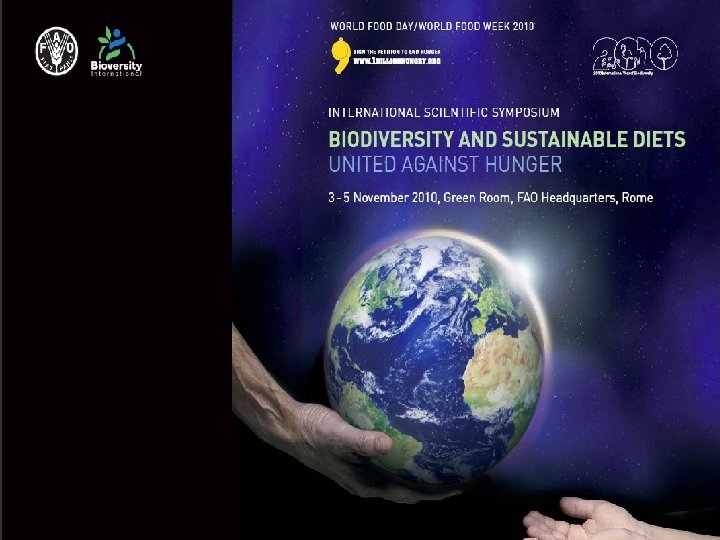
INTERNATIONAL SCIENTIFIC SYMPOSIUM BIODIVERSITY AND SUSTAINABLE DIETS UNITED AGAINST HUNGER 3 -5 NOVEMBER 2010 FAO HEADQUARTERS, ROME FINAL DOCUMENT DEFINITION OF SUSTAINABLE DIETS: Sustainable Diets are those diets with low environmental impacts which contribute to food and nutrition security and to healthy life for present and future generations. Sustainable diets are protective and respectful of biodiversity and ecosystems, culturally acceptable, accessible, economically fair and affordable; nutritionally adequate, safe and healthy; while optimizing natural and human resources.
INTERNATIONAL SCIENTIFIC SYMPOSIUM BIODIVERSITY AND SUSTAINABLE DIETS UNITED AGAINST HUNGER 3 -5 NOVEMBER 2010 FAO HEADQUARTERS, ROME FINAL DOCUMENT 3. Decision-makers should give priority to and promote sustainable diet concepts in policies and programmes in the agriculture, food, environment, trade, education and health sectors. Nutrition should be given more emphasis by plant and animal breeders and research on nutrient content of food biodiversity should be encouraged. Food composition data should be compiled by FAO in the INFOODS databases and by regional and national institutions.
INTERNATIONAL SCIENTIFIC SYMPOSIUM BIODIVERSITY AND SUSTAINABLE DIETS UNITED AGAINST HUNGER 3 -5 NOVEMBER 2010 FAO HEADQUARTERS, ROME FINAL DOCUMENT 4. New projects and case studies should be encouraged to demonstrate the synergies between biodiversity, nutrition and socio-economic, cultural and environment sustainability as well as to gather evidence about the potential of greater use of biodiversity for better nutrition and health and for poverty alleviation and improved livelihoods. The evidence gathered from these research efforts should be compiled by FAO and Bioversity International and made available on an open access web-based platform.
INTERNATIONAL SCIENTIFIC SYMPOSIUM BIODIVERSITY AND SUSTAINABLE DIETS UNITED AGAINST HUNGER 3 -5 NOVEMBER 2010 FAO HEADQUARTERS, ROME FINAL DOCUMENT 5. Food based dietary guidelines and policies should give due consideration to sustainability when setting goals aimed at healthy nutrition. A guidance document on how to develop such guidelines and policies at national level could be elaborated by FAO, in collaboration with Bioversity International and other partners.

INTERNATIONAL SCIENTIFIC SYMPOSIUM BIODIVERSITY AND SUSTAINABLE DIETS UNITED AGAINST HUNGER 3 -5 NOVEMBER 2010 FAO HEADQUARTERS, ROME FINAL DOCUMENT 7. The development of a Code of Conduct for Sustainable Diets is strongly recommended.

Animals The biodiversity of the 35 or so animal species that have been domesticated for use in agriculture and food production is the primary biological capital for livestock development and is vital to food security and sustainable rural development. Many indigenous breeds, some of which are threatened with extinction, have characteristics such as resilience to climatic stress and resistance to diseases and parasites, which make them well adapted to local conditions, and which are of great potential importance to future livestock production. Recent years have seen substantial erosion of domestic animal diversity a trend that is likely to accelerate with the rapid changes currently affecting the livestock sector.
Livestock development in the twentieth century concentrated on a very small number of breeds worldwide, frequently without due consideration to the way in which production environments affect animals’ ability to survive, produce and reproduce. According to: The State of the World’s Animal Genetic Resources for Food and Agriculture (2007), 20 percent of documented livestock breeds are at risk of extinction: 1500 of the 7600 breeds around the globe may be lost forever in the near future.
In order to safeguard and support world’s agri-cultural heritage systems FAO launched in 2002 during the World Summit on sustainable Development (WSSD, Johannesburg, 2002) a UN Partnership Initiative on conservation and adaptive management of Globally Important Agricultural Heritage Systems (GIAHS). The initiative seeks to promote the international recognition, dynamic conservation of these agricultural heritage systems —including where necessary their revitalization— and the outstanding role these systems played in the maintenance and in-situ conservation of agricultural biodiversity of global significance.
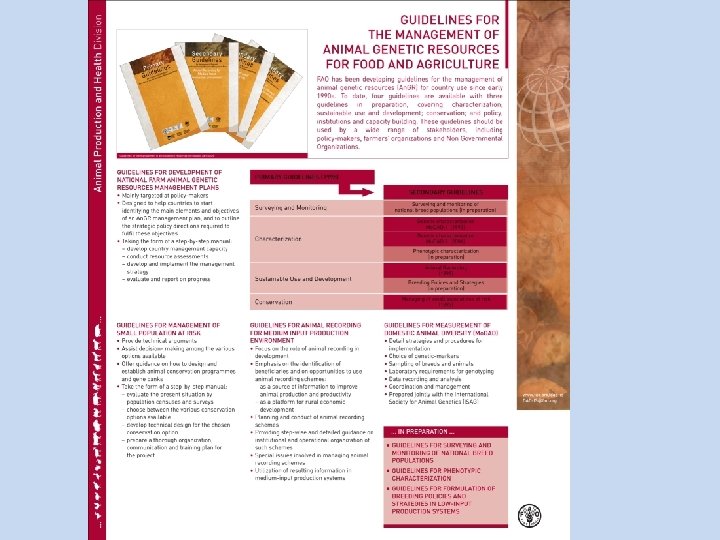
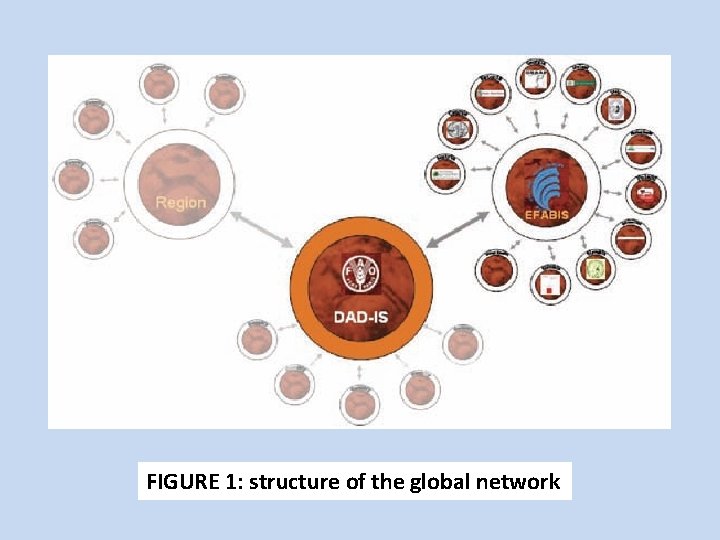
FIGURE 1: structure of the global network
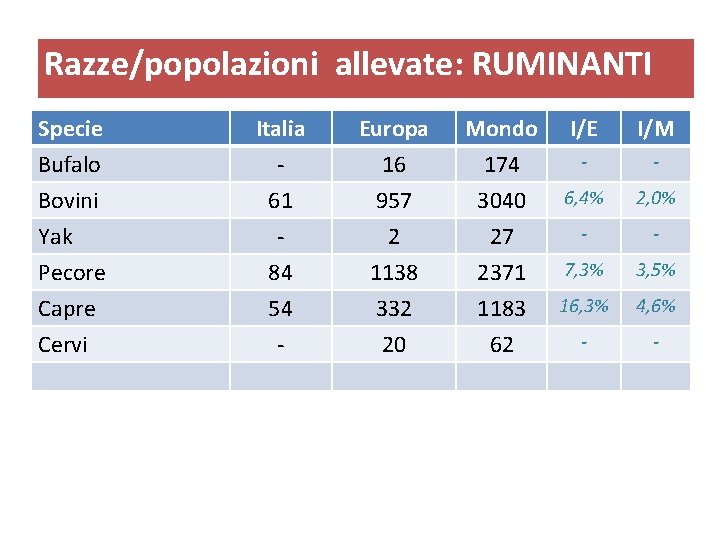
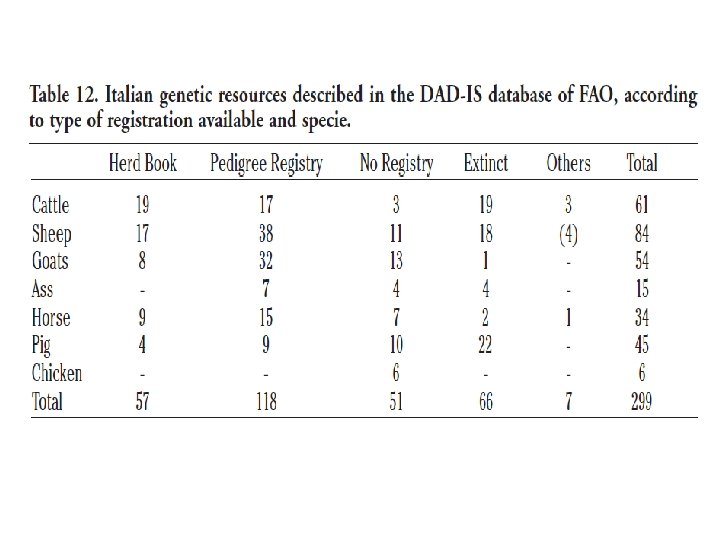
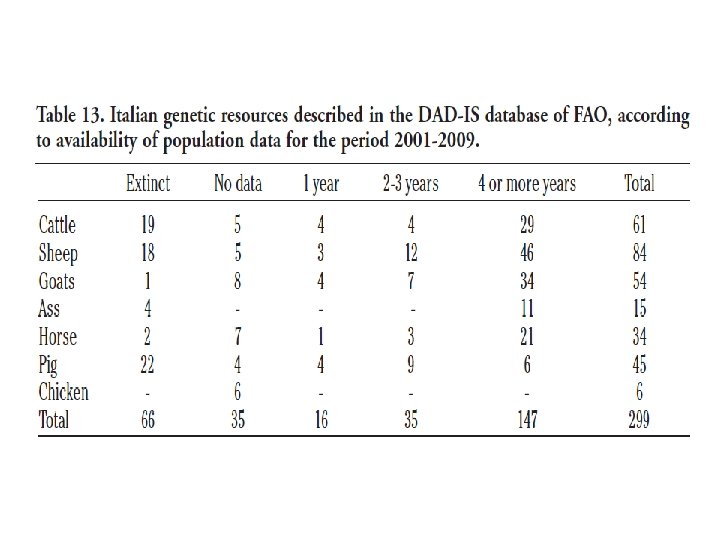
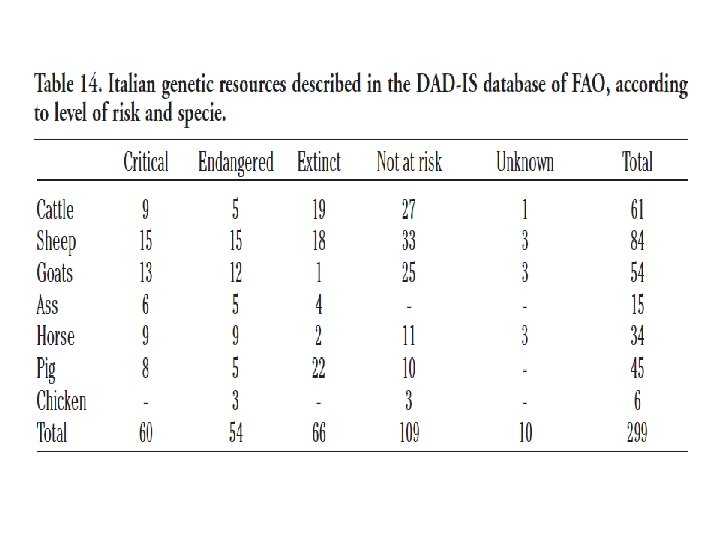
Razze/popolazioni allevate: RUMINANTI Specie Bufalo Bovini Yak Italia 61 - Europa 16 957 2 Mondo 174 3040 27 Pecore Capre Cervi 84 54 - 1138 332 20 2371 1183 62 I/E I/M - - 6, 4% 2, 0% - - 7, 3% 3, 5% 16, 3% 4, 6% - -
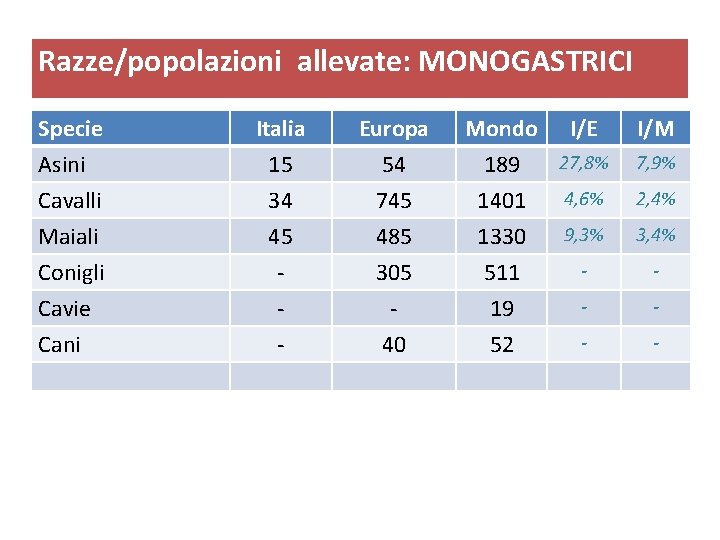
Razze/popolazioni allevate: MONOGASTRICI Specie Asini Cavalli Maiali Italia 15 34 45 Europa 54 745 485 Conigli Cavie Cani - 305 40 Mondo I/E 27, 8% 189 4, 6% 1401 9, 3% 1330 511 19 52 I/M 7, 9% 2, 4% 3, 4% - - -
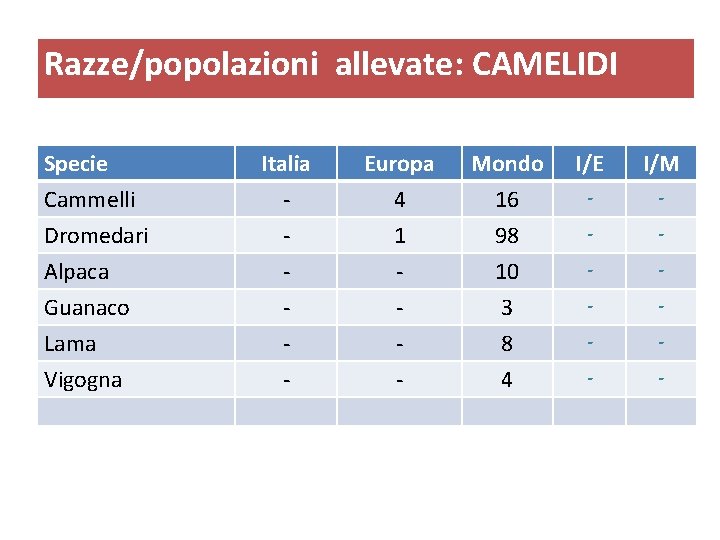
Razze/popolazioni allevate: CAMELIDI Specie Cammelli Dromedari Alpaca Guanaco Lama Vigogna Italia - Europa 4 1 - Mondo 16 98 10 I/E I/M - - - - 3 8 4 - - -
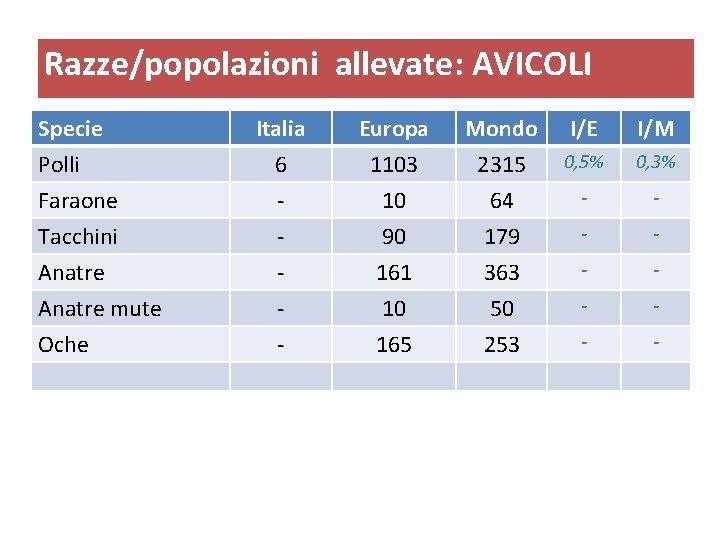
Razze/popolazioni allevate: AVICOLI Specie Polli Faraone Tacchini Anatre mute Oche Italia 6 - Europa 1103 10 90 Mondo 2315 64 179 - 161 10 165 363 50 253 I/E I/M 0, 5% 0, 3% - - - - -
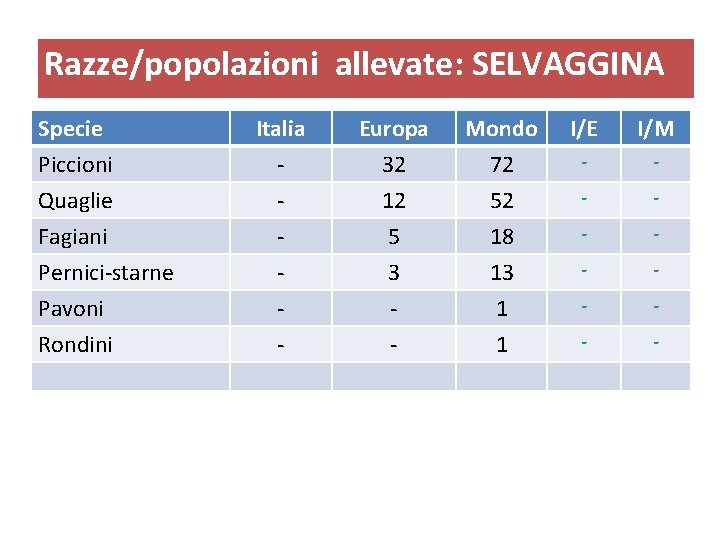
Razze/popolazioni allevate: SELVAGGINA Specie Piccioni Quaglie Fagiani Pernici-starne Pavoni Rondini Italia - Europa 32 12 5 Mondo 72 52 18 I/E I/M - - - - 3 - 13 1 1 - - -
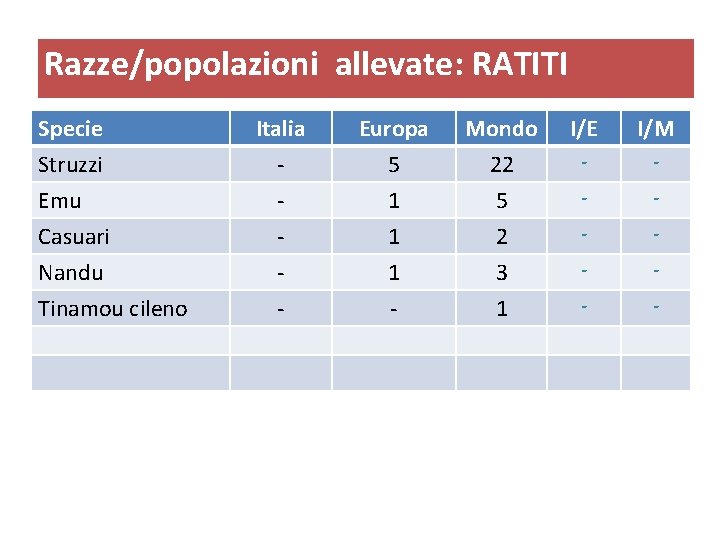
Razze/popolazioni allevate: RATITI Specie Struzzi Emu Casuari Nandu Tinamou cileno Italia - Europa 5 1 1 Mondo 22 5 2 I/E I/M - - - - 1 - 3 1 - -
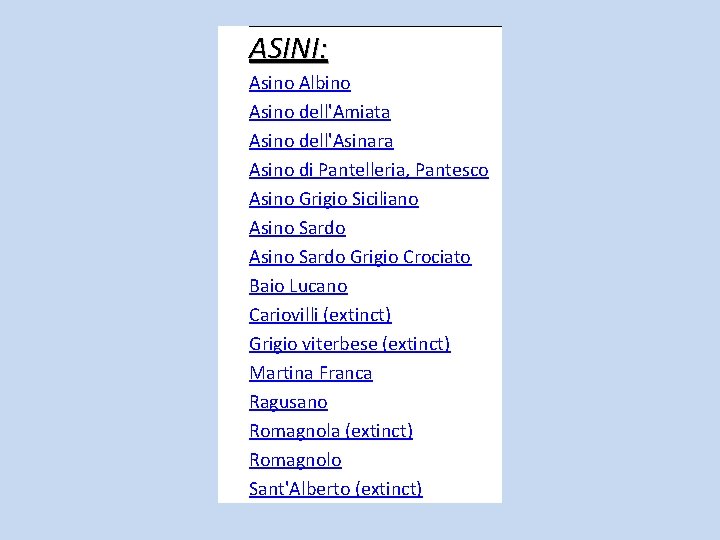
ASINI: Asino Albino Asino dell'Amiata Asino dell'Asinara Asino di Pantelleria, Pantesco Asino Grigio Siciliano Asino Sardo Grigio Crociato Baio Lucano Cariovilli (extinct) Grigio viterbese (extinct) Martina Franca Ragusano Romagnola (extinct) Romagnolo Sant'Alberto (extinct)
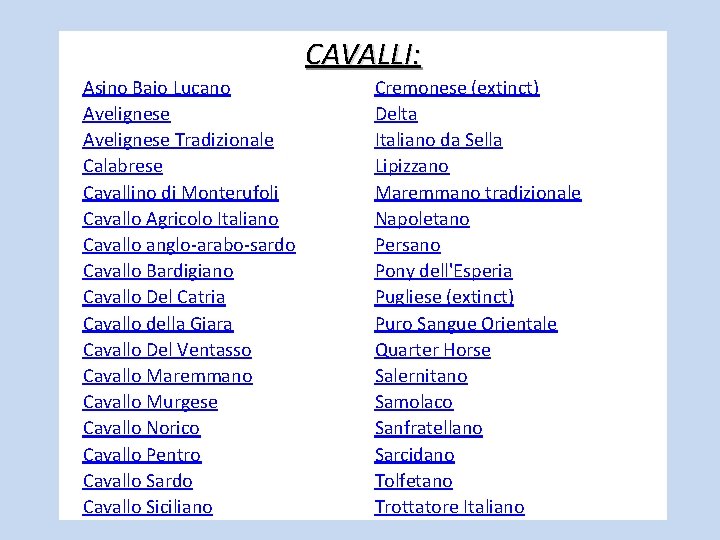
CAVALLI: Asino Baio Lucano Avelignese Tradizionale Calabrese Cavallino di Monterufoli Cavallo Agricolo Italiano Cavallo anglo-arabo-sardo Cavallo Bardigiano Cavallo Del Catria Cavallo della Giara Cavallo Del Ventasso Cavallo Maremmano Cavallo Murgese Cavallo Norico Cavallo Pentro Cavallo Sardo Cavallo Siciliano Cremonese (extinct) Delta Italiano da Sella Lipizzano Maremmano tradizionale Napoletano Persano Pony dell'Esperia Pugliese (extinct) Puro Sangue Orientale Quarter Horse Salernitano Samolaco Sanfratellano Sarcidano Tolfetano Trottatore Italiano
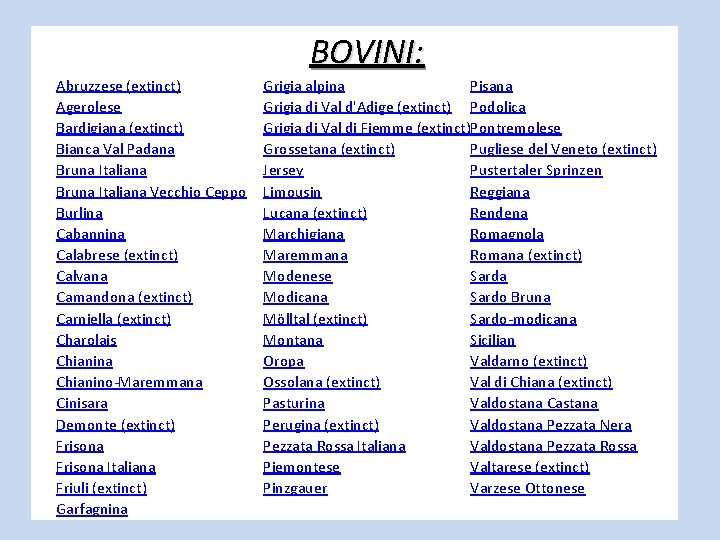
BOVINI: Abruzzese (extinct) Agerolese Bardigiana (extinct) Bianca Val Padana Bruna Italiana Vecchio Ceppo Burlina Cabannina Calabrese (extinct) Calvana Camandona (extinct) Carniella (extinct) Charolais Chianina Chianino-Maremmana Cinisara Demonte (extinct) Frisona Italiana Friuli (extinct) Garfagnina Grigia alpina Pisana Grigia di Val d'Adige (extinct) Podolica Grigia di Val di Fiemme (extinct)Pontremolese Grossetana (extinct) Pugliese del Veneto (extinct) Jersey Pustertaler Sprinzen Limousin Reggiana Lucana (extinct) Rendena Marchigiana Romagnola Maremmana Romana (extinct) Modenese Sarda Modicana Sardo Bruna Mölltal (extinct) Sardo-modicana Montana Sicilian Oropa Valdarno (extinct) Ossolana (extinct) Val di Chiana (extinct) Pasturina Valdostana Castana Perugina (extinct) Valdostana Pezzata Nera Pezzata Rossa Italiana Valdostana Pezzata Rossa Piemontese Valtarese (extinct) Pinzgauer Varzese Ottonese
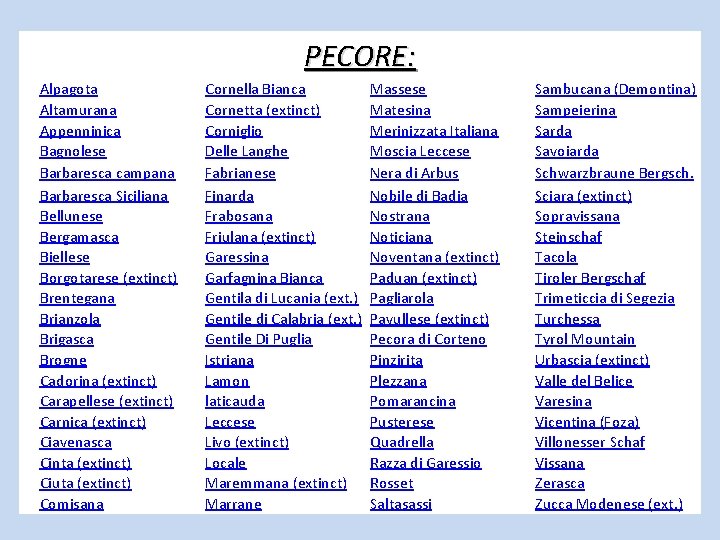
PECORE: Alpagota Altamurana Appenninica Bagnolese Barbaresca campana Barbaresca Siciliana Bellunese Bergamasca Biellese Borgotarese (extinct) Brentegana Brianzola Brigasca Brogne Cadorina (extinct) Carapellese (extinct) Carnica (extinct) Ciavenasca Cinta (extinct) Ciuta (extinct) Comisana Cornella Bianca Cornetta (extinct) Corniglio Delle Langhe Fabrianese Finarda Frabosana Friulana (extinct) Garessina Garfagnina Bianca Gentila di Lucania (ext. ) Gentile di Calabria (ext. ) Gentile Di Puglia Istriana Lamon laticauda Leccese Livo (extinct) Locale Maremmana (extinct) Marrane Massese Matesina Merinizzata Italiana Moscia Leccese Nera di Arbus Nobile di Badia Nostrana Noticiana Noventana (extinct) Paduan (extinct) Pagliarola Pavullese (extinct) Pecora di Corteno Pinzirita Plezzana Pomarancina Pusterese Quadrella Razza di Garessio Rosset Saltasassi Sambucana (Demontina) Sampeierina Sarda Savoiarda Schwarzbraune Bergsch. Sciara (extinct) Sopravissana Steinschaf Tacola Tiroler Bergschaf Trimeticcia di Segezia Turchessa Tyrol Mountain Urbascia (extinct) Valle del Belice Varesina Vicentina (Foza) Villonesser Schaf Vissana Zerasca Zucca Modenese (ext. )
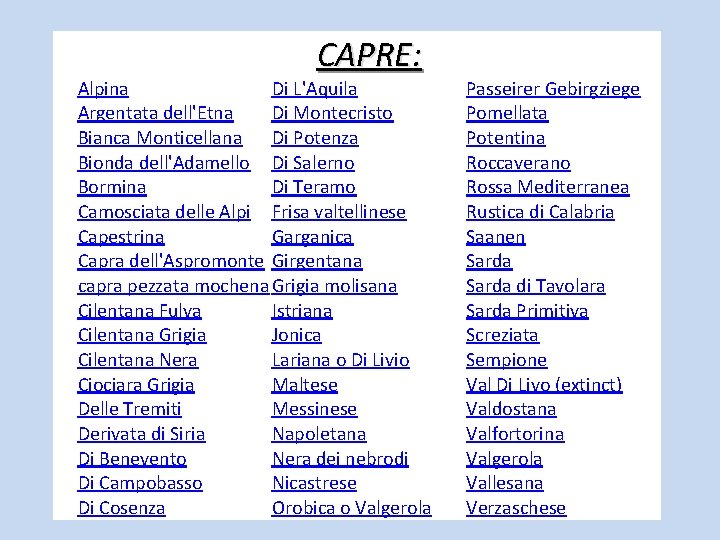
CAPRE: Alpina Di L'Aquila Argentata dell'Etna Di Montecristo Bianca Monticellana Di Potenza Bionda dell'Adamello Di Salerno Bormina Di Teramo Camosciata delle Alpi Frisa valtellinese Capestrina Garganica Capra dell'Aspromonte Girgentana capra pezzata mochena Grigia molisana Cilentana Fulva Istriana Cilentana Grigia Jonica Cilentana Nera Lariana o Di Livio Ciociara Grigia Maltese Delle Tremiti Messinese Derivata di Siria Napoletana Di Benevento Nera dei nebrodi Di Campobasso Nicastrese Di Cosenza Orobica o Valgerola Passeirer Gebirgziege Pomellata Potentina Roccaverano Rossa Mediterranea Rustica di Calabria Saanen Sarda di Tavolara Sarda Primitiva Screziata Sempione Val Di Livo (extinct) Valdostana Valfortorina Valgerola Vallesana Verzaschese
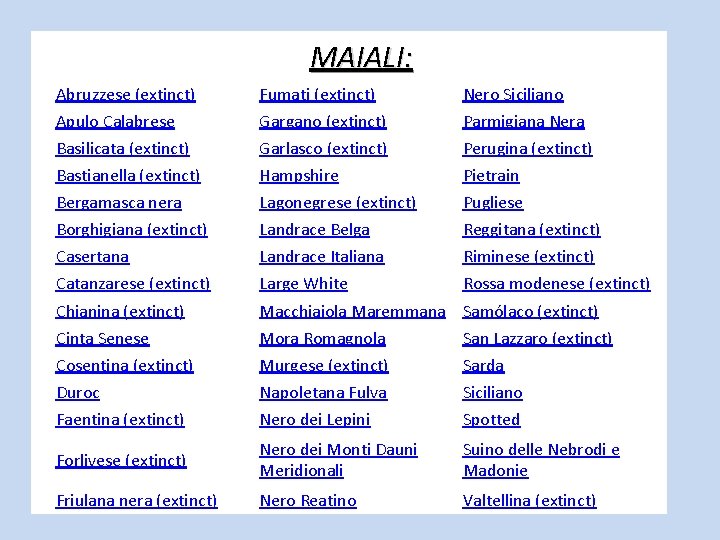
MAIALI: Abruzzese (extinct) Fumati (extinct) Nero Siciliano Apulo Calabrese Gargano (extinct) Parmigiana Nera Basilicata (extinct) Garlasco (extinct) Perugina (extinct) Bastianella (extinct) Hampshire Pietrain Bergamasca nera Lagonegrese (extinct) Pugliese Borghigiana (extinct) Landrace Belga Reggitana (extinct) Casertana Landrace Italiana Riminese (extinct) Catanzarese (extinct) Large White Rossa modenese (extinct) Chianina (extinct) Macchiaiola Maremmana Samólaco (extinct) Cinta Senese Mora Romagnola San Lazzaro (extinct) Cosentina (extinct) Murgese (extinct) Sarda Duroc Napoletana Fulva Siciliano Faentina (extinct) Nero dei Lepini Spotted Forlivese (extinct) Nero dei Monti Dauni Meridionali Suino delle Nebrodi e Madonie Friulana nera (extinct) Nero Reatino Valtellina (extinct)

POLLI: Ancona Livorno Padovana Polverara-Schiatta Siciliana Valdarno
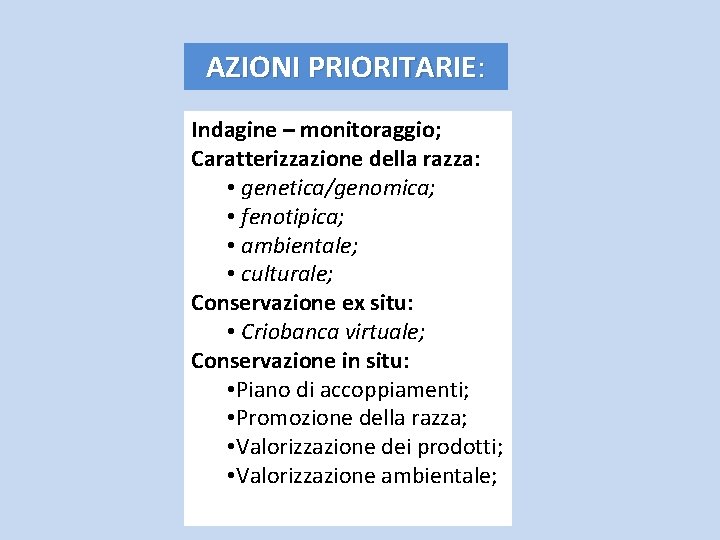
AZIONI PRIORITARIE: Indagine – monitoraggio; Caratterizzazione della razza: • genetica/genomica; • fenotipica; • ambientale; • culturale; Conservazione ex situ: • Criobanca virtuale; Conservazione in situ: • Piano di accoppiamenti; • Promozione della razza; • Valorizzazione dei prodotti; • Valorizzazione ambientale;
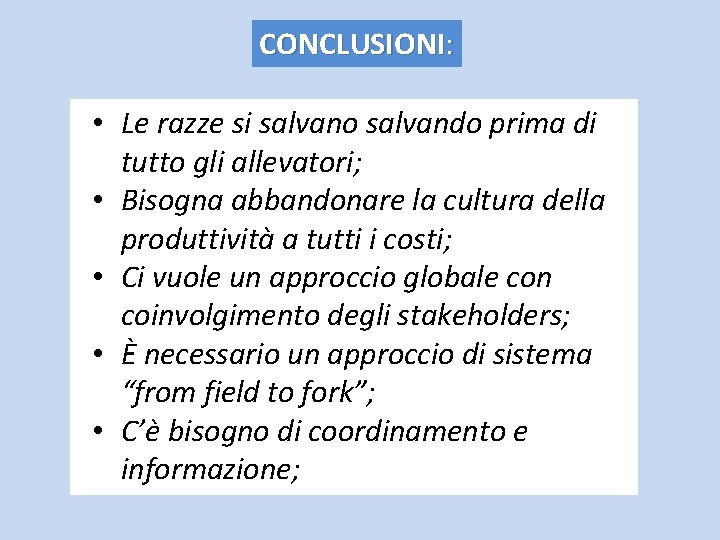
CONCLUSIONI: • Le razze si salvano salvando prima di tutto gli allevatori; • Bisogna abbandonare la cultura della produttività a tutti i costi; • Ci vuole un approccio globale con coinvolgimento degli stakeholders; • È necessario un approccio di sistema “from field to fork”; • C’è bisogno di coordinamento e informazione;
CONCLUSIONI: È un lavoro importante: • Possiamo farlo; • Dobbiamo farlo! GRAZIE !

- Slides: 45