
Giornate del CUIA in Italia Universit di Bari
Giornate del CUIA in Italia Università di Bari “Aldo Moro” 11 -12 Ottobre 2018 Workshop TECS - Giornate Argentine 2018 “ENERGIA DA GRADIENTI SALINI: STATO DELL’ARTE E TENDENZE” 10 -11 maggio 2018 Facultad de Ciencias Químicas - Universidad Nacional de Córdoba - Ciudad de Córdoba Prof. Giorgio Micale, Dott. Javier Luque Di Salvo - Università di Palermo
Outline • Objectives. • A glance into Salinity Gradient Energies concept (SGE). • Workshop location • Workshop program and execution. • Outcomes and future perspectives…
Objectives 1) Introduce to Argentinian partners the state-of-the-art of Salinity Gradient Energies, and related technologies. 2) Identify potential application sites for SGE. 3) Find common research interests in order to join efforts and promote the research among participants. Why Cordoba? • In 2014, it started to function the new ‘Laboratorio de Energias Sustentables (La. ES)’. The main research activities are the experimental synthesis of novel electrodes for lithium batteries. • Many researches on this field also work at DQTC, with expertise in atomistic and nanoscale modelling. Research activities at UNIPA and UNICAL/ITM • Membrane-based technologies for water treatment and sustainable energy production. Process design, optimization and multi-scale modelling. • Currently, 5 (five) EU-funded projects at different stages of execution are being developed at UNIPA.
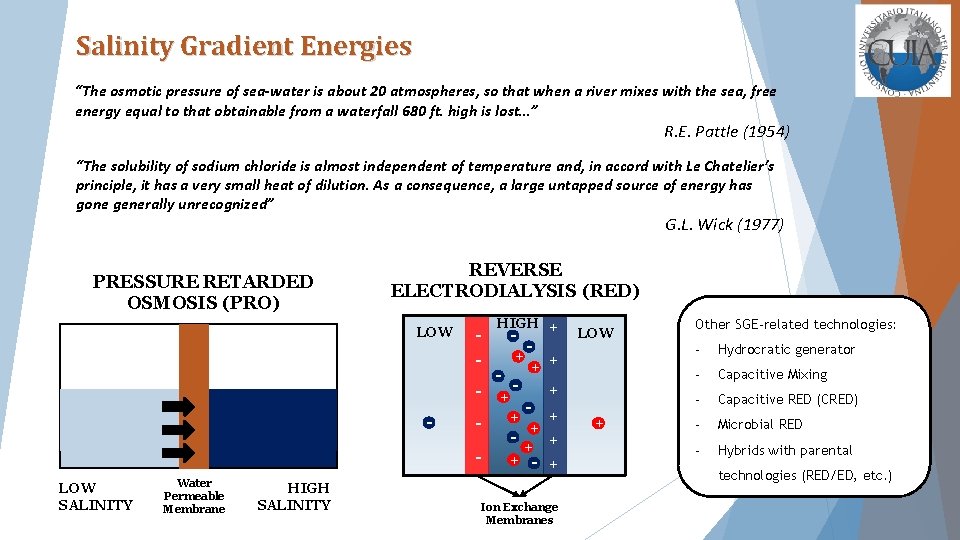
Salinity Gradient Energies “The osmotic pressure of sea-water is about 20 atmospheres, so that when a river mixes with the sea, free energy equal to that obtainable from a waterfall 680 ft. high is lost…” R. E. Pattle (1954) “The solubility of sodium chloride is almost independent of temperature and, in accord with Le Chatelier’s principle, it has a very small heat of dilution. As a consequence, a large untapped source of energy has gone generally unrecognized” G. L. Wick (1977) PRESSURE RETARDED OSMOSIS (PRO) REVERSE ELECTRODIALYSIS (RED) LOW SALINITY Water Permeable Membrane HIGH SALINITY HIGH + - -- ++ - - + + - + - LOW + + + Ion Exchange Membranes + Other SGE-related technologies: - Hydrocratic generator - Capacitive Mixing - Capacitive RED (CRED) - Microbial RED - Hybrids with parental technologies (RED/ED, etc. )
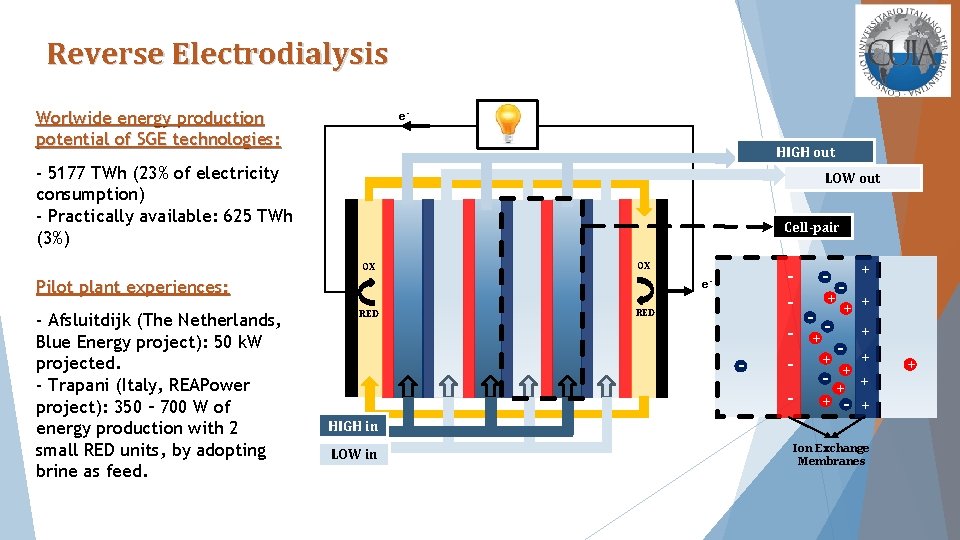
Reverse Electrodialysis Worlwide energy production potential of SGE technologies: e. HIGH out - 5177 TWh (23% of electricity consumption) - Practically available: 625 TWh (3%) LOW out Cell-pair OX OX Pilot plant experiences: - Afsluitdijk (The Netherlands, Blue Energy project): 50 k. W projected. - Trapani (Italy, REAPower project): 350 – 700 W of energy production with 2 small RED units, by adopting brine as feed. e. RED - - -- ++ - - + + - + - + + + HIGH in LOW in Ion Exchange Membranes +
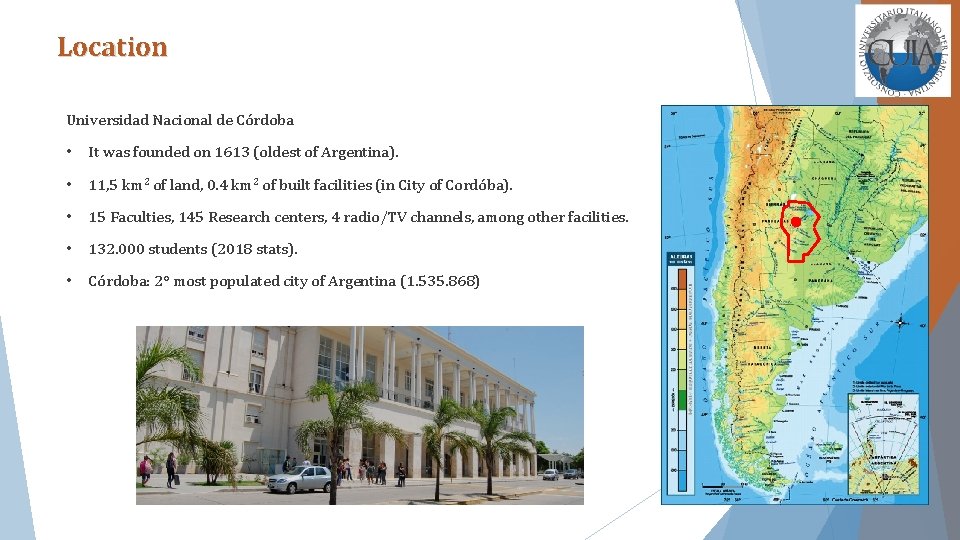
Location Universidad Nacional de Córdoba • It was founded on 1613 (oldest of Argentina). • 11, 5 km 2 of land, 0. 4 km 2 of built facilities (in City of Cordóba). • 15 Faculties, 145 Research centers, 4 radio/TV channels, among other facilities. • 132. 000 students (2018 stats). • Córdoba: 2° most populated city of Argentina (1. 535. 868)
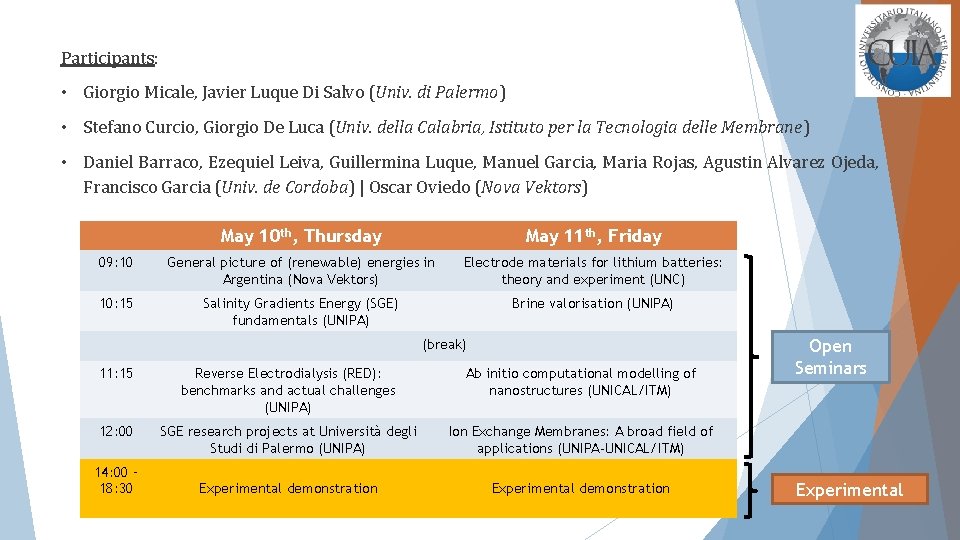
Participants: • Giorgio Micale, Javier Luque Di Salvo (Univ. di Palermo) • Stefano Curcio, Giorgio De Luca (Univ. della Calabria, Istituto per la Tecnologia delle Membrane) • Daniel Barraco, Ezequiel Leiva, Guillermina Luque, Manuel Garcia, Maria Rojas, Agustin Alvarez Ojeda, Francisco Garcia (Univ. de Cordoba) | Oscar Oviedo (Nova Vektors) May 10 th, Thursday May 11 th, Friday 09: 10 General picture of (renewable) energies in Argentina (Nova Vektors) Electrode materials for lithium batteries: theory and experiment (UNC) 10: 15 Salinity Gradients Energy (SGE) fundamentals (UNIPA) Brine valorisation (UNIPA) (break) 11: 15 Reverse Electrodialysis (RED): benchmarks and actual challenges (UNIPA) Ab initio computational modelling of nanostructures (UNICAL/ITM) 12: 00 SGE research projects at Università degli Studi di Palermo (UNIPA) Ion Exchange Membranes: A broad field of applications (UNIPA-UNICAL/ITM) Experimental demonstration 14: 00 – 18: 30 Open Seminars Experimental
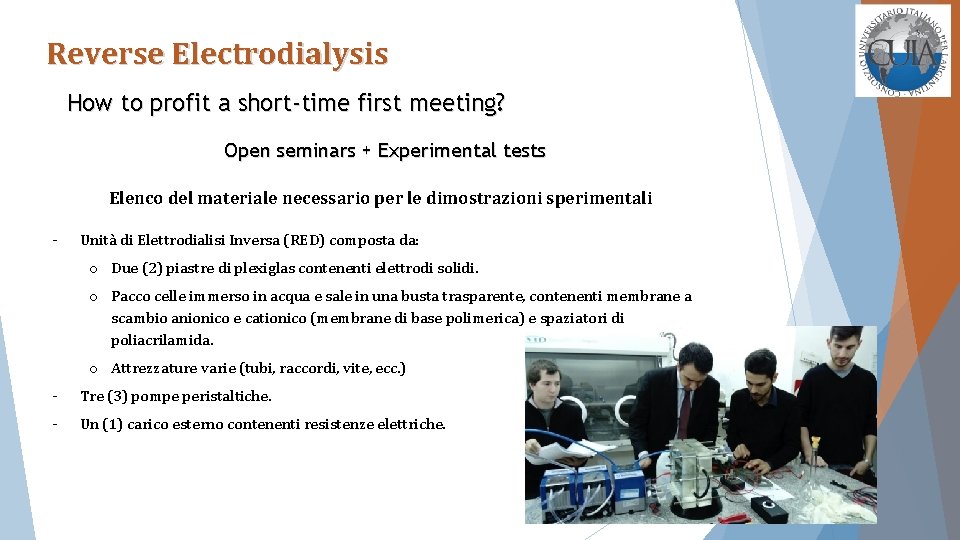
Reverse Electrodialysis How to profit a short-time first meeting? Open seminars + Experimental tests Elenco del materiale necessario per le dimostrazioni sperimentali - Unità di Elettrodialisi Inversa (RED) composta da: o Due (2) piastre di plexiglas contenenti elettrodi solidi. o Pacco celle immerso in acqua e sale in una busta trasparente, contenenti membrane a scambio anionico e cationico (membrane di base polimerica) e spaziatori di poliacrilamida. o Attrezzature varie (tubi, raccordi, vite, ecc. ) - Tre (3) pompe peristaltiche. - Un (1) carico esterno contenenti resistenze elettriche.
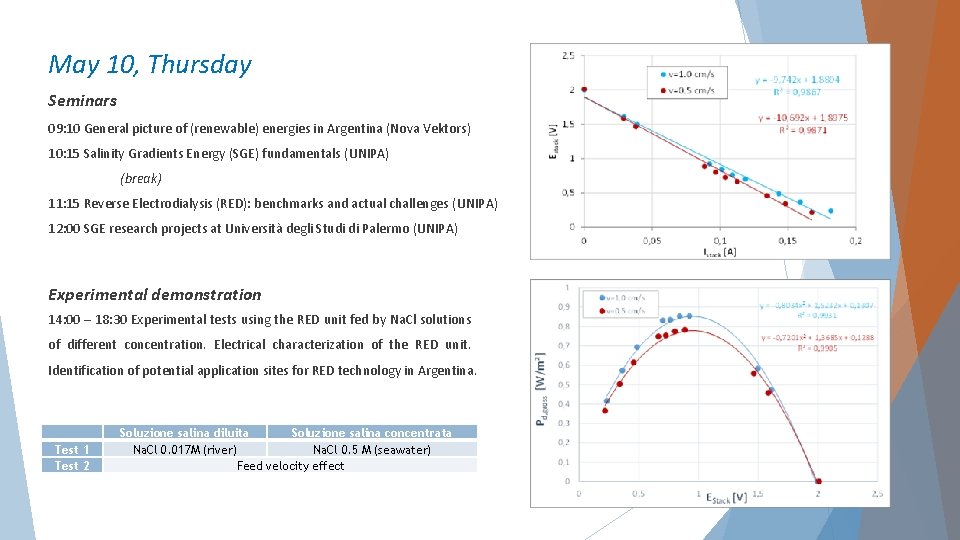
May 10, Thursday Seminars 09: 10 General picture of (renewable) energies in Argentina (Nova Vektors) 10: 15 Salinity Gradients Energy (SGE) fundamentals (UNIPA) (break) 11: 15 Reverse Electrodialysis (RED): benchmarks and actual challenges (UNIPA) 12: 00 SGE research projects at Università degli Studi di Palermo (UNIPA) Experimental demonstration 14: 00 – 18: 30 Experimental tests using the RED unit fed by Na. Cl solutions of different concentration. Electrical characterization of the RED unit. Identification of potential application sites for RED technology in Argentina. Test 1 Test 2 Soluzione salina diluita Soluzione salina concentrata Na. Cl 0. 017 M (river) Na. Cl 0. 5 M (seawater) Feed velocity effect
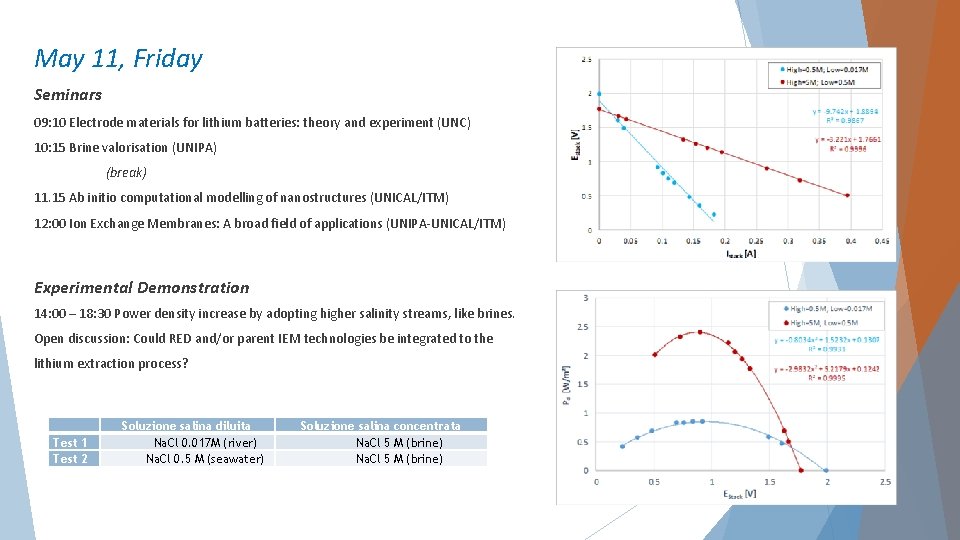
May 11, Friday Seminars 09: 10 Electrode materials for lithium batteries: theory and experiment (UNC) 10: 15 Brine valorisation (UNIPA) (break) 11. 15 Ab initio computational modelling of nanostructures (UNICAL/ITM) 12: 00 Ion Exchange Membranes: A broad field of applications (UNIPA-UNICAL/ITM) Experimental Demonstration 14: 00 – 18: 30 Power density increase by adopting higher salinity streams, like brines. Open discussion: Could RED and/or parent IEM technologies be integrated to the lithium extraction process? Test 1 Test 2 Soluzione salina diluita Na. Cl 0. 017 M (river) Na. Cl 0. 5 M (seawater) Soluzione salina concentrata Na. Cl 5 M (brine)
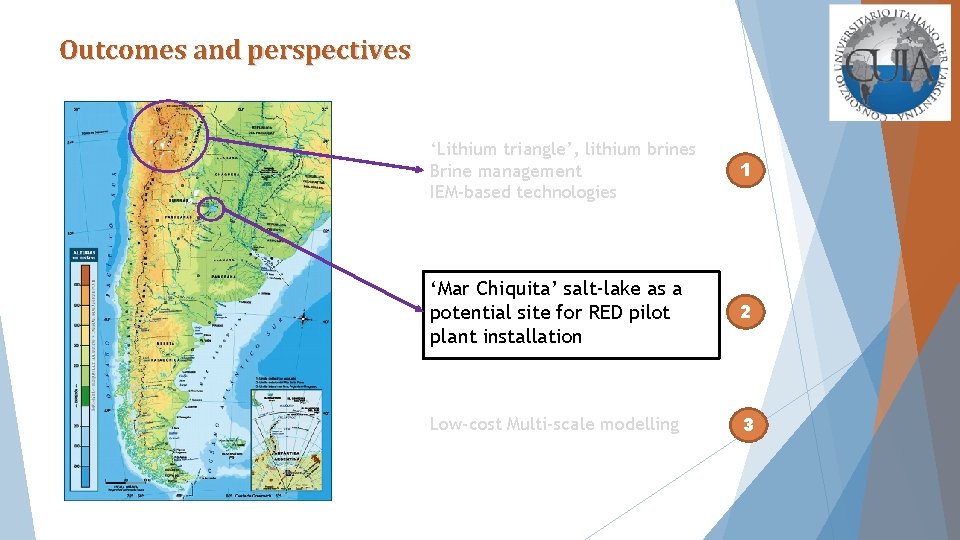
Outcomes and perspectives ‘Lithium triangle’, lithium brines Brine management IEM-based technologies 1 ‘Mar Chiquita’ salt-lake as a potential site for RED pilot plant installation 2 Low-cost Multi-scale modelling 3
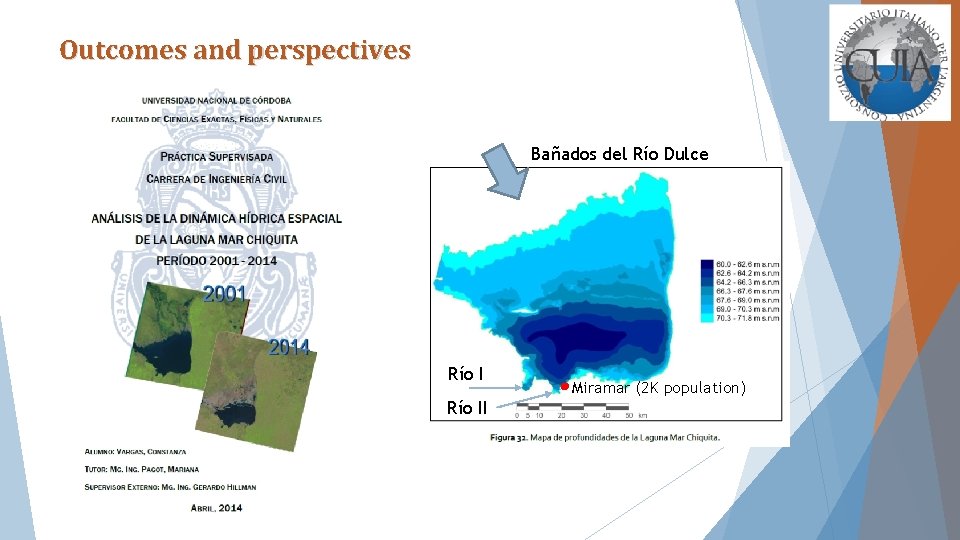
Outcomes and perspectives Bañados del Río Dulce Río II Miramar (2 K population)
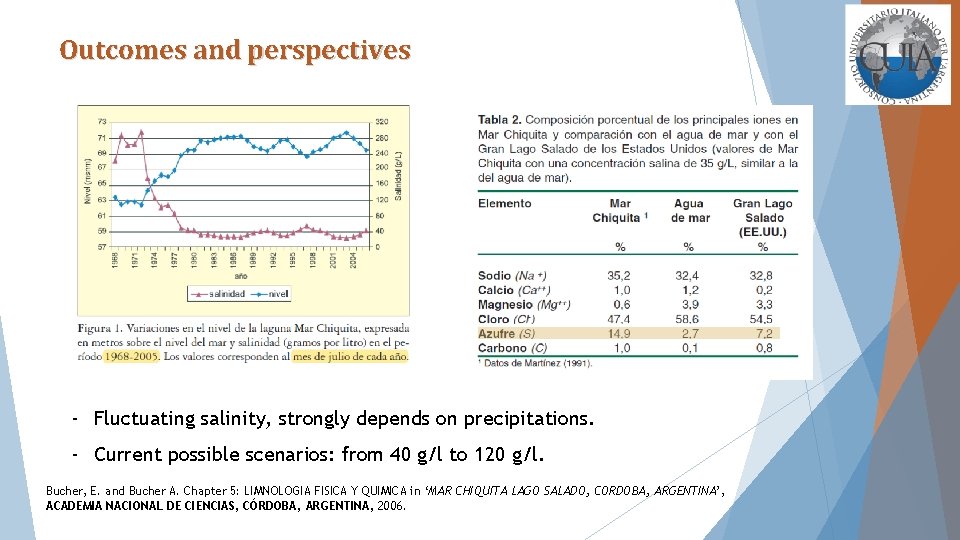
Outcomes and perspectives - Fluctuating salinity, strongly depends on precipitations. - Current possible scenarios: from 40 g/l to 120 g/l. Bucher, E. and Bucher A. Chapter 5: LIMNOLOGIA FISICA Y QUIMICA in ‘MAR CHIQUITA LAGO SALADO, CORDOBA, ARGENTINA’, ACADEMIA NACIONAL DE CIENCIAS, CÓRDOBA, ARGENTINA, 2006.
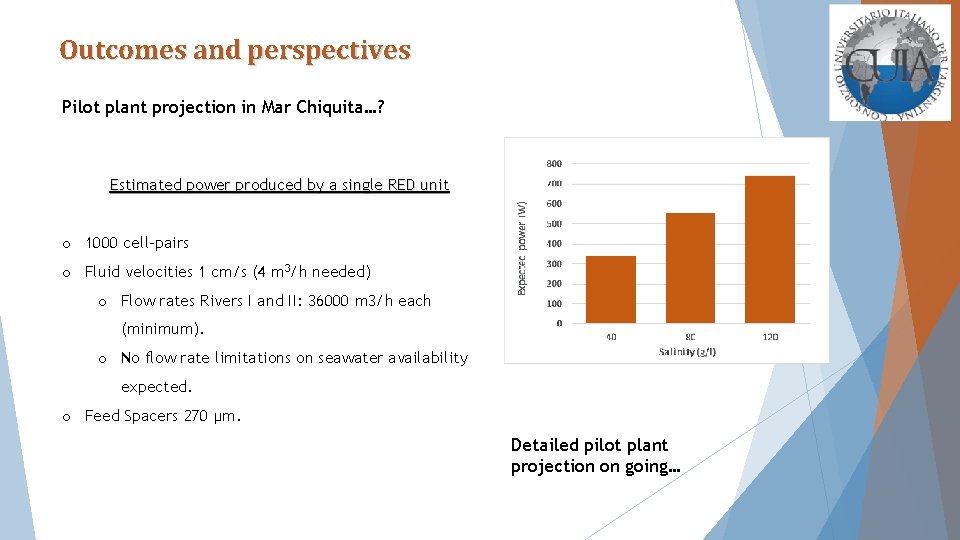
Outcomes and perspectives Pilot plant projection in Mar Chiquita…? Estimated power produced by a single RED unit o 1000 cell-pairs o Fluid velocities 1 cm/s (4 m 3/h needed) o Flow rates Rivers I and II: 36000 m 3/h each (minimum). o No flow rate limitations on seawater availability expected. o Feed Spacers 270 µm. Detailed pilot plant projection on going…
Giornate Argentine 2018 Workshop TECS “ENERGIA DA GRADIENTI SALINI: STATO DELL’ARTE E TENDENZE” Grazie! Gracias!
- Slides: 15