
GInvoicing Impacts to USDA Users Eddie Reso What

- Slides: 26
G-Invoicing – Impacts to USDA Users Eddie Reso
What is G-Invoicing? • Online portal for Interagency Agreements –serves as the “broker” • Mechanism by which agencies arrange and negotiate information electronically • A data exchange platform – common to ALL Federal Agencies • Facilitates the exchange of information between Federal trading partners • Has well-defined lines of communication, and is the origin for sharing data and exchanging information on reimbursable activity
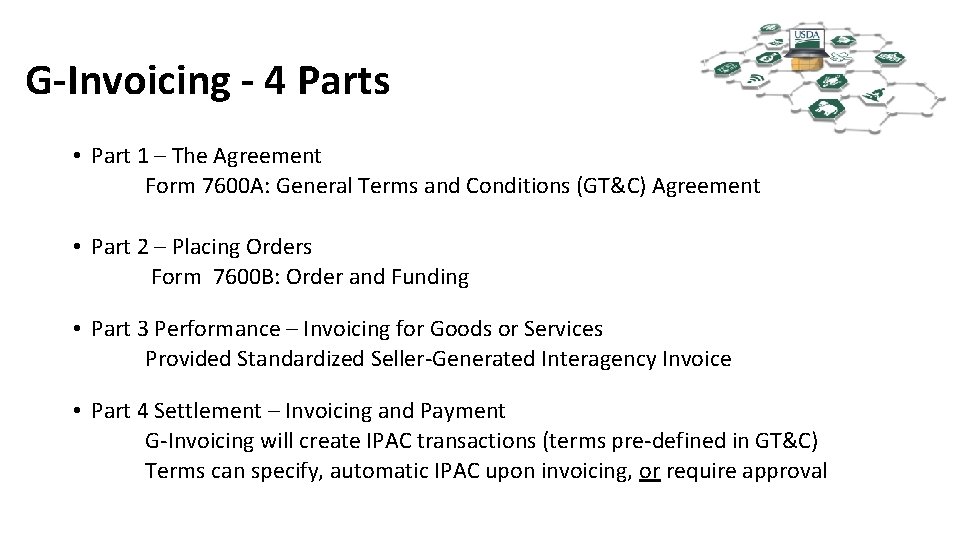
G-Invoicing - 4 Parts • Part 1 – The Agreement Form 7600 A: General Terms and Conditions (GT&C) Agreement • Part 2 – Placing Orders Form 7600 B: Order and Funding • Part 3 Performance – Invoicing for Goods or Services Provided Standardized Seller-Generated Interagency Invoice • Part 4 Settlement – Invoicing and Payment G-Invoicing will create IPAC transactions (terms pre-defined in GT&C) Terms can specify, automatic IPAC upon invoicing, or require approval
G Invoicing High Level Overview
G-Invoicing Implementation • Mandatory for all Federal Agencies • All Federal Agencies must me implemented into G-Invoicing by June 2021 • USDA is currently developing implementation plan • Agreements between USDA Agencies will NOT be in G-Invoicing • Intra-USDA agreements will be recorded in the newly developed IAA Module of the EZFed. Grants system, which is interfaced to FMMI • The new USDA-IAA process for Intra-USDA agreements will continue to utilize the current FMMI internal INTR Process for recording payments and collections
Step 1 – The Agreement • USDA FMMI Agencies will use the G-Invoicing portal for entering agreements • Obtain access from Treasury Fiscal Service • Federal trading partners must also be in G-Invoicing to complete agreement • USDA plans for G-Invoicing Agreement data to be pulled from G-Invoicing and interfaced into FMMI. G-Invoicing will be the data entry point for agreements
Step 2 – The Orders • USDA’s initial vision is for agencies not to enter orders in G-Invoicing • Enter the Purchase Order in FMMI as done today, for all orders • An interface will be built to transmit Purchase Order Data to/from FMMI to G-Invoicing • Special Notes about CARS and Component TAS • G-Invoicing does not support String TAS • Although FMMI still uses String TAS’s - Application of Funds, this is only for front-end user convenience. Behind the scenes the component TAS is stored and transmitted to Treasury for reporting. • USDA Users will need to be familiar with the component TAS format
Step 3 – Performance/Invoicing • USDA’s initial vision is for agencies not to enter performance data in G-Invoicing • G-Invoicing Order Data from USDA customer agencies will be downloaded from G-Invoicing • An interface will be built to use G-Invoicing Order data to create Sales Orders in FMMI • As goods and services are delivered, resource related billing will run as currently done to produce AR Invoices • An interface will be built to extract and send FMMI Billing Data to G-Invoicing to record performance
Step 4 – Settlement In Regards to USDA as the Vendor/Performing Agency: • G-Invoicing will receive data from FMMI to record performance • G-Invoicing system will trigger IPAC transactions to accomplish collections • Settlement terms recorded on established agreements will dictate when the IPAC collections are generated: • FOB Shipping – IPAC transactions will be automatically generated • FOB Destination – Customer agency will have to manually approve invoice in the G-Invoicing portal before IPAC transactions will be generated • Collection confirmation data will be available from both G-Invoicing and IPAC systems for downloading and recording in FMMI
Step 4 – Settlement (cont. ) In Regards to USDA as the Customer/Receiving Agency: • The USDA Trading Partner will record performance data in G-Invoicing • G-Invoicing system will trigger IPAC transactions based on GT&C Terms • USDA will download IPAC disbursement transactions from either the G-Invoicing or IPAC systems • IPAC transactions will be loaded to FMMI and matched against Purchase Orders to record Accounts Payable invoices and cash disbursements as currently done
Summary of Implementation Status • Decision made – USDA agencies will utilize the G-Invoicing Portal for entering agreement data • USDA will not use on-line portal for entering ordering and performance data, but rather electronically load this data, as suggested by Fiscal Service • SAP must provide solution for its Federal customers • SAP is currently working with its Federal customer agencies to gather requirements, address concerns, and provide demonstrations on protypes
What’s Next • Gain access now to G-Invoicing Portal • Schedule live training in Crystal City, VA or Webex Training Questions
Live Demo Lena Napolitano Federal Reserve Bank – St. Louis
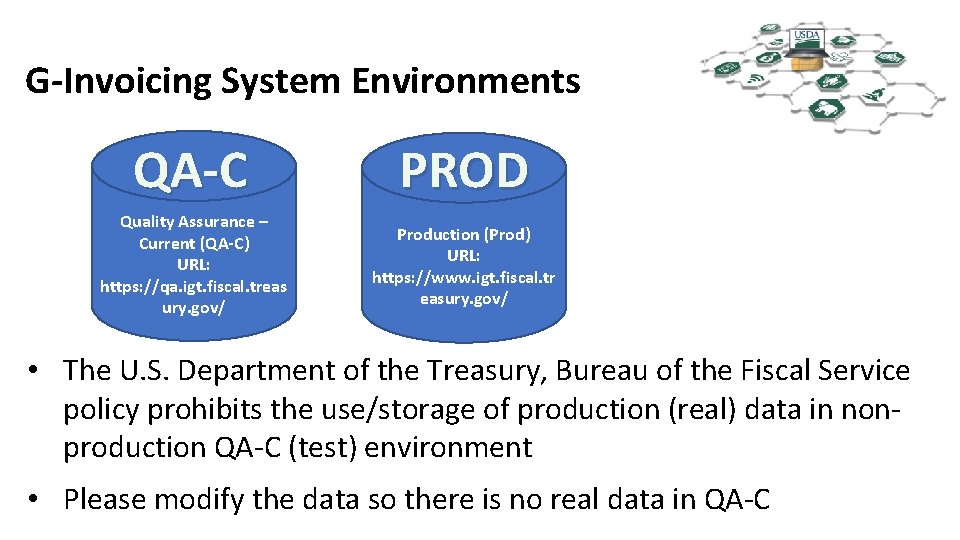
G-Invoicing System Environments QA-C PROD Quality Assurance – Current (QA-C) URL: https: //qa. igt. fiscal. treas ury. gov/ Production (Prod) URL: https: //www. igt. fiscal. tr easury. gov/ • The U. S. Department of the Treasury, Bureau of the Fiscal Service policy prohibits the use/storage of production (real) data in nonproduction QA-C (test) environment • Please modify the data so there is no real data in QA-C
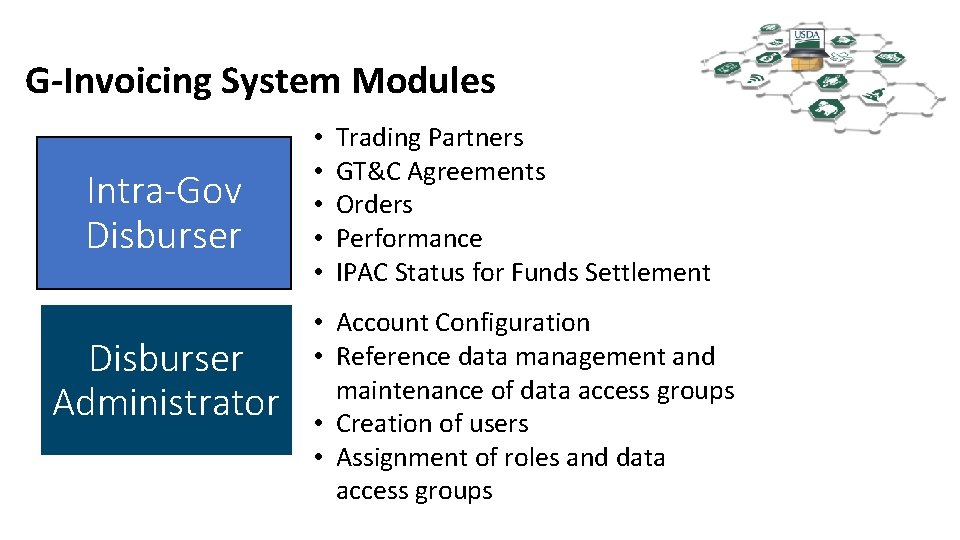
G-Invoicing System Modules Intra-Gov Disburser Administrator • • • Trading Partners GT&C Agreements Orders Performance IPAC Status for Funds Settlement • Account Configuration • Reference data management and maintenance of data access groups • Creation of users • Assignment of roles and data access groups
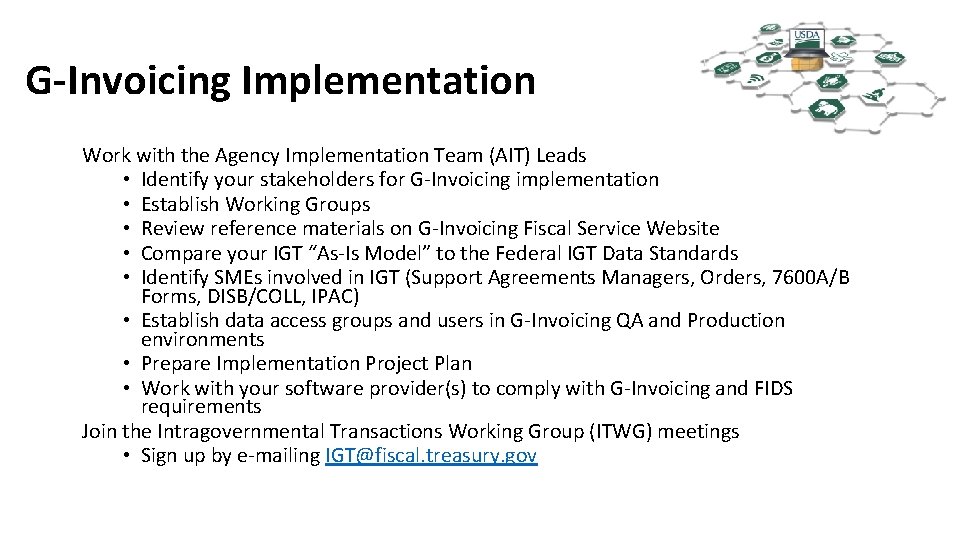
G-Invoicing Implementation Work with the Agency Implementation Team (AIT) Leads • Identify your stakeholders for G-Invoicing implementation • Establish Working Groups • Review reference materials on G-Invoicing Fiscal Service Website • Compare your IGT “As-Is Model” to the Federal IGT Data Standards • Identify SMEs involved in IGT (Support Agreements Managers, Orders, 7600 A/B Forms, DISB/COLL, IPAC) • Establish data access groups and users in G-Invoicing QA and Production environments • Prepare Implementation Project Plan • Work with your software provider(s) to comply with G-Invoicing and FIDS requirements Join the Intragovernmental Transactions Working Group (ITWG) meetings • Sign up by e-mailing IGT@fiscal. treasury. gov
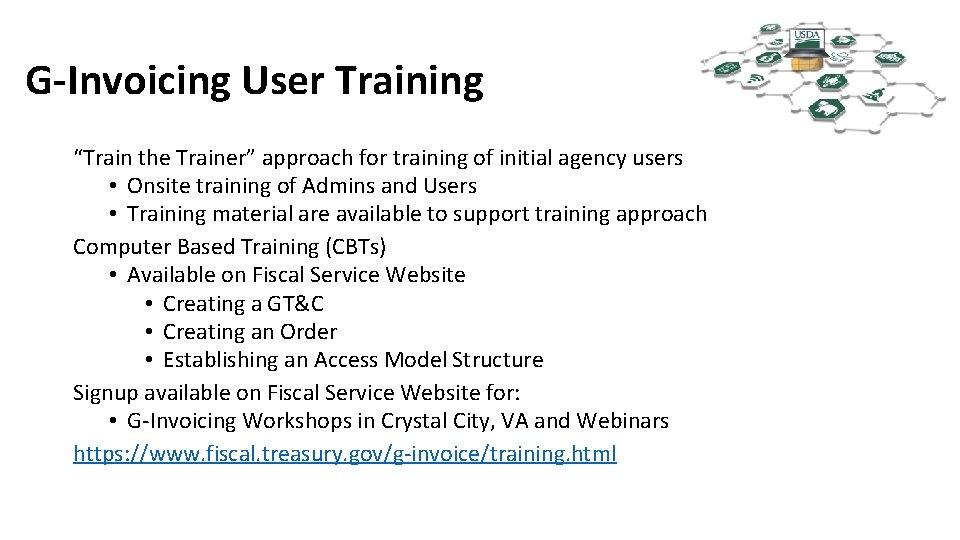
G-Invoicing User Training “Train the Trainer” approach for training of initial agency users • Onsite training of Admins and Users • Training material are available to support training approach Computer Based Training (CBTs) • Available on Fiscal Service Website • Creating a GT&C • Creating an Order • Establishing an Access Model Structure Signup available on Fiscal Service Website for: • G-Invoicing Workshops in Crystal City, VA and Webinars https: //www. fiscal. treasury. gov/g-invoice/training. html
G-Invoicing Treasury Contact Information For IGT Program Management and Agency Outreach Support Chris Beck Manager, General Ledger and Advisory Branch, Bureau of the Fiscal Service (304) 480 -7122; christopher. beck@fiscal. treasury. gov Keith Jarboe IGT Agency Outreach – Engagement & Onboarding Staff Bureau of the Fiscal Service – Fiscal Accounting 202 -874 -7818; keith. jarboe@fiscal. treasury. gov For Intragovernmental Transactions Working Group Information IGT@fiscal. treasury. gov Alex Abshire (alexander. abshire@fiscal. treasury. gov) Wesley Vincent (wesley. vincent@fiscal. treasury. gov) https: //www. fiscal. treasury. gov/g-invoice/ For Intragovernmental Reporting Point of Contact List for Agencies https: //www. fiscal. treasury. gov/gtas/intergovernmental-contact-list-for-agencies. html The Financial Reports Division has provided each agency with an assigned review accountant to answer questions about the Intragovernmental Transactions (IGT)
G-Invoicing Implementation Team Agency Onboarding and Implementation, Federal Reserve Bank of St. Louis Robert Mattison, AIT Manager (314) 444 -3943 Robert. Mattison@stls. frb. org George Pierce, AIT Lead (202) 759 -0701 George. Pierce@stls. frb. org Doug Larson, Senior Project Manager (202) 759 -0700 Douglas. Larson@stls. frb. org Will Beedie, AIT Specialist (314) 444 -8797 William. Beedie@stls. frb. org Lena Napolitano, AIT Lead (202) 759 -0702 Olena. Napolitano@stls. frb. org Shelley Sadler, AIT Specialist (314) 444 -3969 Shelley. Sadler@stls. frb. org If you need your password to be reset, please contact Treasury Support Center at e-mail: GInvoicing@stls. frb. org and/or phone: (877)-440 -9476, Monday – Friday, 7: 00 am - 8: 00 pm
G-Invoicing System Demo https: //qa. igt. fiscal. treasury. gov/
Implementation Plan G-invoicing General Services Administration Robert Smalskas
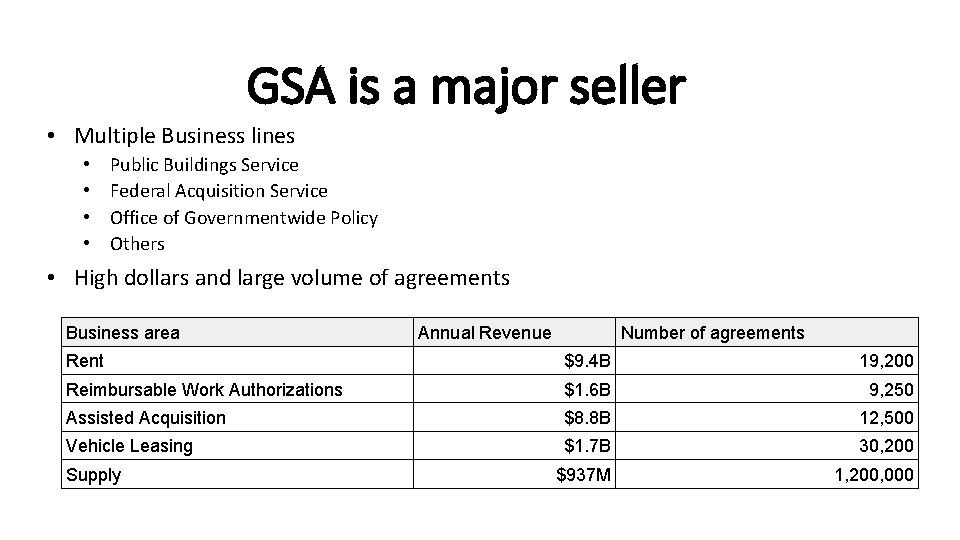
GSA is a major seller • Multiple Business lines • • Public Buildings Service Federal Acquisition Service Office of Governmentwide Policy Others • High dollars and large volume of agreements Business area Annual Revenue Number of agreements Rent $9. 4 B 19, 200 Reimbursable Work Authorizations $1. 6 B 9, 250 Assisted Acquisition $8. 8 B 12, 500 Vehicle Leasing $1. 7 B 30, 200 $937 M 1, 200, 000 Supply
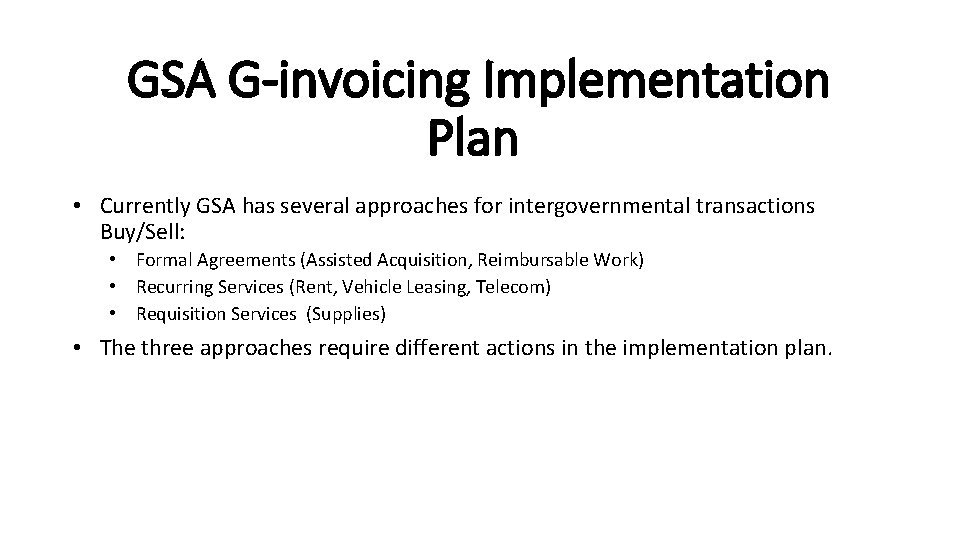
GSA G-invoicing Implementation Plan • Currently GSA has several approaches for intergovernmental transactions Buy/Sell: • Formal Agreements (Assisted Acquisition, Reimbursable Work) • Recurring Services (Rent, Vehicle Leasing, Telecom) • Requisition Services (Supplies) • The three approaches require different actions in the implementation plan.
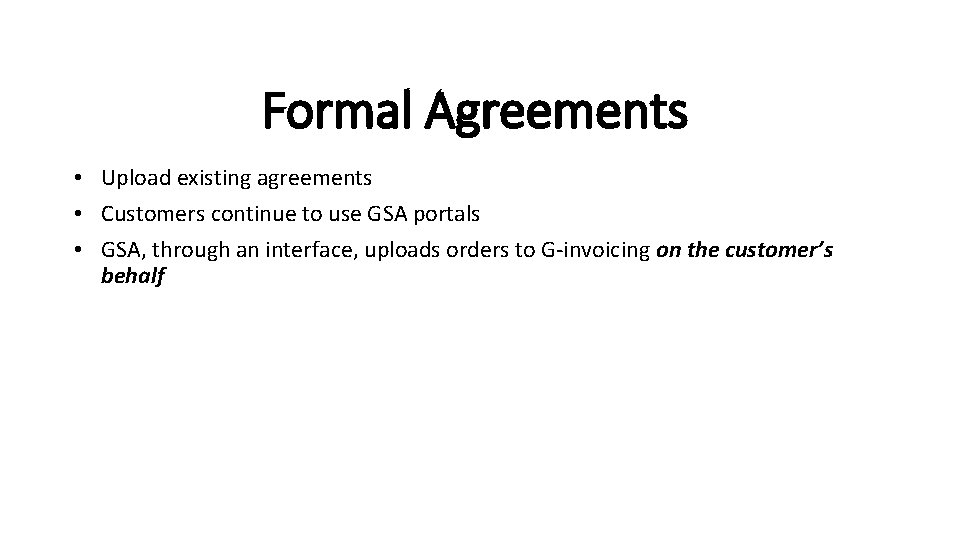
Formal Agreements • Upload existing agreements • Customers continue to use GSA portals • GSA, through an interface, uploads orders to G-invoicing on the customer’s behalf
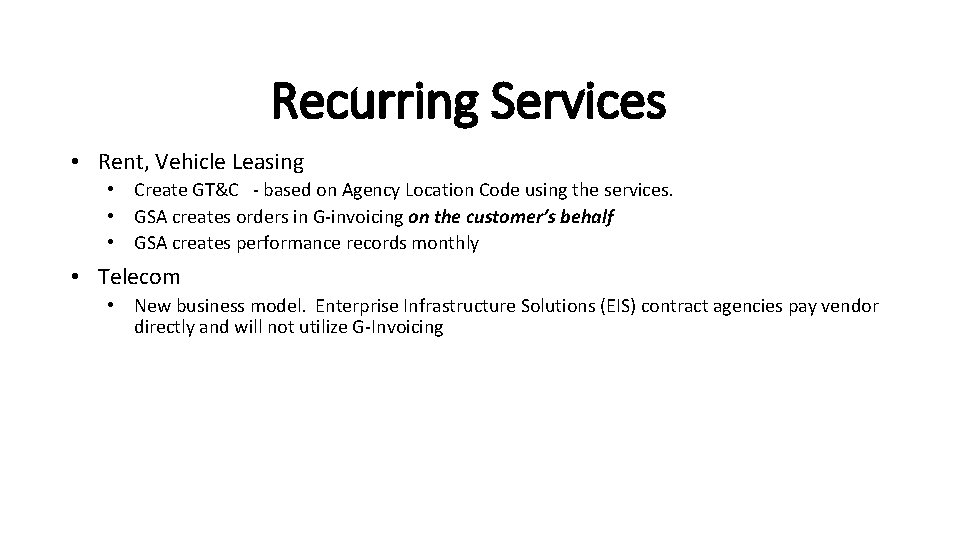
Recurring Services • Rent, Vehicle Leasing • Create GT&C - based on Agency Location Code using the services. • GSA creates orders in G-invoicing on the customer’s behalf • GSA creates performance records monthly • Telecom • New business model. Enterprise Infrastructure Solutions (EIS) contract agencies pay vendor directly and will not utilize G-Invoicing
Requisition Services • Customers order through online e. Commerce systems, phone calls or at a retail store. • No formal agreement • Validation process in place • Customers continue to use sales portals • Millions of automated transactions per year • Inserting G-invoicing approvals into the process could negatively impact timeliness • Exploring options - export data to G-Invoicing