
GINGIVAL INFLAMMATION INTRODUCTION Stage I GingivitisInitial lesion Stage
- Slides: 19
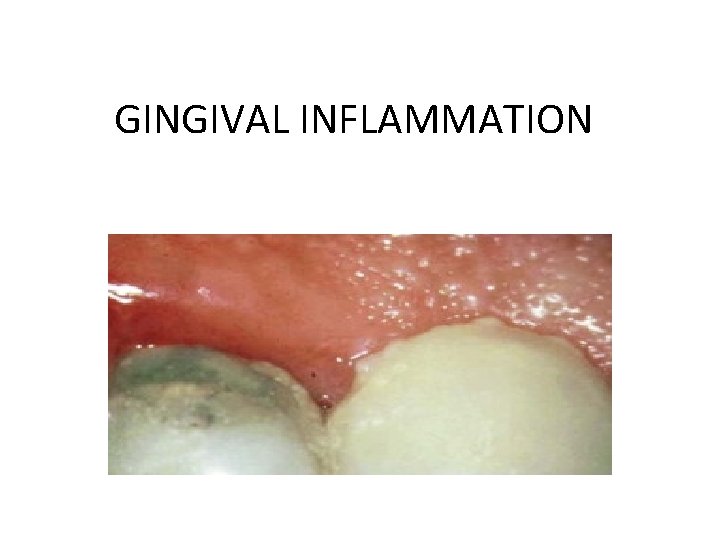
GINGIVAL INFLAMMATION
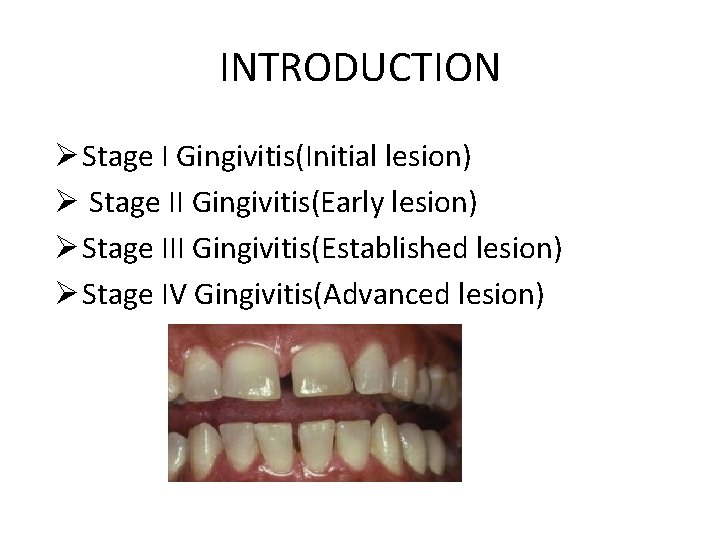
INTRODUCTION Ø Stage I Gingivitis(Initial lesion) Ø Stage II Gingivitis(Early lesion) Ø Stage III Gingivitis(Established lesion) Ø Stage IV Gingivitis(Advanced lesion)
STAGE I GINGIVITIS(INITIAL LESION) Ø First manifestation Vascular changes Dilated capillaries Blood flow increased Ø Initial inflammatory changes due to microbial activation of resident leukocytes & subsequent stimulation of endothelial cells Ø Subclinical gingivitis
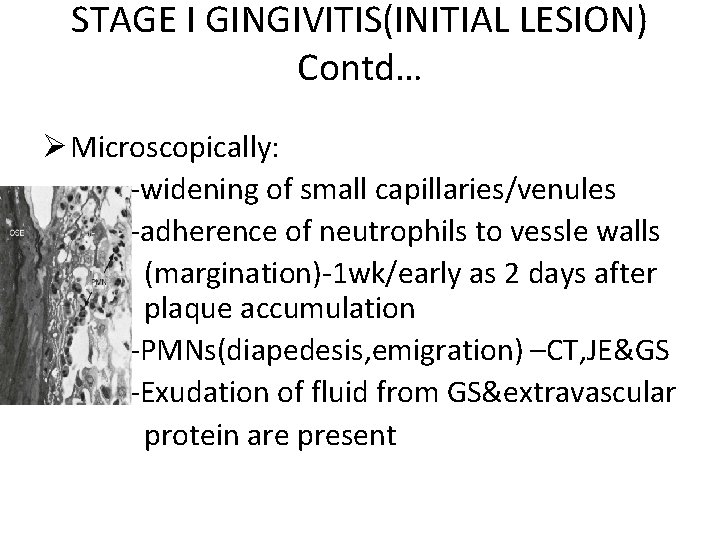
STAGE I GINGIVITIS(INITIAL LESION) Contd… Ø Microscopically: -widening of small capillaries/venules -adherence of neutrophils to vessle walls (margination)-1 wk/early as 2 days after plaque accumulation -PMNs(diapedesis, emigration) –CT, JE&GS -Exudation of fluid from GS&extravascular protein are present
STAGE II GINGIVITIS(EARLY LESION) Ø Evolves from the initial lesion Ø After 1 wk of plaque accumulation Ø Erythema Ø Bleeding on Probing Ø Gingival fluid flow Ø Transmigrating leukocyte maximum-6&12 days
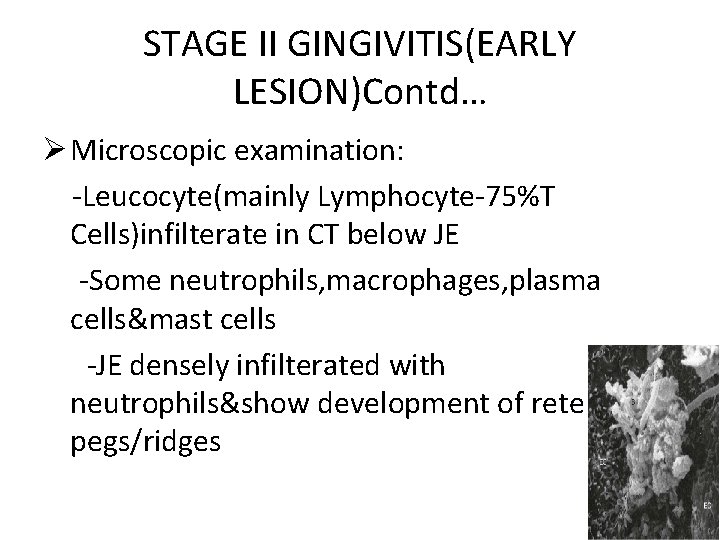
STAGE II GINGIVITIS(EARLY LESION)Contd… Ø Microscopic examination: -Leucocyte(mainly Lymphocyte-75%T Cells)infilterate in CT below JE -Some neutrophils, macrophages, plasma cells&mast cells -JE densely infilterated with neutrophils&show development of rete pegs/ridges
STAGE II GINGIVITIS(EARLY LESION)Contd. Ø 70%collagen destruction around cellular infilterate Ø Circular&Dentogingival group fibers mostly affected Ø PMNs reach in to pocket(chemotactic stimuli) Ø PMNs-phagocytosis(release of lysosomes to engulf bacteria) Ø MMPs-extracellular matrix remodelling(7 days)
STAGE III GINGIVITIS(ESTABLISHED LESION) Ø 2/3 wk after accumulation of plaque Ø Predominance of plasma cells&B lymphocyte Ø Creation of small gingival pocket lined with pocket epithelium Ø B cells predominently Ig. G 1&Ig. G 3 subclasses Ø Vessels engorged , congested&venous return impaired&blood flow sluggish Ø Result localized gingival anoxemia-bluish hue on the reddened gingiva
STAGE III GINGIVITIS(ESTABLISHED LESION contd. . Ø Extravastion of erythrocyte in to CT&brekdown in to component pigments can deepen the color of inflamed gingiva Ø Collagenolytic activity increased in inflammed gingival tissue Ø Increased level of ALP, βglucuronidase, glactosidase, glucocidase, estera se, aminopeptidase&cytochrome oxidase Ø Decreased neutral mucopolysaccharide
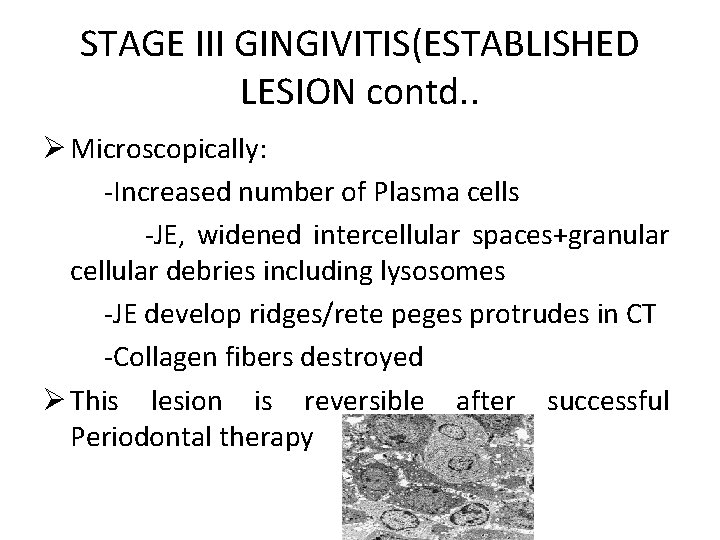
STAGE III GINGIVITIS(ESTABLISHED LESION contd. . Ø Microscopically: -Increased number of Plasma cells -JE, widened intercellular spaces+granular cellular debries including lysosomes -JE develop ridges/rete peges protrudes in CT -Collagen fibers destroyed Ø This lesion is reversible after successful Periodontal therapy
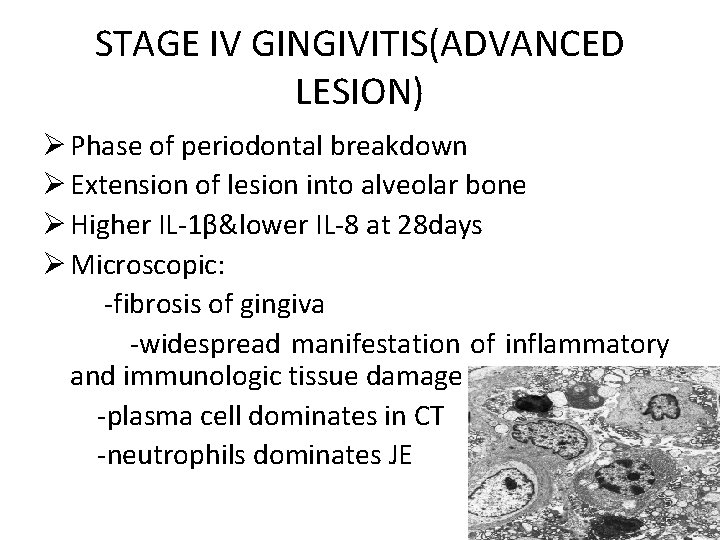
STAGE IV GINGIVITIS(ADVANCED LESION) Ø Phase of periodontal breakdown Ø Extension of lesion into alveolar bone Ø Higher IL-1β&lower IL-8 at 28 days Ø Microscopic: -fibrosis of gingiva -widespread manifestation of inflammatory and immunologic tissue damage -plasma cell dominates in CT -neutrophils dominates JE
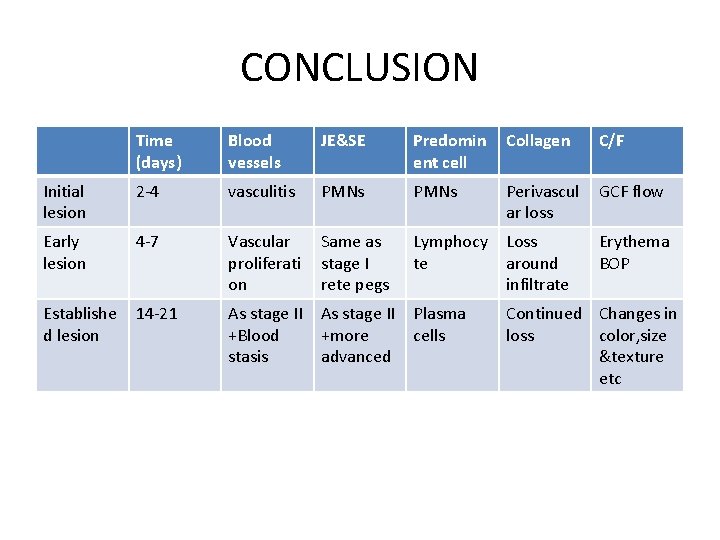
CONCLUSION Time (days) Blood vessels JE&SE Predomin ent cell Collagen C/F Initial lesion 2 -4 vasculitis PMNs Perivascul ar loss GCF flow Early lesion 4 -7 Vascular proliferati on Same as stage I rete pegs Lymphocy te Loss around infiltrate Erythema BOP Establishe d lesion 14 -21 As stage II +Blood stasis As stage II +more advanced Plasma cells Continued Changes in loss color, size &texture etc
MCQ-1 Which of the following clinical condition represents the non apparent initial response of the gingiva to bacterial plaque (a)Subclinical gingivitis (b)Marginal gingivitis (c)Localized gingivitis (d)Generalized gingivitis
MCQ-2 Which of the following leucocytes mainly predominant in the stage I gingivitis (a)PMNs (b)Plasma cells (c)Lymphocytes (d)Basophils
MCQ-3 Which of the following is related with clinical finding of the early lesion of gingivitis (a)Gingival fluid flow (b)Erythema (c)Change texture of gingiva (d)Change size of gingiva
MCQ-4 Which of the following cell is mainly present in the C. T. during stage II gingivitis (a)Neutrophils (b)Lymphocyte (c)Plasma cell (d)Macrophages
MCQ-5 Which group of the fiber is mostly affected in the early stage of gingivitis (a)Circular (b)Alveolar crest (c)Horizontal (d)Transseptal
MCQ-6 The localized gingival anoxemia which superimposes a some what bluish hue on the reddened gingiva is clinical feature of (a)Initial lesion (b)Early lesion (c)Established lesion (d)Advanced lesion
REFERENCES • Carranza’s Clinical Periodontology 11 th Edition • Carranza’s Clinical Periodontology 12 th Edition