
Ginger Dublin 6 th Grade Science Star Facts
Ginger Dublin 6 th Grade Science
Star Facts
Types of Stars and How They Form • Low Mass Stars • Medium Mass Stars • High Mass Stars

Low Mass Stars • • Nebula Protostar Main Sequence Star White Dwarf • Small, cool stars • Use hydrogen slowly • Live more than 30 billion of year
Medium Mass Stars • • • Nebula Protostar Main Sequence Star Red Giant Planetary Nebula White Dwarf • Medium size and temperature • Live about 10 billion years

High Mass Stars • • • Nebula Photostar Main Sequence Star Supergiant Supernova Neutron Star or Black Hole • Hottest, most massive stars • Shortest lives: millions of years • Uses hydrogen quickly
Black Holes • Formed when a supernova explodes causing its core to collapse. • So dense that even light can’t escape its gravity.
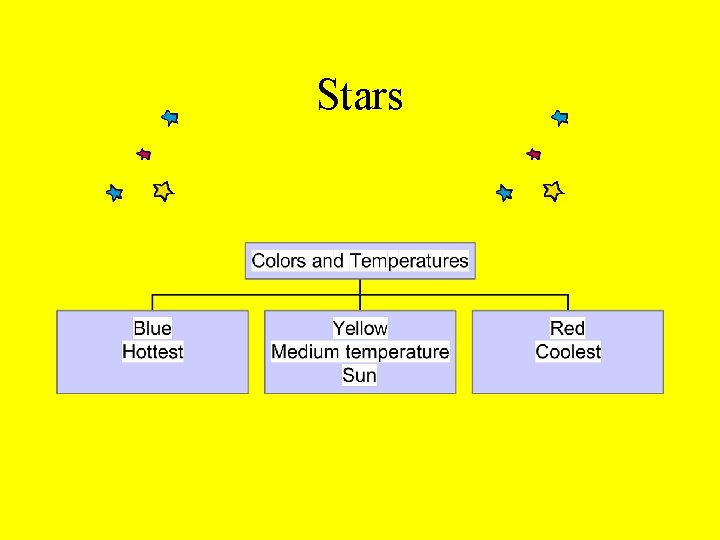
Stars
Starlight Brightness • Apparent Magnitude: How bright a star appears to be from earth when viewed with the unaided eye. Distance can cause a dimmer star to appear to be brighter than a brighter star that is farther away. • Absolute Magnitude: The amount of light (brightness) a star actually has. This is an actual measurement.
Electromagnetic Radiation • Energy that travels through space in waves • Stars give off electromagnetic radiation in different forms • Each form has its own wavelength • • • Radio Waves Infrared Rays Visible Light Ultraviolet Light X-Rays Gamma Rays

- Slides: 11