
Gilgamesh BACKGROUND AND STUFF Background on Gilgamesh 2700
Gilgamesh BACKGROUND AND STUFF

Background on Gilgamesh • 2700 BCE: Gilgamesh was King of Uruk in Mesopotamia • 2700 -2000 BCE: legends/stories about Gilgamesh circulate through oral tradition • 2100 BCE: earliest written accounts of Gilgamesh story appear on cuneiform tablets • 1200 BCE: various written accounts of Gilgamesh collected and combined • 700 BCE: the story is put on 12 tablets • 130 BCE: the story disappears • 1853 CE: tablets discovered by Iraqi archeologist Hormuzd Rassam

Sumerian Background • Sumerians: • Invent beer • Writing form: wood stylus or reed stylus pressed into soft clay tablets • Didn’t invent writing. Vinca invent it around 5500 BCE. • Had sophisticated astronomical records • Divide space and time by six • 12 months, 24 hours, 60 minutes, 60 seconds, 12 zodiac signs • (this number seems relevant to the story) • Don’t invent wheel but invent wheeled vehicle Beer Drinkers
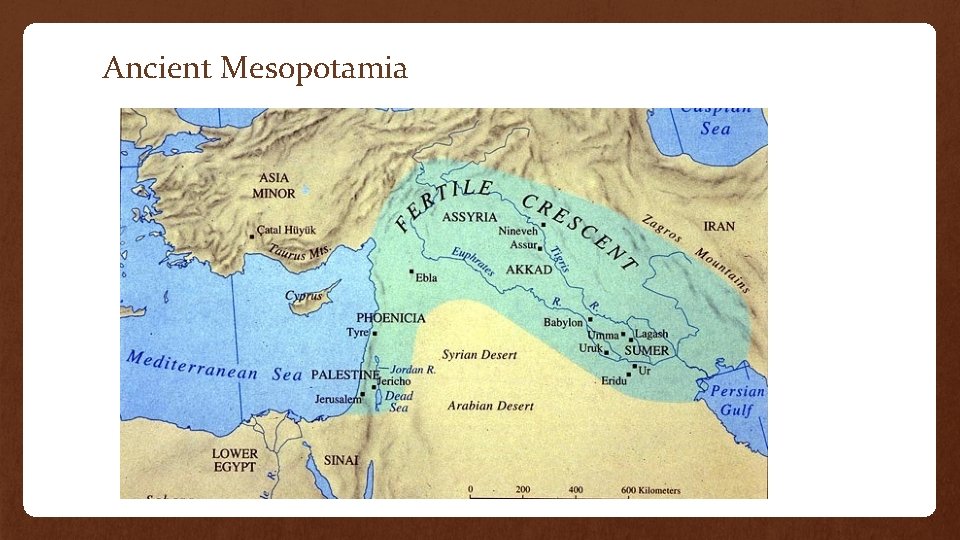
Ancient Mesopotamia
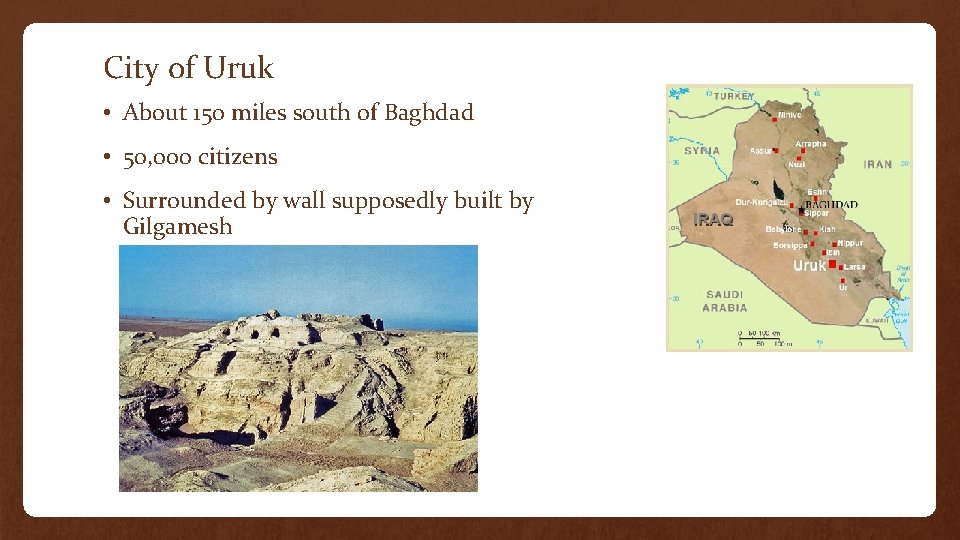
City of Uruk • About 150 miles south of Baghdad • 50, 000 citizens • Surrounded by wall supposedly built by Gilgamesh
Gilgamesh Part of Oral and Written Traditions • Gilgamesh is part of oral culture • Also known as “He Who Saw the Deep” • Oldest written fragments come from 3700 years ago • Gilgamesh predates Homer’s (1800 -1200 BCE) writing by 1500 years • Ashurbanipal (Akkadian king) wrote down the story ~8 BCE • Lost until 1839 or 1853 • George Smith translates into English in 1872 • On reading the text for the first time he jumped up and rushed about the room in a great state of excitement, and, to the astonishment of those present, began to undress himself.
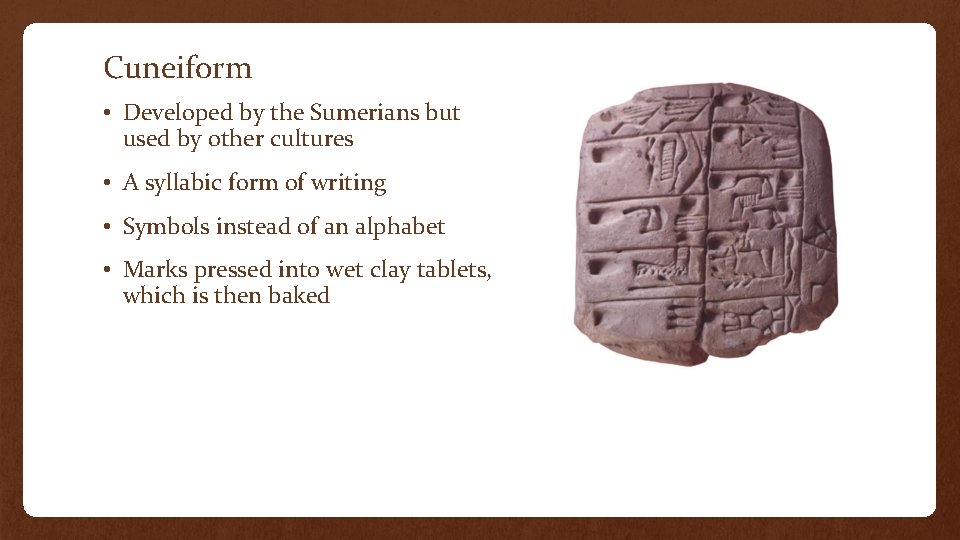
Cuneiform • Developed by the Sumerians but used by other cultures • A syllabic form of writing • Symbols instead of an alphabet • Marks pressed into wet clay tablets, which is then baked
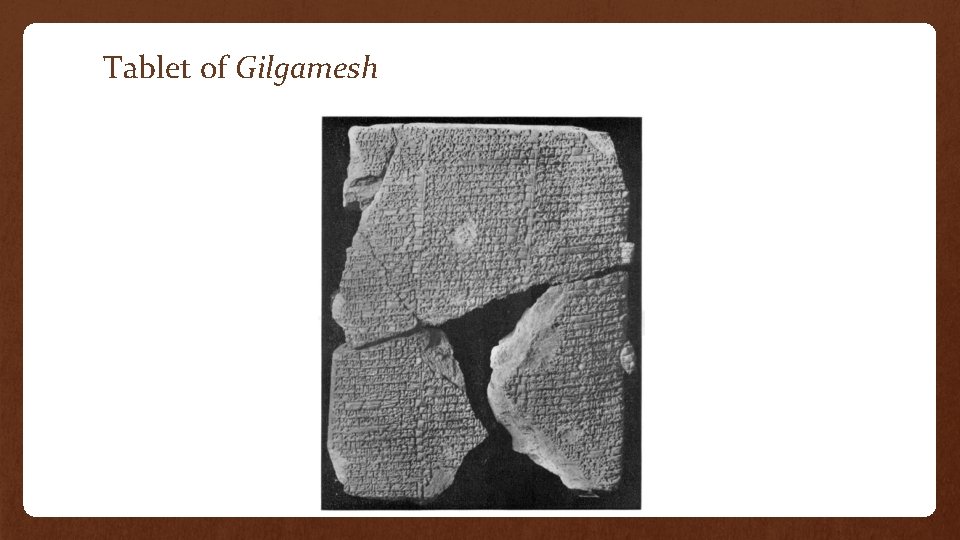
Tablet of Gilgamesh
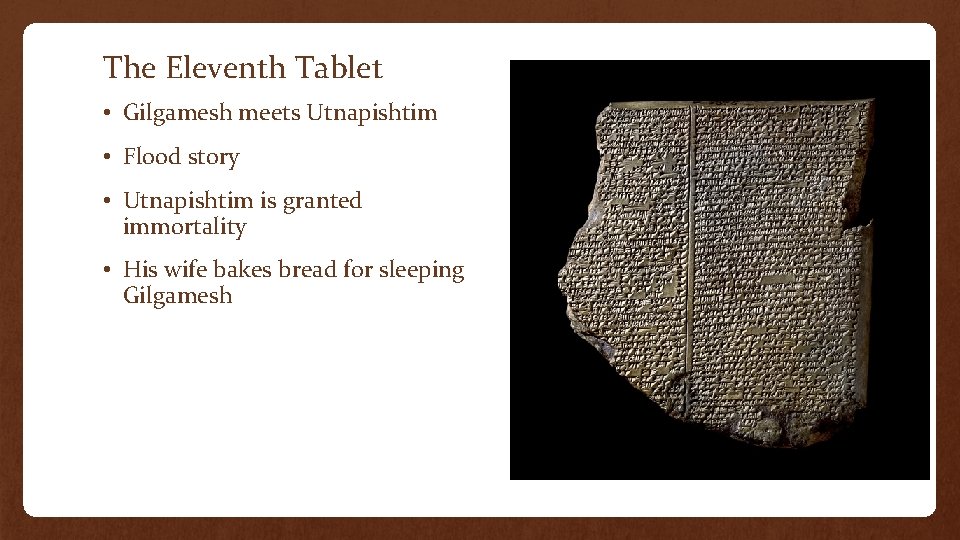
The Eleventh Tablet • Gilgamesh meets Utnapishtim • Flood story • Utnapishtim is granted immortality • His wife bakes bread for sleeping Gilgamesh
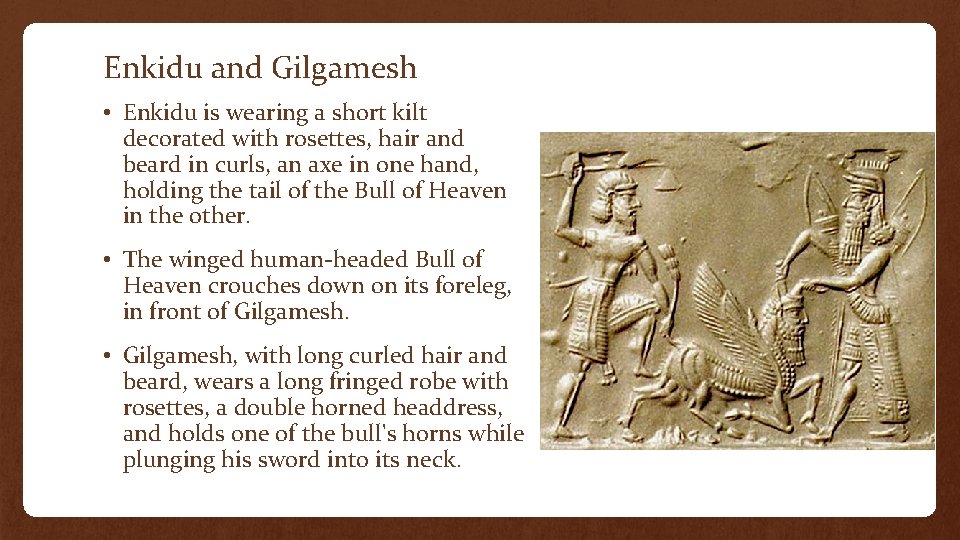
Enkidu and Gilgamesh • Enkidu is wearing a short kilt decorated with rosettes, hair and beard in curls, an axe in one hand, holding the tail of the Bull of Heaven in the other. • The winged human-headed Bull of Heaven crouches down on its foreleg, in front of Gilgamesh. • Gilgamesh, with long curled hair and beard, wears a long fringed robe with rosettes, a double horned headdress, and holds one of the bull's horns while plunging his sword into its neck.
Features of an Epic • Traditionally told orally or sung • Often a long, narrative poem • Writing style is repetitive and elevated • Story starts in the middle of the action • in media res • Hero is larger-than-life
Traits of an Epic Hero • Has supernatural or special abilities • Tries to overcome great odds presented by both humans and gods/goddesses • Often goes on a journey or quest with obstacles where the hero must prove himself and his heroic qualities are tested • Sometimes travels to the underworld or supernatural world where humans have never been • Has helpers • Usually is heroic in the end and does not die/end in tragedy (unlike the tragic hero) Adapted from: http: //www. yale. edu/ynhti/curriculum/units/2007/2/07. 02. 01. x. html#b
- Slides: 12