
Giant Arcs A Probe for Clusters and Cosmogony
Giant Arcs: A Probe for Clusters and Cosmogony Shude Mao Jodrell Bank Observatory Sept 28, 2006 COLLABORATORS: Guoliang Li, Yipeng Jing, Xi Kang, Weipeng Lin (SHAO) Matthias Bartelmann, Massimo Menegentti (Heidelberg) Liang Gao (Durham)
A 2218 Z=0. 175 Giant arcs are background galaxies distorted into long arcs by foreground clusters
A 1689 Z=0. 18 Observations can determine, arc L/W ratio, width, source redshift & arc frequency
Observational samples of giant arcs • Luppino et al. (1999) found strong lensing in eight out of 38 X-ray selected clusters • Optically, Zaritsky & Gozalez (2003) using LCRS and Gladders et al. (2003) using RCS found high fractions • Sand, Ellis, Treu, & Smith (2005) found 104 candidate tangential arcs in 128 clusters with HST • Giant arcs appear common in massive clusters
Why do we study giant arcs? • Giant arcs probe the largest bound structures in the universe • Their numbers and positions are a sensitive probe of cluster properties including their abundance and mass profiles • Their numbers are also sensitive to the cosmogony, particularly the power-spectrum normalisation σ8 • Clusters are nature telescope, allowing us to study faint, high-redshift background objects behind clusters
How do we model giant arcs? • Earlier studies used analytical spherical models (e. g. Wu & Hammer 1993; Wu & Mao 1996). • But clusters are complex (ellipticities, substructures, mergers). • Most recent studies use numerically simulated clusters – Bartelmann and associates (1998 -) – Dalal et al. (2004) – Wambsganss, Ostriker, Bode (2004): 3 D ray-tracing – Li, Mao, Jing, Bartelmann, Kang, Meneghetti (2005)
Numerical simulation • N-body simulation was performed by Jing (2000) in CDM cosmology ( m=0. 3, 8=0. 9) – Dark matter only, 5123 particles – Box size: 300/h Mpc, 30/h kpc (comoving) resolution • 200 massive clusters are selected using the friends-offriends algorithm, from redshift 0. 1, 0. 2, …, 2. 5 • Background source population – At redshift 0. 6, 1. 0, 1. 4, …. , 7 – Sources have 0. 5, 1, 1. 5 arcsecond effective diameters – Ellipticity (=1 -b/a), uniformly distributed from 0. 5 to 1 • Calculate the cross-section for each cluster, and then integrate to obtain the total lensing optical depth.
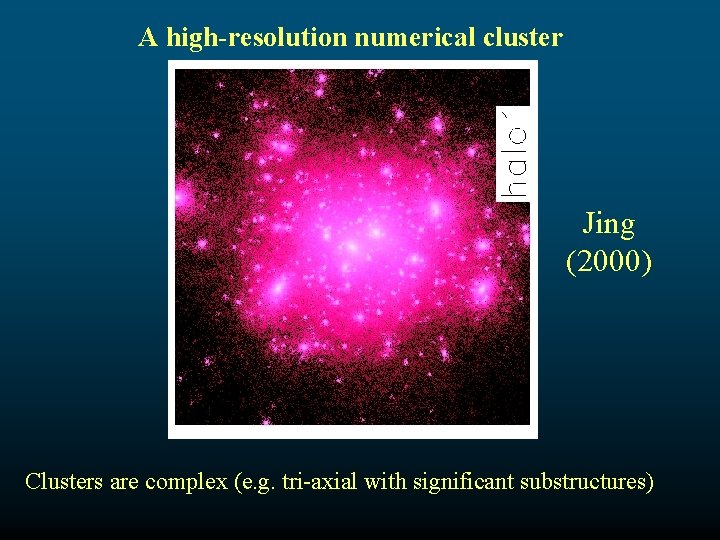
A high-resolution numerical cluster Jing (2000) Clusters are complex (e. g. tri-axial with significant substructures)
From particles to smooth density fields • Simulations give discreet particle positions • Need an efficient and high-fidelity smoothing algorithm from position to density field – We proposed an adaptive smoothing algorithm based on the scatter interpretation of SPH (Li et al. 2006) • First partitions particle weights in 3 D grids according to SPH (for Nneighbor=32, 64). • Then integrate along the line of sight to obtain surface density • Fully adaptive, and better preserves substructures than other methods
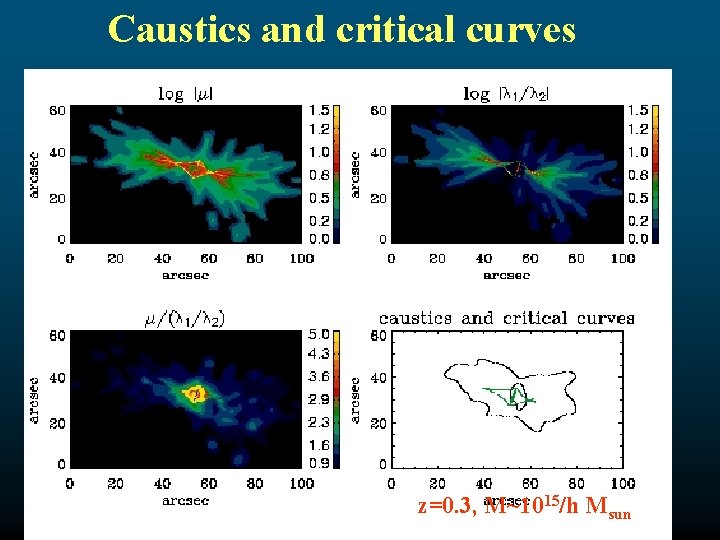
Caustics and critical curves z=0. 3, M~1015/h Msun
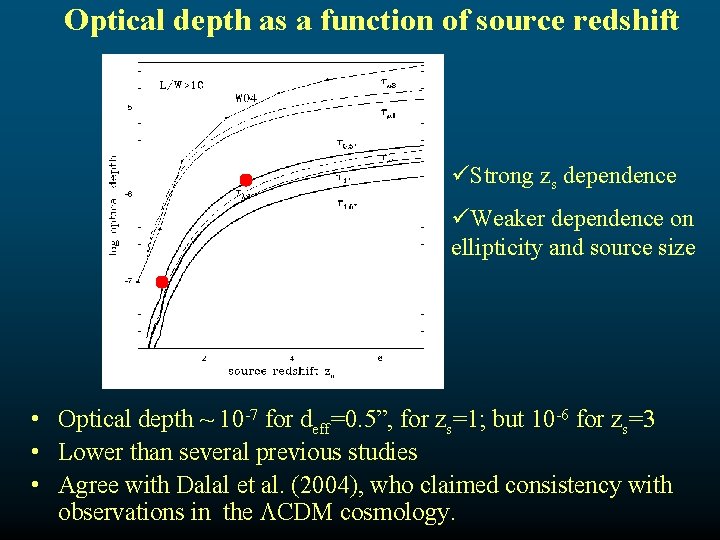
Optical depth as a function of source redshift üStrong zs dependence üWeaker dependence on ellipticity and source size • Optical depth ~ 10 -7 for deff=0. 5”, for zs=1; but 10 -6 for zs=3 • Lower than several previous studies • Agree with Dalal et al. (2004), who claimed consistency with observations in the CDM cosmology.
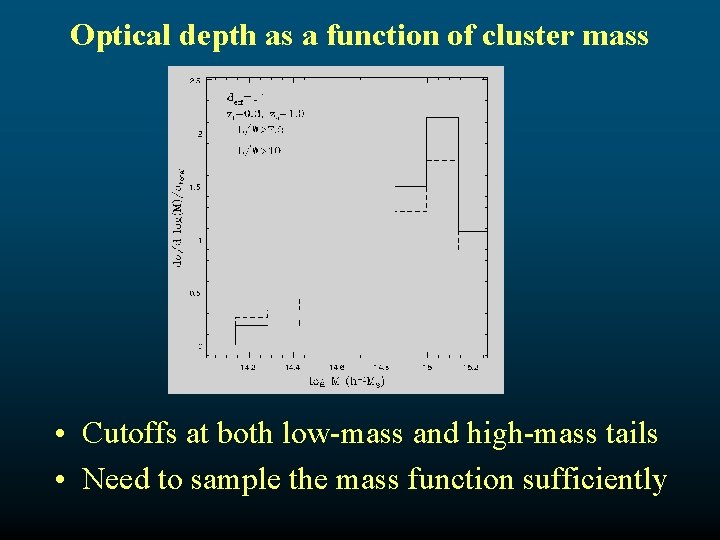
Optical depth as a function of cluster mass • Cutoffs at both low-mass and high-mass tails • Need to sample the mass function sufficiently
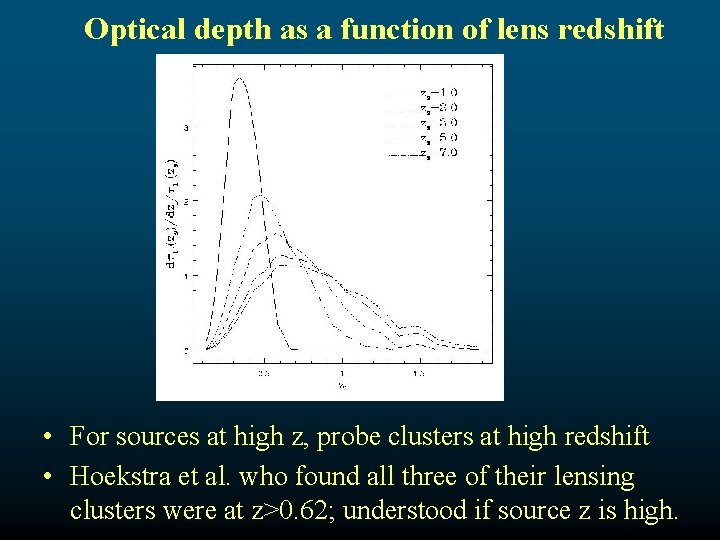
Optical depth as a function of lens redshift • For sources at high z, probe clusters at high redshift • Hoekstra et al. who found all three of their lensing clusters were at z>0. 62; understood if source z is high.
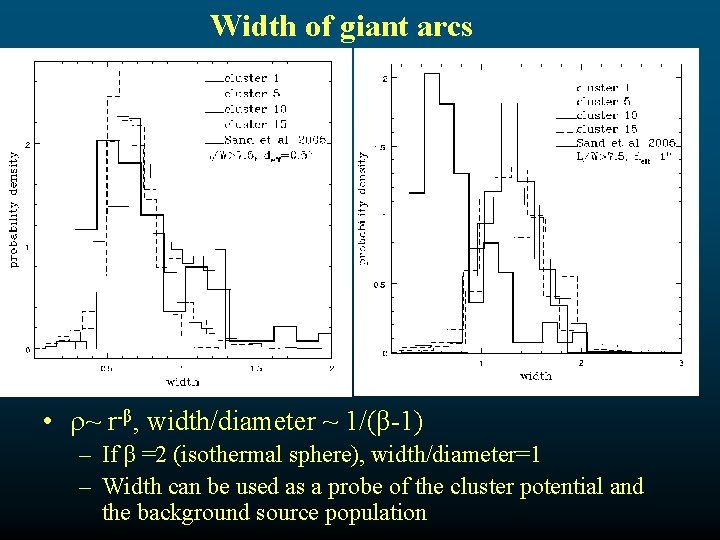
Width of giant arcs • ~ r-β, width/diameter ~ 1/(β-1) – If β =2 (isothermal sphere), width/diameter=1 – Width can be used as a probe of the cluster potential and the background source population
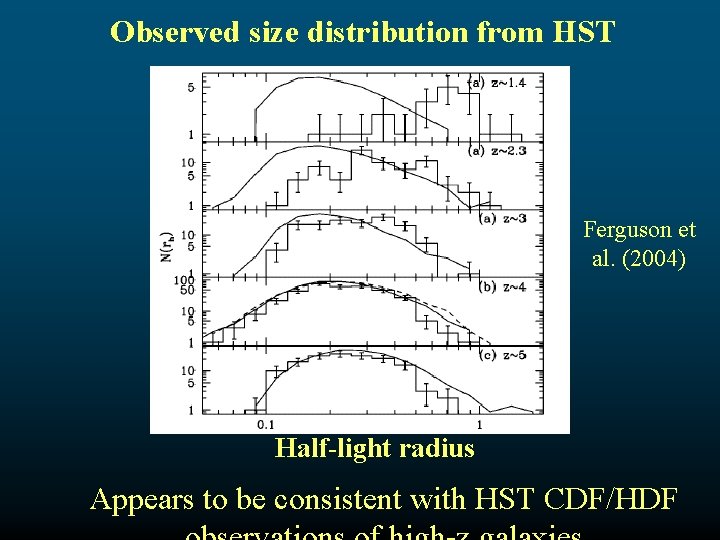
Observed size distribution from HST Ferguson et al. (2004) Half-light radius Appears to be consistent with HST CDF/HDF
Giant arcs in the WMAP three year cosmology • The WMAP three-year model has lower m and 8 compared with the usual LCDM model. • The lower m (0. 238) and 8 (0. 74) both reduce the number of giants • We compared arc predictions in the usual CDM and WMAP three-year models: – Using two 300/h Mpc N-body simulations – The predicted number is reduced by a factor of about six in the WMAP three year model
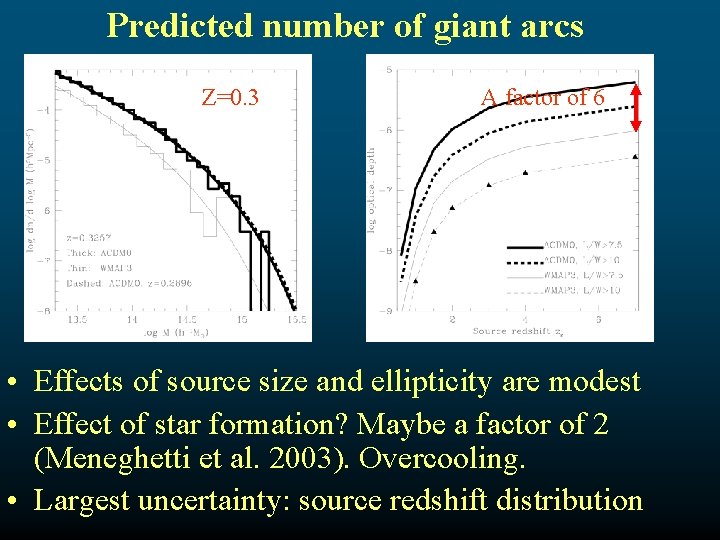
Predicted number of giant arcs Z=0. 3 A factor of 6 • Effects of source size and ellipticity are modest • Effect of star formation? Maybe a factor of 2 (Meneghetti et al. 2003). Overcooling. • Largest uncertainty: source redshift distribution
Summary • Optical depth may be too low in the WMAP threeyear model (with 8=0. 74) – But the source redshift distribution and effects of star formation are still uncertain • Properties of giant arcs (e. g. , widths) can be used to probe of the intrinsic size of high-redshift sources and the cluster potential. • We need many larger giant arc samples, which will come as by-products of weak lensing surveys. • A combination of strong and weak lensing can probe clusters more robustly.
Future works • What is the effect of baryons? • More realistic comparisons with observations – In particular, giant arcs in x-ray selected clusters – Are lensed clusters typical? Tests of the NFW profile. • Explore how the width of giant arcs can be used to probe properties of clusters and highredshift source population • Constrain the power-spectrum normalisation and cosmogony
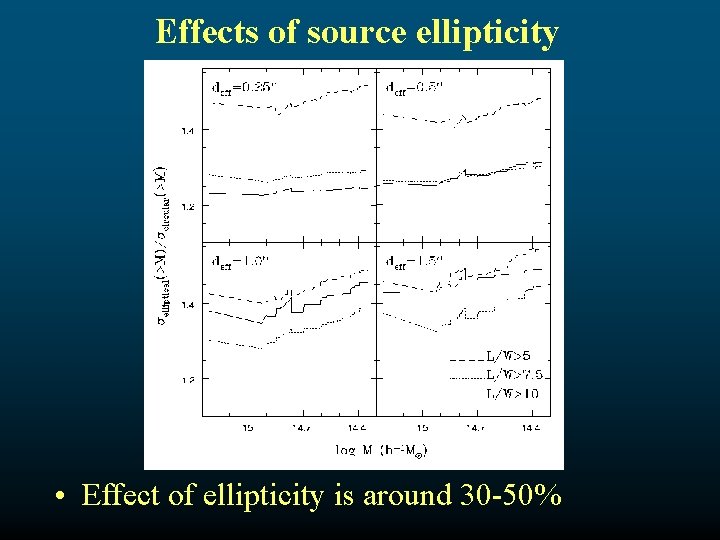
Effects of source ellipticity • Effect of ellipticity is around 30 -50%
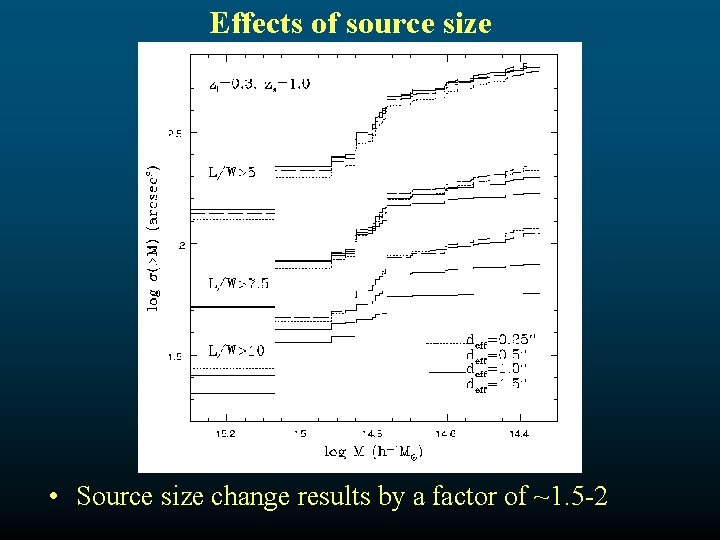
Effects of source size • Source size change results by a factor of ~1. 5 -2
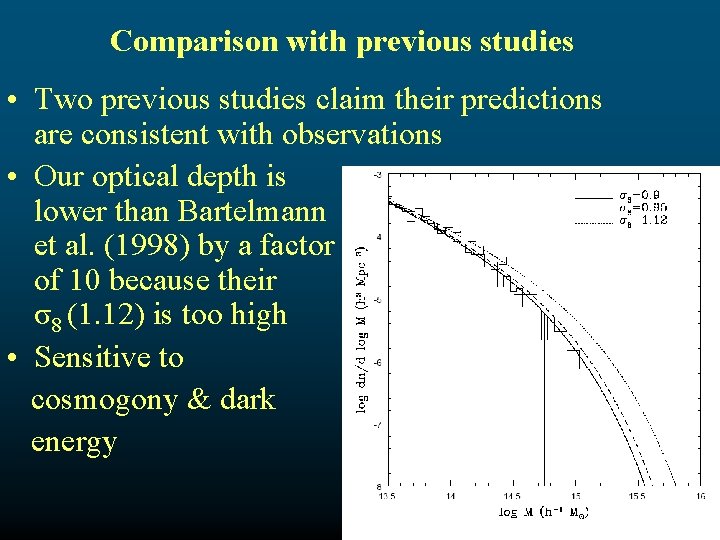
Comparison with previous studies • Two previous studies claim their predictions are consistent with observations • Our optical depth is lower than Bartelmann et al. (1998) by a factor of 10 because their σ8 (1. 12) is too high • Sensitive to cosmogony & dark energy
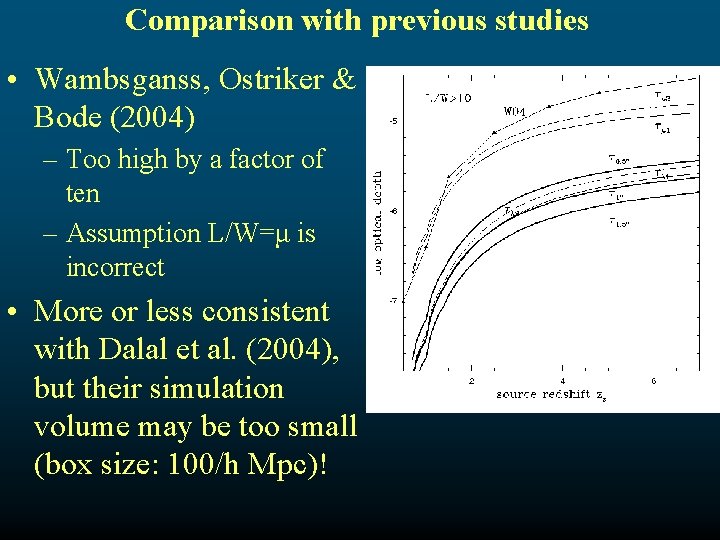
Comparison with previous studies • Wambsganss, Ostriker & Bode (2004) – Too high by a factor of ten – Assumption L/W=μ is incorrect • More or less consistent with Dalal et al. (2004), but their simulation volume may be too small (box size: 100/h Mpc)!
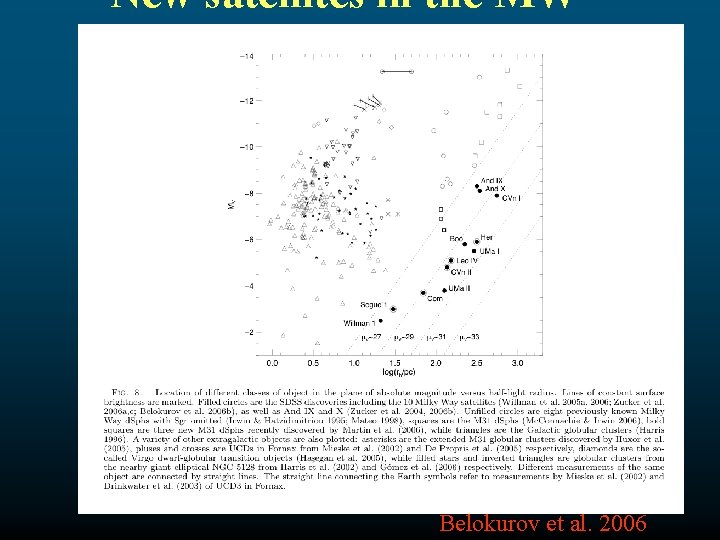
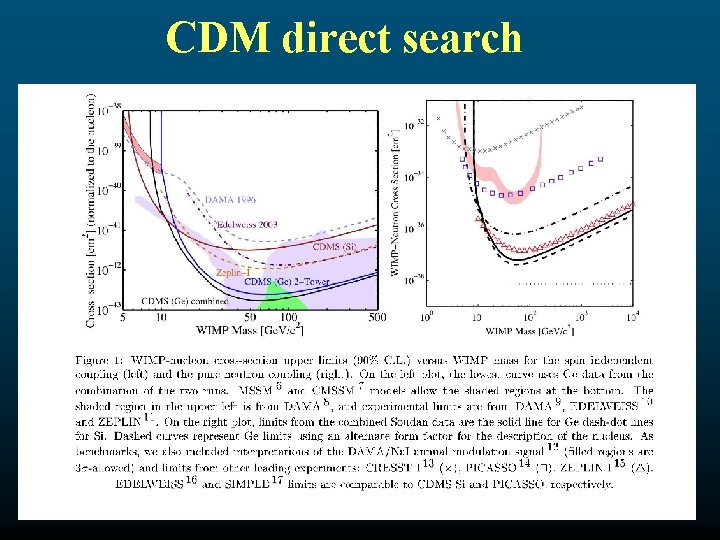
Dark matter (energy) discussions • Do we really need it? MOND? • Evidence for dark matter in galaxies & clusters – Disc galaxies (rotation curve, satellite galaxies) – Elliptical galaxies (dynamics, lensing, x-ray) – Clusters (x-ray, lensing) – Large-scale structure, CMB • Substructures: – too many predicted? – Implications of new satellites found by SDSS in the MW. • Density profiles of dark matter haloes? – Density slopes? Too concentrated (from rotation curve, Tully-Fisher relation)? • Distribution of dark matter in galaxies as a function of radius – Maximal or minimal disks? – Fast bar pattern speed? – Galactic microlesning • What is it? – Cold, hot or warm? Collisionless or self-interacting? – Experimental status of direct search
New satellites in the MW Belokurov et al. 2006
CDM direct search
- Slides: 26