
Gianmarco I P Ottaviano LECTIO INAUGURALIS ACHILLE E
- Slides: 33
Gianmarco I. P. Ottaviano LECTIO INAUGURALIS ACHILLE E GIULIA BOROLI CHAIR IN EUROPEAN STUDIES YOUR NAME THE ECONOMIC GEOGRAPHY OF EUROPEAN NATIONALISM Milan, 6 May 2019 1
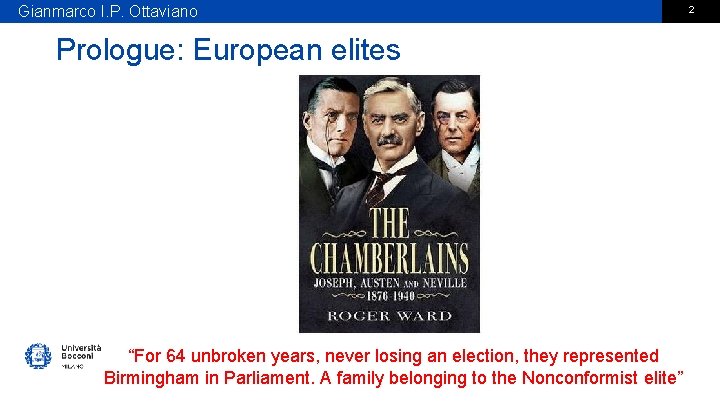
Gianmarco I. P. Ottaviano Prologue: European elites “For 64 unbroken years, never losing an election, they represented Birmingham in Parliament. A family belonging to the Nonconformist elite” 2
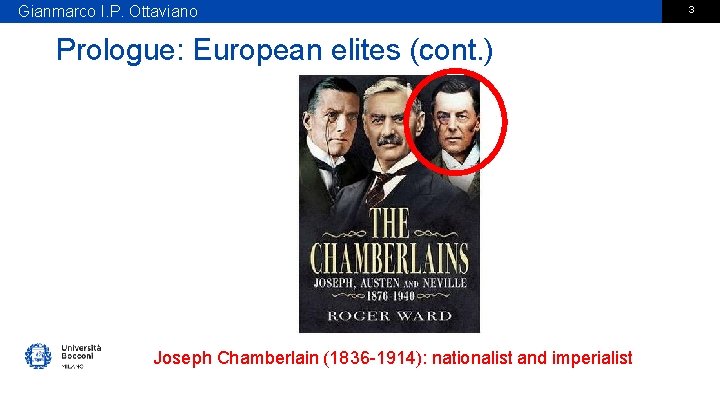
Gianmarco I. P. Ottaviano Prologue: European elites (cont. ) Joseph Chamberlain (1836 -1914): nationalist and imperialist 3
Gianmarco I. P. Ottaviano Prologue: European elites (cont. ) • First wave of globalization (1870 -1914) • “I think that you will agree that we are living in most interesting times… I never remember myself a time in which our history was so full, in which day by day brought us new objects of interest, and, let me say also, new objects for anxiety„ • Joseph Chamberlain, The Western Daily Press, 1898 4
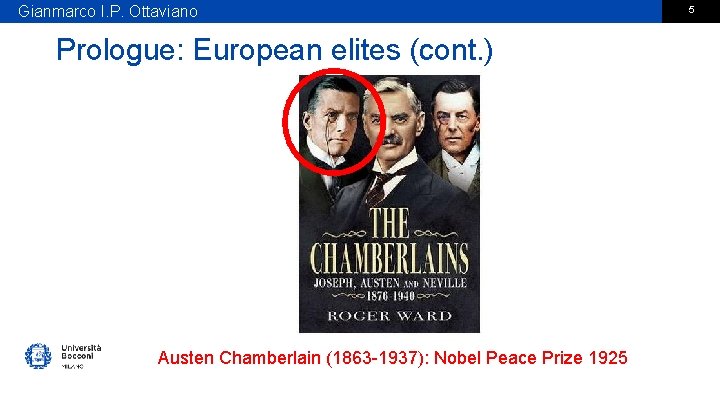
Gianmarco I. P. Ottaviano Prologue: European elites (cont. ) Austen Chamberlain (1863 -1937): Nobel Peace Prize 1925 5
Gianmarco I. P. Ottaviano Prologue: European elites (cont. ) • Between the two world wars (1918 -1939) • “It is not so long ago that a member of the Diplomatic Body in London, who had spent some years of his service in China, told me that there was a Chinese curse which took the form of saying, ‘May you live in interesting times. ’ There is no doubt that the curse has fallen on us … We move from one crisis to another. We suffer one disturbance and shock after another„ • Austen Chamberlain, The Yorkshire Post, 1936 6
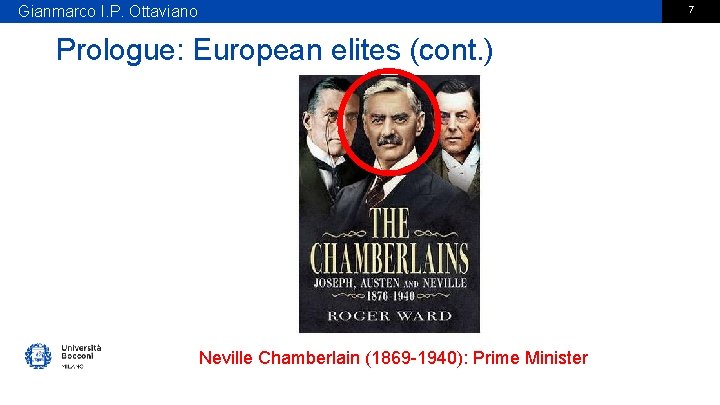
Gianmarco I. P. Ottaviano 7 Prologue: European elites (cont. ) Neville Chamberlain (1869 -1940): Prime Minister
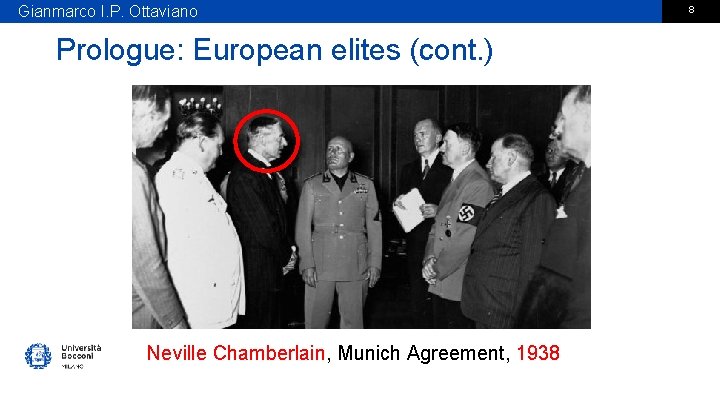
Gianmarco I. P. Ottaviano Prologue: European elites (cont. ) Neville Chamberlain, Munich Agreement, 1938 8
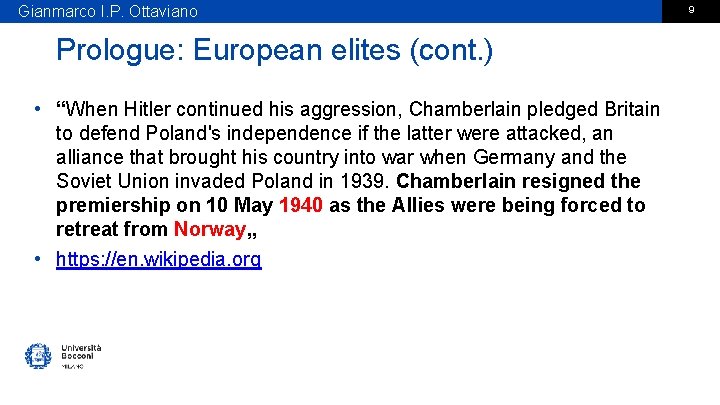
Gianmarco I. P. Ottaviano Prologue: European elites (cont. ) • “When Hitler continued his aggression, Chamberlain pledged Britain to defend Poland's independence if the latter were attacked, an alliance that brought his country into war when Germany and the Soviet Union invaded Poland in 1939. Chamberlain resigned the premiership on 10 May 1940 as the Allies were being forced to retreat from Norway„ • https: //en. wikipedia. org 9
Gianmarco I. P. Ottaviano “Votes without frontiers” • The next European Parliament elections will be the most European yet (The Economist, 27 April 2019) • Events over the 2014 to 2019 parliamentary term have emphasized Europe’s interdependence and the role of pan-European politics: • Migration crisis • Terrorist attacks • Brexit, US new protectionism, and the rise of China • Pro- and anti-migration demonstrations, anti-establishment protests and environmentalist gatherings 10
Gianmarco I. P. Ottaviano “Votes without frontiers” (cont. ) • Threats and crises have increased the EU’s salience, making the notion of “a Europe that protects” more appealing • This “europeanisation” of the public debate is most advanced among nationalists and populists. However: • Brexit has refocused Eurosceptic energies away from quitting towards changing the EU from within • Support for membership has risen across the EU • Growing counter-mobilization of pro-European voters who “no longer take the EU for granted” (ECFR) 11
Gianmarco I. P. Ottaviano People vs. the elites • In the UK the Brexit vote has been interpreted as a vote of the “have nots” against the “haves” triggered by populist rethoric and strategy • Those who disproportionately voted Leave are those who feel trapped by an economic and social system controlled by “amoral elites” (in London and Brussels) that: • Apply the rules of fair play only among themselves • Raise entry barriers to outsiders (“broken social elevator”) • Dodge taxation thanks to privileged access to “tax havens” • Appropriate all the benefits of globalization and technological change 12
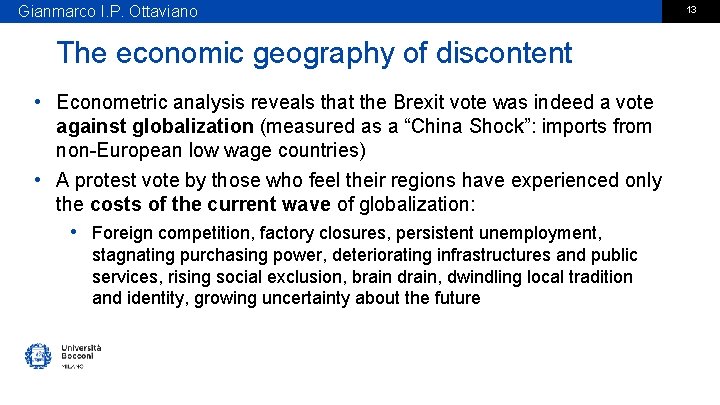
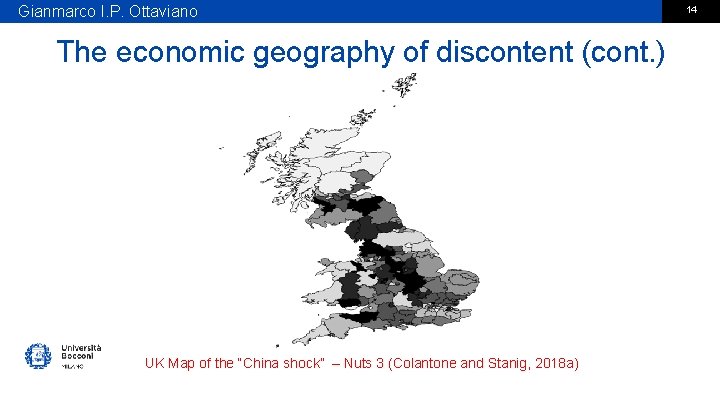
Gianmarco I. P. Ottaviano The economic geography of discontent • Econometric analysis reveals that the Brexit vote was indeed a vote against globalization (measured as a “China Shock”: imports from non-European low wage countries) • A protest vote by those who feel their regions have experienced only the costs of the current wave of globalization: • Foreign competition, factory closures, persistent unemployment, stagnating purchasing power, deteriorating infrastructures and public services, rising social exclusion, brain drain, dwindling local tradition and identity, growing uncertainty about the future 13
Gianmarco I. P. Ottaviano The economic geography of discontent (cont. ) UK Map of the “China shock” – Nuts 3 (Colantone and Stanig, 2018 a) 14
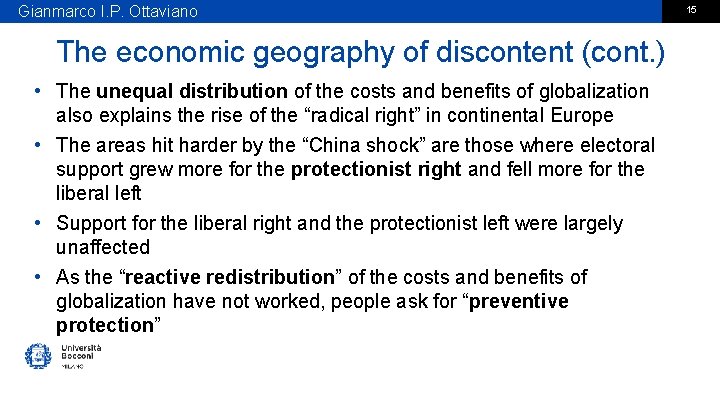
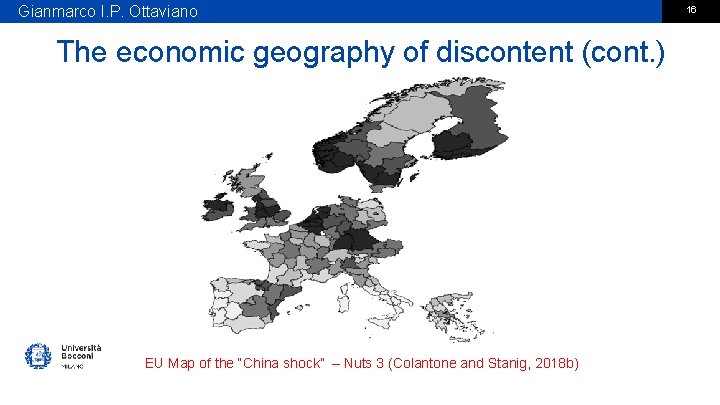
Gianmarco I. P. Ottaviano The economic geography of discontent (cont. ) • The unequal distribution of the costs and benefits of globalization also explains the rise of the “radical right” in continental Europe • The areas hit harder by the “China shock” are those where electoral support grew more for the protectionist right and fell more for the liberal left • Support for the liberal right and the protectionist left were largely unaffected • As the “reactive redistribution” of the costs and benefits of globalization have not worked, people ask for “preventive protection” 15
Gianmarco I. P. Ottaviano The economic geography of discontent (cont. ) EU Map of the “China shock” – Nuts 3 (Colantone and Stanig, 2018 b) 16
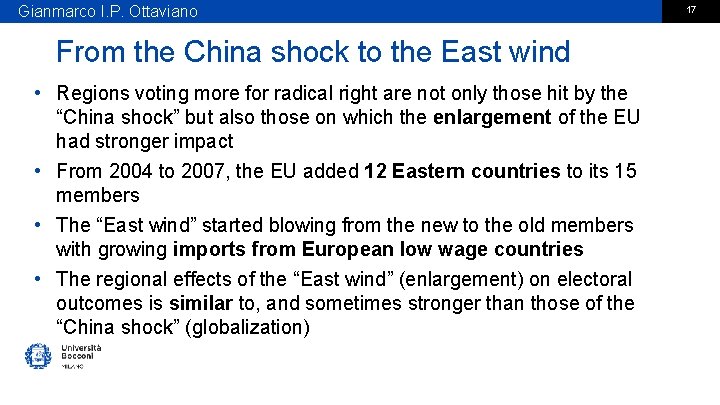
Gianmarco I. P. Ottaviano From the China shock to the East wind • Regions voting more for radical right are not only those hit by the “China shock” but also those on which the enlargement of the EU had stronger impact • From 2004 to 2007, the EU added 12 Eastern countries to its 15 members • The “East wind” started blowing from the new to the old members with growing imports from European low wage countries • The regional effects of the “East wind” (enlargement) on electoral outcomes is similar to, and sometimes stronger than those of the “China shock” (globalization) 17
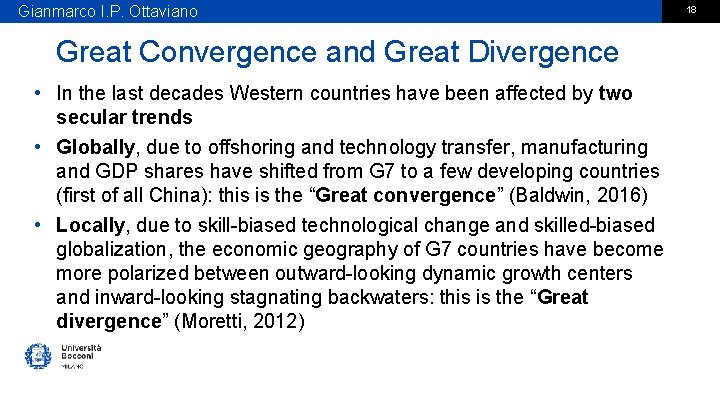
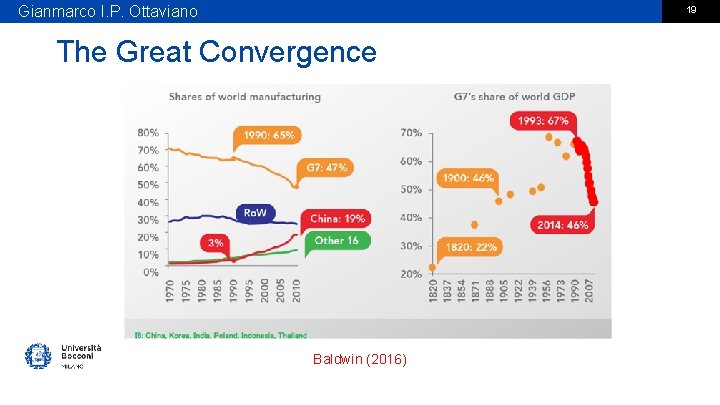
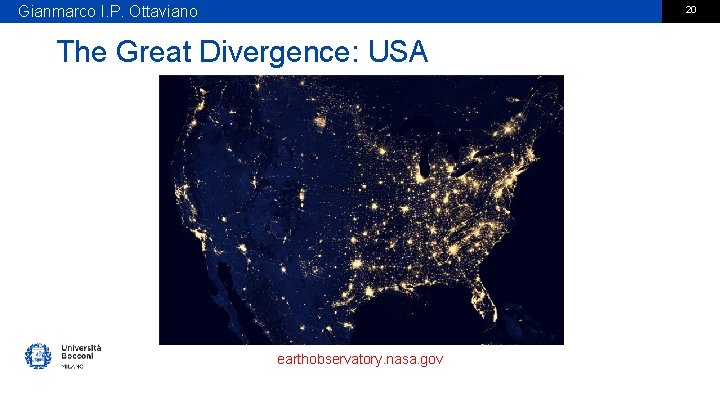
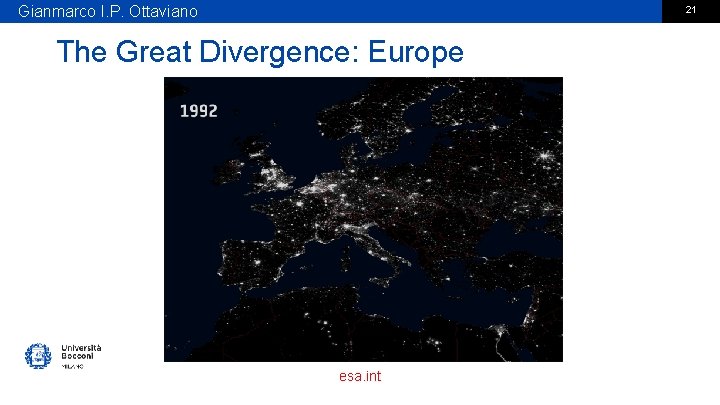
Gianmarco I. P. Ottaviano Great Convergence and Great Divergence • In the last decades Western countries have been affected by two secular trends • Globally, due to offshoring and technology transfer, manufacturing and GDP shares have shifted from G 7 to a few developing countries (first of all China): this is the “Great convergence” (Baldwin, 2016) • Locally, due to skill-biased technological change and skilled-biased globalization, the economic geography of G 7 countries have become more polarized between outward-looking dynamic growth centers and inward-looking stagnating backwaters: this is the “Great divergence” (Moretti, 2012) 18
Gianmarco I. P. Ottaviano 19 The Great Convergence Baldwin (2016)
Gianmarco I. P. Ottaviano 20 The Great Divergence: USA earthobservatory. nasa. gov
Gianmarco I. P. Ottaviano 21 The Great Divergence: Europe esa. int
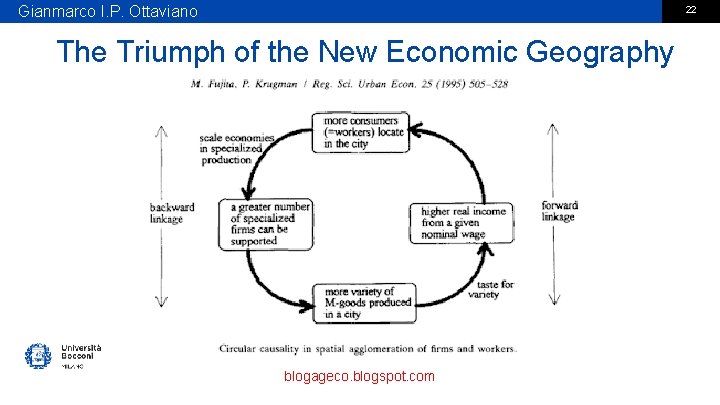
Gianmarco I. P. Ottaviano 22 The Triumph of the New Economic Geography blogageco. blogspot. com
Gianmarco I. P. Ottaviano EU policy making: four misconceptions 1. All important decisions for the EU are made in Brussels with no direct involvement of national government 2. The decisions made in Brussels have no democratic foundation as they are made by unelected bureaucrats 3. There exist no properly “European” decisions that should necessarility made in Brussels 4. The EU is a “luxury good” that European citizens cannot afford as the benefits of rewinding European integration are much larger than its costs 23
Gianmarco I. P. Ottaviano 1 -2: A self-driving bureaucracy? • To the decisions made at EU level European citizens partecipate twice • • First, they elect their representatives in the European parliament Second, they elect their representatives in the national parliaments, which express the national governments themselves represented in the European Council and the Council of the European Union The Councils call the shots in Brussels • 24
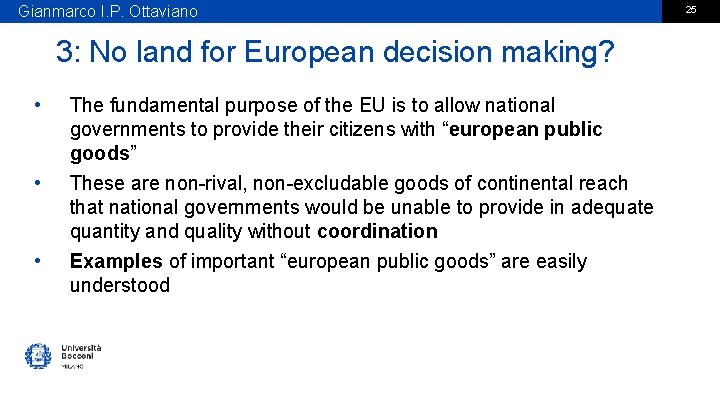
Gianmarco I. P. Ottaviano 3: No land for European decision making? • • • The fundamental purpose of the EU is to allow national governments to provide their citizens with “european public goods” These are non-rival, non-excludable goods of continental reach that national governments would be unable to provide in adequate quantity and quality without coordination Examples of important “european public goods” are easily understood 25
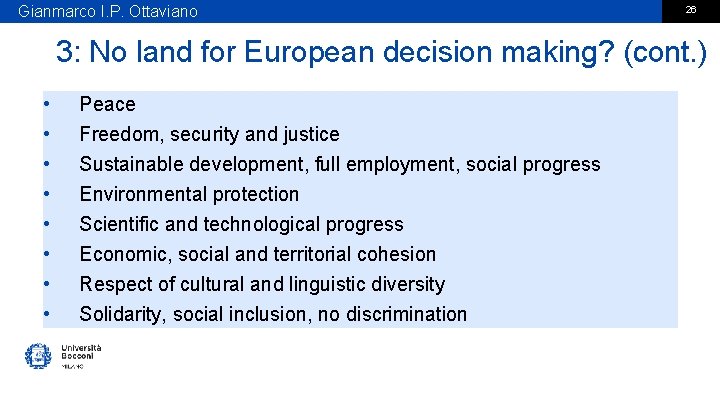
Gianmarco I. P. Ottaviano 26 3: No land for European decision making? (cont. ) • • Peace Freedom, security and justice Sustainable development, full employment, social progress Environmental protection Scientific and technological progress Economic, social and territorial cohesion Respect of cultural and linguistic diversity Solidarity, social inclusion, no discrimination
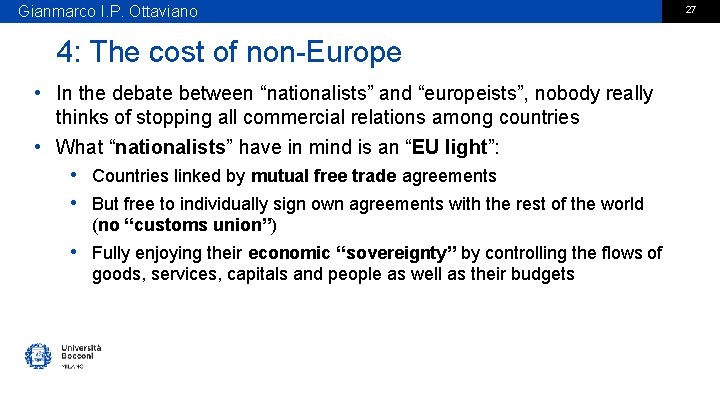
Gianmarco I. P. Ottaviano 4: The cost of non-Europe • In the debate between “nationalists” and “europeists”, nobody really thinks of stopping all commercial relations among countries • What “nationalists” have in mind is an “EU light”: • Countries linked by mutual free trade agreements • But free to individually sign own agreements with the rest of the world (no “customs union”) • Fully enjoying their economic “sovereignty” by controlling the flows of goods, services, capitals and people as well as their budgets 27
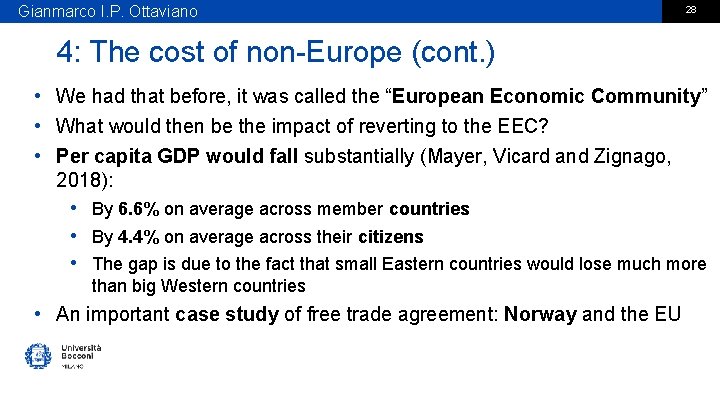
Gianmarco I. P. Ottaviano 28 4: The cost of non-Europe (cont. ) • We had that before, it was called the “European Economic Community” • What would then be the impact of reverting to the EEC? • Per capita GDP would fall substantially (Mayer, Vicard and Zignago, 2018): • By 6. 6% on average across member countries • By 4. 4% on average across their citizens • The gap is due to the fact that small Eastern countries would lose much more than big Western countries • An important case study of free trade agreement: Norway and the EU
Gianmarco I. P. Ottaviano Revamping the EU: what money can’t buy • Maybe the EU is suffering from too much economics, just like the US (Sandel, 2012, on the moral limits of markets) • “We live in a time when almost everything can be bought and sold. Over the past three decades, markets - and market values - have come to govern our lives as never before. We did not arrive at this condition through any deliberate choice. It is almost as if it came upon us. ” • “As a result, without quite realizing it - without ever deciding to do so we drifted from having a market economy to being a market society. ” 29
Gianmarco I. P. Ottaviano Revamping the EU: what money can’t buy (cont. ) • “The difference is this: • A market economy is a tool - a valuable and effective tool - for organizing productive activity. • A market society is a way of life in which market values seep into every aspect of human endeavor. It’s a place where social relations are made over in the image of the market. ” • In much of the public debate and media coverage the project of European integration seems indeed to have drifted from instrumentally developing a market economy to projecting the image of a market society: deficits, surpluses, spreads, market indices, etc. 30
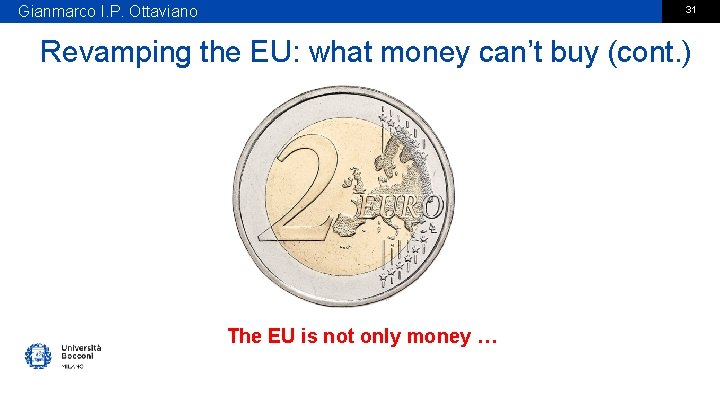
Gianmarco I. P. Ottaviano 31 Revamping the EU: what money can’t buy (cont. ) The EU is not only money …
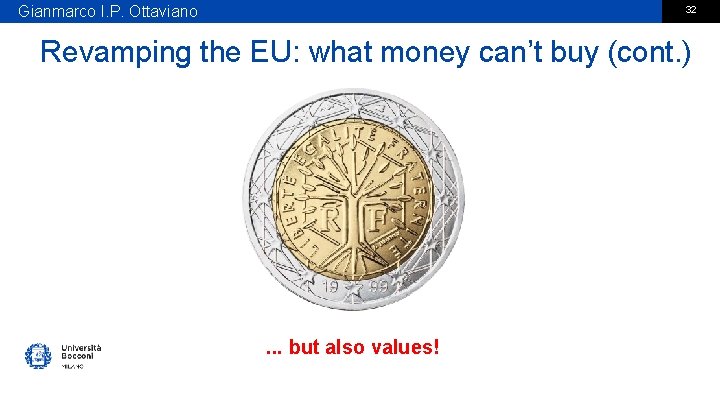
Gianmarco I. P. Ottaviano 32 Revamping the EU: what money can’t buy (cont. ) . . . but also values!
Gianmarco I. P. Ottaviano 33 LECTIO INAUGURALIS ACHILLE E GIULIA BOROLI CHAIR IN EUROPEAN STUDIES YOUR NAME THANK YOU FOR YOUR ATTENTION Milan, 6 May 2019