
GI SYSTEM ASSESSMENT LOOKING AT FOCUSED ASSESSMENT INTRODUCTION





- Slides: 14
GI SYSTEM ASSESSMENT LOOKING AT FOCUSED ASSESSMENT
INTRODUCTION The functions of the gastrointestinal (GI) tract and its accessory organs are essential for life. The process of digestion supplies nutrients to each and every cell in our body. If there is a disruption in any of these mechanisms, the whole body suffers. Physical exam techniques such as inspection, palpation, percussion, and auscultation will be highlighted. We will look at deviations in your assessment findings could indicate potential gastrointestinal problems.
TERMS TO KNOW AND UNDERSTAND Ascites - An abnormal accumulation of serous fluid in the abdominal cavity containing large amounts of protein and electrolytes. Bulge - A protruding part; an outward curve or swelling. Cirrhosis - Cirrhosis of the liver is a chronic disease of the liver characterized by the replacement of normal tissue with fibrous tissue and the loss of functional liver cells. Digestion - The process by which food is converted into substances that can be absorbed and assimilated by the body. Dysphagia - Difficulty in swallowing. Esophageal varices - Abnormally dilated or swollen vessels in the esophagus, which can lead to bleeding.
CONTINUED TERMS Food allergy - An abnormally high sensitivity to certain foods. Food intolerance - Inability to completely digest a type of food, usually due to an enzyme deficiency. Hernia - The protrusion of an organ or other bodily structure through the wall that normally contains it; a rupture. Mass - An aggregate of cells clumped together, such as a tumor. Referred pain - Pain sensation experienced in one part of the body that is different to the actual area of pathology. Spider nevi (or angioma) - A dilation of superficial capillaries with a central red dot from which blood vessels radiate. Visceral pain - Pain related to the internal organs.
COMPONENTS OF A FOCUSED ASSESSMENT • Chief complaint • Present health status • Past health history • Current lifestyle • Psychosocial status • Family history • Physical assessment Communication during the history and physical must be respectful and performed in a culturallysensitive manner. Privacy is vital, and the healthcare professional needs to be aware of posture, body language, and tone of voice while interviewing the patient (Jarvis, 2011; Caple, 2011). Take into consideration that a patient’s ethnicity and culture may affect the history that the patient provides.
FOCUSED HISTORY Begin by getting a very complete history of abdominal or GI complaints, diseases, or disorders. Gastrointestinal disease usually manifests as the presence of one or more of the following: • Change in appetite • Weight gain or loss • Dysphagia • Intolerance to certain foods • Nausea and vomiting • Change in bowel habits • Abdominal pain
WHAT THINGS OCCUR AS A RESULT OF AGING R/T THE GI SYSTEM? LET’S THINK ABOUT THAT?
NUTRITIONAL ASSESSMENT RECENT UNINTENTIONAL WEIGHT LOSS CHEMOTHERAPY OR RADIATION RECENT WEIGHT GAIN FOOD ALLERGIES OR INTOLERNACES DECREASED APPETITE MULTIPLE MEDICATIONS ALTERATIONS IN THE SENSE OF TASTE
CONTINUED NUTRITIONAL ASSESSMENT DIETING HISTORY DIFFICULTY CHEWING OR SWALLOWING VOMITING MOBILITY PROBLEMS DIARRHEA INABILITY TO FEED SELF RECENT SURGERY OR MAJOR ILLNESS OR INJURY
CONTINUED NUTRITIONAL ASSESSMENT SUBSTANCE ABUSE CHRONIC CONDITIONS POTENTIAL SOCIAL ISOLATION LOW INCOME
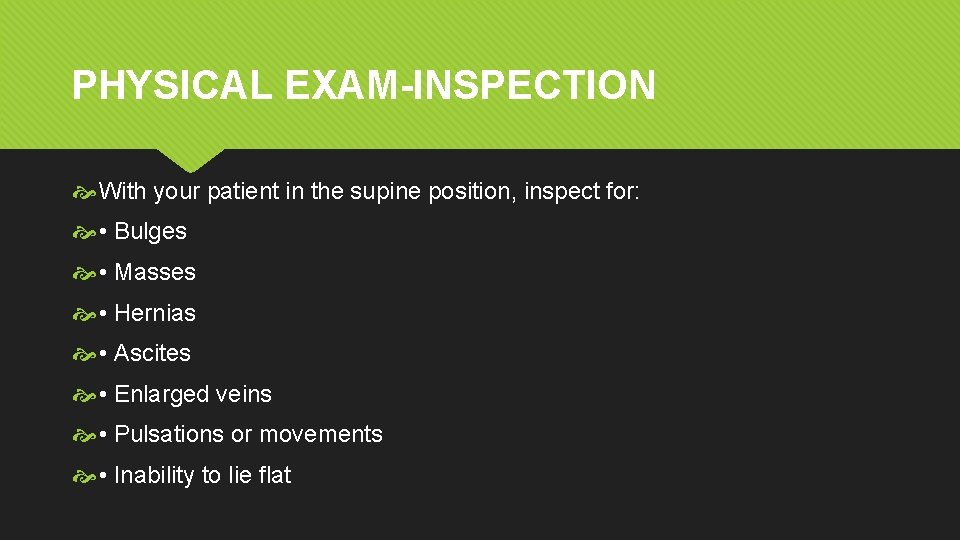
PHYSICAL EXAM-INSPECTION With your patient in the supine position, inspect for: • Bulges • Masses • Hernias • Ascites • Enlarged veins • Pulsations or movements • Inability to lie flat
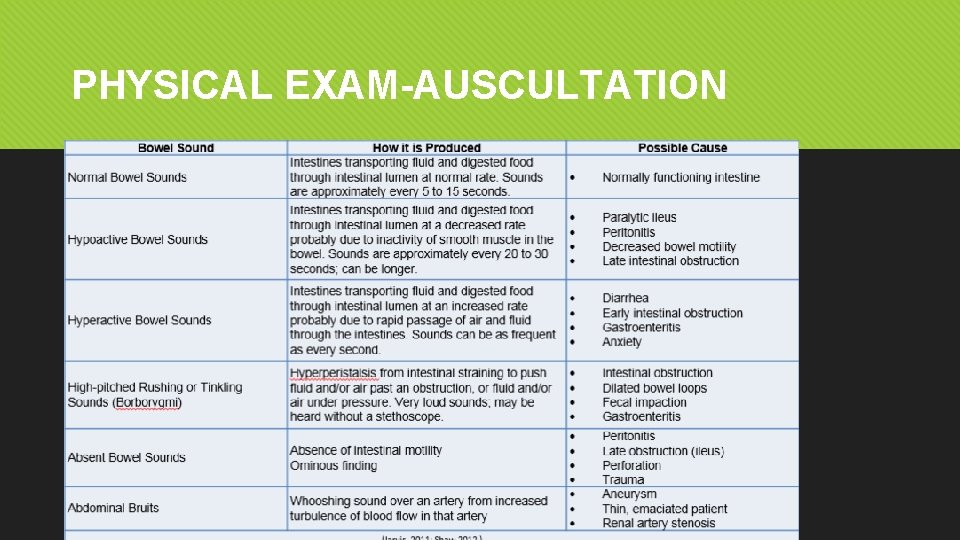
PHYSICAL EXAM-AUSCULTATION
PHYSICAL EXAM-PALPATION PRESS THE SKIN ½ TO ¾ INCH WITH PADS OF FINGERS FOR LIGHT PALPATION PRESS 11/2 TO 2 INCHES FOR DEEP PALPATION Palpation allows you to assess for texture, tenderness, temperature, moisture, pulsations, masses, and internal organs (Shaw, 2012). Normally, you should elicit no tenderness on either light or deep palpation of the abdomen. If inguinal lymph nodes are palpated, they should be small and freely moveable.
ABDOMINAL PAIN WHAT IS: VISCERAL PAIN- DULL, CRAMPY, SQUEEZING OR ACHING. PARIETAL PAIN –INTENSE, CONSTANT, AND ON ONE SIDE. AGGRIVATED BY EXTENSION OF THE LOWER EXTREMITY, COUGHING, OR REBOUND TENDERNESS REFERRED PAIN- USUALLY VISCERAL PAIN THIS IS FELT IN ANOTHER AREA OF THE BODY WHEN A COMMON NERVE PATHWAY IS SHARED. (APPENDICITIS CAN CAUSE UMBILICAL PAIN IN THE BEGINNING. ) DON’T FORGET PQRST