
GI PHYSIOLOGY Digestion and Absorption Water Electrolytes and
GI PHYSIOLOGY Digestion and Absorption Water, Electrolytes and Carbohydrates Gregory J. Bagby, Ph. D Rozas Professor of Physiology CSRB Rm 3 B 9/310 gbagby@lsuhsc. edu 504 -568 -6188
Text for Lectures • Raff and Levitzky – Lecture 1 – Ch 49 – Lecture 2 • Ch 51, pp 522 -525 • Ch 50 – Lecture 3 • Ch 51, pp 517 -522 • Ch 55 -56 • Barrett – Lecture 1 – Ch 1 and 2 – Lecture 2 • Ch 4, pp 70 - 76 • Ch 3 – Lecture 3 • Cp 4, pp 57 -69 • Ch 10 -12 – Lectures 4 -5 • Ch 54 • Ch 7 -9 – Lectures 6 -7 • Ch 58 -59 • Ch 15 -16
CHO and Protein Digestion and Absorption Lecture 6: Objectives 1. Understand mechanisms and regulation of water and electrolyte secretion and absorption 2. Understand the barriers to assimilate dietary watersoluble carboydrates and proteins into the body 3. Describe dietary sources of carbohydrate, pathways of digestion and absorption of CHO polymers, dietary disaccharides and monosaccharides 4. Compare protein digestion and absorption with CHO 5. Describe protein digestion and absorption, and the importance of dietary essential amino acids 6. Describe pathways leading to absorption of vitamin C and vitamin B 12
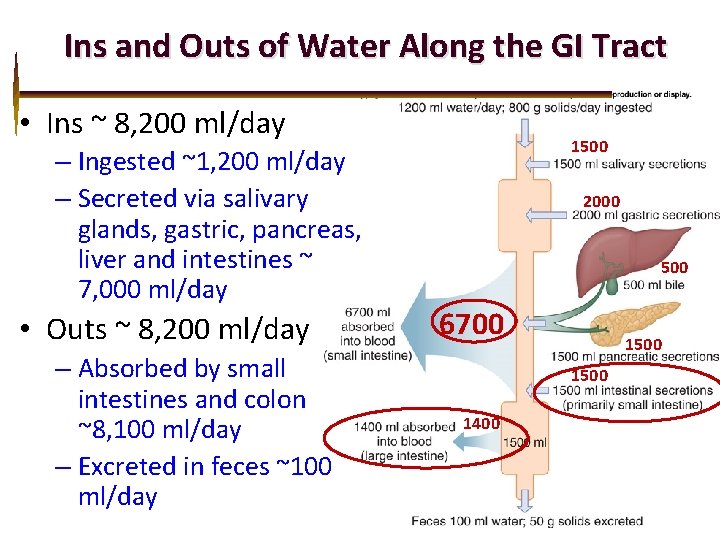
Ins and Outs of Water Along the GI Tract • Ins ~ 8, 200 ml/day – Ingested ~1, 200 ml/day – Secreted via salivary glands, gastric, pancreas, liver and intestines ~ 7, 000 ml/day • Outs ~ 8, 200 ml/day – Absorbed by small intestines and colon ~8, 100 ml/day – Excreted in feces ~100 ml/day 1500 2000 500 6700 1500 1400
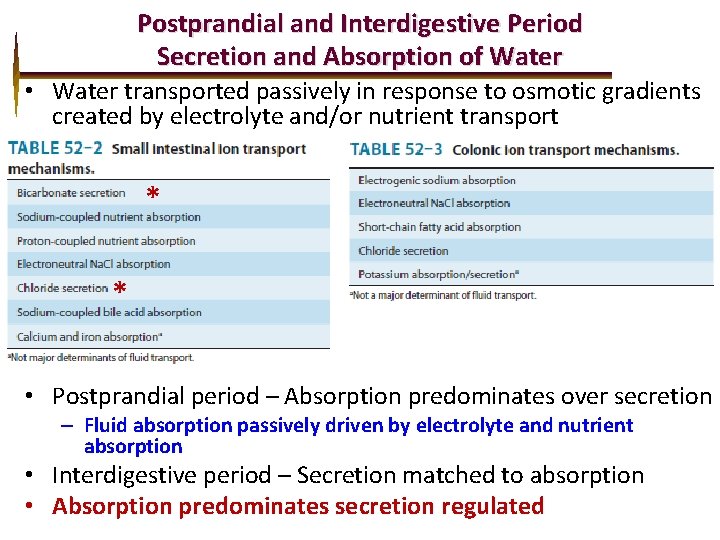
Postprandial and Interdigestive Period Secretion and Absorption of Water • Water transported passively in response to osmotic gradients created by electrolyte and/or nutrient transport * * • Postprandial period – Absorption predominates over secretion – Fluid absorption passively driven by electrolyte and nutrient absorption • Interdigestive period – Secretion matched to absorption • Absorption predominates secretion regulated
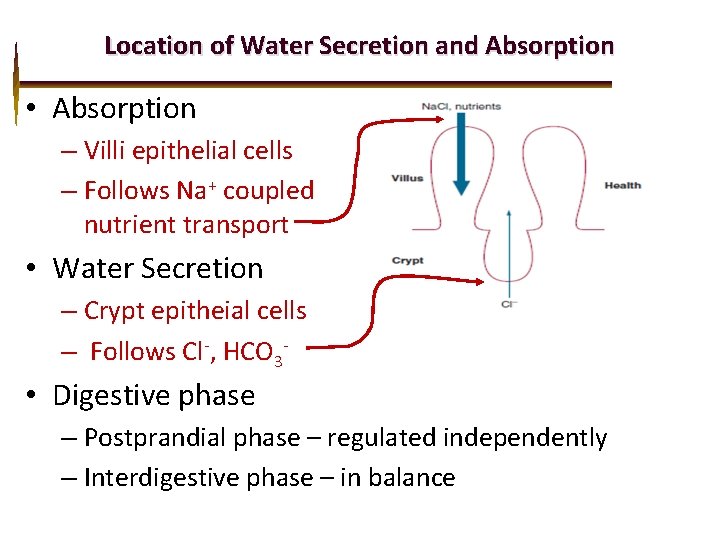
Location of Water Secretion and Absorption • Absorption – Villi epithelial cells – Follows Na+ coupled nutrient transport • Water Secretion – Crypt epitheial cells – Follows Cl-, HCO 3 - • Digestive phase – Postprandial phase – regulated independently – Interdigestive phase – in balance
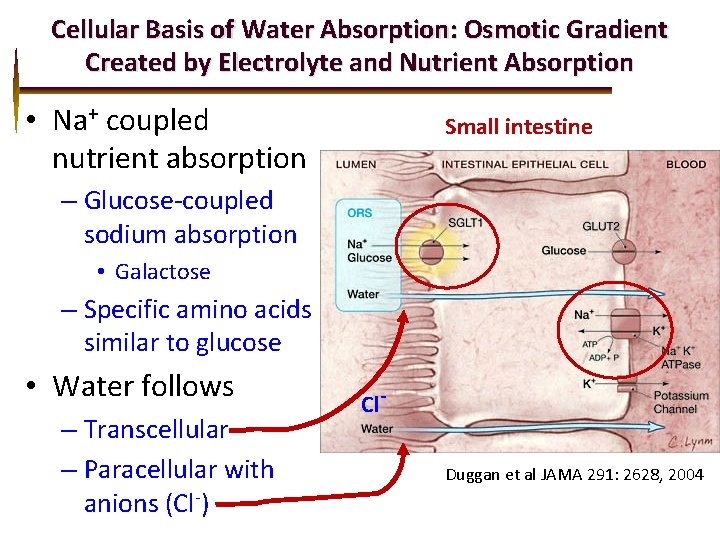
Cellular Basis of Water Absorption: Osmotic Gradient Created by Electrolyte and Nutrient Absorption • Na+ coupled nutrient absorption Small intestine – Glucose-coupled sodium absorption • Galactose – Specific amino acids similar to glucose • Water follows – Transcellular – Paracellular with anions (Cl-) Cl. Duggan et al JAMA 291: 2628, 2004
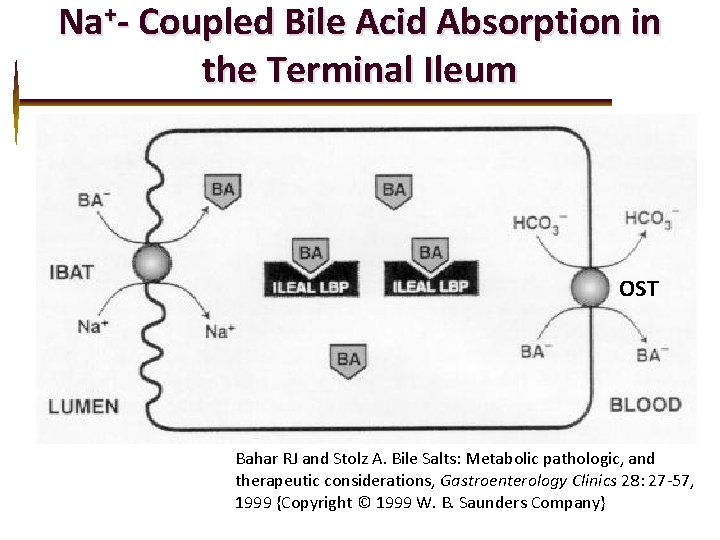
Na+- Coupled Bile Acid Absorption in the Terminal Ileum OST Bahar RJ and Stolz A. Bile Salts: Metabolic pathologic, and therapeutic considerations, Gastroenterology Clinics 28: 27 -57, 1999 {Copyright © 1999 W. B. Saunders Company}
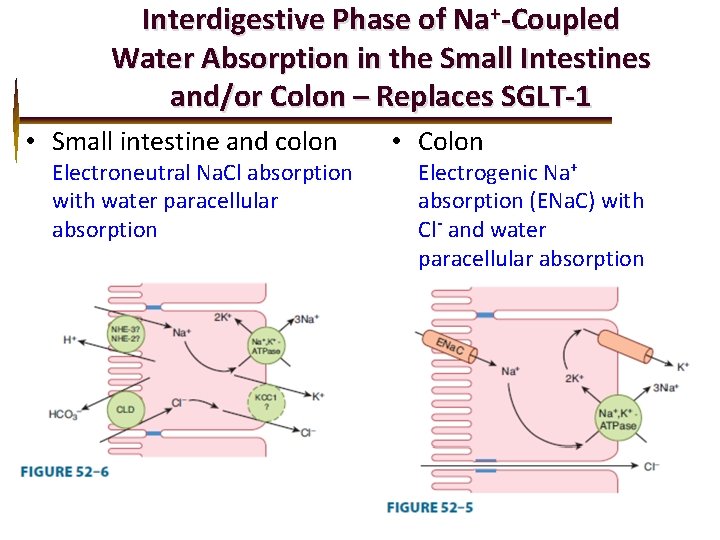
Interdigestive Phase of Na+-Coupled Water Absorption in the Small Intestines and/or Colon – Replaces SGLT-1 • Small intestine and colon Electroneutral Na. Cl absorption with water paracellular absorption • Colon Electrogenic Na+ absorption (ENa. C) with Cl- and water paracellular absorption
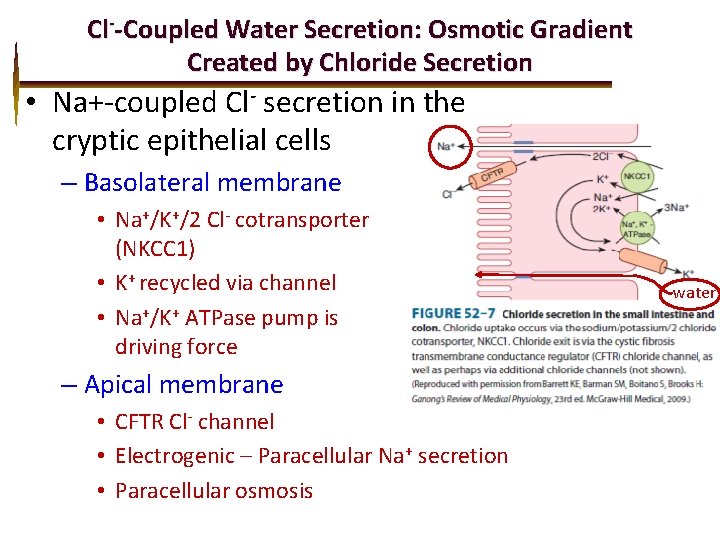
Cl--Coupled Water Secretion: Osmotic Gradient Created by Chloride Secretion • Na+-coupled Cl- secretion in the cryptic epithelial cells – Basolateral membrane • Na+/K+/2 Cl- cotransporter (NKCC 1) • K+ recycled via channel • Na+/K+ ATPase pump is driving force – Apical membrane • CFTR Cl- channel • Electrogenic – Paracellular Na+ secretion • Paracellular osmosis water
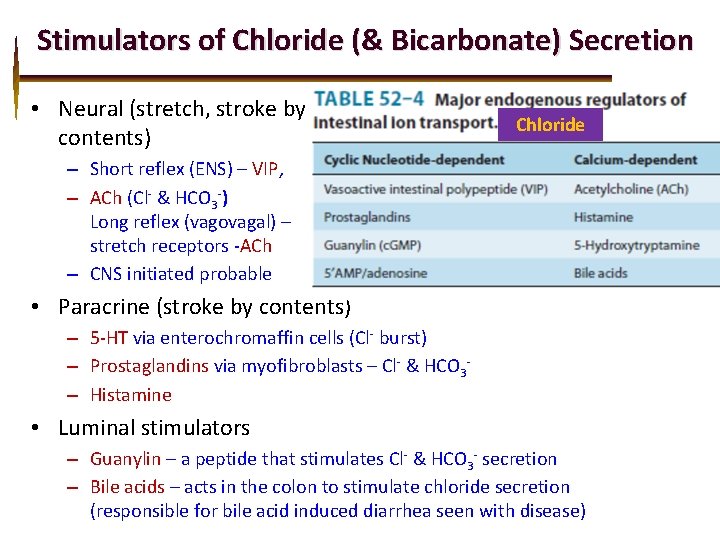
Stimulators of Chloride (& Bicarbonate) Secretion • Neural (stretch, stroke by contents) Chloride – Short reflex (ENS) – VIP, – ACh (Cl- & HCO 3 -) Long reflex (vagovagal) – stretch receptors -ACh – CNS initiated probable • Paracrine (stroke by contents) – 5 -HT via enterochromaffin cells (Cl- burst) – Prostaglandins via myofibroblasts – Cl- & HCO 3– Histamine • Luminal stimulators – Guanylin – a peptide that stimulates Cl- & HCO 3 - secretion – Bile acids – acts in the colon to stimulate chloride secretion (responsible for bile acid induced diarrhea seen with disease)
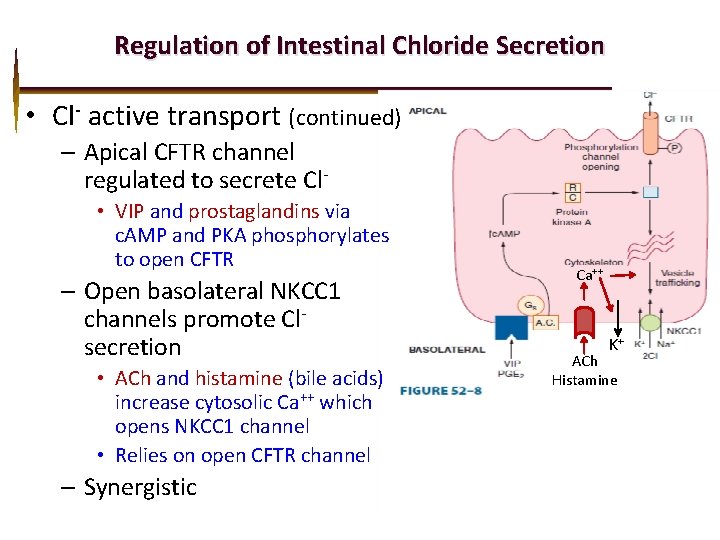
Regulation of Intestinal Chloride Secretion • Cl- active transport (continued) – Apical CFTR channel regulated to secrete Cl • VIP and prostaglandins via c. AMP and PKA phosphorylates to open CFTR – Open basolateral NKCC 1 channels promote Clsecretion • ACh and histamine (bile acids) increase cytosolic Ca++ which opens NKCC 1 channel • Relies on open CFTR channel – Synergistic Ca++ K+ ACh Histamine
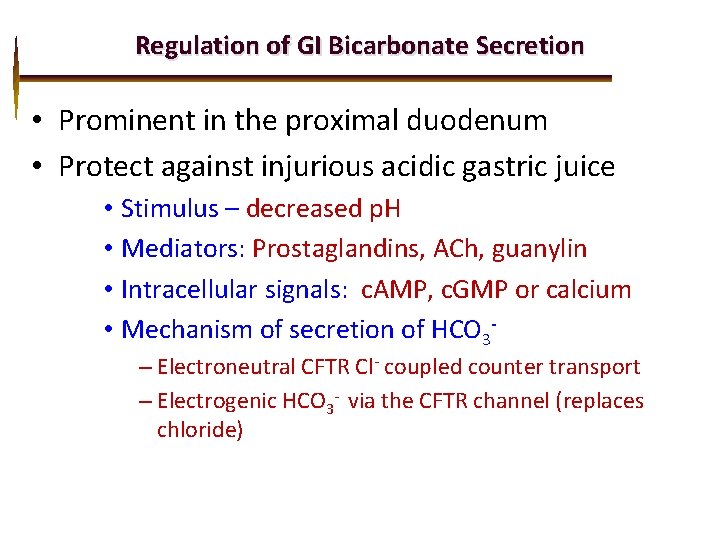
Regulation of GI Bicarbonate Secretion • Prominent in the proximal duodenum • Protect against injurious acidic gastric juice • Stimulus – decreased p. H • Mediators: Prostaglandins, ACh, guanylin • Intracellular signals: c. AMP, c. GMP or calcium • Mechanism of secretion of HCO 3– Electroneutral CFTR Cl- coupled counter transport – Electrogenic HCO 3 - via the CFTR channel (replaces chloride)
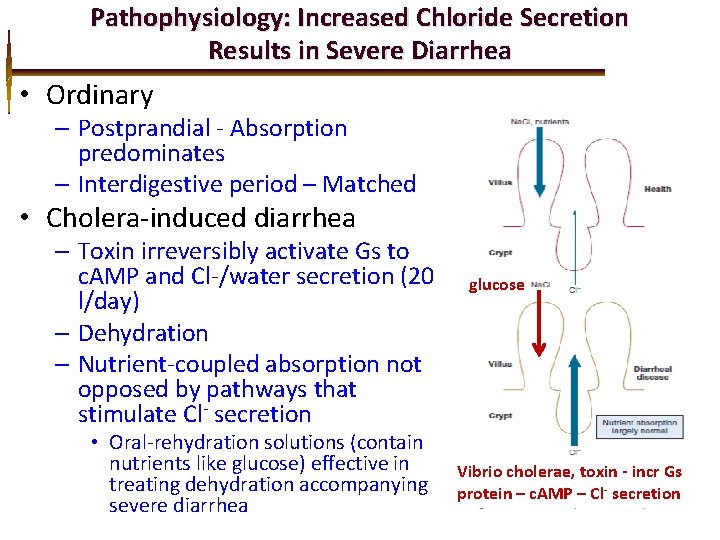
Pathophysiology: Increased Chloride Secretion Results in Severe Diarrhea • Ordinary – Postprandial - Absorption predominates – Interdigestive period – Matched • Cholera-induced diarrhea – Toxin irreversibly activate Gs to c. AMP and Cl-/water secretion (20 l/day) – Dehydration – Nutrient-coupled absorption not opposed by pathways that stimulate Cl- secretion • Oral-rehydration solutions (contain nutrients like glucose) effective in treating dehydration accompanying severe diarrhea glucose Vibrio cholerae, toxin - incr Gs protein – c. AMP – Cl- secretion
Other Diarrheas • Infectious diseases – Salmonella – Clostridium difficile (antibiotic-disrupted microflora) – toxin that increases i. Ca++ – E. coli – heat-stable toxin homology with guanylin • Noninfection (immune and inflammatory mediators) - Inflammatory bowel diseases – Crohn/s disease – Ulcerative colitis
CHO Digestion and Absorption Role and Significance • Major source of calories – CHO – glucose – energy – Storage - glycogen • Building blocks for molecules needed by the body – Proteins – amino acids (esp. essential a. a. ) • Excess to fat
CHO Digestion and Absorption The Carbohydrates • Main digestible CHO – Dissacharides - sucrose, lactose – Starch (polymers of glucose) – two forms • Amylose – straight-chain of glucose (no branching) • Amylopectin – branched polymer of glucose • “Nondigestible CHO (fiber) - can’t be degraded by mammalian digestive enzymes – Provides bulk to stool – Bacterial hydrolases can breakdown • Energy for bacteria • Absorbable byproduct - short-chain fatty acids
CHO Digestion and Absorption Barriers to CHO Absorption • Molecular size and polarity prevents flux across membranes of the gut epithelial cells • To prepare for absorption, macromolecular forms of CHO must be broken down to transportable forms by digestive enzymes 1. Lumen of the small intestines 2. Membrane bound hydrolases in the microvillus epithelial cell apical membrane (or brush boarder)
CHO Digestion and Absorption Luminal and Brush Boarder Digestion • Luminal amylases Salivary amylase (decreased by acidic p. H) • Protected by substrate binding – Salivary amylase • Infants (important) • Pancreatic insufficiency (CF) – Pancreatic amylase • Brush boarder hydrolases (synthesized by and anchored to apical membrane of enterocytes) – Sucrase – Isomaltase – Glucoamylase – Lactase
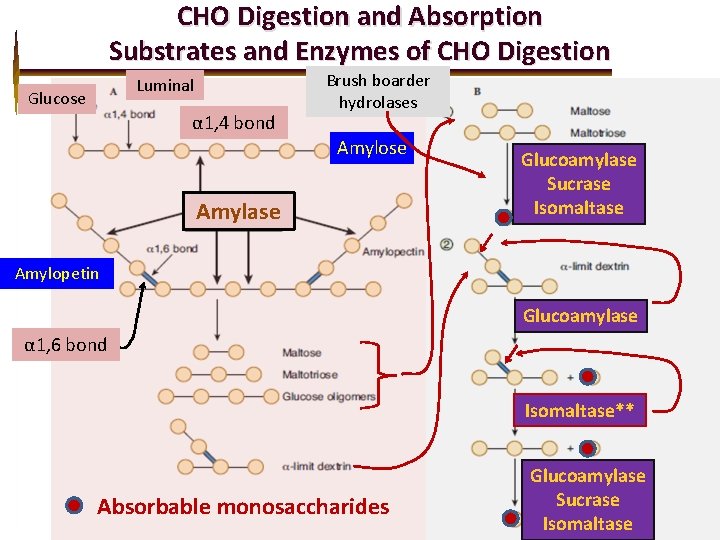
CHO Digestion and Absorption Substrates and Enzymes of CHO Digestion Luminal Glucose α 1, 4 bond Brush boarder hydrolases Amylose Amylase Glucoamylase Sucrase Isomaltase Amylopetin Glucoamylase α 1, 6 bond Isomaltase** Absorbable monosaccharides Glucoamylase Sucrase Isomaltase
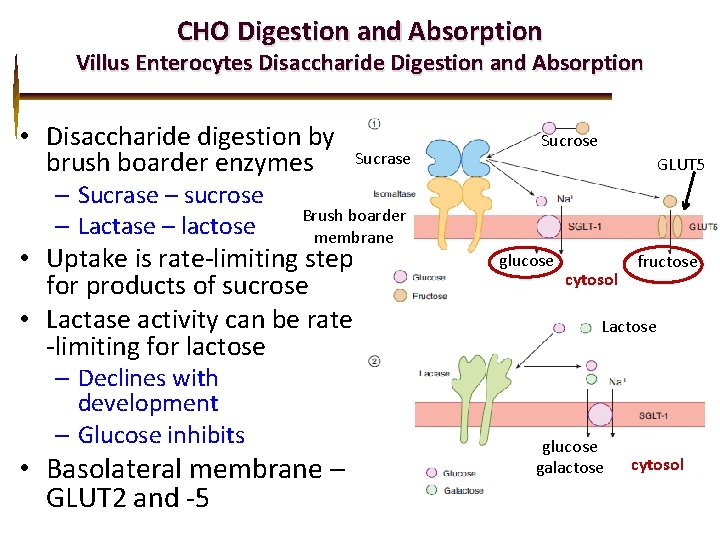
CHO Digestion and Absorption Villus Enterocytes Disaccharide Digestion and Absorption • Disaccharide digestion by brush boarder enzymes – Sucrase – sucrose – Lactase – lactose GLUT 5 Brush boarder membrane • Uptake is rate-limiting step for products of sucrose • Lactase activity can be rate -limiting for lactose – Declines with development – Glucose inhibits Sucrase Sucrose • Basolateral membrane – GLUT 2 and -5 glucose cytosol fructose Lactose glucose galactose cytosol
CHO Digestion and Absorption Developmental Effects • Brush boarder enzymes in place before birth • Pancreatic amylase low in infants (increases gradually over the first year) – importance of salivary amylase • Lactase declines after weaning • Diet plays a role for expression of both enzymes
CHO Digestion and Absorption Regulation of CHO Digestive Enzymes • Short-term – digestive state – Enzymes degraded by pancreatic proteases at the end of each meal – True of other brush boarder digestive enzymes, e. g. proteases • Long-term – dietary regulation – Hydrolases, transporters and amylase adjust to changes in CHO in diet – Insulin suppress synthesis of these enzymes • Increased in Type 1 diabetes mellitus
Protein Digestion and Absorption Protein Assimilation • Comparisons to CHO – Similarities • Requires luminal and brush boarder enzymes • Requires specific apical membrane transports – Differences • Proteins requires broader spectrum of peptidases and transporters – 20 a. a. represent more diverse set of substrates than the 3 monosaccharides • Enterocytes capable of transporting oligomers (di-, tri& perhaps tetra-peptides) • Final stage of protein digestion takes place in the cytosol of enterocytes
- Slides: 24