
GI lab 1 esophagus and stomach Normal esophagus
GI lab 1 esophagus and stomach
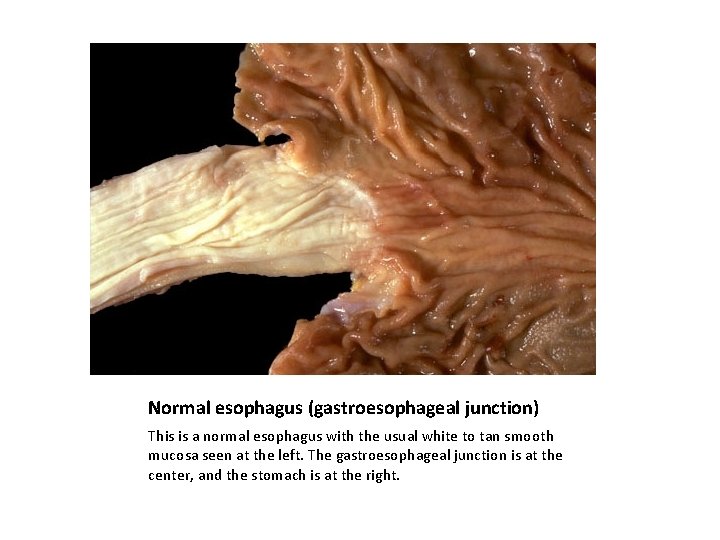
Normal esophagus (gastroesophageal junction) This is a normal esophagus with the usual white to tan smooth mucosa seen at the left. The gastroesophageal junction is at the center, and the stomach is at the right.

Normal esophagus This is normal esophageal squamous mucosa at the left, with underlying submucosa containing mucus glands and a duct surrounded by lymphoid tissue. The muscularis is at the right.
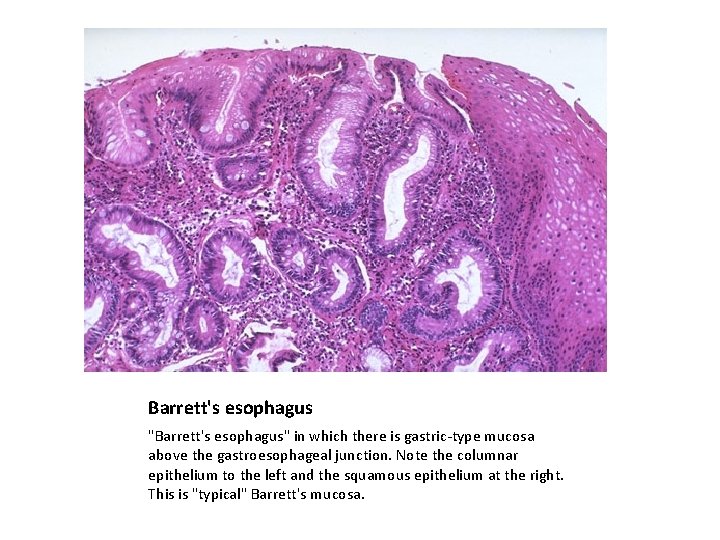
Barrett's esophagus "Barrett's esophagus" in which there is gastric-type mucosa above the gastroesophageal junction. Note the columnar epithelium to the left and the squamous epithelium at the right. This is "typical" Barrett's mucosa.
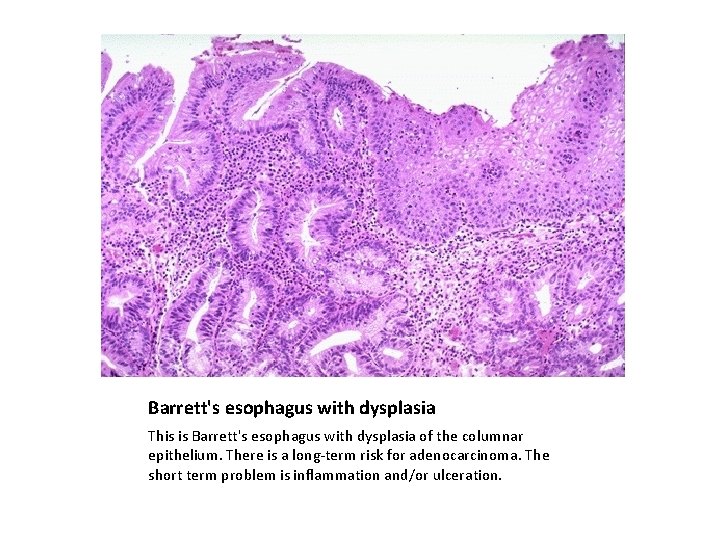
Barrett's esophagus with dysplasia This is Barrett's esophagus with dysplasia of the columnar epithelium. There is a long-term risk for adenocarcinoma. The short term problem is inflammation and/or ulceration.
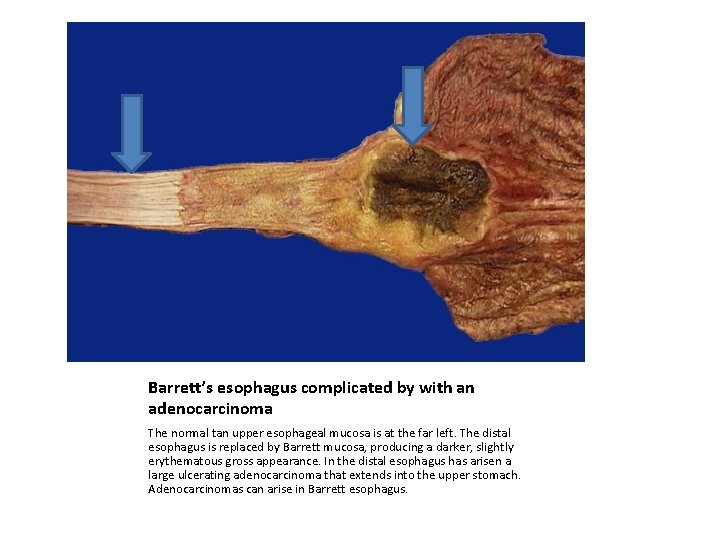
Barrett’s esophagus complicated by with an adenocarcinoma The normal tan upper esophageal mucosa is at the far left. The distal esophagus is replaced by Barrett mucosa, producing a darker, slightly erythematous gross appearance. In the distal esophagus has arisen a large ulcerating adenocarcinoma that extends into the upper stomach. Adenocarcinomas can arise in Barrett esophagus.
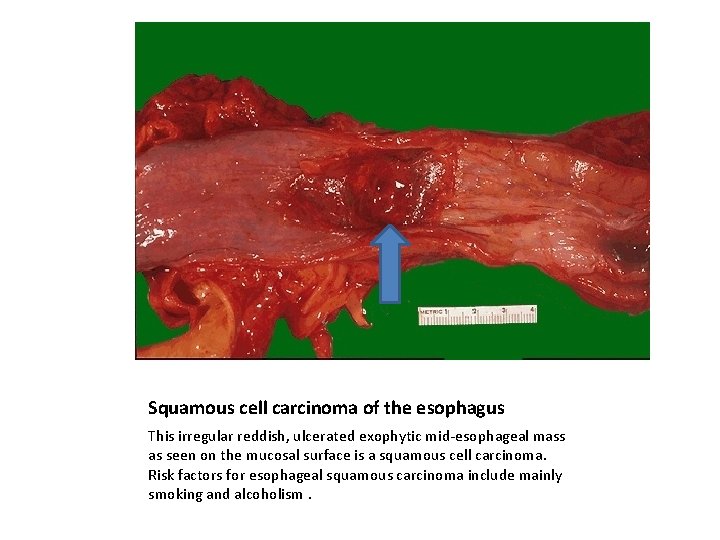
Squamous cell carcinoma of the esophagus This irregular reddish, ulcerated exophytic mid-esophageal mass as seen on the mucosal surface is a squamous cell carcinoma. Risk factors for esophageal squamous carcinoma include mainly smoking and alcoholism.
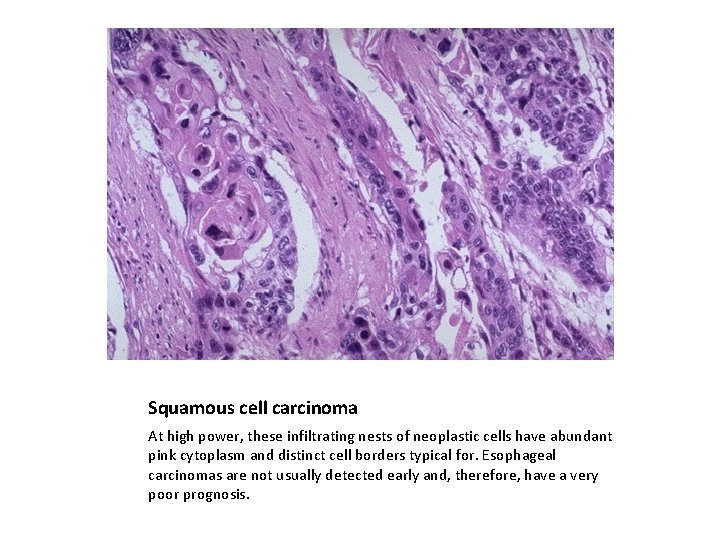
Squamous cell carcinoma At high power, these infiltrating nests of neoplastic cells have abundant pink cytoplasm and distinct cell borders typical for. Esophageal carcinomas are not usually detected early and, therefore, have a very poor prognosis.
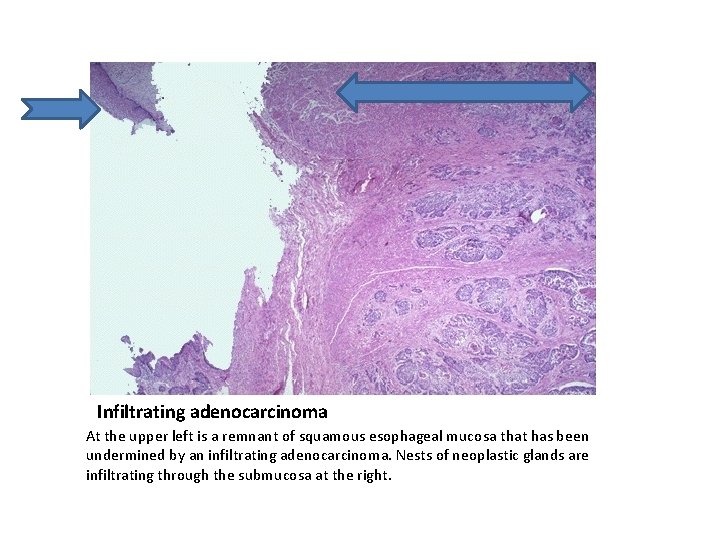
Infiltrating adenocarcinoma At the upper left is a remnant of squamous esophageal mucosa that has been undermined by an infiltrating adenocarcinoma. Nests of neoplastic glands are infiltrating through the submucosa at the right.
Stomach
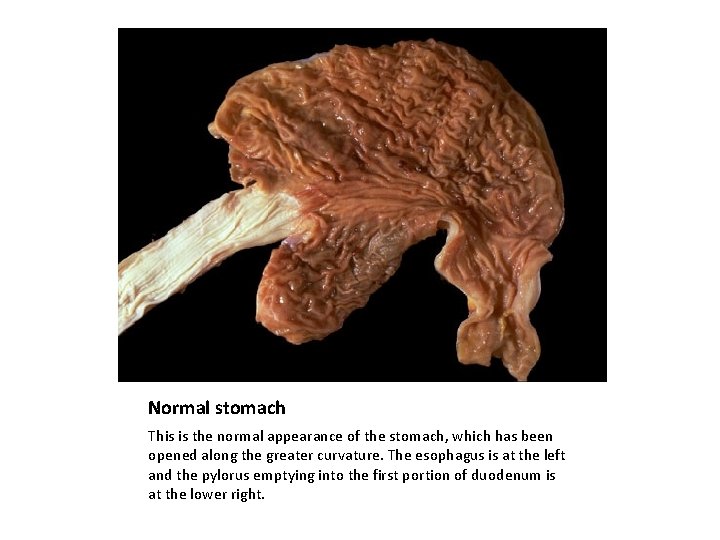
Normal stomach This is the normal appearance of the stomach, which has been opened along the greater curvature. The esophagus is at the left and the pylorus emptying into the first portion of duodenum is at the lower right.
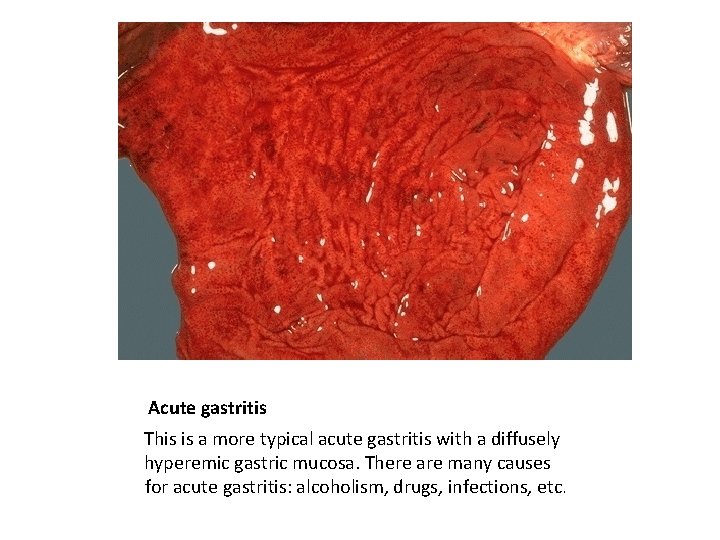
Acute gastritis This is a more typical acute gastritis with a diffusely hyperemic gastric mucosa. There are many causes for acute gastritis: alcoholism, drugs, infections, etc.
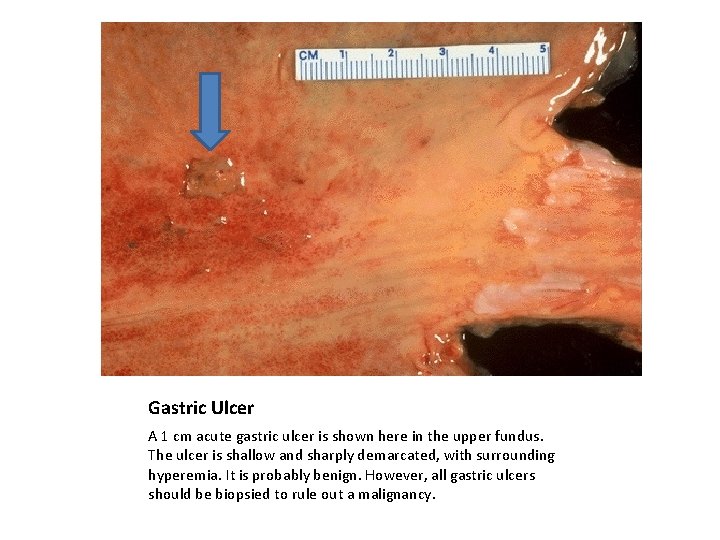
Gastric Ulcer A 1 cm acute gastric ulcer is shown here in the upper fundus. The ulcer is shallow and sharply demarcated, with surrounding hyperemia. It is probably benign. However, all gastric ulcers should be biopsied to rule out a malignancy.
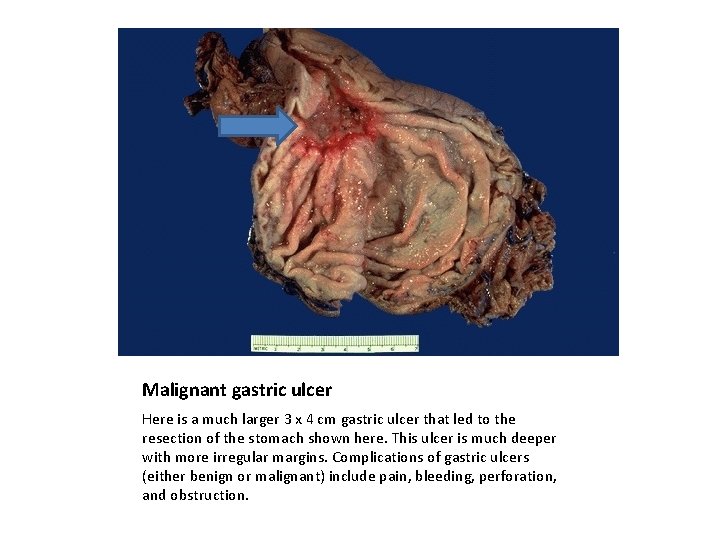
Malignant gastric ulcer Here is a much larger 3 x 4 cm gastric ulcer that led to the resection of the stomach shown here. This ulcer is much deeper with more irregular margins. Complications of gastric ulcers (either benign or malignant) include pain, bleeding, perforation, and obstruction.
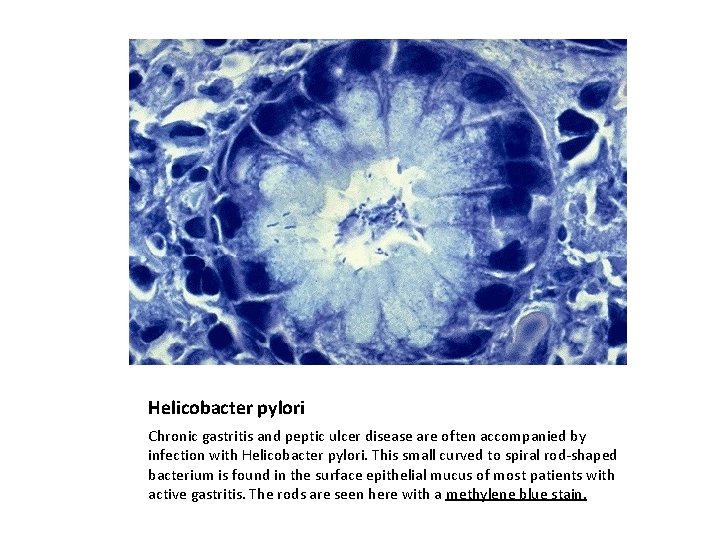
Helicobacter pylori Chronic gastritis and peptic ulcer disease are often accompanied by infection with Helicobacter pylori. This small curved to spiral rod-shaped bacterium is found in the surface epithelial mucus of most patients with active gastritis. The rods are seen here with a methylene blue stain.
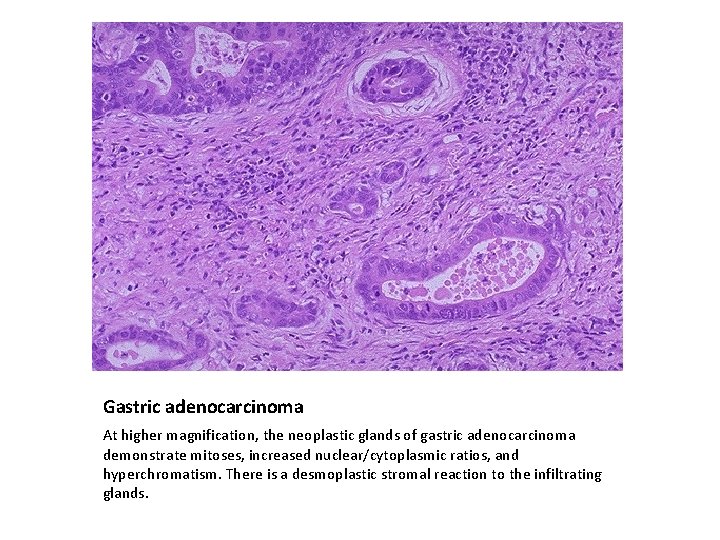
Gastric adenocarcinoma At higher magnification, the neoplastic glands of gastric adenocarcinoma demonstrate mitoses, increased nuclear/cytoplasmic ratios, and hyperchromatism. There is a desmoplastic stromal reaction to the infiltrating glands.
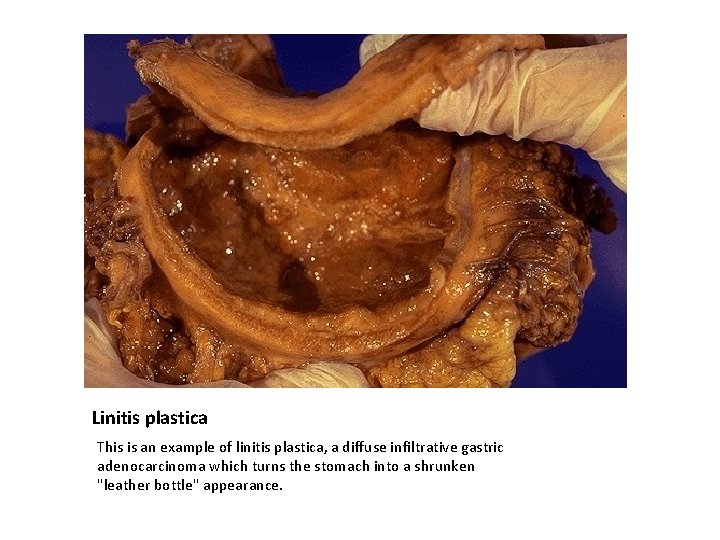
Linitis plastica This is an example of linitis plastica, a diffuse infiltrative gastric adenocarcinoma which turns the stomach into a shrunken "leather bottle" appearance.
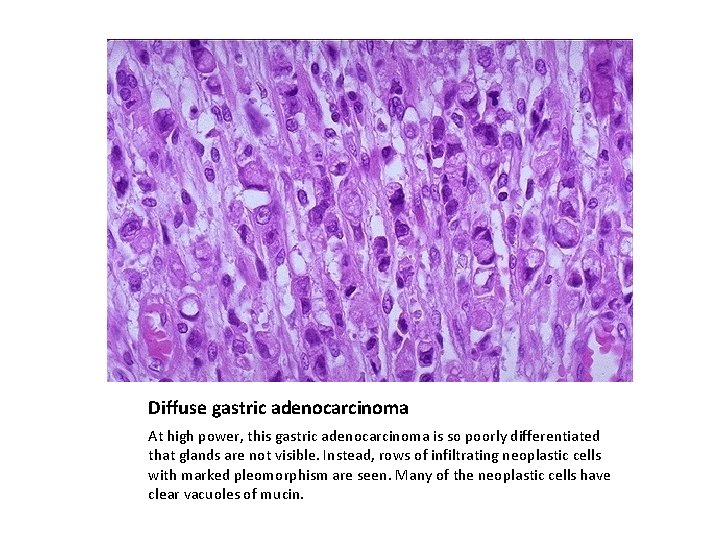
Diffuse gastric adenocarcinoma At high power, this gastric adenocarcinoma is so poorly differentiated that glands are not visible. Instead, rows of infiltrating neoplastic cells with marked pleomorphism are seen. Many of the neoplastic cells have clear vacuoles of mucin.
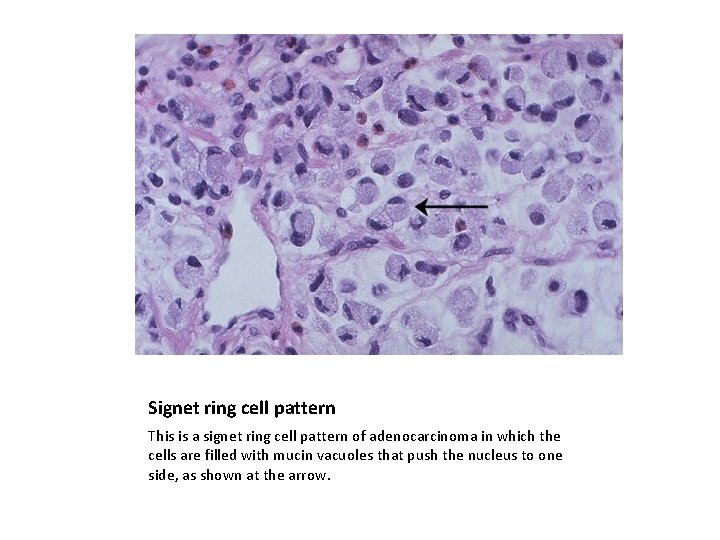
Signet ring cell pattern This is a signet ring cell pattern of adenocarcinoma in which the cells are filled with mucin vacuoles that push the nucleus to one side, as shown at the arrow.

Thank you
- Slides: 20