
Ghana World Bank Group Country Partnership Framework FY
Ghana World Bank Group Country Partnership Framework FY 21 -26 Consultations September, 2020
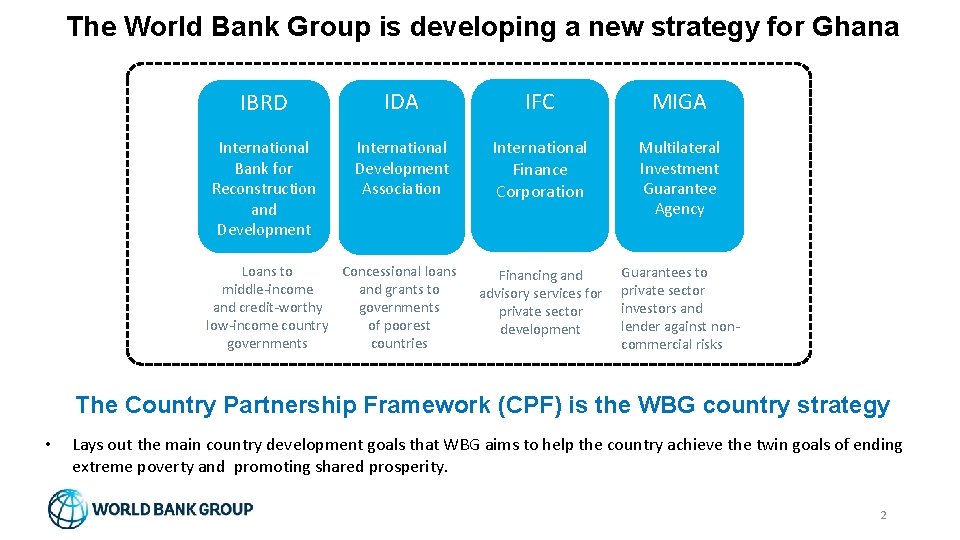
The World Bank Group is developing a new strategy for Ghana IBRD IDA IFC MIGA International Bank for Reconstruction and Development International Development Association International Finance Corporation Multilateral Investment Guarantee Agency Financing and advisory services for private sector development Guarantees to private sector investors and lender against noncommercial risks Concessional loans Loans to and grants to middle-income governments and credit-worthy of poorest low-income country countries governments The Country Partnership Framework (CPF) is the WBG country strategy • Lays out the main country development goals that WBG aims to help the country achieve the twin goals of ending extreme poverty and promoting shared prosperity. 2
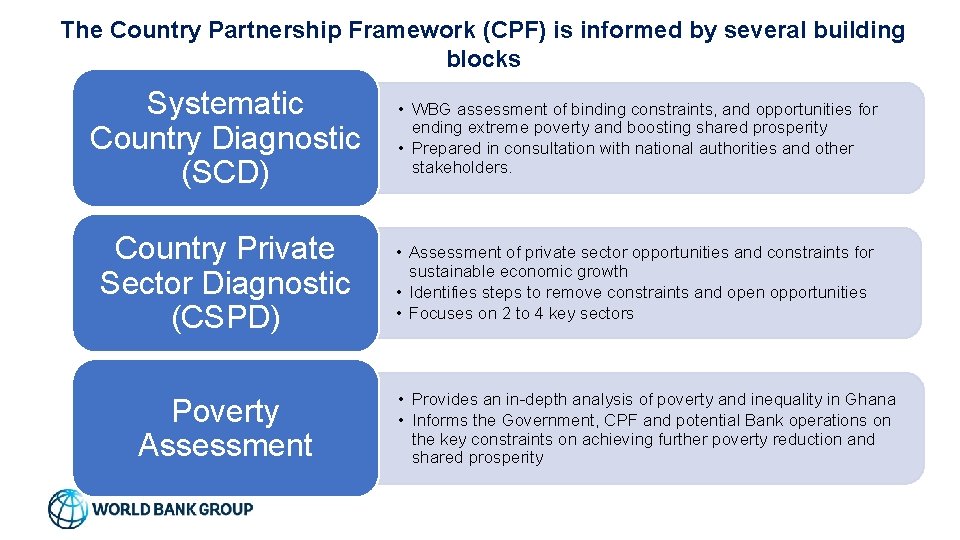
The Country Partnership Framework (CPF) is informed by several building blocks Systematic Country Diagnostic (SCD) • WBG assessment of binding constraints, and opportunities for ending extreme poverty and boosting shared prosperity • Prepared in consultation with national authorities and other stakeholders. Country Private Sector Diagnostic (CSPD) • Assessment of private sector opportunities and constraints for sustainable economic growth • Identifies steps to remove constraints and open opportunities • Focuses on 2 to 4 key sectors Poverty Assessment • Provides an in-depth analysis of poverty and inequality in Ghana • Informs the Government, CPF and potential Bank operations on the key constraints on achieving further poverty reduction and shared prosperity
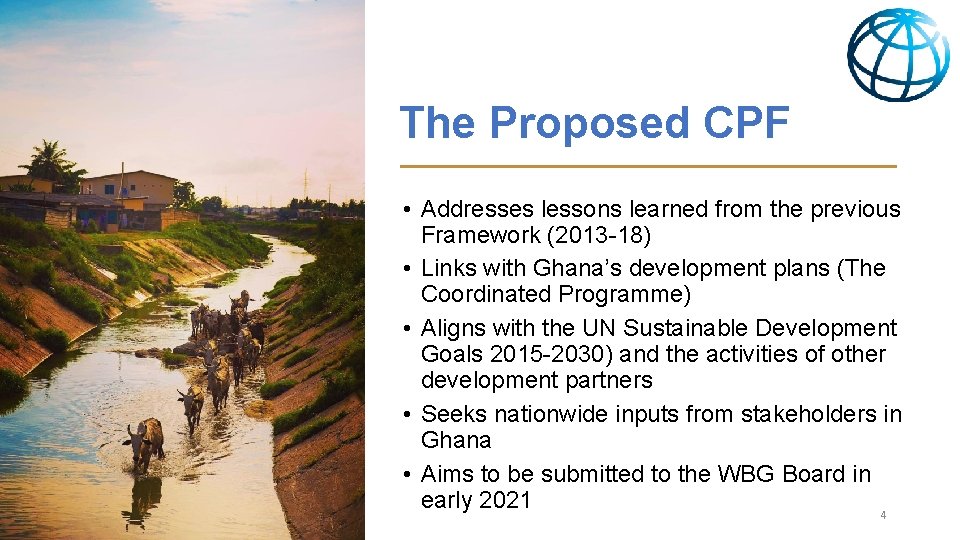
The Proposed CPF • Addresses lessons learned from the previous Framework (2013 -18) • Links with Ghana’s development plans (The Coordinated Programme) • Aligns with the UN Sustainable Development Goals 2015 -2030) and the activities of other development partners • Seeks nationwide inputs from stakeholders in Ghana • Aims to be submitted to the WBG Board in early 2021 4
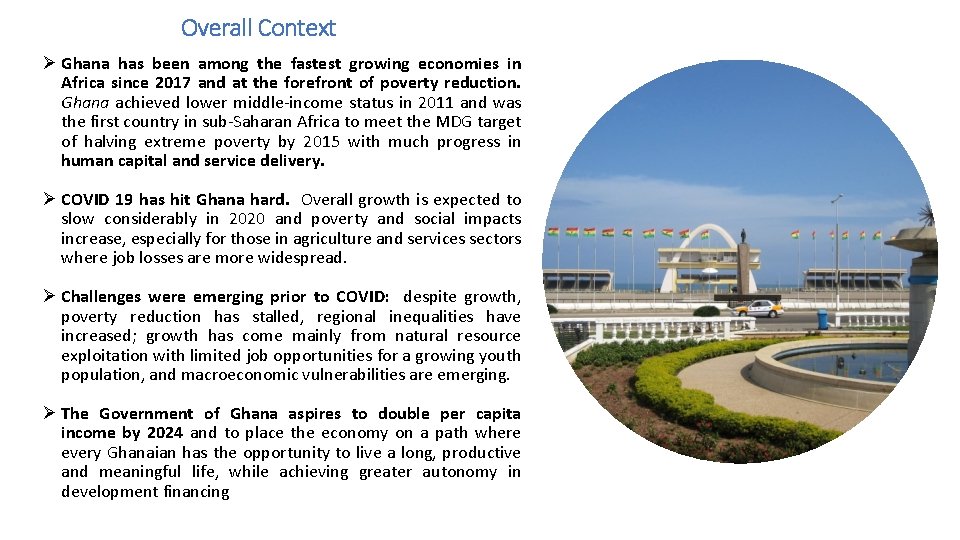
Overall Context Ø Ghana has been among the fastest growing economies in Africa since 2017 and at the forefront of poverty reduction. Ghana achieved lower middle-income status in 2011 and was the first country in sub-Saharan Africa to meet the MDG target of halving extreme poverty by 2015 with much progress in human capital and service delivery. Ø COVID 19 has hit Ghana hard. Overall growth is expected to slow considerably in 2020 and poverty and social impacts increase, especially for those in agriculture and services sectors where job losses are more widespread. Ø Challenges were emerging prior to COVID: despite growth, poverty reduction has stalled, regional inequalities have increased; growth has come mainly from natural resource exploitation with limited job opportunities for a growing youth population, and macroeconomic vulnerabilities are emerging. Ø The Government of Ghana aspires to double per capita income by 2024 and to place the economy on a path where every Ghanaian has the opportunity to live a long, productive and meaningful life, while achieving greater autonomy in development financing

Growth momentum since the 1990 s put Ghana ahead in efforts at poverty reduction in Africa 60 Poverty rates 52. 7 50 39. 5 40 31. 9 30 24. 2 23. 4 2012 20167 20 10 0 1991 1998 2005
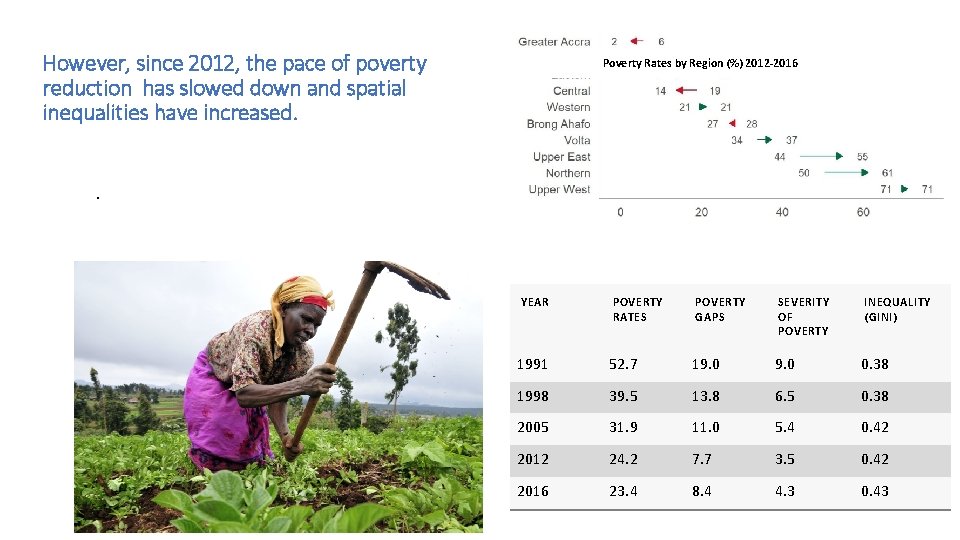
However, since 2012, the pace of poverty reduction has slowed down and spatial inequalities have increased. Poverty Rates by Region (%) 2012 -2016 . Poverty Rates, Gaps, Severity and Inequality YEAR POVERTY RATES POVERTY GAPS SEVERITY OF POVERTY INEQUALITY (GINI) 1991 52. 7 19. 0 0. 38 1998 39. 5 13. 8 6. 5 0. 38 2005 31. 9 11. 0 5. 4 0. 42 2012 24. 2 7. 7 3. 5 0. 42 2016 23. 4 8. 4 4. 3 0. 43
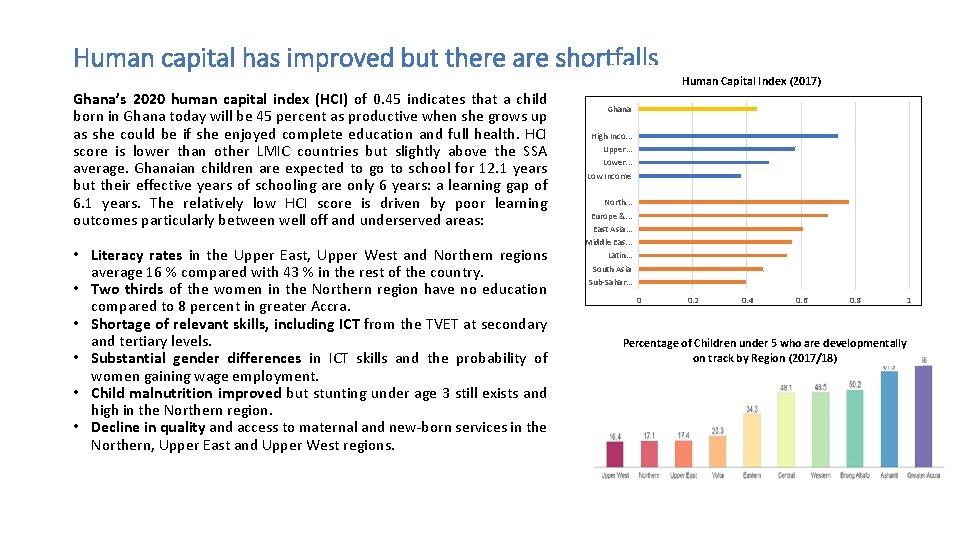
Human capital has improved but there are shortfalls Human Capital Index (2017) Ghana’s 2020 human capital index (HCI) of 0. 45 indicates that a child born in Ghana today will be 45 percent as productive when she grows up as she could be if she enjoyed complete education and full health. HCI score is lower than other LMIC countries but slightly above the SSA average. Ghanaian children are expected to go to school for 12. 1 years but their effective years of schooling are only 6 years: a learning gap of 6. 1 years. The relatively low HCI score is driven by poor learning outcomes particularly between well off and underserved areas: • Literacy rates in the Upper East, Upper West and Northern regions average 16 % compared with 43 % in the rest of the country. • Two thirds of the women in the Northern region have no education compared to 8 percent in greater Accra. • Shortage of relevant skills, including ICT from the TVET at secondary and tertiary levels. • Substantial gender differences in ICT skills and the probability of women gaining wage employment. • Child malnutrition improved but stunting under age 3 still exists and high in the Northern region. • Decline in quality and access to maternal and new-born services in the Northern, Upper East and Upper West regions. Ghana High Inco. . . Upper. . . Low Income North. . . Europe &. . . East Asia. . . Middle Eas. . . Latin. . . South Asia Sub-Sahar. . . 0 0. 2 0. 4 0. 6 0. 8 1 Percentage of Children under 5 who are developmentally on track by Region (2017/18)
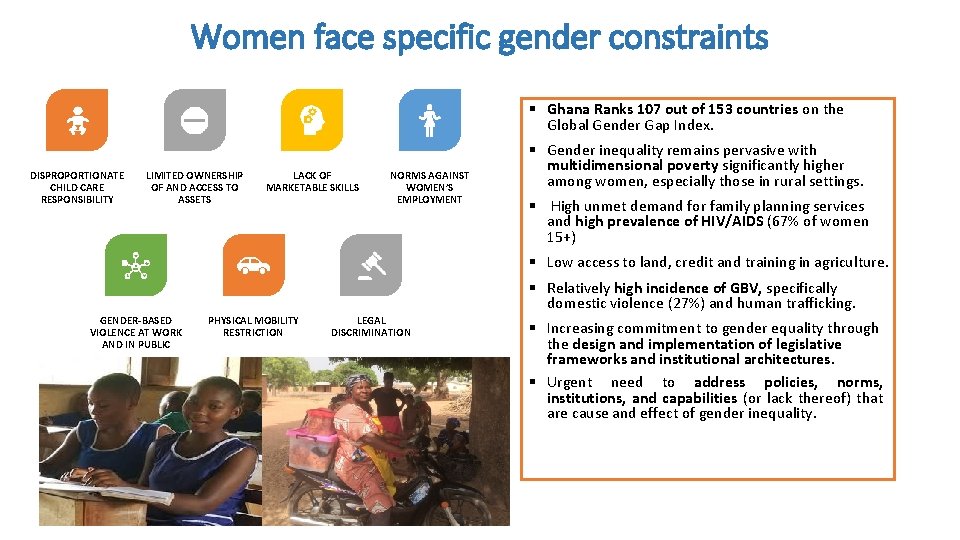
Women face specific gender constraints § Ghana Ranks 107 out of 153 countries on the Global Gender Gap Index. DISPROPORTIONATE CHILD CARE RESPONSIBILITY LIMITED OWNERSHIP OF AND ACCESS TO ASSETS LACK OF MARKETABLE SKILLS NORMS AGAINST WOMEN’S EMPLOYMENT § Gender inequality remains pervasive with multidimensional poverty significantly higher among women, especially those in rural settings. § High unmet demand for family planning services and high prevalence of HIV/AIDS (67% of women 15+) § Low access to land, credit and training in agriculture. § Relatively high incidence of GBV, specifically domestic violence (27%) and human trafficking. GENDER-BASED VIOLENCE AT WORK AND IN PUBLIC PHYSICAL MOBILITY RESTRICTION LEGAL DISCRIMINATION § Increasing commitment to gender equality through the design and implementation of legislative frameworks and institutional architectures. § Urgent need to address policies, norms, institutions, and capabilities (or lack thereof) that are cause and effect of gender inequality.
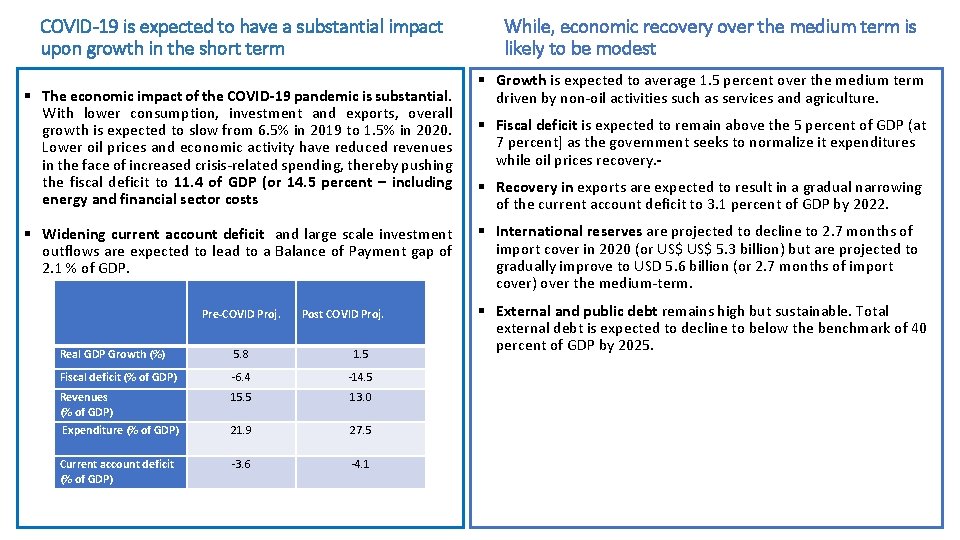
COVID-19 is expected to have a substantial impact upon growth in the short term § The economic impact of the COVID-19 pandemic is substantial. With lower consumption, investment and exports, overall growth is expected to slow from 6. 5% in 2019 to 1. 5% in 2020. Lower oil prices and economic activity have reduced revenues in the face of increased crisis-related spending, thereby pushing the fiscal deficit to 11. 4 of GDP (or 14. 5 percent – including energy and financial sector costs § Widening current account deficit and large scale investment outflows are expected to lead to a Balance of Payment gap of 2. 1 % of GDP. Pre-COVID Proj. Post COVID Proj. Real GDP Growth (%) 5. 8 1. 5 Fiscal deficit (% of GDP) -6. 4 -14. 5 Revenues (% of GDP) Expenditure (% of GDP) 15. 5 13. 0 21. 9 27. 5 Current account deficit (% of GDP) -3. 6 -4. 1 While, economic recovery over the medium term is likely to be modest § Growth is expected to average 1. 5 percent over the medium term driven by non-oil activities such as services and agriculture. § Fiscal deficit is expected to remain above the 5 percent of GDP (at 7 percent] as the government seeks to normalize it expenditures while oil prices recovery. § Recovery in exports are expected to result in a gradual narrowing of the current account deficit to 3. 1 percent of GDP by 2022. § International reserves are projected to decline to 2. 7 months of import cover in 2020 (or US$ 5. 3 billion) but are projected to gradually improve to USD 5. 6 billion (or 2. 7 months of import cover) over the medium-term. § External and public debt remains high but sustainable. Total external debt is expected to decline to below the benchmark of 40 percent of GDP by 2025.
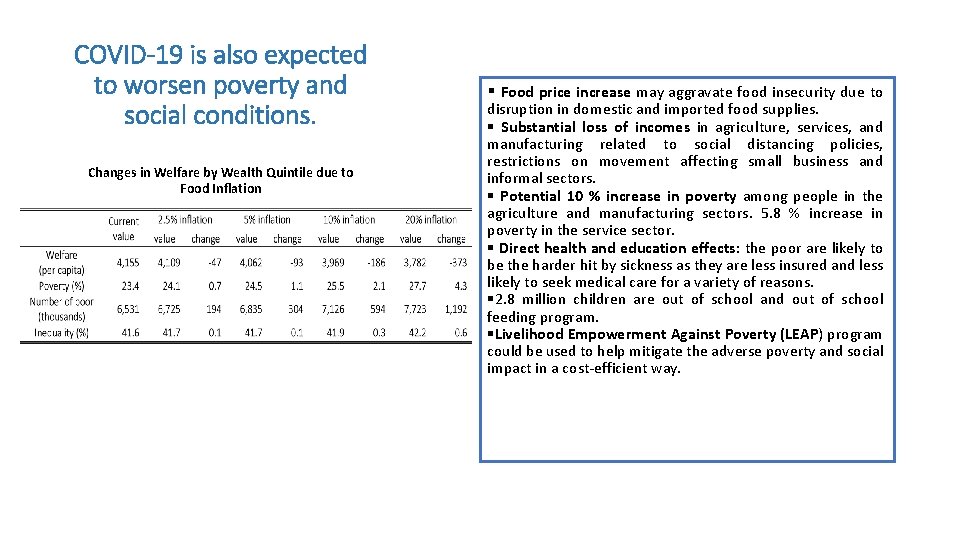
COVID-19 is also expected to worsen poverty and social conditions. Changes in Welfare by Wealth Quintile due to Food Inflation § Food price increase may aggravate food insecurity due to disruption in domestic and imported food supplies. § Substantial loss of incomes in agriculture, services, and manufacturing related to social distancing policies, restrictions on movement affecting small business and informal sectors. § Potential 10 % increase in poverty among people in the agriculture and manufacturing sectors. 5. 8 % increase in poverty in the service sector. § Direct health and education effects: the poor are likely to be the harder hit by sickness as they are less insured and less likely to seek medical care for a variety of reasons. § 2. 8 million children are out of school and out of school feeding program. §Livelihood Empowerment Against Poverty (LEAP) program could be used to help mitigate the adverse poverty and social impact in a cost-efficient way.
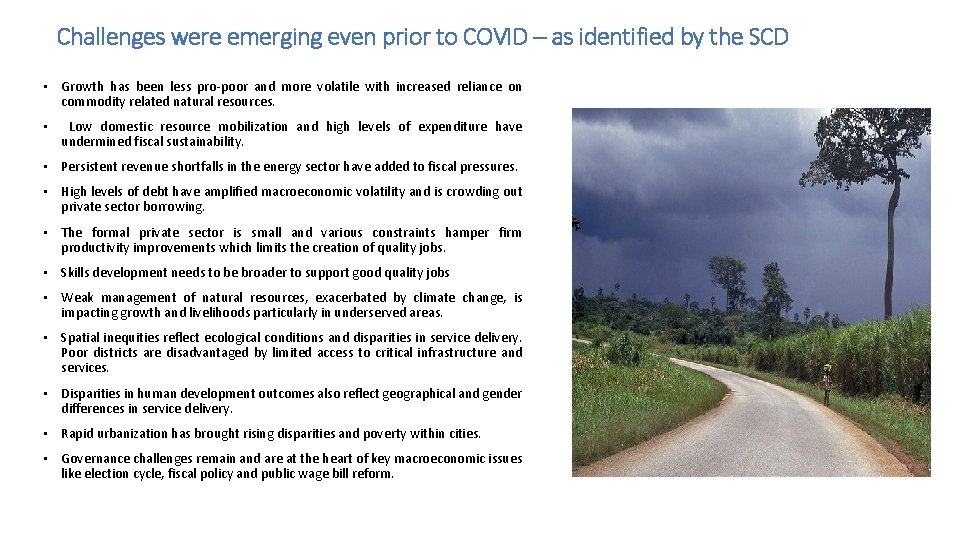
Challenges were emerging even prior to COVID – as identified by the SCD • Growth has been less pro-poor and more volatile with increased reliance on commodity related natural resources. • Low domestic resource mobilization and high levels of expenditure have undermined fiscal sustainability. • Persistent revenue shortfalls in the energy sector have added to fiscal pressures. • High levels of debt have amplified macroeconomic volatility and is crowding out private sector borrowing. • The formal private sector is small and various constraints hamper firm productivity improvements which limits the creation of quality jobs. • Skills development needs to be broader to support good quality jobs • Weak management of natural resources, exacerbated by climate change, is impacting growth and livelihoods particularly in underserved areas. • Spatial inequities reflect ecological conditions and disparities in service delivery. Poor districts are disadvantaged by limited access to critical infrastructure and services. • Disparities in human development outcomes also reflect geographical and gender differences in service delivery. • Rapid urbanization has brought rising disparities and poverty within cities. • Governance challenges remain and are at the heart of key macroeconomic issues like election cycle, fiscal policy and public wage bill reform.
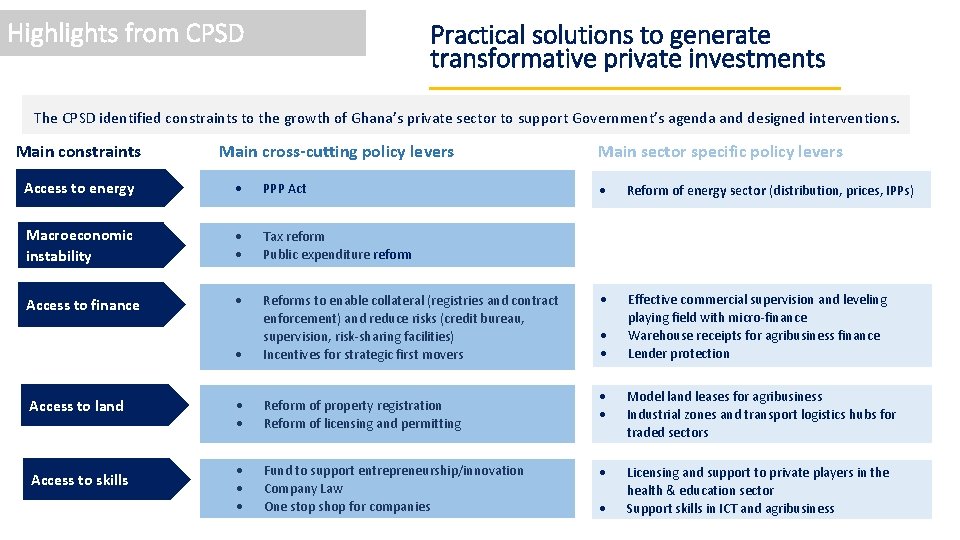
Highlights from CPSD Practical solutions to generate transformative private investments The CPSD identified constraints to the growth of Ghana’s private sector to support Government’s agenda and designed interventions. Main constraints Main cross-cutting policy levers Access to energy PPP Act Macroeconomic instability Tax reform Public expenditure reform Access to finance Reforms to enable collateral (registries and contract enforcement) and reduce risks (credit bureau, supervision, risk-sharing facilities) Incentives for strategic first movers Reform of property registration Reform of licensing and permitting Fund to support entrepreneurship/innovation Company Law One stop shop for companies Access to land Access to skills Main sector specific policy levers Reform of energy sector (distribution, prices, IPPs) Effective commercial supervision and leveling playing field with micro-finance Warehouse receipts for agribusiness finance Lender protection Model land leases for agribusiness Industrial zones and transport logistics hubs for traded sectors Licensing and support to private players in the health & education sector Support skills in ICT and agribusiness
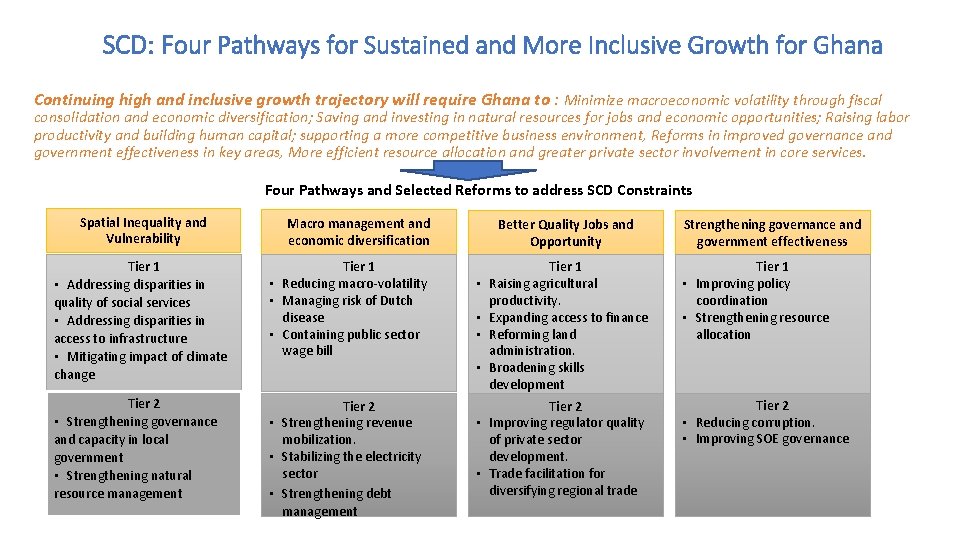
SCD: Four Pathways for Sustained and More Inclusive Growth for Ghana Continuing high and inclusive growth trajectory will require Ghana to : Minimize macroeconomic volatility through fiscal consolidation and economic diversification; Saving and investing in natural resources for jobs and economic opportunities; Raising labor productivity and building human capital; supporting a more competitive business environment, Reforms in improved governance and government effectiveness in key areas, More efficient resource allocation and greater private sector involvement in core services. Four Pathways and Selected Reforms to address SCD Constraints Spatial Inequality and Vulnerability Macro management and economic diversification Tier 1 • Addressing disparities in quality of social services • Addressing disparities in access to infrastructure • Mitigating impact of climate change Tier 1 • Reducing macro-volatility • Managing risk of Dutch disease • Containing public sector wage bill Tier 2 • Strengthening governance and capacity in local government • Strengthening natural resource management Tier 2 • Strengthening revenue mobilization. • Stabilizing the electricity sector • Strengthening debt management Better Quality Jobs and Opportunity • • Tier 1 Raising agricultural productivity. Expanding access to finance Reforming land administration. Broadening skills development Tier 2 • Improving regulator quality of private sector development. • Trade facilitation for diversifying regional trade Strengthening governance and government effectiveness Tier 1 • Improving policy coordination • Strengthening resource allocation Tier 2 • Reducing corruption. • Improving SOE governance
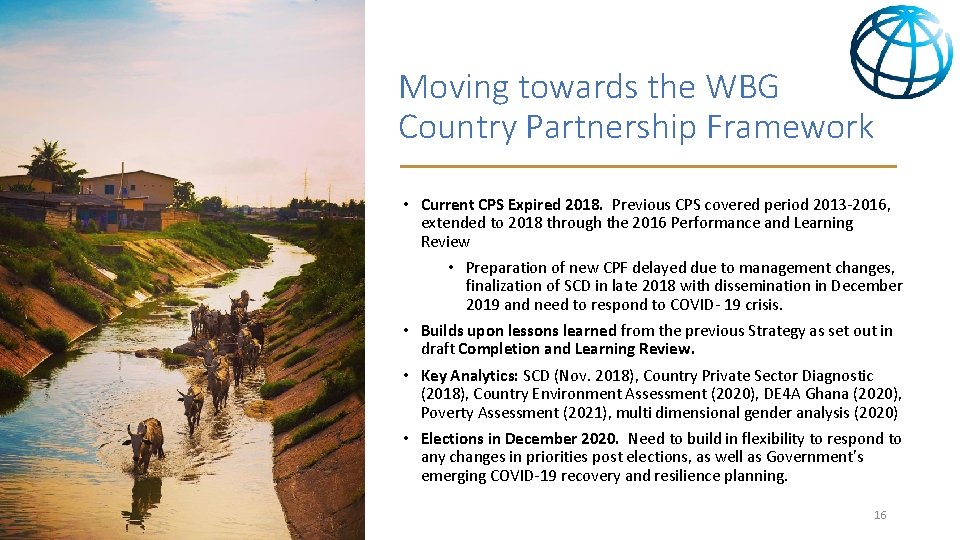
Moving towards the WBG Country Partnership Framework • Current CPS Expired 2018. Previous CPS covered period 2013 -2016, extended to 2018 through the 2016 Performance and Learning Review • Preparation of new CPF delayed due to management changes, finalization of SCD in late 2018 with dissemination in December 2019 and need to respond to COVID- 19 crisis. • Builds upon lessons learned from the previous Strategy as set out in draft Completion and Learning Review. • Key Analytics: SCD (Nov. 2018), Country Private Sector Diagnostic (2018), Country Environment Assessment (2020), DE 4 A Ghana (2020), Poverty Assessment (2021), multi dimensional gender analysis (2020) • Elections in December 2020. Need to build in flexibility to respond to any changes in priorities post elections, as well as Government’s emerging COVID-19 recovery and resilience planning. 16
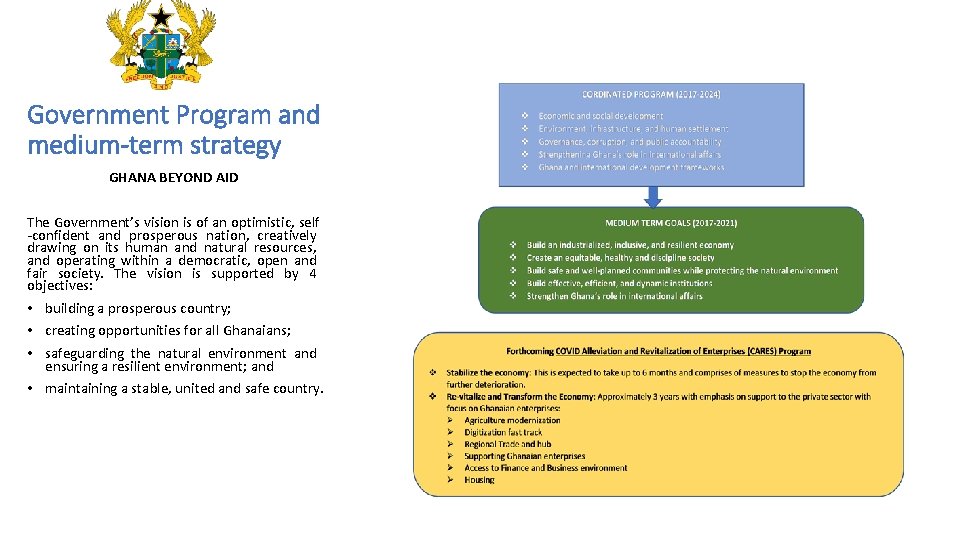
Government Program and medium-term strategy GHANA BEYOND AID The Government’s vision is of an optimistic, self -confident and prosperous nation, creatively drawing on its human and natural resources, and operating within a democratic, open and fair society. The vision is supported by 4 objectives: • building a prosperous country; • creating opportunities for all Ghanaians; • safeguarding the natural environment and ensuring a resilient environment; and • maintaining a stable, united and safe country.
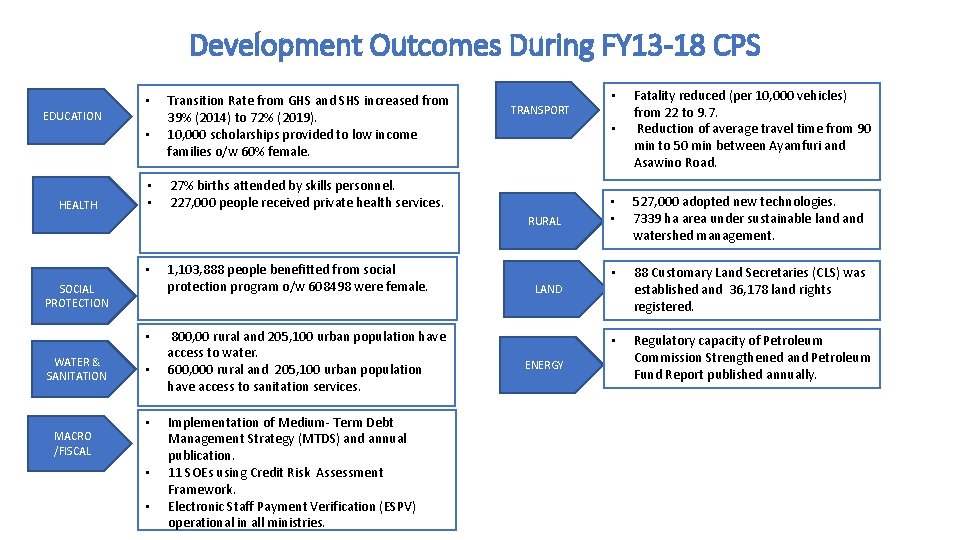
Development Outcomes During FY 13 -18 CPS • EDUCATION • HEALTH • • Transition Rate from GHS and SHS increased from 39% (2014) to 72% (2019). 10, 000 scholarships provided to low income families o/w 60% female. TRANSPORT • 27% births attended by skills personnel. 227, 000 people received private health services. RURAL • SOCIAL PROTECTION • WATER & SANITATION MACRO /FISCAL • • 1, 103, 888 people benefitted from social protection program o/w 608498 were female. 800, 00 rural and 205, 100 urban population have access to water. 600, 000 rural and 205, 100 urban population have access to sanitation services. Implementation of Medium- Term Debt Management Strategy (MTDS) and annual publication. 11 SOEs using Credit Risk Assessment Framework. Electronic Staff Payment Verification (ESPV) operational in all ministries. • • • 527, 000 adopted new technologies. 7339 ha area under sustainable land watershed management. • 88 Customary Land Secretaries (CLS) was established and 36, 178 land rights registered. • Regulatory capacity of Petroleum Commission Strengthened and Petroleum Fund Report published annually. LAND ENERGY Fatality reduced (per 10, 000 vehicles) from 22 to 9. 7. Reduction of average travel time from 90 min to 50 min between Ayamfuri and Asawino Road.
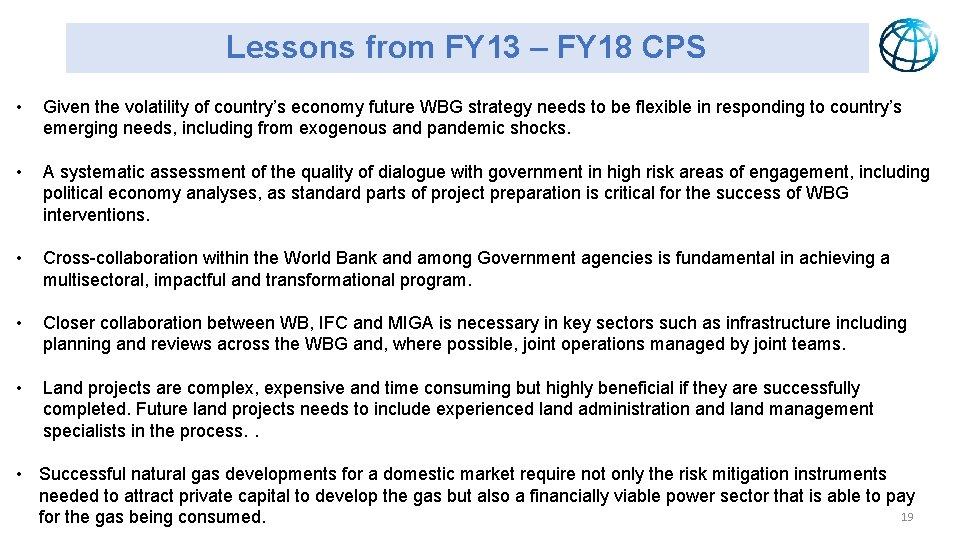
Lessons from FY 13 – FY 18 CPS • Given the volatility of country’s economy future WBG strategy needs to be flexible in responding to country’s emerging needs, including from exogenous and pandemic shocks. • A systematic assessment of the quality of dialogue with government in high risk areas of engagement, including political economy analyses, as standard parts of project preparation is critical for the success of WBG interventions. • Cross-collaboration within the World Bank and among Government agencies is fundamental in achieving a multisectoral, impactful and transformational program. • Closer collaboration between WB, IFC and MIGA is necessary in key sectors such as infrastructure including planning and reviews across the WBG and, where possible, joint operations managed by joint teams. • Land projects are complex, expensive and time consuming but highly beneficial if they are successfully completed. Future land projects needs to include experienced land administration and land management specialists in the process. . • Successful natural gas developments for a domestic market require not only the risk mitigation instruments needed to attract private capital to develop the gas but also a financially viable power sector that is able to pay 19 for the gas being consumed.
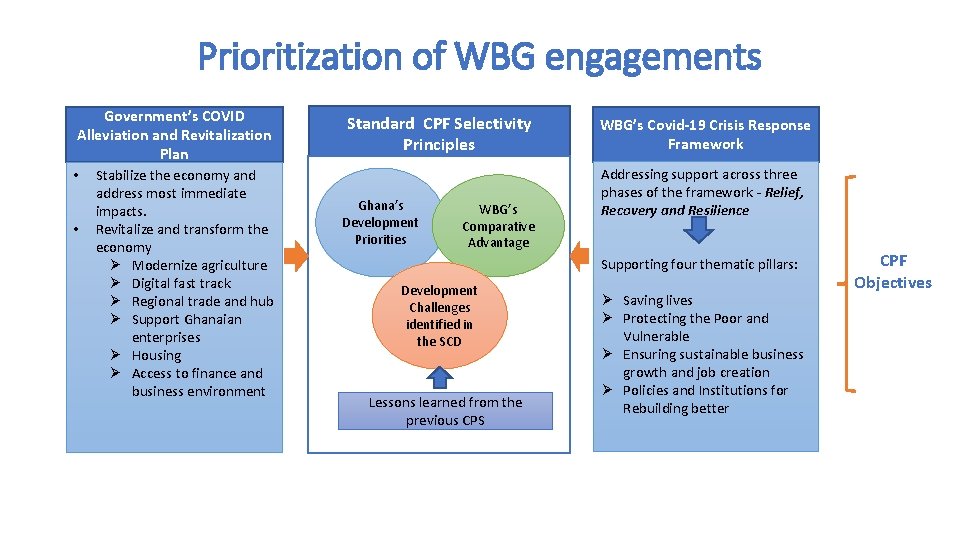
Prioritization of WBG engagements Government’s COVID Alleviation and Revitalization Plan • Stabilize the economy and • address most immediate impacts. Revitalize and transform the economy Ø Modernize agriculture Ø Digital fast track Ø Regional trade and hub Ø Support Ghanaian enterprises Ø Housing Ø Access to finance and business environment Standard CPF Selectivity Principles Ghana’s Development Priorities WBG’s Comparative Advantage WBG’s Covid-19 Crisis Response Framework Addressing support across three phases of the framework - Relief, Recovery and Resilience Supporting four thematic pillars: Development Challenges identified in the SCD Lessons learned from the previous CPS Ø Saving lives Ø Protecting the Poor and Vulnerable Ø Ensuring sustainable business growth and job creation Ø Policies and Institutions for Rebuilding better CPF Objectives
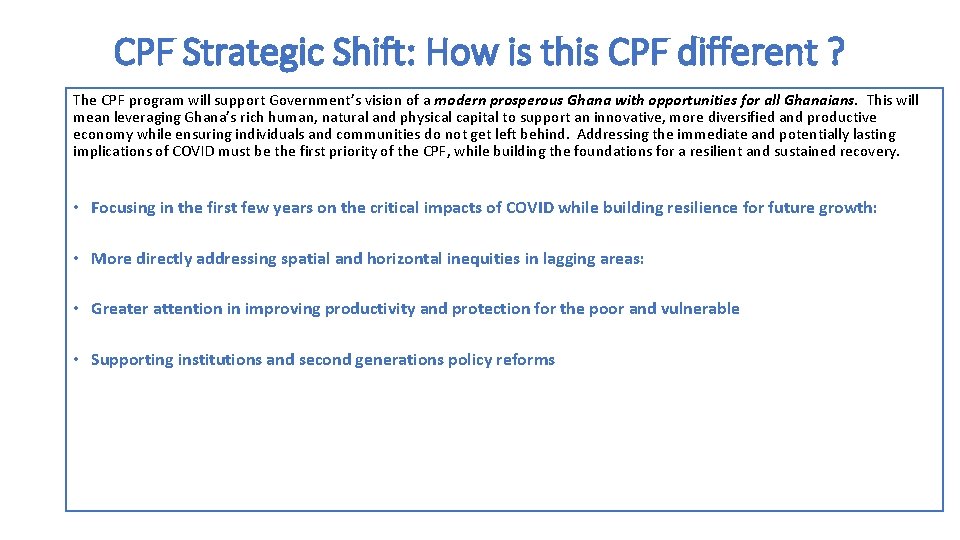
CPF Strategic Shift: How is this CPF different ? The CPF program will support Government’s vision of a modern prosperous Ghana with opportunities for all Ghanaians. This will mean leveraging Ghana’s rich human, natural and physical capital to support an innovative, more diversified and productive economy while ensuring individuals and communities do not get left behind. Addressing the immediate and potentially lasting implications of COVID must be the first priority of the CPF, while building the foundations for a resilient and sustained recovery. • Focusing in the first few years on the critical impacts of COVID while building resilience for future growth: • More directly addressing spatial and horizontal inequities in lagging areas: • Greater attention in improving productivity and protection for the poor and vulnerable • Supporting institutions and second generations policy reforms
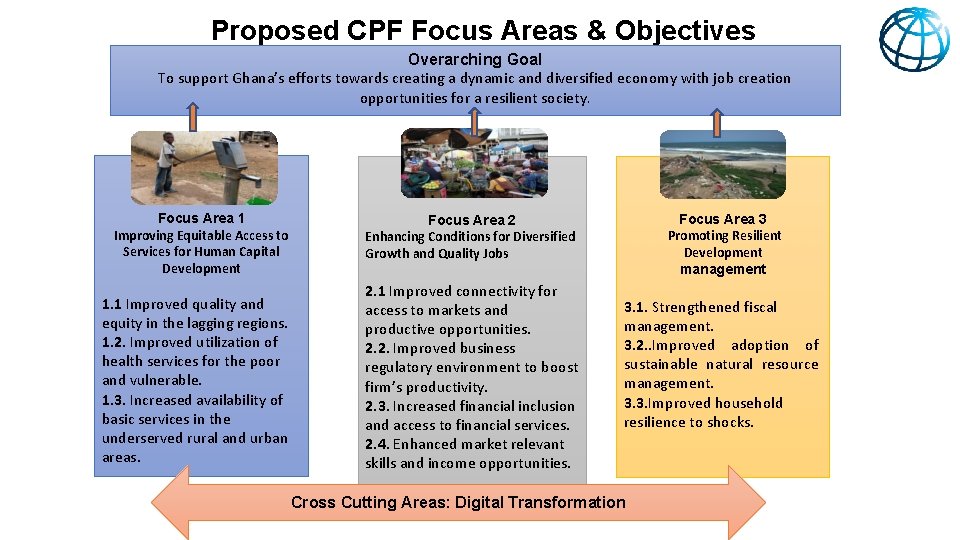
Proposed CPF Focus Areas & Objectives Overarching Goal To support Ghana’s efforts towards creating a dynamic and diversified economy with job creation opportunities for a resilient society. . Focus Area 1 Improving Equitable Access to Services for Human Capital Development 1. 1 Improved quality and equity in the lagging regions. 1. 2. Improved utilization of health services for the poor and vulnerable. 1. 3. Increased availability of basic services in the underserved rural and urban areas. Focus Area 3 Promoting Resilient Development management Focus Area 2 Enhancing Conditions for Diversified Growth and Quality Jobs 2. 1 Improved connectivity for access to markets and productive opportunities. 2. 2. Improved business regulatory environment to boost firm’s productivity. 2. 3. Increased financial inclusion and access to financial services. 2. 4. Enhanced market relevant skills and income opportunities. 3. 1. Strengthened fiscal management. 3. 2. . Improved adoption of sustainable natural resource management. 3. 3. Improved household resilience to shocks. Cross Cutting Areas: Digital Transformation
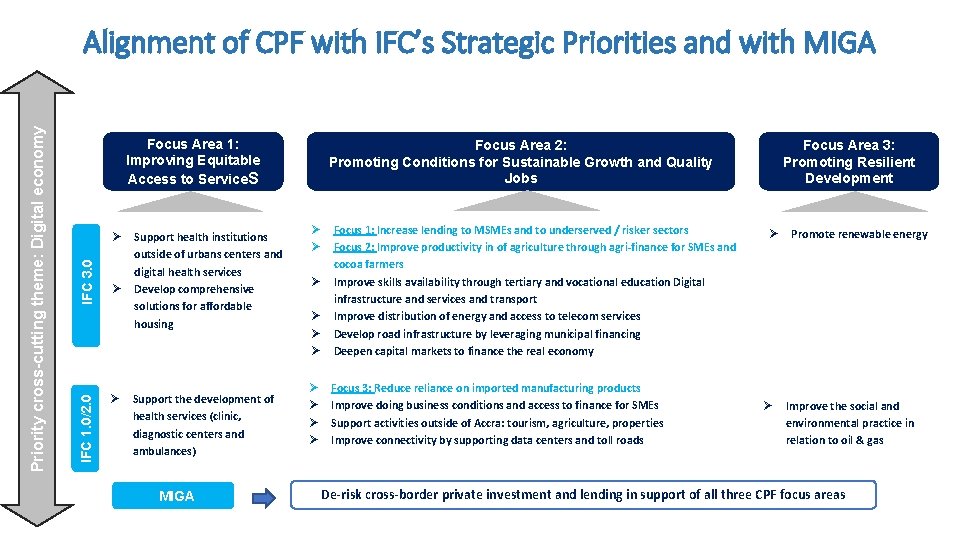
Focus Area 1: Improving Equitable Access to Service. S IFC 3. 0 Ø IFC 1. 0/2. 0 Priority cross-cutting theme: Digital economy Alignment of CPF with IFC’s Strategic Priorities and with MIGA Ø Ø Support health institutions outside of urbans centers and digital health services Develop comprehensive solutions for affordable housing Support the development of health services (clinic, diagnostic centers and ambulances) MIGA Focus Area 3: Promoting Resilient Development Focus Area 2: Promoting Conditions for Sustainable Growth and Quality Jobs Ø Ø Ø Focus 1: Increase lending to MSMEs and to underserved / risker sectors Focus 2: Improve productivity in of agriculture through agri-finance for SMEs and cocoa farmers Improve skills availability through tertiary and vocational education Digital infrastructure and services and transport Improve distribution of energy and access to telecom services Develop road infrastructure by leveraging municipal financing Deepen capital markets to finance the real economy Ø Ø Focus 3: Reduce reliance on imported manufacturing products Improve doing business conditions and access to finance for SMEs Support activities outside of Accra: tourism, agriculture, properties Improve connectivity by supporting data centers and toll roads Ø Ø Ø Promote renewable energy Improve the social and environmental practice in relation to oil & gas De-risk cross-border private investment and lending in support of all three CPF focus areas
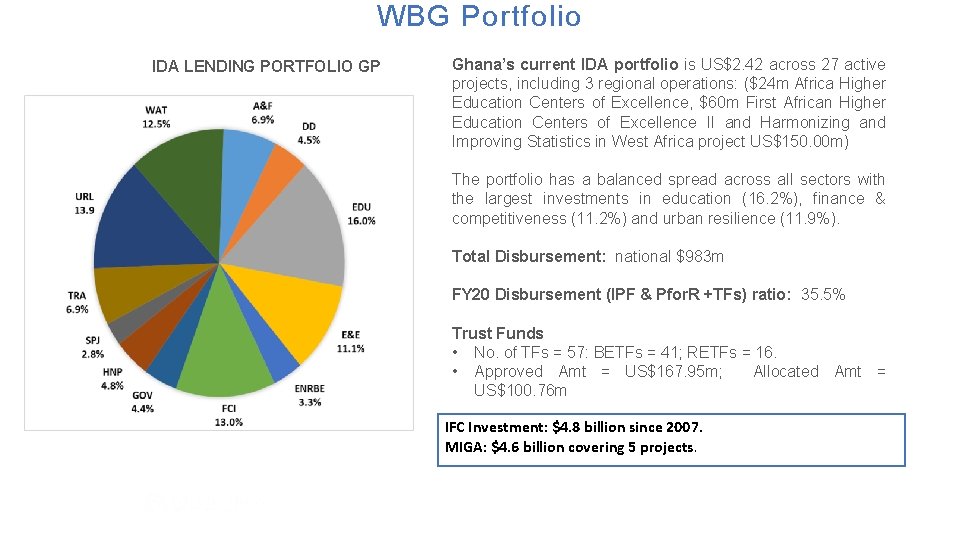
WBG Portfolio IDA LENDING PORTFOLIO GP Ghana’s current IDA portfolio is US$2. 42 across 27 active projects, including 3 regional operations: ($24 m Africa Higher Education Centers of Excellence, $60 m First African Higher Education Centers of Excellence II and Harmonizing and Improving Statistics in West Africa project US$150. 00 m) The portfolio has a balanced spread across all sectors with the largest investments in education (16. 2%), finance & competitiveness (11. 2%) and urban resilience (11. 9%). Total Disbursement: national $983 m FY 20 Disbursement (IPF & Pfor. R +TFs) ratio: 35. 5% Trust Funds • No. of TFs = 57: BETFs = 41; RETFs = 16. • Approved Amt = US$167. 95 m; Allocated Amt = US$100. 76 m IFC Investment: $4. 8 billion since 2007. MIGA: $4. 6 billion covering 5 projects.
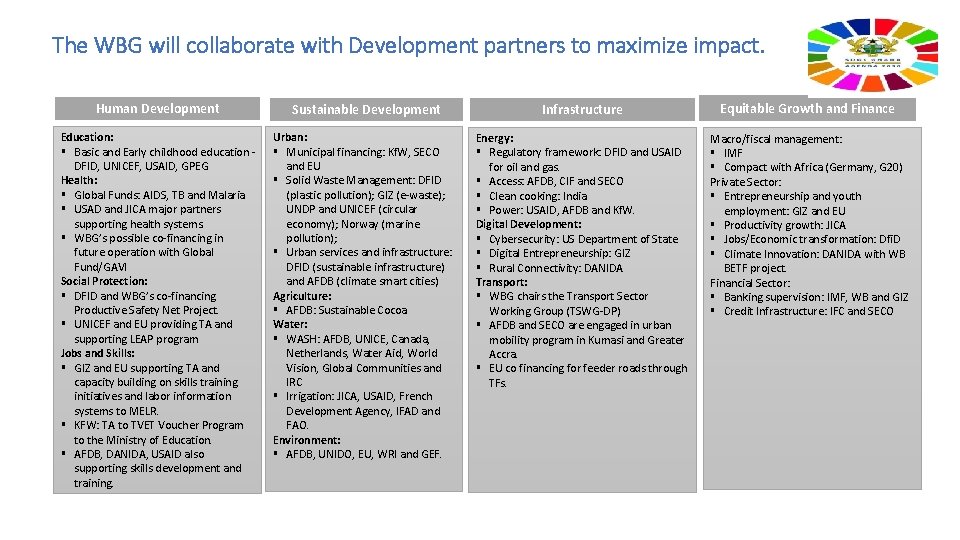
The WBG will collaborate with Development partners to maximize impact. Human Development Education: § Basic and Early childhood education DFID, UNICEF, USAID, GPEG Health: § Global Funds: AIDS, TB and Malaria § USAD and JICA major partners supporting health systems. § WBG’s possible co-financing in future operation with Global Fund/GAVI Social Protection: § DFID and WBG’s co-financing Productive Safety Net Project. § UNICEF and EU providing TA and supporting LEAP program Jobs and Skills: § GIZ and EU supporting TA and capacity building on skills training initiatives and labor information systems to MELR. § KFW: TA to TVET Voucher Program to the Ministry of Education. § AFDB, DANIDA, USAID also supporting skills development and training. Sustainable Development Urban: § Municipal financing: Kf. W, SECO and EU § Solid Waste Management: DFID (plastic pollution); GIZ (e-waste); UNDP and UNICEF (circular economy); Norway (marine pollution); § Urban services and infrastructure: DFID (sustainable infrastructure) and AFDB (climate smart cities) Agriculture: § AFDB: Sustainable Cocoa Water: § WASH: AFDB, UNICE, Canada, Netherlands, Water Aid, World Vision, Global Communities and IRC § Irrigation: JICA, USAID, French Development Agency, IFAD and FAO. Environment: § AFDB, UNIDO, EU, WRI and GEF. Infrastructure Equitable Growth and Finance Energy: § Regulatory framework: DFID and USAID for oil and gas. § Access: AFDB, CIF and SECO § Clean cooking: India § Power: USAID, AFDB and Kf. W. Digital Development: § Cybersecurity: US Department of State § Digital Entrepreneurship: GIZ § Rural Connectivity: DANIDA Transport: § WBG chairs the Transport Sector Working Group (TSWG-DP) § AFDB and SECO are engaged in urban mobility program in Kumasi and Greater Accra. § EU co financing for feeder roads through TFs. Macro/fiscal management: § IMF § Compact with Africa (Germany, G 20) Private Sector: § Entrepreneurship and youth employment: GIZ and EU § Productivity growth: JICA § Jobs/Economic transformation: Dfi. D § Climate Innovation: DANIDA with WB BETF project. Financial Sector: § Banking supervision: IMF, WB and GIZ § Credit Infrastructure: IFC and SECO
Timeline • September: Virtual consultations Ø Ø Ø Government Agencies Private Sector Civil Society Youth Disabled • Internal Review: October 2020 • Consultation phase 2: January 2021 • Final draft CPF: target date March 2021 • Board presentation: April 2021 26
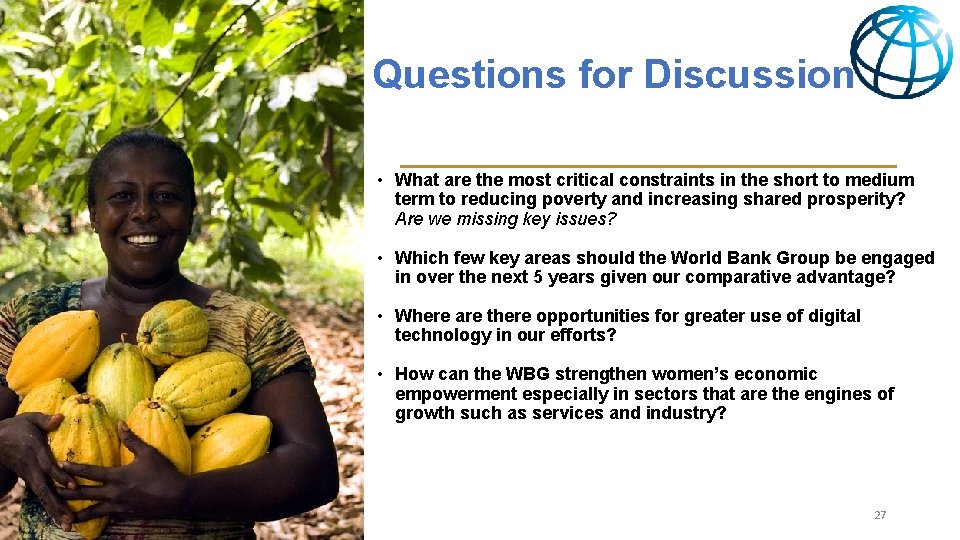
Questions for Discussion • What are the most critical constraints in the short to medium term to reducing poverty and increasing shared prosperity? Are we missing key issues? • Which few key areas should the World Bank Group be engaged in over the next 5 years given our comparative advantage? • Where are there opportunities for greater use of digital technology in our efforts? • How can the WBG strengthen women’s economic empowerment especially in sectors that are the engines of growth such as services and industry? 27
- Slides: 26