
Getty ImagesCorbis Getty ImagesCorbis Emotion is a psychological
Getty Images/Corbis
Getty Images/Corbis Emotion is a psychological state involving subjective experience, physiological response, and behavioral or expressive response. (Emotion moves us to act, set goals, and make rational decisions. )
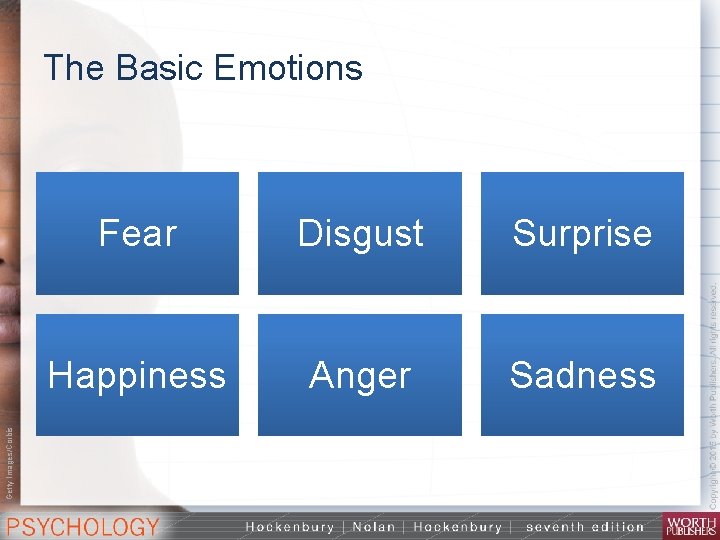
Getty Images/Corbis The Basic Emotions Fear Disgust Surprise Happiness Anger Sadness
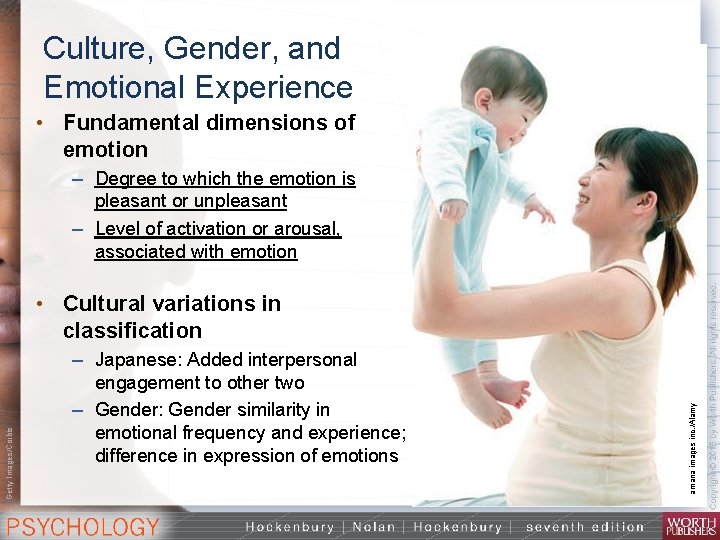
Culture, Gender, and Emotional Experience • Fundamental dimensions of emotion – Degree to which the emotion is pleasant or unpleasant – Level of activation or arousal, associated with emotion – Japanese: Added interpersonal engagement to other two – Gender: Gender similarity in emotional frequency and experience; difference in expression of emotions amana images inc. /Alamy Getty Images/Corbis • Cultural variations in classification
Neuroscience of Emotion • Emotions are associated with distinct patterns of responses by the sympathetic nervous system and in the brain. • Sympathetic nervous system is aroused by emotions (fight-orflight response) Getty Images/Corbis • Different emotions stimulate different responses • Fear: Decrease in skin temperature (cold feet) • Anger: Increase in skin temperature (hot under the collar) • Differing patterns of sympathetic nervous system activation are universal, reflecting hard-wired biological responses to basic emotions
IN FOCUS Detecting Lies • Does a polygraph detect lies? – No. It measures physiological changes associated with emotions; based on assumption that lying is accompanied by anxiety, fear, and stress. • Potential problems Getty Images/Corbis – No unique physiological arousal pattern for lying. – Some people can lie with experiencing anxiety or arousal. – Innocent people may be fearful or anxious when asked incriminating questions. – Polygraph interpretation can be highly subjective. • Microexpressions may produce nonverbal cues.
The Emotional Brain: Fear and the Amygdala • Amygdala: Part of limbic system Getty Images/Corbis – Activates when something threatening, fearful faces, or hear sounds related to fear is seen – Evaluates significance of stimuli and generates emotional responses and generates hormonal secretions and autonomic reactions that accompany strong emotions • Rats with a damaged amygdala cannot be classically conditioned to acquire a fear response. • Humans with a damaged amygdala have “psychic blindness” — an inability to recognize fear in facial expressions and voice.
Activating the Amygdala • Direct and indirect neural pathways: Le Doux’s Model • Two neural pathways for sensory information that project from thalamus Getty Images/Corbis – One leads to cortex – One leads directly to amygdala bypassing cortex – Thalamus –>amygdala pathway stimulates sympathetic nervous system
The Expression of Emotion Ekman (1980) estimates the human face is capable of creating more than 7, 000 different expressions. • Each basic emotion is associated with a unique facial expression. • Facial expressions are innate and “hard-wired”. Getty Images/Corbis Spontaneous facial expressions of children and young adults who were born blind do not differ from those of sighted children and adults. Innate facial expressions are the same across many cultures.
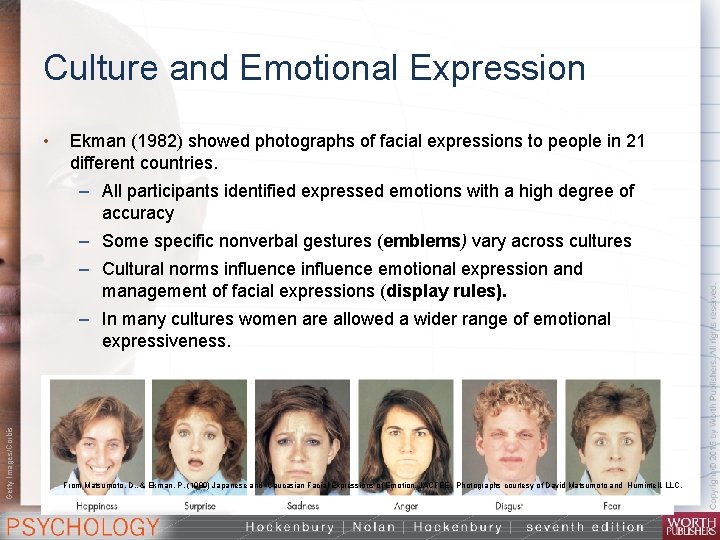
Culture and Emotional Expression • Ekman (1982) showed photographs of facial expressions to people in 21 different countries. – All participants identified expressed emotions with a high degree of accuracy – Some specific nonverbal gestures (emblems) vary across cultures – Cultural norms influence emotional expression and management of facial expressions (display rules). Getty Images/Corbis – In many cultures women are allowed a wider range of emotional expressiveness. From Matsumoto, D. , & Ekman, P. (1989) Japanese and Caucasian Facial Expressions of Emotion. JACFEE. Photographs courtesy of David Matsumoto and Humintell, LLC.
CRITICAL THINKING Emotion in Nonhuman Animals Getty Images/Corbis • Darwin: Capacity to experience emotions is an evolved traits shared by humans and lower animals • No clear way to understand how animals subjectively experience emotions. • Anthropomorphism can hinder progress in understanding animal emotions. • Do rats laugh? Are foxes in love?
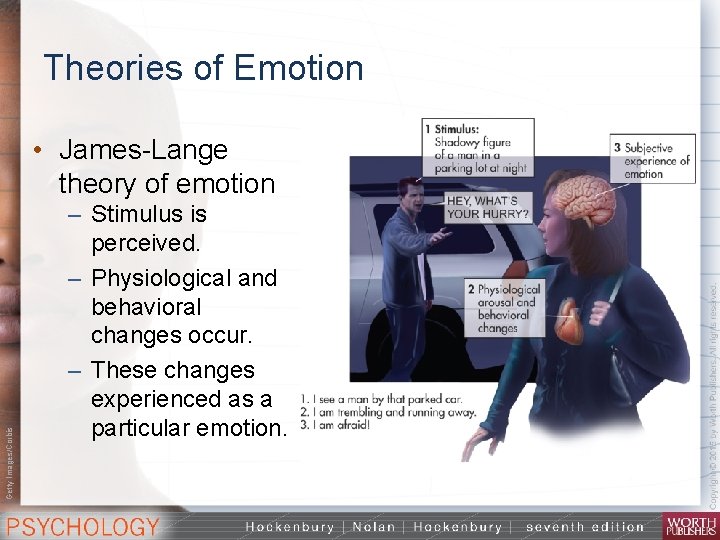
Theories of Emotion Getty Images/Corbis • James-Lange theory of emotion – Stimulus is perceived. – Physiological and behavioral changes occur. – These changes experienced as a particular emotion.
Cannon-Bard Theory of Emotion Getty Images/Corbis • Thalamus > experience of emotion • Hypothalamus > expression of emotion
Facial Feedback Hypothesis Getty Images/Corbis • Expressing a specific emotion, especially facially, causes us to subjectively experience that emotion. • Botox injections can dampen emotional experience and the ability to perceive it.
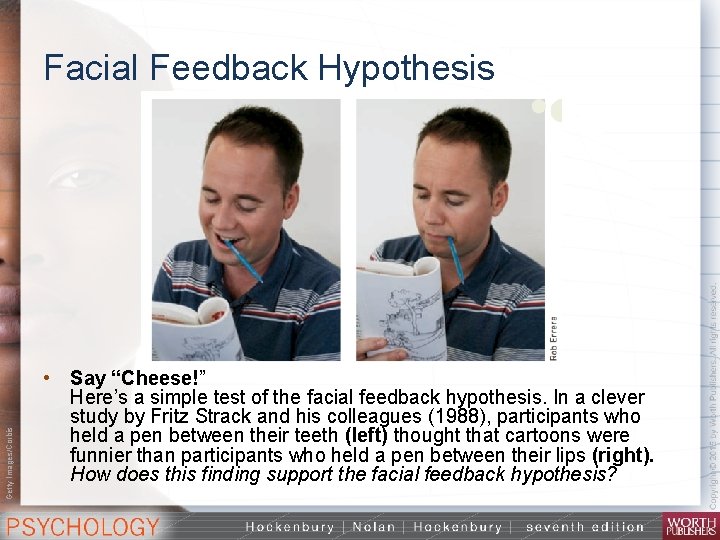
Getty Images/Corbis Facial Feedback Hypothesis • Say “Cheese!” Here’s a simple test of the facial feedback hypothesis. In a clever study by Fritz Strack and his colleagues (1988), participants who held a pen between their teeth (left) thought that cartoons were funnier than participants who held a pen between their lips (right). How does this finding support the facial feedback hypothesis?
Cognitive Theories of Emotion • Two-factor theory of emotion (Schachter and Singer) – Emotion is the interaction of physiological arousal and the cognitive label that we apply to explain arousal Getty Images/Corbis • Cognitive appraisal theory of emotion (Lazarus) – Emotions result from cognitive appraisal of a situation’s effect on personal well-being – Similar to two-factor, but theory’s emphasis is on cognitive appraisal as essential trigger for emotional response.
- Slides: 16