
Getty ImagesCorbis Getty ImagesCorbis Developmental psychology Branch of

Getty Images/Corbis
Getty Images/Corbis Developmental psychology: Branch of psychology that studies how people change over the lifespan Developmental psychologists: Investigate the influence of biological, environmental, social, cultural, and behavioral factors on development at every age and stage of life
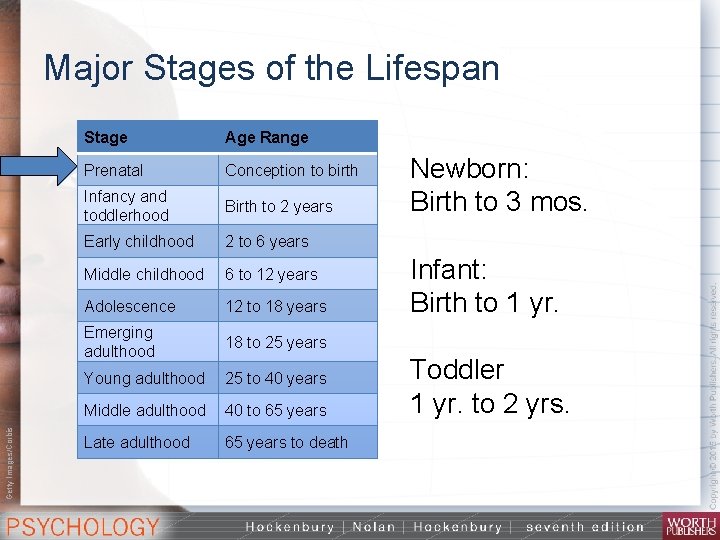
Getty Images/Corbis Major Stages of the Lifespan Stage Age Range Prenatal Conception to birth Infancy and toddlerhood Birth to 2 years Early childhood 2 to 6 years Middle childhood 6 to 12 years Adolescence 12 to 18 years Emerging adulthood 18 to 25 years Young adulthood 25 to 40 years Middle adulthood 40 to 65 years Late adulthood 65 years to death Newborn: Birth to 3 mos. Infant: Birth to 1 yr. Toddler 1 yr. to 2 yrs.
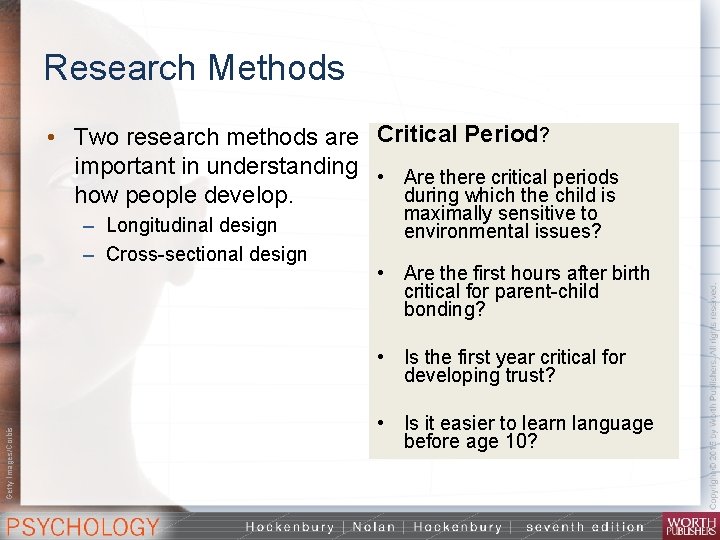
Research Methods • Two research methods are Critical Period? important in understanding • Are there critical periods during which the child is how people develop. – Longitudinal design – Cross-sectional design maximally sensitive to environmental issues? • Are the first hours after birth critical for parent-child bonding? Getty Images/Corbis • Is the first year critical for developing trust? • Is it easier to learn language before age 10?
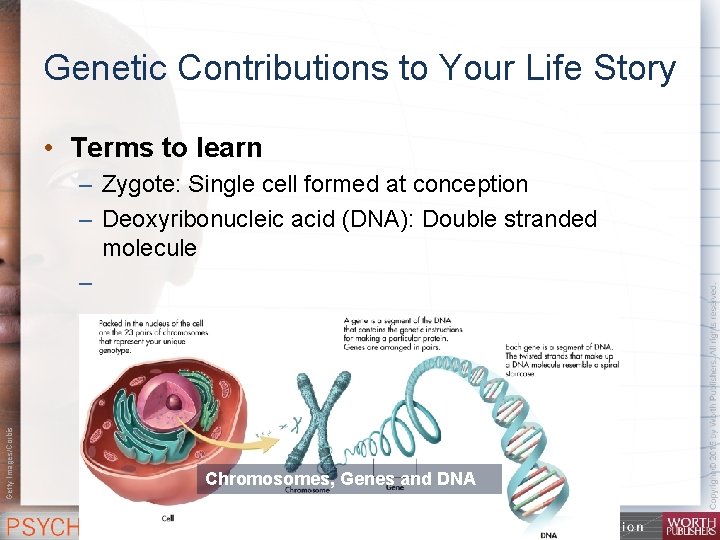
Genetic Contributions to Your Life Story • Terms to learn Getty Images/Corbis – Zygote: Single cell formed at conception – Deoxyribonucleic acid (DNA): Double stranded molecule – Chromosomes, Genes and DNA
Genetic Contributions to Your Life Story • A few more terms to learn – Gene: A segment of DNA, on the chromosome – Chromosome: Long threadlike structure made up strands of DNA, in cell nucleus Getty Images/Corbis • 23 pairs – Genotype & Phenotype – Alleles: 2 for each gene, one from mom, one from dad – Sex chromosomes
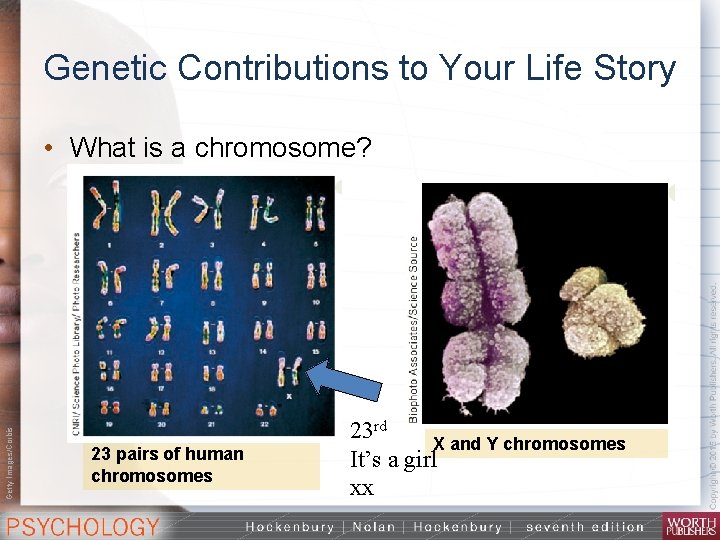
Genetic Contributions to Your Life Story Getty Images/Corbis • What is a chromosome? 23 pairs of human chromosomes 23 rd X and Y chromosomes It’s a girl xx
Getty Images/Corbis Genotype Your unique genotype From Genotype to Phenotype • Mother’s egg cell and father’s sperm cell each contributed 23 chromosomes and represents your unique genotype or genetic makeup. • Dominant genes will always be expressed; recessive genes will not be expressed unless they are in a pair. • Most characteristics involve interaction of multiple genes. • Different genotypes react differently to environmental factors which sculpts gene expression. • Most of the genes in each person are dormant. • Experience affects which genes are turned on (and off). • People have genetic predispositions to develop in a particular way.

Getty Images/Corbis Characteristic Dominant Recessive Hair Dark Curly Light Straight Eyes Brown Hands 5 fingers Normal limbs Broad lips Dimples Grey Blue Extra fingers Limb dwarfing Thin lips No dimples Face

Getty Images/Corbis B b b b

B b Getty Images/Corbis b b Bb bb Child has 50 -50 Chance of blue or Brown eyes

Getty Images/Corbis Sex Linked Traits • Traits linked to the X or Y chromosomes • Usually recessive and carried on the X chromosome • Appear more frequently in one sex than another • Color blindness, baldness, hemophilia, Fragile X
New Science of Epigenetics Getty Images/Corbis • Epigenetics is the study of the cellular mechanisms that control gene expression and of the ways that gene expression affects health and behavior. – Gene expression can be triggered by the activity of other genes, internal chemical changes, or by external environmental factor. – Epigenetic “settings” determine whether a cell will become a skin cell, a nerve cell, or a heart muscle cell.
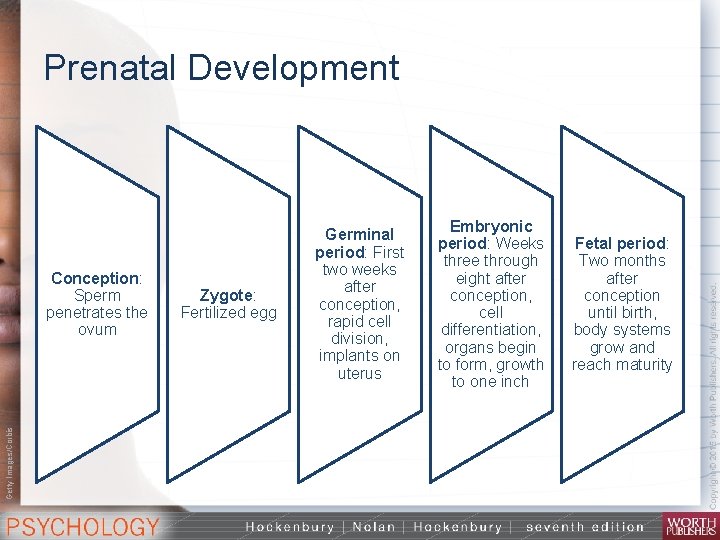
Prenatal Development Getty Images/Corbis Conception: Sperm penetrates the ovum Zygote: Fertilized egg Germinal period: First two weeks after conception, rapid cell division, implants on uterus Embryonic period: Weeks three through eight after conception, cell differentiation, organs begin to form, growth to one inch Fetal period: Two months after conception until birth, body systems grow and reach maturity

Embryonic Period Risk of teratogens Getty Images/Corbis • Teratogens: Harmful agents or substances that can cause malformations or defects in an embryo or fetus. – – – – Exposure to radiation Toxic chemicals and metals, Viruses and bacteria Prescription and nonprescription drugs Addictive drugs Maternal smoking and exposure to second-hand smoke Alcohol Mother’s psychological state, unhealthy behaviors
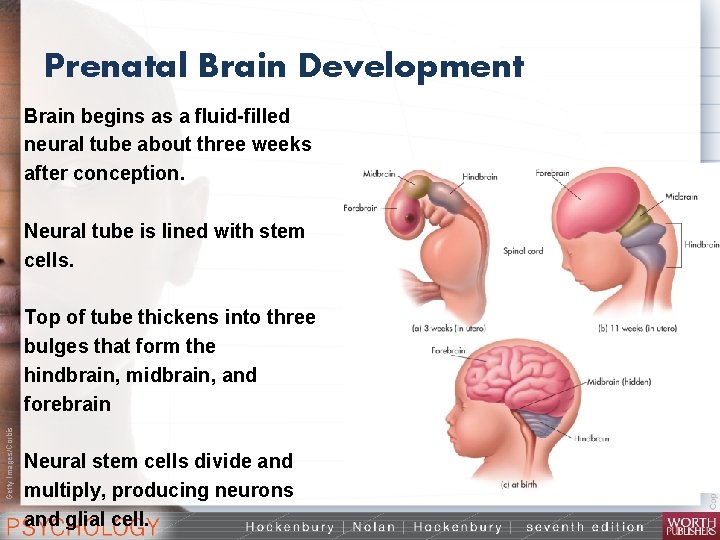
Prenatal Brain Development Brain begins as a fluid-filled neural tube about three weeks after conception. Neural tube is lined with stem cells. Getty Images/Corbis Top of tube thickens into three bulges that form the hindbrain, midbrain, and forebrain Neural stem cells divide and multiply, producing neurons and glial cell.
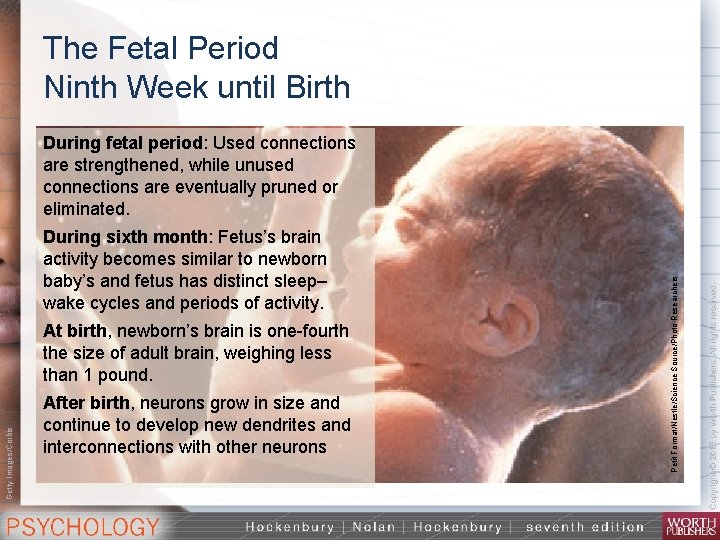
The Fetal Period Ninth Week until Birth During sixth month: Fetus’s brain activity becomes similar to newborn baby’s and fetus has distinct sleep– wake cycles and periods of activity. Getty Images/Corbis At birth, newborn’s brain is one-fourth the size of adult brain, weighing less than 1 pound. After birth, neurons grow in size and continue to develop new dendrites and interconnections with other neurons Petit Format/Nestle/Science Source/Photo Researchers During fetal period: Used connections are strengthened, while unused connections are eventually pruned or eliminated.

Development During Infancy and Childhood • Newborn Reflexes • Rooting—turning the head and opening the mouth in the direction of a touch on the cheek • Sucking—sucking rhythmically in response to oral stimulation Getty Images/Corbis • Babinski—fanning and curling toes when foot is stroked • Grasping—the baby will grip your finger so tightly that he can be lifted upright flexes
Development During Infancy and Childhood Newborn Reflexes • Stepping Getty Images/Corbis • Moro—throwing the arms out, arching the back and bringing the arms together as if to hold onto something (in response to loud noise or sudden change in position of the head)

Newborn Senses • Vision Getty Images/Corbis – Least developed sense – Newborn infant is nearsighted and prefers human face. Blurry distance vision. – Optimal viewing distance for the newborn is about 6 to 12 inches. – Poor color recognition

http: //www. pbs. org/wnet/brain/episode 1/infantvision/flash. html Getty Images/Corbis • 3 months
Newborn Senses Getty Images/Corbis • Hearing – Within just hours of birth, a newborn displays a preference for her mother’s voice and face over a stranger’s. • Other Senses – Turn away from unpleasant odors – Prefer sweet to sour tastes
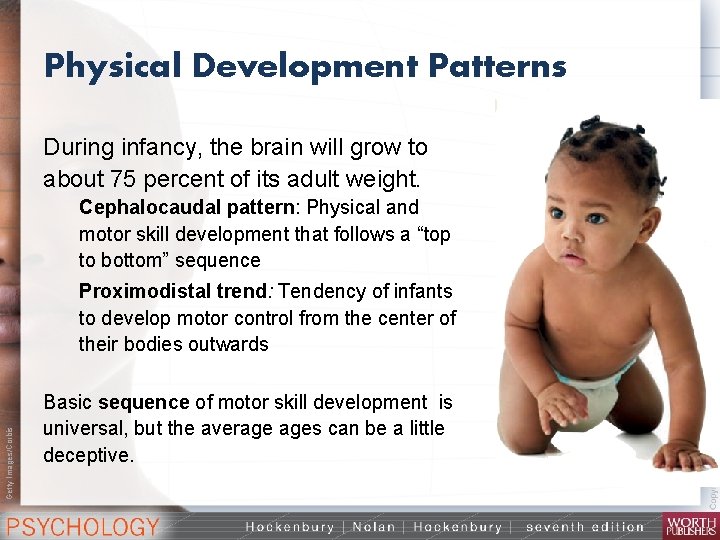
Physical Development Patterns During infancy, the brain will grow to about 75 percent of its adult weight. Cephalocaudal pattern: Physical and motor skill development that follows a “top to bottom” sequence Getty Images/Corbis Proximodistal trend: Tendency of infants to develop motor control from the center of their bodies outwards Basic sequence of motor skill development is universal, but the average ages can be a little deceptive.
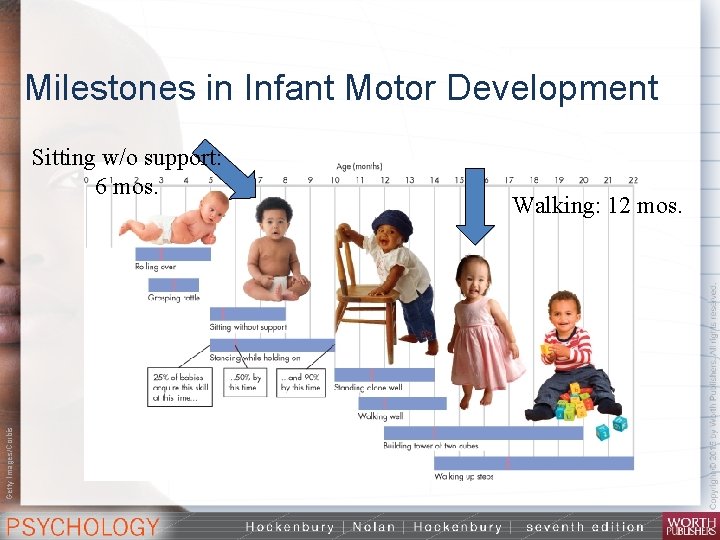
Milestones in Infant Motor Development Getty Images/Corbis Sitting w/o support: 6 mos. Walking: 12 mos.
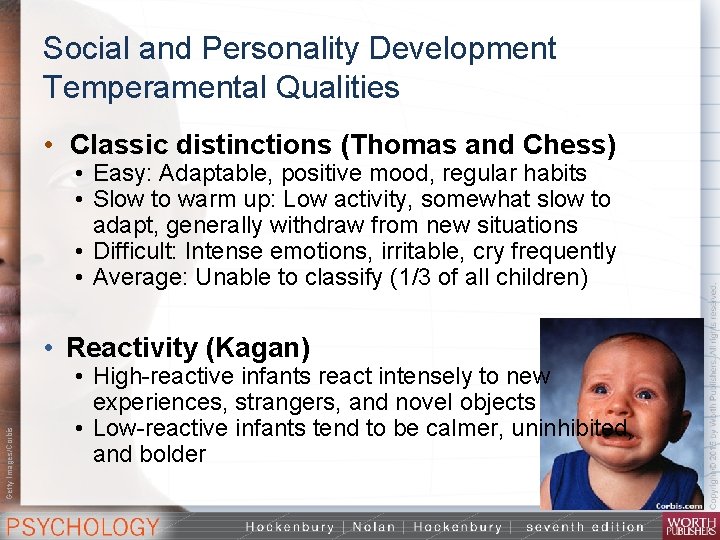
Social and Personality Development Temperamental Qualities • Classic distinctions (Thomas and Chess) • Easy: Adaptable, positive mood, regular habits • Slow to warm up: Low activity, somewhat slow to adapt, generally withdraw from new situations • Difficult: Intense emotions, irritable, cry frequently • Average: Unable to classify (1/3 of all children) Getty Images/Corbis • Reactivity (Kagan) • High-reactive infants react intensely to new experiences, strangers, and novel objects • Low-reactive infants tend to be calmer, uninhibited, and bolder
Social and Personality Development Temperamental Qualities Getty Images/Corbis Influences • Virtually all temperament researchers agree that individual differences in temperament • have a genetic and biological basis (Gagne & others, 2009). • However, researchers also agree that environmental experiences can modify a child’s basic temperament – Individual differences in temperament have a genetic and biological basis – Environmental experiences can modify a child’s basic temperament – Infant temperament can also be affected by cultural beliefs

Getty Images/Corbis https: //www. youtube. com/watch? v=_O 60 TYAIg. C 4 The importance of “contact comfort” in infancy Sandra E. Hockenbury, Susan A. Nolan, Don H. Hockenbury: Psychology, Seventh Edition Copyright © 2015 by Worth Publishers
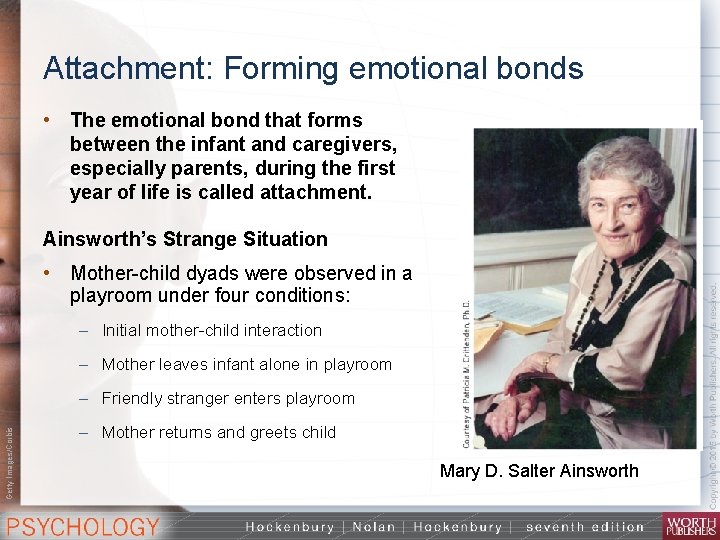
Attachment: Forming emotional bonds • The emotional bond that forms between the infant and caregivers, especially parents, during the first year of life is called attachment. Ainsworth’s Strange Situation • Mother-child dyads were observed in a playroom under four conditions: – Initial mother-child interaction – Mother leaves infant alone in playroom Getty Images/Corbis – Friendly stranger enters playroom – Mother returns and greets child Mary D. Salter Ainsworth

Forms of Attachment • In Strange Situation procedure – Securely attached infants explore the room when mother is present, become upset and explores less when mother is not present, and show pleasure when mother returns Sensitivity to the infant’s needs • Importance of attachment Getty Images/Corbis – Secure attachment in infancy forms the basis for emotional bonds in later childhood.

Forms of Attachment: Insecure Attachment Parents are neglectful, inconsistent or insensitive Getty Images/Corbis • Avoidantly attached—a form of insecure attachment in which child avoids mother and acts coldly to her • Anxious resistant attachment—a form of insecure attachment where the child remains close to mother and remains distressed despite her attempts to comfort
Language Development • Learning language – By the time children reach 3 years of age, they will have learned approximately 3, 000 words and many complex rules of language. – Infants can distinguish among the speech sounds of all the world’s languages. – Infants lose this ability by 10– 12 months of age. Getty Images/Corbis • Noam Chomsky: – Every child is born with a biological predisposition to learn language—any language.
Language Development • Universal characteristics – Very distinct pronunciation – Simplified vocabulary – Short sentences – High pitch and exaggerated intonation and expression Getty Images/Corbis – Content restricted to topics that are familiar to the child – Instinctive adult use of infant-directed speech (motherese) – Infant preference for infant-directed

Language Development • Stages Getty Images/Corbis – Cooing and babbling: 2 mos. & 4 mos. – One-word stage: 12 mos. – Two-word stage: 24 mos. – Sentences: 24+ mos.

Getty Images/Corbis Language Comprehension v. Language Production Acquire 2 x faster than production

Vocabulary Getty Images/Corbis • At 3 years old: – 3, 000 words – Use/Understand complex rules of language • By school age: – 10, 000 words

Deaf Babies Babble with Their Hands • Deaf babies whose parents use American Sign Language (ASL) than their voices. • Just as hearing babies repeat the same syllables over and over, deaf babies repeat the same simple hand gestures. Getty Images/Corbis • Hearing babies born to deaf parents who are exposed only to sign language also babble with their hands. • In the image to the left, a baby repeats the sign for “A. ”

SCIENCE VERSUS PSEUDOSCIENCE Can a DVD Program Your Baby to Be a Genius? Getty Images/Corbis • Many companies that market baby media either imply or state outright that their products are educational and will help infants learn. – Zimmerman and colleagues: Viewing media designed for infant learning was negatively correlated with infant vocabulary growth. – De. Loache and colleagues: Results from experimental study suggested babies learned most words from interaction with parents; no difference between video group learning and no exposure group • Illusory correlation
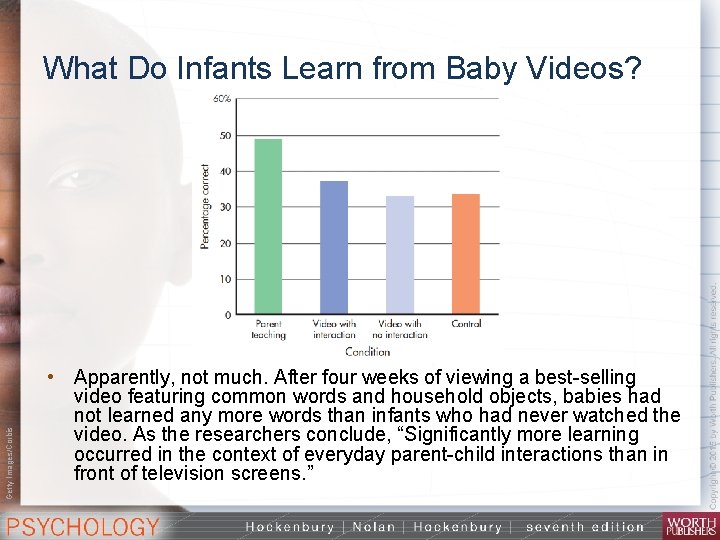
Getty Images/Corbis What Do Infants Learn from Baby Videos? • Apparently, not much. After four weeks of viewing a best-selling video featuring common words and household objects, babies had not learned any more words than infants who had never watched the video. As the researchers conclude, “Significantly more learning occurred in the context of everyday parent-child interactions than in front of television screens. ”
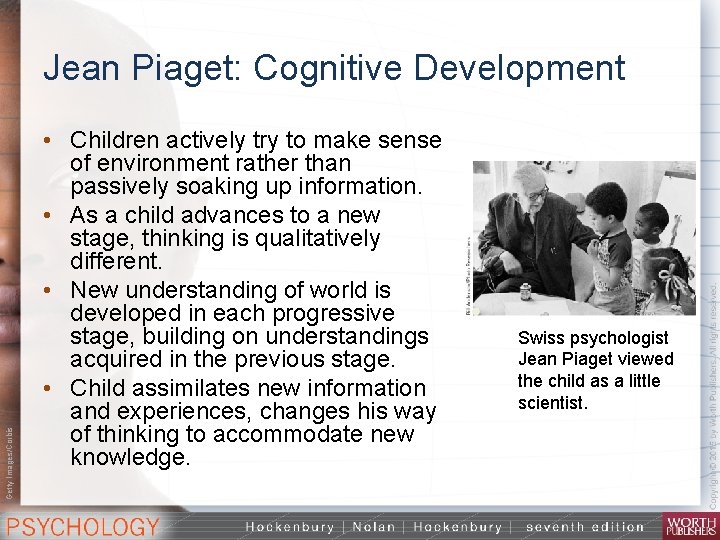
Getty Images/Corbis Jean Piaget: Cognitive Development • Children actively try to make sense of environment rather than passively soaking up information. • As a child advances to a new stage, thinking is qualitatively different. • New understanding of world is developed in each progressive stage, building on understandings acquired in the previous stage. • Child assimilates new information and experiences, changes his way of thinking to accommodate new knowledge. Swiss psychologist Jean Piaget viewed the child as a little scientist.

Development of Schemas • Schemas are frameworks that develop to help organize knowledge • Assimilation—process of taking new information or a new experience and fitting it into an already existing schema Getty Images/Corbis – Cow is a doggie. • Accommodation—process by which existing schemas are changed or new schemas are created in order to fit new information – Cow is a cow (new word)
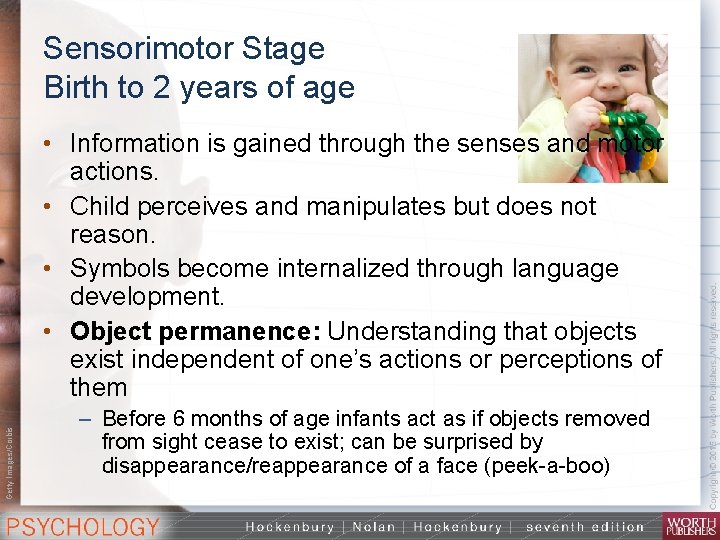
Sensorimotor Stage Birth to 2 years of age Getty Images/Corbis • Information is gained through the senses and motor actions. • Child perceives and manipulates but does not reason. • Symbols become internalized through language development. • Object permanence: Understanding that objects exist independent of one’s actions or perceptions of them – Before 6 months of age infants act as if objects removed from sight cease to exist; can be surprised by disappearance/reappearance of a face (peek-a-boo)

Preoperational Stage 2 to 7 years Getty Images/Corbis • Young child’s increasing capacity for symbolic thought is delightfully reflected in symbolic play and deferred imitation. • In symbolic play, one object stands for another. Deferred imitation is the capacity to repeat an action observed earlier. – Egocentrism: inability to consider events from another’s point of view – Irreversibility – Centration: focus only on one aspect of a situation – Conservation: not achieved yet

Getty Images/Corbis Preoperational Thinking: Manipulating Mental Symbols Sandra E. Hockenbury, Susan A. Nolan, Don H. Hockenbury: Psychology, Seventh Edition Copyright © 2015 by Worth Publishers
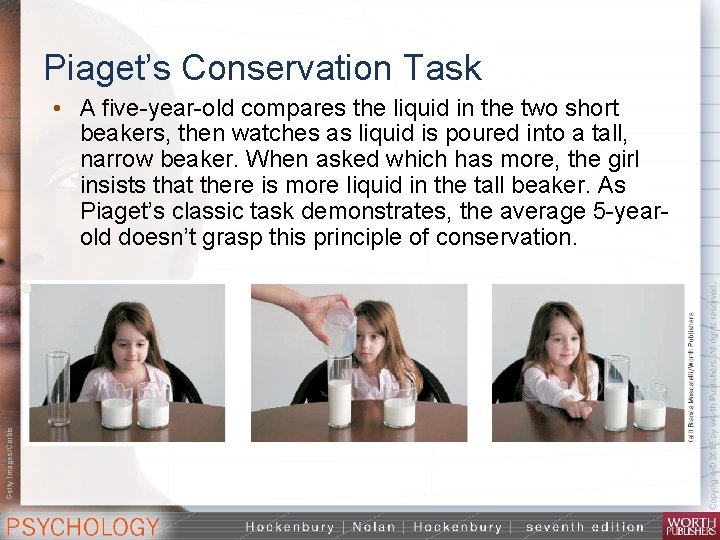
Piaget’s Conservation Task Getty Images/Corbis • A five-year-old compares the liquid in the two short beakers, then watches as liquid is poured into a tall, narrow beaker. When asked which has more, the girl insists that there is more liquid in the tall beaker. As Piaget’s classic task demonstrates, the average 5 -yearold doesn’t grasp this principle of conservation.
Getty Images/Corbis Concrete Operational Stage Age 7 to Beginning of Adolescence • Understanding of mental operations leading to increasingly logical thought • Using classification and categorization • Becoming less egocentric • Having inability to reason abstractly or hypothetically • Understanding concept of conservation
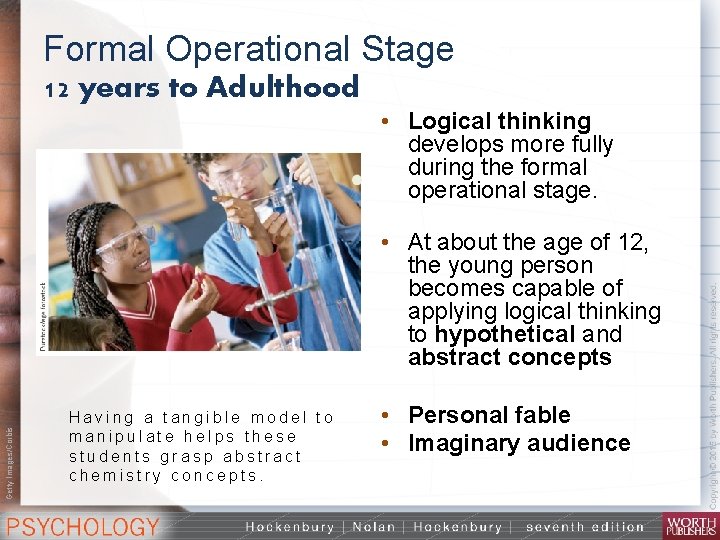
Formal Operational Stage 12 years to Adulthood • Logical thinking develops more fully during the formal operational stage. Getty Images/Corbis • At about the age of 12, the young person becomes capable of applying logical thinking to hypothetical and abstract concepts Having a tangible model to manipulate helps these students grasp abstract chemistry concepts. • Personal fable • Imaginary audience
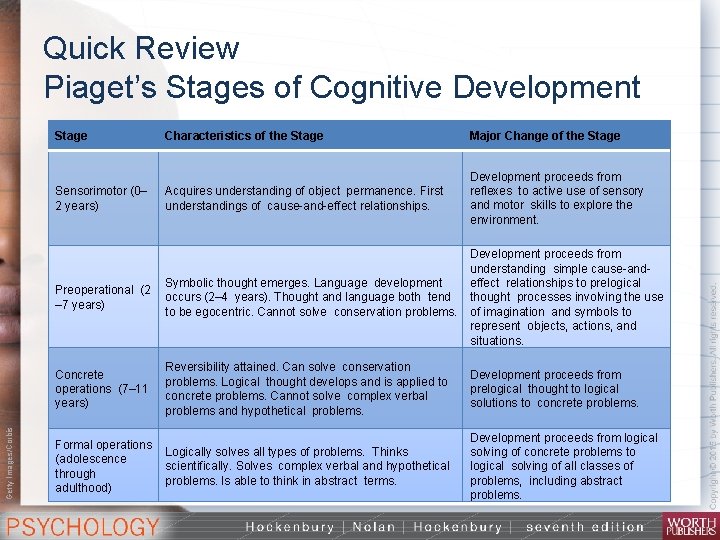
Getty Images/Corbis Quick Review Piaget’s Stages of Cognitive Development Stage Characteristics of the Stage Major Change of the Stage Sensorimotor (0– 2 years) Acquires understanding of object permanence. First understandings of cause-and-effect relationships. Development proceeds from reflexes to active use of sensory and motor skills to explore the environment. Preoperational (2 – 7 years) Symbolic thought emerges. Language development occurs (2– 4 years). Thought and language both tend to be egocentric. Cannot solve conservation problems. Development proceeds from understanding simple cause-andeffect relationships to prelogical thought processes involving the use of imagination and symbols to represent objects, actions, and situations. Concrete operations (7– 11 years) Reversibility attained. Can solve conservation problems. Logical thought develops and is applied to concrete problems. Cannot solve complex verbal problems and hypothetical problems. Development proceeds from prelogical thought to logical solutions to concrete problems. Formal operations (adolescence through adulthood) Logically solves all types of problems. Thinks scientifically. Solves complex verbal and hypothetical problems. Is able to think in abstract terms. Development proceeds from logical solving of concrete problems to logical solving of all classes of problems, including abstract problems.
Evaluating Piaget’s Theory Criticisms Strengths Getty Images/Corbis • Inspired many studies • Was one of most important 20 th century scientist • Fundamental idea accepted • Infants, young children, and adults use distinctly different cognitive abilities to construct understanding of world • Underestimation of cognitive abilities of infants and children • Baillargeon • Underestimation of social and cultural environment on cognitive development • Vygotsky (ZPD) • Overestimation of degree of achievement of formal operational thought processes • Kuhn and others: informationprocessing model of cognitive development
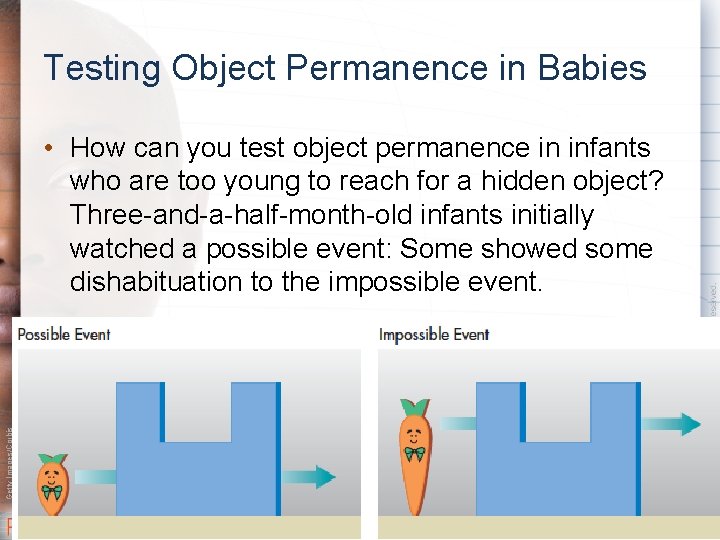
Testing Object Permanence in Babies Getty Images/Corbis • How can you test object permanence in infants who are too young to reach for a hidden object? Three-and-a-half-month-old infants initially watched a possible event: Some showed some dishabituation to the impossible event.

Vygotsky’s Sociocultural Perspective (contrast to Piaget) • Emphasized the child’s interaction with the social world (other people) as a cause of development Getty Images/Corbis – “Scaffolding” – Adults can guide children to higher cognitive understandings • Vygotsky believed language to be the foundation for social interaction and thought • Piaget believed language was a byproduct of thought
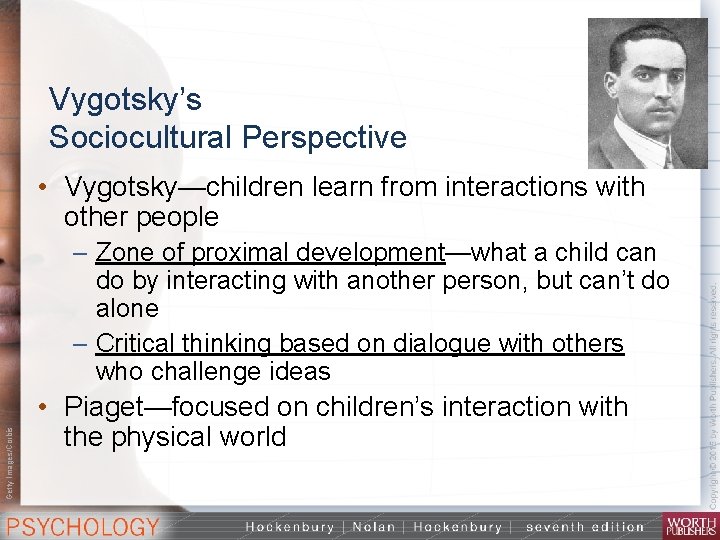
Vygotsky’s Sociocultural Perspective • Vygotsky—children learn from interactions with other people Getty Images/Corbis – Zone of proximal development—what a child can do by interacting with another person, but can’t do alone – Critical thinking based on dialogue with others who challenge ideas • Piaget—focused on children’s interaction with the physical world
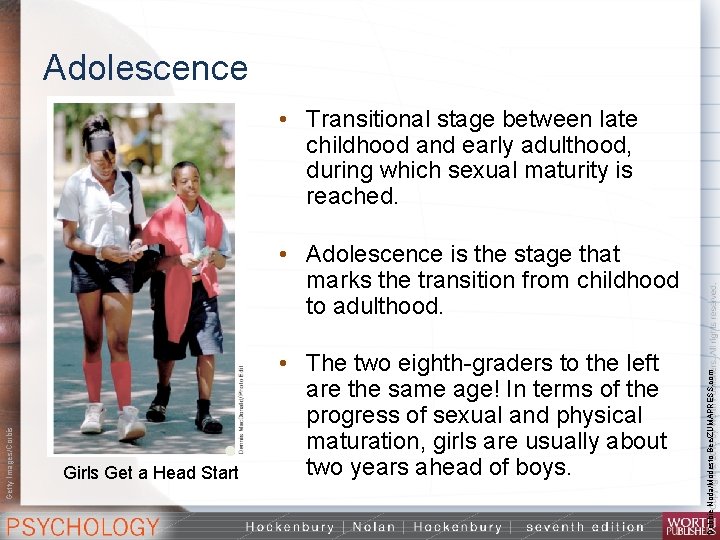
Adolescence • Transitional stage between late childhood and early adulthood, during which sexual maturity is reached. Girls Get a Head Start • The two eighth-graders to the left are the same age! In terms of the progress of sexual and physical maturation, girls are usually about two years ahead of boys. Debbie Noda/Modesto Bee/ZUMAPRESS. com Getty Images/Corbis • Adolescence is the stage that marks the transition from childhood to adulthood.
Adolescence: Physical and Sexual Development • Puberty: Stage of adolescence in which individual reaches sexual maturity and becomes physiologically capable of sexual reproduction. • Primary sex characteristics: Sexual organs that are directly involved in reproduction Getty Images/Corbis • Secondary sex characteristics: Sexual characteristics that develop during puberty and are not directly involved in reproduction but differentiate between the sexes, such as male facial hair • Adolescent growth spurt: Period of accelerated growth during puberty, involving rapid increases in height and weight.
Adolescent Brain • A Work in Progress – Little evidence of “raging hormones” causes emotional problems. Getty Images/Corbis – Neuronal pruning surges occur and prefrontal cortex last to undergo pruning. – Second wave of gray matter overproduction just prior to puberty, followed by a second round of neuronal pruning during the teenage years – Prefrontal cortex reaches full maturity by mid-20 s
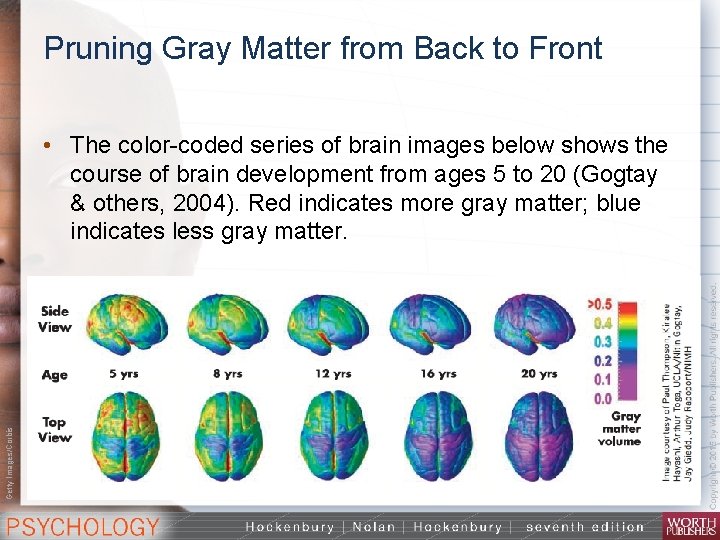
Pruning Gray Matter from Back to Front Getty Images/Corbis • The color-coded series of brain images below shows the course of brain development from ages 5 to 20 (Gogtay & others, 2004). Red indicates more gray matter; blue indicates less gray matter.
Getty Images/Corbis Factors Affecting Timing of Puberty Absence of the father in the home environment Quality of family relationship Menarche comes earlier for girls in these homes Genetics Girls experience menarche around same age as their mother did, closer for identical twins than non-twin siblings Environment Nutrition and health Body size and physical activity Heavier children begin puberty earlier Boys in these homes have accelerated physical development Physically demanding exercise delays menarche

Courtesy of the authors Getty Images/Corbis Early-maturing boys Tend to be successful in athletics and popular with their peers, but they are more susceptible to risky behaviors, such as drug, alcohol, or steroid use Early-maturing girls Tend to have more negative feelings about the arrival of puberty and body changes, have higher rates of teenage pregnancy, and may be embarrassed or harassed by unwanted attention from older males
Social Development in Adolescence • Parent-child relationships are overall positive. – • Friends and peers become more of an influence. – • Tend to reinforce the traits and goals that parents fostered during childhood Romantic relationships influence psychological and social development in both positive and negative ways. – Getty Images/Corbis Conflict increases during this time; this is seen as healthy as autonomy increases – – By age of 12, about 25 percent of adolescents report a “special romantic relationship” By age 15: 50 percent By age 18: 70 percent
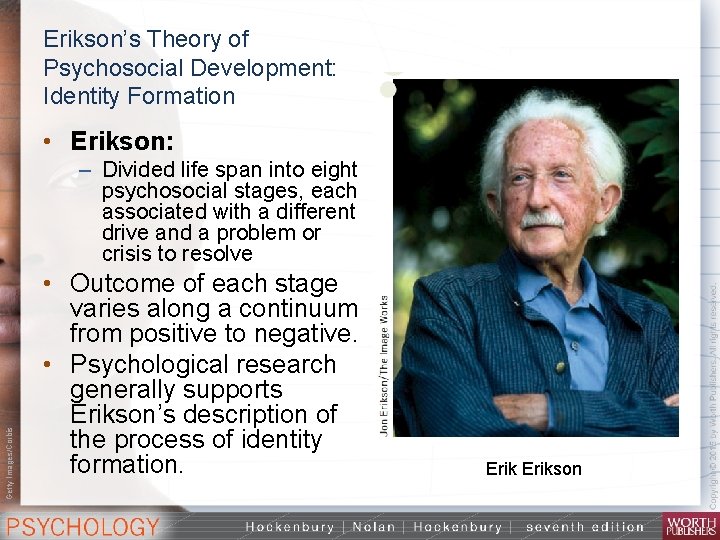
Erikson’s Theory of Psychosocial Development: Identity Formation • Erikson: Getty Images/Corbis – Divided life span into eight psychosocial stages, each associated with a different drive and a problem or crisis to resolve • Outcome of each stage varies along a continuum from positive to negative. • Psychological research generally supports Erikson’s description of the process of identity formation. Erikson
Getty Images/Corbis Stage 1 (Birth– 1) Trust vs. Mistrust • Infants must rely on others for care • Consistent and dependable care giving and meeting infant needs leads to a sense of trust • Infants who are not well cared for will develop mistrust
Getty Images/Corbis Stage 2 (1– 3 years) Autonomy vs. Shame and Doubt • Children are discovering their own independence • Those given the opportunity to experience independence will gain a sense of autonomy • Children that are overly restrained or punished harshly will develop shame and doubt
Getty Images/Corbis Stage 3 (3– 5 years) Initiative vs. Guilt • Children are exposed to the wider social world and given greater responsibility • Sense of accomplishment leads to initiative (taking the first step in accomplishing a task), whereas feelings of guilt can emerge if the child is made to feel too anxious or irresponsible
Getty Images/Corbis Stage 4 (5– 12 years) Industry vs. Inferiority • Stage of life surrounding mastery of knowledge and intellectual skills • Sense of competence and achievement leads to industry • Feeling incompetent and unproductive leads to inferiority
Getty Images/Corbis Stage 5 (Adolescence) Identity vs. Confusion • Developing a sense of who one is and where one is going in life • Successful resolution leads to positive identity • Unsuccessful resolution leads to identity confusion or a negative identity
Getty Images/Corbis Stage 6 (Young adulthood) Intimacy vs. Isolation • Time for sharing oneself with another person • Capacity to hold commitments with others leads to intimacy • Failure to establish commitments leads to feelings of isolation
Getty Images/Corbis Stage 7 (Middle adulthood) Generativity vs. Stagnation • Caring for others in family, friends, and work leads to sense of contribution to later generations • Stagnation (which comes from selfabsorption) comes from a sense of boredom and meaninglessness
Getty Images/Corbis Stage 8 (Late adulthood to Death) Integrity vs. Despair • Successful resolutions of all previous crises leads to integrity and the ability to see broad truths and advise those in earlier stages • See meaning in one’s own life • Despair arises from feelings of helplessness and the bitter sense that life has been incomplete
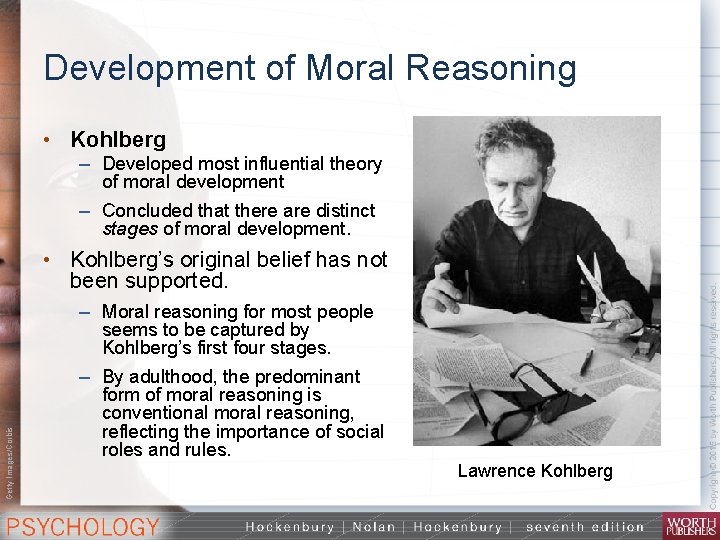
Development of Moral Reasoning • Kohlberg – Developed most influential theory of moral development – Concluded that there are distinct stages of moral development. Getty Images/Corbis • Kohlberg’s original belief has not been supported. – Moral reasoning for most people seems to be captured by Kohlberg’s first four stages. – By adulthood, the predominant form of moral reasoning is conventional moral reasoning, reflecting the importance of social roles and rules. Lawrence Kohlberg
Kohlberg’s Levels and Stages of Moral Development Getty Images/Corbis I. Preconventional Level • Moral reasoning is guided by external consequences. No internalization of values or rules. • Stage 1: Punishment and Obedience • “Right” is obeying the rules simply to avoid punishment because others have power over you and can punish you. • Stage 2: Mutual Benefit • “Right” is an even or fair exchange so that both parties benefit. Moral reasoning guided by a sense of “fair play. ”
Kohlberg’s Levels and Stages of Moral Development Getty Images/Corbis II. Conventional Level • Moral reasoning is guided by conformity to social roles, rules, and expectations that the person has learned and internalized. • Stage 3: Interpersonal Expectations • “Right” is being a “good” person by conforming to social expectations, such as showing concern for others and following rules set by others so as to win their approval. • Stage 4: Law and Order • “Right” is helping maintain social order by doing one’s duty, obeying laws simply because they are laws, and showing respect for authorities simply because they are authorities.

Kohlberg’s Levels and Stages of Moral Development Getty Images/Corbis III. Postconventional Level • Moral reasoning is guided by internalized legal and moral principles that protect the rights of all members of society. • Stage 5: Legal Principles • “Right” is helping protect the basic rights of all members of society by upholding legalistic principles that promote the values of fairness, justice, equality, and democracy. • Stage 6: Universal Moral Principles • “Right” is determined by self-chosen ethical principles that reflect the person’s respect for ideals such as nonviolence, equality, and human dignity. If these moral principles conflict with democratically determined laws, the person’s selfchosen moral principles take precedence.
Gender, Culture, and Moral Reasoning: Carol Gilligan Getty Images/Corbis • Developed a model of women’s moral development based on an ethic of care and responsibility • Found women tend to stress importance of maintaining interpersonal relationships and responding to needs of others. • Research shows that Kohlberg may be incorrect, but so was Gilligan. • Evidence suggests that both men and women used a mix of care and justice perspectives.
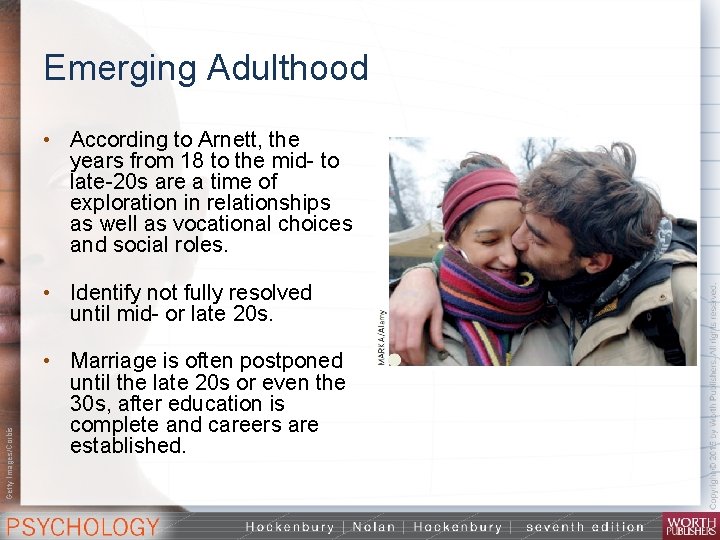
Emerging Adulthood • According to Arnett, the years from 18 to the mid- to late-20 s are a time of exploration in relationships as well as vocational choices and social roles. Getty Images/Corbis • Identify not fully resolved until mid- or late 20 s. • Marriage is often postponed until the late 20 s or even the 30 s, after education is complete and careers are established.
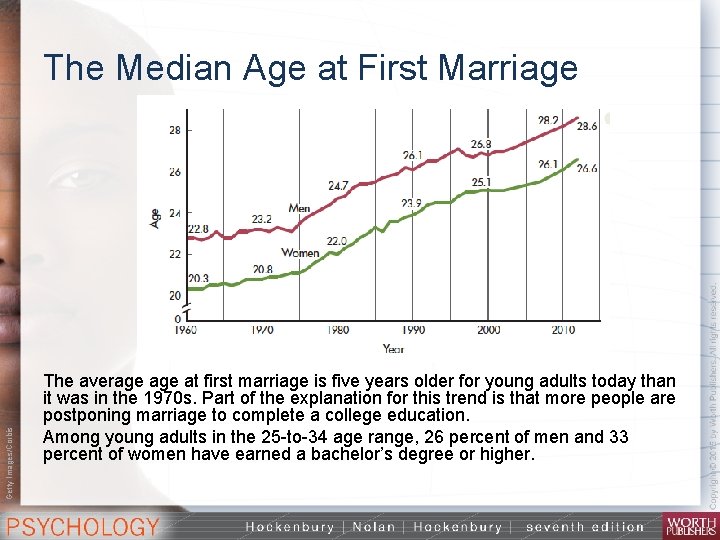
Getty Images/Corbis The Median Age at First Marriage The average at first marriage is five years older for young adults today than it was in the 1970 s. Part of the explanation for this trend is that more people are postponing marriage to complete a college education. Among young adults in the 25 -to-34 age range, 26 percent of men and 33 percent of women have earned a bachelor’s degree or higher.
Adulthood Development Physical strength typically peaks in early adulthood: the 20 s and 30 s Getty Images/Corbis By middle adulthood, roughly from the 40 s to the mid-60 s, physical strength and endurance gradually decline and mental reaction times also begin to slow. During late adulthood, from the mid-60 s on, physical stamina and reaction time tend to decline further and faster. Loss of lean muscle, increased body fat, weakened bones, and cognitive decay
Social Changes in Adulthood Middle adulthood Getty Images/Corbis • Primary psychosocial task becomes one of generativity --to contribute to future generations through children, career, and other meaningful activities. Friends and Lovers in Adulthood • Adults typically have fewer friends than adolescents. • Female friends tend to confide in one another. • Male friends tend to do things of mutual interest. • Young adults are marrying at a later average age. • “Traditional” family may no longer be the norm.

Getty Images/Corbis Changing Structure of American Families and Households
Transition to Parenthood Getty Images/Corbis Marital satisfaction and time together tend to decline after the birth of the first child. Married women with children are more likely than single women or childless women to interrupt their careers, leave their jobs, or switch to part-time work because of childrearing responsibilities. Boomerang children can negatively impact marital relationships.
Raising Psychologically Healthy Children Getty Images/Corbis • How to be an authoritative parent: 1. Let your children know that you love them. 2. Listen to your children. 3. Use induction to teach as you discipline. 4. Work with your child’s temperamental qualities. 5. Understand your child’s age-related cognitive abilities and limitations. 6. Do not expect perfection, and learn to go with the flow.
Getty Images/Corbis Parenting Styles: Diana Baumrind Parental Control v. Responsiveness • Authoritarian – High parental control – Low responsiveness to child’s needs/wishes • Permissive – Low parental control (indifferent/indulgent) – High/Low responsiveness to child’s needs/wishes • Authoritative – Rules are firm, enforced (High control) – Reasons discussed for rules (High responsiveness)
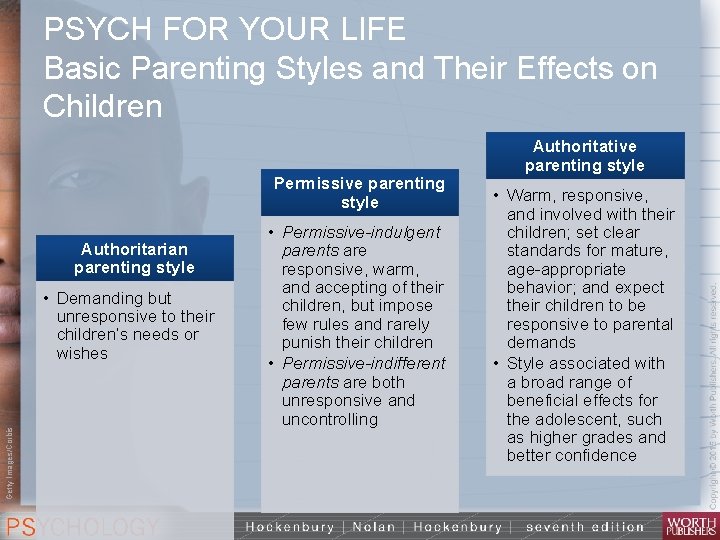
PSYCH FOR YOUR LIFE Basic Parenting Styles and Their Effects on Children Permissive parenting style Authoritarian parenting style Getty Images/Corbis • Demanding but unresponsive to their children’s needs or wishes • Permissive-indulgent parents are responsive, warm, and accepting of their children, but impose few rules and rarely punish their children • Permissive-indifferent parents are both unresponsive and uncontrolling Authoritative parenting style • Warm, responsive, and involved with their children; set clear standards for mature, age-appropriate behavior; and expect their children to be responsive to parental demands • Style associated with a broad range of beneficial effects for the adolescent, such as higher grades and better confidence
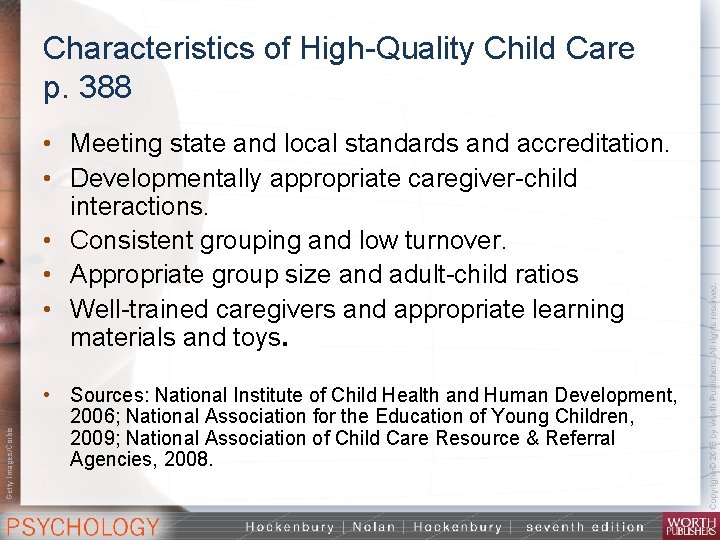
Characteristics of High-Quality Child Care p. 388 Getty Images/Corbis • Meeting state and local standards and accreditation. • Developmentally appropriate caregiver-child interactions. • Consistent grouping and low turnover. • Appropriate group size and adult-child ratios • Well-trained caregivers and appropriate learning materials and toys. • Sources: National Institute of Child Health and Human Development, 2006; National Association for the Education of Young Children, 2009; National Association of Child Care Resource & Referral Agencies, 2008.
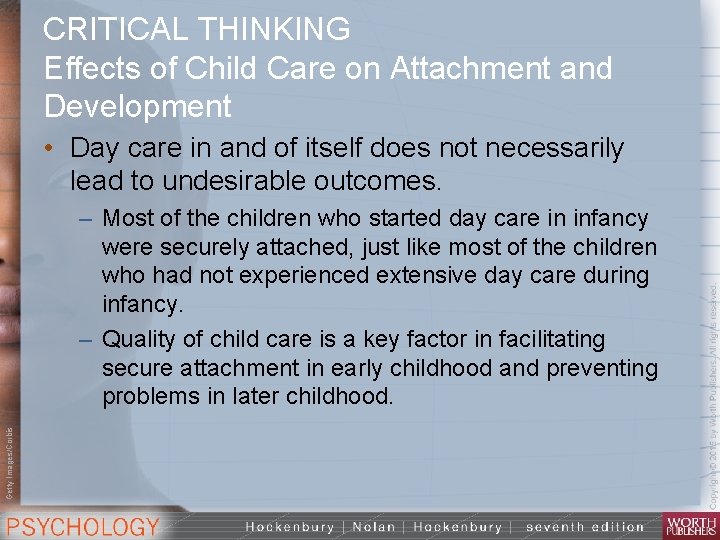
CRITICAL THINKING Effects of Child Care on Attachment and Development • Day care in and of itself does not necessarily lead to undesirable outcomes. Getty Images/Corbis – Most of the children who started day care in infancy were securely attached, just like most of the children who had not experienced extensive day care during infancy. – Quality of child care is a key factor in facilitating secure attachment in early childhood and preventing problems in later childhood.
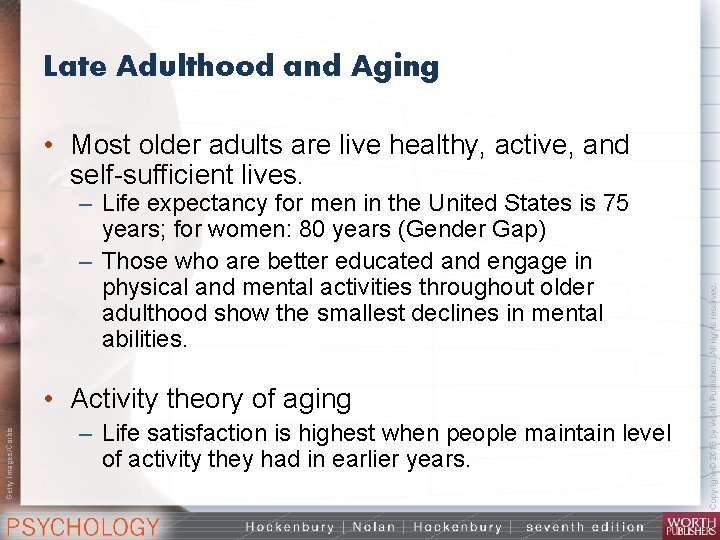
Late Adulthood and Aging • Most older adults are live healthy, active, and self-sufficient lives. – Life expectancy for men in the United States is 75 years; for women: 80 years (Gender Gap) – Those who are better educated and engage in physical and mental activities throughout older adulthood show the smallest declines in mental abilities. Getty Images/Corbis • Activity theory of aging – Life satisfaction is highest when people maintain level of activity they had in earlier years.
Getty Images/Corbis FOCUS ON NEUROSCIENCE Boosting the Aging Brain • Dozens of studies have shown that exercise, especially aerobic exercise, improves cognitive functioning in old age • Remaining mentally and physically active decreases age-related risks for cognitive impairment and Alzheimer’s disease (CORRELATIONAL) • Some studies have shown that aerobic exercise is neuroprotective - a very moderate, simple exercise program can significantly improve cognitive abilities and brain health—even in late adulthood
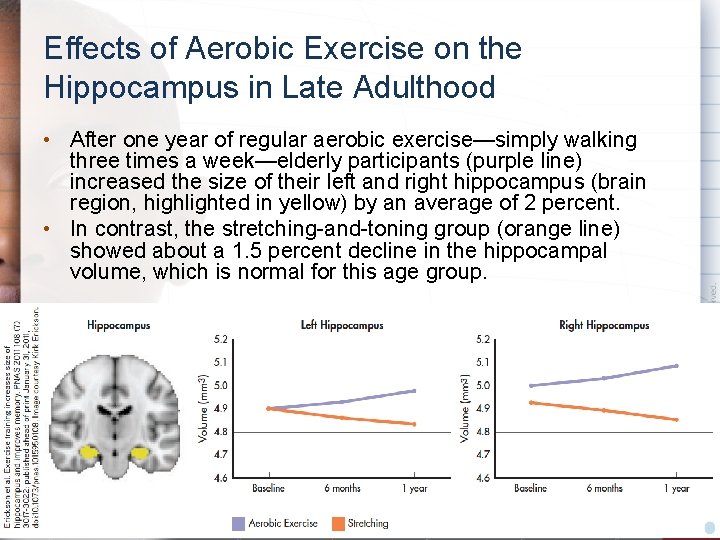
Effects of Aerobic Exercise on the Hippocampus in Late Adulthood Getty Images/Corbis • After one year of regular aerobic exercise—simply walking three times a week—elderly participants (purple line) increased the size of their left and right hippocampus (brain region, highlighted in yellow) by an average of 2 percent. • In contrast, the stretching-and-toning group (orange line) showed about a 1. 5 percent decline in the hippocampal volume, which is normal for this age group.
Late Adulthood and Aging: Social Development • Older adults gradually “disengage, ” or withdraw, from vocational, social, and relationship roles as they face the prospect of their lives ending (Lange & Grossman, 2010). Getty Images/Corbis • Life satisfaction in late adulthood is highest when people maintain previous level of activity, either by continuing old activities or by finding new ones (Lange & Grossman, 2010) (activity theory of aging), • Older adults experience ego integrity when they look back on their lives and feel satisfied; despair is felt when people are filled with regrets, bitterness, or missed opportunities.
Dying and Death • In general, anxiety about dying peaks in middle adulthood, tends to decrease in late adulthood • Kübler-Ross’s stages of dying – – – Denial Anger Bargaining Depression Acceptance Getty Images/Corbis • Critique – Dying people do not necessarily progress through predictable sequence of stages. – Dying is an individual process.
- Slides: 88