
GETTING TO ROOT CAUSE COUNTERMEASURES Getting Back On

GETTING TO ROOT CAUSE / COUNTERMEASURES Getting Back On Track pg 1
PROBLEMS ARE INEVITABLE WHEN WE GET OFF TRACK WE MUST… ■ Quantify gap between actual and expected performance ■ Identify cause of gap / miss ■ Determine how to get back on track as quickly as possible DO THIS WITH COUNTERMEASURES pg 2
COUNTERMEASURES… ARE: ARE NOT: ■ Highly focused ■ Implemented quickly ■ Aggressive ■ Data driven ■ Sustainable ■ Broad ■ Drawn out ■ Passive ■ Based on opinion ■ Unsustainable NOT AN ACTION PLAN. . . ALTHOUGH MAY IMPROVE THE ACTION PLAN! pg 3
LEARNING FROM OUR MISSES GOOD COUNTERMEASURE PREPARATION WILL RESULT IN: ■ Productive self-criticism ■ More robust systems ■ Closer customer contact ■ Higher level understanding of marketplace “. . . THOSE WHO CANNOT REMEMBER THE PAST ARE CONDEMNED TO REPEAT IT. . . ” pg 4
COMMON COUNTERMEASURE MISTAKES ■ Mistaking correlation with causation ■ Spending time on "smaller" issues instead of those causing majority of problem ■ Allowing too much time for corrective action ■ Focusing on the "what" or "who" instead of the “why” ■ No linkage between countermeasure and data pg 5
COUNTERMEASURE FUNDAMENTALS COUNTERMEASURE TOOLS ■ Root cause ■ Pareto analysis / Stratification ■ 5 why analysis pg 6

ROOT CAUSE pg 7
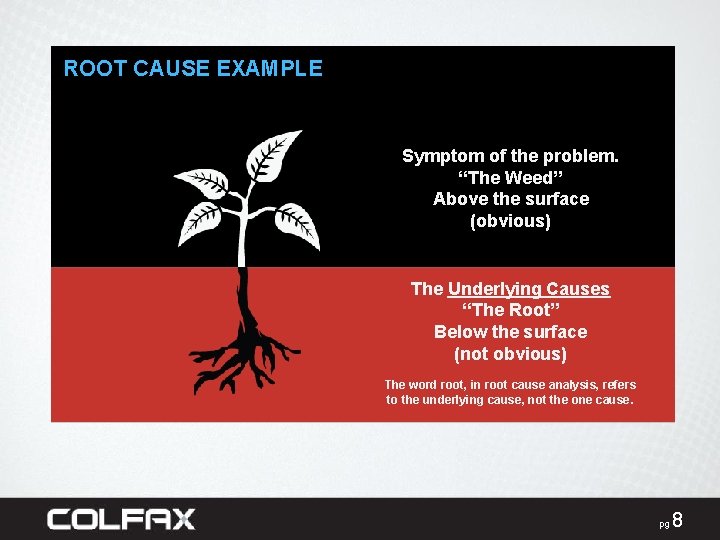
ROOT CAUSE EXAMPLE Symptom of the problem. “The Weed” Above the surface (obvious) The Underlying Causes “The Root” Below the surface (not obvious) The word root, in root cause analysis, refers to the underlying cause, not the one cause. pg 8

PARETO ANALYSIS pg 9
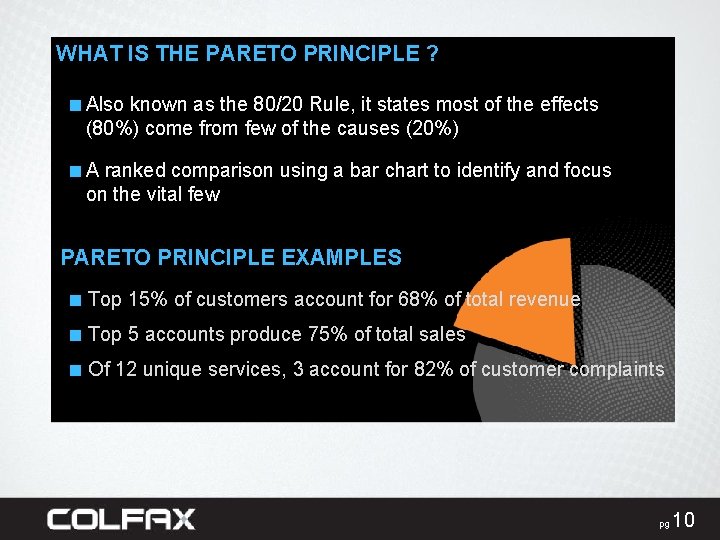
WHAT IS THE PARETO PRINCIPLE ? ■ Also known as the 80/20 Rule, it states most of the effects (80%) come from few of the causes (20%) ■ A ranked comparison using a bar chart to identify and focus on the vital few PARETO PRINCIPLE EXAMPLES ■ Top 15% of customers account for 68% of total revenue ■ Top 5 accounts produce 75% of total sales ■ Of 12 unique services, 3 account for 82% of customer complaints pg 10
PARETO PRINCIPLE LIMIT TASKS TO THE MOST IMPORTANT ■ Efficient vs. effective ■ Separate and focus on the critical few – find the break point (at least 60%) DON’T CONFUSE ACTIVITY WITH RESULTS. pg 11
PARETO PRINCIPLE PITFALLS PROBLEM: DATA SHOWS NO CLEAR DISTINCTION BETWEEN CATEGORIES SOLUTION: CHOOSE A DIFFERENT BREAKDOWN OF CATEGORIZING Try stratification By cost accounts By products or services By observable symptoms By reasons By location of the problems pg 12
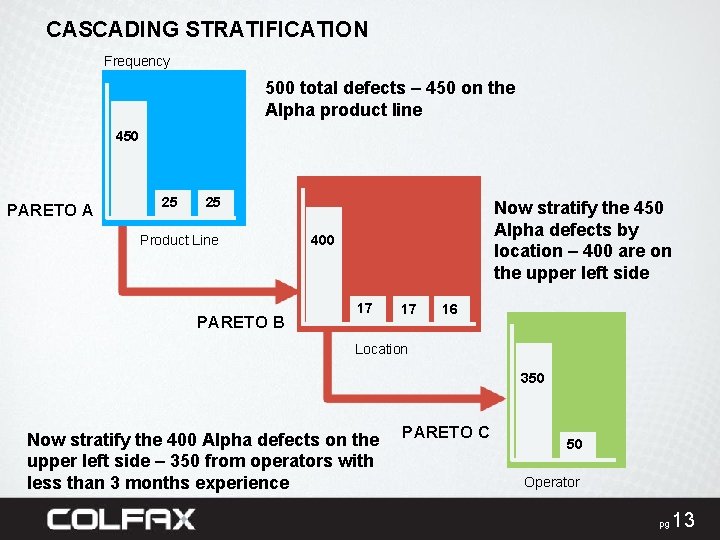
CASCADING STRATIFICATION Frequency 500 total defects – 450 on the Alpha product line 450 PARETO A 25 25 Product Line PARETO B Now stratify the 450 Alpha defects by location – 400 are on the upper left side 400 17 17 16 Location 350 Now stratify the 400 Alpha defects on the upper left side – 350 from operators with less than 3 months experience PARETO C 50 Operator pg 13
5 WHY ANALYSIS pg 14
5 WHY ANALYSIS ■ Series of questions developed by Toyota Motor Corporation ■ Begin the process on a single primary issue (start with connection to last Pareto analysis) ■ Ask “Why? ” sequentially about the same problem (NOT 5 different “Why’s”) ■ Asking “why? ” five times will enable the root cause and solution to become clear pg 15
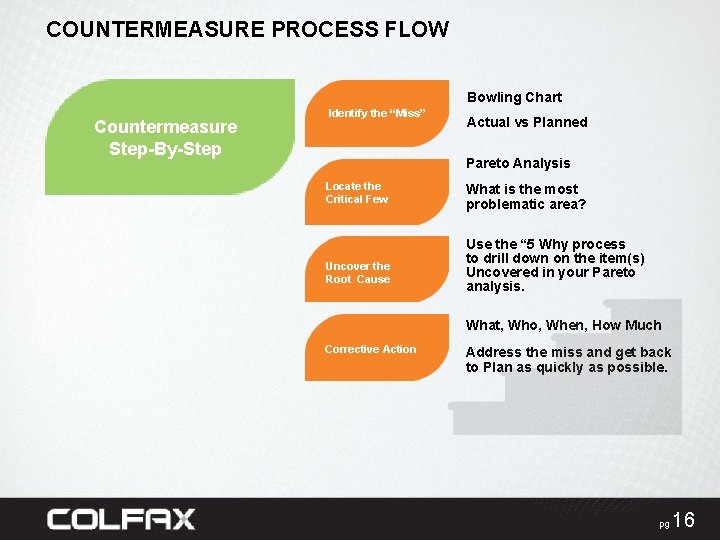
COUNTERMEASURE PROCESS FLOW Bowling Chart Countermeasure Step-By-Step Identify the “Miss” Actual vs Planned Pareto Analysis Locate the Critical Few Uncover the Root Cause What is the most problematic area? Use the “ 5 Why process to drill down on the item(s) Uncovered in your Pareto analysis. What, Who, When, How Much Corrective Action Address the miss and get back to Plan as quickly as possible. pg 16
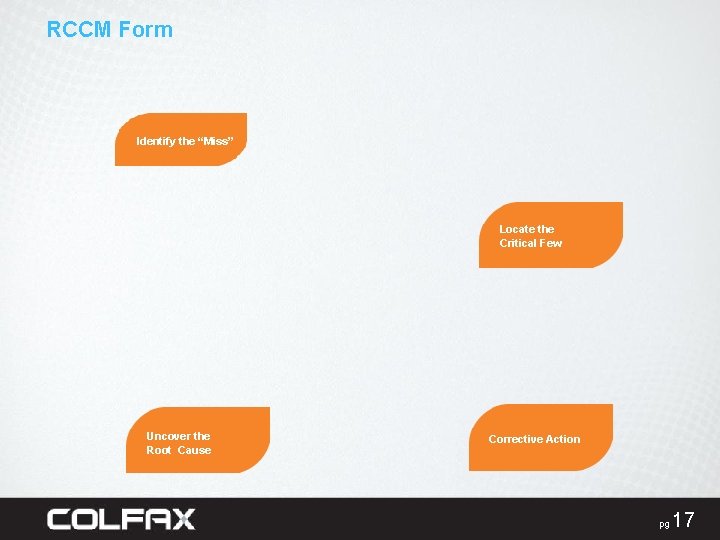
RCCM Form Identify the “Miss” Locate the Critical Few Uncover the Root Cause Corrective Action pg 17
GROUP EXERCISE pg 18
GROUP EXERCISE IDENTIFY A “MISSED” TARGET IN YOUR AREA OF RESPONSIBILITY ■ Sales quota ■ Deadline ■ Shipment, etc. DEVELOP COUNTERMEASURE USING THE 4 -STEP PROCESS ■ Bowling chart ■ Pareto (with stratification) ■ 5 Why ■ Corrective action (verify it solves the 5 Why) pg 19
- Slides: 19