
Getting To Know Your Protein Comparative Protein Analysis











- Slides: 33
Getting To Know Your Protein Comparative Protein Analysis: Part II. Protein Domain Identification & Classification Robert Latek, Ph. D Sr. Bioinformatics Scientist Whitehead Institute for Biomedical WIBR Bioinformatics Courses, © Whitehead. Research Institute, 2004
Comparative Protein Analysis • Part I. : – Phylogenetic Trees and Multiple Sequence Alignments are important tools to understand global relationships between sequences. – http: //jura. wi. mit. edu/bio/education/bioinfo-mini/seq/ (AA Subst. Matrices) • Part II. : – How do you identify sequence relationships that are restricted to localized regions? – Can you apply phylogenetic trees and MSAs to only sub-regions of sequences? – How do you apply what you know about a group of sequences to finding additional, related sequences? – What can the relationship between your sequences and previously discovered ones tell you about their function? • Assigning sequences to Protein Families WIBR Bioinformatics Courses, © Whitehead Institute, 2004 2
Syllabus • Protein Families – Identifying Protein Domains – Family Databases & Searches • Searching for Family Members – Pattern Searches • Patscan – Profile Searches • PSI-BLAST/HMMER 2 WIBR Bioinformatics Courses, © Whitehead Institute, 2004 3
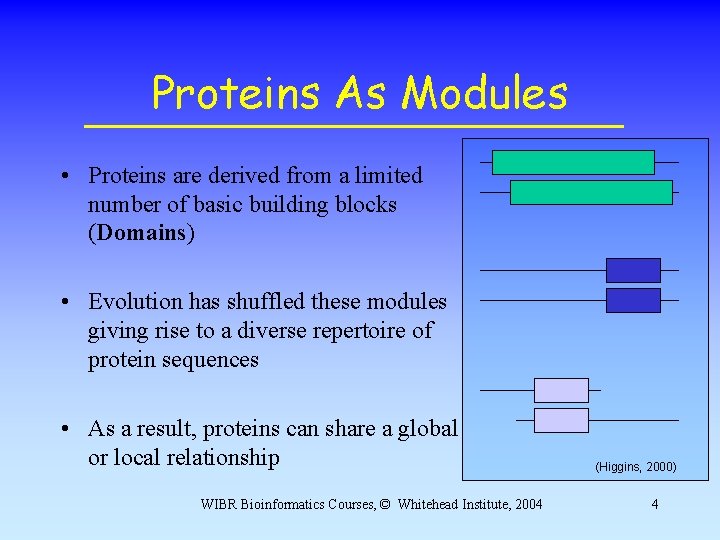
Proteins As Modules • Proteins are derived from a limited number of basic building blocks (Domains) • Evolution has shuffled these modules giving rise to a diverse repertoire of protein sequences • As a result, proteins can share a global or local relationship WIBR Bioinformatics Courses, © Whitehead Institute, 2004 (Higgins, 2000) 4
Protein Domains SH 2 Motif Janus Kinase 2 Modular Sequence Architecture Motifs describe the domain WIBR Bioinformatics Courses, © Whitehead Institute, 2004 5
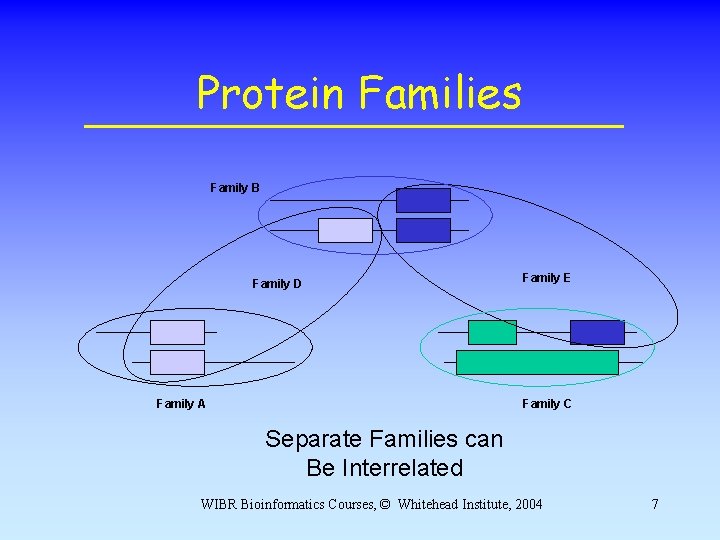
Protein Families • Protein Family - a group of proteins that share a common function and/or structure, that are potentially derived from a common ancestor (set of homologous proteins) • Characterizing a Family - Compare the sequence and structure patterns of the family members to reveal shared characteristics that potentially describe common biological properties • Motif/Domain - sequence and/or structure patterns common to protein family members (a trait) WIBR Bioinformatics Courses, © Whitehead Institute, 2004 6
Protein Families Family B Family D Family A Family E Family C Separate Families can Be Interrelated WIBR Bioinformatics Courses, © Whitehead Institute, 2004 7
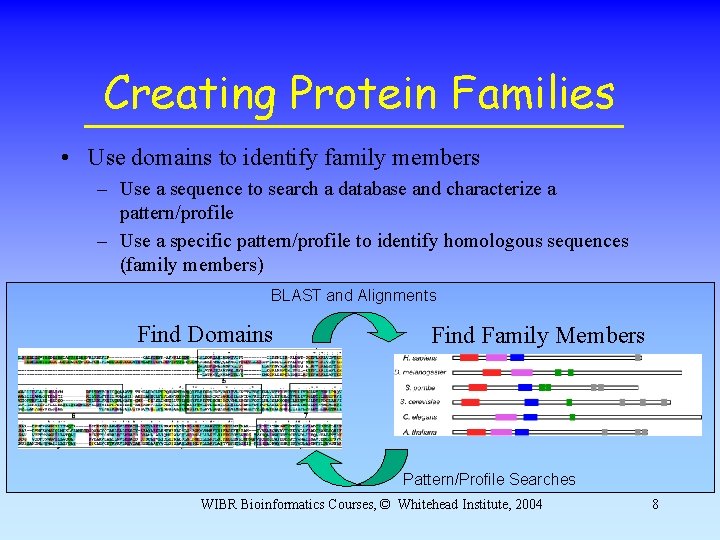
Creating Protein Families • Use domains to identify family members – Use a sequence to search a database and characterize a pattern/profile – Use a specific pattern/profile to identify homologous sequences (family members) BLAST and Alignments Find Domains Find Family Members Pattern/Profile Searches WIBR Bioinformatics Courses, © Whitehead Institute, 2004 8
Family Database Resources • Curated Databases* – Proteins are placed into families with which they share a specific sequence pattern • Clustering Databases* – Sequence similarity-based without the prior knowledge of specific patterns • Derived Databases* – Pool other databases into one central resource • Search and Browse WIBR Bioinformatics Courses, © Whitehead Institute, 2004 *(Higgins, 2000) 9
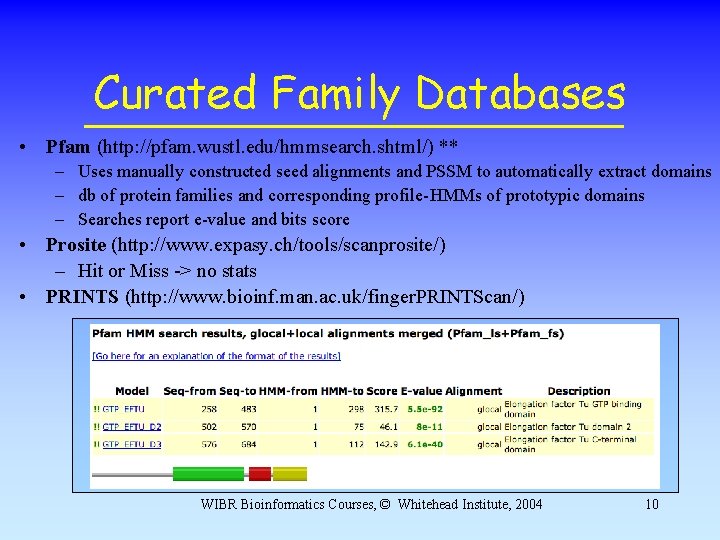
Curated Family Databases • Pfam (http: //pfam. wustl. edu/hmmsearch. shtml/) ** – Uses manually constructed seed alignments and PSSM to automatically extract domains – db of protein families and corresponding profile-HMMs of prototypic domains – Searches report e-value and bits score • Prosite (http: //www. expasy. ch/tools/scanprosite/) – Hit or Miss -> no stats • PRINTS (http: //www. bioinf. man. ac. uk/finger. PRINTScan/) WIBR Bioinformatics Courses, © Whitehead Institute, 2004 10
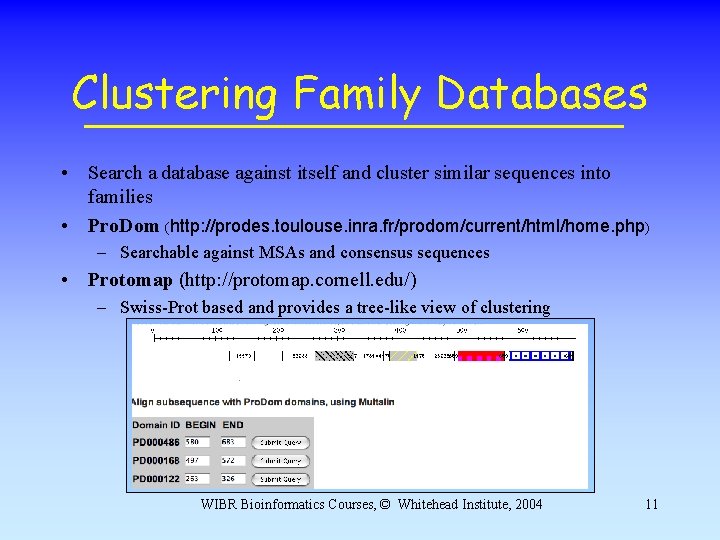
Clustering Family Databases • Search a database against itself and cluster similar sequences into families • Pro. Dom (http: //prodes. toulouse. inra. fr/prodom/current/html/home. php) – Searchable against MSAs and consensus sequences • Protomap (http: //protomap. cornell. edu/) – Swiss-Prot based and provides a tree-like view of clustering WIBR Bioinformatics Courses, © Whitehead Institute, 2004 11
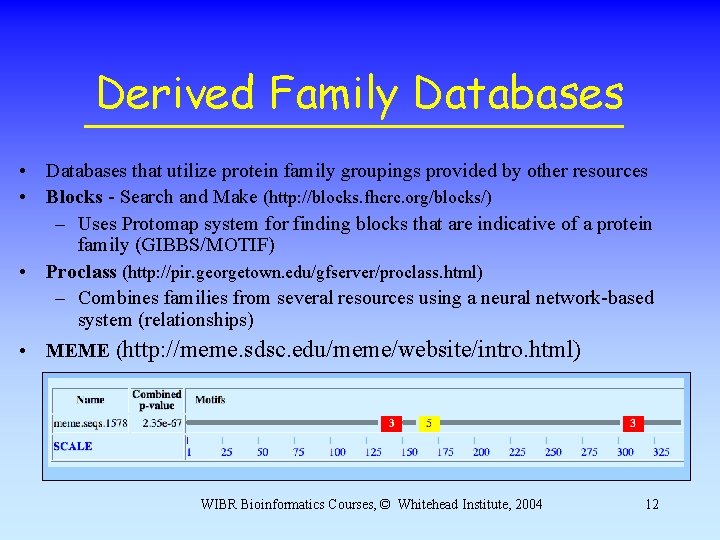
Derived Family Databases • Databases that utilize protein family groupings provided by other resources • Blocks - Search and Make (http: //blocks. fhcrc. org/blocks/) – Uses Protomap system for finding blocks that are indicative of a protein family (GIBBS/MOTIF) • Proclass (http: //pir. georgetown. edu/gfserver/proclass. html) – Combines families from several resources using a neural network-based system (relationships) • MEME (http: //meme. sdsc. edu/meme/website/intro. html) WIBR Bioinformatics Courses, © Whitehead Institute, 2004 12
Syllabus • Protein Families – Identifying Protein Domains – Family Databases & Searches • Searching for Family Members – Pattern Searches • Patscan – Profile Searches • PSI-BLAST/HMMER 2 WIBR Bioinformatics Courses, © Whitehead Institute, 2004 13
Searching Family Databases • BLAST searches provide a great deal of information, but it is difficult to select out the important sequences (listed by score, not family) • Family searches can give an immediate indication of a protein’s classification/function • Use Family Database search tools to identify domains and family members WIBR Bioinformatics Courses, © Whitehead Institute, 2004 14
Patterns & Profiles • Techniques for searching sequence databases to uncover common domains/motifs of biological significance that categorize a protein into a family • Pattern - a deterministic syntax that describes multiple combinations of possible residues within a protein string • Profile - probabilistic generalizations that assign to every segment position, a probability that each of the 20 aa will occur WIBR Bioinformatics Courses, © Whitehead Institute, 2004 15
Discovery Algorithms • Pattern Driven Methods – Enumerate all possible patterns in solution space and try matching them to a set of sequences 1 A C D. . . Y 2 A C D. . . Y 3 A C D. . . Y 4 A C D. . . Y Poss. 1 Poss. 2 Poss. 3 Poss. 4 Poss. 5 Etc. 1 2 3 4 AAAA ACAA AACA AAAC ACCA WIBR Bioinformatics Courses, © Whitehead Institute, 2004 16
Discovery Algorithms • Sequence Driven Methods – Build up a pattern by pair-wise comparisons of input sequences, storing positions in common, removing positions that are different ACDEFGHIKL A -DLNGH-KL A- D - - GH- KL WIBR Bioinformatics Courses, © Whitehead Institute, 2004 17
Pattern Building • Find patterns like “pos 1 xx pos 2 xxxx pos 3” – Definition of a non-contiguous motif 1. 2. 3. 4 5. 6. C C C Y A W Y N L D T D C M N Y G F N G T C C C A R G S M T F T I D P A T A S H I F L I V M F W R D E K R R Q T R K Q Q S V M D N K A K D A S K V N T V L D M S V E A D H L H R R T K K K M E V H H H A H D K E N R S T K R S E A V D M L H H H C xxxx [LIVMFW] xxxx H xxxxx H Define/Search A Motif http: //us. expasy. org/tools/scanprosite/ WIBR Bioinformatics Courses, © Whitehead Institute, 2004 18
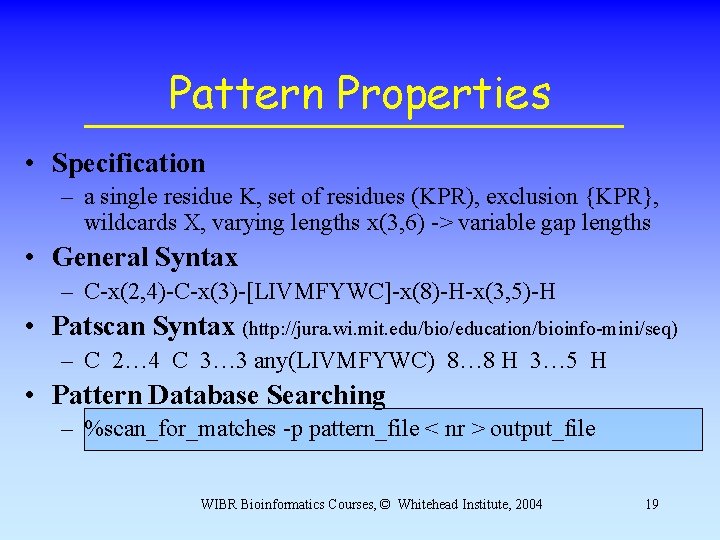
Pattern Properties • Specification – a single residue K, set of residues (KPR), exclusion {KPR}, wildcards X, varying lengths x(3, 6) -> variable gap lengths • General Syntax – C-x(2, 4)-C-x(3)-[LIVMFYWC]-x(8)-H-x(3, 5)-H • Patscan Syntax (http: //jura. wi. mit. edu/bio/education/bioinfo-mini/seq) – C 2… 4 C 3… 3 any(LIVMFYWC) 8… 8 H 3… 5 H • Pattern Database Searching – %scan_for_matches -p pattern_file < nr > output_file WIBR Bioinformatics Courses, © Whitehead Institute, 2004 19
Sequence Pattern Concerns • Pattern descriptors must allow for approximate matching by defining an acceptable distance between a pattern and a potential hit – Weigh the sensitivity and specificity of a pattern • What is the likelihood that a pattern would randomly occur? WIBR Bioinformatics Courses, © Whitehead Institute, 2004 20
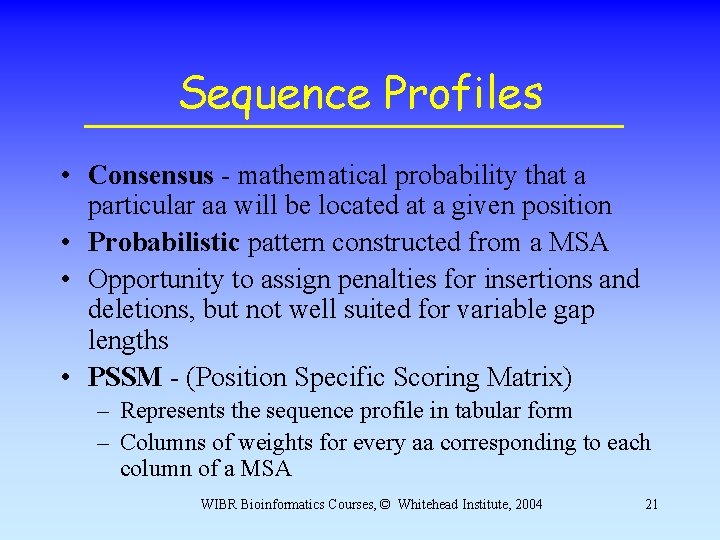
Sequence Profiles • Consensus - mathematical probability that a particular aa will be located at a given position • Probabilistic pattern constructed from a MSA • Opportunity to assign penalties for insertions and deletions, but not well suited for variable gap lengths • PSSM - (Position Specific Scoring Matrix) – Represents the sequence profile in tabular form – Columns of weights for every aa corresponding to each column of a MSA WIBR Bioinformatics Courses, © Whitehead Institute, 2004 21
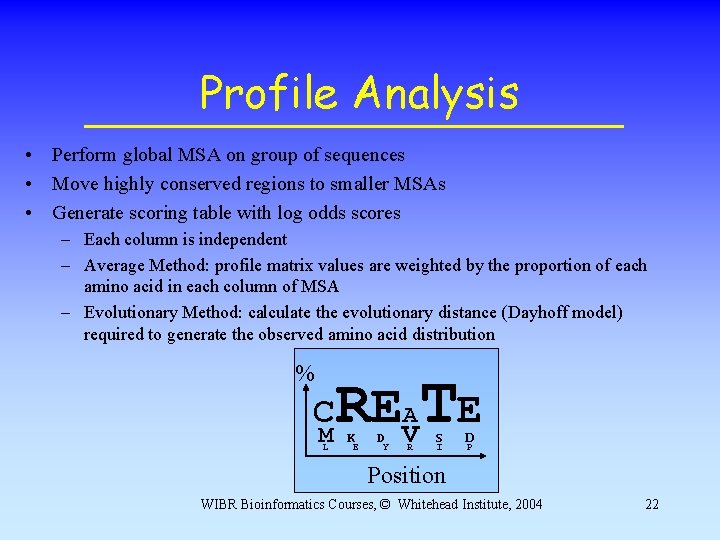
Profile Analysis • Perform global MSA on group of sequences • Move highly conserved regions to smaller MSAs • Generate scoring table with log odds scores – Each column is independent – Average Method: profile matrix values are weighted by the proportion of each amino acid in each column of MSA – Evolutionary Method: calculate the evolutionary distance (Dayhoff model) required to generate the observed amino acid distribution % C ML REVTE A K E D Y R S I D P Position WIBR Bioinformatics Courses, © Whitehead Institute, 2004 22
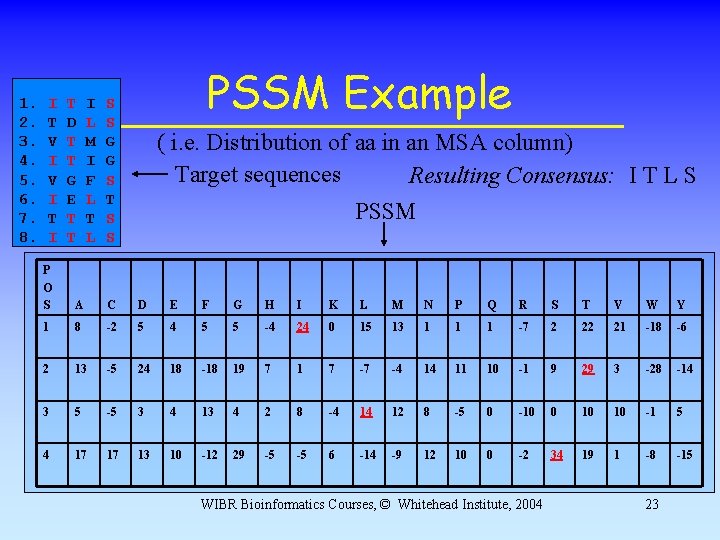
1. 2. 3. 4. 5. 6. 7. 8. I T V I T I T D T T G E T T I L M I F L T L PSSM Example S S G G S T S S ( i. e. Distribution of aa in an MSA column) Target sequences Resulting Consensus: I T L S PSSM P O S A C D E F G H I K L M N P Q R S T V W Y 1 8 -2 5 4 5 5 -4 24 0 15 13 1 1 1 -7 2 22 21 -18 -6 2 13 -5 24 18 -18 19 7 1 7 -7 -4 14 11 10 -1 9 29 3 -28 -14 3 5 -5 3 4 13 4 2 8 -4 14 12 8 -5 0 -10 0 10 10 -1 5 4 17 17 13 10 -12 29 -5 -5 6 -14 -9 12 10 0 -2 34 19 1 -8 -15 WIBR Bioinformatics Courses, © Whitehead Institute, 2004 23
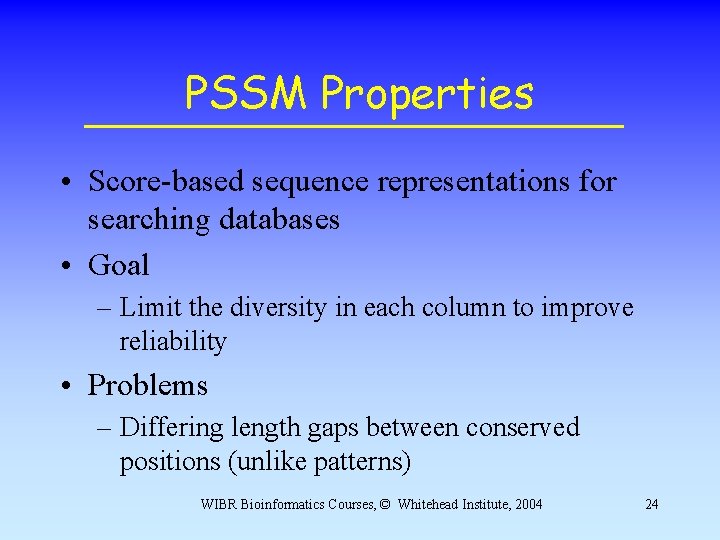
PSSM Properties • Score-based sequence representations for searching databases • Goal – Limit the diversity in each column to improve reliability • Problems – Differing length gaps between conserved positions (unlike patterns) WIBR Bioinformatics Courses, © Whitehead Institute, 2004 24
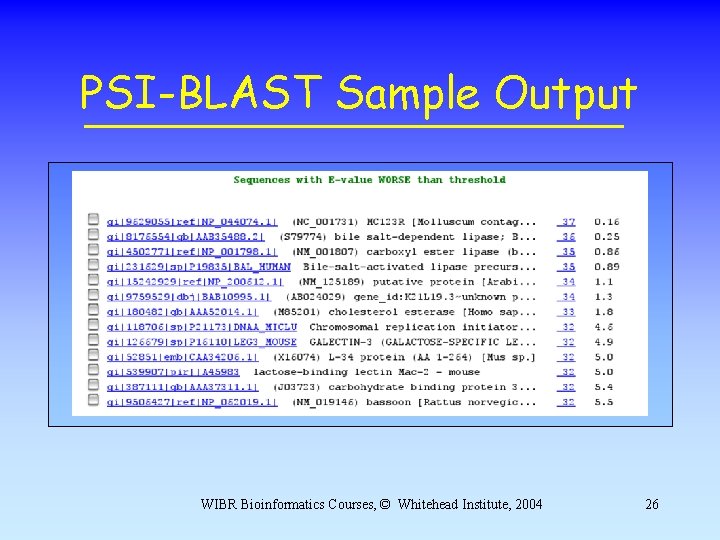
PSI-BLAST Implementation • PSI-BLAST Sequence http: //www. ncbi. nlm. nih. gov/BLAST/ – Start with a sequence, BLAST it, align select results to query sequence, estimate a profile with the MSA, search DB with the profile - constructs PSSM – Iterate until process stabilizes – Focus on domains, not entire sequences Align Blast Select Results – Greatly improves sensitivity WIBR Bioinformatics Courses, © Whitehead Institute, 2004 25
PSI-BLAST Sample Output WIBR Bioinformatics Courses, © Whitehead Institute, 2004 26
HMM Building • Hidden Markov Models are Statistical methods that consider all the possible combinations of matches, mismatches, and gaps to generate a consensus (Higgins, 2000) • Sequence ordering and alignments are not necessary at the onset (but in many cases alignments are recommended) • Ideally use at least 20 sequences in the training set to build a model • Calibration prevents over-fitting training set (i. e. Ala scan) • Generate a model (profile/PSSM), then search a database with it WIBR Bioinformatics Courses, © Whitehead Institute, 2004 27
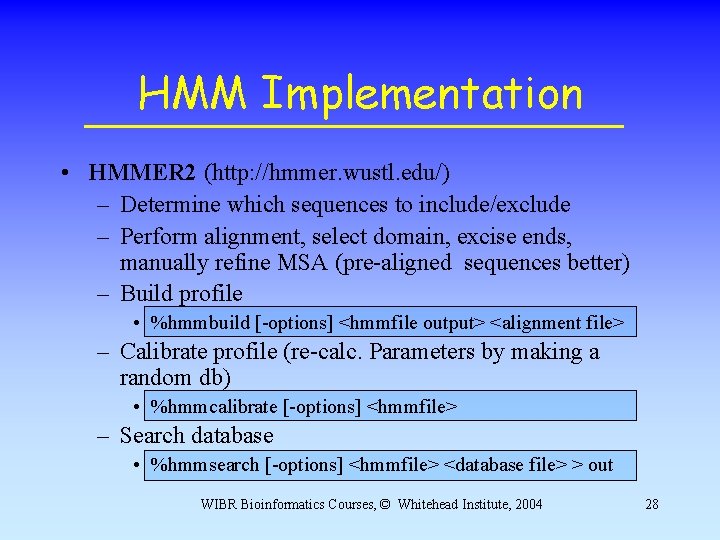
HMM Implementation • HMMER 2 (http: //hmmer. wustl. edu/) – Determine which sequences to include/exclude – Perform alignment, select domain, excise ends, manually refine MSA (pre-aligned sequences better) – Build profile • %hmmbuild [-options] <hmmfile output> <alignment file> – Calibrate profile (re-calc. Parameters by making a random db) • %hmmcalibrate [-options] <hmmfile> – Search database • %hmmsearch [-options] <hmmfile> <database file> > out WIBR Bioinformatics Courses, © Whitehead Institute, 2004 28
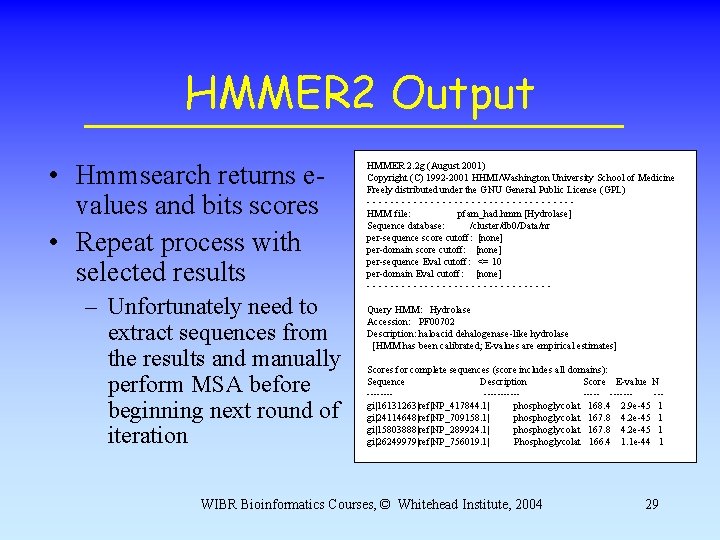
HMMER 2 Output • Hmmsearch returns evalues and bits scores • Repeat process with selected results – Unfortunately need to extract sequences from the results and manually perform MSA before beginning next round of iteration HMMER 2. 2 g (August 2001) Copyright (C) 1992 -2001 HHMI/Washington University School of Medicine Freely distributed under the GNU General Public License (GPL) ------------------HMM file: pfam_had. hmm [Hydrolase] Sequence database: /cluster/db 0/Data/nr per-sequence score cutoff: [none] per-domain score cutoff: [none] per-sequence Eval cutoff: <= 10 per-domain Eval cutoff: [none] ----------------Query HMM: Hydrolase Accession: PF 00702 Description: haloacid dehalogenase-like hydrolase [HMM has been calibrated; E-values are empirical estimates] Scores for complete sequences (score includes all domains): Sequence Description Score E-value N -----------gi|16131263|ref|NP_417844. 1| phosphoglycolat 168. 4 2. 9 e-45 1 gi|24114648|ref|NP_709158. 1| phosphoglycolat 167. 8 4. 2 e-45 1 gi|15803888|ref|NP_289924. 1| phosphoglycolat 167. 8 4. 2 e-45 1 gi|26249979|ref|NP_756019. 1| Phosphoglycolat 166. 4 1. 1 e-44 1 WIBR Bioinformatics Courses, © Whitehead Institute, 2004 29
Patterns vs. Profiles • Patterns – Easy to understand (human-readable) – Account for different length gaps • Profiles – Sensitivity, better signal to noise ratio – Teachable WIBR Bioinformatics Courses, © Whitehead Institute, 2004 30
Domain ID & Searching • Family/Domain Search – http: //pfam. wustl. edu • Pattern Search MLEICLKLVGCKSKKGLSSSSSCYLEEALQRPVASDFEPQGLSEAARWNSKENLLAGPSENDPNLFVALY DFVASGDNTLSITKGEKLRVLGYNHNGEWCEAQTKNGQGWVPSNYITPVNSLEKHSWYHGPVSRNAAEYL LSSGINGSFLVRESESSPGQRSISLRYEGRVYHYRINTASDGKLYVSSESRFNTLAELVHHHSTVADGLI TTLHYPAPKRNKPTVYGVSPNYDKWEMERTDITMKHKLGGGQYGEVYEGVWKKYSLTVAVKTLKEDTMEV EEFLKEAAVMKEIKHPNLVQLLGVCTREPPFYIITEFMTYGNLLDYLRECNRQEVNAVVLLYMATQISSA MEYLEKKNFIHRDLAARNCLVGENHLVKVADFGLSRLMTGDTYTAHAGAKFPIKWTAPESLAYNKFSIKS DVWAFGVLLWEIATYGMSPYPGIDLSQVYELLEKDYRMERPEGCPEKVYELMRACWQWNPSDRPSFAEIH QAFETMFQESSISDEVEKELGKQGVRGAVSTLLQAPELPTKTRTSRRAAEHRDTTDVPEMPHSKGQGESD PLDHEPAVSPLLPRKERGPPEGGLNEDERLLPKDKKTNLFSALIKKKKKTAPTPPKRSSSFREMDGQPER RGAGEEEGRDISNGALAFTPLDTADPAKSPKPSNGAGVPNGALRESGGSGFRSPHLWKKSSTLTSSRLAT GEEEGGGSSSKRFLRSCSASCVPHGAKDTEWRSVTLPRDLQSTGRQFDSSTFGGHKSEKPALPRKRAGEN RSDQVTRGTVTPPPRLVKKNEEAADEVFKDIMESSPGSSPPNLTPKPLRRQVTVAPASGLPHKEEAGKGS ALGTPAAAEPVTPTSKAGSGAPGGTSKGPAEESRVRRHKHSSESPGRDKGKLSRLKPAPPPPPAASAGKA GGKPSQSPSQEAAGEAVLGAKTKATSLVDAVNSDAAKPSQPGEGLKKPVLPATPKPQSAKPSGTPISPAP VPSTLPSASSALAGDQPSSTAFIPLISTRVSLRKTRQPPERIASGAITKGVVLDSTEALCLAISRNSEQM ASHSAVLEAGKNLYTFCVSYVDSIQQMRNKFAFREAINKLENNLRELQICPATAGSGPAATQDFSKLLSS VKEISDIVQR – scan_for_matches (Patscan) • scan_for_matches -p pattern_file < /cluster/db 0/Data/yeast. aa > output_file any(CF) any(HF) any(GK) 1. . . 1 any(IL) 4. . . 4 any(AS) 3. . . 3 any(LI) 3. . . 3 any(GA) 3. . . 3 G 1. . . 1 any(YF) 1. . . 1 any(LI) R • Profile Search – HMMER 2 • hmmbuild [-options] <hmmfile output> <alignment file> WIBR Bioinformatics Courses, © Whitehead Institute, 2004 31
Exercises • Use PFAM to identify domains within your sequence • Scan your sequences with Pro. Site to find a pattern to represent the domain • Use the Pro. Site pattern to search the nonredundant db • Use PSI-BLAST to build a sequence profile and search the non-redundant db WIBR Bioinformatics Courses, © Whitehead Institute, 2004 32
References • Bioinformatics: Sequence and genome Analysis. David W. Mount. CSHL Press, 2001. • Bioinformatics: A Practical Guide to the Analysis of Genes and Proteins. Andreas D. Baxevanis and B. F. Francis Ouellete. Wiley Interscience, 2001. • Bioinformatics: Sequence, structure, and databanks. Des Higgins and Willie Taylor. Oxford University Press, 2000. WIBR Bioinformatics Courses, © Whitehead Institute, 2004 33