
Getting the Most Out of Class Become Engaged

Getting the Most Out of Class
Become Engaged in Learning Active learning: learning through engagement and participation • Skills from active learning: • • Working with others • Improving thinking, listening, writing, and speaking skills • Functioning independently and teaching yourself • Managing time • Gaining sensitivity to cultural differences See text pp. 107 -108
Stay Engaged Before Class and Between Class Meetings Before-class tips: • • Do the assigned reading • Pay attention to course syllabus • Make use of additional materials • Warm up for class • Get organized See text p. 109
Participate in Class: Listening Listen actively and with an open mind • • Be ready for the message • Focus on the main concepts and central ideas • Listen for new ideas • Repeat mentally • Decide what is important • Keep an open mind • Ask questions • Sort, organize, and categorize See text pp. 110 -112
Participate in Class: Speaking Speak up • • Sit close to the front • Focus on the lecture • Raise your hand when you don’t understand • There is no such thing as a stupid question • Speak up • Don’t bluff • Bring in relevant outside material See text pp. 112 -113
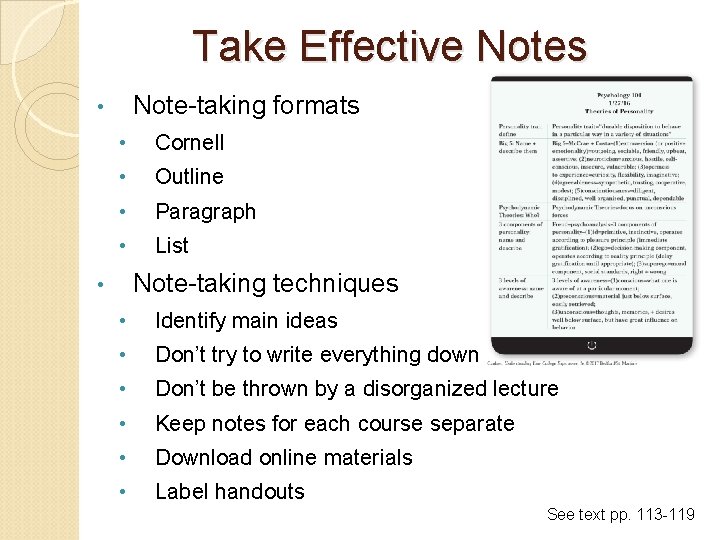
Take Effective Notes Note-taking formats • • Cornell • Outline • Paragraph • List Note-taking techniques • • Identify main ideas • Don’t try to write everything down • Don’t be thrown by a disorganized lecture • Keep notes for each course separate • Download online materials • Label handouts See text pp. 113 -119
Take Effective Notes: Types of Courses Taking notes in non-lecture courses • • Adapt note-taking methods to match the situation Taking notes in mathematics and science • courses • Write down equations, formulas, diagrams, charts, graphs, and definitions • • Write the instructor’s words precisely • Use standard symbols, abbreviations, and notation • Take notes in pencil • Keep math and science notes until graduation Use technology to take notes See text pp. 119 -121
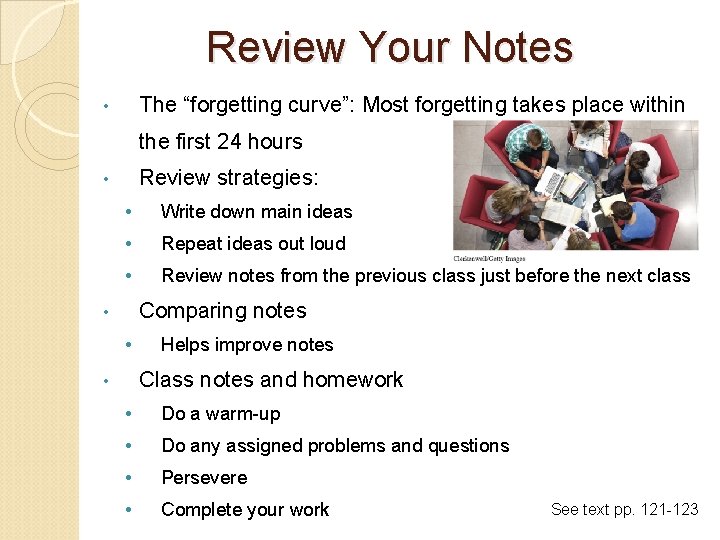
Review Your Notes The “forgetting curve”: Most forgetting takes place within • the first 24 hours Review strategies: • • Write down main ideas • Repeat ideas out loud • Review notes from the previous class just before the next class Comparing notes • • Helps improve notes Class notes and homework • • Do a warm-up • Do any assigned problems and questions • Persevere • Complete your work See text pp. 121 -123
Tech Tip: Explore Note-Taking Programs and Apps Use basic programs to sharpen note-taking skills • • Word • • Excel • • Good for economics and accounting courses Power. Point • • Great for taking notes in most classes Invaluable tool for visual learners Use apps to take notes on your phone and across devices See text p. 124
- Slides: 9