
Getting the Extinction Factor BNL History Kevin Brown
Getting the Extinction Factor: BNL History Kevin Brown C-AD Dept. , BNL kbrown@bnl. gov & L. Ahrens, M. Blaskiewicz, J. M. Brennan, J. W. Glenn, Y. Y. Lee, T. Roser, J. Wei
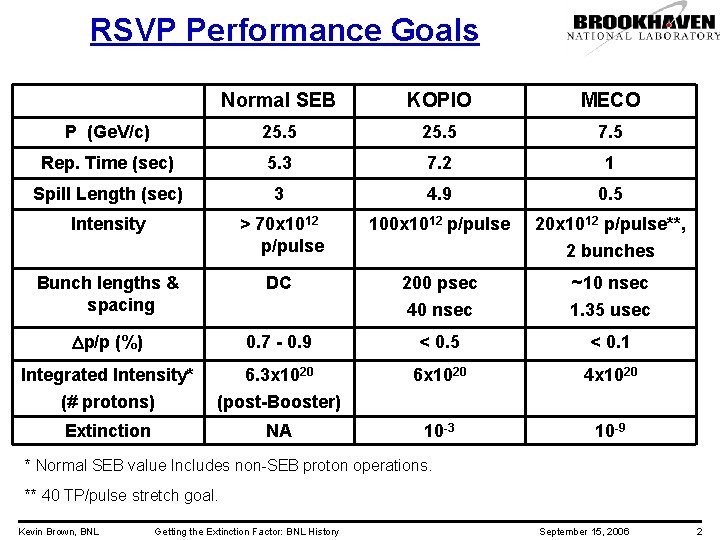
RSVP Performance Goals Normal SEB KOPIO MECO P (Ge. V/c) 25. 5 7. 5 Rep. Time (sec) 5. 3 7. 2 1 Spill Length (sec) 3 4. 9 0. 5 Intensity > 70 x 1012 p/pulse 100 x 1012 p/pulse 20 x 1012 p/pulse**, Bunch lengths & spacing DC 200 psec ~10 nsec 40 nsec 1. 35 usec Dp/p (%) 0. 7 - 0. 9 < 0. 5 < 0. 1 Integrated Intensity* 6. 3 x 10²⁰ 6 x 10²⁰ 4 x 10²⁰ (# protons) (post-Booster) Extinction NA 10 -3 10 -9 2 bunches * Normal SEB value Includes non-SEB proton operations. ** 40 TP/pulse stretch goal. Kevin Brown, BNL Getting the Extinction Factor: BNL History September 15, 2006 2
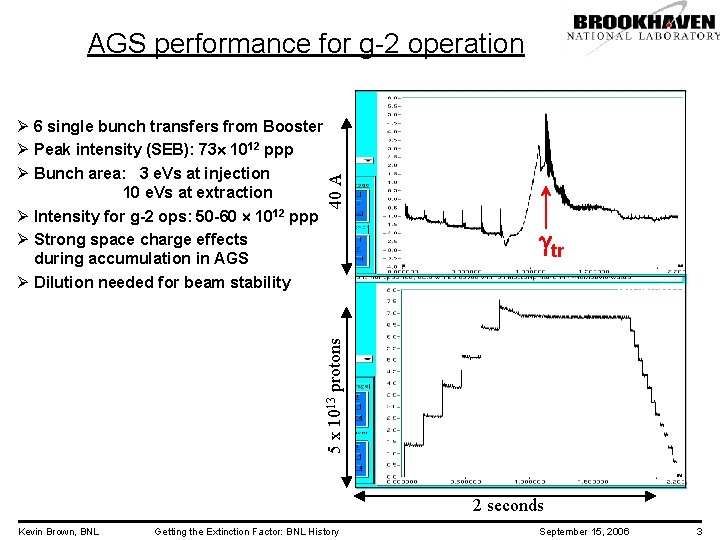
AGS performance for g-2 operation gtr Intensity 5 x 10¹³ protons Ø 6 single bunch transfers from Booster Ø Peak intensity (SEB): 73 1012 ppp Ø Bunch area: 3 e. Vs at injection 10 e. Vs at extraction Ø Intensity for g-2 ops: 50 -60 1012 ppp Ø Strong space charge effects during accumulation in AGS Ø Dilution needed for beam stability 40 A Peak current 2 seconds Kevin Brown, BNL Getting the Extinction Factor: BNL History September 15, 2006 3
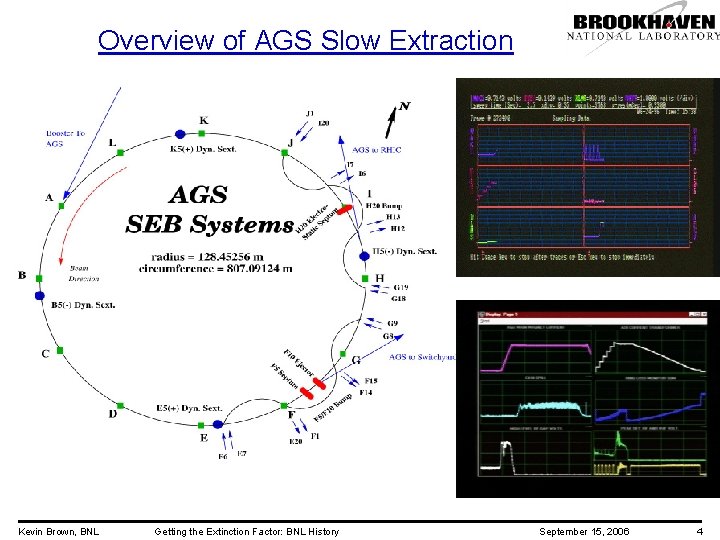
Overview of AGS Slow Extraction Kevin Brown, BNL Getting the Extinction Factor: BNL History September 15, 2006 4
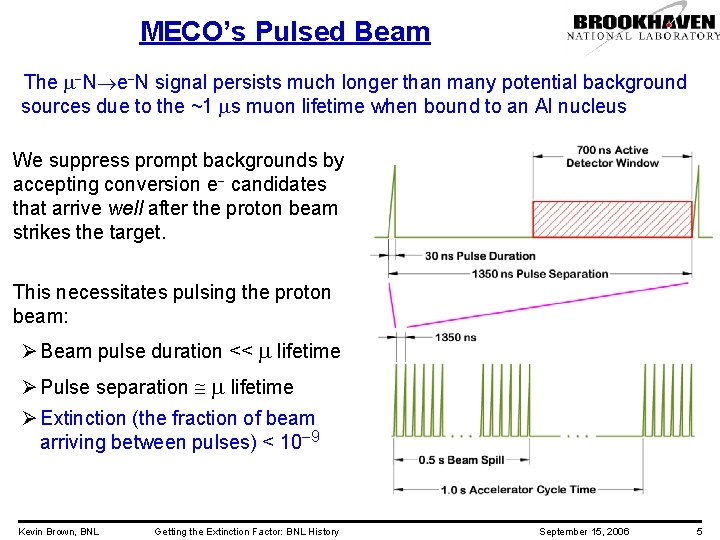
MECO’s Pulsed Beam The m N e N signal persists much longer than many potential background sources due to the ~1 ms muon lifetime when bound to an Al nucleus We suppress prompt backgrounds by accepting conversion e candidates that arrive well after the proton beam strikes the target. This necessitates pulsing the proton beam: Ø Beam pulse duration << m lifetime Ø Pulse separation m lifetime Ø Extinction (the fraction of beam arriving between pulses) < 10 9 Kevin Brown, BNL Getting the Extinction Factor: BNL History September 15, 2006 5
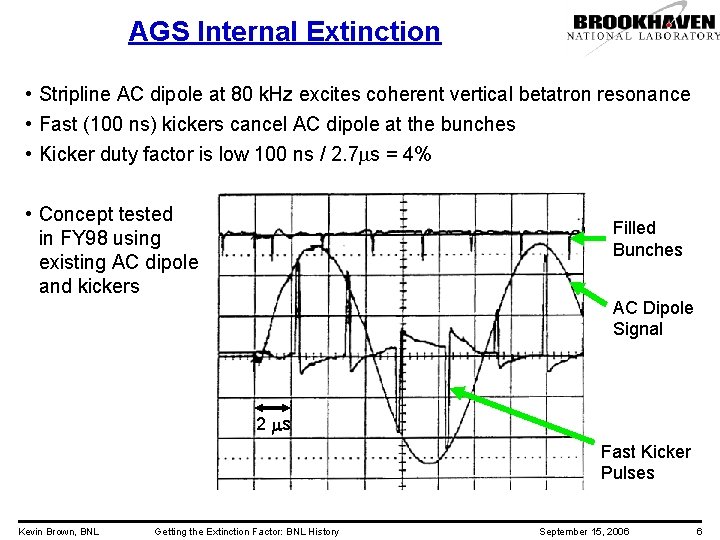
AGS Internal Extinction • Stripline AC dipole at 80 k. Hz excites coherent vertical betatron resonance • Fast (100 ns) kickers cancel AC dipole at the bunches • Kicker duty factor is low 100 ns / 2. 7 ms = 4% • Concept tested in FY 98 using existing AC dipole and kickers Filled Bunches AC Dipole Signal 2 ms Fast Kicker Pulses Kevin Brown, BNL Getting the Extinction Factor: BNL History September 15, 2006 6
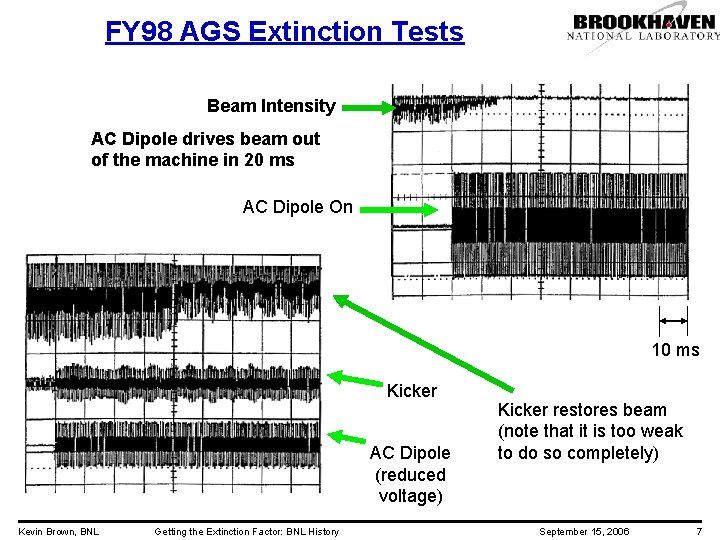
FY 98 AGS Extinction Tests Beam Intensity AC Dipole drives beam out of the machine in 20 ms AC Dipole On 10 ms Kicker AC Dipole (reduced voltage) Kevin Brown, BNL Getting the Extinction Factor: BNL History Kicker restores beam (note that it is too weak to do so completely) September 15, 2006 7

Early Extinction Measurements • Initial test at 24 Ge. V/c with one bucket in the AGS yielded <10 -6 extinction between buckets and 10 -3 in unfilled buckets Histogram = QVT Dots = scaler counts • A second test at 7. 4 Ge. V/c with a single bucket found <10 -7 extinction • Test time was insufficient in either case to optimize the extinction during the test • It is possible that careful tuning alone will suffice to achieve <10 -9 but we are conservatively assuming that it will not Beam Intensity vs. Time modulo 1. 35 ms during test with E 871 trigger Kevin Brown, BNL Getting the Extinction Factor: BNL History September 15, 2006 8
MECO Extraction Boundary Conditions 1. Proximity to gtr has benefits and problems 1. Benefits 1. Synchrotron frequency is slower closer to gtr 1. Slower synchrotron frequency a lower probability of extinction corruption after initial cleaning. 2. Slower synchrotron frequency a better slow spill control and higher probability of improved spill structure. 2. Closer to gtr shorter bunches in AGS and larger dp/p 2. Problems 1. Closer to gtr higher peak currents 2. Closer to gtr shorter bunches and larger dp/p 3. Closer to gtr lower RF voltage (to reduce peak currents and avoid momentum aperture) MINIMUM voltage sets one boundary condition. Amount of radial control (d. E /turn) sets another. 2. Gap cleaning system effectiveness strongly depends on betatron tune spread = a function of dp/p. Closer to gtr may mean less effective gap cleaning. (AC Dipole effectiveness). 3. High intensity will also increase tune spread (e. g. , more tune spread will help reduce susceptibility to instabilities), also reducing effectiveness of Gap cleaning system. Kevin Brown, BNL Getting the Extinction Factor: BNL History September 15, 2006 9
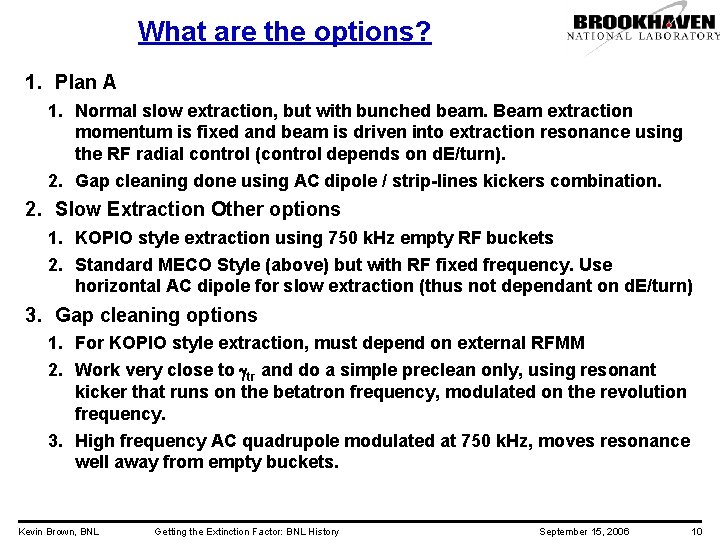
What are the options? 1. Plan A 1. Normal slow extraction, but with bunched beam. Beam extraction momentum is fixed and beam is driven into extraction resonance using the RF radial control (control depends on d. E/turn). 2. Gap cleaning done using AC dipole / strip-lines kickers combination. 2. Slow Extraction Other options 1. KOPIO style extraction using 750 k. Hz empty RF buckets 2. Standard MECO Style (above) but with RF fixed frequency. Use horizontal AC dipole for slow extraction (thus not dependant on d. E/turn) 3. Gap cleaning options 1. For KOPIO style extraction, must depend on external RFMM 2. Work very close to gtr and do a simple preclean only, using resonant kicker that runs on the betatron frequency, modulated on the revolution frequency. 3. High frequency AC quadrupole modulated at 750 k. Hz, moves resonance well away from empty buckets. Kevin Brown, BNL Getting the Extinction Factor: BNL History September 15, 2006 10
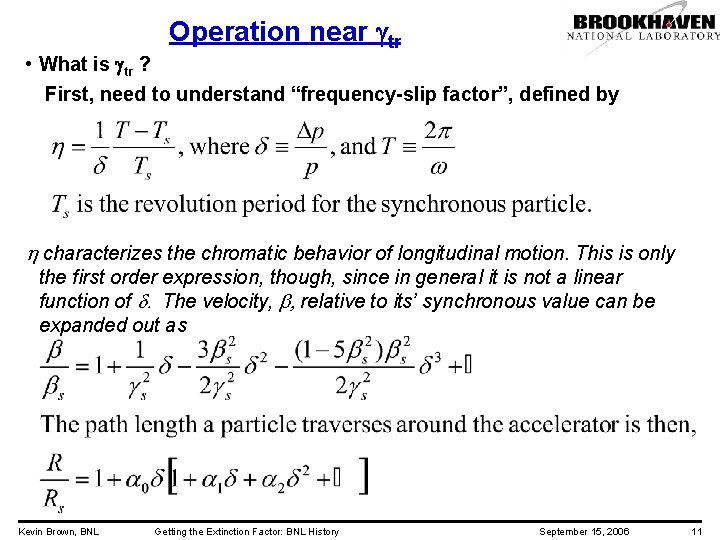
Operation near gtr • What is gtr ? First, need to understand “frequency-slip factor”, defined by h characterizes the chromatic behavior of longitudinal motion. This is only the first order expression, though, since in general it is not a linear function of d. The velocity, b, relative to its’ synchronous value can be expanded out as Kevin Brown, BNL Getting the Extinction Factor: BNL History September 15, 2006 11
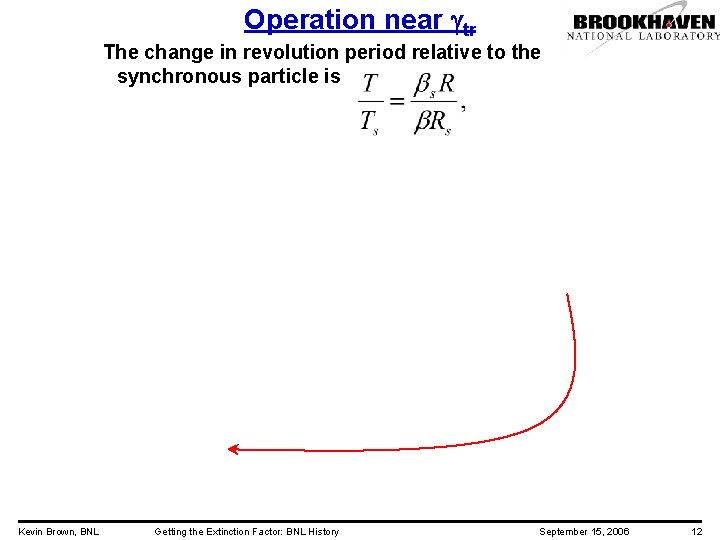
Operation near gtr The change in revolution period relative to the synchronous particle is Kevin Brown, BNL Getting the Extinction Factor: BNL History September 15, 2006 12
Operation near gtr Kevin Brown, BNL Getting the Extinction Factor: BNL History September 15, 2006 13
Operation near gtr g Kevin Brown, BNL Getting the Extinction Factor: BNL History September 15, 2006 14
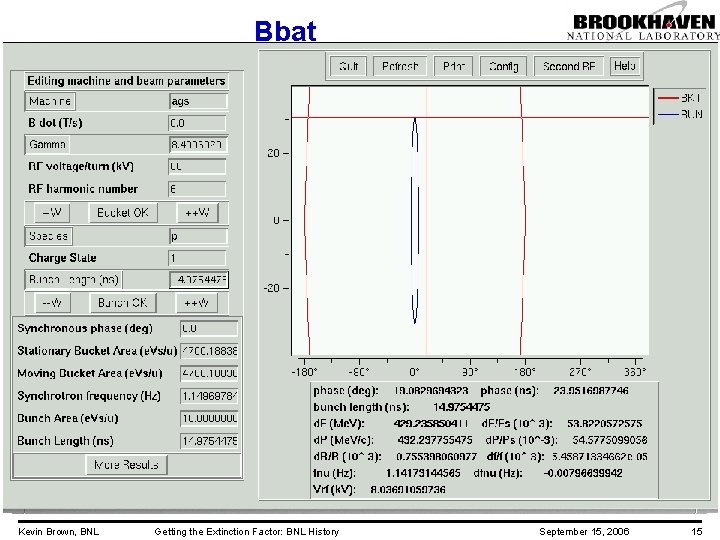
Bbat Kevin Brown, BNL Getting the Extinction Factor: BNL History September 15, 2006 15
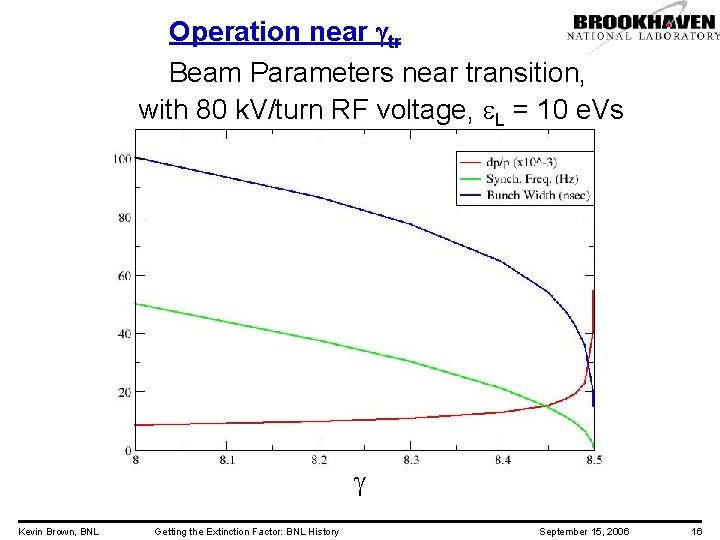
Operation near gtr Beam Parameters near transition, with 80 k. V/turn RF voltage, e. L = 10 e. Vs g Kevin Brown, BNL Getting the Extinction Factor: BNL History September 15, 2006 16
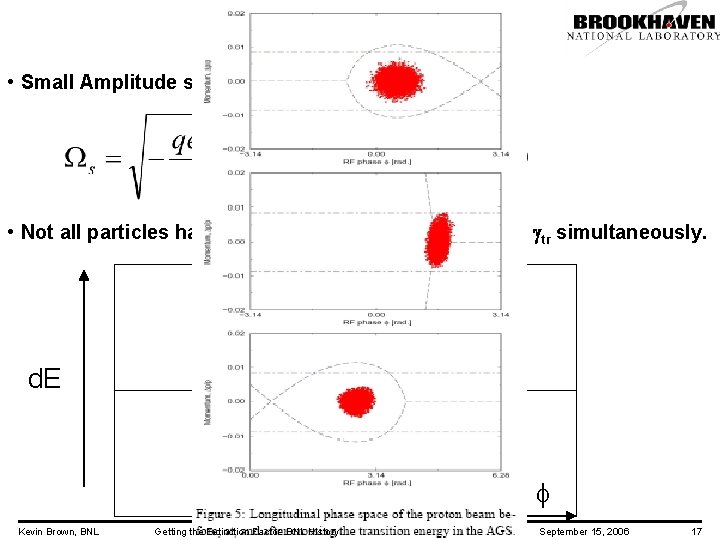
So what ? • Small Amplitude synchrotron-oscillation frequency • Not all particles have same E, so not all pass through gtr simultaneously. d. E f Kevin Brown, BNL Getting the Extinction Factor: BNL History September 15, 2006 17
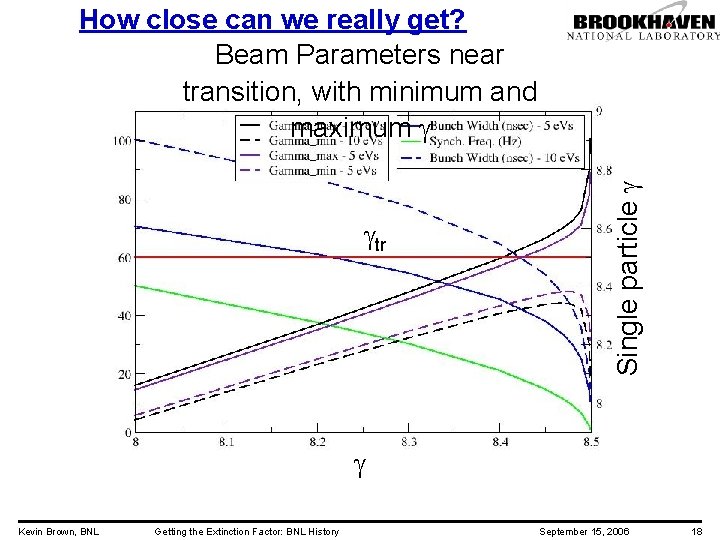
gtr Single particle g How close can we really get? Beam Parameters near transition, with minimum and maximum g g Kevin Brown, BNL Getting the Extinction Factor: BNL History September 15, 2006 18
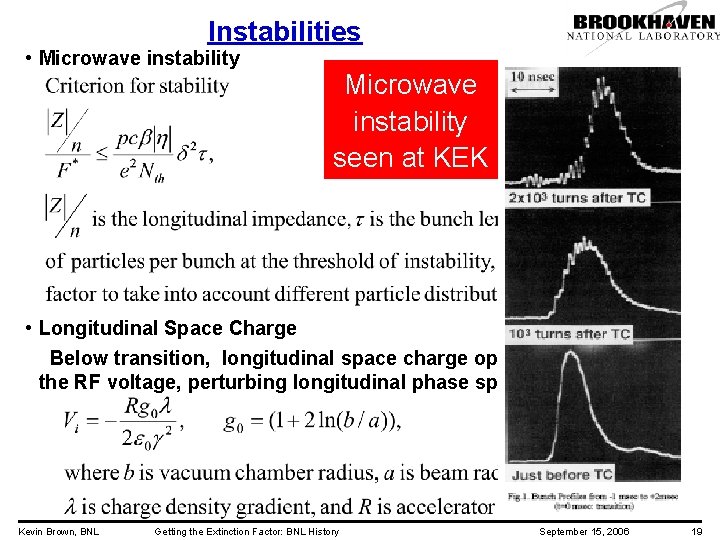
Instabilities • Microwave instability seen at KEK • Longitudinal Space Charge Below transition, longitudinal space charge opposes the effect of the RF voltage, perturbing longitudinal phase space (Good thing!) Kevin Brown, BNL Getting the Extinction Factor: BNL History September 15, 2006 19
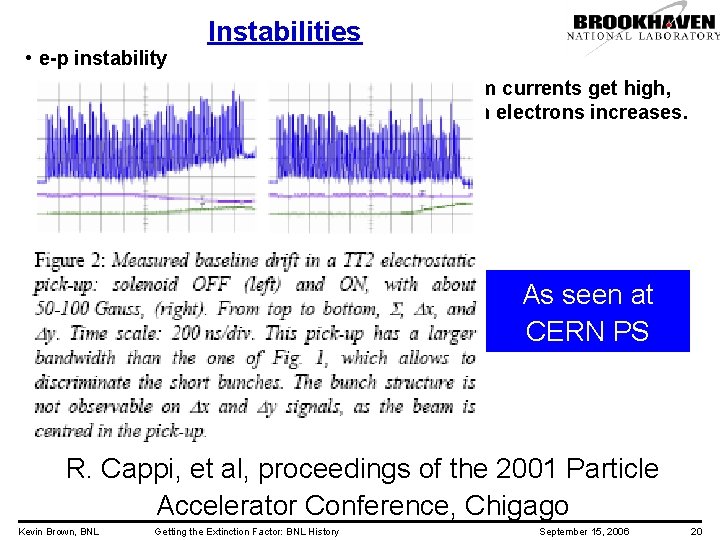
Instabilities • e-p instability As bunch lengths get very short and peak beam currents get high, the probability of higher mode interactions with electrons increases. V. Danilov et al, LANL, proceedings of the 1999 Particle As. Accelerator seen at Conference, New York, 1999 CERN PS R. Cappi, et al, proceedings of the 2001 Particle Accelerator Conference, Chigago Kevin Brown, BNL Getting the Extinction Factor: BNL History September 15, 2006 20
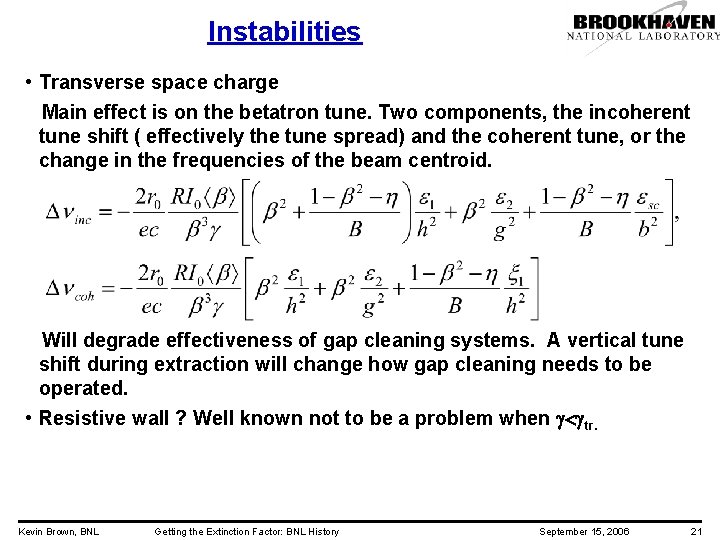
Instabilities • Transverse space charge Main effect is on the betatron tune. Two components, the incoherent tune shift ( effectively the tune spread) and the coherent tune, or the change in the frequencies of the beam centroid. Will degrade effectiveness of gap cleaning systems. A vertical tune shift during extraction will change how gap cleaning needs to be operated. • Resistive wall ? Well known not to be a problem when g<gtr. Kevin Brown, BNL Getting the Extinction Factor: BNL History September 15, 2006 21
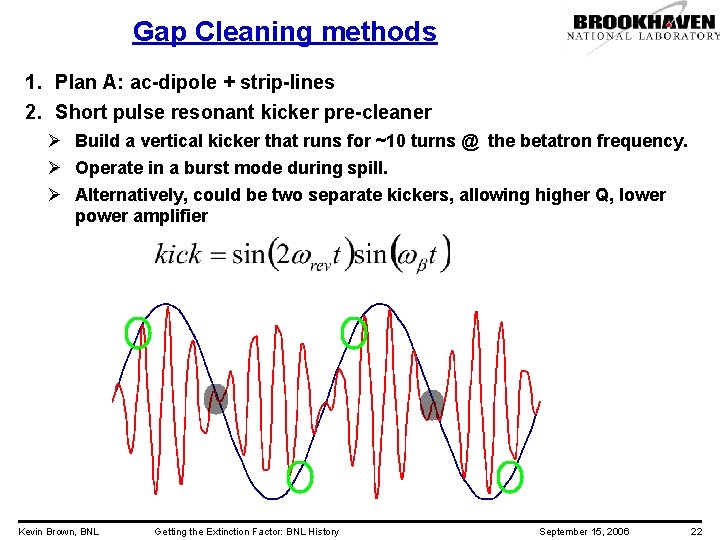
Gap Cleaning methods 1. Plan A: ac-dipole + strip-lines 2. Short pulse resonant kicker pre-cleaner Ø Build a vertical kicker that runs for ~10 turns @ the betatron frequency. Ø Operate in a burst mode during spill. Ø Alternatively, could be two separate kickers, allowing higher Q, lower power amplifier Kevin Brown, BNL Getting the Extinction Factor: BNL History September 15, 2006 22
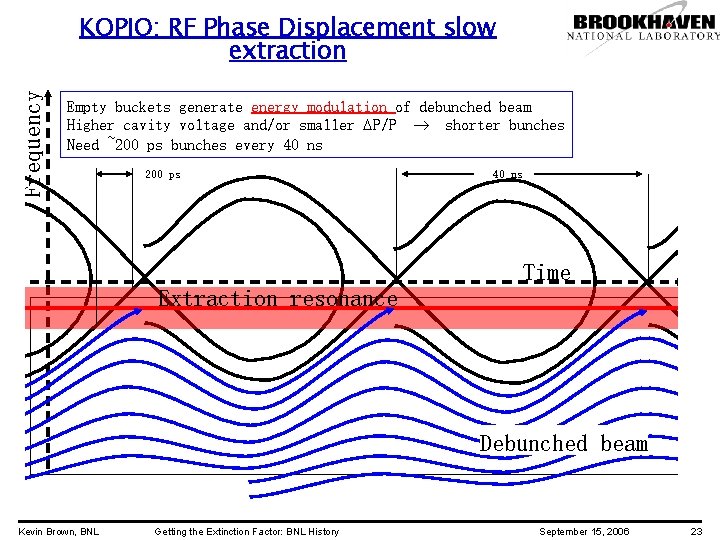
Frequency KOPIO: RF Phase Displacement slow extraction Empty buckets generate energy modulation of debunched beam Higher cavity voltage and/or smaller DP/P shorter bunches Need ~200 ps bunches every 40 ns 200 ps 40 ns Time Extraction resonance Debunched beam Kevin Brown, BNL Getting the Extinction Factor: BNL History September 15, 2006 23
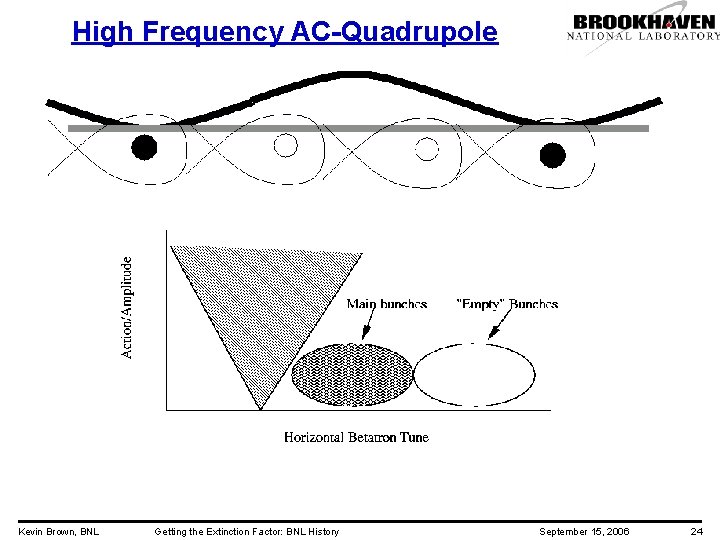
High Frequency AC-Quadrupole Kevin Brown, BNL Getting the Extinction Factor: BNL History September 15, 2006 24
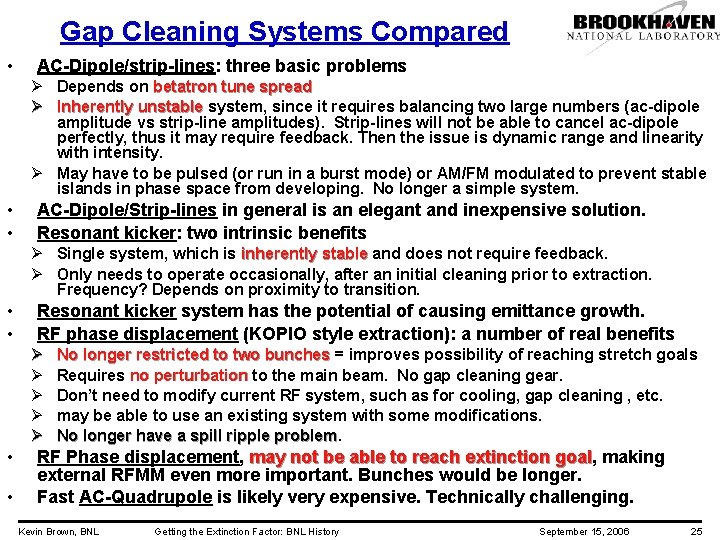
Gap Cleaning Systems Compared • AC-Dipole/strip-lines: three basic problems Ø Depends on betatron tune spread Ø Inherently unstable system, since it requires balancing two large numbers (ac-dipole amplitude vs strip-line amplitudes). Strip-lines will not be able to cancel ac-dipole perfectly, thus it may require feedback. Then the issue is dynamic range and linearity with intensity. Ø May have to be pulsed (or run in a burst mode) or AM/FM modulated to prevent stable islands in phase space from developing. No longer a simple system. • • AC-Dipole/Strip-lines in general is an elegant and inexpensive solution. Resonant kicker: two intrinsic benefits Ø Single system, which is inherently stable and does not require feedback. Ø Only needs to operate occasionally, after an initial cleaning prior to extraction. Frequency? Depends on proximity to transition. • • Resonant kicker system has the potential of causing emittance growth. RF phase displacement (KOPIO style extraction): a number of real benefits Ø Ø Ø • • No longer restricted to two bunches = improves possibility of reaching stretch goals Requires no perturbation to the main beam. No gap cleaning gear. Don’t need to modify current RF system, such as for cooling, gap cleaning , etc. may be able to use an existing system with some modifications. No longer have a spill ripple problem RF Phase displacement, may not be able to reach extinction goal, goal making external RFMM even more important. Bunches would be longer. Fast AC-Quadrupole is likely very expensive. Technically challenging. Kevin Brown, BNL Getting the Extinction Factor: BNL History September 15, 2006 25
Simulations Questions 1. e. L constraints defined by Booster extraction and AGS injection. 1. Booster extraction is momentum aperture limited (need low dp/p for clean extraction) 2. AGS injection longitudinal matching? 3. Minimum bucket area in AGS set by B-dot and RF Voltage program. 2. Beam dynamics near gtr 1. 2. 3. 4. 5. 6. 7. what constraints define proximity to gtr (operating constraints) What are predicted bunch widths vs g What are predicted peak currents vs g Predicted dp/p vs g, intensity E-p, e-cloud near gtr Transit times vs g and dp/p Synchrotron frequency and frequency spread. 3. Mechanisms that affect extinction 1. 2. 3. 4. 5. Captured beam in empty buckets Scatter from residual gas Scatter from vacuum chambers (& momentum aperture) E-cloud, intra-beam, microwave instability, etc. Image current resonances (impedance & space charge) Kevin Brown, BNL Getting the Extinction Factor: BNL History September 15, 2006 26
Simulations Questions 3. Extraction 1. 2. 3. 4. AGS impedance (+ new equipment) Spill structure correction 6 -D emittance vs intensity What working point (n, x) is optimal 4. Gap cleaning methods 1. Plan A: ac-dipole + strip-lines • Development of stable islands in phase space • Burst mode, AM/FM • What is cleaning efficiency, for simple AGS, no space charge 2. Short pulse resonant kicker pre-cleaner • What frequencies to use? • Operate in a burst mode during spill? • What is cleaning efficiency, for simple AGS, no space charge 3. Avoid resonance with fast ac-quadrupole • What is cleaning efficiency, for simple AGS, no space charge Kevin Brown, BNL Getting the Extinction Factor: BNL History September 15, 2006 27
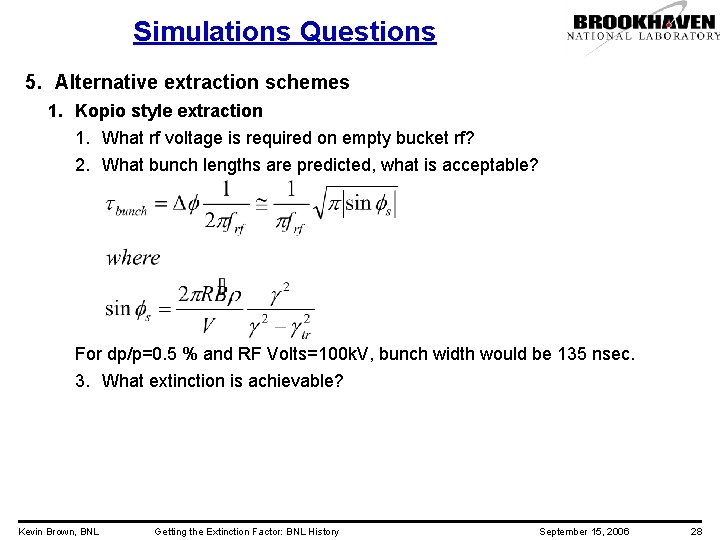
Simulations Questions 5. Alternative extraction schemes 1. Kopio style extraction 1. What rf voltage is required on empty bucket rf? 2. What bunch lengths are predicted, what is acceptable? For dp/p=0. 5 % and RF Volts=100 k. V, bunch width would be 135 nsec. 3. What extinction is achievable? Kevin Brown, BNL Getting the Extinction Factor: BNL History September 15, 2006 28
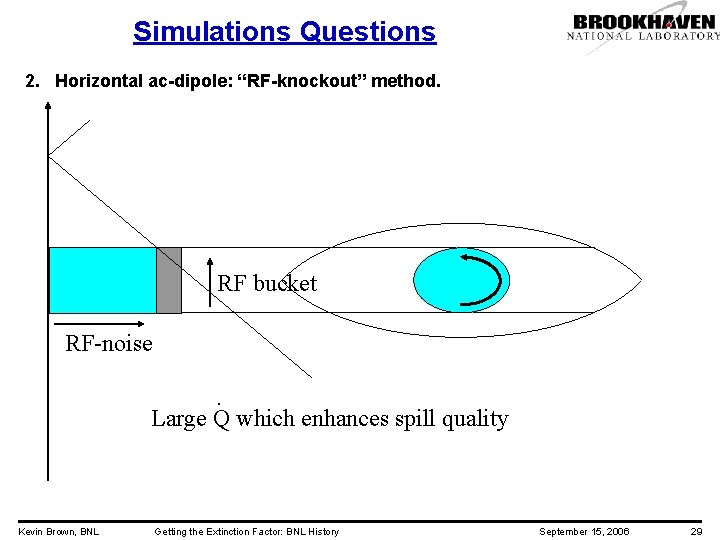
Simulations Questions 2. Horizontal ac-dipole: “RF-knockout” method. RF bucket RF-noise. Large Q which enhances spill quality Kevin Brown, BNL Getting the Extinction Factor: BNL History September 15, 2006 29
Conclusions 1. The method for MECO extraction, which ensured good intensity and meets extinction requirements, is not well established nor well defined. The goals were believed to be achievable. To improve on our understanding required more beam studies and simulations. 2. Operation near the AGS gtr point is not well understood. 3. Instabilities, especially near gtr point, are not well understood. 4. Gap cleaning methods need to be compared in more detail to understand the relative benefits and effectiveness. 5. On a positive note: the required extinction levels appear to be achievable. Kevin Brown, BNL Getting the Extinction Factor: BNL History September 15, 2006 30
- Slides: 30