
Getting Started with the Kernel Obtaining the Kernel
Getting Started with the Kernel
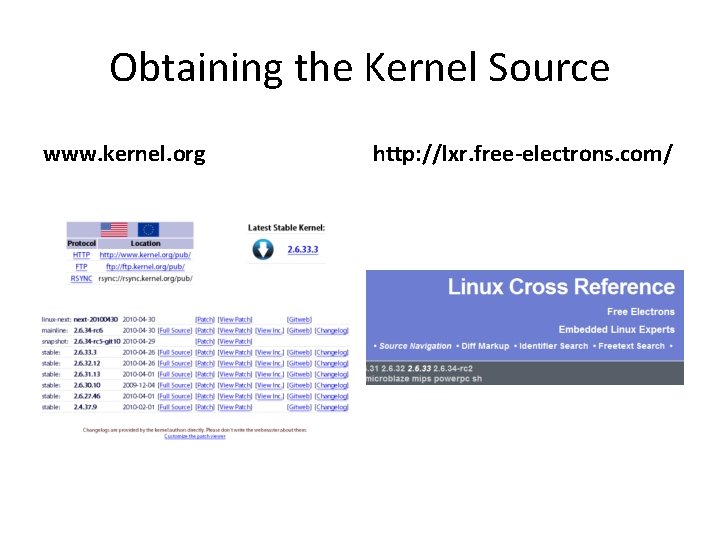
Obtaining the Kernel Source www. kernel. org http: //lxr. free-electrons. com/
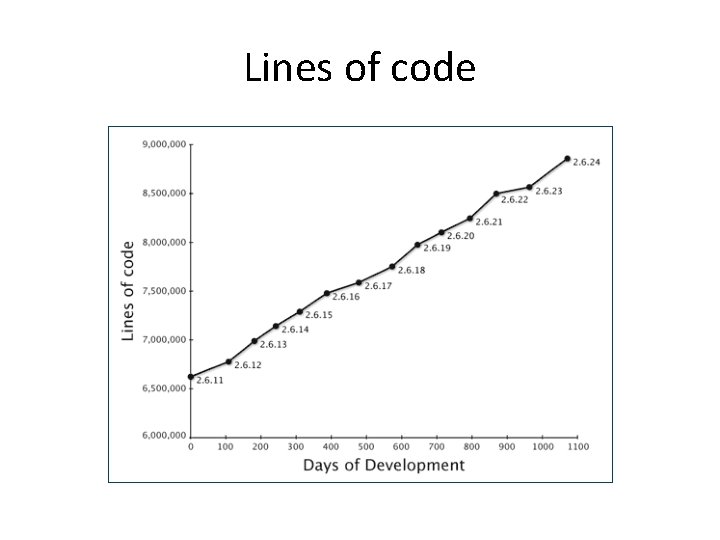
Lines of code

The Kernel Source Tree Directory lib Description Architecture-specific source Crypto API Kernel source documentation Device drivers The VFS and the individual file systems Kernel headers Kernel boot and initialization Interprocess communication code Core subsystems, such as the scheduler Helper routines mm Memory management subsystem and the VM net Networking subsystem Scripts used to build the kernel Linux Security Module Sound subsystem Early user-space code (called initramfs) arch crypto Documentation drivers fs include init ipc kernel scripts security sound usr
A Beast of a Different Nature (in kernel mode) • The kernel does not have access to the C library. • The kernel is coded in GNU C. (not in ANSI C) • The kernel lacks memory protection like user-space. • • The kernel cannot easily use floating point. • The kernel has a small fixedsize stack. • Because the kernel has asynchronous interrupts, is preemptive, and supports SMP, synchronization and concurrency are major concerns within the kernel. Portability is important.
Different Natures • No libc support – There are multiple reasons for this, including some chicken-and-the-egg situations, but the primary reason is speed and size (upcall? ). – Many of the usual libc functions have been implemented inside the kernel. • For example <linux/string. h>

Inline Functions An inline function is declared when the keywords static and inline are used as part of the function definition. For example: static inline void wolf(unsigned long tail_size) – Because they are marked static , an exported function is not created.
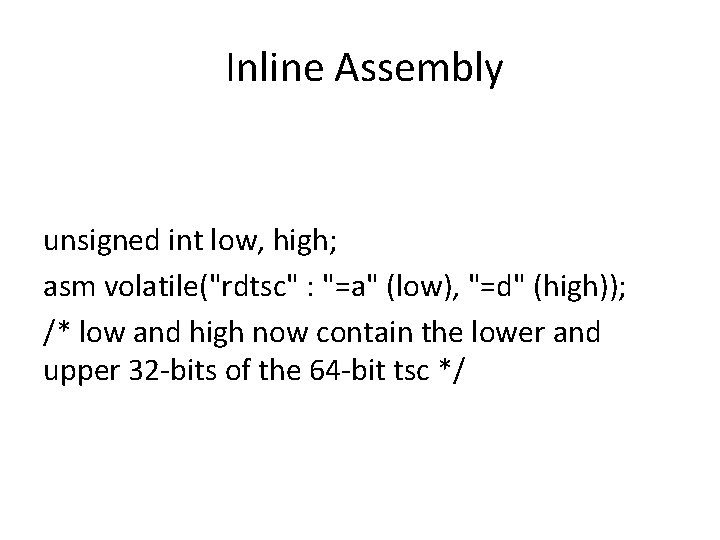
Inline Assembly unsigned int low, high; asm volatile("rdtsc" : "=a" (low), "=d" (high)); /* low and high now contain the lower and upper 32 -bits of the 64 -bit tsc */
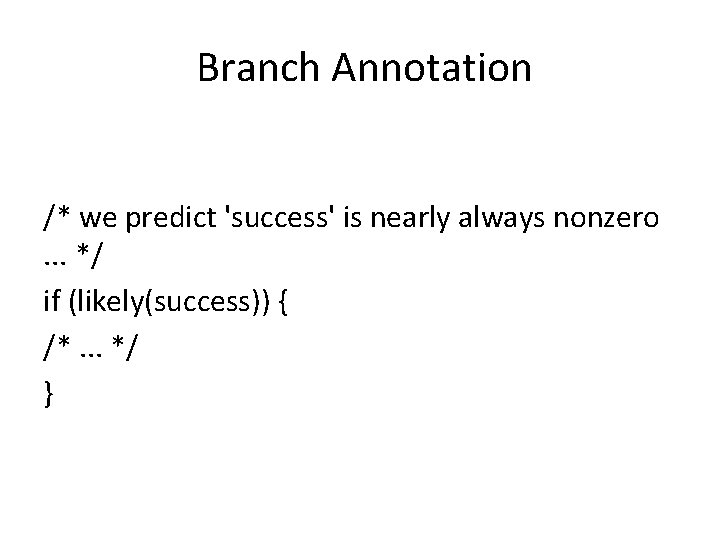
Branch Annotation /* we predict 'success' is nearly always nonzero. . . */ if (likely(success)) { /*. . . */ }
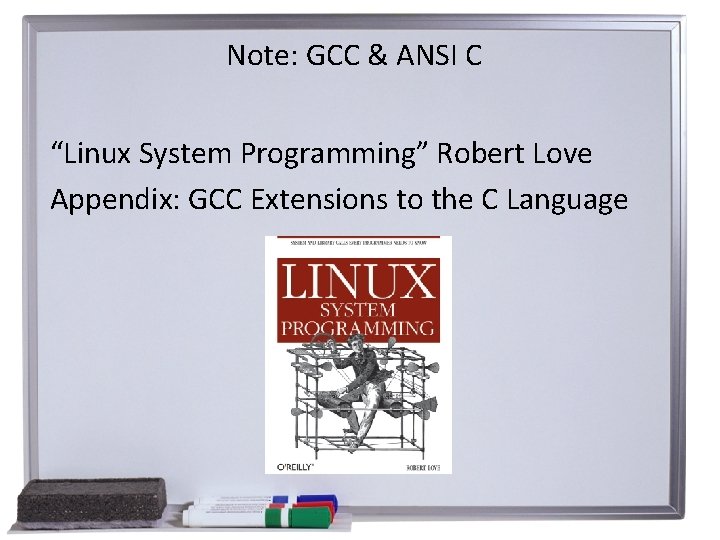
Note: GCC & ANSI C “Linux System Programming” Robert Love Appendix: GCC Extensions to the C Language
No (Easy) Use of Floating Point • When a user-space process uses floating-point instructions, the kernel manages the transition from integer to floating point mode. • Unlike user-space, the kernel does not have the luxury of seamless support for floating point because it cannot easily trap itself.
Note: “DO” have some floating-point computations • Recompile GNU‘s libc with option “--without -fp” to avoid using floating-point hardware while providing floating-point computations • Compile the module's. c files with gcc's – "-msoft-float" option and – "-D__NO_MATH_INLINES".
Small, Fixed-Size Stack • The user-space stack can dynamically grow • The kernel stack is small and fixed in size – Historically, the kernel stack is two pages. – Recently, the size of kernel stack is one page only!!!
Synchronization and Concurrency • Linux is a preemptive multitasking operating system. • The Linux kernel is preemptive. • Linux supports symmetrical multiprocessing – For example, Linux can use more than one core/processor to decode TCP/IP packets (named softirq) • Interrupts occur asynchronously
Conclusion It is imperative that you read and modify the kernel source – Only through actually reading and experimenting with the code can you ever understand it. – The source is freely available—use it! – http: //140. 123. 102. 115/lxr/linux/
homework • Use “git” to maintain your kernel source tree • Compile a Linux kernel
- Slides: 16