
Getting Started with C C Programming Language What




- Slides: 20
Getting Started with C
C Programming Language �What is C? �C is a structured, relatively low-level, portable programming language. �Why study C? �Many popular software tools are written in C. �Has strongly influenced many other languages. �C-shell, java, C++, Perl, etc. �Forces the user to understand fundamental aspects of programming. �Very concise language.
History of C �C �Evolved by Ritchie from two previous programming languages, BCPL and B �Used to develop UNIX �Used to write modern operating systems �Hardware independent (portable) �By late 1970's C had evolved to "traditional C"
History of C �Standardization �Many slight variations of C existed, and were incompatible �Committee formed to create a "unambiguous, machine-independent" definition �Standard created in 1989, updated in 1999
First C Program
A Simple C Program A first program in C */ #include <stdio. h> int main() { printf( "Welcome to C!n" ); return 0; } Welcome to C! � Comments � Text surrounded by /* and */ is ignored by computer � Used to describe program � #include <stdio. h> � Preprocessor directive � Tells computer to load contents of a certain file � <stdio. h> allows standard input/output operations
A Simple C Program, Cont. �int main() �C programs contain one or more functions, exactly one of which must be main �Parenthesis used to indicate a function �int means that main "returns" an integer value �Braces ({ and }) indicate a block �The bodies of all functions must be contained in braces
2. 2 A Simple C Program: Printing a Line of Text �Return 0; �A way to exit a function �Return 0, in this case, means that the program terminated normally
Second C Program User variables, reading user input
Addition program */ #include <stdio. h> int main() { integer 1, integer 2, sum; /* declaration */ printf( "Enter first integern" ); /* prompt */ scanf( "%d", &integer 1 ); /* read an integer */ printf( "Enter second integern" ); /* prompt */ scanf( "%d", &integer 2 ); /* read an integer */ sum = integer 1 + integer 2; /* assignment of sum */ printf( "Sum is %dn", sum ); /* print sum */ return 0; /* indicate that program ended successfully */ } Enter first integer 45 Enter second integer 72 Sum is 117
Variables in Programming �Represent storage units in a program �Used to store/retrieve data over life of program �Type of variable determines what can be placed in the storage unit �Assignment – process of placing a particular value in a variable �Variables must be declared before they are assigned �The value of a variable can change; A constant always has the same value
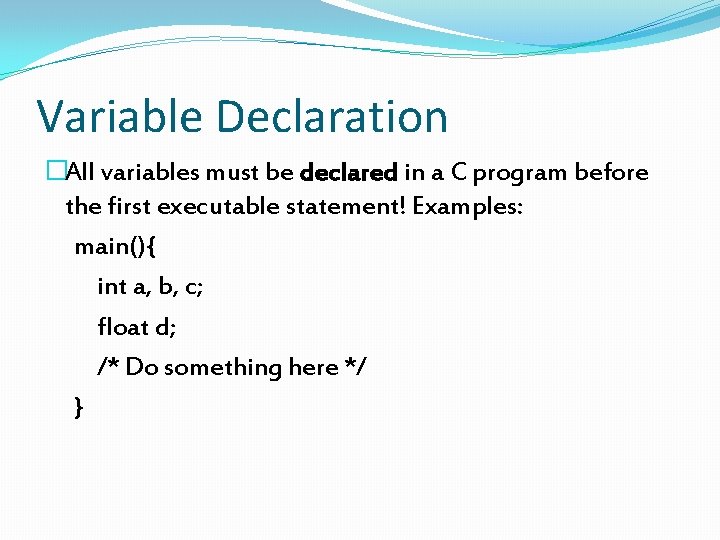
Variable Declaration �All variables must be declared in a C program before the first executable statement! Examples: main(){ int a, b, c; float d; /* Do something here */ }
Variable assignment �After variables are declared, they must (should) be given values. This is called assignment and it is done with the ‘=‘ operator. Examples: float a, b; int c; b = 2. 12; c = 200;
Basic C variable types �There are four basic data types in C: �char � A single byte capable of holding one character in the local character set. �int � An integer of unspecified size �float � Single-precision floating point �double � Double-precision floating point
Statements �Note: all statements end with a semicolon! �Statements can (with a few exceptions) be broken across lines or ganged on a single line �Commas separate multiple declarations �Blank lines have no effect �Extra spaces between tokens has no effect. �Comments are ignored by the compiler
The printf Executable Statement � The only executable statements we’ve seen to this point are � Assignments � The printf and scanf functions � Assignment expressions with simple operators (+, -) � Very hard to write any program without being able to print output. Must look at printf in more detail to start writing useful code.
printf(), cont. �Sends output to standard out, which for now we can think of as the terminal screen. �General form printf(format descriptor, var 1, var 2, …); �format descriptor is composed of �Ordinary characters � copied directly to output �Conversion specification � Causes conversion and printing of next argument to printf � Each conversion specification begins with %
Printf() examples �Easiest to start with some examples �printf(“%sn”, “hello world”); � Translated: “print hello world as a string followed by a newline character” �printf(“%dt%dn”, j, k); � Translated: “print the value of the variable j as an integer followed by a tab followed by the value of the variable k as an integer followed by a new line. ” �printf(“%f : %fn”, x, y, z); � English: “print the value of the floating point variable x, followed by a space, then a colon, then a space, etc.
Invisible characters �Some special characters are not visible directly in the output stream. These all begin with an escape character (ie ); �n newline �t horizontal tab �a alert bell �v vertical tab
Scanf function �In <stdio. f>, so no new #include(‘s) �Basic syntax �scanf( format-specifier, &var 1, &var 2, etc. ); �Format-specifier is identical to printf �We do not need to understand everything here, just enough to do some basic I/O �Examples �int a; scanf(“%d”, &a); �double x; scanf(“%f”, &x); �Blocks program until user enters input!