
Getting Started with BTEC applied science Welcome message
Getting Started with BTEC applied science
Welcome message The purpose of this Power. Point is to provide you with a range of activities and resources to prepare you to start the BTEC APPLIED SCIENCE course in September. It is aimed to be used after you complete your GCSE throughout the remainder of the Summer term and over the Summer Holidays to ensure you are ready to start your course in September. After five years of hard work you have chosen to study BTEC Applied Science. You have decided to follow in the footsteps of Charles Darwin, Gregor Mendel, Louis Pasteur and many more. You have decided you want a challenge, equip yourself with skills for further education and study, but also understand the world around you. Throughout your time studying BTEC Applied Science, we will support you every step of the way, answer your questions, but also share a love of the subject. The journey starts here, and we cannot wait to share the adventure with you. Welcome to BTEC Applied Science!
The applied science sector is diverse and wide-ranging, including, for example, biomedical, forensic, physical and chemical sciences. There approx. 5. 8 million people employed in applied science occupations in the UK. This equates to approximately 20% of the workforce. The applied science sector has a crucial role to play in delivering economic growth in the UK and allowing companies to compete in a rapidly enlarging global market.
What does the qualification cover? The content of this qualification has been developed in consultation with academics to ensure that it supports progression to higher education. In addition, employers andprofession al bodies have been involved and consulted, in order to confirm that the content is also appropriate and consistent with current practice for students planningto enter employment directly in the applied science sector. Everyone taking this qualification will study three mandatory units: ● Principles and Application of Science I ● Practical Scientific Procedures and Techniques ● Science Investigation Skills. Additional unit: ● physiology of human body systems. The units will cover aspects of all three sciences and a greater emphasis on scientific skills and techniques.
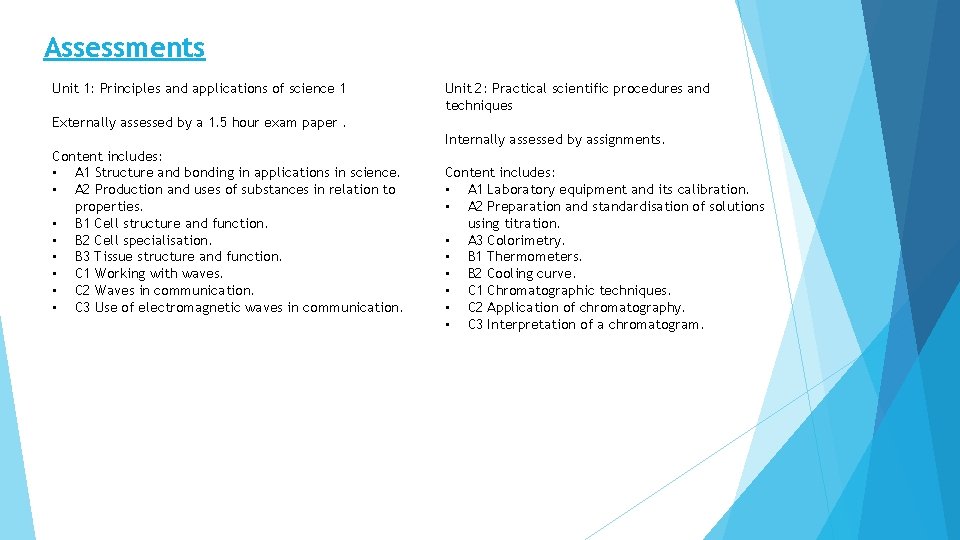
Assessments Unit 1: Principles and applications of science 1 Unit 2: Practical scientific procedures and techniques Externally assessed by a 1. 5 hour exam paper. Internally assessed by assignments. Content includes: • A 1 Structure and bonding in applications in science. • A 2 Production and uses of substances in relation to properties. • B 1 Cell structure and function. • B 2 Cell specialisation. • B 3 Tissue structure and function. • C 1 Working with waves. • C 2 Waves in communication. • C 3 Use of electromagnetic waves in communication. Content includes: • A 1 Laboratory equipment and its calibration. • A 2 Preparation and standardisation of solutions using titration. • A 3 Colorimetry. • B 1 Thermometers. • B 2 Cooling curve. • C 1 Chromatographic techniques. • C 2 Application of chromatography. • C 3 Interpretation of a chromatogram.
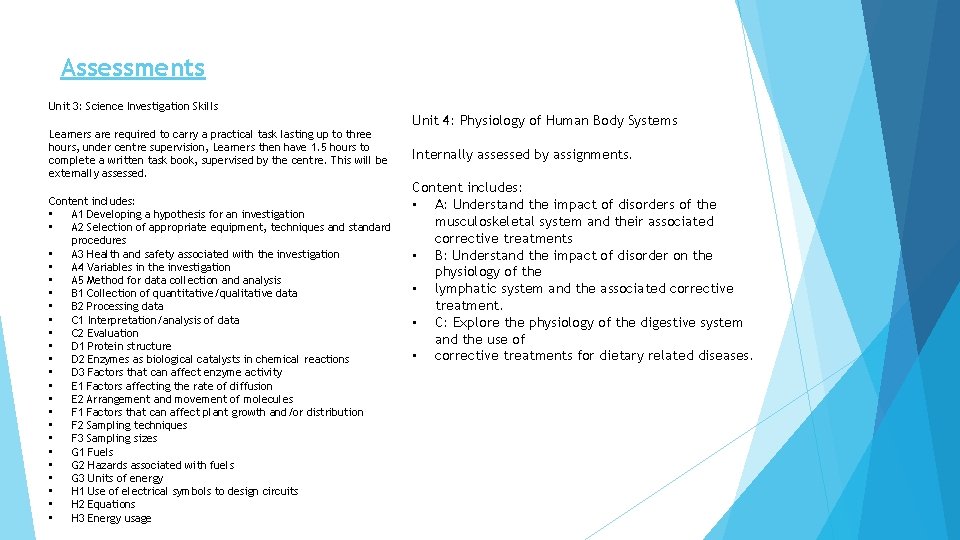
Assessments Unit 3: Science Investigation Skills Learners are required to carry a practical task lasting up to three hours, under centre supervision, Learners then have 1. 5 hours to complete a written task book, supervised by the centre. This will be externally assessed. Content includes: • A 1 Developing a hypothesis for an investigation • A 2 Selection of appropriate equipment, techniques and standard procedures • A 3 Health and safety associated with the investigation • A 4 Variables in the investigation • A 5 Method for data collection and analysis • B 1 Collection of quantitative/qualitative data • B 2 Processing data • C 1 Interpretation/analysis of data • C 2 Evaluation • D 1 Protein structure • D 2 Enzymes as biological catalysts in chemical reactions • D 3 Factors that can affect enzyme activity • E 1 Factors affecting the rate of diffusion • E 2 Arrangement and movement of molecules • F 1 Factors that can affect plant growth and/or distribution • F 2 Sampling techniques • F 3 Sampling sizes • G 1 Fuels • G 2 Hazards associated with fuels • G 3 Units of energy • H 1 Use of electrical symbols to design circuits • H 2 Equations • H 3 Energy usage Unit 4: Physiology of Human Body Systems Internally assessed by assignments. Content includes: • A: Understand the impact of disorders of the musculoskeletal system and their associated corrective treatments • B: Understand the impact of disorder on the physiology of the • lymphatic system and the associated corrective treatment. • C: Explore the physiology of the digestive system and the use of • corrective treatments for dietary related diseases.
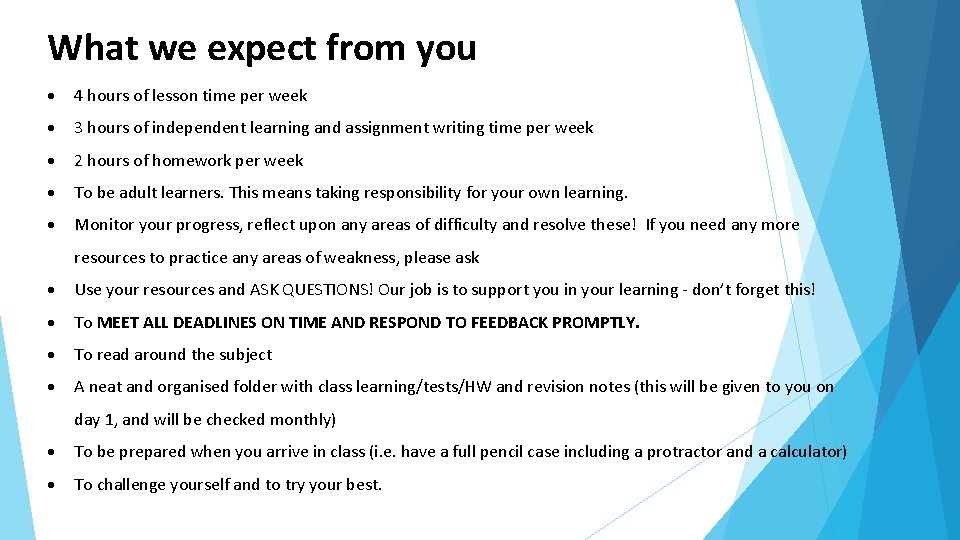
What we expect from you 4 hours of lesson time per week 3 hours of independent learning and assignment writing time per week 2 hours of homework per week To be adult learners. This means taking responsibility for your own learning. Monitor your progress, reflect upon any areas of difficulty and resolve these! If you need any more resources to practice any areas of weakness, please ask Use your resources and ASK QUESTIONS! Our job is to support you in your learning - don’t forget this! To MEET ALL DEADLINES ON TIME AND RESPOND TO FEEDBACK PROMPTLY. To read around the subject A neat and organised folder with class learning/tests/HW and revision notes (this will be given to you on day 1, and will be checked monthly) To be prepared when you arrive in class (i. e. have a full pencil case including a protractor and a calculator) To challenge yourself and to try your best.
- Slides: 7