
Getting Started The objective is to be able
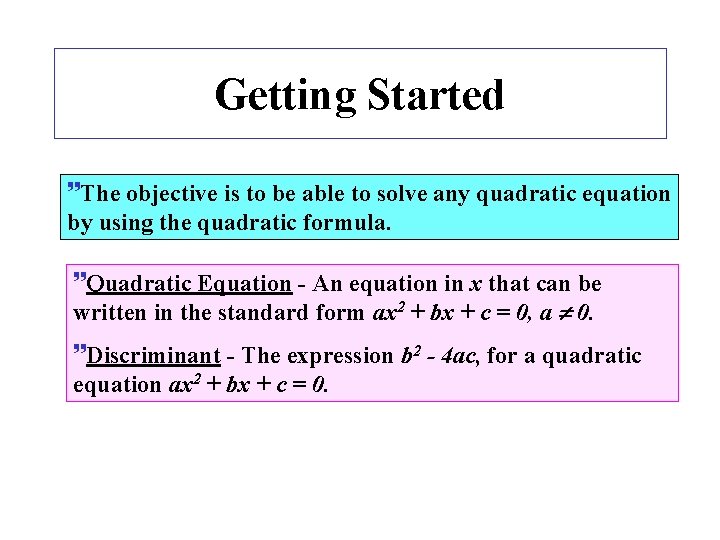
Getting Started ~The objective is to be able to solve any quadratic equation by using the quadratic formula. ~Quadratic Equation - An equation in x that can be written in the standard form ax 2 + bx + c = 0, a 0. ~Discriminant - The expression b 2 - 4 ac, for a quadratic equation ax 2 + bx + c = 0.
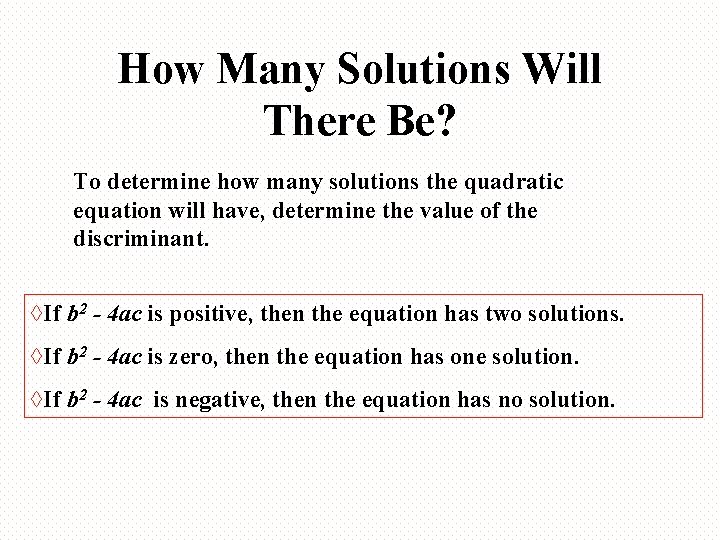
How Many Solutions Will There Be? To determine how many solutions the quadratic equation will have, determine the value of the discriminant. àIf b 2 - 4 ac is positive, then the equation has two solutions. àIf b 2 - 4 ac is zero, then the equation has one solution. àIf b 2 - 4 ac is negative, then the equation has no solution.
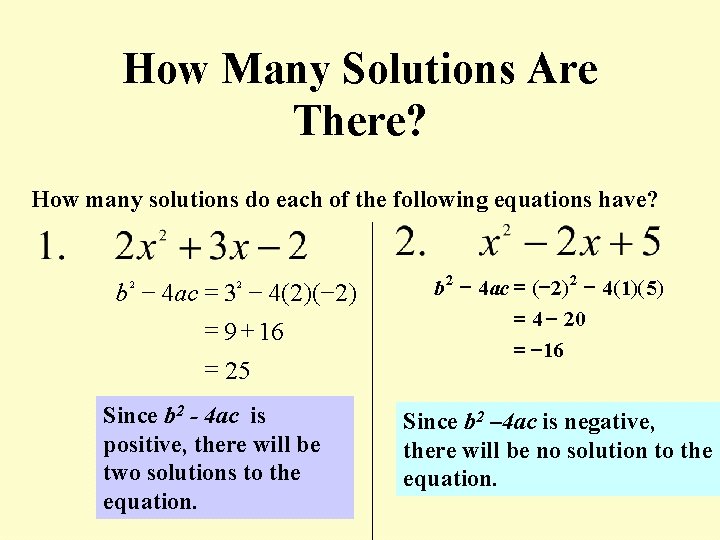
How Many Solutions Are There? How many solutions do each of the following equations have? b - 4 ac = 3 - 4(2)(-2) = 9 + 16 = 25 2 2 Since b 2 - 4 ac is positive, there will be two solutions to the equation. b 2 - 4 ac = ( -2) 2 - 4 (1)( 5 ) = 4 - 20 = -16 Since b 2 – 4 ac is negative, there will be no solution to the equation.
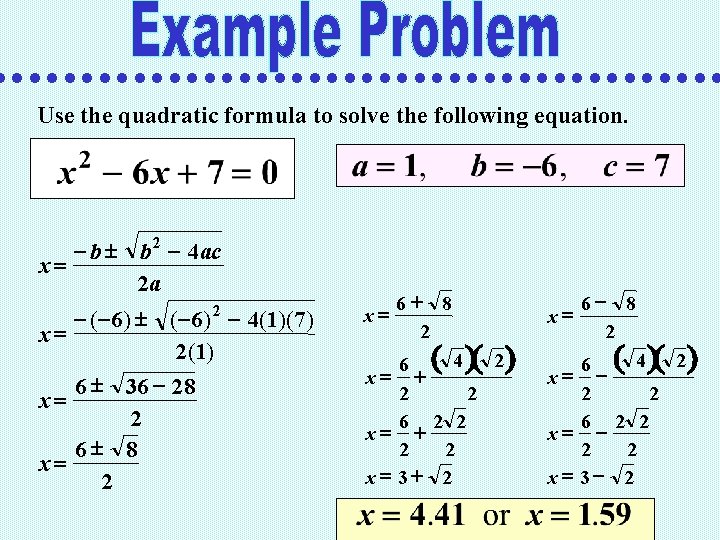
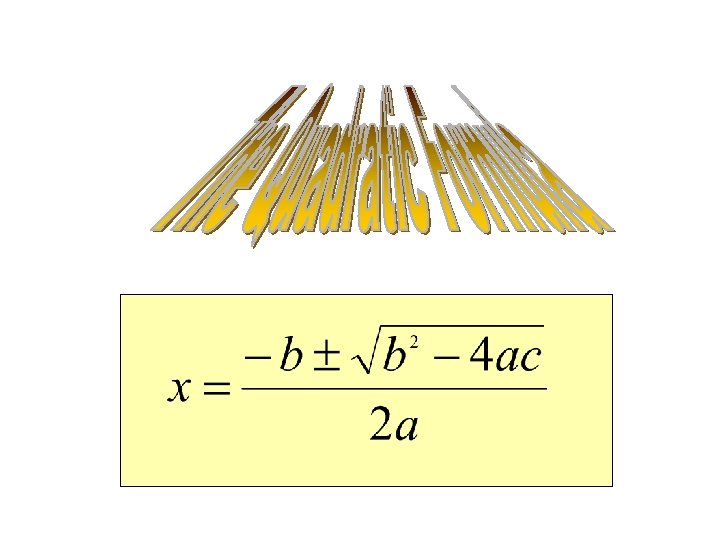
Use the quadratic formula to solve the following equation. - b ± b 2 - 4 ac x= 2 a 2 - ( -6 ) ± ( -6 ) - 4 (1)( 7) 2(1) 6 ± 36 - 28 x= 2 6± 8 x= 2 x= 6+ 8 x= 2 ( )( ) 4 2 6 x= + 2 2 6 2 2 = + x 2 2 x= 3+ 2 6 - 8 x= 2 4 2 6 x= 2 2 6 2 2 = x 2 2 x= 3 - 2 ( )( )
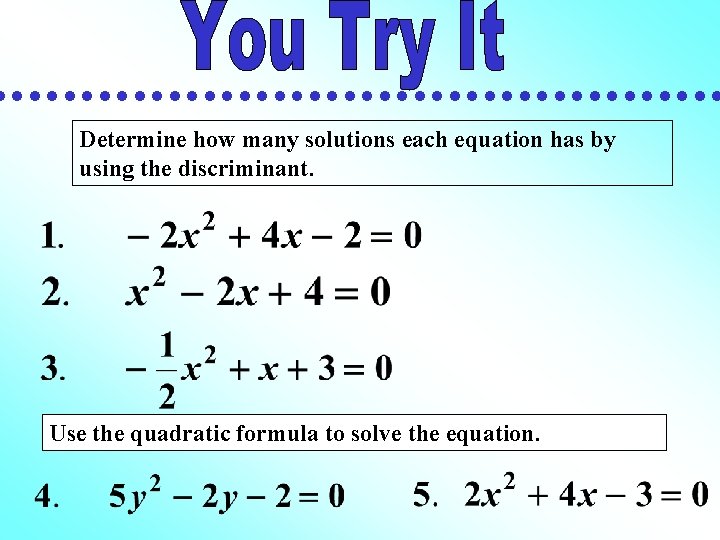
Determine how many solutions each equation has by using the discriminant. Use the quadratic formula to solve the equation.
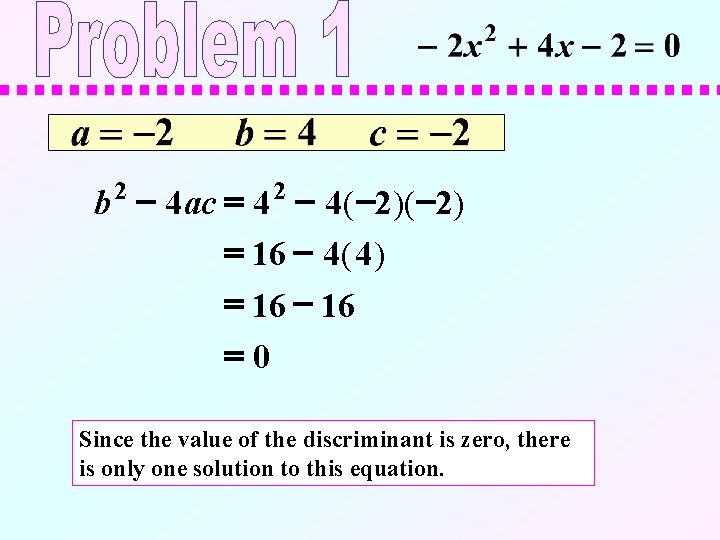
2 2 = b 4 ac 4 4 ( -2) = 16 - 4 ( 4 ) = 16 - 16 =0 Since the value of the discriminant is zero, there is only one solution to this equation.
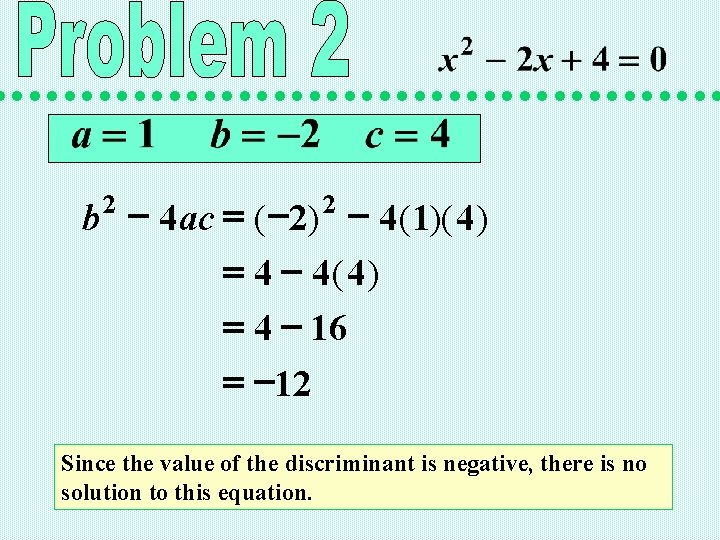
2 2 = b 4 ac ( 2) - 4 (1)( 4 ) = 4 - 4(4) = 4 - 16 = -12 Since the value of the discriminant is negative, there is no solution to this equation.
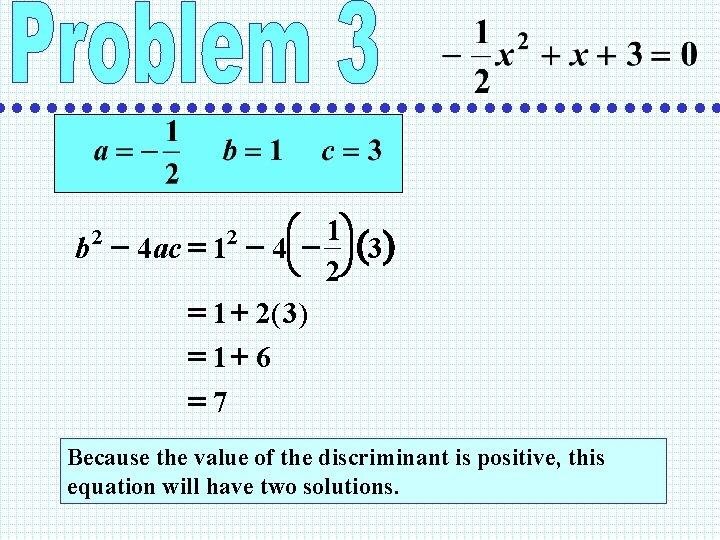
1ö æ b - 4 ac = 1 - 4ç - ÷ (3) è 2ø 2 2 = 1 + 2( 3) = 1+ 6 =7 Because the value of the discriminant is positive, this equation will have two solutions.
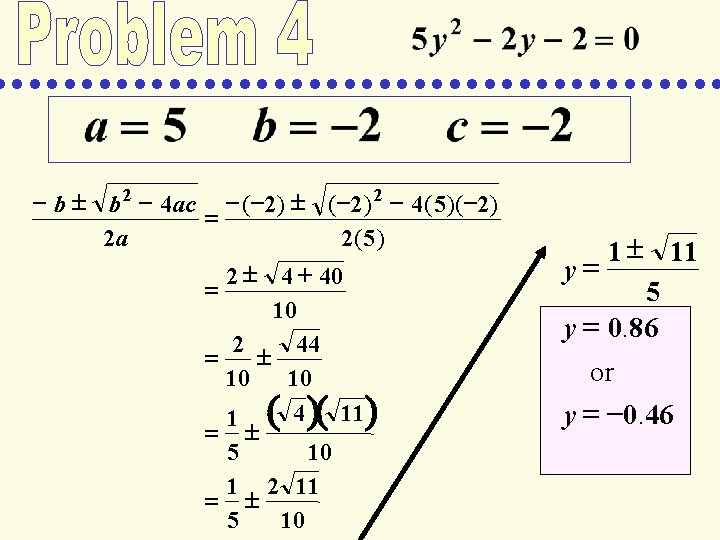
- b ± b 2 - 4 ac - ( -2) ± ( -2) 2 - 4 ( 5 )( -2) = 2 a 2( 5 ) 2 ± 4 + 40 = 10 2 44 = ± 10 10 4 11 1 = ± 10 5 1 2 11 = ± 5 10 ( )( ) 1 ± 11 y= 5 y = 0. 86 or y = -0. 46
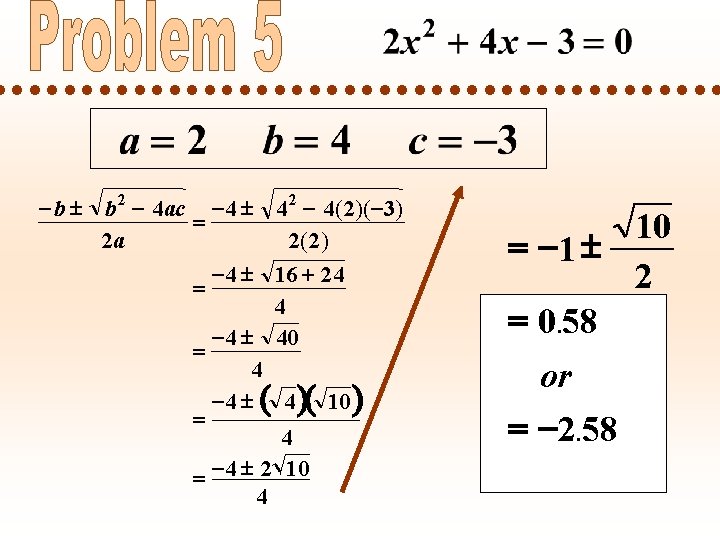
- Slides: 11