
Getting rid of Transgenerational Trauma through EMDR Helene


- Slides: 36
Getting rid of Transgenerational Trauma through EMDR Helene Dellucci Université Lorraine – Metz, France Hana Vojtova SIPE – Trencin, Slovakia 15 th EMDR Europe Conference 2014 June 26 th-29 th, Edinburgh
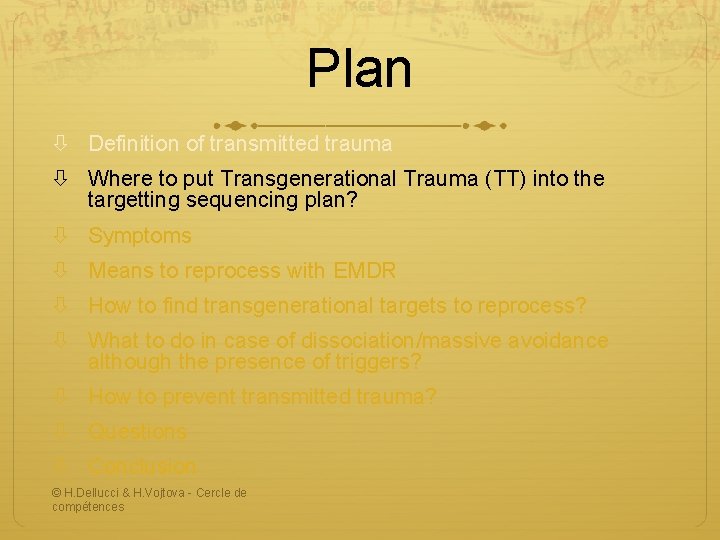
Plan Definition of transmitted trauma Where to put transgenerational trauma into the targetting sequencing plan? Transgenerational Trauma (TT) Symptoms Means to reprocess TT with EMDR How to find transgenerational targets to reprocess? What to do in case of dissociation/massive avoidance although present triggers? How to prevent transmitted trauma? Questions Conclusion © H. Dellucci & H. Vojtova - Cercle de compétences
Transmitted Trauma (1) Family Trauma or collective trauma: emotional wounds left in various people of the same group (family, couple, . . ) after an adverse event disrupts connections within the family, disturbs the roles of each other, changes sub-groups, alters the capacity to share emotions, Leads to compensation through enmeshment. © H. Dellucci & H. Vojtova - Cercle de compétences
Transmitted Trauma (2) Transgenerational Trauma : emotional wounds carried out by persons who have not lived themselves the adverse event(s) The explicit dimension is often unavailable or anecdotical The implicit dimension is present, through the body, in fragments, scattered images and contents, impulse phobia Triggers are still present in the every day life of the persons who carry the wound These contents have (apparently) no felt sense A sense making narrative soothes (nevertheless its truthfulness), by finding its place between present benchmarks There is more or less massive avoidance/dissociation © H. Dellucci & H. Vojtova - Cercle de compétences
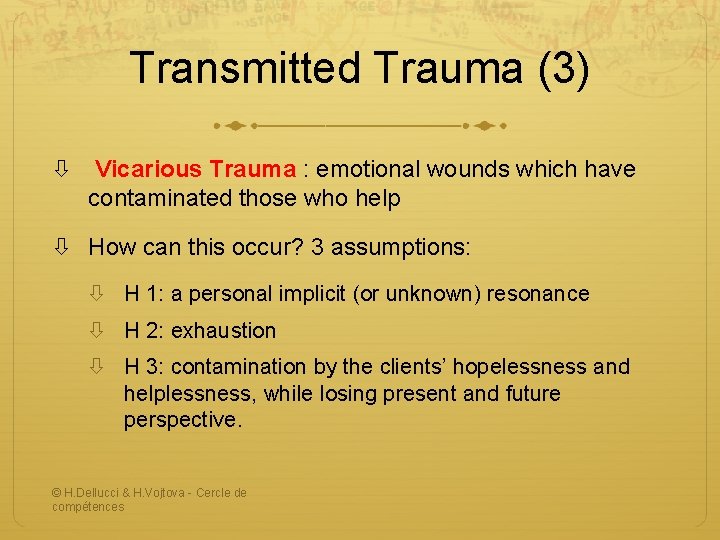
Transmitted Trauma (3) Vicarious Trauma : emotional wounds which have contaminated those who help How can this occur? 3 assumptions: H 1: a personal implicit (or unknown) resonance H 2: exhaustion H 3: contamination by the clients’ hopelessness and helplessness, while losing present and future perspective. © H. Dellucci & H. Vojtova - Cercle de compétences
Plan Definition of transmitted trauma Where to put Transgenerational Trauma (TT) into the targetting sequencing plan? Symptoms Means to reprocess with EMDR How to find transgenerational targets to reprocess? What to do in case of dissociation/massive avoidance although the presence of triggers? How to prevent transmitted trauma? Questions Conclusion © H. Dellucci & H. Vojtova - Cercle de compétences
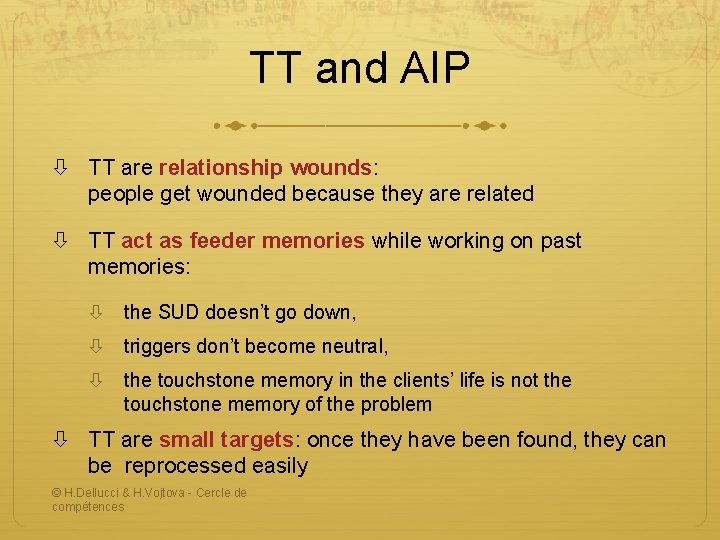
TT and AIP TT are relationship wounds: people get wounded because they are related TT act as feeder memories while working on past memories: the SUD doesn’t go down, triggers don’t become neutral, the touchstone memory in the clients’ life is not the touchstone memory of the problem TT are small targets: once they have been found, they can be reprocessed easily © H. Dellucci & H. Vojtova - Cercle de compétences
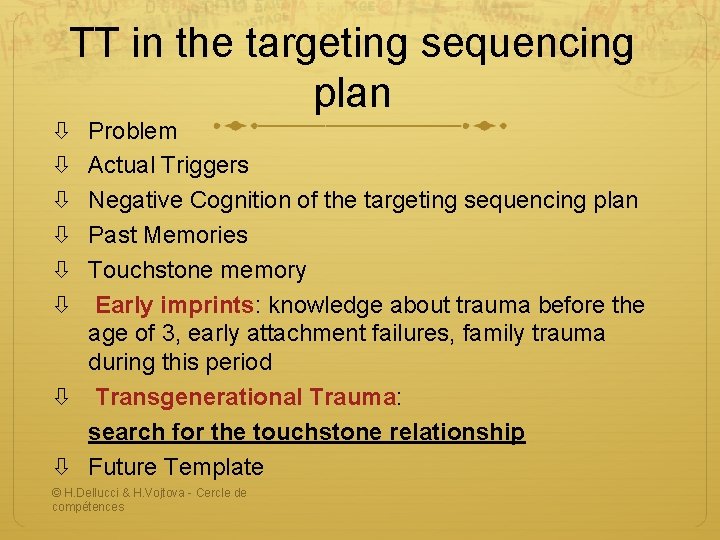
TT in the targeting sequencing plan Problem Actual Triggers Negative Cognition of the targeting sequencing plan Past Memories Touchstone memory Early imprints: knowledge about trauma before the age of 3, early attachment failures, family trauma during this period Transgenerational Trauma: search for the touchstone relationship Future Template © H. Dellucci & H. Vojtova - Cercle de compétences
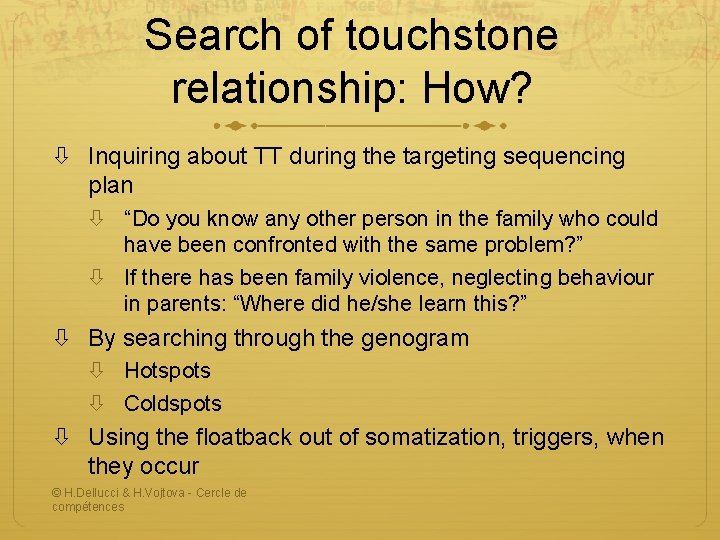
Search of touchstone relationship: How? Inquiring about TT during the targeting sequencing plan “Do you know any other person in the family who could have been confronted with the same problem? ” If there has been family violence, neglecting behaviour in parents: “Where did he/she learn this? ” By searching through the genogram Hotspots Coldspots Using the floatback out of somatization, triggers, when they occur © H. Dellucci & H. Vojtova - Cercle de compétences
Plan Definition of transmitted trauma Where to put Transgenerational Trauma into the targetting sequencing plan? TT Symptoms Means to reprocess with EMDR How to find transgenerational targets to reprocess? What to do in case of dissociation/massive avoidance although the presence of triggers? How to prevent transmitted trauma? Questions Conclusion © H. Dellucci & H. Vojtova - Cercle de compétences
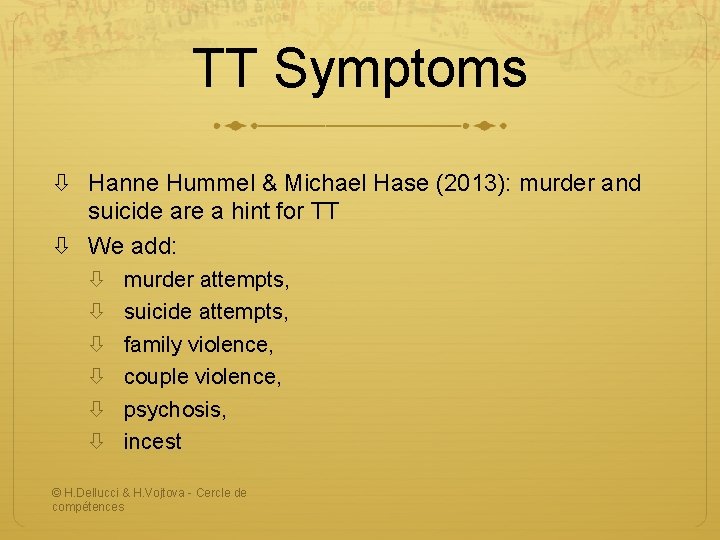
TT Symptoms Hanne Hummel & Michael Hase (2013): murder and suicide are a hint for TT We add: murder attempts, suicide attempts, family violence, couple violence, psychosis, incest © H. Dellucci & H. Vojtova - Cercle de compétences
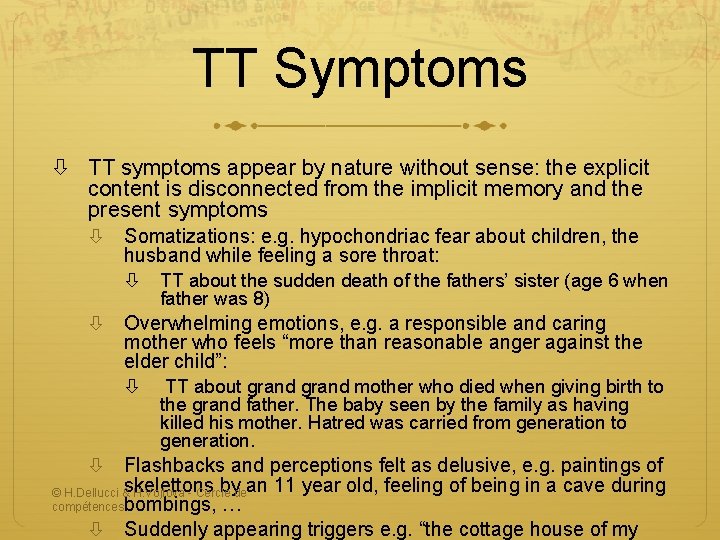
TT Symptoms TT symptoms appear by nature without sense: the explicit content is disconnected from the implicit memory and the present symptoms Somatizations: e. g. hypochondriac fear about children, the husband while feeling a sore throat: TT about the sudden death of the fathers’ sister (age 6 when father was 8) Overwhelming emotions, e. g. a responsible and caring mother who feels “more than reasonable anger against the elder child”: TT about grand mother who died when giving birth to the grand father. The baby seen by the family as having killed his mother. Hatred was carried from generation to generation. Flashbacks and perceptions felt as delusive, e. g. paintings of skelettons by an 11 year old, feeling of being in a cave during © H. Dellucci & H. Vojtova - Cercle de compétences bombings, … Suddenly appearing triggers e. g. “the cottage house of my
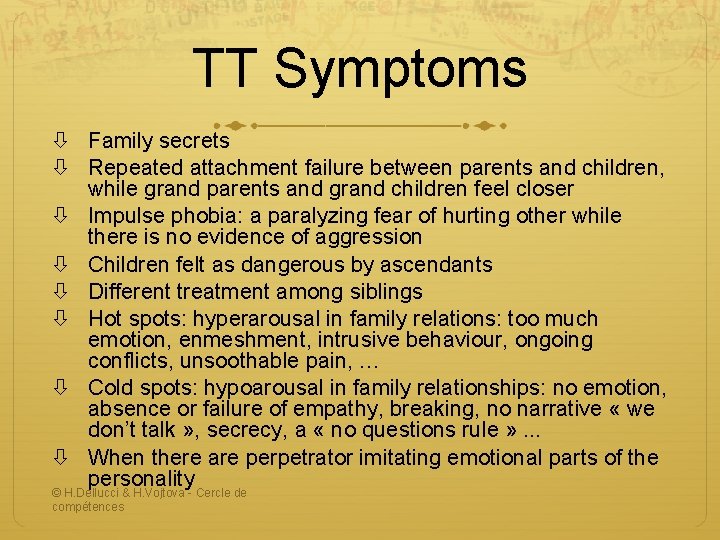
TT Symptoms Family secrets Repeated attachment failure between parents and children, while grand parents and grand children feel closer Impulse phobia: a paralyzing fear of hurting other while there is no evidence of aggression Children felt as dangerous by ascendants Different treatment among siblings Hot spots: hyperarousal in family relations: too much emotion, enmeshment, intrusive behaviour, ongoing conflicts, unsoothable pain, … Cold spots: hypoarousal in family relationships: no emotion, absence or failure of empathy, breaking, no narrative « we don’t talk » , secrecy, a « no questions rule » . . . When there are perpetrator imitating emotional parts of the personality © H. Dellucci & H. Vojtova - Cercle de compétences
Plan Definition of transmitted trauma Where to put Transgenerational Trauma into the targetting sequencing plan? Symptoms Means to reprocess with EMDR How to find transgenerational targets to reprocess? What to do in case of dissociation/massive avoidance although the presence of triggers? How to prevent transmitted trauma? Questions Conclusion © H. Dellucci & H. Vojtova - Cercle de compétences
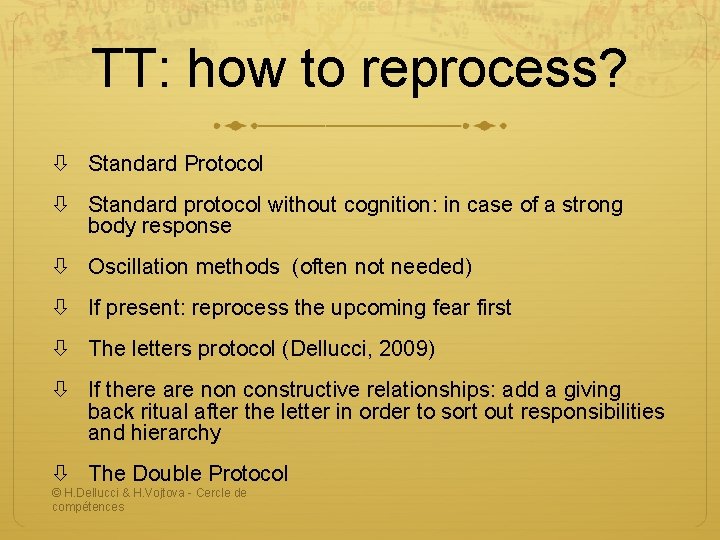
TT: how to reprocess? Standard Protocol Standard protocol without cognition: in case of a strong body response Oscillation methods (often not needed) If present: reprocess the upcoming fear first The letters protocol (Dellucci, 2009) If there are non constructive relationships: add a giving back ritual after the letter in order to sort out responsibilities and hierarchy The Double Protocol © H. Dellucci & H. Vojtova - Cercle de compétences
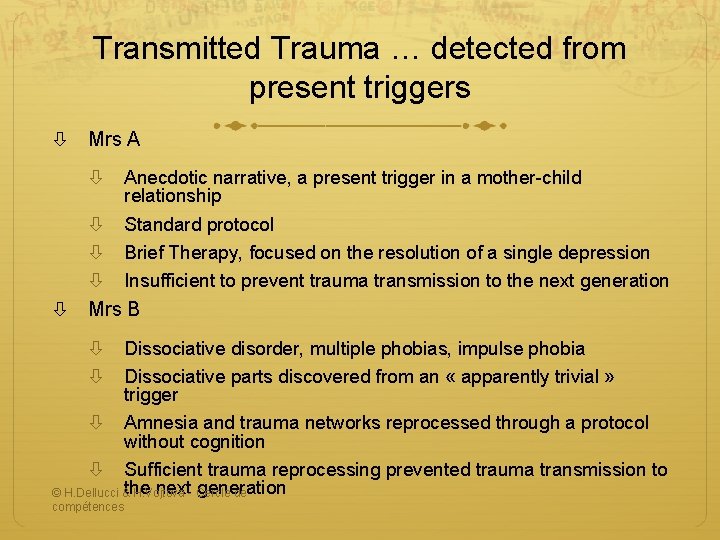
Transmitted Trauma … detected from present triggers Mrs A Anecdotic narrative, a present trigger in a mother-child relationship Standard protocol Brief Therapy, focused on the resolution of a single depression Insufficient to prevent trauma transmission to the next generation Mrs B Dissociative disorder, multiple phobias, impulse phobia Dissociative parts discovered from an « apparently trivial » trigger Amnesia and trauma networks reprocessed through a protocol without cognition Sufficient trauma reprocessing prevented trauma transmission to the next generation © H. Dellucci & H. Vojtova - Cercle de compétences
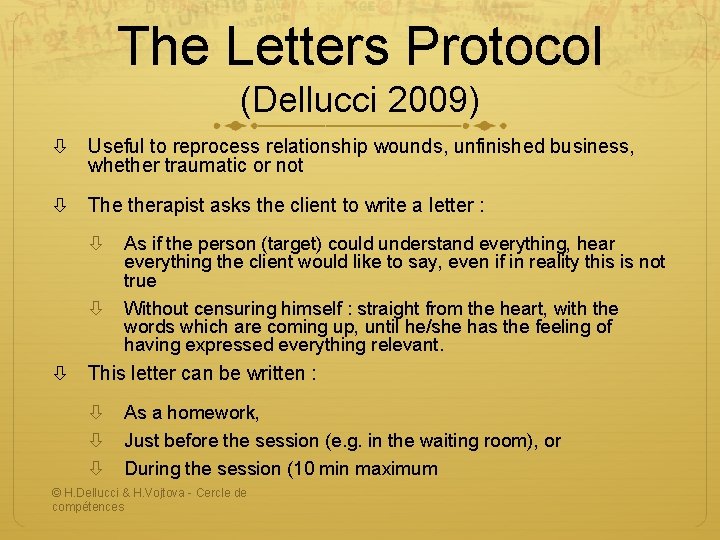
The Letters Protocol (Dellucci 2009) Useful to reprocess relationship wounds, unfinished business, whether traumatic or not The therapist asks the client to write a letter : As if the person (target) could understand everything, hear everything the client would like to say, even if in reality this is not true Without censuring himself : straight from the heart, with the words which are coming up, until he/she has the feeling of having expressed everything relevant. This letter can be written : As a homework, Just before the session (e. g. in the waiting room), or During the session (10 min maximum © H. Dellucci & H. Vojtova - Cercle de compétences
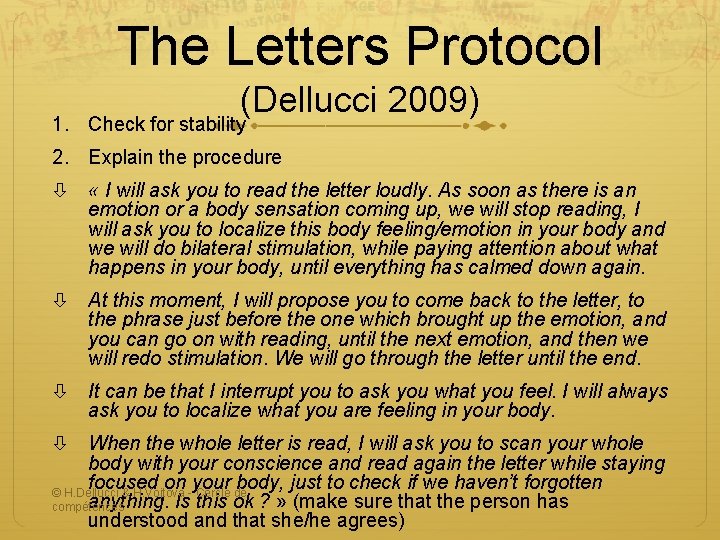
The Letters Protocol (Dellucci 2009) 1. Check for stability 2. Explain the procedure « I will ask you to read the letter loudly. As soon as there is an emotion or a body sensation coming up, we will stop reading, I will ask you to localize this body feeling/emotion in your body and we will do bilateral stimulation, while paying attention about what happens in your body, until everything has calmed down again. At this moment, I will propose you to come back to the letter, to the phrase just before the one which brought up the emotion, and you can go on with reading, until the next emotion, and then we will redo stimulation. We will go through the letter until the end. It can be that I interrupt you to ask you what you feel. I will always ask you to localize what you are feeling in your body. When the whole letter is read, I will ask you to scan your whole body with your conscience and read again the letter while staying focused on your body, just to check if we haven’t forgotten © H. Dellucci & H. Vojtova - Cercle de anything. Is this ok ? » (make sure that the person has compétences understood and that she/he agrees)
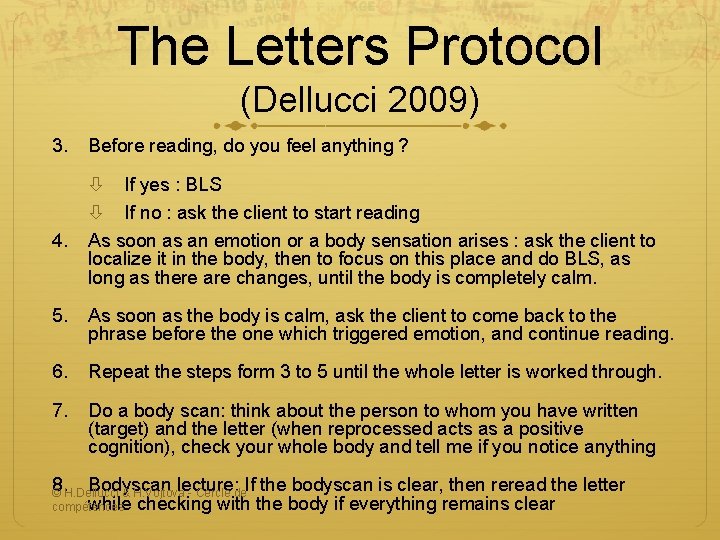
The Letters Protocol (Dellucci 2009) 3. 4. Before reading, do you feel anything ? If yes : BLS If no : ask the client to start reading As soon as an emotion or a body sensation arises : ask the client to localize it in the body, then to focus on this place and do BLS, as long as there are changes, until the body is completely calm. 5. As soon as the body is calm, ask the client to come back to the phrase before the one which triggered emotion, and continue reading. 6. Repeat the steps form 3 to 5 until the whole letter is worked through. 7. Do a body scan: think about the person to whom you have written (target) and the letter (when reprocessed acts as a positive cognition), check your whole body and tell me if you notice anything 8. Bodyscan lecture: If the bodyscan is clear, then reread the letter © H. Dellucci & H. Vojtova - Cercle de while checking with the body if everything remains clear compétences
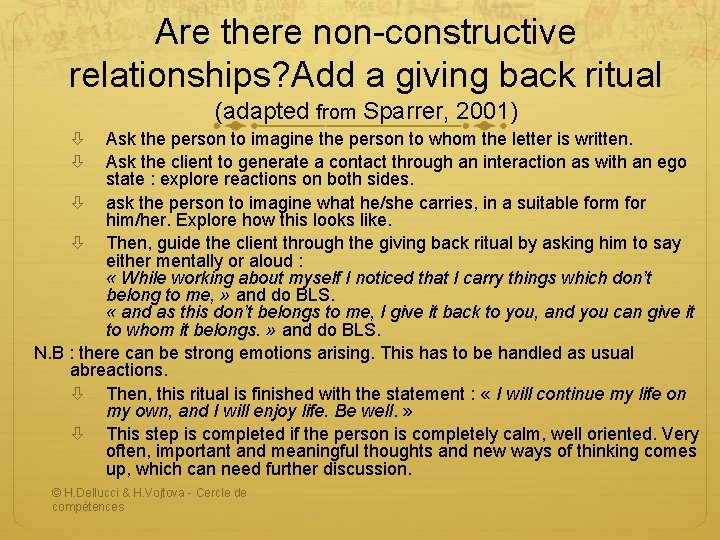
Are there non-constructive relationships? Add a giving back ritual (adapted from Sparrer, 2001) Ask the person to imagine the person to whom the letter is written. Ask the client to generate a contact through an interaction as with an ego state : explore reactions on both sides. ask the person to imagine what he/she carries, in a suitable form for him/her. Explore how this looks like. Then, guide the client through the giving back ritual by asking him to say either mentally or aloud : « While working about myself I noticed that I carry things which don’t belong to me, » and do BLS. « and as this don’t belongs to me, I give it back to you, and you can give it to whom it belongs. » and do BLS. N. B : there can be strong emotions arising. This has to be handled as usual abreactions. Then, this ritual is finished with the statement : « I will continue my life on my own, and I will enjoy life. Be well. » This step is completed if the person is completely calm, well oriented. Very often, important and meaningful thoughts and new ways of thinking comes up, which can need further discussion. © H. Dellucci & H. Vojtova - Cercle de compétences
Interveawe to support a giving back ritual It often happens that people are reluctant to give back. In this case, it may be useful to do the following interweave : « Sometimes small children, as courageous as heroes, would do anything possible in order to help their parents. Especially when they notice that their parents feel not well. Then they take on their little shoulders the problems of the parents, by hoping that this will bring them relieve. And finally, this doesn’t give relieve, neither to themselves, nor to the parents. The work of the parents is to carry out their problems themselves, and the one of the children is to trust the parents, that they will succeed. » This interweave can be done step by step, with BLS, the main goal being that the person, mentally, can give back its undue burden, accept to let go of it, and let the receiver handle it, by inviting him to give it back to ascendants. © H. Dellucci & H. Vojtova - Cercle de compétences
Plan Definition of transmitted trauma Where to put Transgenerational Trauma into the targetting sequencing plan? Symptoms Means to reprocess with EMDR How to find transgenerational targets to reprocess? What to do in case of dissociation/massive avoidance although the presence of triggers? How to prevent transmitted trauma? Questions Conclusion © H. Dellucci & H. Vojtova - Cercle de compétences
How to find transgenerational targets to reprocess? Explore the family system by doing a genogram Start with the actual narrow family system Then extend to the family of origin: siblings, parents, grand parents Contextualize what happened while asking surviving questions: how did … do to overcome …? … in this situation? How did they do in order to not make it even worse? How were they able to have children? A family who has survived, was able to have a next generation. We all are evidence that our family has survived. Add any other meaningful person who still is or acted as a resource © H. Dellucci & H. Vojtova - Cercle de compétences
How to find transgenerational targets to reprocess? Explore the quality of relationships: positive and negative symptoms: Hot spots: hyperarousal in family relations: too much emotion, enmeshment, intrusive behaviour, ongoing conflicts, unsoothable pain, … Cold spots: hypoarousal in family relationships: no emotion, absence or failure of empathy, breaking, no narrative « we don’t talk» , secrecy, a « no questions rule » . . . Explore by direct questioning: “Do you know any other person in the family who could have been confronted with the same problem? ” “… the same cognition? ” If there has been family violence, neglecting behaviour in parents: “Where did he/she learn this? ” Use the “Yes/No” body response as a resource while exploring the genogram: has this problem to do with your generation? With the generation of your parents? With the generation above? On © H. Dellucci & H. Vojtova - Cercle de compétences the mothers’ side? On the fathers’ side?
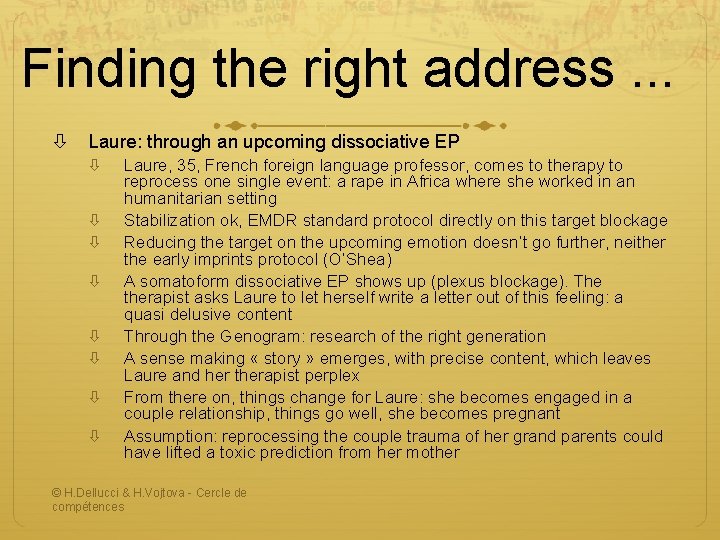
Finding the right address. . . Laure: through an upcoming dissociative EP Laure, 35, French foreign language professor, comes to therapy to reprocess one single event: a rape in Africa where she worked in an humanitarian setting Stabilization ok, EMDR standard protocol directly on this target blockage Reducing the target on the upcoming emotion doesn’t go further, neither the early imprints protocol (O’Shea) A somatoform dissociative EP shows up (plexus blockage). The therapist asks Laure to let herself write a letter out of this feeling: a quasi delusive content Through the Genogram: research of the right generation A sense making « story » emerges, with precise content, which leaves Laure and her therapist perplex From there on, things change for Laure: she becomes engaged in a couple relationship, things go well, she becomes pregnant Assumption: reprocessing the couple trauma of her grand parents could have lifted a toxic prediction from her mother © H. Dellucci & H. Vojtova - Cercle de compétences
Plan Definition of transmitted trauma Where to put Transgenerational Trauma into the targetting sequencing plan? Symptoms Means to reprocess with EMDR How to find transgenerational targets to reprocess? What to do in case of dissociation/massive avoidance although the presence of triggers? How to prevent transmitted trauma? Questions Conclusion © H. Dellucci & H. Vojtova - Cercle de compétences
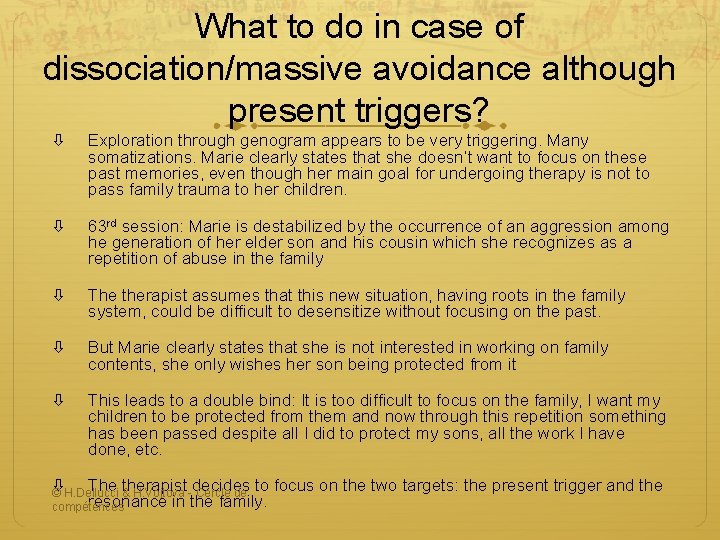
What to do in case of dissociation/massive avoidance although present triggers? Marie: a client who doesn’t want to work on material from the past (massive avoidance) despite family repetition in the present: the double protocol Age 45, psychotraumatologist, coming to therapy after having attended a conference about transgenerational trauma A long EMDR therapy (71 sessions) focused on resetting emotions, fears, triggers, early imprints. Result: a symptom reduction and changes for a better life quality. Extensive amnesia, good functioning in every day life and relationships: as a parent, in her work, as a friend, in the couple Emotional parts of the personality upcoming, leading to an intense hostility and phobia in Marie. Ongoing EMDR while constructing inner supportive bonds and EMD on bodily pain. Distancing from the family of origin because too much triggering © H. Dellucci & H. Vojtova - Cercle de compétences
What to do in case of dissociation/massive avoidance although present triggers? Exploration through genogram appears to be very triggering. Many somatizations. Marie clearly states that she doesn’t want to focus on these past memories, even though her main goal for undergoing therapy is not to pass family trauma to her children. 63 rd session: Marie is destabilized by the occurrence of an aggression among he generation of her elder son and his cousin which she recognizes as a repetition of abuse in the family The therapist assumes that this new situation, having roots in the family system, could be difficult to desensitize without focusing on the past. But Marie clearly states that she is not interested in working on family contents, she only wishes her son being protected from it This leads to a double bind: It is too difficult to focus on the family, I want my children to be protected from them and now through this repetition something has been passed despite all I did to protect my sons, all the work I have done, etc. The therapist decides to focus on the two targets: the present trigger and the © H. Dellucci & H. Vojtova - Cercle de resonance in the family. compétences
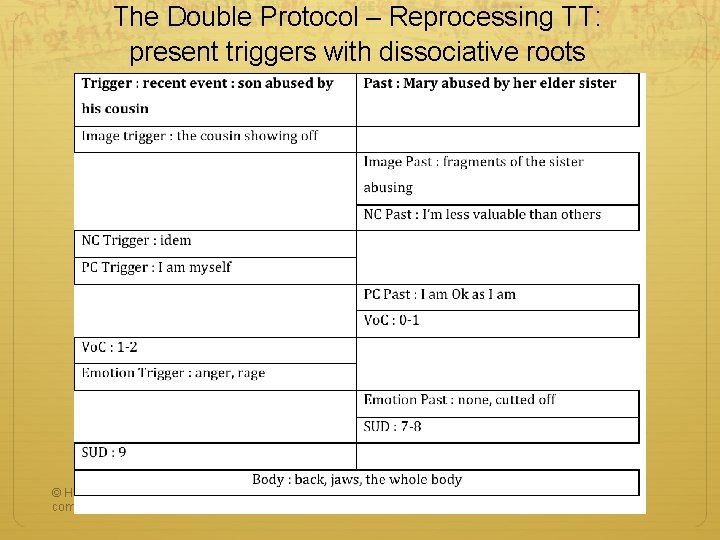
The Double Protocol – Reprocessing TT: present triggers with dissociative roots © H. Dellucci & H. Vojtova - Cercle de compétences
The Double Protocol – Reprocessing TT: present triggers with dissociative roots Phase 4: going from the image of the trigger, the image of the past, the NC of the trigger, and the bodily sensations and reprocess until SUD = 0 for both targets Phase 5: Check first and install PC of the recent event (trigger) and then the PC of the Past event. Phase 6: do a bodyscan first with the recent event, and then with the past event until both are clear Marie reprocessed until phase 6 for both targets through the double protocol in one session without dissociation. What came out after the session was the fathers’ “crazy rage” when he got overwhelmed Continuation with a letter to the father and the letter protocol (during 4 sessions) Therapy closure one session later (after the summer holidays) © H. Dellucci & H. Vojtova - Cercle de compétences
Plan Definition of transmitted trauma Where to put Transgenerational Trauma into the targetting sequencing plan? Symptoms Means to reprocess with EMDR How to find transgenerational targets to reprocess? What to do in case of dissociation/massive avoidance although the presence of triggers? How to prevent transmitted trauma? Questions Conclusion © H. Dellucci & H. Vojtova - Cercle de compétences
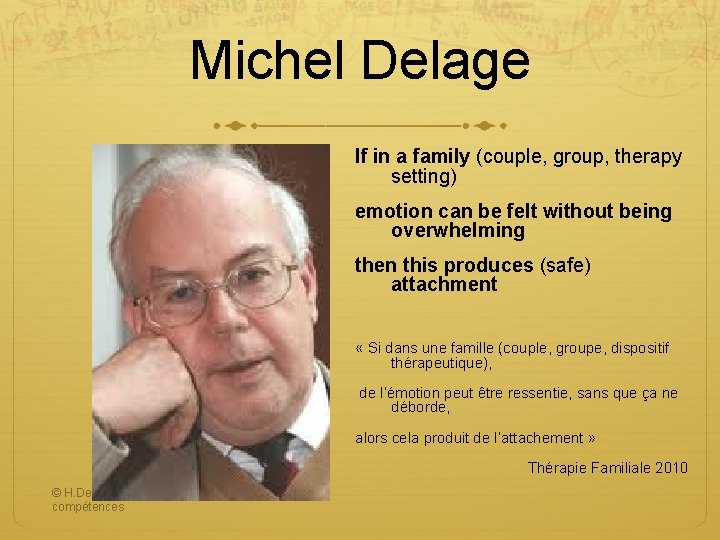
Michel Delage If in a family (couple, group, therapy setting) emotion can be felt without being overwhelming then this produces (safe) attachment « Si dans une famille (couple, groupe, dispositif thérapeutique), de l‘émotion peut être ressentie, sans que ça ne déborde, alors cela produit de l‘attachement » Thérapie Familiale 2010 © H. Dellucci & H. Vojtova - Cercle de compétences
How to prevent transmitted trauma? Goal: bring it to a sense making narrative which can be shared and allows to share emotions while staying in the window of tolerance Feeling concerned is not pathological Start working with the concerned and motivated people: they carry the emotion which can be reprocessed Reprocessing targets of transmitted trauma protects those for who we care, and the next generation: if you don’t want to work for yourself, it is useful to do it for others you care Build a narrative for the next generation and share what feels meaningful © H. Dellucci & H. Vojtova - Cercle de compétences
Plan Definition of transmitted trauma Where to put Transgenerational Trauma into the targetting sequencing plan? Symptoms Means to reprocess with EMDR How to find transgenerational targets to reprocess? What to do in case of dissociation/massive avoidance although the presence of triggers? How to prevent transmitted trauma? Questions Conclusion © H. Dellucci & H. Vojtova - Cercle de compétences
Conclusion Wherever it comes from: Transgenerational Trauma is healable These are relationship wounds: you are wounded because you are related TT are small targets They need the help of therapist to find the right address: the touchstone relationship Ongoing transmission is stoppable and prevention possible © H. Dellucci & H. Vojtova - Cercle de compétences
Thank you © H. Dellucci & H. Vojtova - Cercle de compétences