
Getting it Right 1 Wall Floor Tiles by
Getting it Right 1 - Wall & Floor Tiles by: Ms. Ang Pek Lay FMM Malaysian Ceramic Industry Group (MCIG) 13 October 2016 REHDA Institute
Ø Ø Ø Presentation Outline Manufacturing Process Flow What are Ceramic Tiles Advantages of Ceramic Tiles Classification and Types of Tiles Technical Specification - MS ISO 13006 Standard Labelling Choosing the Right Tiles Installation Guideline Some common tiling failures Costing Care & Maintenance Warranty
What Are Ceramic Tiles? Ceramic tile is defined as product that is manufactured from a mixture of natural inorganic materials, comprising of mainly ØClay (main component) Clay ØFeldspar (main component for Porcelain tiles) Feldspar ØLimestone (main component for Wall tiles) ØSilica Sand ØColour Pigments this is processed and pressed into shape and then fired to high temperatures (up to 1220°C) to produce a strong and durable product.
Manufacturing Process of Ceramic Tiles
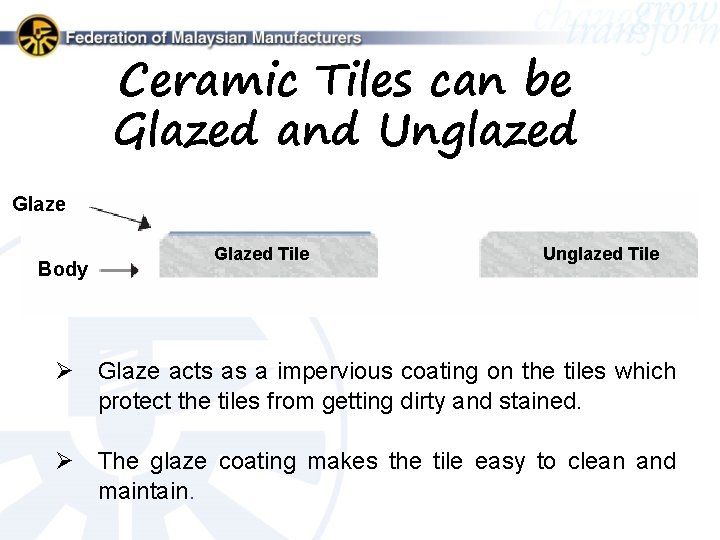
Ceramic Tiles can be Glazed and Unglazed Glaze Body Glazed Tile Unglazed Tile Ø Glaze acts as a impervious coating on the tiles which protect the tiles from getting dirty and stained. Ø The glaze coating makes the tile easy to clean and maintain.
Advantages of Ceramic Tiles Aesthetics Tiles available in limitless colours, textures and designs Durable Correctly specified tiles and with proper care, tiles will last a lifetime. Colour-fast Colours on tiles do not fade. Easy to clean Tiles come with an impervious glaze or vitrified surface, make it easy to clean. Fire Proof Tiles being fired at a high temperature makes it fire resistant. Chemical Resistant Tiles are resistant to most common household chemicals. Low allergy & Safe Tiles are inert and unlike many plastic finishes, will not give off any hazardous fumes and are free from V. O. C. (volatile organic compounds)
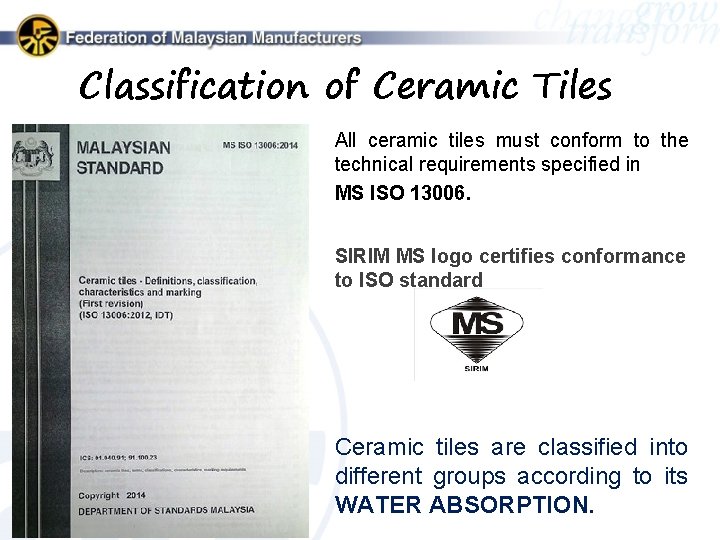
Classification of Ceramic Tiles All ceramic tiles must conform to the technical requirements specified in MS ISO 13006. SIRIM MS logo certifies conformance to ISO standard Ceramic tiles are classified into different groups according to its WATER ABSORPTION.
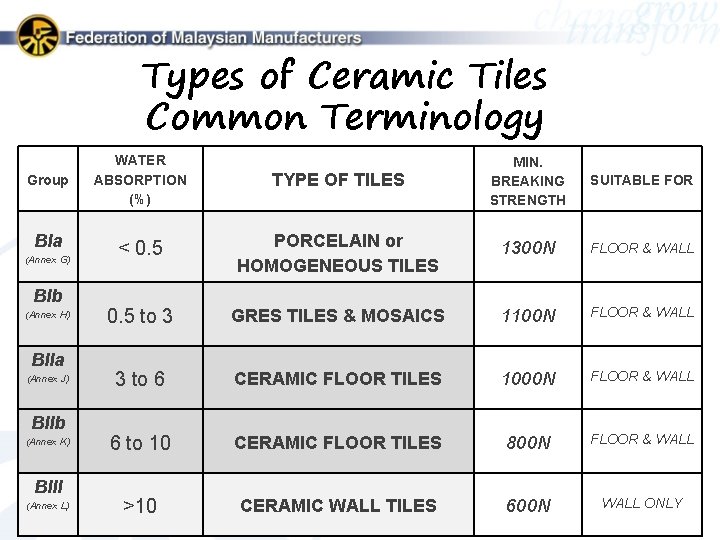
Types of Ceramic Tiles Common Terminology Group BIa (Annex G) BIb (Annex H) BIIa (Annex J) BIIb (Annex K) BIII (Annex L) WATER ABSORPTION (%) TYPE OF TILES MIN. BREAKING STRENGTH SUITABLE FOR < 0. 5 PORCELAIN or HOMOGENEOUS TILES 1300 N FLOOR & WALL 0. 5 to 3 GRES TILES & MOSAICS 1100 N FLOOR & WALL 3 to 6 CERAMIC FLOOR TILES 1000 N FLOOR & WALL 6 to 10 CERAMIC FLOOR TILES 800 N FLOOR & WALL >10 CERAMIC WALL TILES 600 N WALL ONLY
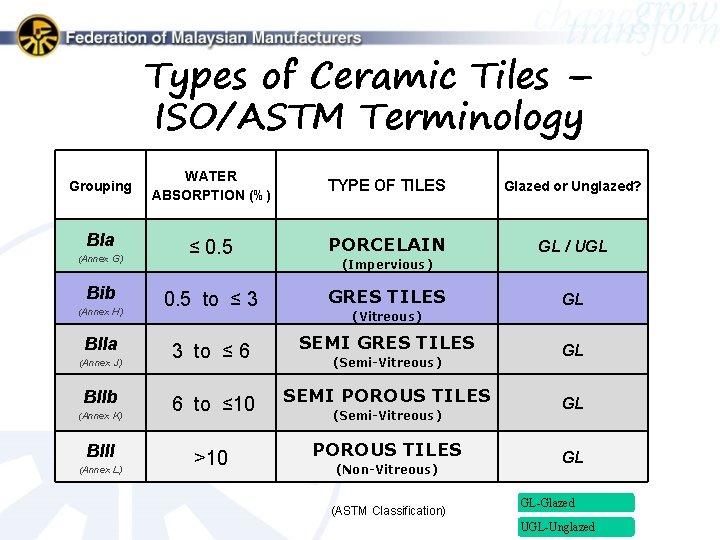
Types of Ceramic Tiles – ISO/ASTM Terminology Grouping BIa (Annex G) Bib (Annex H) BIIa (Annex J) BIIb (Annex K) BIII (Annex L) WATER ABSORPTION (%) TYPE OF TILES Glazed or Unglazed? ≤ 0. 5 PORCELAIN GL / UGL 0. 5 to ≤ 3 GRES TILES 3 to ≤ 6 SEMI GRES TILES 6 to ≤ 10 SEMI POROUS TILES >10 POROUS TILES (Impervious) GL (Vitreous) (Semi-Vitreous) (Non-Vitreous) (ASTM Classification) GL GL-Glazed UGL-Unglazed
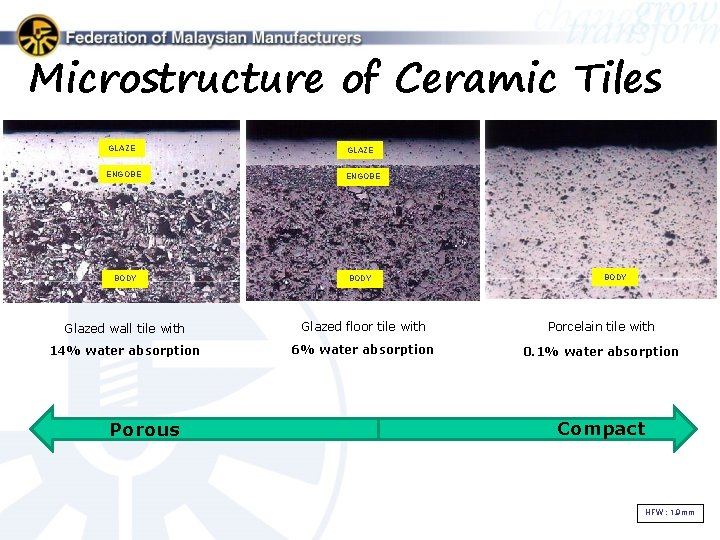
Microstructure of Ceramic Tiles GLAZE ENGOBE BODY Glazed wall tile with Glazed floor tile with Porcelain tile with 14% water absorption 6% water absorption 0. 1% water absorption Porous Compact HFW : 1. 9 mm
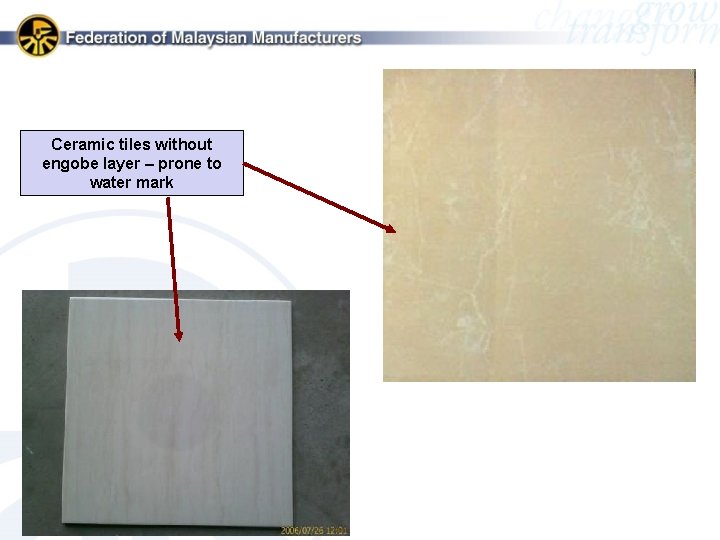
Ceramic tiles without engobe layer – prone to water mark
Porcelain or Homogeneous Tiles?
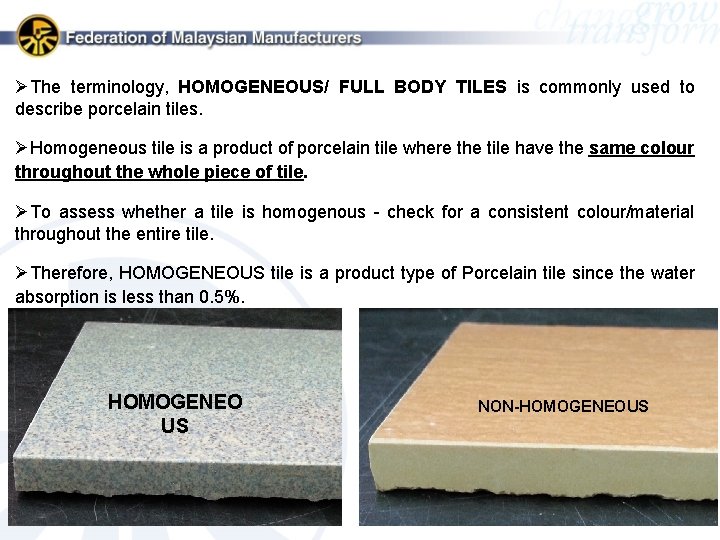
ØThe terminology, HOMOGENEOUS/ FULL BODY TILES is commonly used to describe porcelain tiles. ØHomogeneous tile is a product of porcelain tile where the tile have the same colour throughout the whole piece of tile. ØTo assess whether a tile is homogenous - check for a consistent colour/material throughout the entire tile. ØTherefore, HOMOGENEOUS tile is a product type of Porcelain tile since the water absorption is less than 0. 5%. HOMOGENEO US NON-HOMOGENEOUS
Glazed Porcelain vs Polished Porcelain
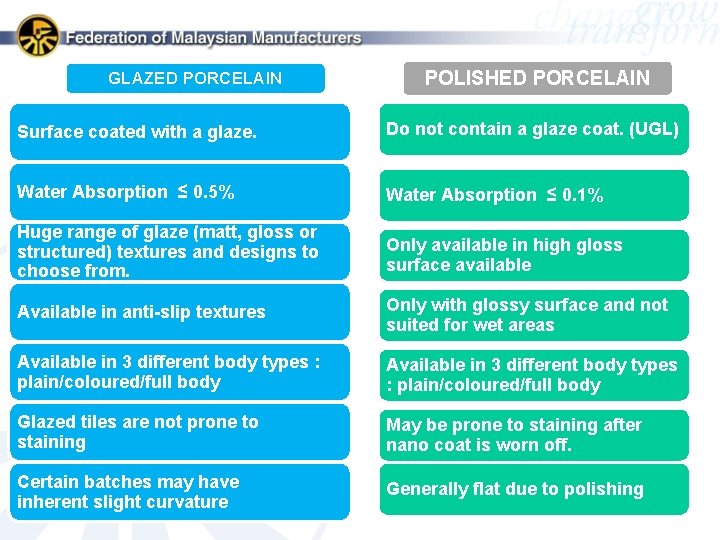
GLAZED PORCELAIN POLISHED PORCELAIN Surface coated with a glaze. Do not contain a glaze coat. (UGL) Water Absorption ≤ 0. 5% Water Absorption ≤ 0. 1% Huge range of glaze (matt, gloss or structured) textures and designs to choose from. Only available in high gloss surface available Available in anti-slip textures Only with glossy surface and not suited for wet areas Available in 3 different body types : plain/coloured/full body Glazed tiles are not prone to staining May be prone to staining after nano coat is worn off. Certain batches may have inherent slight curvature Generally flat due to polishing
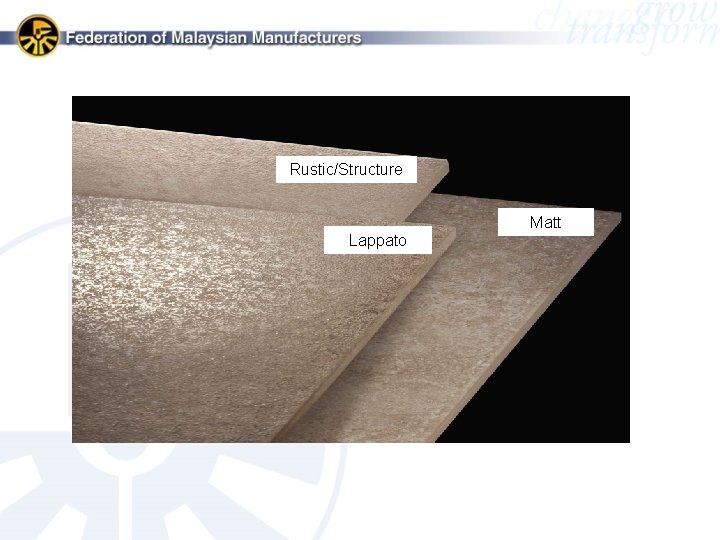
Rustic/Structure Lappato Matt
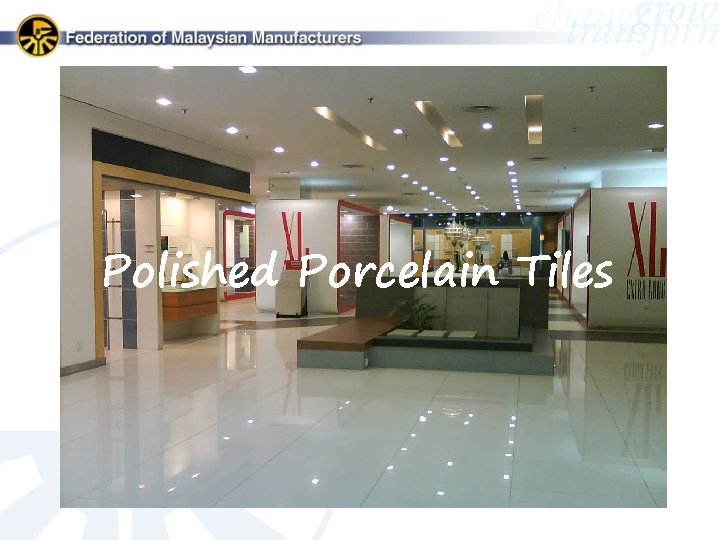
Polished Porcelain Tiles
Technical Specification- MS ISO 13006

Typical Technical Specification for Porcelain Tile Properties Dimensional Length & Width Thickness Straightness of Sides Rectangularity Surface Flatness -Center curvature -Edge curvature -Warpage Physical Water Absorption Breaking Strength Abrasive Resistance Crazing Resistance Chemical Resistance to Staining Technical Specification ± 0. 5% or max 2 mm ± 5. 0% ± 0. 5% ± 0. 6% or max 2 mm ± 0. 5% ≤ 0. 5% Min 1300 N Min PEI 3 Pass Min. Class B Min. Class 3
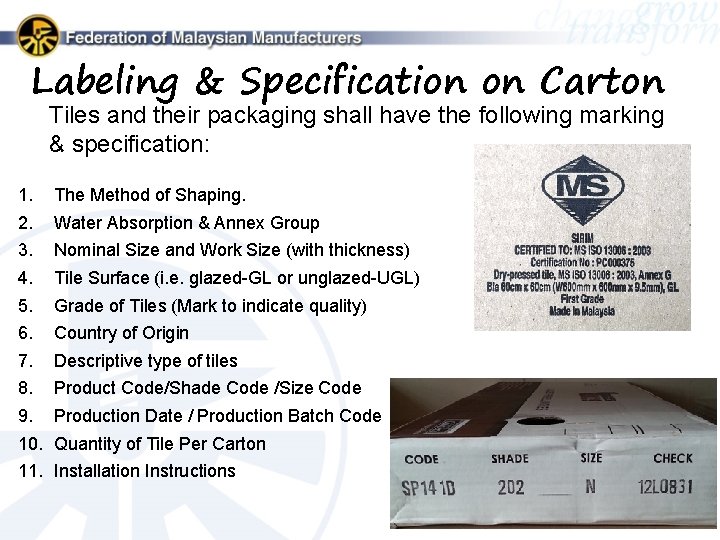
Labeling & Specification on Carton Tiles and their packaging shall have the following marking & specification: 1. 2. 3. 4. 5. 6. 7. 8. 9. 10. 11. The Method of Shaping. Water Absorption & Annex Group Nominal Size and Work Size (with thickness) Tile Surface (i. e. glazed-GL or unglazed-UGL) Grade of Tiles (Mark to indicate quality) Country of Origin Descriptive type of tiles Product Code/Shade Code /Size Code Production Date / Production Batch Code Quantity of Tile Per Carton Installation Instructions
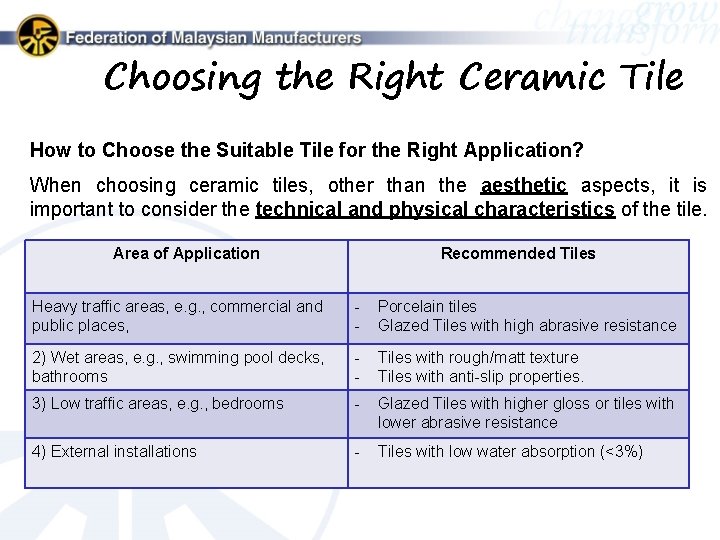
Choosing the Right Ceramic Tile How to Choose the Suitable Tile for the Right Application? When choosing ceramic tiles, other than the aesthetic aspects, it is important to consider the technical and physical characteristics of the tile. Area of Application Recommended Tiles Heavy traffic areas, e. g. , commercial and public places, - Porcelain tiles Glazed Tiles with high abrasive resistance 2) Wet areas, e. g. , swimming pool decks, bathrooms - Tiles with rough/matt texture Tiles with anti-slip properties. 3) Low traffic areas, e. g. , bedrooms - Glazed Tiles with higher gloss or tiles with lower abrasive resistance 4) External installations - Tiles with low water absorption (<3%)
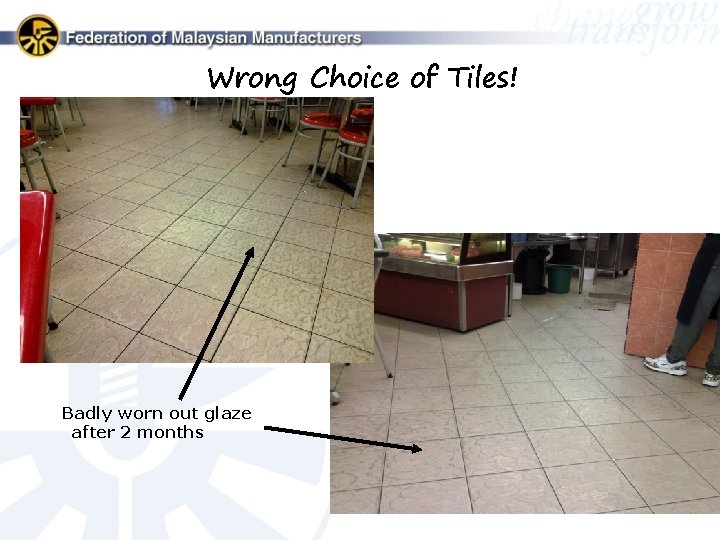
Wrong Choice of Tiles! Badly worn out glaze after 2 months
Installation Guideline. MS 1294: Part 1 -4
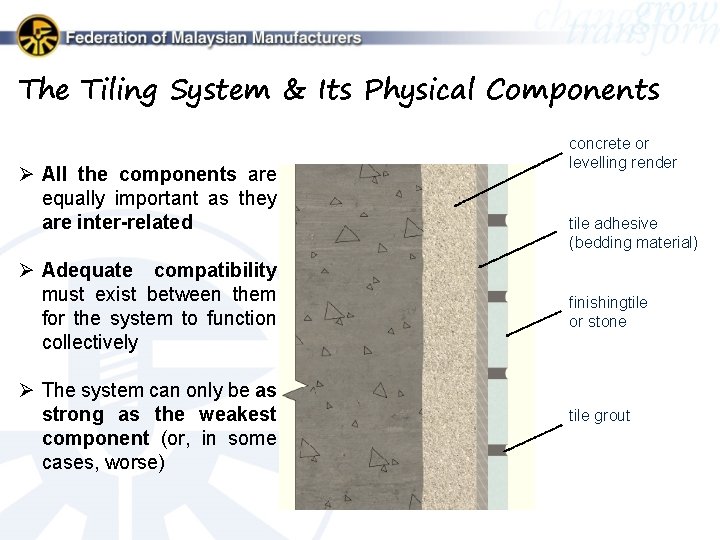
The Tiling System & Its Physical Components Ø All the components are equally important as they are inter-related Ø Adequate compatibility must exist between them for the system to function collectively Ø The system can only be as strong as the weakest component (or, in some cases, worse) concrete or levelling render tile adhesive (bedding material) finishing tile or stone tile grout

The Tile Adhesive: Identify the Selection Criteria Ø Type of tile based on water absorption Ø Size of tile, ranging from mosaics to large format tiles Ø Rigidity of support structure eg. slab deflection, vibrations Ø Slab or wall installation? Ø Substrate type eg. cementitious or dry wall? Ø Traffic loads eg high volume, heavy traffic? Ø Interior or exterior application? Ø Exposure to water eg periodic wetting / drying? Ø Installation conditions eg. hot and windy conditions? Ø Waiting period rapid return to service? Ø Chemical resistance eg chemical plants, industrial kitchens? Ø Floor design eg intricate patterns? . . . etc.
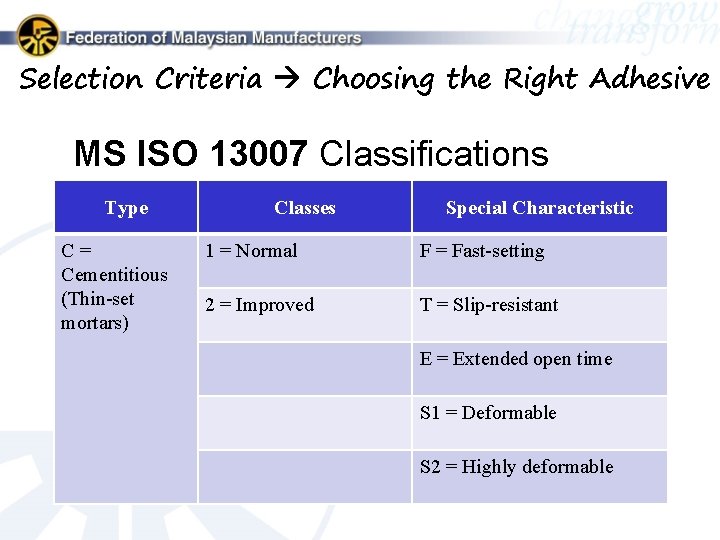
Selection Criteria Choosing the Right Adhesive MS ISO 13007 Classifications Type C = Cementitious (Thin-set mortars) Classes Special Characteristic 1 = Normal F = Fast-setting 2 = Improved T = Slip-resistant E = Extended open time S 1 = Deformable S 2 = Highly deformable
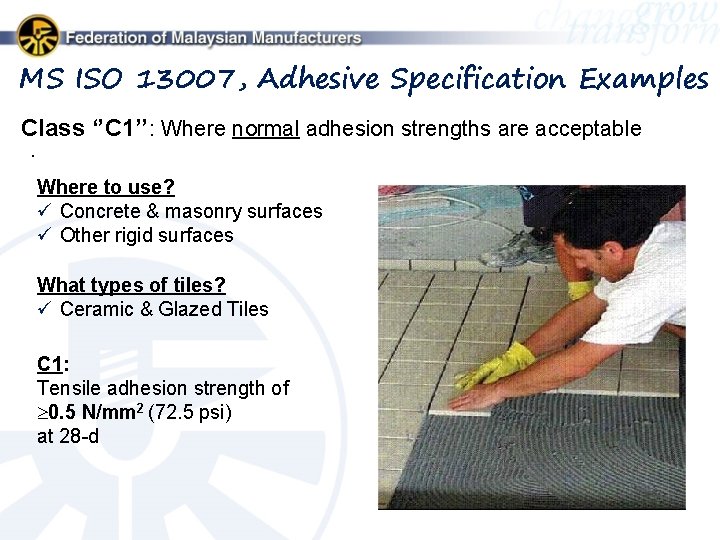
MS ISO 13007, Adhesive Specification Examples Class ‘’C 1’’: Where normal adhesion strengths are acceptable. Where to use? ü Concrete & masonry surfaces ü Other rigid surfaces What types of tiles? ü Ceramic & Glazed Tiles C 1: Tensile adhesion strength of ³ 0. 5 N/mm 2 (72. 5 psi) at 28 -d
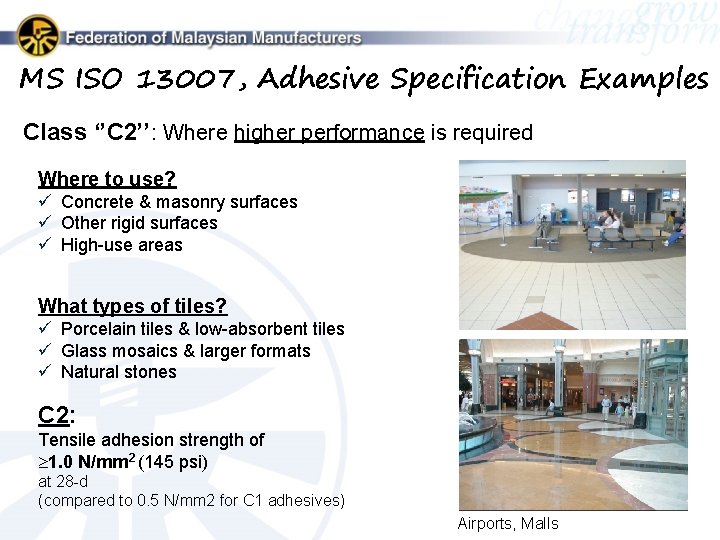
MS ISO 13007, Adhesive Specification Examples Class ‘’C 2’’: Where higher performance is required Where to use? ü Concrete & masonry surfaces ü Other rigid surfaces ü High-use areas What types of tiles? ü Porcelain tiles & low-absorbent tiles ü Glass mosaics & larger formats ü Natural stones C 2: Tensile adhesion strength of ³ 1. 0 N/mm 2 (145 psi) at 28 -d (compared to 0. 5 N/mm 2 for C 1 adhesives) Airports, Malls
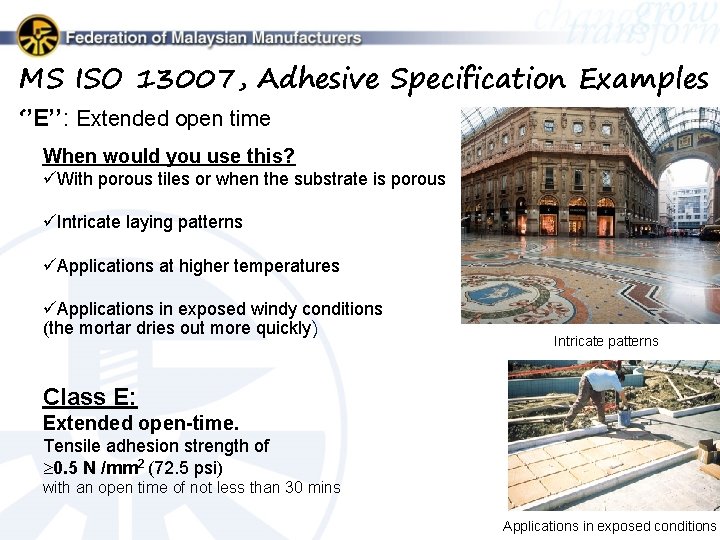
MS ISO 13007, Adhesive Specification Examples ‘’E’’: Extended open time When would you use this? üWith porous tiles or when the substrate is porous üIntricate laying patterns üApplications at higher temperatures üApplications in exposed windy conditions (the mortar dries out more quickly) Intricate patterns Class E: Extended open-time. Tensile adhesion strength of ³ 0. 5 N /mm 2 (72. 5 psi) with an open time of not less than 30 mins Applications in exposed conditions
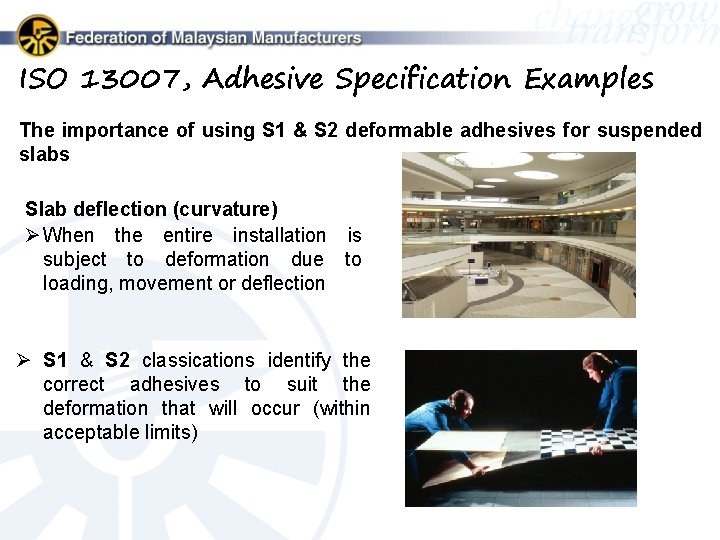
ISO 13007, Adhesive Specification Examples The importance of using S 1 & S 2 deformable adhesives for suspended slabs Slab deflection (curvature) Ø When the entire installation is subject to deformation due to loading, movement or deflection Ø S 1 & S 2 classications identify the correct adhesives to suit the deformation that will occur (within acceptable limits)
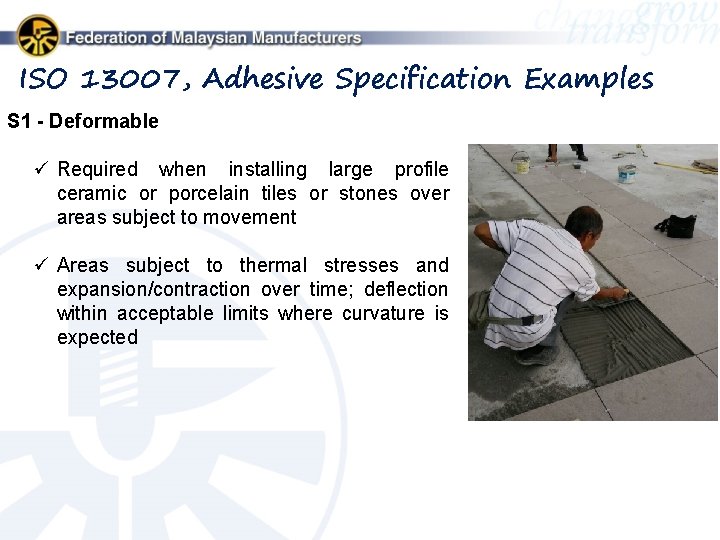
ISO 13007, Adhesive Specification Examples S 1 - Deformable ü Required when installing large profile ceramic or porcelain tiles or stones over areas subject to movement ü Areas subject to thermal stresses and expansion/contraction over time; deflection within acceptable limits where curvature is expected
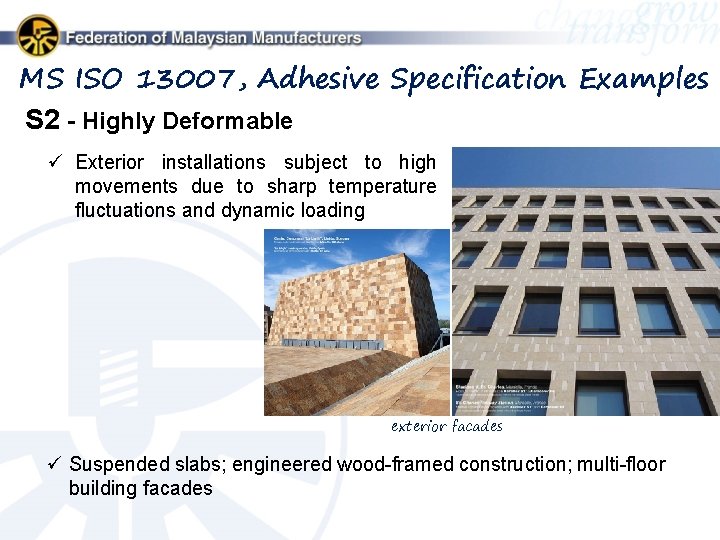
MS ISO 13007, Adhesive Specification Examples S 2 - Highly Deformable ü Exterior installations subject to high movements due to sharp temperature fluctuations and dynamic loading exterior facades ü Suspended slabs; engineered wood-framed construction; multi-floor building facades
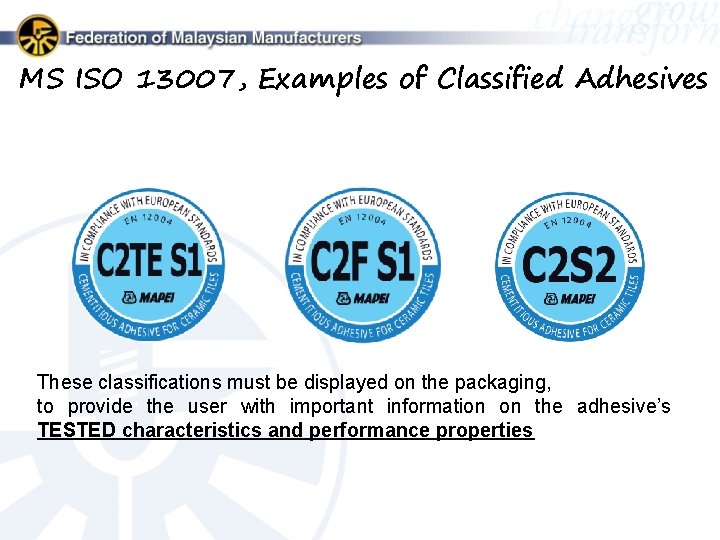
MS ISO 13007, Examples of Classified Adhesives These classifications must be displayed on the packaging, to provide the user with important information on the adhesive’s TESTED characteristics and performance properties
Other Necessary Requirements For A Quality Tiled Finish Ø Substrate preparation flat, sound, clean Ø Workmanship to follow MS 1294 -Code of Practice for the design and installation for ceramic tiles and mosaics Ø Tiling Gap for wall tiles – Minimum 1. 5 mm Ø Tiling Gap for floor tiles-Minimum 3. 00 mm Ø Protection of work
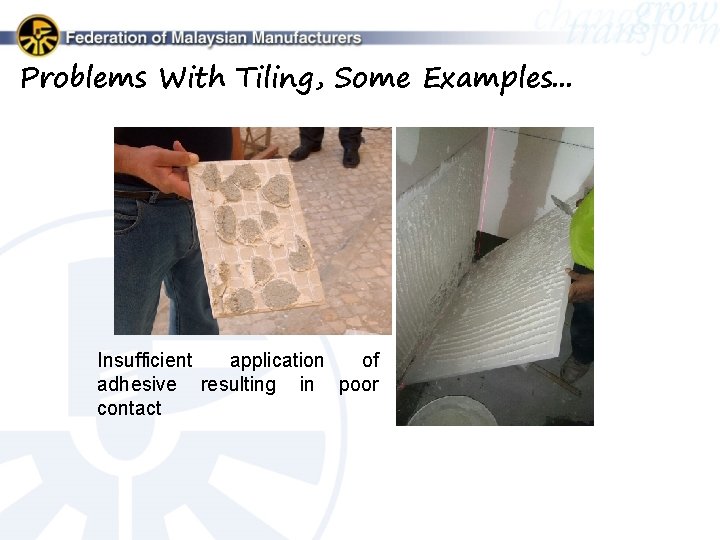
Problems With Tiling, Some Examples. . . Insufficient application of adhesive resulting in poor contact
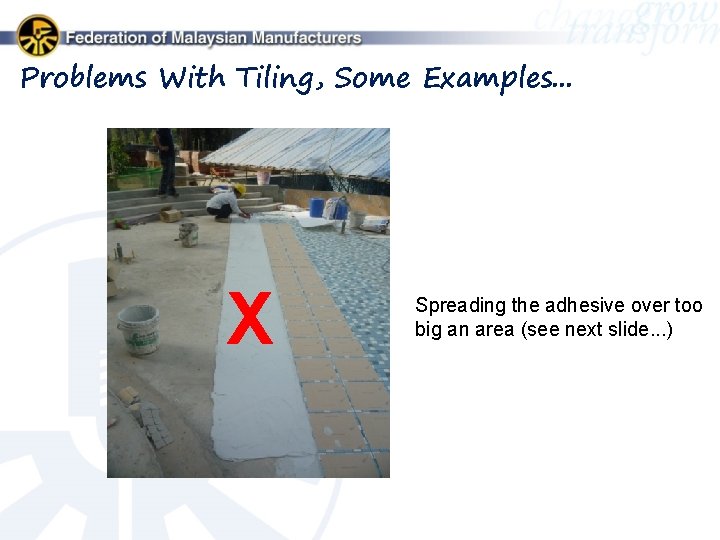
Problems With Tiling, Some Examples. . . X Spreading the adhesive over too big an area (see next slide. . . )
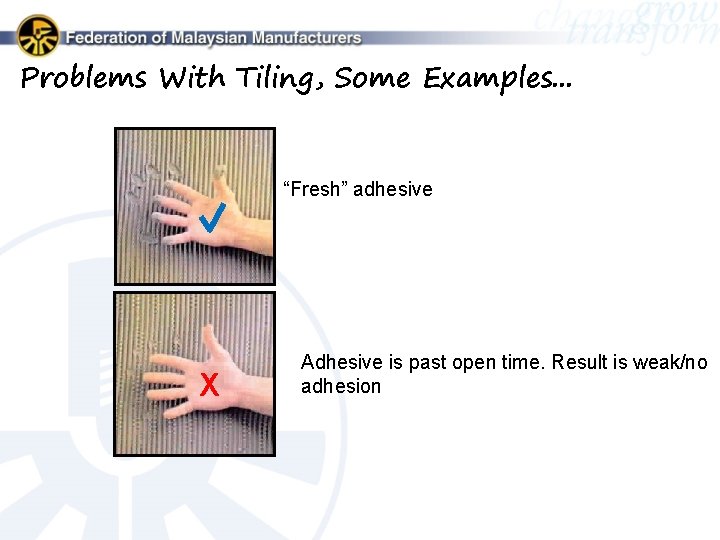
Problems With Tiling, Some Examples. . . “Fresh” adhesive X Adhesive is past open time. Result is weak/no adhesion
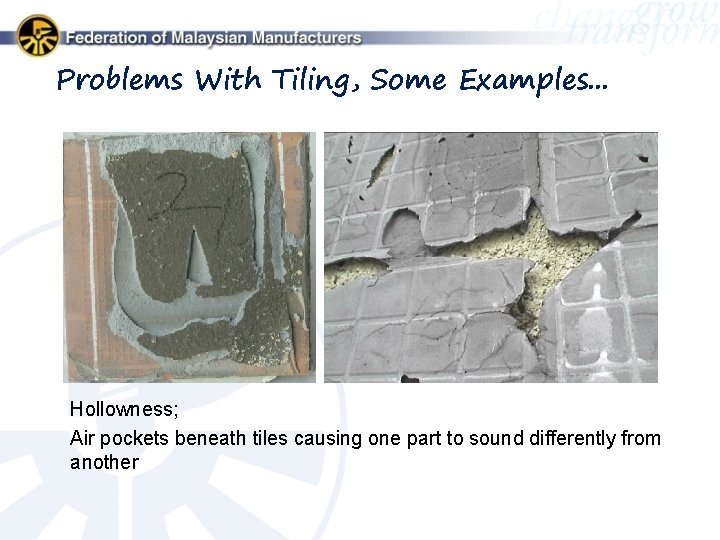
Problems With Tiling, Some Examples. . . Hollowness; Air pockets beneath tiles causing one part to sound differently from another
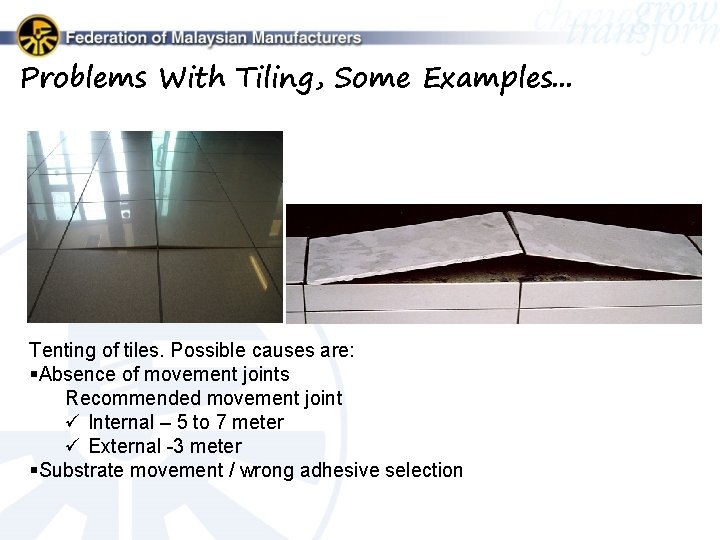
Problems With Tiling, Some Examples. . . Tenting of tiles. Possible causes are: §Absence of movement joints Recommended movement joint ü Internal – 5 to 7 meter ü External -3 meter §Substrate movement / wrong adhesive selection
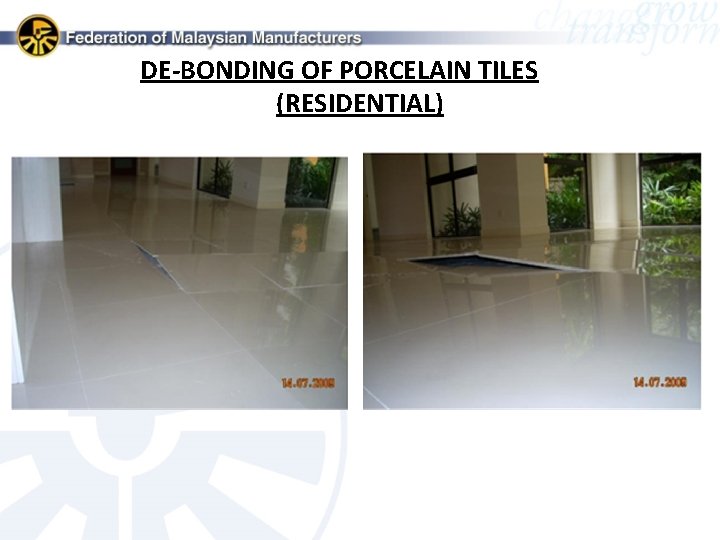
DE-BONDING OF PORCELAIN TILES (RESIDENTIAL)
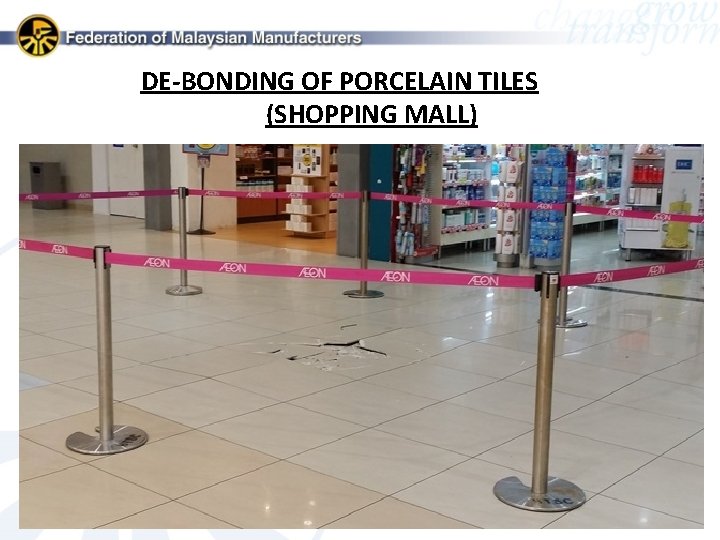
DE-BONDING OF PORCELAIN TILES (SHOPPING MALL)
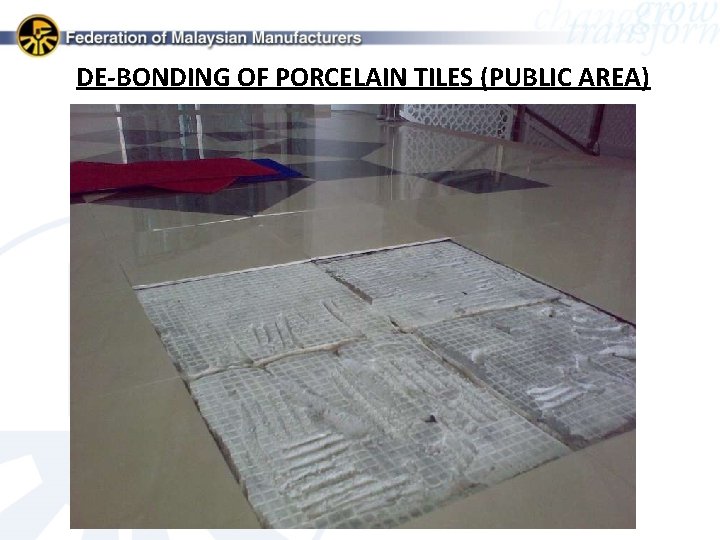
DE-BONDING OF PORCELAIN TILES (PUBLIC AREA)
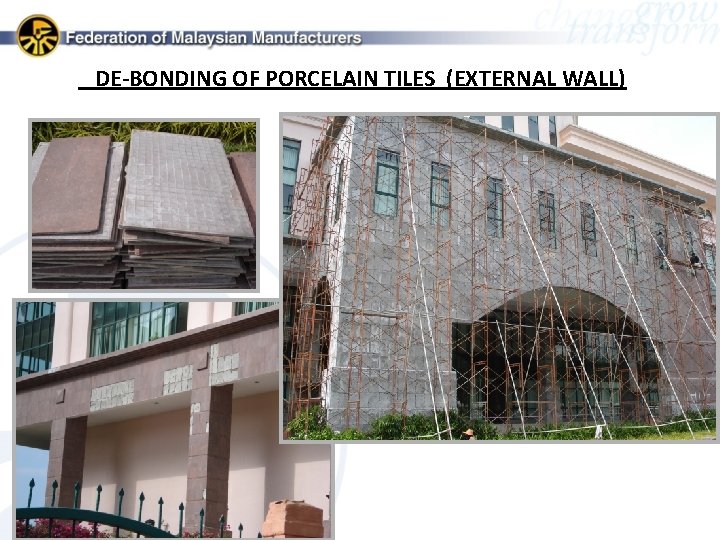
DE-BONDING OF PORCELAIN TILES (EXTERNAL WALL)
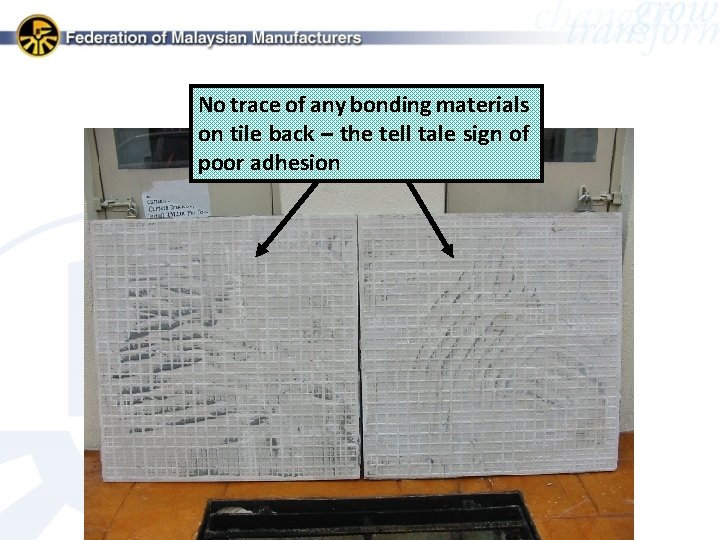
No trace of any bonding materials on tile back – the tell tale sign of poor adhesion
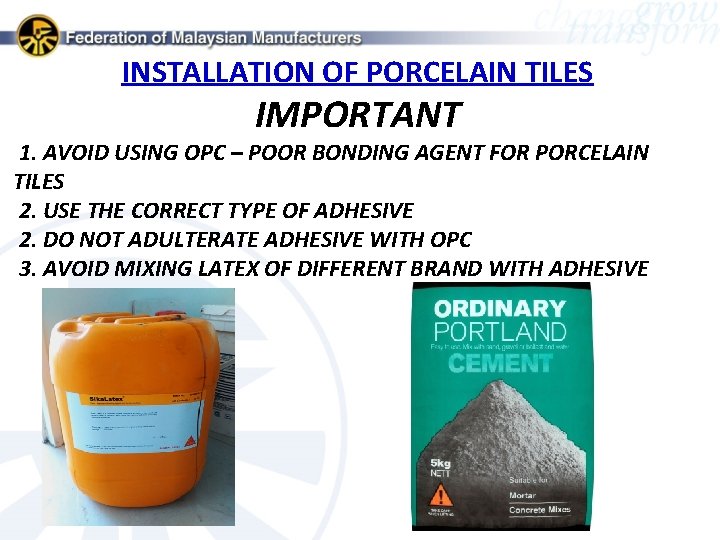
INSTALLATION OF PORCELAIN TILES IMPORTANT 1. AVOID USING OPC – POOR BONDING AGENT FOR PORCELAIN TILES 2. USE THE CORRECT TYPE OF ADHESIVE 2. DO NOT ADULTERATE ADHESIVE WITH OPC 3. AVOID MIXING LATEX OF DIFFERENT BRAND WITH ADHESIVE
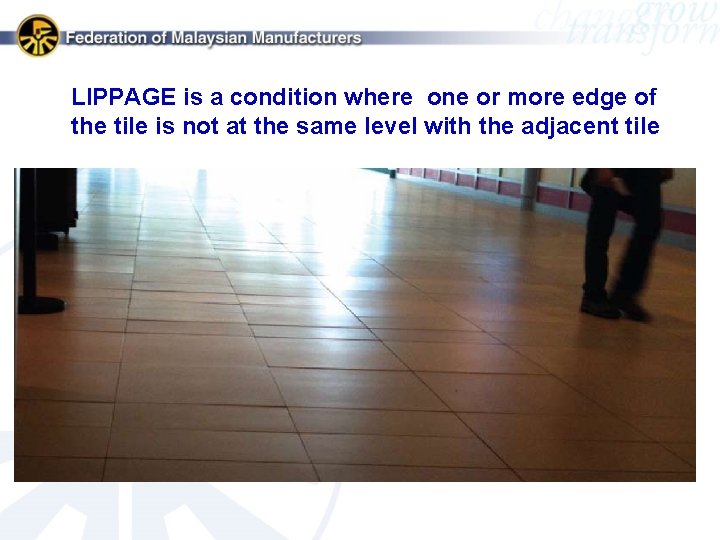
LIPPAGE is a condition where one or more edge of the tile is not at the same level with the adjacent tile
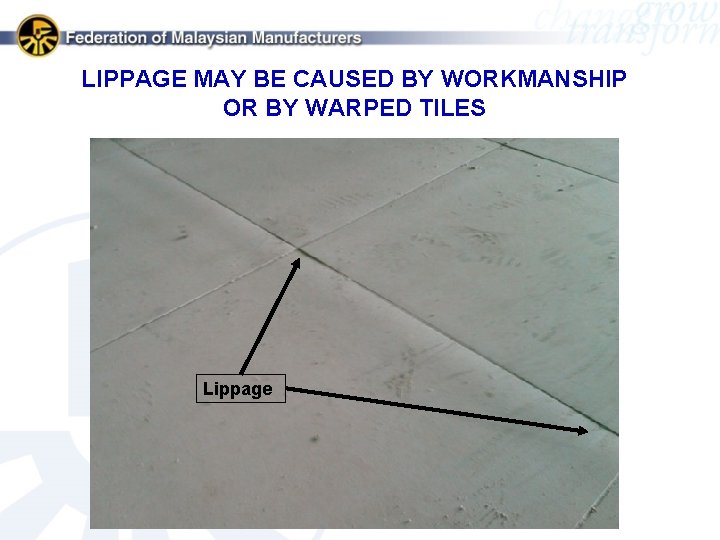
LIPPAGE MAY BE CAUSED BY WORKMANSHIP OR BY WARPED TILES Lippage
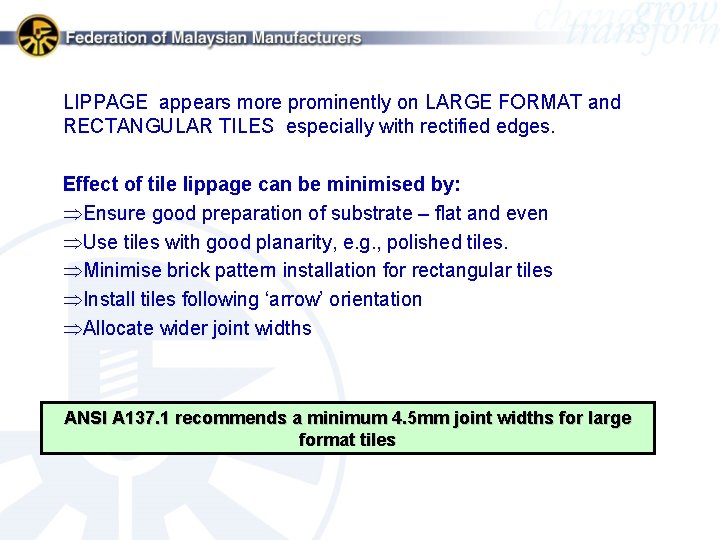
LIPPAGE appears more prominently on LARGE FORMAT and RECTANGULAR TILES especially with rectified edges. Effect of tile lippage can be minimised by: ÞEnsure good preparation of substrate – flat and even ÞUse tiles with good planarity, e. g. , polished tiles. ÞMinimise brick pattern installation for rectangular tiles ÞInstall tiles following ‘arrow’ orientation ÞAllocate wider joint widths ANSI A 137. 1 recommends a minimum 4. 5 mm joint widths for large format tiles
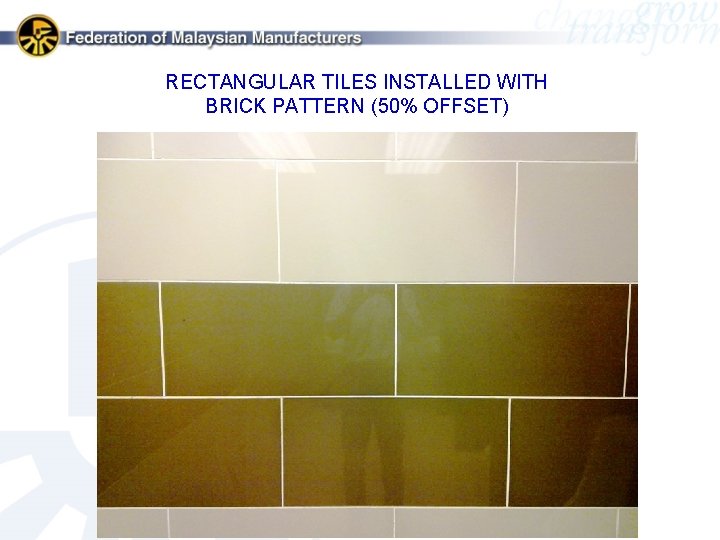
RECTANGULAR TILES INSTALLED WITH BRICK PATTERN (50% OFFSET)
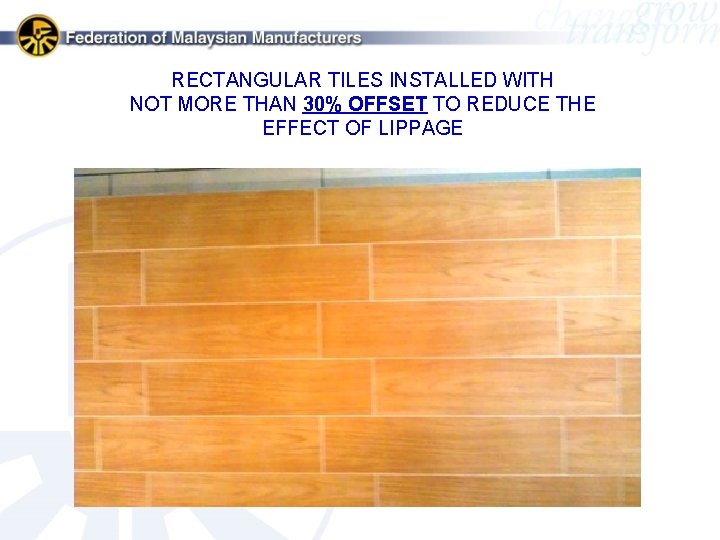
RECTANGULAR TILES INSTALLED WITH NOT MORE THAN 30% OFFSET TO REDUCE THE EFFECT OF LIPPAGE
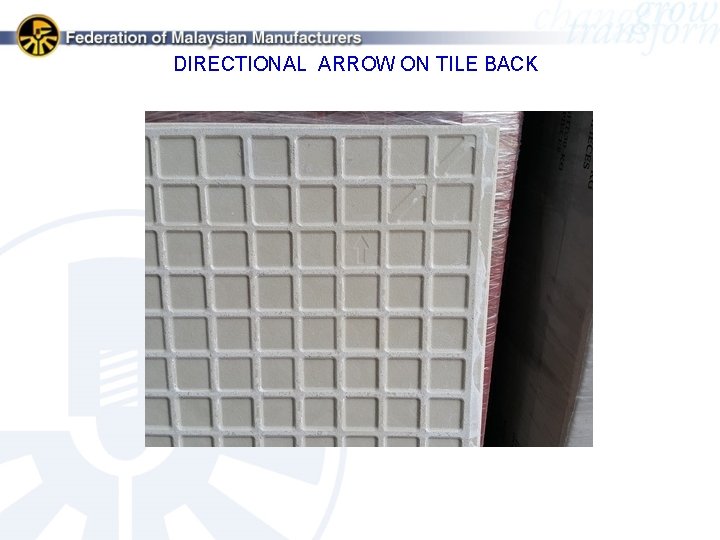
DIRECTIONAL ARROW ON TILE BACK
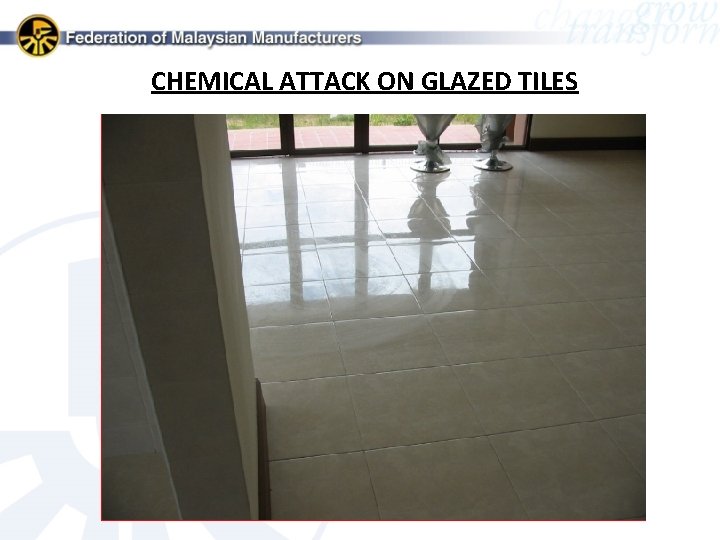
CHEMICAL ATTACK ON GLAZED TILES
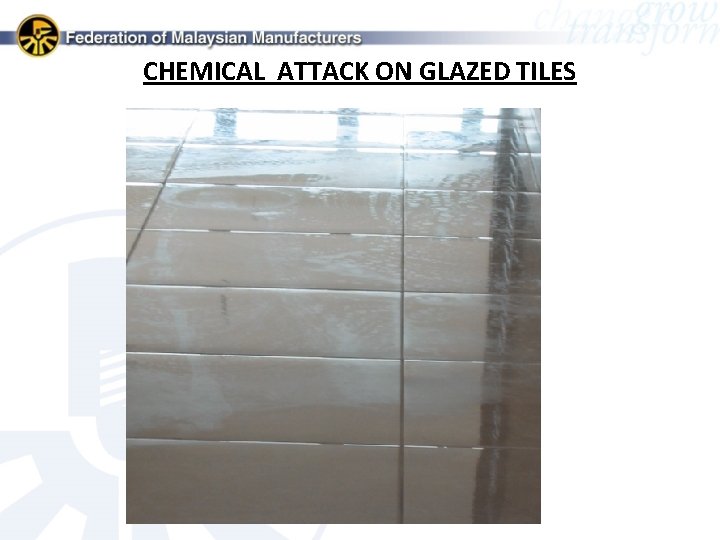
CHEMICAL ATTACK ON GLAZED TILES
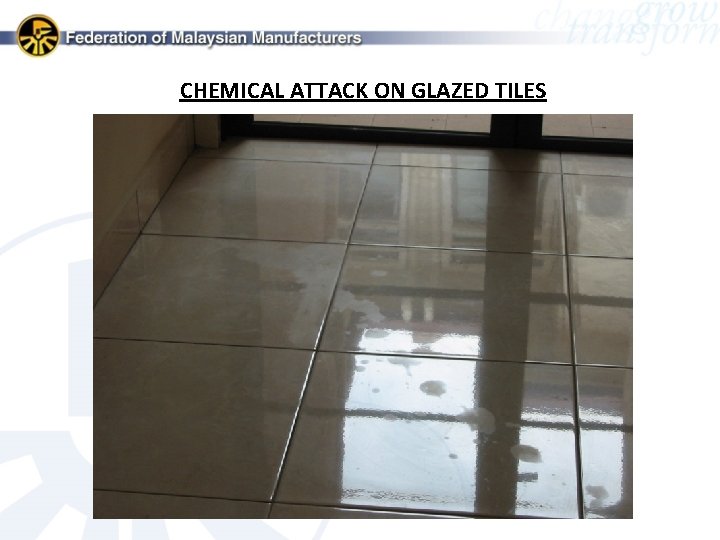
CHEMICAL ATTACK ON GLAZED TILES
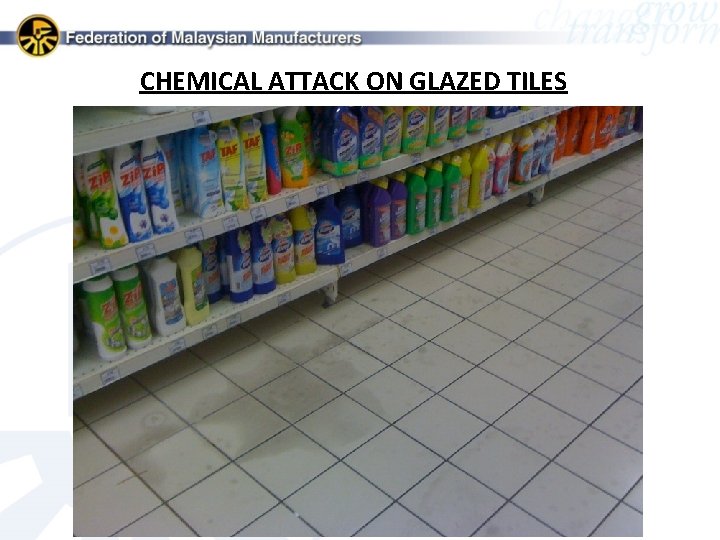
CHEMICAL ATTACK ON GLAZED TILES
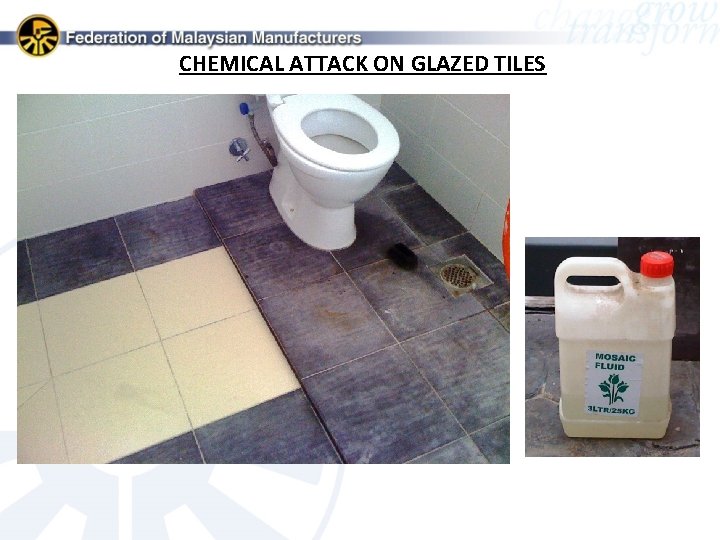
CHEMICAL ATTACK ON GLAZED TILES
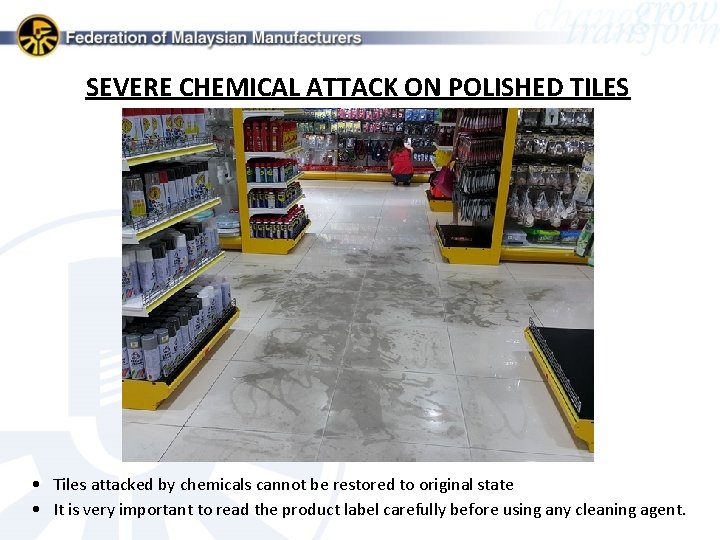
SEVERE CHEMICAL ATTACK ON POLISHED TILES • Tiles attacked by chemicals cannot be restored to original state • It is very important to read the product label carefully before using any cleaning agent.
Costing
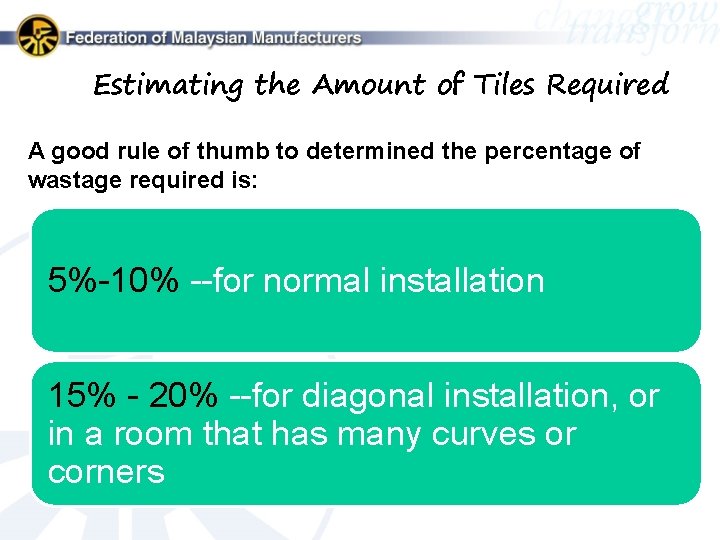
Estimating the Amount of Tiles Required A good rule of thumb to determined the percentage of wastage required is: 5%-10% --for normal installation 15% - 20% --for diagonal installation, or in a room that has many curves or corners
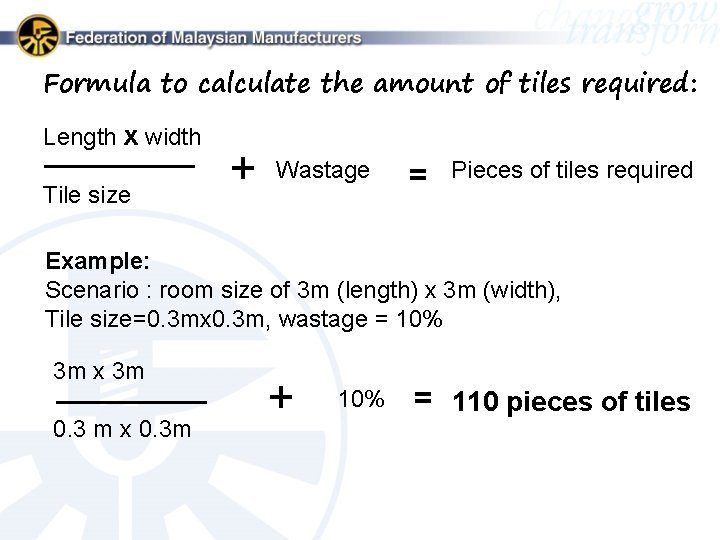
Formula to calculate the amount of tiles required: Length x width Tile size + Wastage = Pieces of tiles required Example: Scenario : room size of 3 m (length) x 3 m (width), Tile size=0. 3 mx 0. 3 m, wastage = 10% 3 m x 3 m 0. 3 m x 0. 3 m + 10% = 110 pieces of tiles
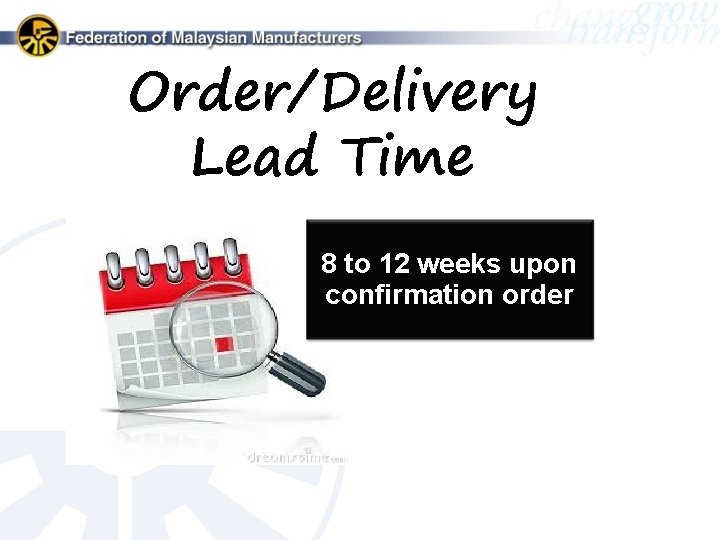
Order/Delivery Lead Time 8 to 12 weeks upon confirmation order

Care & Maintenance
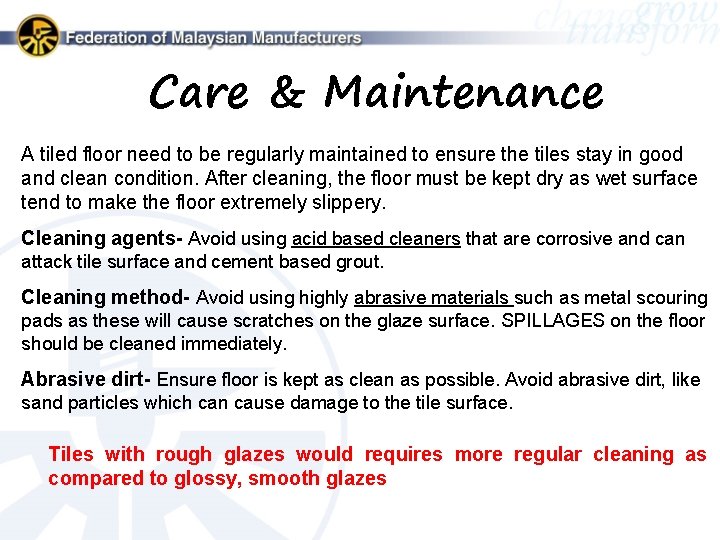
Care & Maintenance A tiled floor need to be regularly maintained to ensure the tiles stay in good and clean condition. After cleaning, the floor must be kept dry as wet surface tend to make the floor extremely slippery. Cleaning agents- Avoid using acid based cleaners that are corrosive and can attack tile surface and cement based grout. Cleaning method- Avoid using highly abrasive materials such as metal scouring pads as these will cause scratches on the glaze surface. SPILLAGES on the floor should be cleaned immediately. Abrasive dirt- Ensure floor is kept as clean as possible. Avoid abrasive dirt, like sand particles which can cause damage to the tile surface. Tiles with rough glazes would requires more regular cleaning as compared to glossy, smooth glazes
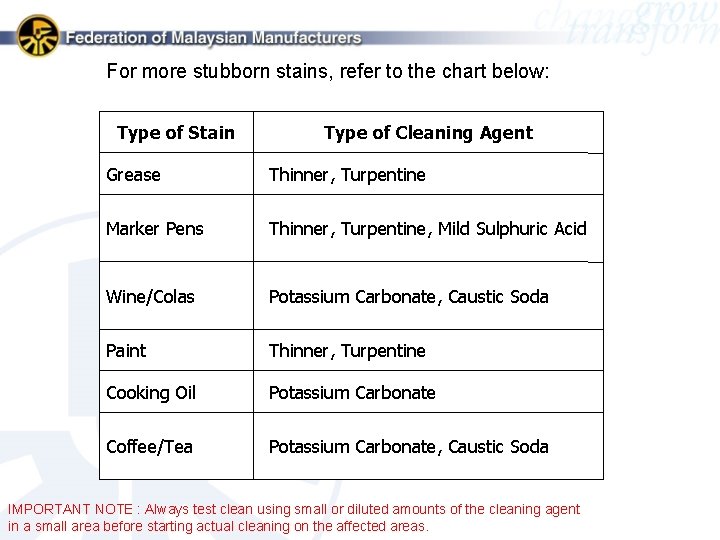
For more stubborn stains, refer to the chart below: Type of Stain Type of Cleaning Agent Grease Thinner, Turpentine Marker Pens Thinner, Turpentine, Mild Sulphuric Acid Wine/Colas Potassium Carbonate, Caustic Soda Paint Thinner, Turpentine Cooking Oil Potassium Carbonate Coffee/Tea Potassium Carbonate, Caustic Soda IMPORTANT NOTE : Always test clean using small or diluted amounts of the cleaning agent in a small area before starting actual cleaning on the affected areas.
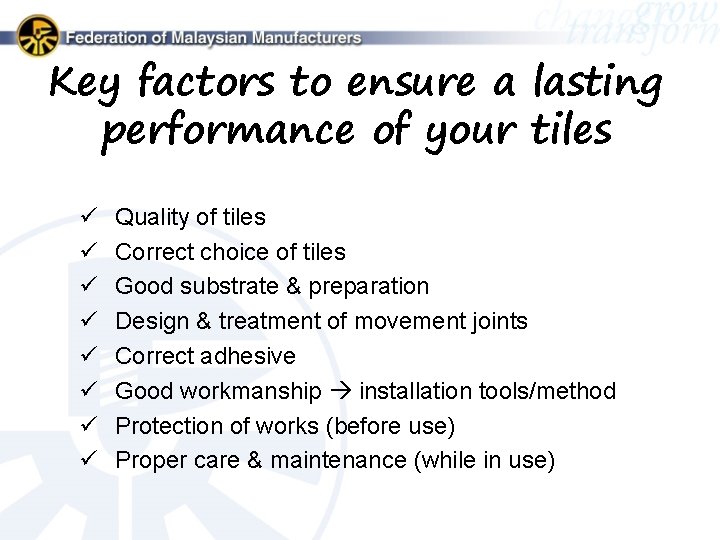
Key factors to ensure a lasting performance of your tiles ü ü ü ü Quality of tiles Correct choice of tiles Good substrate & preparation Design & treatment of movement joints Correct adhesive Good workmanship installation tools/method Protection of works (before use) Proper care & maintenance (while in use)
All manufacturers’ warranties are only valid for uninstalled tiles, it is important to stop tiling any further if any doubts or concerns about the tile quality. Immediately contact your tile supplier with your concerns.
Q&A
THANK YOU
- Slides: 68