
Getting Connected Chapter 2 Part 4 Networking CS
- Slides: 40
Getting Connected (Chapter 2 Part 4) Networking CS 3470, Section 1 Sarah Diesburg
Five Problems Encoding/decoding Framing Error Detection Error Correction Media Access
Five Problems Encoding/decoding Framing Error Detection Error Correction Media Access
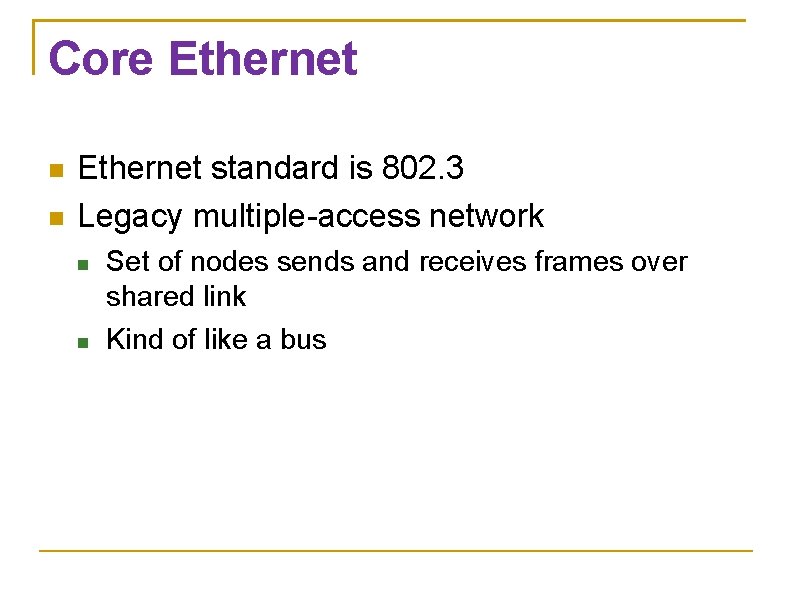
Core Ethernet standard is 802. 3 Legacy multiple-access network Set of nodes sends and receives frames over shared link Kind of like a bus
Core Ethernet is CSMA/CD, which stands for “Carrier Sense, Multiple Access with Collision Detection. ” Carrier sense: all nodes can distinguish between idle and busy link Collision detection: node listens as it transmits can tell if it collides with another frame 5
Core Ethernet By standard, Ethernet is implemented using Coax, on segments limited to 500 m Hosts joined by “tapping into” segment Multiple Ethernet segments joined together by repeaters What do you think a repeater does? No more than four repeaters allowed. 6
Core Ethernet Total reach: 2500 m All physical limitations considered, an Ethernet is limited to 1024 hosts maximum. Any signal emitted by a host on the ethernet is broadcast over the entire network Terminators attached to the end absorb the signal and prevent bounce-back.
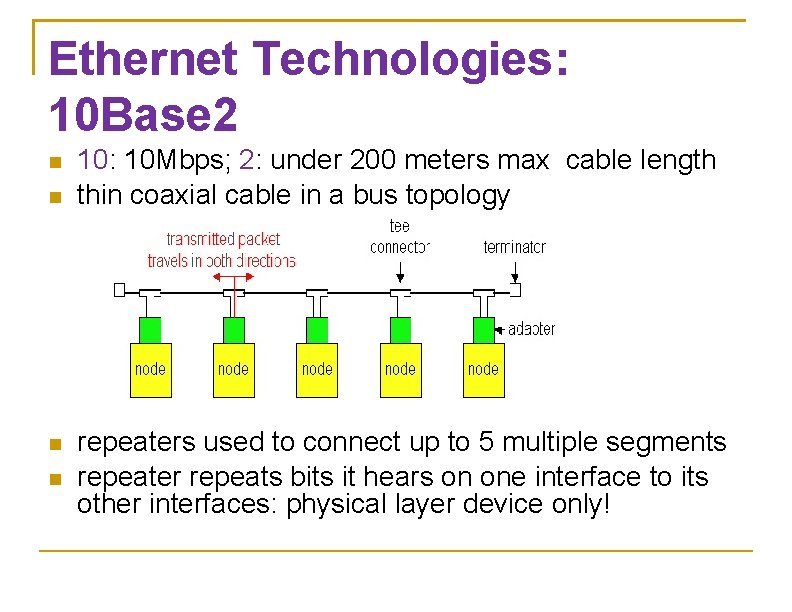
Ethernet Technologies: 10 Base 2 10: 10 Mbps; 2: under 200 meters max cable length thin coaxial cable in a bus topology repeaters used to connect up to 5 multiple segments repeater repeats bits it hears on one interface to its other interfaces: physical layer device only!
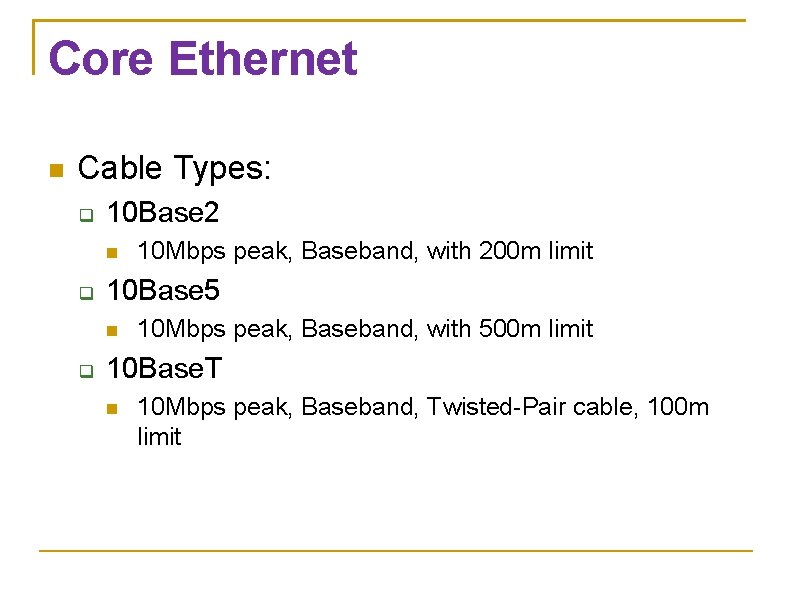
Core Ethernet Cable Types: 10 Base 2 10 Base 5 10 Mbps peak, Baseband, with 200 m limit 10 Mbps peak, Baseband, with 500 m limit 10 Base. T 10 Mbps peak, Baseband, Twisted-Pair cable, 100 m limit
Core Ethernet Encoding schemes Original specification used Manchester encoding Higher-speed Ethernet uses 4 B/5 B or the similar 8 B/10 B encoding 10
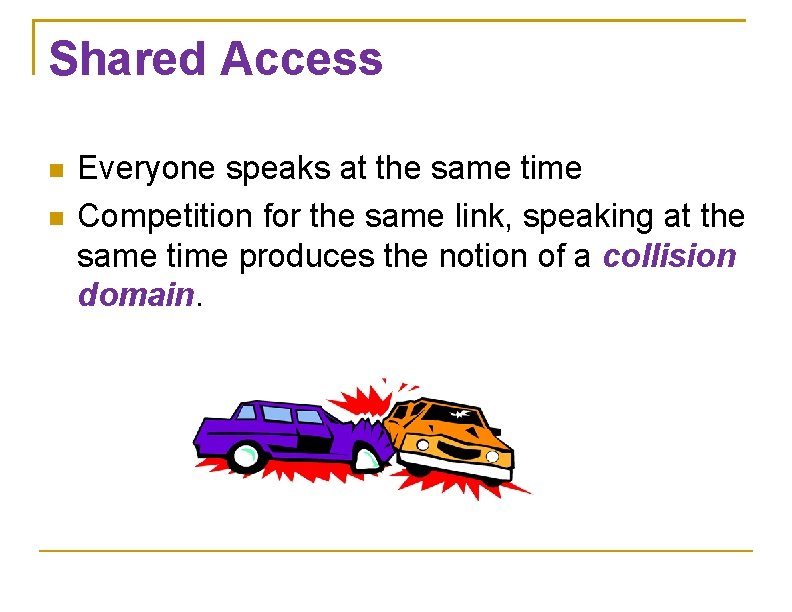
Shared Access Everyone speaks at the same time Competition for the same link, speaking at the same time produces the notion of a collision domain.
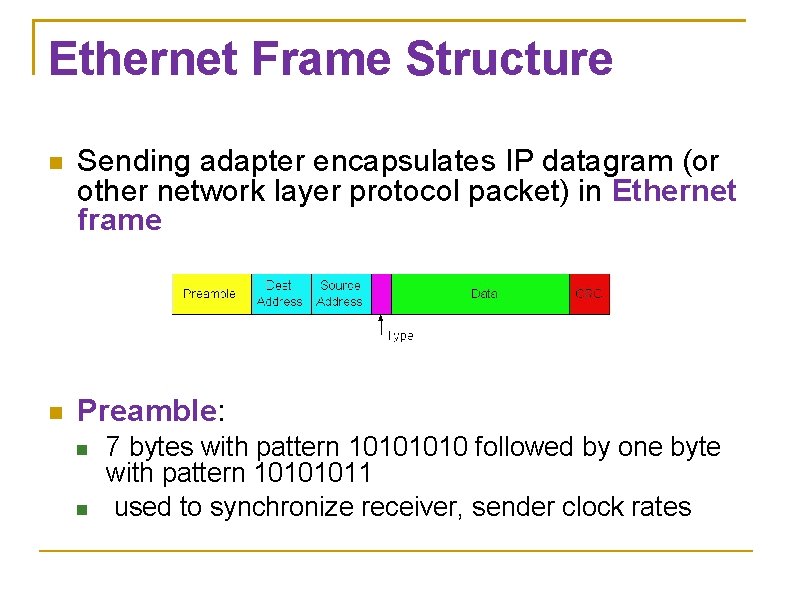
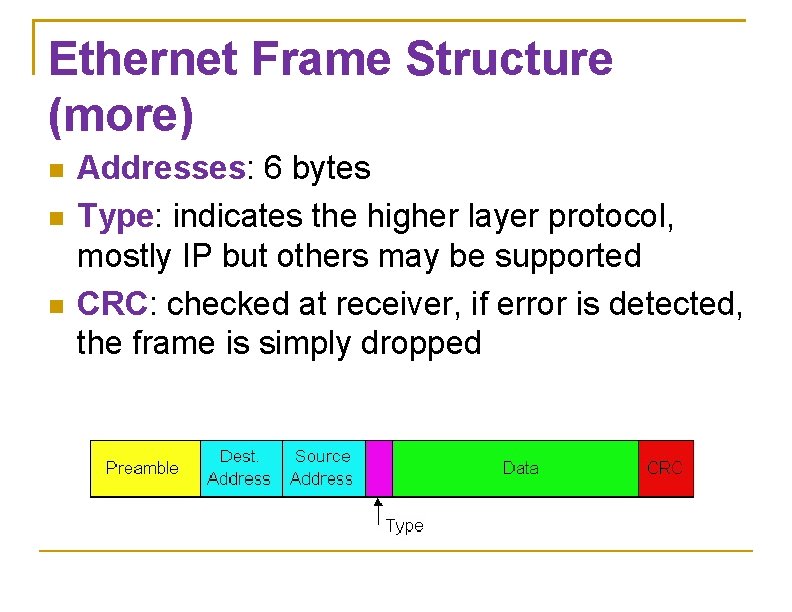
Ethernet Frame Structure Sending adapter encapsulates IP datagram (or other network layer protocol packet) in Ethernet frame Preamble: 7 bytes with pattern 1010 followed by one byte with pattern 10101011 used to synchronize receiver, sender clock rates
Ethernet Frame Structure (more) Addresses: 6 bytes Type: indicates the higher layer protocol, mostly IP but others may be supported CRC: checked at receiver, if error is detected, the frame is simply dropped
MAC Addresses Every Ethernet adapter in the world has a unique address Media Access Control (MAC) Burned into ROM in hardware Sequence of six numbers separated by colons Six binary numbers Usually displayed in hex for humans 14
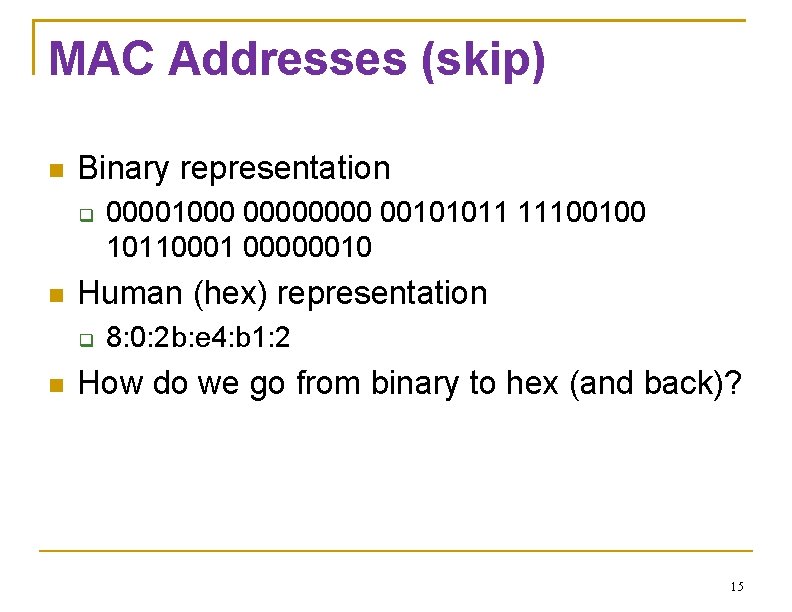
MAC Addresses (skip) Binary representation Human (hex) representation 00001000 0000 00101011 11100100 10110001 00000010 8: 0: 2 b: e 4: b 1: 2 How do we go from binary to hex (and back)? 15
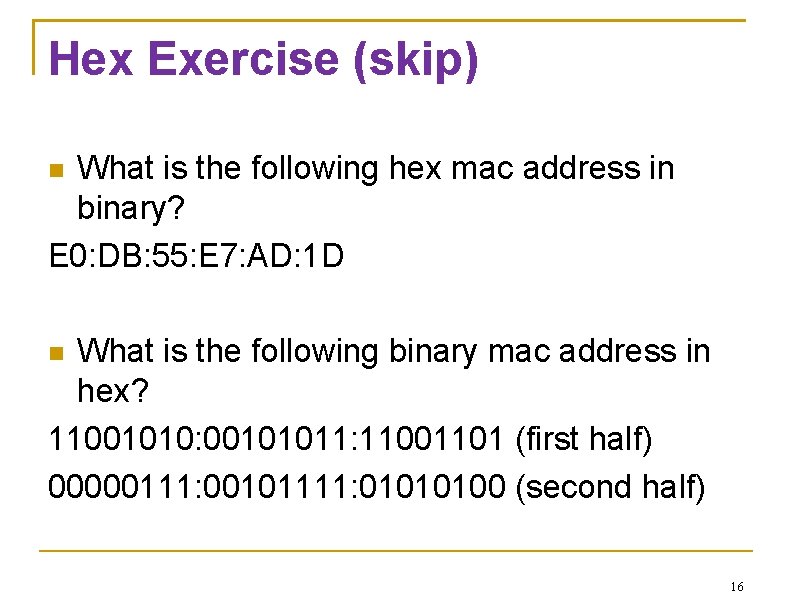
Hex Exercise (skip) What is the following hex mac address in binary? E 0: DB: 55: E 7: AD: 1 D What is the following binary mac address in hex? 11001010: 00101011: 11001101 (first half) 00000111: 00101111: 01010100 (second half) 16
MAC Addresses How do we find them on our machines? Windows Linux cmd -> “ipconfig /all” $> /sbin/ifconfig –a Can a machine have more than one MAC address? Is it changeable? 17
MAC Addresses Ethernet adapter receives all frames and accepts frames that are addressed to Its own address Broadcast address (all 1’s) Multicast address that it has been programmed to accept Can also be put into promiscuous mode to accept all frames Only used in network debugging and hacking 18
MAC Addresses So if a MAC address is unique, can every packet sent be traced back to a unique user? 19
CSMA (Carrier Sense Multiple Access) Ethernet is CSMA/CD, which stands for “Carrier Sense, Multiple Access with Collision Detection. ” Carrier sense: all nodes can distinguish between idle and busy link Collision detection: node listens as it transmits can tell if it collides with another frame 20
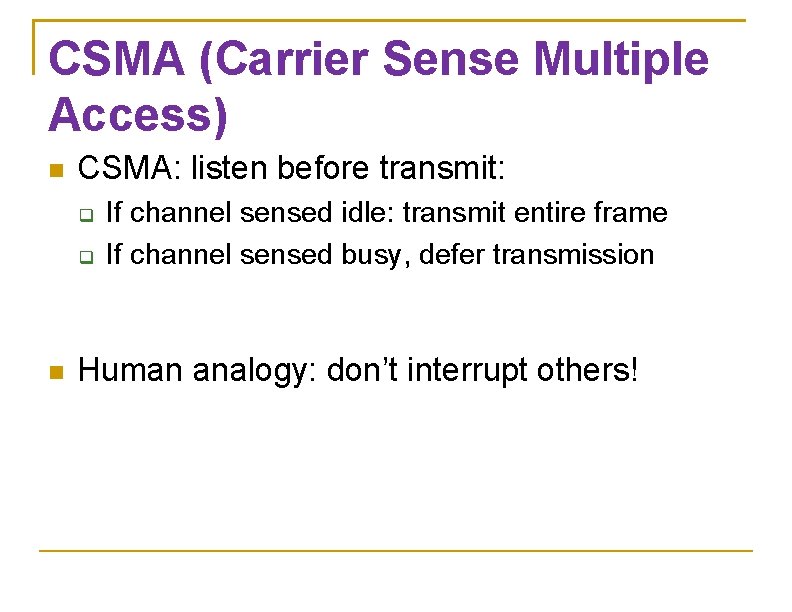
CSMA (Carrier Sense Multiple Access) CSMA: listen before transmit: If channel sensed idle: transmit entire frame If channel sensed busy, defer transmission Human analogy: don’t interrupt others!
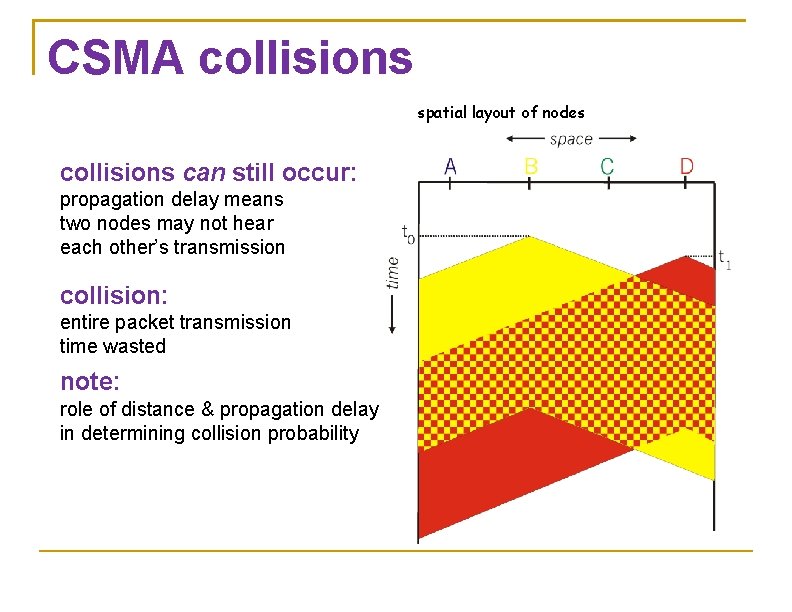
CSMA collisions spatial layout of nodes collisions can still occur: propagation delay means two nodes may not hear each other’s transmission collision: entire packet transmission time wasted note: role of distance & propagation delay in determining collision probability
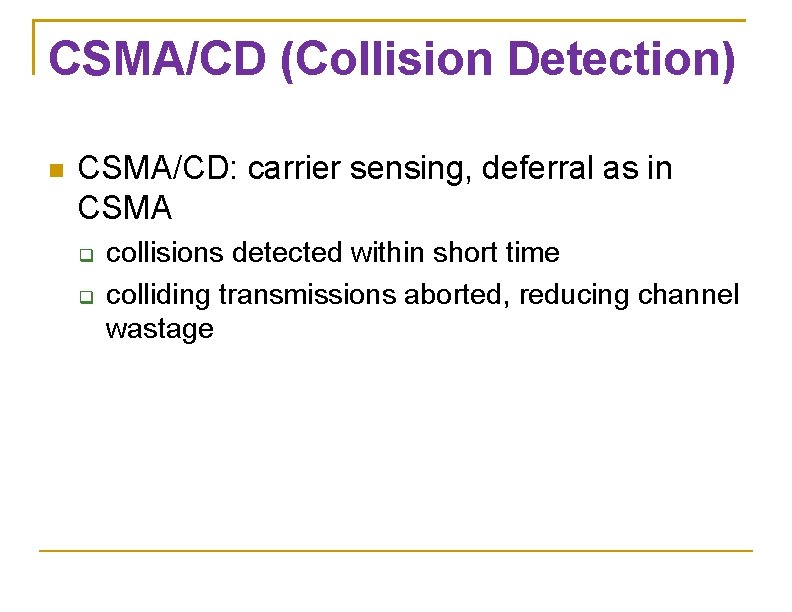
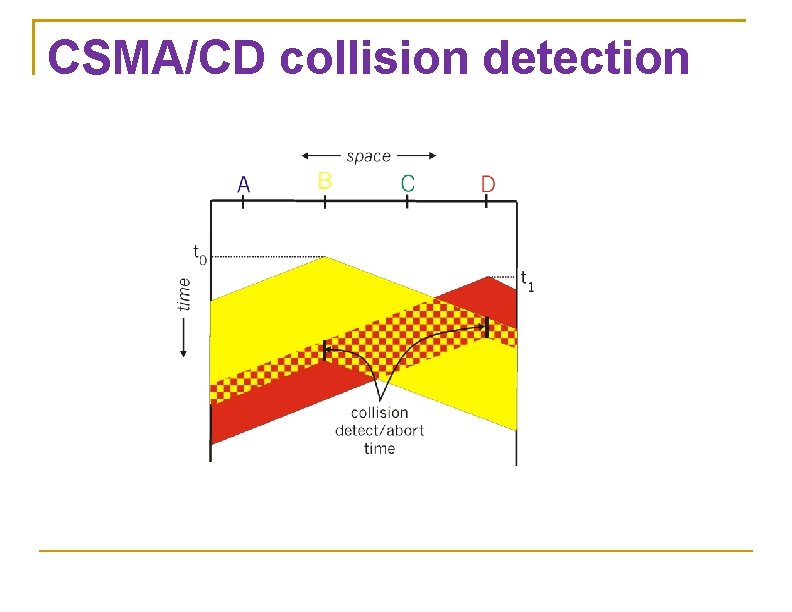
CSMA/CD (Collision Detection) CSMA/CD: carrier sensing, deferral as in CSMA collisions detected within short time colliding transmissions aborted, reducing channel wastage
CSMA/CD collision detection
Collisions When an adapter detects its frame in a collision, it transmits a 32 -bit jamming sequence and stops Will minimally send 96 bits – 64 bit preamble and 32 bits of jamming Also called a runt frame What sort of configuration will cause the most runt frames? 25
Transmitter Algorithm So that’s great that we can detect collisions, but lot’s of collisions are probably bad How can we minimize collisions? Exponential backoff 26
Transmitter Algorithm Maximum distance between any to end hosts is 2500 m At most four repeaters in any Ethernet segment Transmitters are required to send 512 bits per frame. Consider A and B at opposite ends of the network. A sends at time “t. ” One link latency, d, is required to reach host B First bit of A's transmission reaches B at time “t+d. ” B still sees an idle line and begins to transmit B's frame immediately collides with A's. B sends a 96 -bit jamming sequence (a runt frame), arriving at time t +2 d
Some Physical Specifications to the 802 Standard. . . . So A must still be talking when the runt frame comes back. Max distance = 2500 m Round-trip delay assuming four repeaters and “low” propagation speed is 51. 2µs. At 10 -Mbps, this “pipe” is exactly 512 bits. Falloff: 51. 2µs to send. Whoa! Collision. Either send next frame or not. . . (Backoff 0 or 51. 2µs) Still busy? Double your choices and pick randomly (e. g. , pick randomly from 0µs, 51. 2µs, 102. 4µs, 153. 6µs)
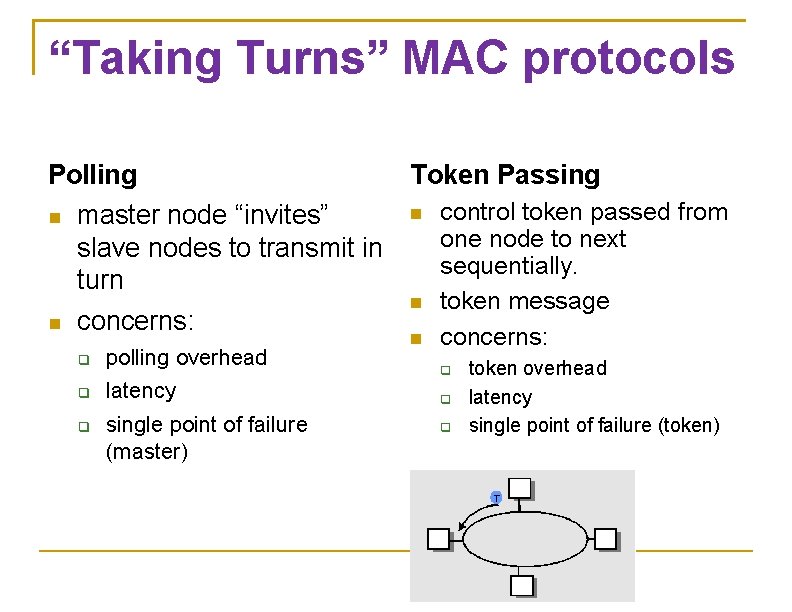
“Taking Turns” MAC protocols Polling master node “invites” slave nodes to transmit in turn concerns: polling overhead latency single point of failure (master) Token Passing control token passed from one node to next sequentially. token message concerns: token overhead latency single point of failure (token)
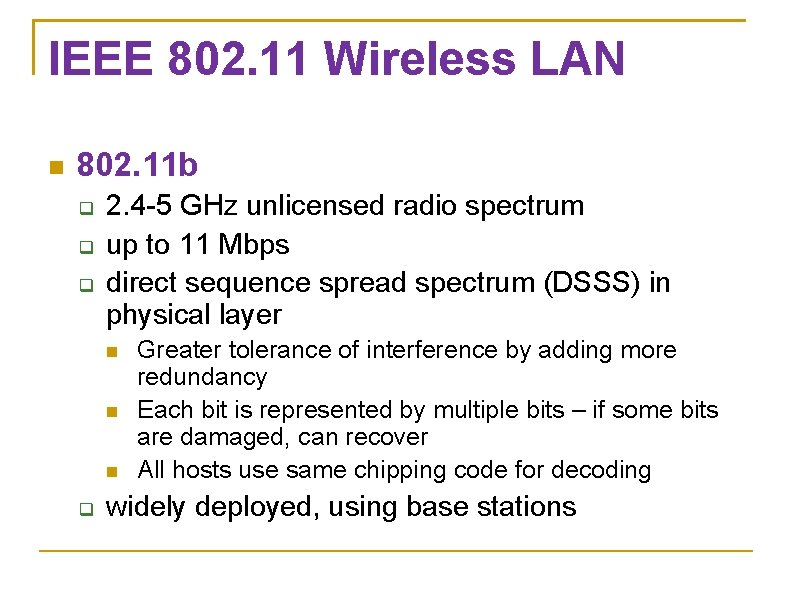
IEEE 802. 11 Wireless LAN 802. 11 b 2. 4 -5 GHz unlicensed radio spectrum up to 11 Mbps direct sequence spread spectrum (DSSS) in physical layer Greater tolerance of interference by adding more redundancy Each bit is represented by multiple bits – if some bits are damaged, can recover All hosts use same chipping code for decoding widely deployed, using base stations
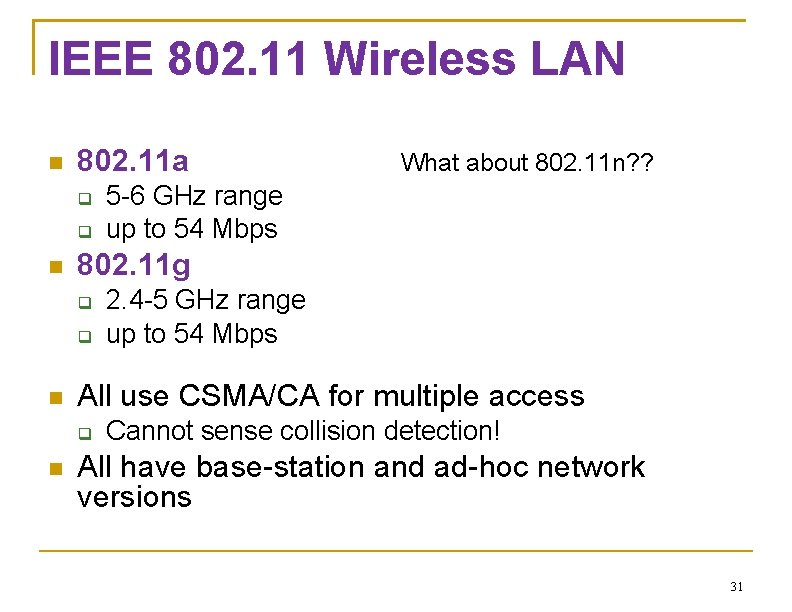
IEEE 802. 11 Wireless LAN 802. 11 a 2. 4 -5 GHz range up to 54 Mbps All use CSMA/CA for multiple access 5 -6 GHz range up to 54 Mbps 802. 11 g What about 802. 11 n? ? Cannot sense collision detection! All have base-station and ad-hoc network versions 31
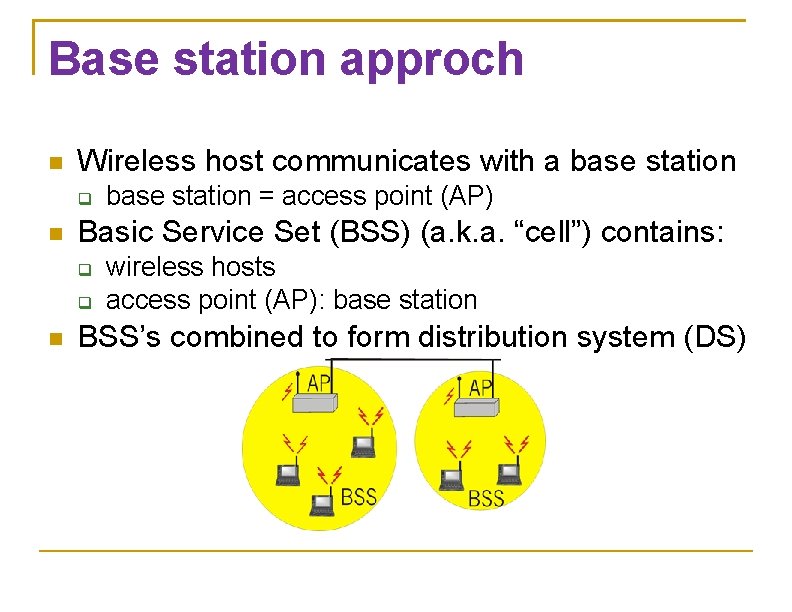
Base station approch Wireless host communicates with a base station Basic Service Set (BSS) (a. k. a. “cell”) contains: base station = access point (AP) wireless hosts access point (AP): base station BSS’s combined to form distribution system (DS)
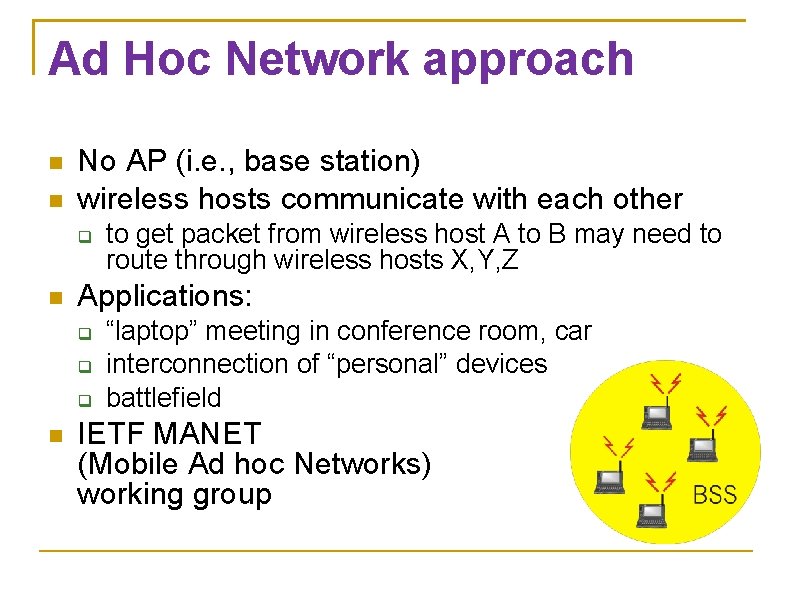
Ad Hoc Network approach No AP (i. e. , base station) wireless hosts communicate with each other Applications: to get packet from wireless host A to B may need to route through wireless hosts X, Y, Z “laptop” meeting in conference room, car interconnection of “personal” devices battlefield IETF MANET (Mobile Ad hoc Networks) working group
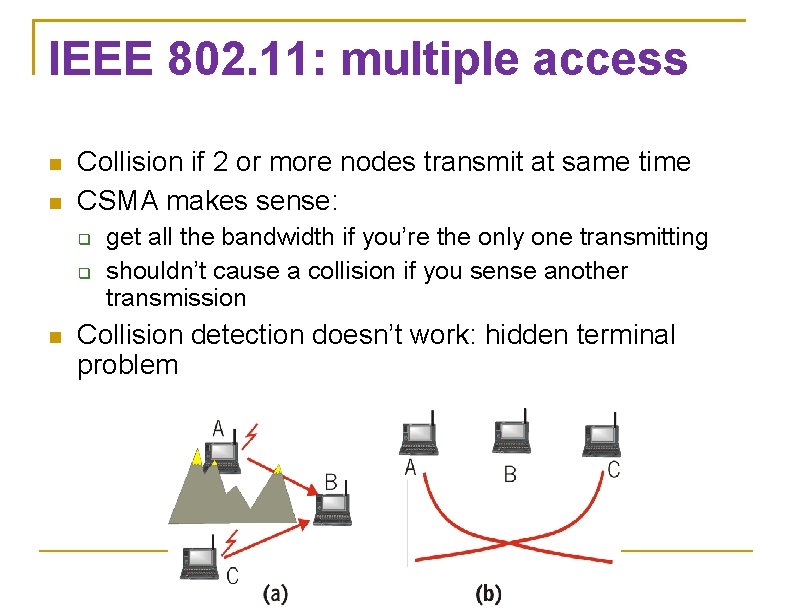
IEEE 802. 11: multiple access Collision if 2 or more nodes transmit at same time CSMA makes sense: get all the bandwidth if you’re the only one transmitting shouldn’t cause a collision if you sense another transmission Collision detection doesn’t work: hidden terminal problem
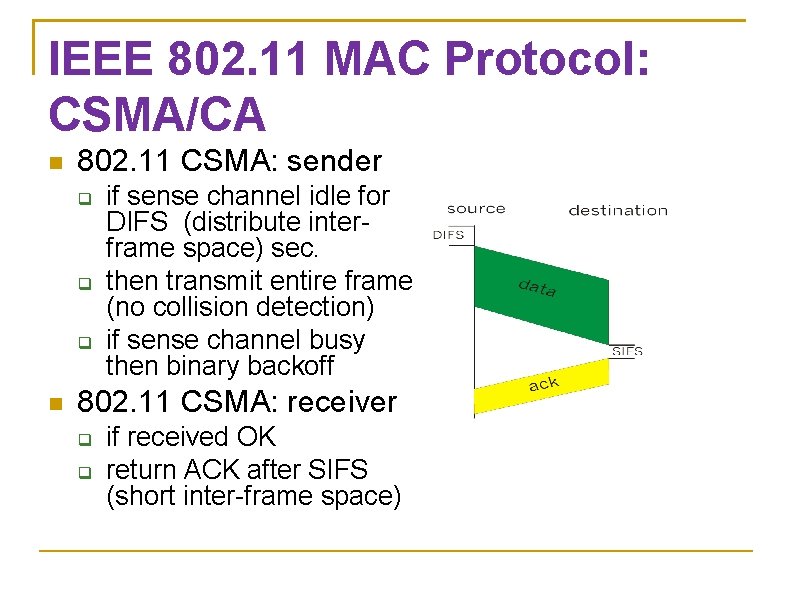
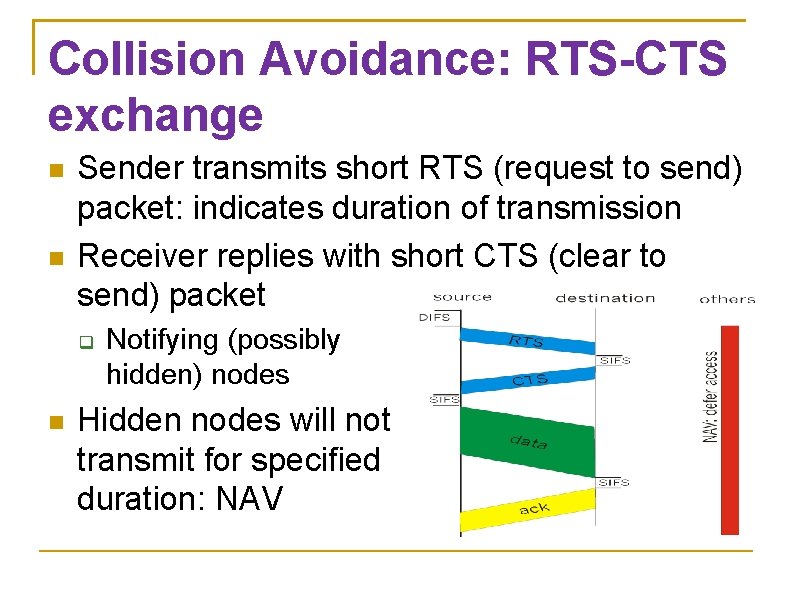
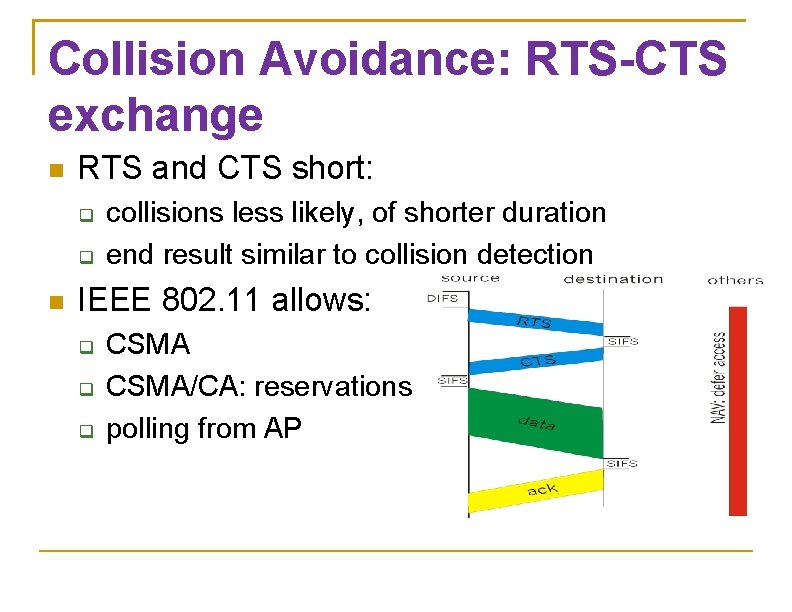
IEEE 802. 11 MAC Protocol: CSMA/CA 802. 11 CSMA: sender if sense channel idle for DIFS (distribute interframe space) sec. then transmit entire frame (no collision detection) if sense channel busy then binary backoff 802. 11 CSMA: receiver if received OK return ACK after SIFS (short inter-frame space)
Collision avoidance mechanisms Problem: Two nodes, hidden from each other, transmit complete frames to base station Wasted bandwidth for long duration ! Solution: Small reservation packets Nodes track reservation interval with internal “network allocation vector” (NAV)
Collision Avoidance: RTS-CTS exchange Sender transmits short RTS (request to send) packet: indicates duration of transmission Receiver replies with short CTS (clear to send) packet Notifying (possibly hidden) nodes Hidden nodes will not transmit for specified duration: NAV
Collision Avoidance: RTS-CTS exchange RTS and CTS short: collisions less likely, of shorter duration end result similar to collision detection IEEE 802. 11 allows: CSMA/CA: reservations polling from AP
Summary of MAC protocols What do you do with a shared media? Channel Partitioning, by time, frequency or code Random partitioning (dynamic) Taking Turns
End of Notes for Exam 1 40