
Getting Back to Our Roots The rapid growth
Getting Back to Our Roots The rapid growth in the development of new methods for the design and analysis of split-plot experimental designs Brian Adams 12/2/2020 1

12/2/2020 3

12/2/2020 4
Getting Back to Our Roots: Split-Plot Designs • Agricultural experiments to improve crop yields have been going on since we planted the first garden. • The rise and fall of most empires can be attributed to agricultural output. • Split-plot designs were originally developed by R. A. Fisher (1925) for use in agricultural experiments. 12/2/2020 5
Getting Back to Our Roots: Split-Plot Designs • Split-plot experiments were developed to address the difficulty in complete randomization. • In these experiments, some of the factors (the hard-to-change ones) are intentionally reset less often than the easy-to-change factors. In a completely randomized experiment, all factors are reset an equal number of times. 12/2/2020 6
Getting Back to Our Roots: Split-Plot Designs • Split-plot and other noncompletely randomized experimental designs have not received proper attention because the mathematical concepts are usually more complicated or more general than those in the completely randomized design. • Fortunately, the availability of statistical software has slowly started to ease the analysis and interpretation of more complicated experimental structures, such as split-plot experiments. 12/2/2020 7
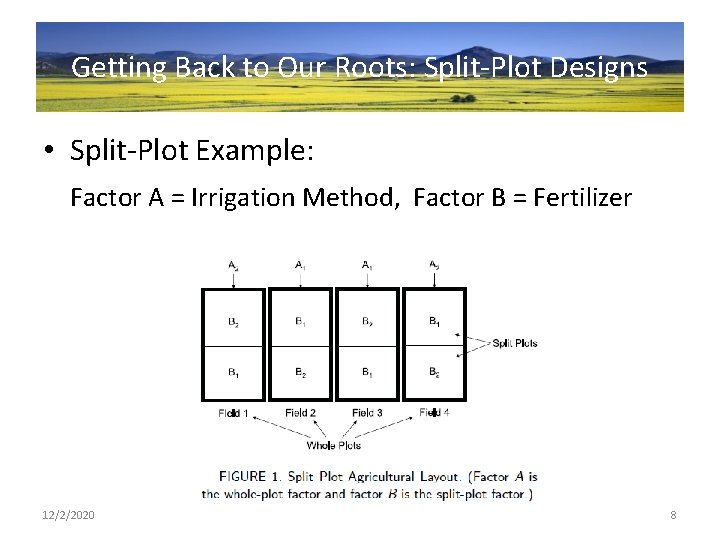
Getting Back to Our Roots: Split-Plot Designs • Split-Plot Example: Factor A = Irrigation Method, Factor B = Fertilizer 12/2/2020 8
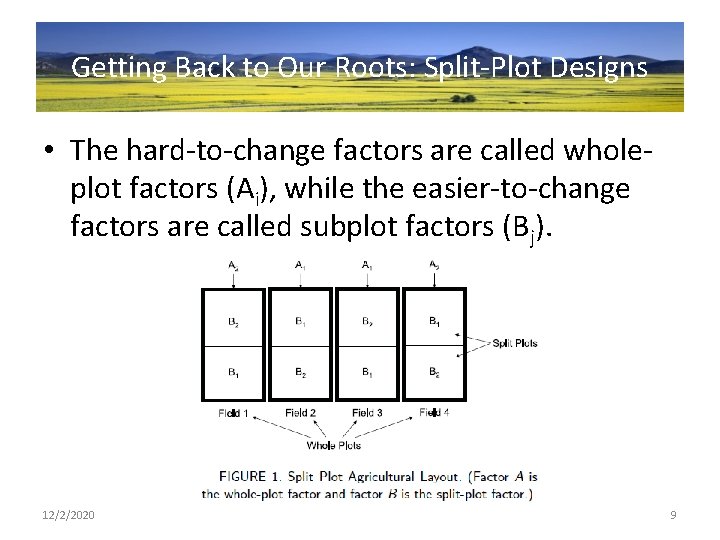
Getting Back to Our Roots: Split-Plot Designs • The hard-to-change factors are called wholeplot factors (Ai), while the easier-to-change factors are called subplot factors (Bj). 12/2/2020 9
Getting Back to Our Roots: Split-Plot Designs • Recently there has been an increase in research and software development in the design of experiments for split-plot situations. • Facilities for construction of split-plot designs are not as yet generally available in software packages (with SAS/JMP being one exception). • “All industrial experiments are split-plot experiments. ” - attributed to the famous industrial statistician, Cuthbert Daniel. 12/2/2020 10
Getting Back to Our Roots: Split-Plot Designs Tufte: How did you become interested in statistics? Daniel: It’s an interesting story although I can’t make much sense of it. I tend to describe things I can’t analyze as being due to luck. I’ve lived a life of luck. I have depended on luck all my life and have been wonderfully lucky at every stage. I came into statistics by luck. My wife Janet – whom I’d met by luck – was at Harvard taking her degree in biochemistry. One day she brought home a book she was told to read by her supervisor. It was called Statistical Methods for Research by a chap named R. A. Fischer. I picked it up and looked at it and after about an hour I said this is great. That’s how I 12/2/2020 11 came to statistics.
Getting Back to Our Roots: Split-Plot Designs • Split-plot designs have three main characteristics: – The levels of all the factors are not randomly determined and reset for each experimental run. – The size of the experimental unit is not the same for all experimental factors. – There is a restriction on the random assignment of the treatment combinations to the experimental units. 12/2/2020 12
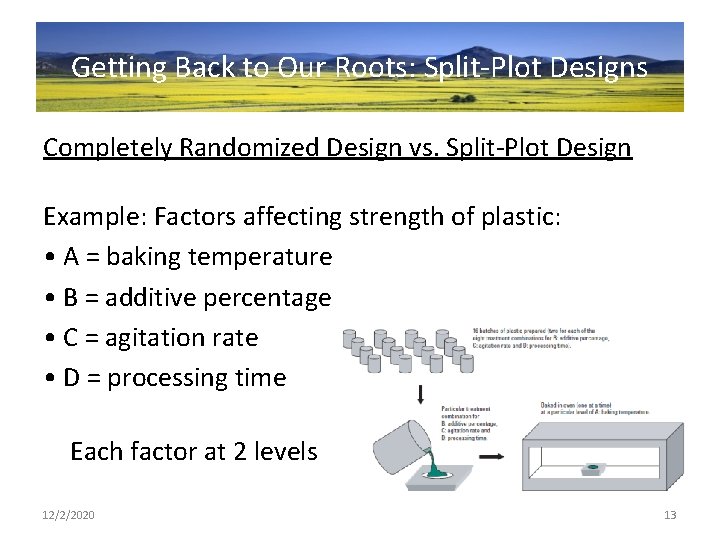
Getting Back to Our Roots: Split-Plot Designs Completely Randomized Design vs. Split-Plot Design Example: Factors affecting strength of plastic: • A = baking temperature • B = additive percentage • C = agitation rate • D = processing time Each factor at 2 levels 12/2/2020 13

Getting Back to Our Roots: Split-Plot Designs Completely Randomized Design vs. Split-Plot Design To conduct this experiment as a completely randomized design, you would run all 16 treatment combinations in a random order. 12/2/2020 14
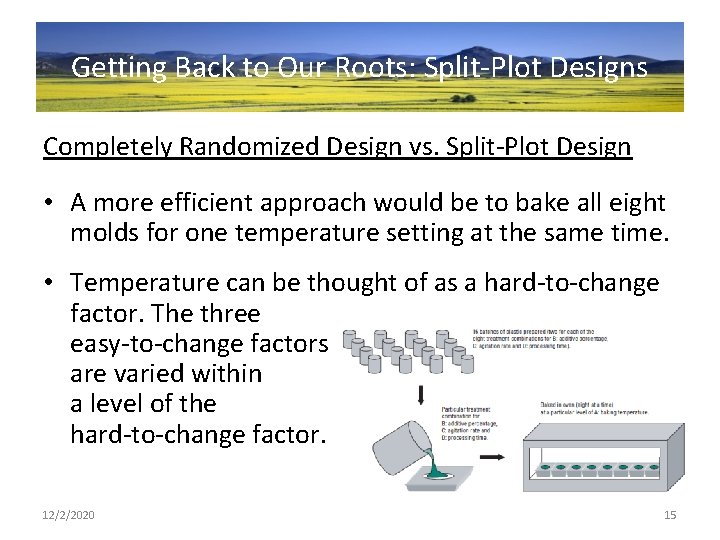
Getting Back to Our Roots: Split-Plot Designs Completely Randomized Design vs. Split-Plot Design • A more efficient approach would be to bake all eight molds for one temperature setting at the same time. • Temperature can be thought of as a hard-to-change factor. The three easy-to-change factors are varied within a level of the hard-to-change factor. 12/2/2020 15
Getting Back to Our Roots: Split-Plot Designs • Why Use Split-Plot Designs? – Factors that are hard to change – Costs less than a completely randomized design – They are often more efficient statistically (i. e. greater overall precision). 12/2/2020 16
Getting Back to Our Roots: Split-Plot Designs • Drawbacks? – Choosing a “best” split-plot design for a given design scenario can be a daunting task, even for a professional statistician. – Schwarz (2007) notes, “In my experience in statistical consulting, this design is likely the most common design to be analyzed incorrectly. ” – Why? The analysis of a split-plot experiment is more complex than that for a completely randomized experiment due to the presence of both split-plot and whole-plot random errors 12/2/2020 17
Getting Back to Our Roots: Split-Plot Designs • Drawbacks? – The main plot treatments are measured with less precision than they are in a randomized complete block design (RCBD). – When missing data occur, the analysis is more complex than for a RCBD with missing data – Different treatment comparisons have different basic error variances which make the analysis more complex than with the RCBD 12/2/2020 18
Getting Back to Our Roots: Split-Plot Designs • Many practitioners fail to see there is more to knowing the correct analysis than just being able to identify the treatment structure. • The analysis of designed experiments directly follows from the way the runs were carried out. • The model for the split-plot design is built by including terms corresponding to the treatment structure and terms corresponding to the experimental units. 12/2/2020 19
Getting Back to Our Roots: Split-Plot Designs Split Plot Model Response 12/2/2020 20
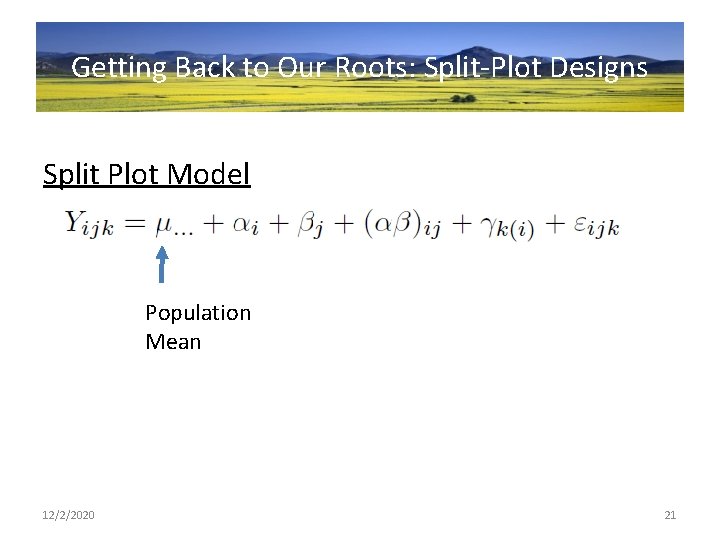
Getting Back to Our Roots: Split-Plot Designs Split Plot Model Population Mean 12/2/2020 21
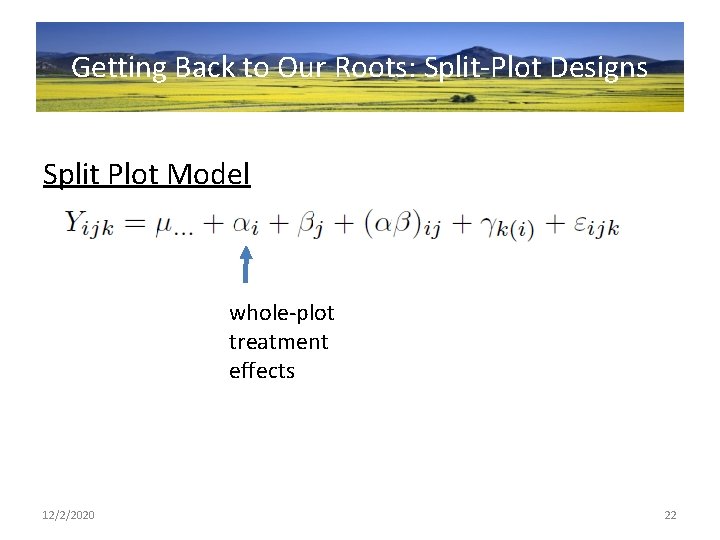
Getting Back to Our Roots: Split-Plot Designs Split Plot Model whole-plot treatment effects 12/2/2020 22
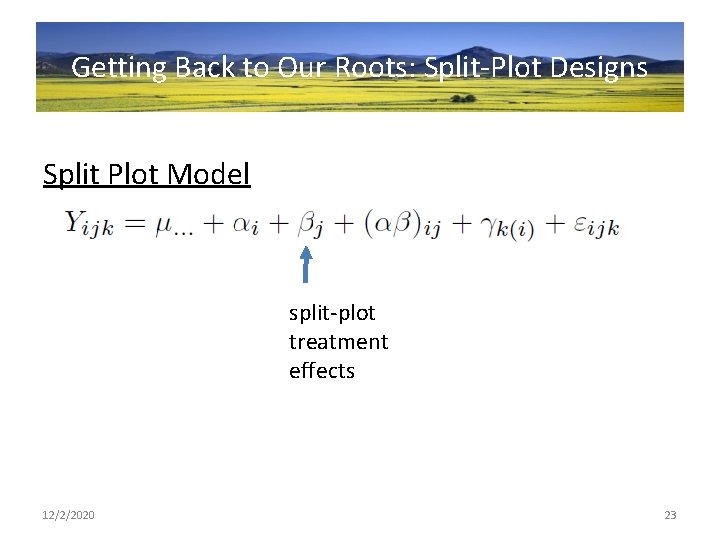
Getting Back to Our Roots: Split-Plot Designs Split Plot Model split-plot treatment effects 12/2/2020 23

Getting Back to Our Roots: Split-Plot Designs Split Plot Model interaction effects 12/2/2020 24
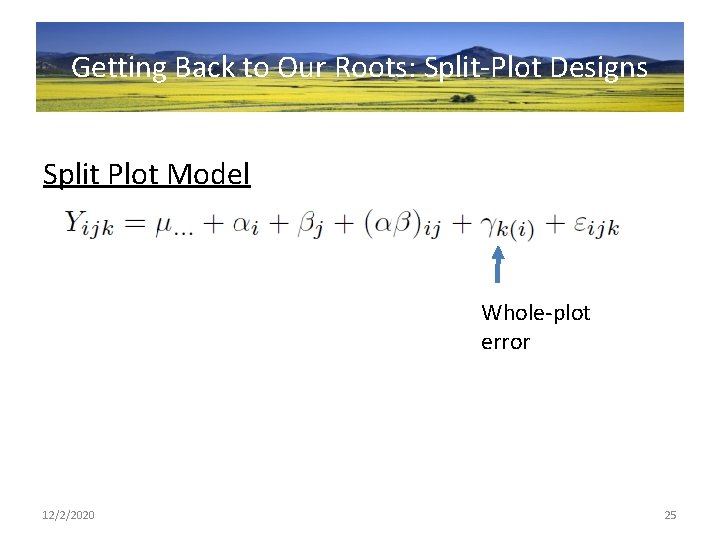
Getting Back to Our Roots: Split-Plot Designs Split Plot Model Whole-plot error 12/2/2020 25
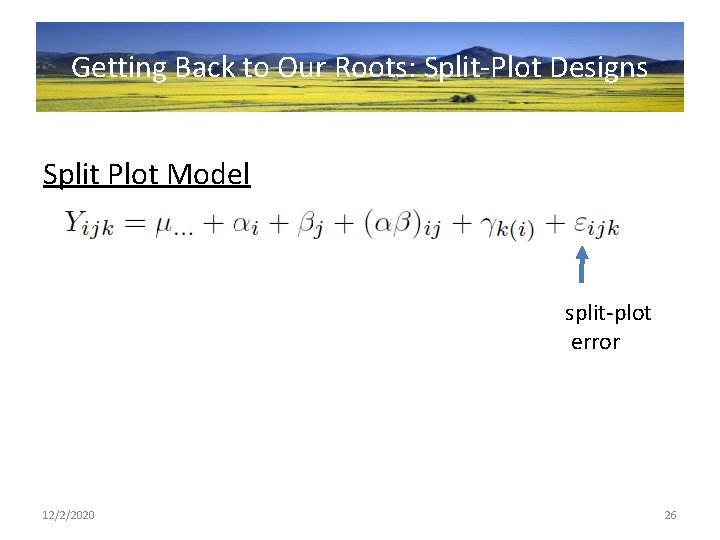
Getting Back to Our Roots: Split-Plot Designs Split Plot Model split-plot error 12/2/2020 26
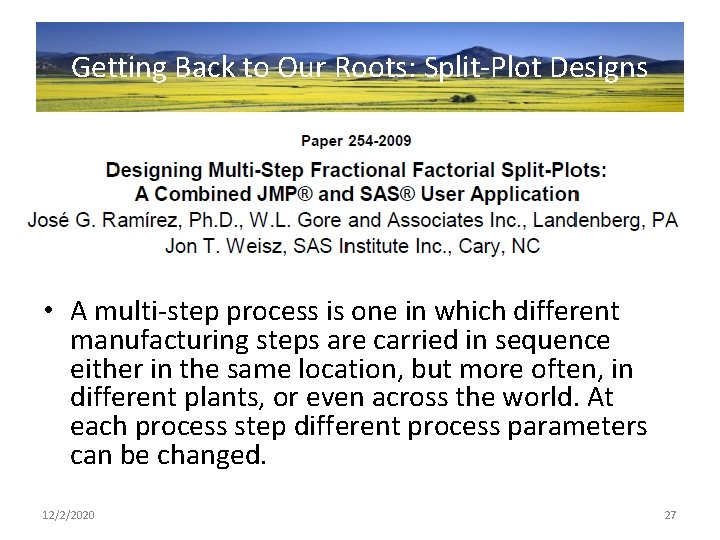
Getting Back to Our Roots: Split-Plot Designs • A multi-step process is one in which different manufacturing steps are carried in sequence either in the same location, but more often, in different plants, or even across the world. At each process step different process parameters can be changed. 12/2/2020 27
Getting Back to Our Roots: Split-Plot Designs • We need ways of designing experiments that take into account the split-plot structure induced by multi-step processes. • We also need to consider the requirement of trying to use a reasonable number of runs. • Two approaches are possible: – Fractional factorial designs – Specify a model along with an optimality criteria to obtain a design 12/2/2020 28

Getting Back to Our Roots: Split-Plot Designs • JMP users can take advantage of the optimality criteria approach to design experiments for 2 Step and 3 -Step processes. • But what if your process has more than 3 steps? Or you want a design for a 2 -Step or 3 -Step situation with different characteristics than the ones offered by JMP? • Recent advances in fractional factorial split-plot (FFSP) methods and software make it possible to design experiments for virtually any number of process steps. 12/2/2020 29

Getting Back to Our Roots: Split-Plot Designs • We can take advantage of the new features in PROC FACTEX, SAS/QC version 9. 2. • The new features consist of the BLOCK UNIT=() option for describing the split-plot structure of the experiment, and the UNITEFFECT statement for specifying where effects of interest should be estimable within this scheme. 12/2/2020 30
Getting Back to Our Roots: Split-Plot Designs • JMP version 7 introduced a new era of integration between JMP and SAS. • JMP is now able to connect to and submit SAS code to PC SAS on the same machine or to a remote server. • SAS can now take advantage of the JMP Scripting Language’s (JSL) ability to create dynamic user interfaces and JMP’s interactive graphics. 12/2/2020 31
Getting Back to Our Roots: Split-Plot Designs • The authors have developed JSL code for designing fractional factorial experiments for multi-step process situations. • Take advantage of the new features in PROC FACTEX in SAS/QC using a native JMP interface. • These capabilities enhance the Custom DOE Design capabilities available in JMP, giving the user more design choices. 12/2/2020 32
Getting Back to Our Roots: Split-Plot Designs 12/2/2020 33
Getting Back to Our Roots: Split-Plot Designs • Split-Plot Designs: What, Why, and How – Bradley Jones SAS Institute, and Christopher J. Nachtsheim, University of Minnesota • How To Recognize A Split-Plot Experiment - Scott M. Kowalski and Kevin J. Potcner 12/2/2020 34
- Slides: 33