
Getting a Grip on Patient Numbers Panel Sizes
Getting a Grip on Patient Numbers, Panel Sizes and Continuity in a Residency Practice William Lovett M. D. Ellen Johnson M. D. December 4, 2010

Why Did We Start This Process? l l l PCMH Better continuity Better data Increase accountability by physicians for their patient panel. Clean up a mess. Better Care

Have you looked at panel sizes in your practice? 1. Yes 2. No
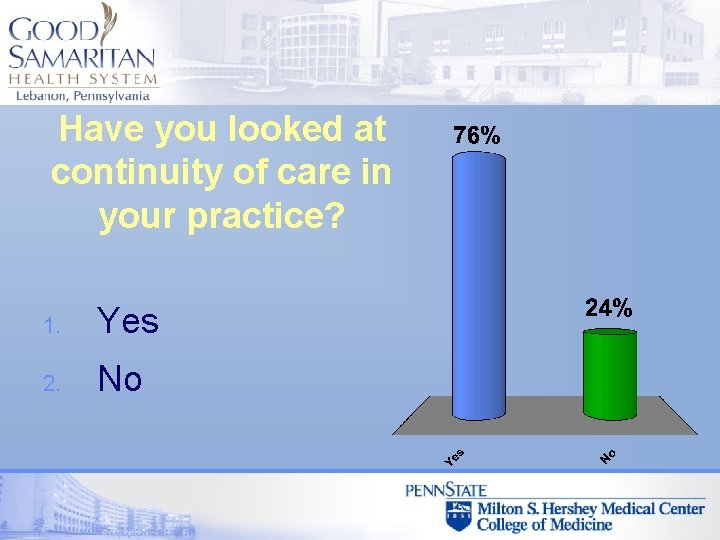
Have you looked at continuity of care in your practice? 1. Yes 2. No

Do you actively manage resident patient panels? 1. Yes 2. No
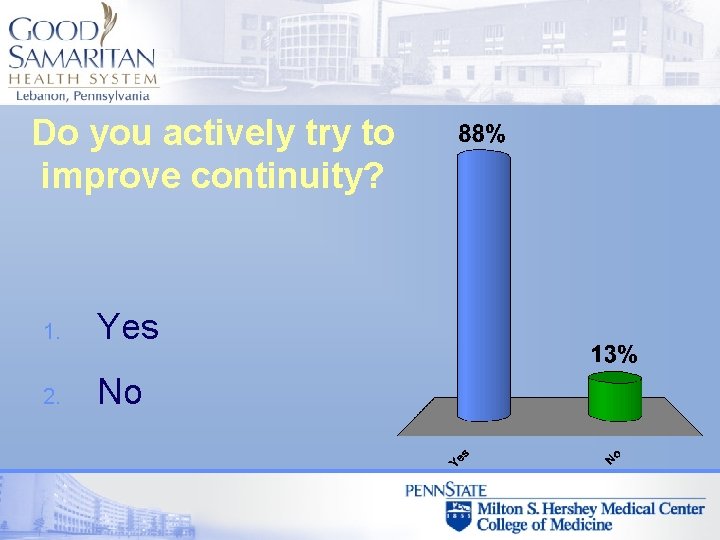
Do you actively try to improve continuity? 1. Yes 2. No

Which is more important, patient numbers or continuity of care? 1. 2. Patient Numbers Continuity of Care
Patient Centered Medical Home l l Population Based Care - One of principles of the PCMH. Each resident or faculty member is responsible for their panel.

Improving Continuity l Make the panel sizes congruent with the amount of time that residents spend in the office in each year.
Better Data l Information submitted to registries about our practice will more likely represent what we are actually doing.

Increase Accountability l l Providers will have panels that reflect who they actually see. Accurate immunization rates, cancer screening rates, etc. , can then be given to individual providers.
Cleaning Up l Remove patients who: n n were only seen as med call patients or newborns in the hospital were nursing home patients had transferred had not been seen in over 3 years.
Cleaning Up l l Remove patients from the panels of graduated residents. Move patients to the panels of the provider that they actually see.

Improvement with Clean Up
BETTER CARE l l One of the hallmarks of family medicine is continuity. With appropriately sized and accurate panels, we improve continuity and care (not to mention patient and provider satisfaction).

How do we assign patients in the computer?

How did we determine ideal faculty panel sizes? l l Literature estimates of ideal panel sizes ranged from 1400 - 2500. After taking into account our efficiency and our patient population, we chose an ideal panel size of 1500.

Individual panel size determination l l We looked back at 7 months of office visits to arrive at a percentage of fulltime equivalence for faculty and midlevels. That percentage multiplied by 1500 gave us panel sizes for each faculty or mid-level provider.

Panel Size Determination - Faculty and Mid-Levels l l l Dr A - FTE 0. 114 x 1500 = 171 Dr B - FTE 0. 196 x 1500 = 294 Dr C - FTE 0. 336 x 1500 = 504 Dr D - FTE 0. 172 x 1500 = 258 Midlevel A - FTE 1. 00 x 1500 = 1500 Midlevel B - FTE 0. 56 x 1500 = 839
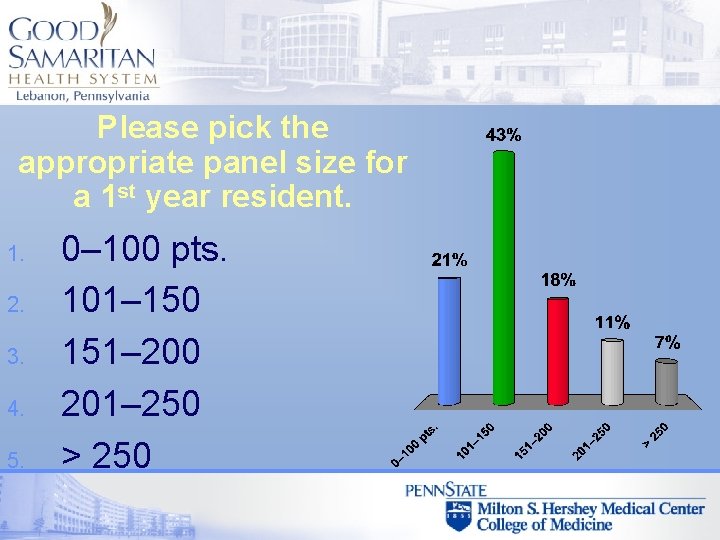
Please pick the appropriate panel size for a 1 st year resident. 1. 2. 3. 4. 5. 0– 100 pts. 101– 150 151– 200 201– 250 > 250

Please pick the appropriate panel size for a 2 nd year resident. 1. 2. 3. 4. 5. 0 -100 pts. 101 -150 151 -200 200 -250 > 250
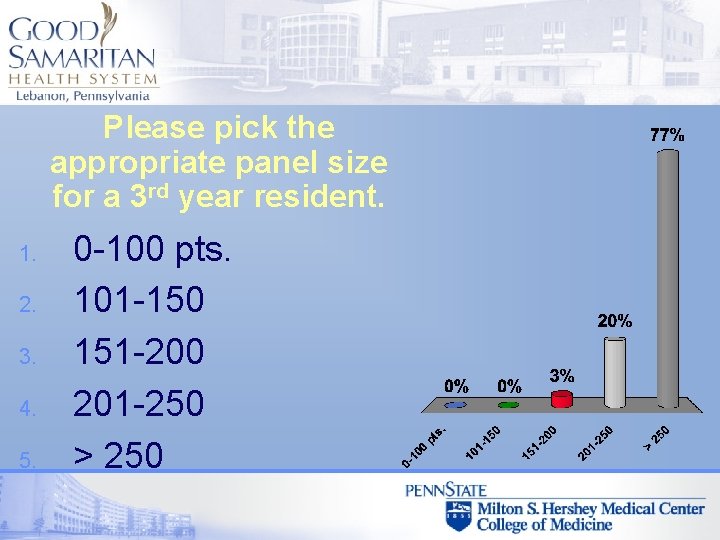
Please pick the appropriate panel size for a 3 rd year resident. 1. 2. 3. 4. 5. 0 -100 pts. 101 -150 151 -200 201 -250 > 250
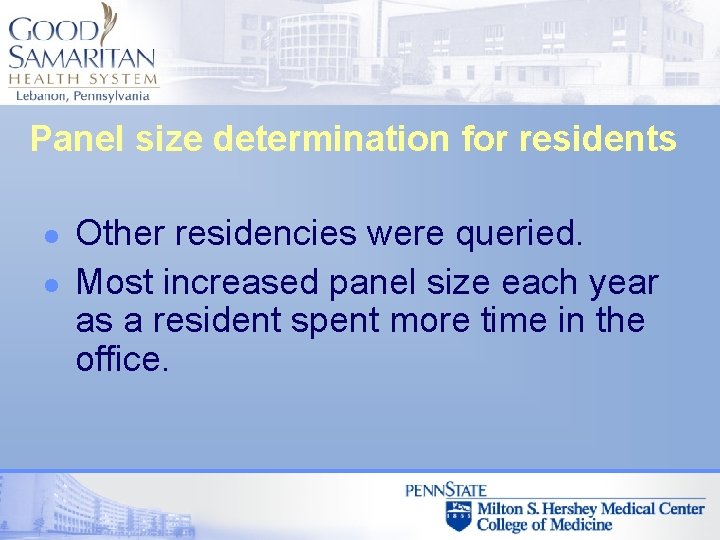
Panel size determination for residents l l Other residencies were queried. Most increased panel size each year as a resident spent more time in the office.
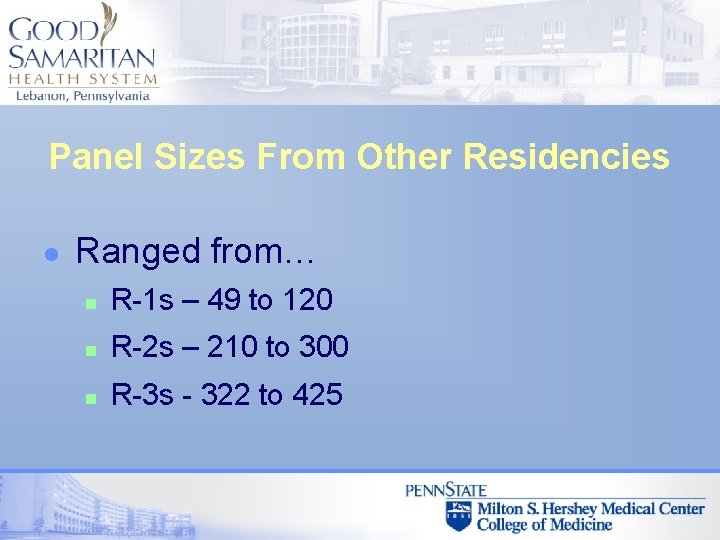
Panel Sizes From Other Residencies l Ranged from… n R-1 s – 49 to 120 n R-2 s – 210 to 300 n R-3 s - 322 to 425
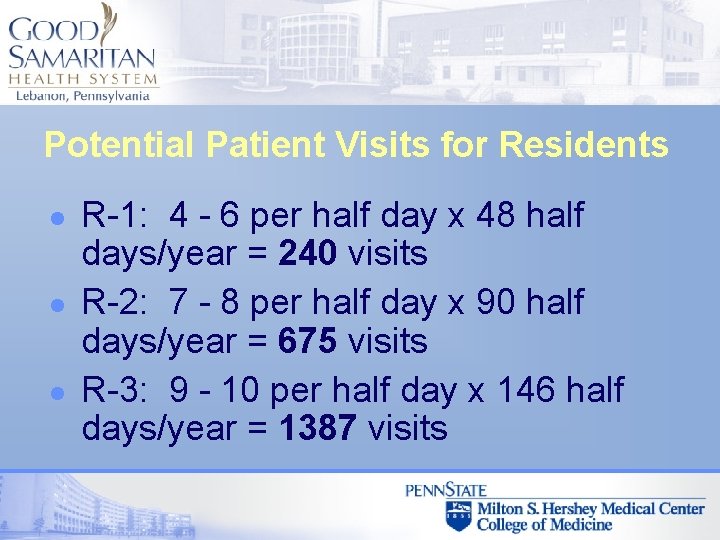
Potential Patient Visits for Residents l l l R-1: 4 - 6 per half day x 48 half days/year = 240 visits R-2: 7 - 8 per half day x 90 half days/year = 675 visits R-3: 9 - 10 per half day x 146 half days/year = 1387 visits

Actual Patient Visits for Residents (July 1 -Dec 31 2009, Annualized) l R-1 s: 178 l R-2 s: 503 l R-3 s: 847
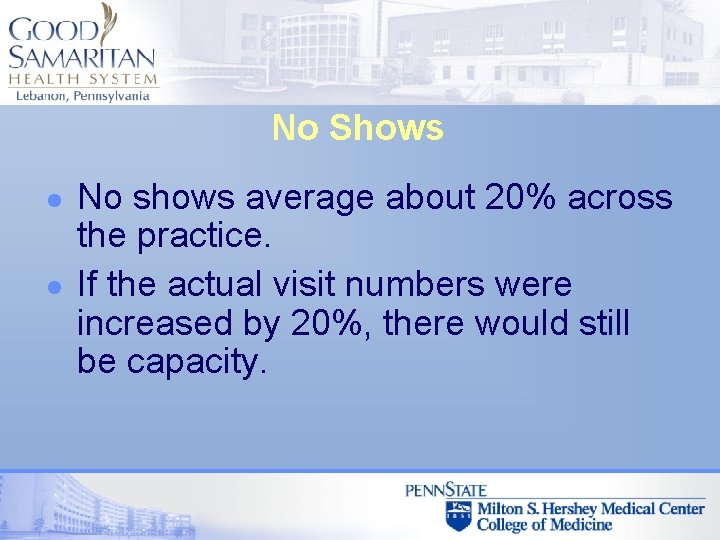
No Shows l l No shows average about 20% across the practice. If the actual visit numbers were increased by 20%, there would still be capacity.

Two ways to determine resident panel size l 1. Based on available # visits l 2. Based on actual # visits
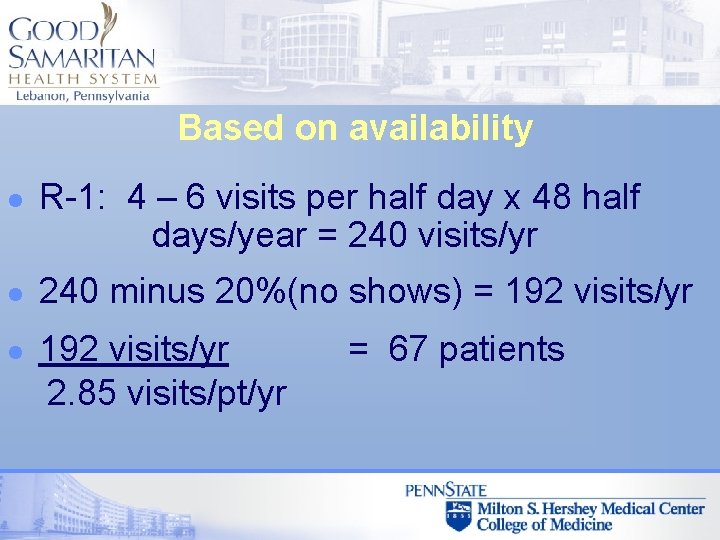
Based on availability l l l R-1: 4 – 6 visits per half day x 48 half days/year = 240 visits/yr 240 minus 20%(no shows) = 192 visits/yr 2. 85 visits/pt/yr = 67 patients
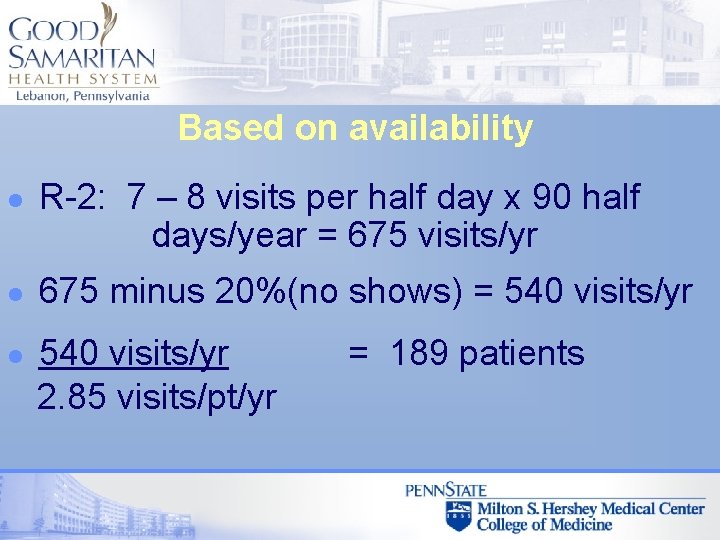
Based on availability l l l R-2: 7 – 8 visits per half day x 90 half days/year = 675 visits/yr 675 minus 20%(no shows) = 540 visits/yr 2. 85 visits/pt/yr = 189 patients
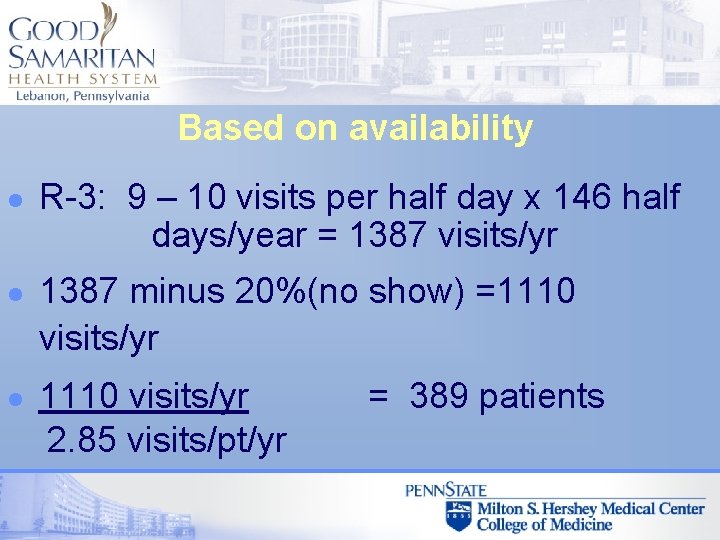
Based on availability l l l R-3: 9 – 10 visits per half day x 146 half days/year = 1387 visits/yr 1387 minus 20%(no show) =1110 visits/yr 2. 85 visits/pt/yr = 389 patients
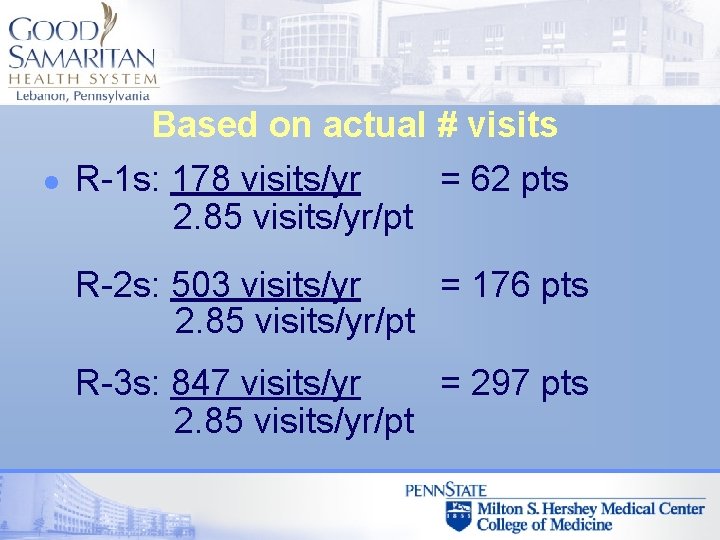
l Based on actual # visits R-1 s: 178 visits/yr = 62 pts 2. 85 visits/yr/pt R-2 s: 503 visits/yr = 176 pts 2. 85 visits/yr/pt R-3 s: 847 visits/yr = 297 pts 2. 85 visits/yr/pt
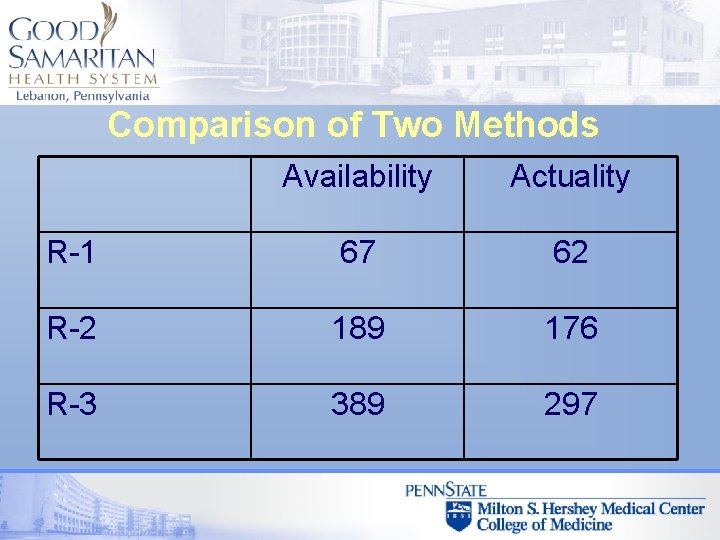
Comparison of Two Methods Availability Actuality R-1 67 62 R-2 189 176 R-3 389 297

Actual Resident Panels in One of our Offices l R-1 s: 219, 209, 235, 226; mean 222 l R-2 s: 225, 292, 160, 207; mean 221 l R-3 s: 239, 292, 270, 228; mean 257

Our Panel Sizes and Rationale l l R-1 s Panel Size of 50 patients. Panels were hand picked by one of the faculty to include: n n l patients who had chronic care needs (DM, HTN, Hyperlipidemia) or babies in the 1 st year of life. Visits/year assumed to be >2. 85

Our Panel Size and Rationale l l l R-2 s: 265 patients. Includes young adults and others who don’t visit the doctor as often It is assumed that many of the acute visits will go to other providers for these patients.
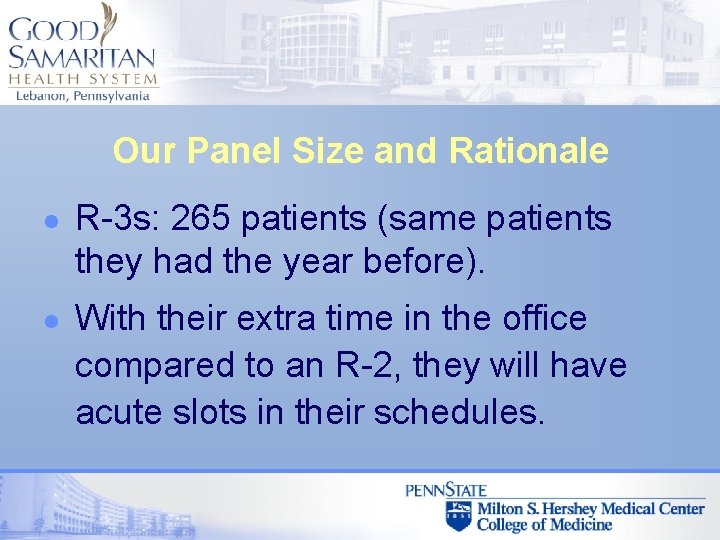
Our Panel Size and Rationale l l R-3 s: 265 patients (same patients they had the year before). With their extra time in the office compared to an R-2, they will have acute slots in their schedules.
Teaching and Learning Implications l R-1 s and R-2 s n l R-3 s n n l focus on learning chronic care and well child care. continue the chronic care and continuity with their patients add the aspect of acute care due to increased availability. Only R-3 s, faculty and mid-levels have acute care slots in their schedules.
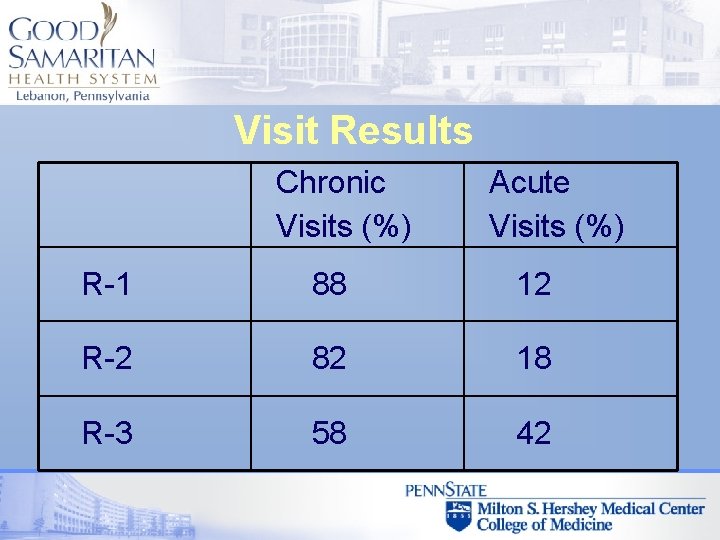
Visit Results Chronic Visits (%) Acute Visits (%) R-1 88 12 R-2 82 18 R-3 58 42

Improvements in Continuity Chronic Visits Acute Visits w/ Provider w/ Team w/Provider w/ Team Pre Post 66% ? 48% ? ? 80% 74% ? 31% 6% 22% 9% Overall 58% 65%
Provider Impressions l l l Extremely positive for improved continuity noted by providers – 79% Patients noticed improved continuity – 55% Less difficulty scheduling pts for return visit with PCP – 47%

Questions? ? ? l Thank You
- Slides: 42