
Get to Know Metadata Object Description Schema MODS
Get to Know Metadata Object Description Schema (MODS) Panhandle Library Access Network August 18, 2016 Karen Snow, MLS, Ph. D Graduate School of Library & Information Science Dominican University, River Forest, Illinois ksnow@dom. edu
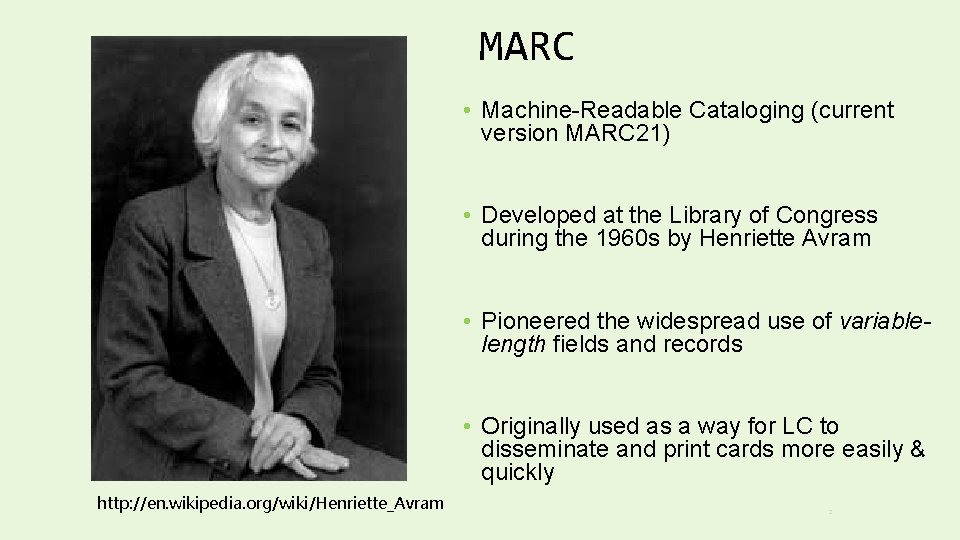
MARC • Machine-Readable Cataloging (current version MARC 21) • Developed at the Library of Congress during the 1960 s by Henriette Avram • Pioneered the widespread use of variablelength fields and records • Originally used as a way for LC to disseminate and print cards more easily & quickly http: //en. wikipedia. org/wiki/Henriette_Avram 2
MARCXML & MODS • During the 1990 s, LC began experimenting with using XML. The product: MARCXML and the Metadata Object Description Schema (MODS) • MARCXML – an XML markup of MARC 21 records that retains the field and subfield codes • MODS – an natively XML-based schema that retains selected data elements from MARC, but uses language-based tags rather than numeric ones. Not as robust as MARC 21, but works well for cataloging digital (and digitized) resources 3
Metadata Object Description Schema (MODS) • Developed in 2002 by the Library of Congress as an XML-based offshoot of MARC, but geared more towards describing digital resources • MODS version 3. 6 – current version • “MODS is an XML schema and guidelines for encoding a resource description. It supports discovery and management of resources, and access to them, as well as exchange and management of encoded descriptions. ” http: //www. loc. gov/standards/mods/design-principles-mods-mads. html 4
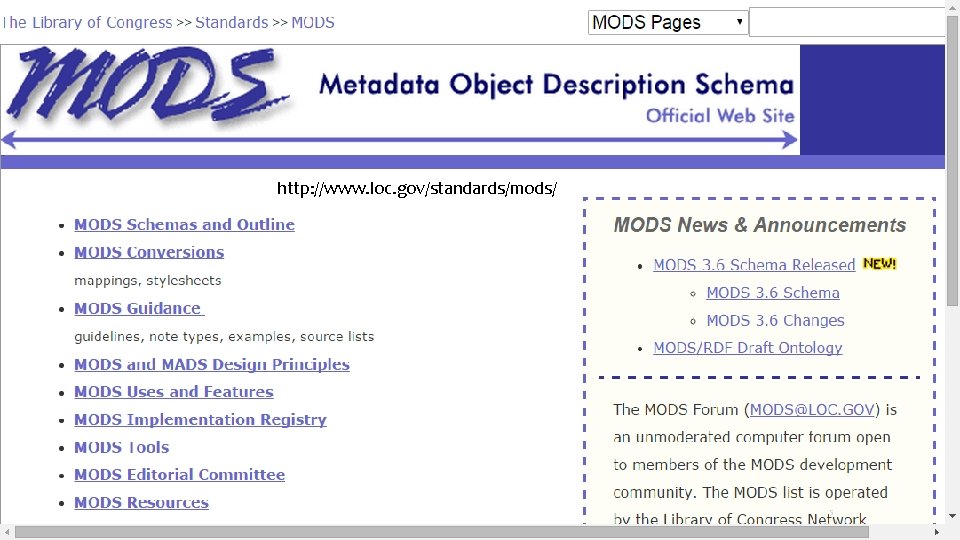
http: //www. loc. gov/standards/mods/ 5
MODS Features • The elements generally inherit the semantics of MARC • Some data has been repackaged; in some cases what is in several data elements in MARC may be brought together into one in MODS • MODS does not assume the use of any specific cataloging code http: //www. loc. gov/standards/mods-overview. html 6
MODS Advantages • The element set is richer than Dublin Core • The element set is more compatible with library data than ONIX • The schema is more end user oriented than the full MARCXML schema • The element set is simpler than the full MARC format http: //www. loc. gov/standards/mods-overview. html 7
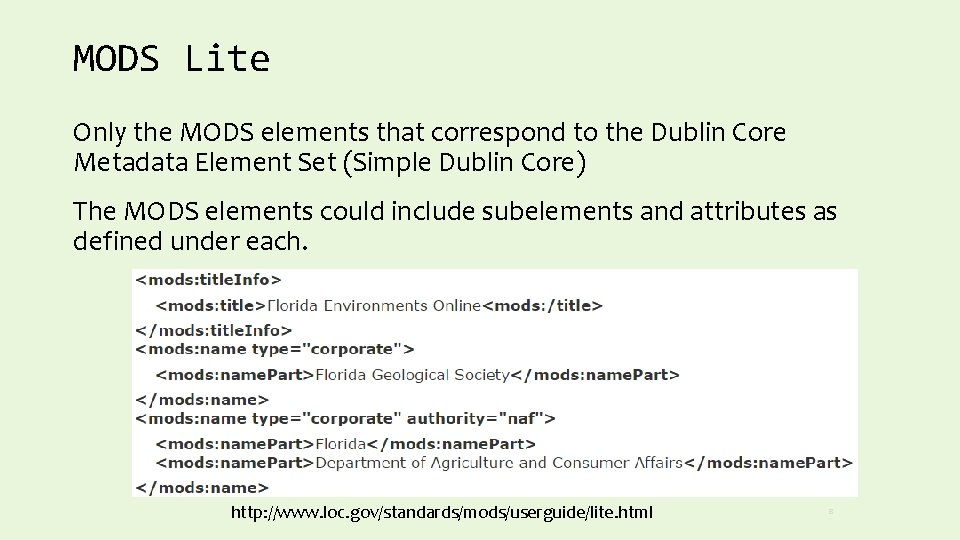
MODS Lite Only the MODS elements that correspond to the Dublin Core Metadata Element Set (Simple Dublin Core) The MODS elements could include subelements and attributes as defined under each. http: //www. loc. gov/standards/mods/userguide/lite. html 8
MODS Goals Support encoding a description for any type of resource 1) Make no restrictions on type of resource described 2) Define new elements and attributes needed for unsupported types of resources 3) Provide a means for encoding descriptive elements that are not otherwise accommodated in MODS (namely, the "extension" element) http: //www. loc. gov/standards/mods/design-principles-mods-mads. html 9
MODS Goals Allow full description of whole-to-part and similar types of relationships • Repeat <related. Item type=“constituent”> as needed to describe the parts of a complex resource • Use <related. Item> to preserve one-to-one principle if describing analog/digitized versions of a resource http: //www. loc. gov/standards/mods/design-principles-mods-mads. html 10
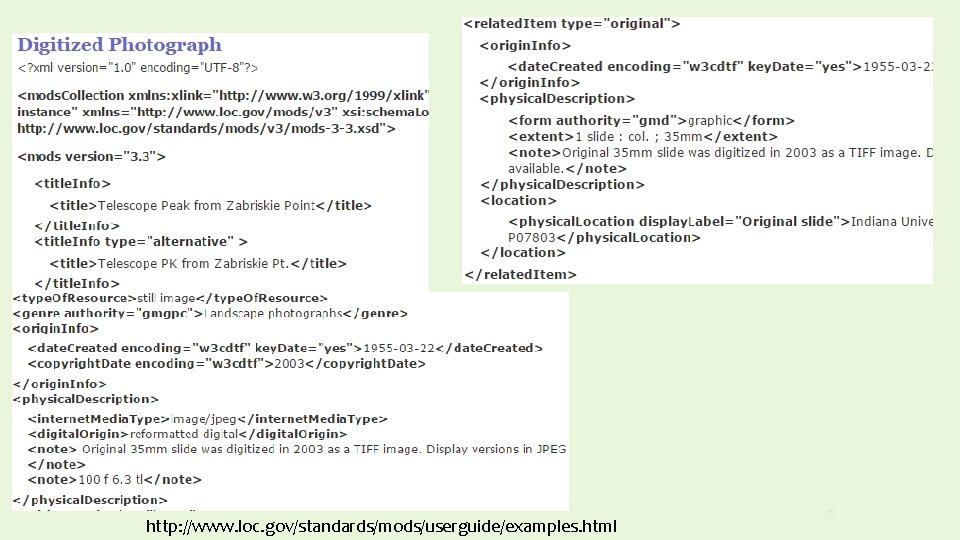
http: //www. loc. gov/standards/mods/userguide/examples. html 11
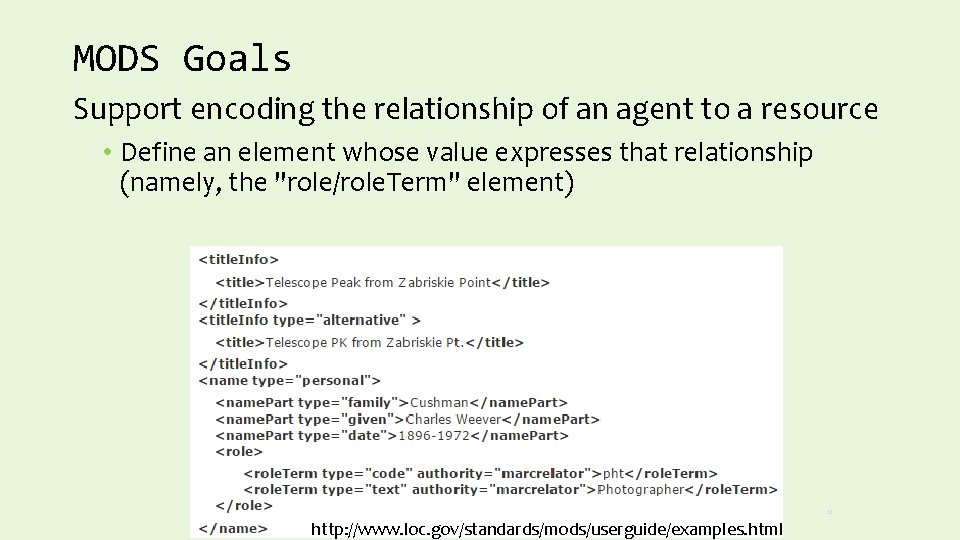
MODS Goals Support encoding the relationship of an agent to a resource • Define an element whose value expresses that relationship (namely, the "role/role. Term" element) 12 http: //www. loc. gov/standards/mods/userguide/examples. html
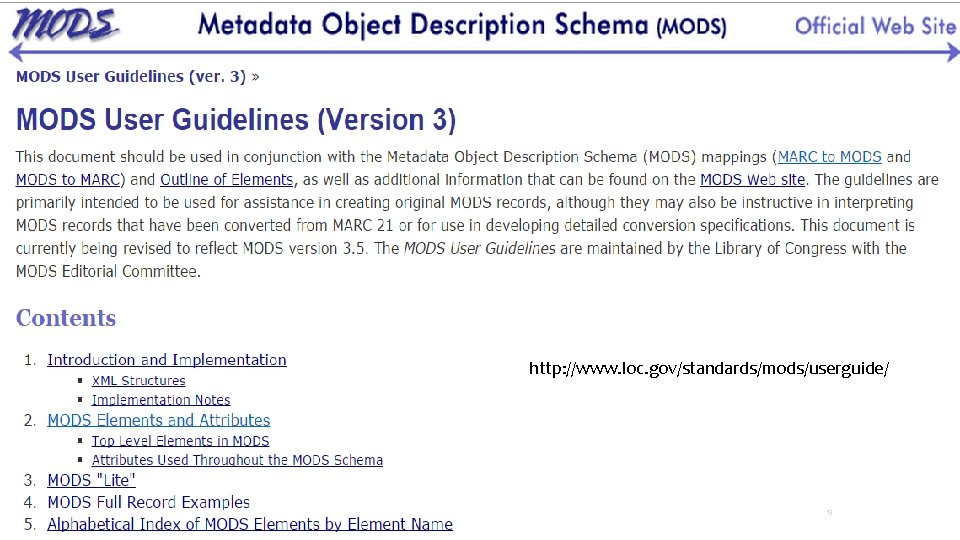
http: //www. loc. gov/standards/mods/userguide/ 13
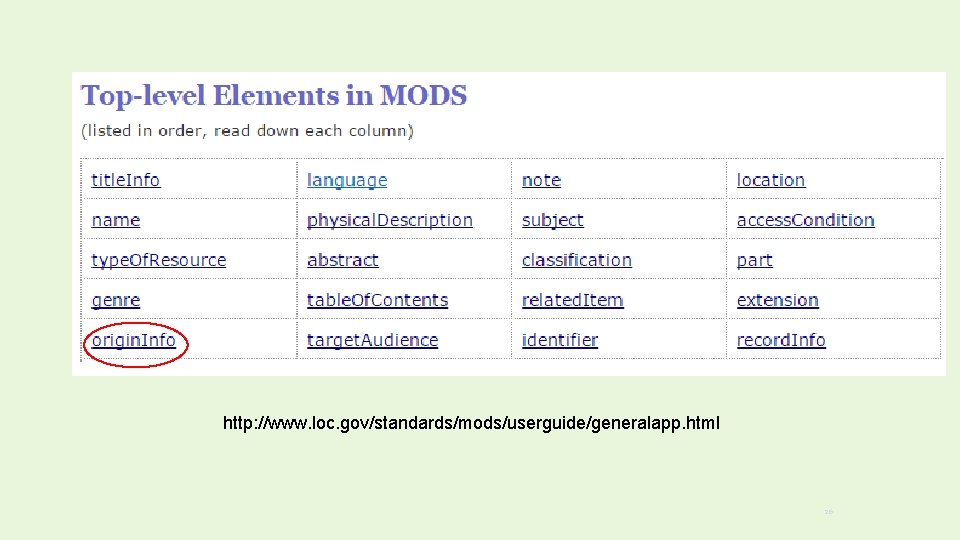
MODS • 20 top-level elements • No element is mandatory, but a MODS record must have at least one element • All elements are repeatable except for <record. Info> (administrative metadata about the metadata record) 14
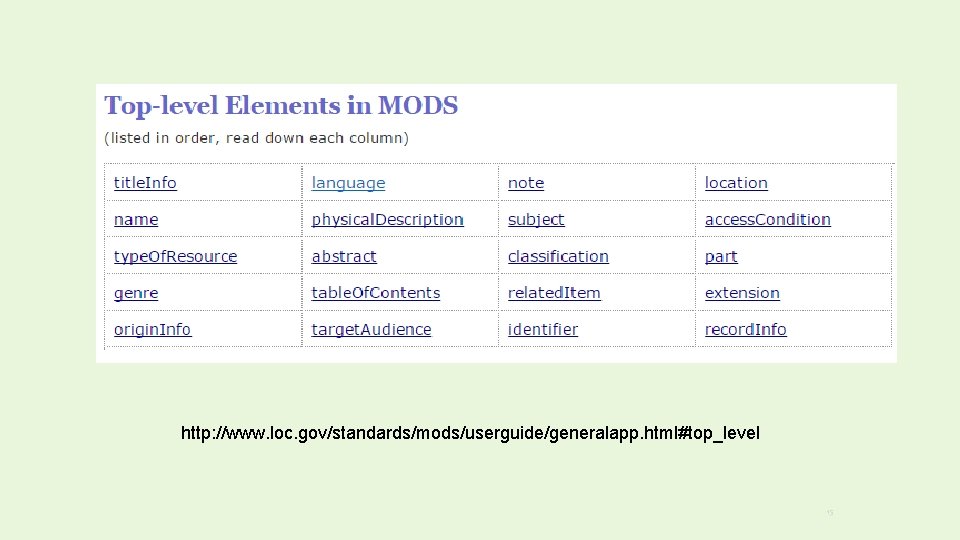
http: //www. loc. gov/standards/mods/userguide/generalapp. html#top_level 15
MODS • Elements/subelements are camel case - all begin with a lowercase letter & if the element/subelement contains multiple words, subsequent words begin with an uppercase letter • type. Of. Resource • date. Created • display. Form 16

MODS - Structure Nested, hierarchical, parent-child elements Main elements, subelements (child elements), and attributes <title. Info> <title>Post-Fordism</title> <sub. Title>A Reader</sub. Title> </title. Info> <name type="personal"> <name. Part type="given">Ash</name. Part> <name. Part type="family">Amin</name. Part> <role. Term type="text">editor</role. Term> </role> </name> 17
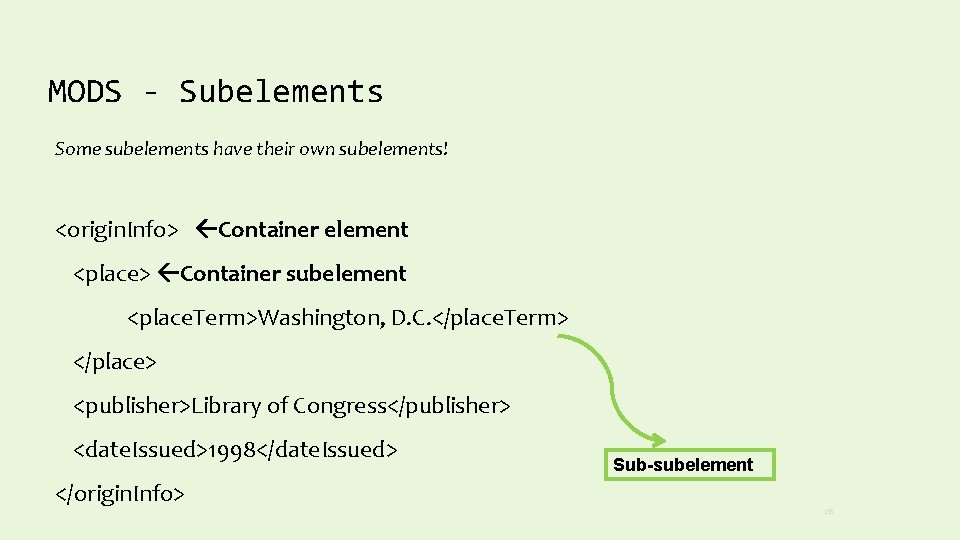
MODS - Elements • Some top-level elements are “container” elements, some are not (about half are container elements) • “Container” (or “wrapper”) elements do not contain values; only the subelements & non-container elements contain values 18
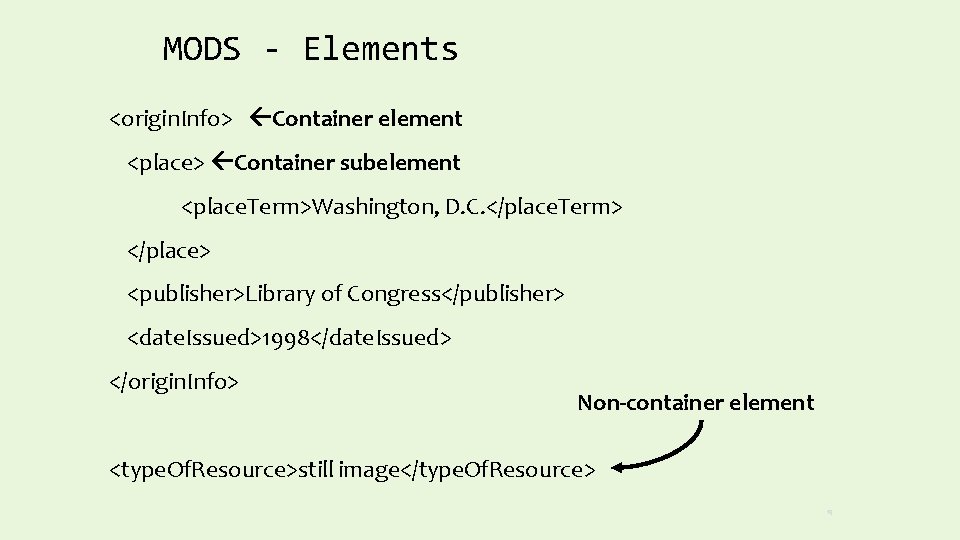
MODS - Elements <origin. Info> Container element <place> Container subelement <place. Term>Washington, D. C. </place. Term> </place> <publisher>Library of Congress</publisher> <date. Issued>1998</date. Issued> </origin. Info> Non-container element <type. Of. Resource>still image</type. Of. Resource> 19
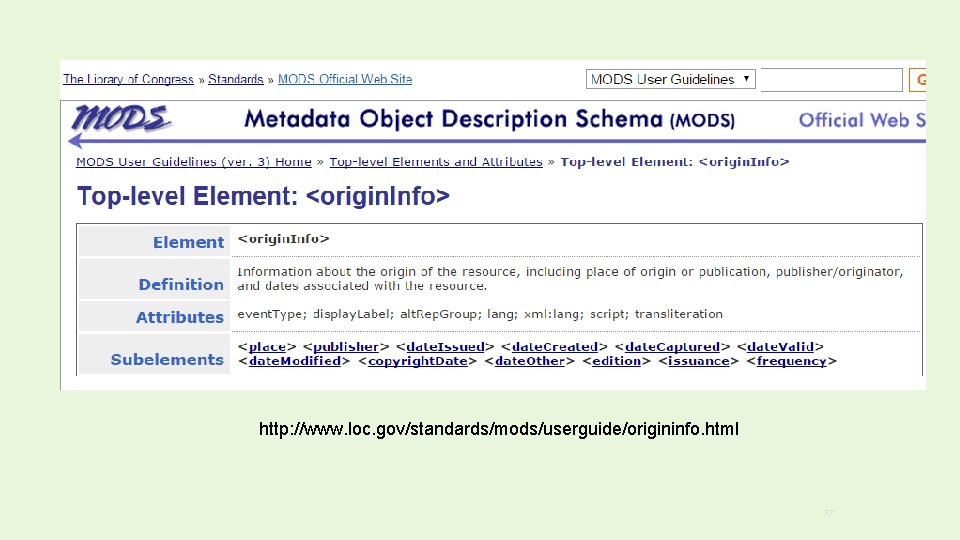
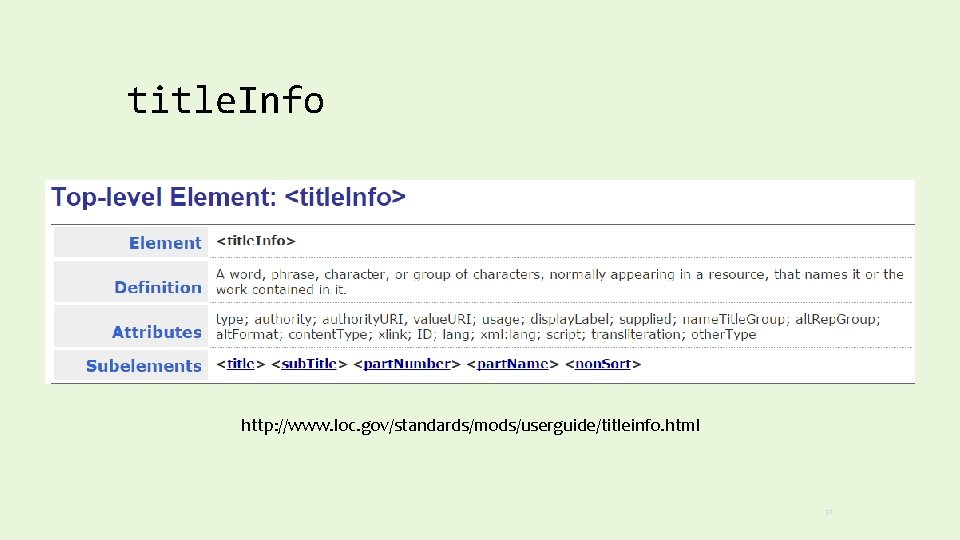
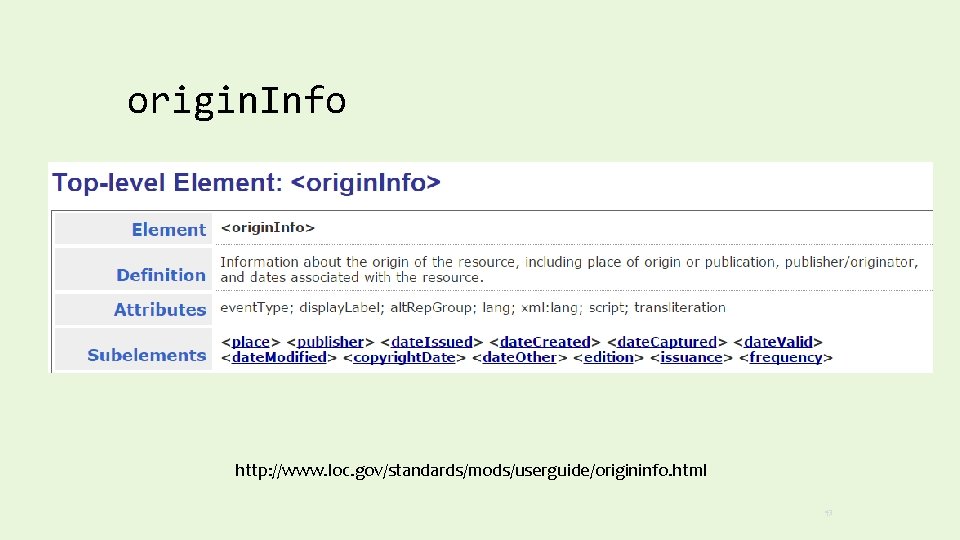
MODS – Top-Level Elements title. Info: A word, phrase, character, or group of characters, normally appearing in a resource, that names it or the work contained in it. (maps to DC Title) name: The name of a person, organization, or event (conference, meeting, etc. ) associated in some way with the resource. (maps to DC Creator & Contributor) type. Of. Resource: A term that specifies the characteristics and general type of content of the resource. (maps to DC Type) genre: A term or terms that designate a category characterizing a particular style, form, or content, such as artistic, musical, literary composition, etc. (maps to DC Type) origin. Info: Information about the origin of the resource, including place of origin or publication, publisher/originator, and dates associated with the resource. (maps to DC Publisher and Date) language: A designation of the language in which the content of a resource is expressed. (maps to DC Language) 20
MODS – Top-Level Elements physical. Description: Describes the physical attributes of the information resource. (maps to DC Format) abstract: A summary of the content of the resource. (maps to DC Description) table. Of. Contents: A description of the contents of a resource. (maps to DC Description) target. Audience: A description of the intellectual level of the audience for which the resource is intended. (no direct mapping to any DC element) note: General textual information relating to a resource. (maps to DC Description) subject: A term or phrase representing the primary topic(s) on which a work is focused. (maps to DC Subject and Coverage) classification: A designation applied to a resource that indicates the subject by applying a formal system of coding and organizing resources according to subject areas. (maps to DC Subject) 21
MODS – Top-Level Elements related. Item: Information that identifies other resources related to the one being described. (maps to DC Relation and Source) identifier: Contains a unique standard number or code that distinctively identifies a resource. (maps to DC Identifier) location: Identifies the institution or repository holding the resource, or the electronic location in the form of a URL where it is available. (maps to DC Identifier & possibly Relation? ) access. Condition: Information about restrictions imposed on access to a resource. (maps to DC Rights) part: The designation of physical parts of a resource in a detailed form. (no direct mapping to any DC element) extension: Provides additional information not covered by MODS. (no direct mapping to any DC element) record. Info: Information about the metadata record. (no direct mapping to any DC element) 22
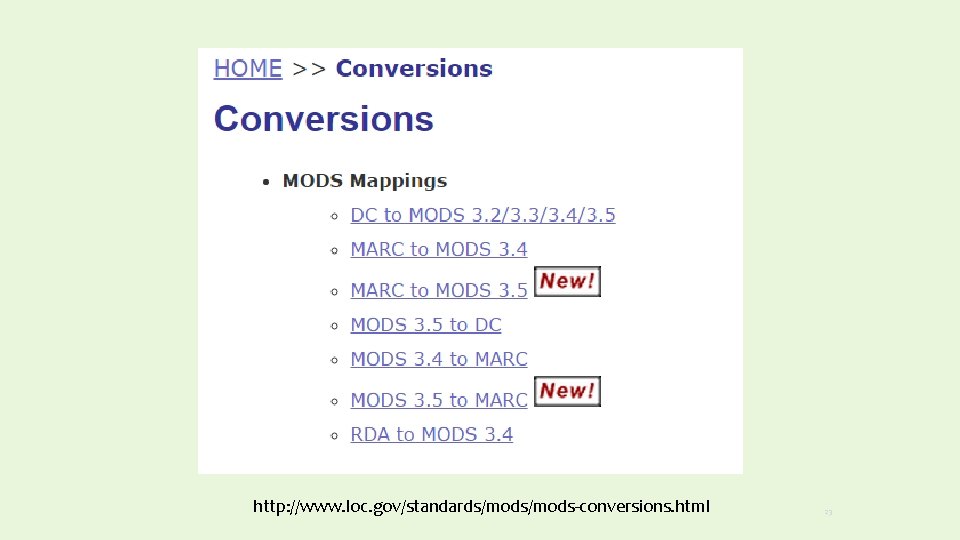
http: //www. loc. gov/standards/mods-conversions. html 23
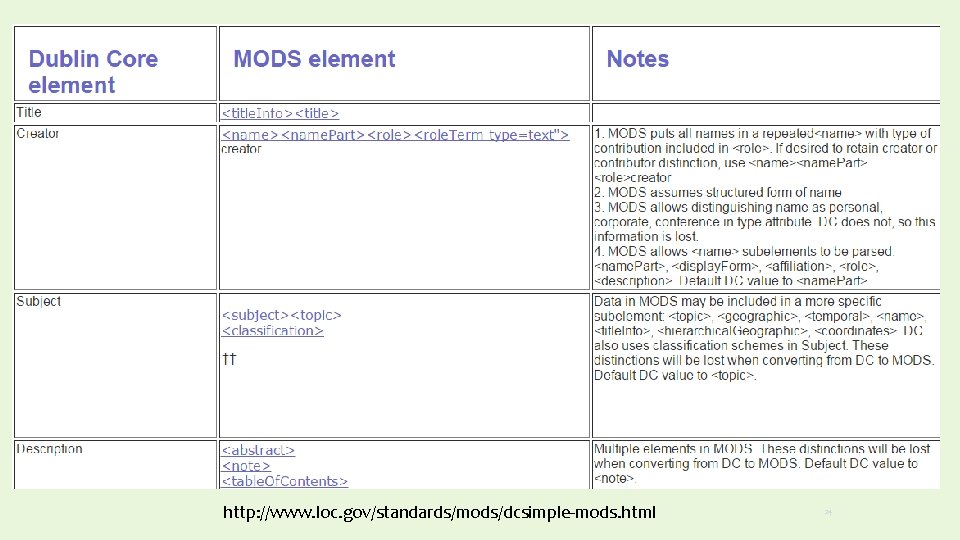
http: //www. loc. gov/standards/mods/dcsimple-mods. html 24
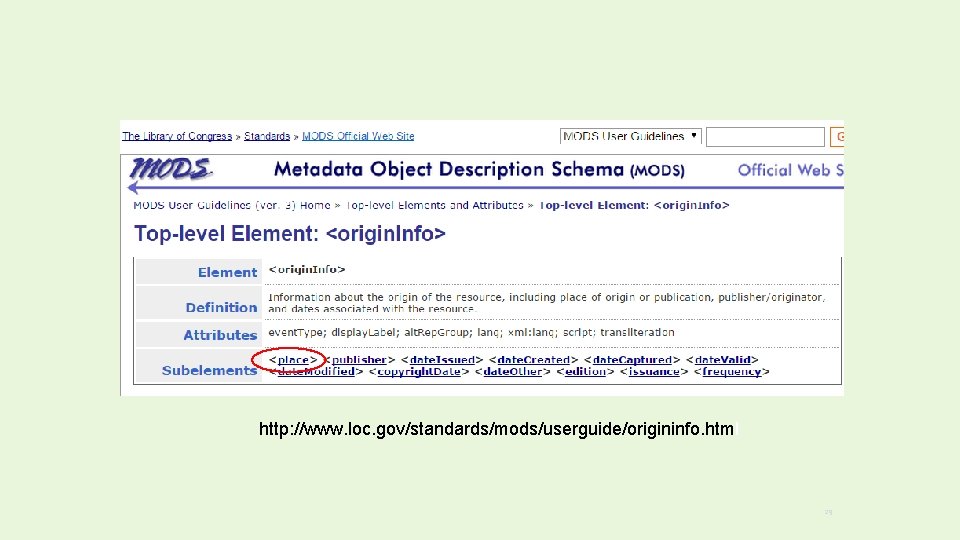
MODS - Subelements = Refinement for elements For example: Element = origin. Info Subelements = place; publisher; date. Created; etc… 25
http: //www. loc. gov/standards/mods/userguide/generalapp. html 26
http: //www. loc. gov/standards/mods/userguide/origininfo. html 27
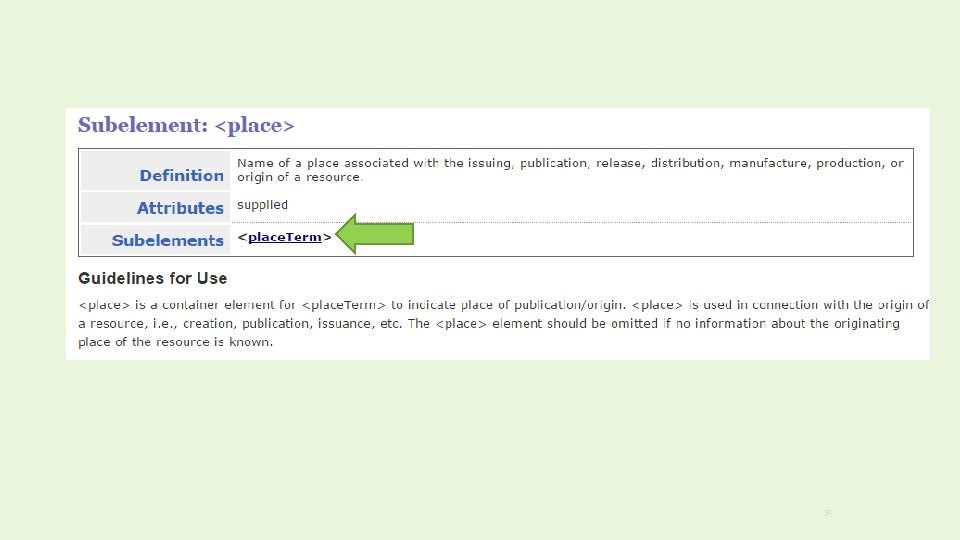
MODS - Subelements Some subelements have their own subelements! <origin. Info> Container element <place> Container subelement <place. Term>Washington, D. C. </place. Term> </place> <publisher>Library of Congress</publisher> <date. Issued>1998</date. Issued> </origin. Info> Sub-subelement 28
http: //www. loc. gov/standards/mods/userguide/origininfo. html 29
30
Elements I Will Discuss Today • title. Info • name • origin. Info • subject 31
title. Info http: //www. loc. gov/standards/mods/userguide/titleinfo. html 32
title. Info - subelements title: A word, phrase, character, or group of characters that constitutes the chief title of a resource, i. e. , the title normally used when citing the resource. sub. Title: A word, phrase, character, or group of characters that contains the remainder of the title information after the title proper. part. Number: A part or section number of a title. part. Name: A part or section name of a title. non. Sort: Characters, including initial articles, punctuation, and spaces that appear at the beginning of a title that should be ignored for indexing of titles. http: //www. loc. gov/standards/mods/userguide/titleinfo. html 33
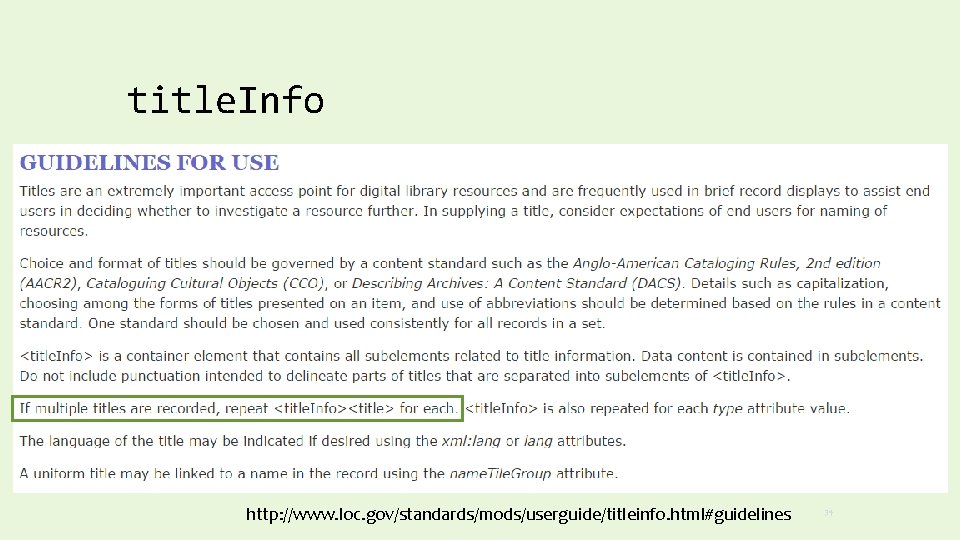
title. Info http: //www. loc. gov/standards/mods/userguide/titleinfo. html#guidelines 34
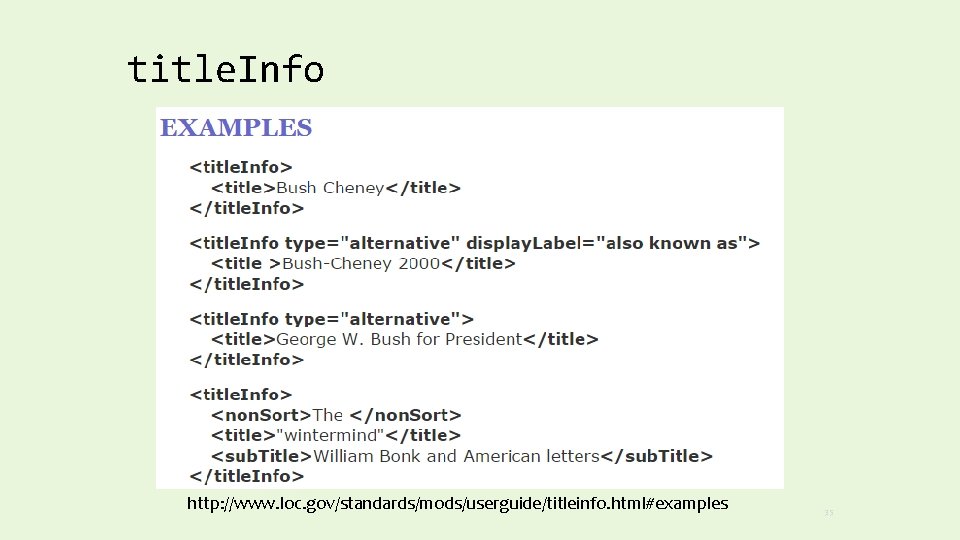
title. Info http: //www. loc. gov/standards/mods/userguide/titleinfo. html#examples 35

title. Info http: //www. loc. gov/standards/mods/userguide/titleinfo. html#examples 36
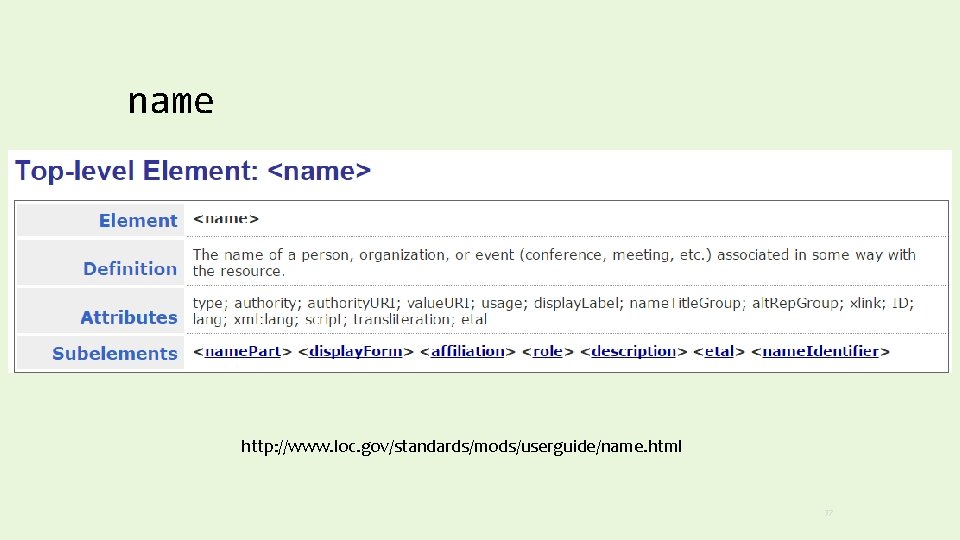
name http: //www. loc. gov/standards/mods/userguide/name. html 37

name http: //www. loc. gov/standards/mods/userguide/name. html#guidelines 38
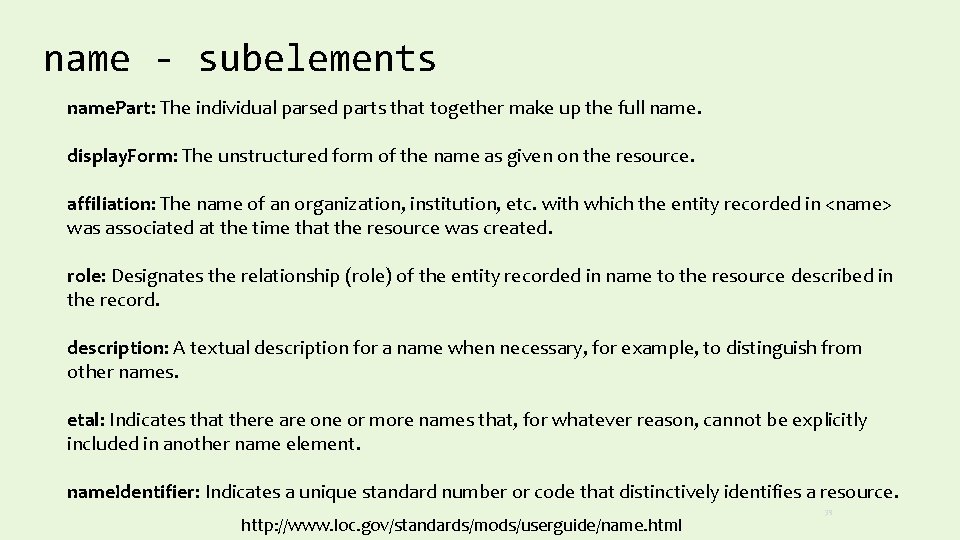
name - subelements name. Part: The individual parsed parts that together make up the full name. display. Form: The unstructured form of the name as given on the resource. affiliation: The name of an organization, institution, etc. with which the entity recorded in <name> was associated at the time that the resource was created. role: Designates the relationship (role) of the entity recorded in name to the resource described in the record. description: A textual description for a name when necessary, for example, to distinguish from other names. etal: Indicates that there are one or more names that, for whatever reason, cannot be explicitly included in another name element. name. Identifier: Indicates a unique standard number or code that distinctively identifies a resource. http: //www. loc. gov/standards/mods/userguide/name. html 39
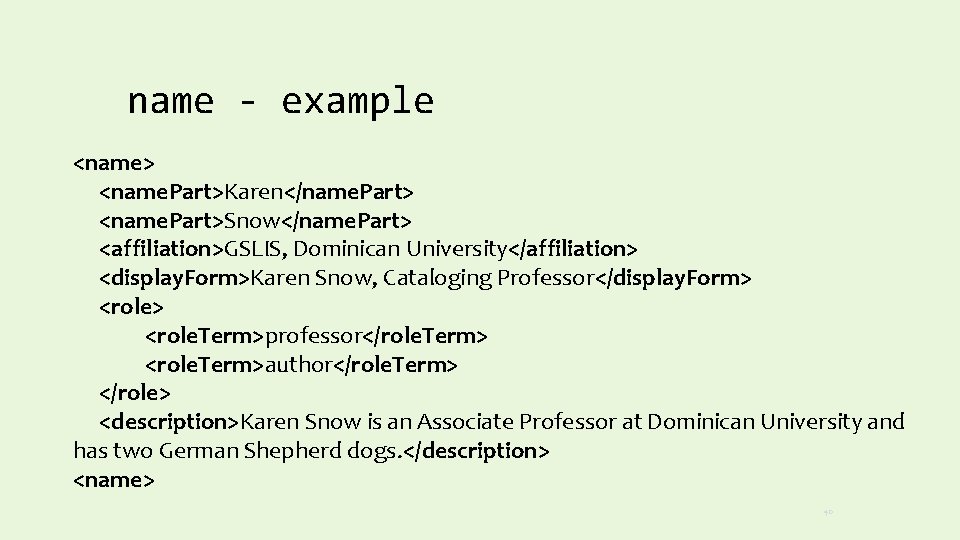
name - example <name> <name. Part>Karen</name. Part> <name. Part>Snow</name. Part> <affiliation>GSLIS, Dominican University</affiliation> <display. Form>Karen Snow, Cataloging Professor</display. Form> <role. Term>professor</role. Term> <role. Term>author</role. Term> </role> <description>Karen Snow is an Associate Professor at Dominican University and has two German Shepherd dogs. </description> <name> 40
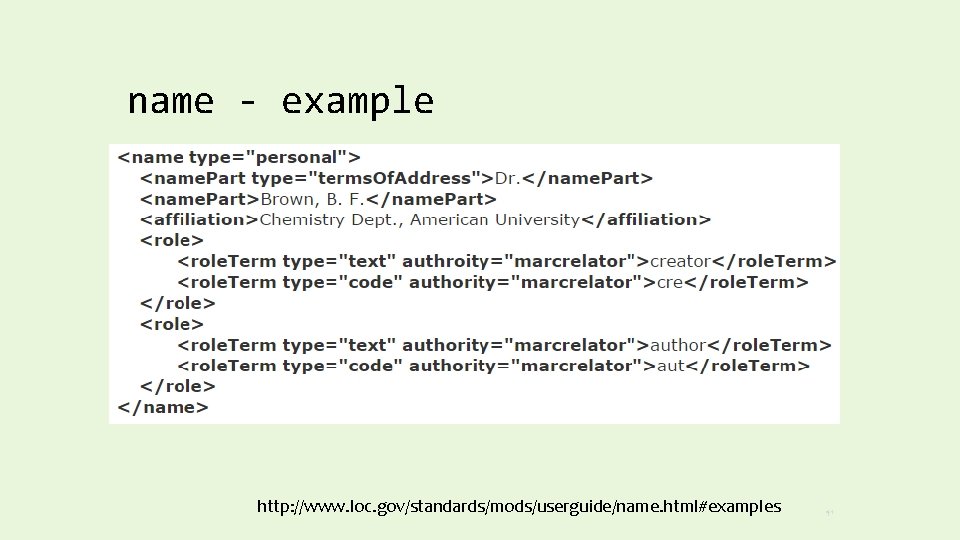
name - example http: //www. loc. gov/standards/mods/userguide/name. html#examples 41
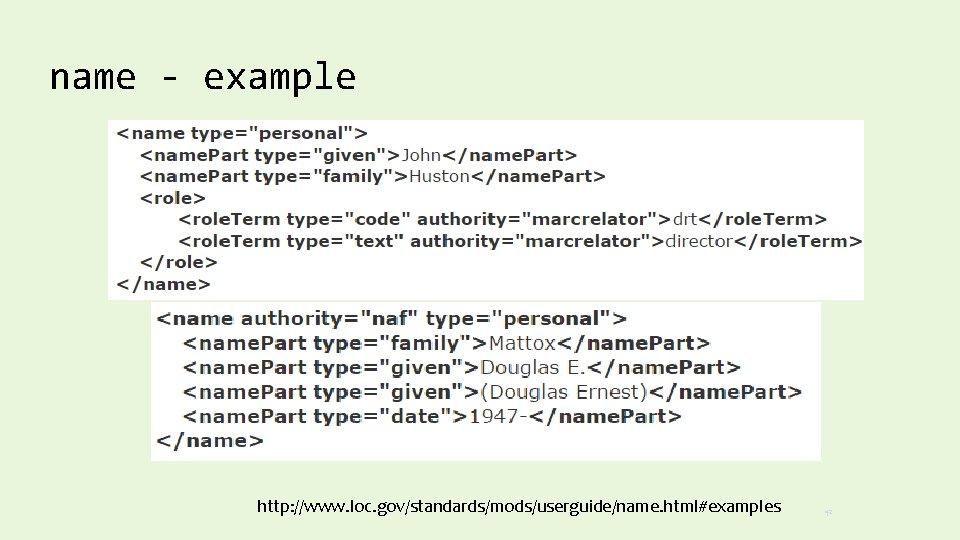
name - example http: //www. loc. gov/standards/mods/userguide/name. html#examples 42
origin. Info http: //www. loc. gov/standards/mods/userguide/origininfo. html 43
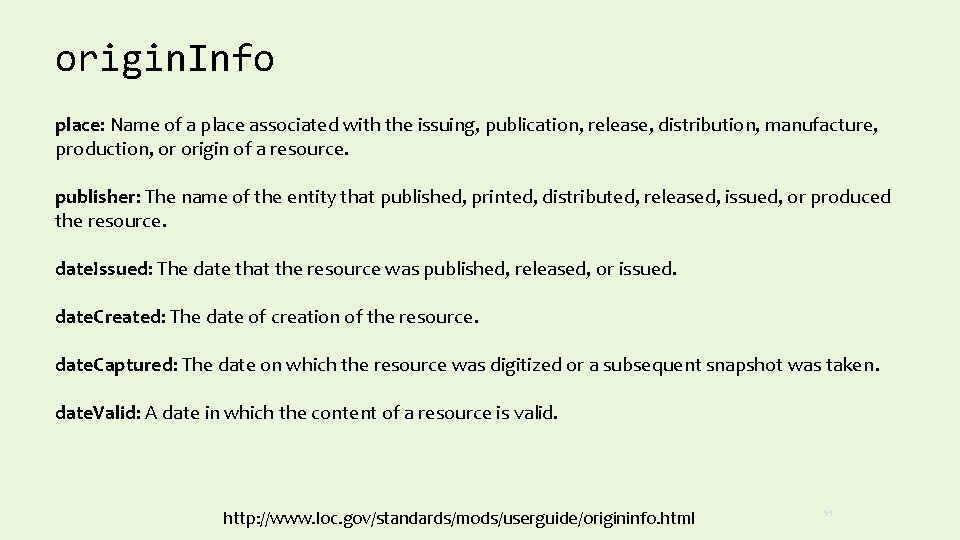
origin. Info place: Name of a place associated with the issuing, publication, release, distribution, manufacture, production, or origin of a resource. publisher: The name of the entity that published, printed, distributed, released, issued, or produced the resource. date. Issued: The date that the resource was published, released, or issued. date. Created: The date of creation of the resource. date. Captured: The date on which the resource was digitized or a subsequent snapshot was taken. date. Valid: A date in which the content of a resource is valid. http: //www. loc. gov/standards/mods/userguide/origininfo. html 44
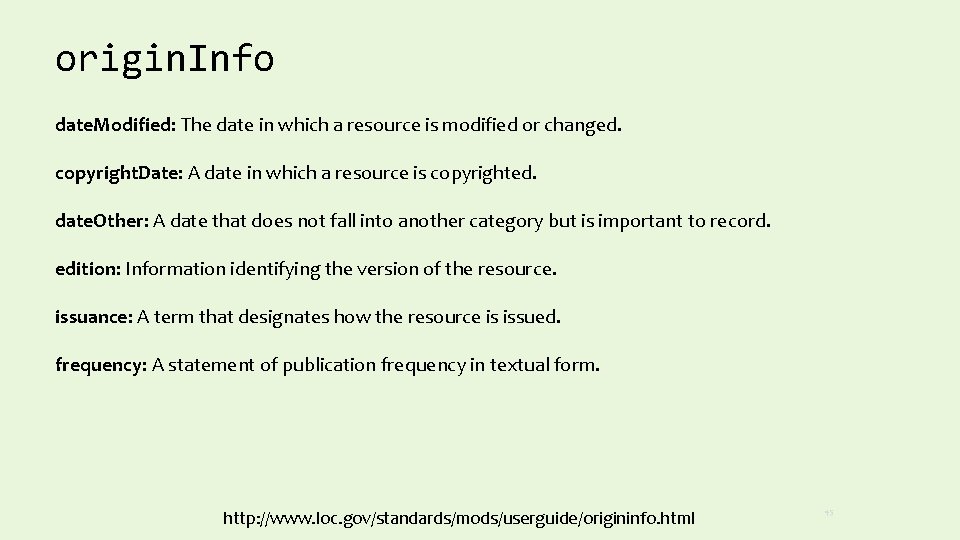
origin. Info date. Modified: The date in which a resource is modified or changed. copyright. Date: A date in which a resource is copyrighted. date. Other: A date that does not fall into another category but is important to record. edition: Information identifying the version of the resource. issuance: A term that designates how the resource is issued. frequency: A statement of publication frequency in textual form. http: //www. loc. gov/standards/mods/userguide/origininfo. html 45
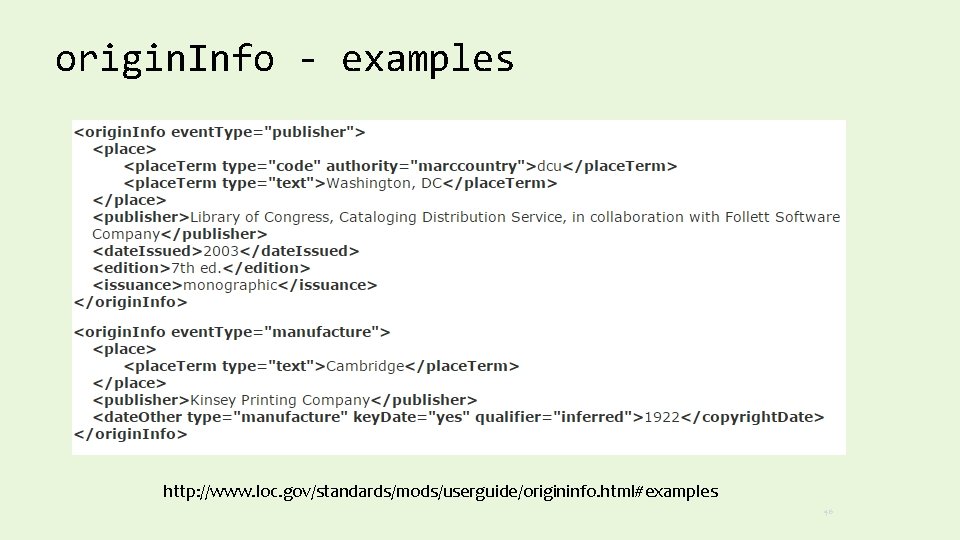
origin. Info - examples http: //www. loc. gov/standards/mods/userguide/origininfo. html#examples 46
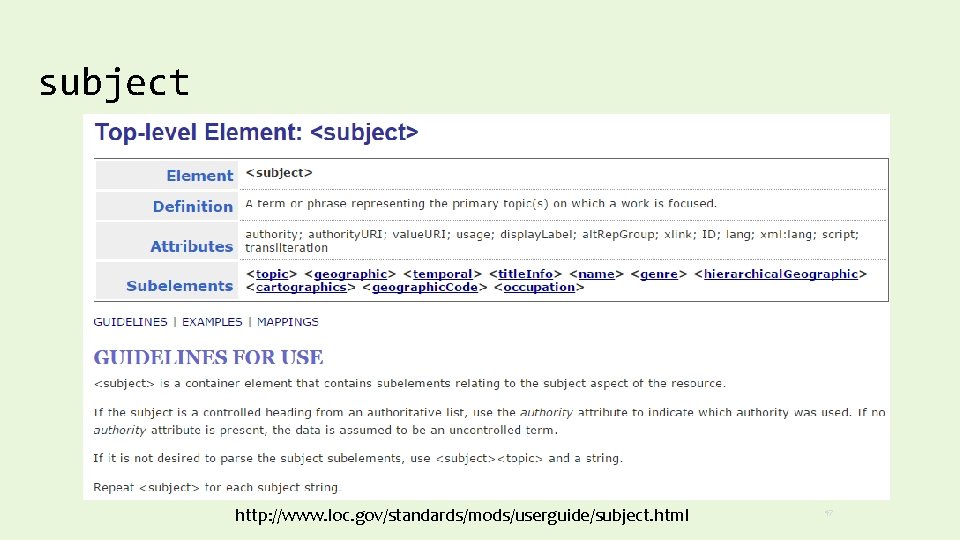
subject http: //www. loc. gov/standards/mods/userguide/subject. html 47

subject - subelements topic: Used as the tag for any topical subjects that are not appropriate in the <geographic>, <temporal>, <title. Info>, <name>, <genre>, <hierarchical. Geographic>, or <occupation> subelements. geographic: Used for geographic subject terms that are not appropriate for the <hierarchical. Geographic> element. temporal: Used for chronological subject terms or temporal coverage. title. Info: A title used as a subject. name: A name used as a subject. http: //www. loc. gov/standards/mods/userguide/subject. html 48
subject - subelements genre: A genre or form used as part of a subject string when the subject authority distinguishes parts of the subject string (e. g. LCSH). hierarchical. Geographic: A geographic name given in a hierarchical form relating to the resource. cartographics: Cartographic (maps or charts) data indicating spatial coverage. geographic. Code: A geographic area code associated with a resource. occupation: A term that is descriptive of the occupation reflected in the contents of the described materials. http: //www. loc. gov/standards/mods/userguide/subject. html 49
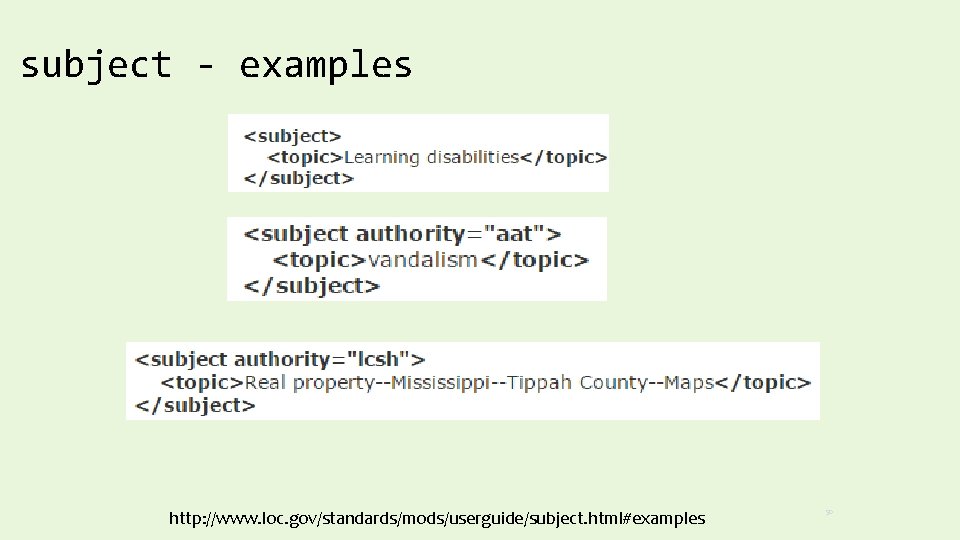
subject - examples http: //www. loc. gov/standards/mods/userguide/subject. html#examples 50
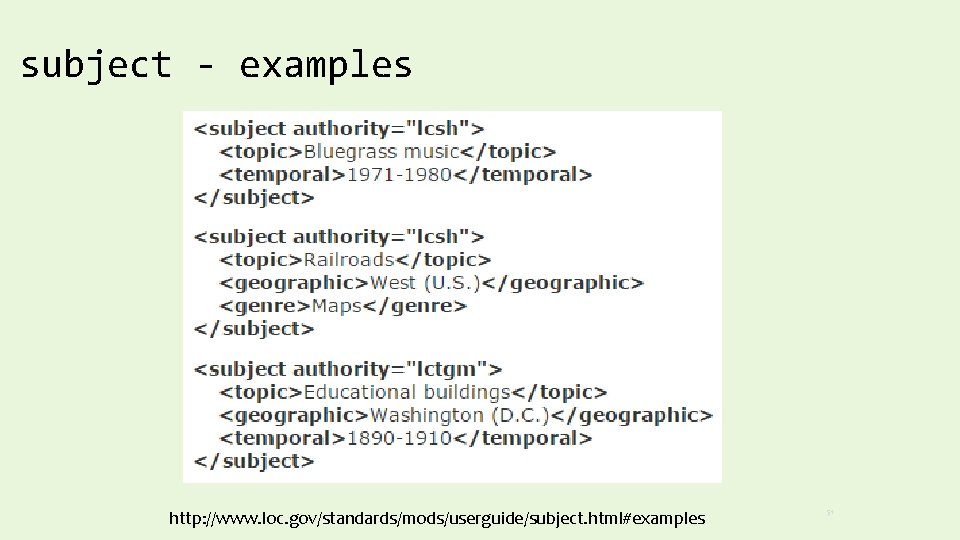
subject - examples http: //www. loc. gov/standards/mods/userguide/subject. html#examples 51
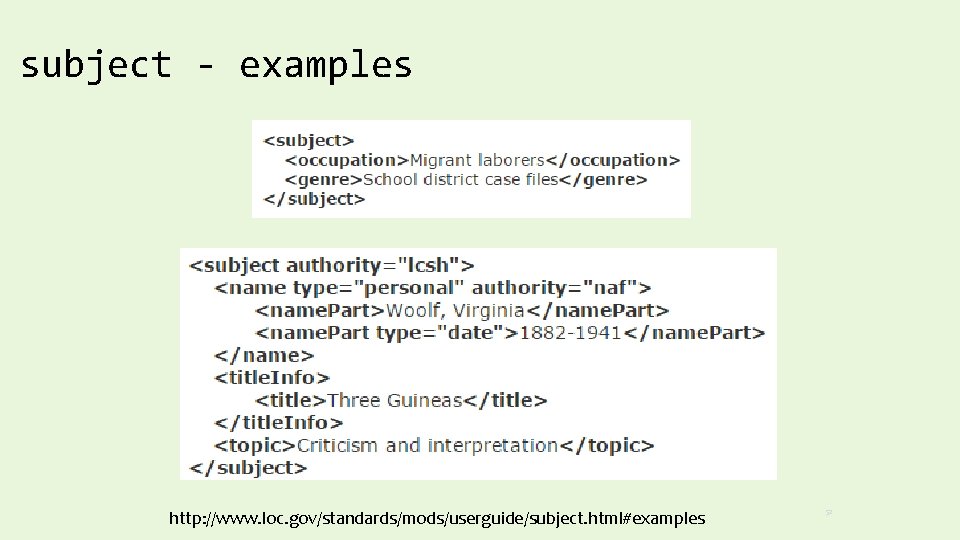
subject - examples http: //www. loc. gov/standards/mods/userguide/subject. html#examples 52
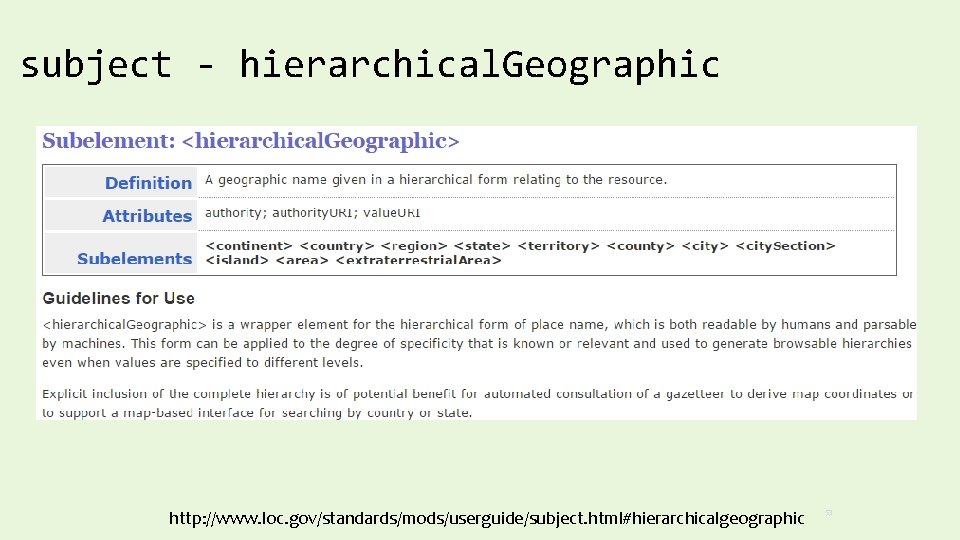
subject - hierarchical. Geographic http: //www. loc. gov/standards/mods/userguide/subject. html#hierarchicalgeographic 53
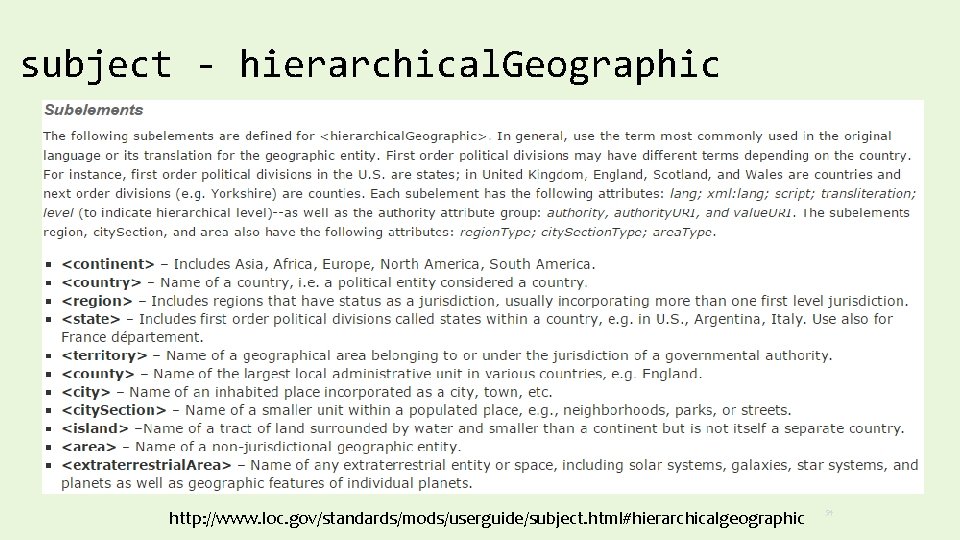
subject - hierarchical. Geographic http: //www. loc. gov/standards/mods/userguide/subject. html#hierarchicalgeographic 54
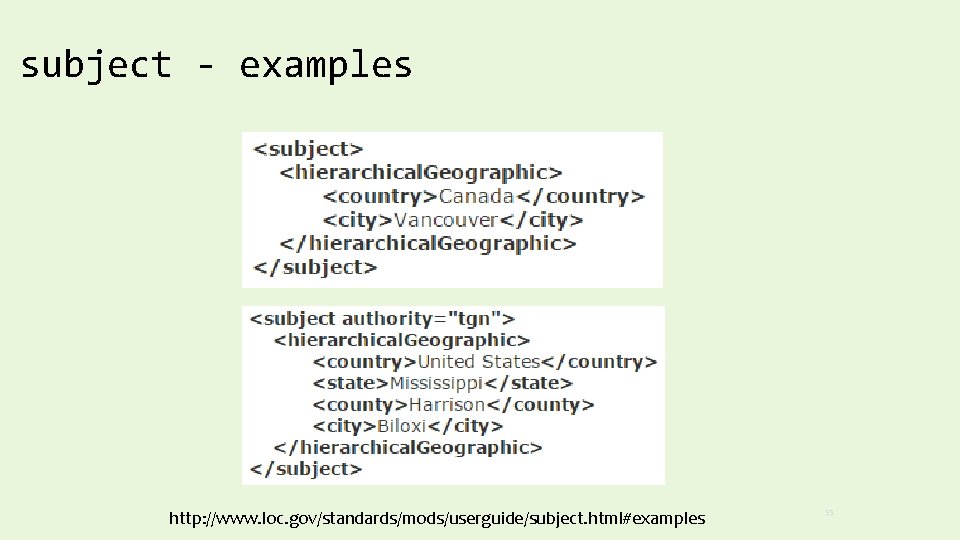
subject - examples http: //www. loc. gov/standards/mods/userguide/subject. html#examples 55
Activity • Use the metadata provided in the MODS Metadata handout to populate the values in the MODS Activity XML Template. • Map the local elements below to the appropriate MODS element. • You do not need to add any attributes or additional XML coding. • Many of the MODS subelements in the template will not be used. 56
- Slides: 56