
GET Intermediate Phase CAPS Training pas2012 1 ASSESSMENT
- Slides: 20
GET Intermediate Phase CAPS Training pas/2012 1
ASSESSMENT OUTCOMES: At the end of this Activity: • participants will be able to differentiate between the various Assessment Tools • participants will be familiar with Examinations as a Form of Assessment pas/2012 2
RELEVANT DOCUMENTS: • CAPS Orientation 2012 Training Manual: (Activities 37 & 38 pages 55 & 56) • CAPS Document: (HL pages 90 – 104) & (FAL pages 93 – 109) • National Protocol for Assessment (NPA) Gr. R-12: - Importance of Assessment (pages 3 – 21) - Assessment of Learners with Special Needs (pages 22 – 23) pas/2012 3
What is Assessment? • “Assessment is a continuous, planned process of identifying, gathering and interpreting information about the knowledge and skills demonstrated by the learner. pas/2012 4
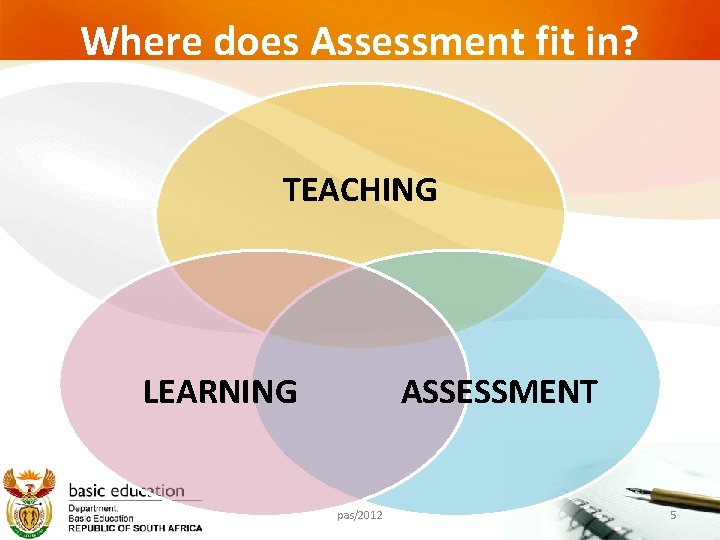
Where does Assessment fit in? TEACHING LEARNING ASSESSMENT pas/2012 5
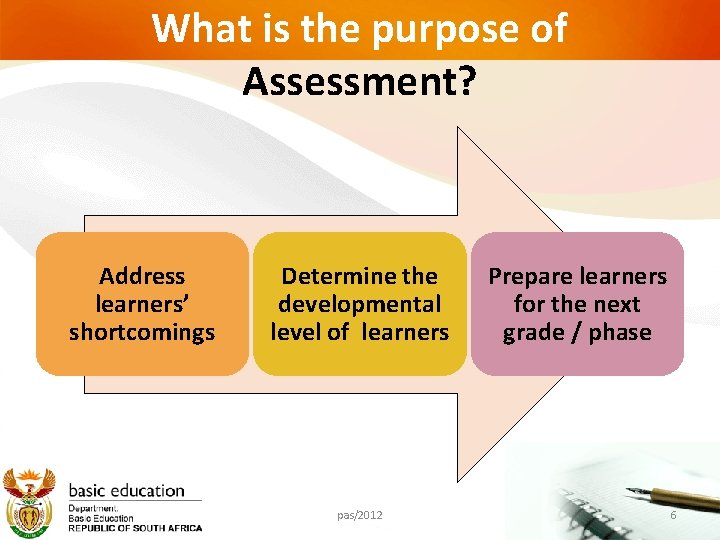
What is the purpose of Assessment? Address learners’ shortcomings Determine the developmental level of learners pas/2012 Prepare learners for the next grade / phase 6
ASSESSMENT TOOLS • • Observation book Observation sheets Checklists Pen & paper Rubrics Computer (inclusive) Learner’s work, etc. pas/2012 7
FORMS OF ASSESSMENT • Oral activities, e. g. role-play, recitals, interviews • Practical activities e. g. demonstrations in which learners demonstrate physical movement skills e. g. games • Presentations e. g. drawing, paintings, constructions • Individual or group projects • Investigations pas/2012 8
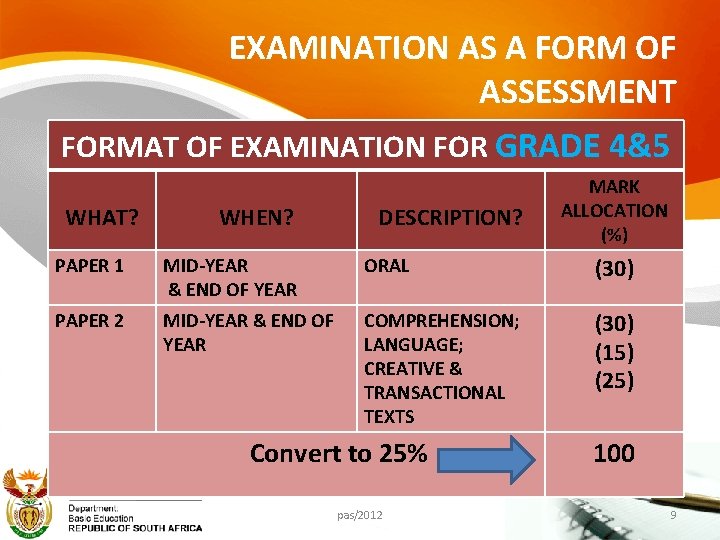
EXAMINATION AS A FORM OF ASSESSMENT FORMAT OF EXAMINATION FOR GRADE 4&5 WHAT? WHEN? DESCRIPTION? MARK ALLOCATION (%) PAPER 1 MID-YEAR & END OF YEAR ORAL (30) PAPER 2 MID-YEAR & END OF YEAR COMPREHENSION; LANGUAGE; CREATIVE & TRANSACTIONAL TEXTS (30) (15) (25) Convert to 25% pas/2012 100 9
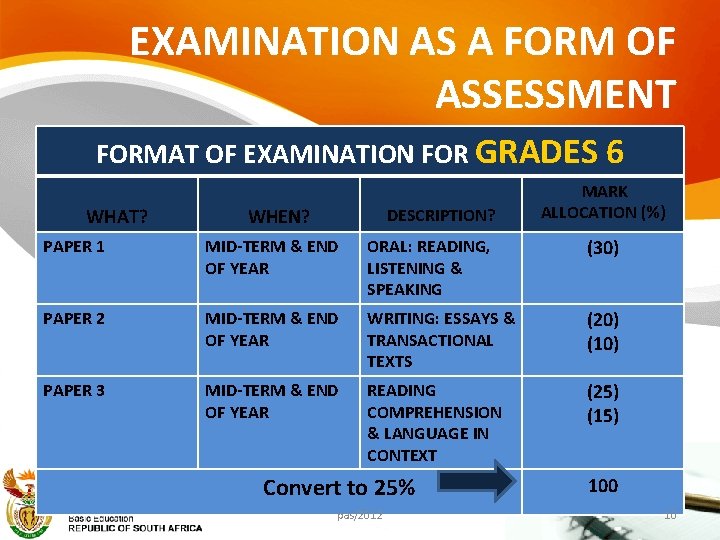
EXAMINATION AS A FORM OF ASSESSMENT FORMAT OF EXAMINATION FOR GRADES 6 WHAT? WHEN? DESCRIPTION? MARK ALLOCATION (%) PAPER 1 MID-TERM & END OF YEAR ORAL: READING, LISTENING & SPEAKING (30) PAPER 2 MID-TERM & END OF YEAR WRITING: ESSAYS & TRANSACTIONAL TEXTS (20) (10) PAPER 3 MID-TERM & END OF YEAR READING COMPREHENSION & LANGUAGE IN CONTEXT (25) (15) Convert to 25% pas/2012 100 10
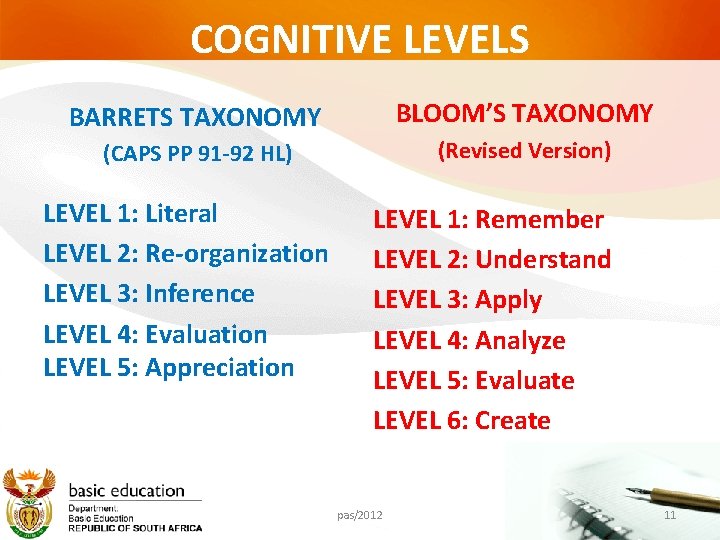
COGNITIVE LEVELS BARRETS TAXONOMY BLOOM’S TAXONOMY (CAPS PP 91 -92 HL) (Revised Version) LEVEL 1: Literal LEVEL 2: Re-organization LEVEL 3: Inference LEVEL 4: Evaluation LEVEL 5: Appreciation LEVEL 1: Remember LEVEL 2: Understand LEVEL 3: Apply LEVEL 4: Analyze LEVEL 5: Evaluate LEVEL 6: Create pas/2012 11
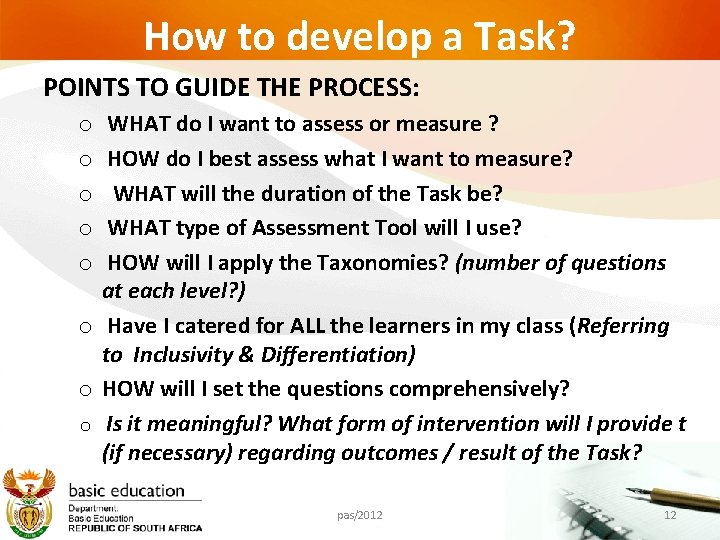
How to develop a Task? POINTS TO GUIDE THE PROCESS: WHAT do I want to assess or measure ? HOW do I best assess what I want to measure? WHAT will the duration of the Task be? WHAT type of Assessment Tool will I use? HOW will I apply the Taxonomies? (number of questions at each level? ) o Have I catered for ALL the learners in my class (Referring to Inclusivity & Differentiation) o HOW will I set the questions comprehensively? o Is it meaningful? What form of intervention will I provide t (if necessary) regarding outcomes / result of the Task? o o o pas/2012 12
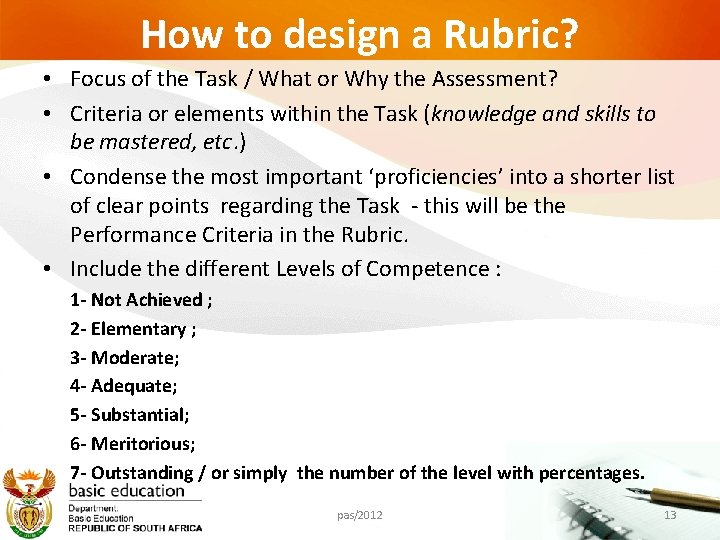
How to design a Rubric? • Focus of the Task / What or Why the Assessment? • Criteria or elements within the Task (knowledge and skills to be mastered, etc. ) • Condense the most important ‘proficiencies’ into a shorter list of clear points regarding the Task - this will be the Performance Criteria in the Rubric. • Include the different Levels of Competence : 1 - Not Achieved ; 2 - Elementary ; 3 - Moderate; 4 - Adequate; 5 - Substantial; 6 - Meritorious; 7 - Outstanding / or simply the number of the level with percentages. pas/2012 13
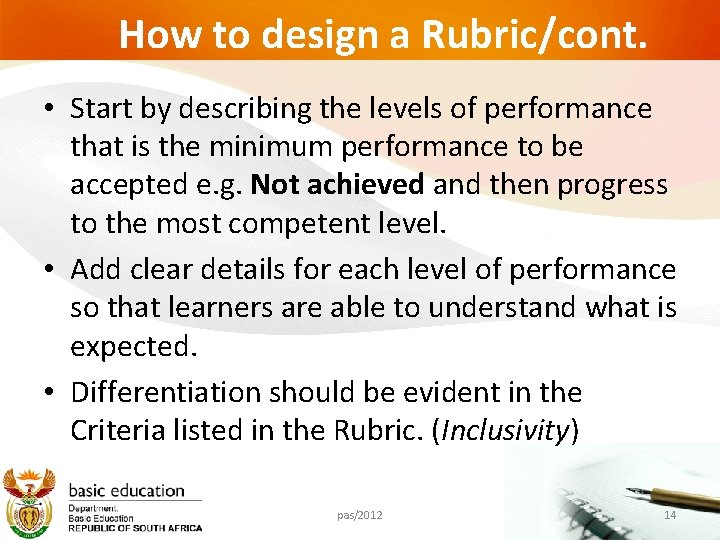
How to design a Rubric/cont. • Start by describing the levels of performance that is the minimum performance to be accepted e. g. Not achieved and then progress to the most competent level. • Add clear details for each level of performance so that learners are able to understand what is expected. • Differentiation should be evident in the Criteria listed in the Rubric. (Inclusivity) pas/2012 14
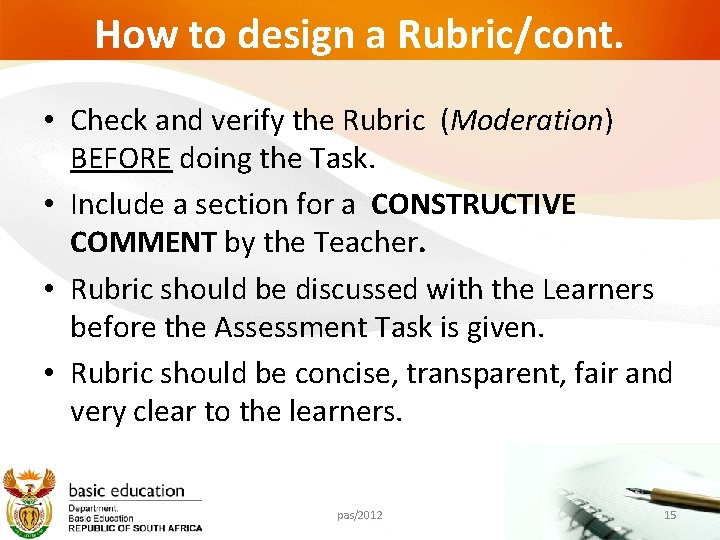
How to design a Rubric/cont. • Check and verify the Rubric (Moderation) BEFORE doing the Task. • Include a section for a CONSTRUCTIVE COMMENT by the Teacher. • Rubric should be discussed with the Learners before the Assessment Task is given. • Rubric should be concise, transparent, fair and very clear to the learners. pas/2012 15
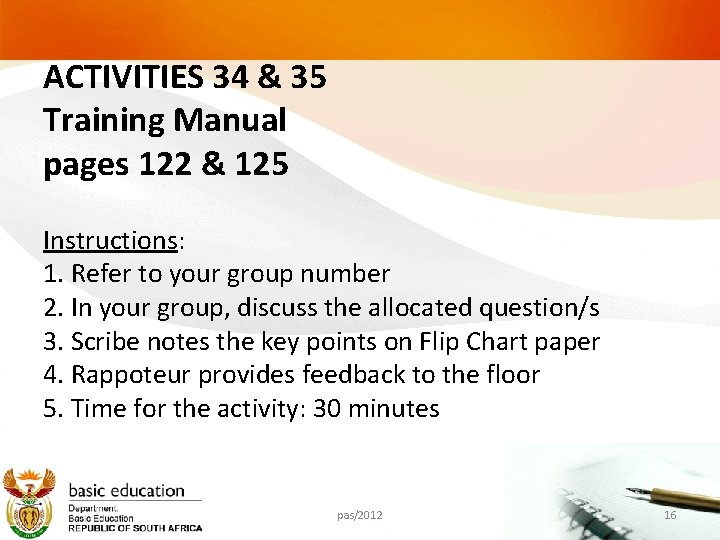
ACTIVITIES 34 & 35 Training Manual pages 122 & 125 Instructions: 1. Refer to your group number 2. In your group, discuss the allocated question/s 3. Scribe notes the key points on Flip Chart paper 4. Rappoteur provides feedback to the floor 5. Time for the activity: 30 minutes pas/2012 16
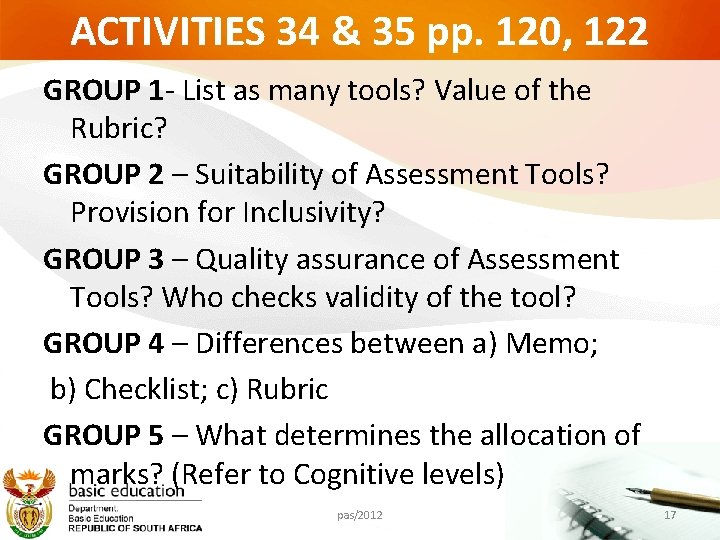
ACTIVITIES 34 & 35 pp. 120, 122 GROUP 1 - List as many tools? Value of the Rubric? GROUP 2 – Suitability of Assessment Tools? Provision for Inclusivity? GROUP 3 – Quality assurance of Assessment Tools? Who checks validity of the tool? GROUP 4 – Differences between a) Memo; b) Checklist; c) Rubric GROUP 5 – What determines the allocation of marks? (Refer to Cognitive levels) pas/2012 17
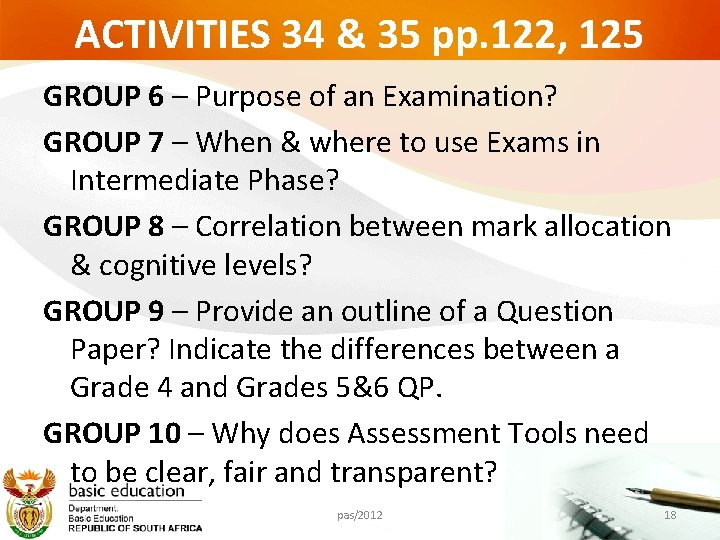
ACTIVITIES 34 & 35 pp. 122, 125 GROUP 6 – Purpose of an Examination? GROUP 7 – When & where to use Exams in Intermediate Phase? GROUP 8 – Correlation between mark allocation & cognitive levels? GROUP 9 – Provide an outline of a Question Paper? Indicate the differences between a Grade 4 and Grades 5&6 QP. GROUP 10 – Why does Assessment Tools need to be clear, fair and transparent? pas/2012 18
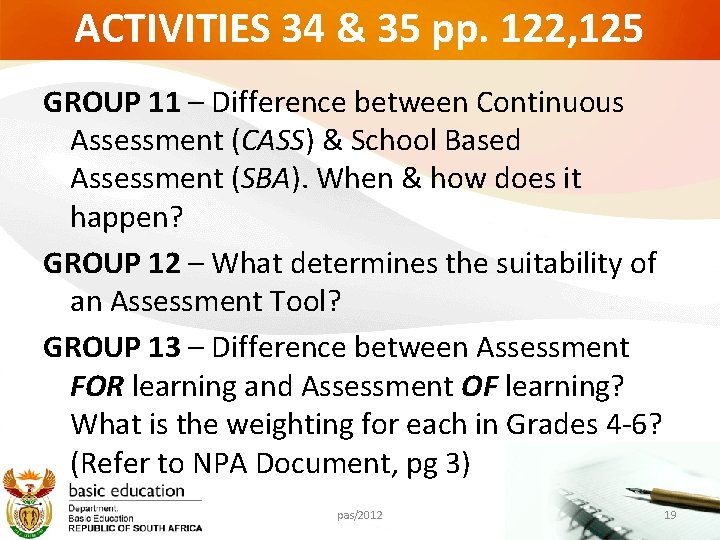
ACTIVITIES 34 & 35 pp. 122, 125 GROUP 11 – Difference between Continuous Assessment (CASS) & School Based Assessment (SBA). When & how does it happen? GROUP 12 – What determines the suitability of an Assessment Tool? GROUP 13 – Difference between Assessment FOR learning and Assessment OF learning? What is the weighting for each in Grades 4 -6? (Refer to NPA Document, pg 3) pas/2012 19
‘ To put the world in order, we must first put the nation in order; To put the nation in order, we must first put the family in order; To put the family in order, we must cultivate our personal life – we must first set our hearts right. ’ - CONFUCIUS THANK YOU. pas/2012 20