
Gestational Trophoblastic Disease for Undergraduates Max Brinsmead MB
Gestational Trophoblastic Disease for Undergraduates Max Brinsmead MB BS Ph. D May 2015
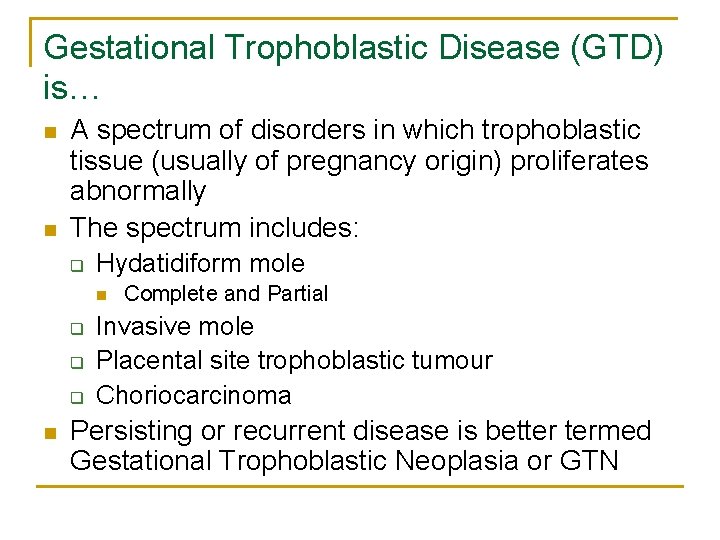
Gestational Trophoblastic Disease (GTD) is… n n A spectrum of disorders in which trophoblastic tissue (usually of pregnancy origin) proliferates abnormally The spectrum includes: q Hydatidiform mole n q q q n Complete and Partial Invasive mole Placental site trophoblastic tumour Choriocarcinoma Persisting or recurrent disease is better termed Gestational Trophoblastic Neoplasia or GTN
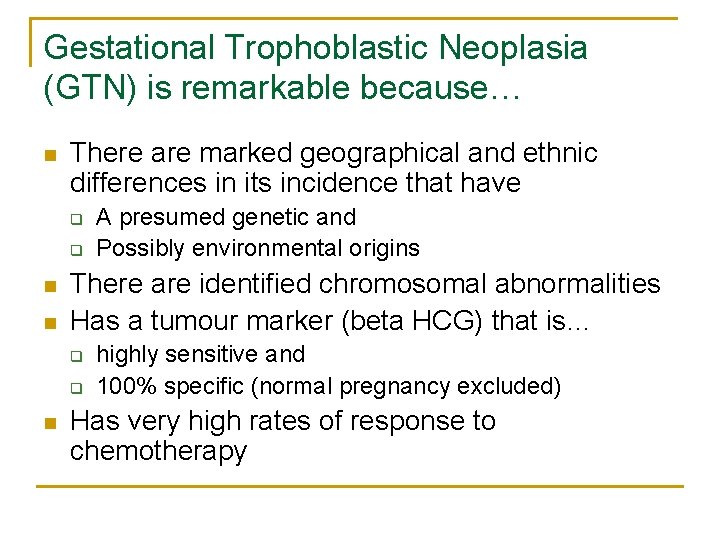
Gestational Trophoblastic Neoplasia (GTN) is remarkable because… n There are marked geographical and ethnic differences in its incidence that have q q n n There are identified chromosomal abnormalities Has a tumour marker (beta HCG) that is… q q n A presumed genetic and Possibly environmental origins highly sensitive and 100% specific (normal pregnancy excluded) Has very high rates of response to chemotherapy
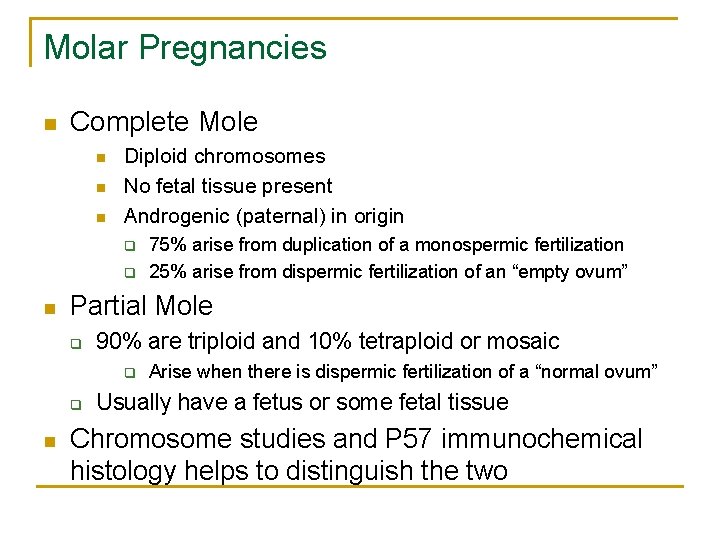
Molar Pregnancies n Complete Mole n n n Diploid chromosomes No fetal tissue present Androgenic (paternal) in origin q q n Partial Mole q 90% are triploid and 10% tetraploid or mosaic q q n 75% arise from duplication of a monospermic fertilization 25% arise from dispermic fertilization of an “empty ovum” Arise when there is dispermic fertilization of a “normal ovum” Usually have a fetus or some fetal tissue Chromosome studies and P 57 immunochemical histology helps to distinguish the two
GTD Incidence and Risk of Malignancy n n n n Incidence of ≈ 1: 750 Caucasian pregnancies ≈ 1: 400 Asian pregnancies May be as many as 1: 110 pregnancies in SE Asia 10 -fold more common when maternal age is >40 years Complete mole has a 15% risk of GTN Partial mole has a 0. 5% risk of GTN But only 1: 50, 000 normal pregnancies go on to GTN
Common Presentations of GTD n n n Bleeding in early pregnancy “Large for dates” and no fetus or FH found As an incidental finding during routine early pregnancy ultrasound q n Placenta has a “snow-storm” appearance Partial mole usually diagnosed by histology of failed 1 st trimester pregnancy tissue
Uncommon Presentations of GTD n Hyperemesis q n Early onset pre eclampsia (<20 w) q n But most are not GTD Clasically with triploidy i. e. 69 XXY Thyrotoxicosis n n n Abdominal distension with theca lutein cysts Secondary postpartum haemorrhage or ongoing PV bleeding after any pregnancy q n Due to a TSH-effect of abundant HCG But most are not GTN Seizures (from brain metastases) or haemoptysis (from lung metatases)
Management of Molar Pregnancies n Suction curettage preferred over medical evacuation n Because of the risk of trophoblastic embolisation Cervical ripening with PG’s acceptable Oxytocin infusion for life threatening haemorrhage n Mole plus a normal twin pregnancy presents dilemmas n Don’t forget the Anti-D if Rh negative
Never miss a Mole or GTN by… n Send all “products of conception” for histology n n Not required after termination of pregnancy n n n When there has been a normal ultrasound before TOP Or fetal parts are identified Do a urine test for HCG 3 weeks after all nonsurgically managed miscarriage n n When passed spontaneously When curetted after failed pregnancy After curette for secondary postpartum haemorrhage And no POC for histology And do a HCG for any abnormal bleeding within 3 months of any pregnancy n Or if the woman presents with a weird tumour
Follow up of molar pregnancies: n Monitor for GTN after Complete Mole by… n n n For Partial Mole n n n Weekly HCG until 3 consecutive are negative Or at 8 w if negative before Then monthly for 6 m No pregnancy please for 6 m from time of 1 st negative test May stop weekly HCG’s when negative No pregnancy for 6 m please COC increases the risk of GTN by RR 1. 19 n n n Barrier contraceptives best But only until the HCG returns to normal And any contraceptive is better than another pregnancy
Management of Gestational Trophoblastic Neoplasia n Best done by registering all molar pregnancies with a Specialist Centre n Methotrexate is the 1 st line drug but treatment requires individualization n Multi-agent chemotherapy may be required Second curette rarely necessary A few patients require surgery (usually hysterectomy) as part of their care n n

Any Questions or Comments? Please leave a note on the Welcome Page of this website
- Slides: 12